Bloomberg

Meta Is on Brink of Falling Out of Top 20 Biggest US Stocks

(Bloomberg) — Meta Platforms Inc. shareholders are paying dearly for its spending on the metaverse: The Facebook parent’s market value has collapsed by a whopping $520 billion in the past year, and now it’s on the brink of getting booted from the ranks of the 20 largest US companies.

The punishment shows no signs of easing anytime soon. Meta’s stock is down as much as 23% in premarket trading after it spooked investors with ballooning costs to fund its version of virtual reality and a decline in revenue. 

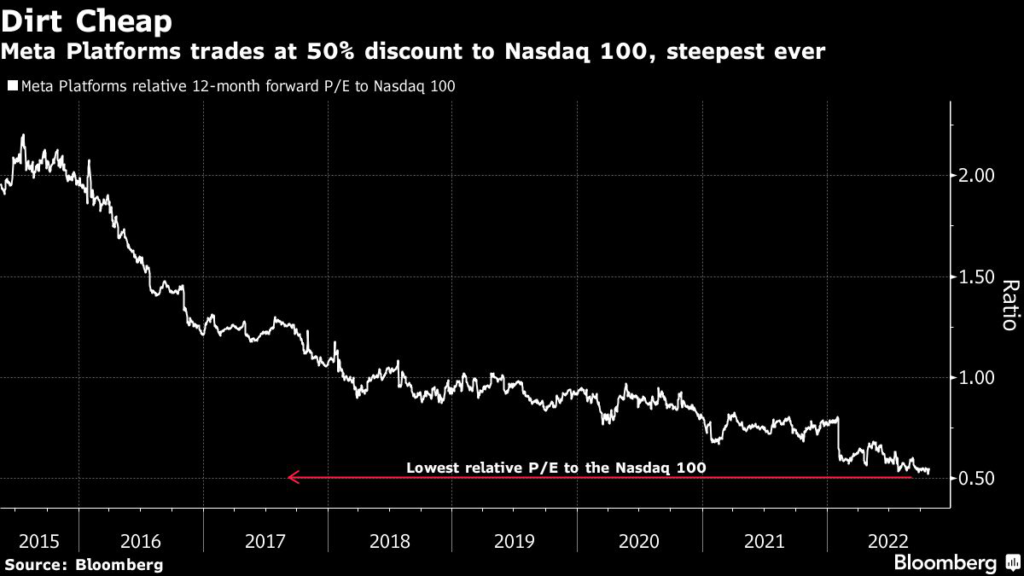
Meta was the sixth biggest US company by market capitalization at the start of the year, flirting with a $1 trillion market value. Fast forward 10 months and the stock will be worth about $283 billion, ranking it 20th, if it opens regular trading in line with its decline in the premarket. It will now be smaller than companies including Chevron Corp., Eli Lilly & Co. and Procter & Gamble Co.

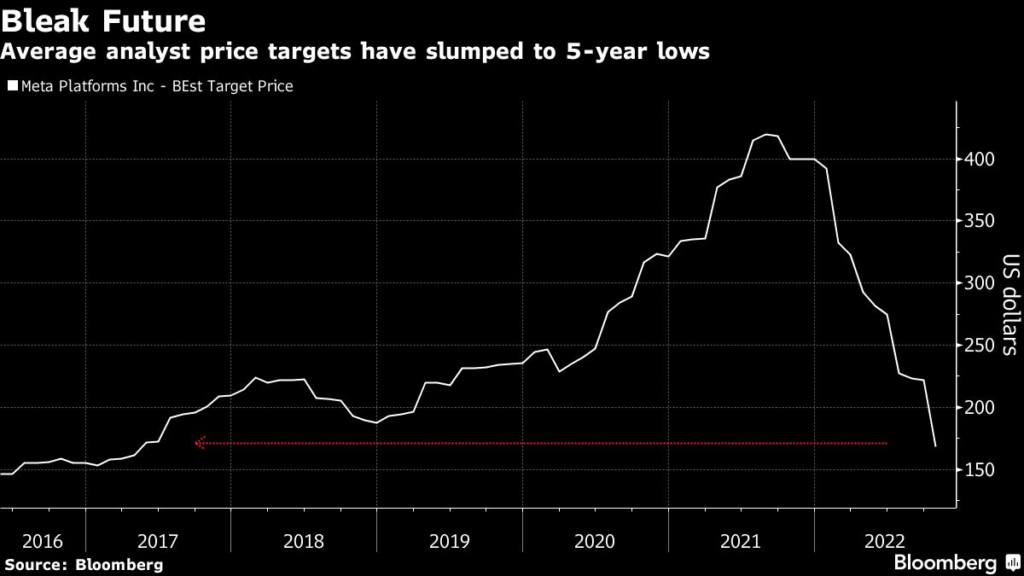
Once a Wall Street darling, Meta is gradually losing favor with brokerages. At least three investment banks — Morgan Stanley, Cowen and KeyBanc Capital Markets — cut their rating on the stock after the company gave a disappointing quarterly revenue outlook.

“Meta remains too aggressive with its investments in long-term initiatives despite a sharp deceleration in expected revenue growth,” said Mandeep Singh, an analyst at Bloomberg Intelligence. “The company’s opex and capex view for 2023 is surprising, given the lack of traction so far with its metaverse efforts.” 

While Thursday’s premarket slump is a big move, it pales in comparison to its record-setting rout in February when it plunged 26% on the back of woeful earnings results, and erased about $251 billion in market value. That’s the biggest wipeout in market value for any US company ever. 

The decline in the stock this year has attracted value investors, who buy beaten-down stocks in anticipation of a turnaround. But there’s no sign of those bets paying off any time soon. 

Meta announced its shift to investing in virtual reality a year ago, along with a name change of the company from Facebook Inc. to Meta Platforms. The company said Wednesday it expects total expenses for this year to be $85 billion to $87 billion. 

For 2023, that number will grow to an expected $96 billion to $101 billion. That’s the big negative, since investors were hoping Meta would aggressively cut costs, said Neil Campling, an analyst at Mirabaud Securities. 

The company’s quarterly capital expenditure was more than all but 16 of the S&P 500 companies spent all of last year, according to Bloomberg data. 

Campling likened a buillish trade in Meta to IBM in 2005, saying “like IBM symbolizes dinosaur tech 1.0… so Meta faces the risk of being the next-generation fossil.”

–With assistance from Tom Contiliano and Kit Rees.

(Adds Cowen downgrade, chart and updates stock moves.)

More stories like this are available on bloomberg.com

©2022 Bloomberg L.P.

Ukraine Latest: Putin Set for Key Speech After Nuclear Exercises

(Bloomberg) — Russian President Vladimir Putin is set to make a major appearance at the annual Valdai discussion club Thursday, a day after overseeing scheduled nuclear exercises that tested a “massive” retaliatory strike.

Ksenia Sobchak, the celebrity-journalist daughter of Putin’s political mentor fled Russia for Europe as police detained a close associate and raided her home as part of a criminal case for alleged extortion.

Russia has lost close to 250 helicopters in Ukraine since its invasion, and will not be able to replace the equipment it has lost, Ukrainian President Volodymyr Zelenskiy said in his regular nightly address.

(See RSAN on the Bloomberg Terminal for the Russian Sanctions Dashboard.)

Key Developments

  • Putin-Linked Celebrity Journalist Sobchak Flees Russia
  • Is Putin Strangling Russia’s Golden Gas Goose? The IEA Thinks So
  • Russia Crisis Heralds Turning Point for Global Energy, IEA Says
  • Biden Team Reworks Plan for Russia Oil-Price Cap as Markets Sour
  • What Is a ‘Dirty Bomb’ and Why Is Ukraine Worried?: QuickTake

On the Ground

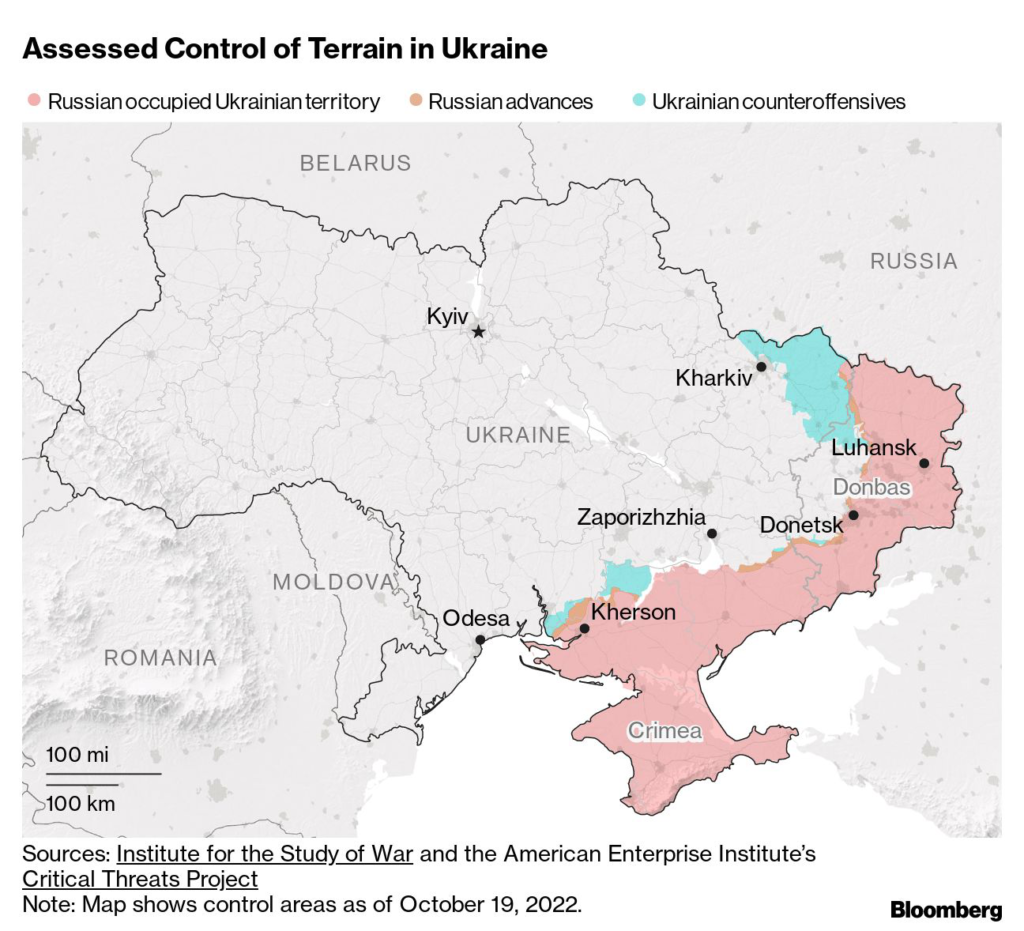
Russian forces struck the Kyiv region and the southern city of Zaporizhzhia overnight, Ukrinform reported, citing local authorities. Ukraine’s “South” command said air defense downed a Russian Ka-52 helicopter and an Su-25 fighter jet in the Kherson region Thursday morning. Ukrainian troops downed 18 out of 20 Shahed-136 drones launched by Russia over the past 24 hours at the country’s critical infrastructure, Commander-in-Chief of the Armed Forces Valeriy Zaluzhnyi said on Telegram. Russian assaults near seven settlements in the Donetsk and Luhansk regions were repelled over the past day, the General Staff of the Ukrainian military reported on Facebook.

(All times CET)

Kyiv May Face 30% Power Deficit From Repeated Attacks (1:27 p.m.)

Kyiv may face a 30% power supply deficit due to additional heavy Russian strikes on local energy infrastructure on Thursday morning, the capital’s grid operator Yasno said in a Facebook statement. “The damage is serious. Therefore, we have a sharp shortage of energy supply,” the company said. 

“Usually, Kyiv consumes 1,000-1,200 MW. Currently, the estimated available capacity is 600-800 MW.” Yasno said upcoming blackouts will be longer and will affect much larger number of consumers than before. 

City authorities expect more widespread, stricter limits on power supply in the next days to avoid complete outages.

Putin Told Guinea-Bissau Leader He’s Still Ready for Ukraine Talks (12:20 a.m.)

Russian President Vladimir Putin told his Guinea-Bissau counterpart that his country remains ready for talks with Ukraine, while accusing Kyiv of refusing dialog, the Kremlin said.

Putin accepted an offer by President Umaro Sissoco Embalo to convey this message to Ukraine’s Volodymyr Zelenskiy, Putin’s spokesman Dmitry Peskov told reporters on a conference call. The African leader met with Putin and Zelenskiy on consecutive days this week.

“Russia isn’t changing its position, we’re ready to talk at the table, but it’s a matter now of the complete refusal of Ukraine to negotiate,” Peskov said. Putin has so far refused to meet Zelenskiy. The Ukrainian leader has formally ruled out holding talks with Putin and tied negotiations with a future leader to a withdrawal by Russia from all the territory it’s occupied in Ukraine.

Russian Missile Attacks Become Less Intense, Official Says (11:45 a.m.)

The number of Russian missile attacks has fallen by almost two-thirds since Oct. 19 compared to a previous seven-day period, Ukrainian military spokesman Oleksiy Hromov said in a video briefing Thursday.

Ukrainian forces downed nearly half of the 52 missiles fired by Russia during the latest period, he said, which compares to Russia firing 146 missiles over the previous seven days. Single-use drone attacks declined by a third, with Ukraine shooting down 79% of the 114 drones fired.

Russian Lawmakers Tighten Ban on ‘Gay Propaganda’ (11:35 a.m.)

Russian lawmakers approved a sweeping expansion of a ban on “propaganda of non-traditional sexual relations,” broadening the restrictions to include adults and outlawing the portrayal of gay relationships in books, films, the media and the internet.

The Kremlin has stepped up its public embrace of what it calls “traditional values” in the months since its invasion of Ukraine, a conflict it portrays as a showdown with what it describes as western attitudes alien to Russia. 

Ukraine Exports 9M Tns of Farm Products Through Grain Corridor (11 a.m.)

Ukraine has loaded 397 ships and exported over 9 million tns of grain and other farm products to Africa, Europe and Asia since the opening of the grain corridor, the Ukrainian Sea Ports Administration said on Facebook.

Oleksiy Vostrikov, the administration’s chief, said Russia is “deliberately delaying the full implementation of the ‘grain initiative,’ thus Ukrainian ports work at only 30% of their capacity.” He added: “But we are doing everything possible to ensure the regularity of shipments and increase the volume of cargo processing.”  

Foodstuffs have been shipped under a safe-transit deal brokered by Turkey and the UN for three Black Sea ports. There’s currently a huge and growing backlog of ships — some 175 — waiting to move to port to load grain. 

Ukraine to Get Hawk Defense from Spain, Reznikov Says (10:45 a.m.)

Spain will be the first country to provide Ukraine with Hawk air defense systems, the country’s Defense Minister Oleksii Reznikov said on Twitter. Reznikov wrote that he expects the new military aid package from Spain to arrive soon.

Ukraine Limits Power Supply in Central Regions After Latest Attacks (10:05 a.m.)

Ukraine’s grid operator Ukrenergo instructed local operators to limit power consumption in four regions and in the city of Kyiv after Russian attacks overnight hit the electric grid in the center of the country. Energy supply will be limited in the regions around Kyiv, Chernihiv, Cherkasy and Zhytomyr after infrastructure was damaged by Russian forces.

Journalist Daughter of Putin Mentor Flees Russia (9:45 a.m.)

Ksenia Sobchak, 40, a socialite and TV presenter who has publicly questioned the invasion of Ukraine, is in Lithuania, authorities in the Baltic nation said Thursday. She called the investigation an attack on her online media outlet.

Sobchak, a celebrity who took part in anti-Kremlin protests that erupted before the 2012 presidential election, also ran in the 2018 race against Putin but got less than 2% of the vote. The opposition branded her participation as a ploy by the Russian leadership to give the appearance of democracy after officials barred Putin’s top opponent from contesting the vote. Her late father Anatoly Sobchak was the mayor of St. Petersburg.

Ukraine’s Grid Operators Still Struggling, IEA Says (9:05 a.m.)

Ukraine’s electricity-grid operators continue struggling to cover nationwide demand after two weeks of Russian strikes against power infrastructure. Generation trailed supply for a fourth consecutive day on Wednesday, according to the latest data published by the International Energy Agency.

Zelenskiy has appealed to Ukrainians to save energy after convening a meeting with advisers to discuss infrastructure repairs made more difficult by the Russian attacks, according to the Telegram channel of grid operator Ukrenergo.

Russia Says Civilian Satellites Used By Ukraine May Be Targets: Tass (8:45 a.m.)

Russia may consider civilian satellites used by Ukraine and its allies as “legitimate targets for retaliation,” a senior diplomat said, according to Tass.

Calling such equipment “quasi-civilian infrastructure,” Konstantin Vorontsov, deputy head of the arms control department at the Foreign Ministry, told a United Nations session that its use for military purposes is a “very dangerous trend.” He didn’t specify under what circumstances Russia might make such a strike.

Kyiv and its allies have used commercial satellites for intelligence information and communications to combat the Russian invasion.

Putin to Give Major Address to Annual Valdai Forum (08:15 a.m.)

Putin will deliver his speech after 4 p.m. Moscow time. He has increasingly ratcheted up his invasion of Ukraine, now dragging into its ninth month, since Kyiv scored a series of battlefield advances. After calling up at least 300,000 reservists, Russia annexed four Ukrainian regions it partly controls and introduced martial law in some areas.

Russia Has Lost Almost 250 Helicopters, Zelenskiy Says (7:50 a.m.)

Russia will not be able to replace the equipment it has lost in Ukraine since its invasion, Zelenskiy said in his regular nightly address. “The total number of downed Russian helicopters is approaching to 250,” Zelenskiy said. “Russia will not be able to restore these losses”. 

Zelenskiy said the fiercest battles are currently taking place in Bakhmut and Avdiyivka in the Donetsk region, as well as in other areas.

More stories like this are available on bloomberg.com

©2022 Bloomberg L.P.

Morgan Stanley Downgrades Meta for First Time as Costs Soar

(Bloomberg) — Morgan Stanley cut its rating on Meta Platforms Inc. for the first time ever, forecasting the stock will lag until the social media giant’s “outsized investments” in the metaverse start to pay off. 

Shares of the Facebook parent were down 20% in premarket trading after it gave a disappointing quarterly revenue outlook.

Analysts led by Brian Nowak downgraded the stock for the first time since taking up coverage in 2015, saying they expect free cash flow to slump by 60% in 2023. The analysts also slashed their price target — or prediction for the firm’s stock 12 months from now — by nearly half to $105. Meta’s shares closed on Wednesday at $129.82.

The brokerage was joined by analysts from Cowen and KeyBanc Capital Markets, who also downgraded the stock for the first time ever. All three brokerages were not immediately available to comment further on their downgrades.

“Over the long term we see these AI investments as likely being differentiated for engagement and ad monetization,” Nowak writes in a note. “Not many companies have the ability to spend $69 billion of capex in two years to rebuild their server stack like META is.”

–With assistance from James Cone.

More stories like this are available on bloomberg.com

©2022 Bloomberg L.P.
SoftBank-Backed View Raises $200 Million in Convertible Notes

(Bloomberg) — View Inc., a maker of so-called “smart windows” that is backed by SoftBank Group Corp., has raised $200 million in convertible notes from an investor group led by an affiliate of RXR.

RXR Chairman and Chief Executive Officer Scott Rechler will join the board of the Milpitas, California-based company, which is led by CEO Rao Mulpuri, according to a statement, confirming an earlier report by Bloomberg. The investor group also included USAA Real Estate, Anson Funds and the environmental strategies group of BNP Paribas Asset Management, among others.

“At View, we are committed to creating sustainable, experiential, healthier, and smarter buildings,” Mulpuri said in the statement. “With the products and operations already in place, this capital allows us to scale our business to broad market adoption and profitability.”

Shares in View rose about 5% in pre-market trading in New York.

View has been public since March 2021, following a merger with a blank-check firm led by Cantor Fitzgerald. The company’s valuation, once as high as $2.24 billion, had plummeted to about $250 million as of Wednesday’s close in New York. In addition to SoftBank, investors include Madrone Capital Partners, which is affiliated with Walmart heir Rob Walton, and Singapore sovereign wealth fund GIC.

Convertible notes have been touted as a potential financing source for companies that face capital needs after merging with a SPAC. They’re less dilutive than traditional equity and don’t have the same restrictive covenants or credit-rating needs as other debt, according to a Mayer Brown presentation. They have yet to be widely adopted by companies that have gone public via the SPAC route.

“Smart windows represent one of the most impactful ways to reduce energy usage and carbon emissions from real estate,” said Rechler. “View has thoughtfully built the intellectual property, full-stack products, manufacturing capacity, operational infrastructure, and most importantly, a delighted customer base needed to transform the real estate industry.”

(Updates with statement from 2nd paragraph.)

More stories like this are available on bloomberg.com

©2022 Bloomberg L.P.
Fidelity Says More Institutional Investors Are Holding Crypto

(Bloomberg) — Institutional acceptance of cryptocurrencies increased this year even as prices tumbled as more investors begin to view digital assets as worthwhile holdings, according to a Fidelity Investments survey. 

Nearly 60% of institutional investors surveyed said they were invested in digital assets in the first half of the year, a six-point increase from last year. The Institutional Investor Digital Assets Study found that four-in-five investors believe that investment portfolios should include digital assets.

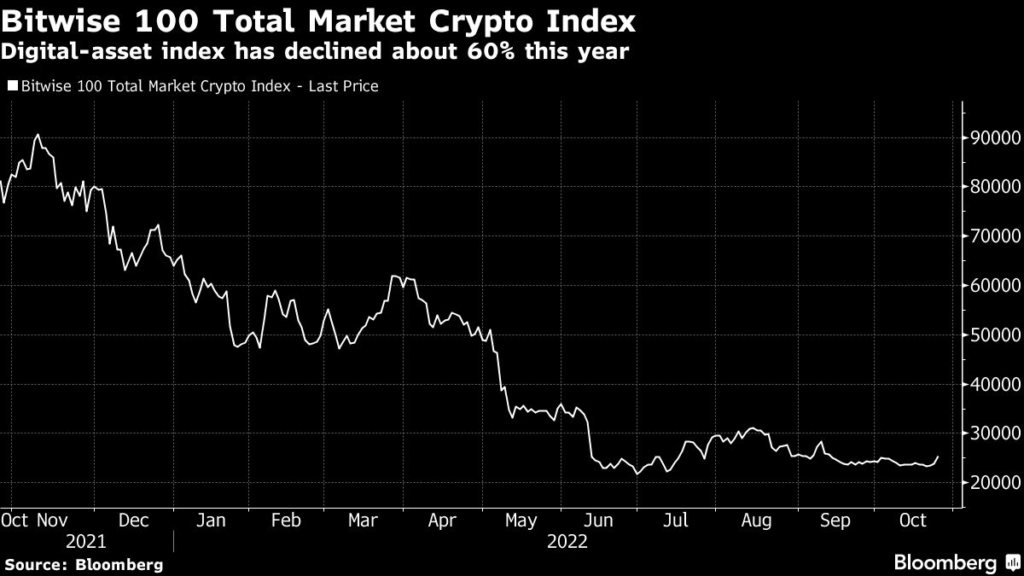
The Fidelity Digital Assets study, now in its fourth year, hints that institutions are warming up to digital assets, despite the 50% or more plunge in most prices and a lack of regulation still shrouding the asset class. 

“While the markets have faced headwinds in recent months, we believe that digital assets fundamentals remain strong and that the institutionalization of the market over the past several years has positioned it to weather recent events,” said Tom Jessop, president of Fidelity Digital Assets, which offers crypto custody and execution services for institutional investors.

The study surveyed more than 1,000 institutional investors, such as hedge fund managers and financial advisors, across the US, Europe and Asia. For those who invest directly in digital assets, Bitcoin and Ether remain the most popular choices. Ownership of Ether in the US increased five points year-over-year. 

More than 65% of respondents in both Asia and Europe said they owned digital assets, compared to just 42% of respondents in the US. 

Even so, respondents who do not yet invest in digital assets pointed to many of the same risks as investors did in last year’s survey. Price volatility, security concerns, and the risks of market manipulation remain top concerns. 

“While short-term price fluctuation is a characteristic somewhat inherent to this emerging asset class, many of the other concerns cited by respondents can be addressed as institutional investors move through their journey of education,” said Chris Kuiper, director of research for Fidelity Digital Assets. He added that if investors become more familiar with blockchain technology, they will be more likely to see the value of digital assets. 

More stories like this are available on bloomberg.com

©2022 Bloomberg L.P.
Elizabeth Warren Sharpens Attack Against Zelle System

(Bloomberg) — US Senator Elizabeth Warren is ratcheting up her campaign against the popular peer-to-peer payments system Zelle.

Warren on Wednesday sent a letter to Consumer Financial Protection Bureau Director Rohit Chopra, calling for expanded regulations after she collected private data on rising fraud rates on Zelle from some of the country’s largest banks. Warren, a Democrat from Massachusetts, offered to share the data with Chopra, according to the letter obtained by Bloomberg.

“As the CFPB considers whether to take action on this topic, the findings of my investigation reveal that the agency must strengthen consumer protections on peer-to-peer platforms like Zelle,” Warren said.

Earlier this month, Warren released a report based on data from Bank of America Corp., Truist Financial Corp., PNC Financial Services Group Inc. and US Bancorp that showed the value of scam and fraud claims more than doubled to $236 million in 2021. Those banks and three other lenders — JPMorgan Chase & Co., Wells Fargo & Co. and Capital One Financial Corp. — jointly own Early Warning Services LLC, which operates Zelle. 

Early Warning has disputed the report’s findings, noting tens of millions of consumers use Zelle every day and the company has said more than 99.9% of payments are sent across its network without any report of fraud or scams.

“Any external analysis done is incomplete and does not reflect the efforts and data reported by more than 1,700 financial institutions on the Zelle network,” Early Warning said in a statement this month. 

Under Regulation E, which governs how banks handle electronic fund transfers, if a hacker logs into a customer’s bank account and sends money, lenders are required to provide a refund. But fraudsters have increasingly sought to use the Zelle network to persuade consumers to send them money. In those cases, with the real customer sending the money, banks aren’t required to make consumers whole.

Warren and other lawmakers have previously encouraged Chopra to expand the definition of an “error” payment to include when a consumer is tricked into paying. They have also suggested that the CFPB could issue guidance that such a transaction counts as an “unauthorized electronic fund transfer,” meaning banks would have to reimburse consumers.

Banks have said they are working on providing better guardrails on the network by closing accounts of customers who receive the fraudulent funds. The network also has cut off multiple lenders who didn’t properly police clients accused of defrauding customers of other banks on the network. 

Zelle has swelled in popularity in recent years, with consumers using the system to send money to friends and family instantly. The network has processed more than 5 billion transactions and handled nearly $1.5 trillion in payments since its inception in 2017. 

“While the Zelle transaction volume has dramatically increased, the proportion of fraud and scams has steadily decreased,” Early Warning Services said in an emailed statement in September. “Zelle and our financial institutions have spent millions on consumer protection, and we will continue to invest as our efforts have proven to help reduce fraud and scams.”

(Updates with more information beginning in fifth paragraph.)

More stories like this are available on bloomberg.com

©2022 Bloomberg L.P.
One Key Not Two for Toyota Customers as Car Chip Shortage Bites

(Bloomberg) — In another sign the world’s shortage of chips still hasn’t abated, Toyota Motor Corp. will temporarily give new car buyers just one smart key instead of two as it seeks to ration semiconductors.

The measure will apply to 14 models for sale in Japan, including Crown sedans, Prius hybrids and the battery-electric bZ4X, for production in November, the Japanese automaker said in a notice to customers Thursday.

One of the usual two smart keys will be replaced with a regular old fashioned one. Semiconductors are used in electronic keys to lock and unlock cars remotely. Toyota’s luxury car brand Lexus will take similar measures.

The move is further evidence the auto industry is still struggling with a persistent shortage of semiconductors. Toyota, the world’s biggest carmaker, warned last week it expects to miss its fiscal-year target of assembling 9.7 million vehicles, due in part to the dearth of various auto parts and niggling supply chain issues. 

Read more: Toyota Warns of Falling Short of Output Goal on Chip Shortages

Toyota apologized to customers for the inconvenience, saying it will “make efforts to deliver the second smart key as early as we can.”


More stories like this are available on bloomberg.com

©2022 Bloomberg L.P.
France and Germany Are Hatching a Plan to Protect Europe’s E-Vehicle Makers

(Bloomberg) — French President Emmanuel Macron is looking to enlist German Chancellor Olaf Scholz’s support for a new plan to help European auto makers compete with the US and China, after President Joseph Biden outlined heavy subsidies benefiting electric cars made in North America.

Though they’ve squabbled over defense and energy policies, Paris and Berlin agree that the European Union needs to do more to promote national industries, officials in both capitals said.

In a Wednesday interview on France 2 television after meeting Scholz in Paris, Macron said the two leaders were converging on the idea of assuring that EU car subsidies are used for European-made vehicles. That could help blunt the effects of the US Inflation Reduction Act, which among other provisions offers subsidies for electric cars made in North America.

“You have China and the US protecting their industry, but Europe remains open to all winds, we must change,” Macron said on France 2. “France and Germany must stick together because we’ve been too open, because many of our carmakers were selling a lot in China and they didn’t want to close things.” 

Scholz has echoed this view, according to a person familiar with the German leader’s thinking.

Macron in 2017 pushed for what he called the Buy European Act for public procurement, which would apply to companies with more than half their production in the bloc. But he was forced to abandon the idea in the face of opposition from Brussels.

Germany also opposed the plan, citing consequences for trade with China and the US, particularly for car makers Volkswagen AG, Mercedes-Benz Group AG and BMW AG.

Since that time, however, the Covid pandemic has exposed Europe’s dependency on overseas supply chains and the EU has effectively relaxed some of its rules on state aid, suggesting that new initiatives to shield companies from competition could find support in Brussels.

Still, reviving the Buy European idea now for electric vehicles may prove complicated, even with Germany on board. Free trade accords could have to be renegotiated and the measure could run afoul of existing EU rules, or World Trade Organization agreements. It could also spark a trade war, with other countries enacting retaliatory measures.


More stories like this are available on bloomberg.com

©2022 Bloomberg L.P.
Cash Clampdown in Nigeria Seeks to Curb Currency Hoarding, Kidnappings

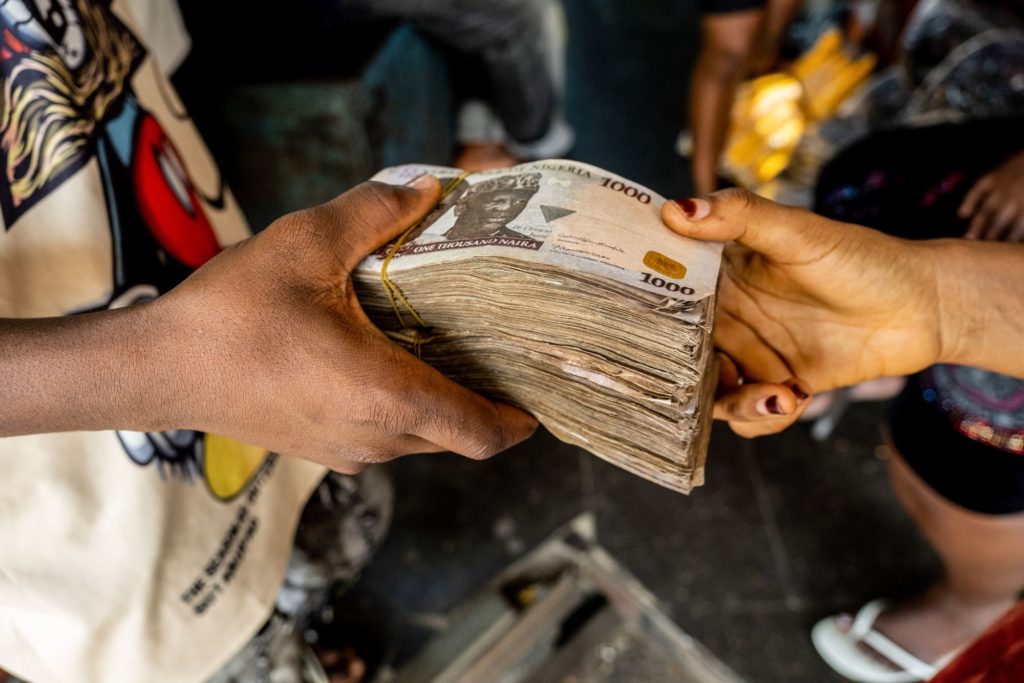
(Bloomberg) — Nigeria’s central bank said it’s move to replace high-value currency notes will help prevent hoarding and stymie illegal activity and kidnappings in Africa’s largest economy. 

The country’s banking regulator plans to issue redesigned 200-, 500- and 1,000-naira notes from mid-December, Central Bank Governor Godwin Emefiele said at a briefing in Abuja, the capital, on Wednesday. Old bills will cease to be legal tender starting Jan. 31, giving citizens of the West African country, where cash dominates transactions, six weeks to exchange their notes. The country is scheduled to hold presidential elections 25 days later. 

“At first sight, with the very ambitious timeframe outlined, this looks like an attempt by Nigeria to deal with illicit funds,” said Razia Khan, head of research for Africa and the Middle East at Standard Chartered. “Given problems related to crude theft and security, this is understandable.”

The central bank says it doesn’t have visibility on 85% of cash in Nigeria, which is undermining the efficacy of monetary policy and the integrity of the currency, according to Emefiele. The authorities operate a multiple exchange-rate regime dominated by a tightly controlled official exchange rate and a parallel market where the naira is freely traded — while the former has weakened less than 10% since December, the latter is down by nearly a third within the same period, according to Bank of America.

Read: Naira Likely to be Devalued by 20% in 2023, Bank of America Says

The move to ban the notes may lead to chaos in the country of almost 220 million people, the majority of whom live in rural areas away from bank branches. Six years ago, Indian Prime Minister Narendra Modi’s decision to outlaw high-value currency overnight led to a prolonged scramble for cash and slowed economic growth in Asia’s third-largest economy.

Nigeria’s previous attempt at demonetization also didn’t go according to plan. In 1984, President Muhammadu Buhari’s military government changed the color of currency notes in an effort to combat corruption — Buhari was removed from office in a coup the following year and the naira was devalued a year later.

Scramble for Cash

Nigeria’s cash in circulation has more than doubled since 2015 to 3.23 trillion naira ($7.3 billion) as of September, Emefiele said. 

“It is unacceptable and indeed it takes the control of money supply out of the hands of the central bank,” Emefiele said. The measure is expected to have a “positive impact” on the inflation rate, which climbed to a 17-year high in September, he said.

While the introduction of new naira notes is unlikely to have an impact on the currency’s official exchange rate, it could bring pressure to bear on the widely used black market rate, said Samir Gadio, head of Africa Strategy at Standard Chartered Bank.  

The naira weakened 3.3% to 775 per US dollar in the illegal market as residents sought to convert cash into dollars, according to Yahaya Adamu, a trader on the streets of Abuja, the capital. The central bank’s official rate fell 0.1% 441.66 — a record low.

Ransom Payments

Nigeria’s anti-graft agency warned bureau-de-change operators and lenders not to “assist unscrupulous customers in laundering suspected proceeds of crimes through their system” during the currency-exchange process, according to an emailed statement.

Operators must be “wary of currency hoarders who would attempt to seize this opportunity to offload the currencies they had illegally stashed away,” the agency said.

Emefiele said that reducing the amount of cash in circulation would minimize “access to large volumes of money outside the banking system used as source of funds for ransom payments.”

The West African nation has been faced with a widespread abduction-for-ransom crisis. 

The bank also plans to mint more of its eNaira digital currency that has struggled to gain traction after its launch a year ago. Only 1 million people have downloaded an eNaira wallet since its introduction and transaction volumes have been negligible.

Read: Digital-Currency Plan Falters as Nigerians Defiant on Crypto

–With assistance from Monique Vanek.

More stories like this are available on bloomberg.com

©2022 Bloomberg L.P.
Why Climate Tech Is Getting Broader and Narrower at the Same Time

(Bloomberg) —

Last week, TechCrunch held its annual Disrupt conference, which culminates in a “startup battlefield.” Past winners of the competition run the gamut from digital men’s fertility clinics to software for cannabis businesses to customer-support AI.

This year, the winner was a lithium extraction startup. Three of the other five finalists were also climate- or environment-oriented, focusing respectively on plastic decomposition, green hydrogen and outdoor work robots. The preponderance of climate-focused companies is striking, as is the breadth of their approaches. 

It’s not just startup competition leaderboards. This is a busy moment for every level of climate capital, from early-stage venture capital to multibillion-dollar infrastructure. And the funding available for climate-oriented businesses and projects, whether VC or government-sponsored loans, is expanding. New capital, new investors and newly coalesced expertise will create a much bigger climate technology market and allow for more precise targeting of opportunities. 

In a sense, any technology that increases the efficiency of an economic activity could be considered climate tech, since greater efficiency leads to less consumption and with it, lower emissions per unit of output. But companies seeking investment should have a fine-grained understanding of their climate impact. Likewise, investors should have a topline goal of emissions reductions and climate improvement, from their portfolio companies individually and as an investment portfolio. 

The narrowing trend comes from increasingly specialized investors. 

One such new fund is Convective Capital, which raised $35 million to focus solely on wildfires. Another is Propeller, which raised $100 million for ocean-based climate investments. Lowercarbon Capital, already a very active climate investor, has raised a new $250 million fund expressly for nuclear fusion startups. There is also Singapore-based Circulate Capital, which manages $165 million across several funds to invest “at the nexus of climate technology, plastic recycling, and the circular economy.” 

At the same time, there is also a proliferation of very large infrastructure funds with a climate focus. In July, Brookfield closed its $15 billion Global Transition Fund, which exceeded its initial hard cap on funds raised and was still oversubscribed. Copenhagen Infrastructure Partners is targeting a similarly large fund next year. Then there are government entities, such as the US Department of Energy Loan Programs Office and its $300 billion-plus funding capability, and multilateral institutional efforts including the $11.3 billion Green Climate Fund.

We will need trillions of dollars of annual investment to decarbonize the global economy over the next three decades, and while the funds to do so are not yet allocated, the structures are emerging. 

My proposal: Any technology investment with a tight focus on decarbonization should qualify as climate tech, but it needs rigorous specification. That means an investment needs a specific, climate-first sector and market focus. It means drawing on climate-specific investor experience and expertise. It also means having a clear fit to climate-focused funds across different investment stages, risk appetites and investment durations. And it requires a clear statement of intended emissions reductions per unit of economic activity.

Qualification in this fashion is a feature, not a bug, of an expanding market. It creates a climate investor landscape that simultaneously includes early-stage funds focused purely on one climate challenge; expert operators with decades of climate experience; and multibillion-dollar funds that only deploy in hundred-million-dollar chunks. (I am part of this world too through Voyager Ventures, whose founding partners have three decades of climate investing policymaking and company formation between them.) 

This landscape, as it evolves, will allow businesses to move from startup to government-sponsored de-risking to maturity through an informed, attuned sequence of capital allocators. Climate investment capital will grow to fund everything from two students with a PowerPoint deck to the world’s biggest infrastructure projects. 

For climate entrepreneurs, the funding universe is becoming both bigger and more specific. For climate investors, the market is expanding to new sectors and increasing in scale. This is a good thing — it just means that those raising funds, and investing them, will need to be climate-specific as well as climate-focused. 

Nat Bullard is a senior contributor to BloombergNEF and Bloomberg Green. He is a venture partner at Voyager, an early-stage climate technology investor. 

More stories like this are available on bloomberg.com

©2022 Bloomberg L.P.

Close Bitnami banner
Bitnami