Bloomberg

US Stocks Brace for Pain on Fresh Earnings Blows: Markets Wrap

(Bloomberg) — Wall Street saw a session of twists and turns on Wednesday, with stocks snapping a three-day rally as earnings from megacap firms highlighted the toll the Federal Reserve, and consequently the surging dollar, had on the economy. 

The S&P 500 closed lower and the Nasdaq 100 fell more than 2%. Meta Platforms Inc. dropped 12% postmarket on a softer-than-expected revenue view and Ford Motor Co. also fell after it warned of a profit shortfall due to inflation. Snap Inc. and Pinterest Inc. also dipped in extended trading. 

Treasuries gained, with the 10-year yield briefly dropping below 4% as investors mulled the Fed’s path after the Bank of Canada announced a smaller-than-expected rate hike. 

Data that released this week showed a contraction in the services and manufacturing sectors and a drop in sales of new US homes, indicating that Fed tightening is starting to hit the economy. But investors still expect the central bank to raise rates by three-quarters of a percentage point during its next meeting before pondering the end of its tightening regime. 

In any case, it’ll be challenging for the Fed to announce that they’re going to be less hawkish, as they have to manage investors’ expectations along the way, according to Dustin Thackeray, chief investment officer at Crewe Advisors.

“They obviously don’t want to be too dovish and the market is obviously looking for any sort of a sign from the Fed that we’re hitting the break, so to speak, on rate increases,” he said by phone. “If they continue on their too hawkish stance, there is a risk that things kind of get out of hand on that end as well. So they’re definitely walking a very fine line.”

Read More: Stock Fissures Widen in Day of Severe Moves Below Market Surface

Key events this week:

  • Earnings due this week include: Apple, Exxon Mobil, Ford Motor, Credit Suisse, Airbus, Amazon, Bank of China, Boeing, Caterpillar, Cnooc, Intel, McDonald’s, Merck, Samsung Electronics, Shell, Vale, Volkswagen
  • ECB rate decision, Thursday
  • US GDP, durable goods orders, initial jobless claims, Thursday
  • Bank of Japan policy decision, Friday
  • US personal income, personal spending, pending home sales, University of Michigan consumer sentiment, Friday

Some of the main moves in markets:

Stocks

  • The S&P 500 fell 0.7% as of 4 p.m. New York time
  • The Nasdaq 100 fell 2.3%
  • The Dow Jones Industrial Average was little changed
  • The MSCI World index rose 1.6%

Currencies

  • The Bloomberg Dollar Spot Index fell 0.9%
  • The euro rose 1.2% to $1.0081
  • The British pound rose 1.3% to $1.1626
  • The Japanese yen rose 1.1% to 146.36 per dollar

Cryptocurrencies

  • Bitcoin rose 2.9% to $20,780.62
  • Ether rose 6.1% to $1,564.26

Bonds

  • The yield on 10-year Treasuries declined nine basis points to 4.01%
  • Germany’s 10-year yield declined six basis points to 2.11%
  • Britain’s 10-year yield declined six basis points to 3.58%

Commodities

  • West Texas Intermediate crude rose 3.3% to $88.15 a barrel
  • Gold futures rose 0.6% to $1,668.30 an ounce

–With assistance from Allegra Catelli, Abigail Moses, Robert Brand, Vildana Hajric and Peyton Forte.

More stories like this are available on bloomberg.com

©2022 Bloomberg L.P.

Mobileye Gains 38% in Year’s Best Debut for Big US IPO

(Bloomberg) — Mobileye Global Inc., the self-driving technology company spun off by Intel Corp. scored the 2022’s biggest trading-debut gain for a major US listing after raising $861 million in an initial public offering priced above its targeted range.

The first-day gain, which would have been unextraordinary by standards in previous boom eras, comes after one of the few US initial public offerings this year to exceed its goals and as numerous other would-be public companies wait for the market to improve.

Mobileye’s shares opened trading in New York Wednesday at $26.71 apiece after selling for $21 in the IPO. After rising as much as 42% from the offer price, they closed up 38% to $28.97, giving the company a market value of about $23 billion.

The company sold 41 million shares Tuesday after marketing them for $18 to $20, making it only the fourth out of 199 in the US this year to price its IPO above the targeted range, according to data compiled by Bloomberg.

While Mobileye’s market value tops the $15.3 billion Intel paid for Mobileye in 2017, it’s still short of the $30 billion valuation the company had sought earlier, Bloomberg News has reported. In conjunction with the listing General Atlantic agreed to buy $100 million worth of shares in a private placement, according to Mobileye’s filings with the US Securities and Exchange Commission. 

Last year’s record-high volumes for IPOs in the US and around the world have tanked amid market volatility, inflation fears and geopolitical risks, as well as a poor showing by companies that went public in 2021, which are down 22% on a weighted average basis.

‘Expansion Opportunity’

“Mobileye’s initial IPO pop validates investors’ interest in Mobileye’s growth prospects in the advanced driver-assistance systems (ADAS) market,” said Mandeep Singh, a senior analyst for Bloomberg Intelligence. “We believe similar to the growth of chips in smartphones, increasing demand for computer vision and ADAS systems in automobiles could be a multiyear expansion opportunity in semiconductors.”

The success of Mobileye’s listing springs from its proven business model and steady growth expectations, Singh said. “Still, it will be hard for companies without profitability to go public in this market,” he said.

IPO volume in the US has plummeted to about $23 billion since Jan. 1, compared with $279 billion at this point in 2021, the data show.

Only two 2022 listings on US exchanges have topped $1 billion. Corebridge Financial Inc. raised $1.68 billion in September, while private equity firm TPG Inc.’s January listing brought in $1.1 billion. Last year, 45 companies raised $1 billion or more in IPOs on the New York Stock Exchange and Nasdaq, the data show.

Awaiting Instacart 

Mobileye’s offering is the fourth-largest in the US and might stand as the last major IPO of the year unless a surprise contender pivots quickly toward a listing. Instacart Inc., another highly anticipated listing, decided against an IPO this year after cutting its valuation for the third time, to $13 billion, Bloomberg News reported this month.

Mobileye is off to a strong start in a tough year for its semiconductor peers. The Philadelphia Stock Exchange Semiconductor Index has lost 40% of its value this year. But even within the rout, caused by rapidly declining demand in end markets such as personal computers and smartphones, orders for auto-related chips have held up and shortages persist.

Amnon Shashua co-founded Mobileye in 1999 and and helped take it public in the US in 2014. He has been its chief executive officer since 2017.

In a letter to shareholders included in the prospectus, Shashua said the company’s driver-assistance technology has been used in more than 125 million vehicles. He said he expects the technology to be deployed in 270 million more vehicles by 2030.

“While the core of our business today is making human-driven cars safer, we are working tirelessly to bring about a future of autonomously driven vehicles,” Shashua said.

Mobileye said it will use the cash raised to toward net proceeds for working capital and general corporate purposes, as well as repaying a portion of debt owed to Intel. As of July, it had $774 million of cash and cash equivalents. In the 12 months ended Dec. 25, it had a net loss of $75 million on revenue of $1.39 billion, according to its filings.

Intel Chief Executive Officer Pat Gelsinger is seeking to capitalize on the Israel-based business, which makes chips for cameras and drive-assistance features, and is seen as a prized asset as the car industry races toward fully automated vehicles. But the bright future for self-driving vehicles that was prophesied by Intel, Waymo and others has sputtered. A world full of robo-taxis seems at best decades away and the losses for investors who put faith in the field are mounting.

Intel’s Control

Intel said in its filings that it will continue to hold all of Mobileye’s Class B shares, which will allow it to control the company with 99.4% of the voting power.

Shashua had indicated an interest in purchasing as much as $10 million of shares of Class A common stock, according to the filings. Baillie Gifford and Norges Bank Investment Management, as cornerstone investors, have indicated interest in purchasing up to an aggregate of $330 million shares.

Mobileye’s offering was led by Goldman Sachs Group Inc. and Morgan Stanley. The 23 other underwriters listed in its filings include Evercore Inc., Barclays Plc, Citigroup Inc. and Bank of America Corp.

The company’s shares are trading on Nasdaq under the symbol MBLY, the same ticker it used when it went public the first time in 2014.

(Updates with closing share price in third paragraph.)

More stories like this are available on bloomberg.com

©2022 Bloomberg L.P.

Europe’s Web Summit Withdraws Invitation to the Grayzone Website

(Bloomberg) — Web Summit, the largest technology conference in Europe, has withdrawn an invitation for speakers from the Grayzone, after a backlash against the website’s anti-Ukrainian government narratives. 

In a series of tweets, the Web Summit, which is expecting more than 70,000 attendees at its conference in Lisbon next week, said late Wednesday that they had rescinded their invitation from the Grayzone following controversy over their presence on the schedule. 

“We understand the reaction of many to Grayzone’s presence in Lisbon and we pledge to approach the crucial issues of freedom of expression and platform technologies with greater care,” the conference said on Twitter. 

Since the start of Russia’s invasion of Ukraine, the Grayzone has published posts that accuse senior members of the Ukraine government and military of being sympathetic to Nazis. 

Asked for a comment, Editor-in-Chief Max Blumenthal said “powerful forces” had deemed the Grayzone’s “critical journalism” incompatible with the conference. He said the cancellation occurred in an atmosphere when calls for negotiation and dissent against a “war that is ruining European economies and bringing the West to the brink of nuclear confrontation are ruthlessly silenced.”

The company, which says it produces investigations on “empire,” also cast doubt about the use of chemical weapons in Syria, and writes stories about what it describes as intelligence activity and how it says the US and UK governments are interfering in other countries’ affairs. Left-leaning website Alternet.org funded the company from 2016 to 2018, and the Grayzone says it’s now independent.

–With assistance from Agatha Cantrill.

More stories like this are available on bloomberg.com

©2022 Bloomberg L.P.

Alphabet’s Quarterly Earnings No Longer a Sure Thing

(Bloomberg) — Technology powerhouse Alphabet Inc. thrilled investors during the bull market by consistently reporting stronger-than-expected sales and earnings. Those days are over.

Disappointing quarterly updates from the Google parent, as well as Microsoft Corp. and semiconductor giant Texas Instruments Inc., triggered a selloff threatening to wipe more than $400 billion in market value off some of the biggest US companies. The news is foiling bets that this year’s $5.5 trillion selloff in tech stocks had reached bottom.

The quarterly updates underscored growing pressure on everything from corporate IT budgets to digital ad spending and chips for industrial machinery. The Nasdaq 100 Index dropped 2.3% as the results refocused investor attention on the damage to earnings and the economy from the Federal Reserve’s rapid interest rate hikes. 

“The global economy is at a tipping point,” said Jessica Amir, strategist at Saxo Capital Markets. “The stronger dollar will continue to hurt businesses’ forward earnings, at a time when consumer demand is likely to fall with the reverse wealth effect expected to grip markets. Pressure remains on riskier asset classes such as tech.”

Alphabet now has reported three straight quarters of disappointing earnings per share, according to data compiled by Bloomberg, the longest such streak in seven years. Prior to this year, the company had beaten estimates nine quarters in a row, and had only missed once since the end of 2017.

Analysts and investors have been too optimistic this year about other tech giants reporting this week: Facebook parent Meta Platforms Inc. and Amazon.com Inc. each have missed on revenue in three of the past four quarters, the data show. Meta publishes earnings after the market closes Wednesday, with Amazon and Apple Inc. to follow on Thursday.

Signs of weakness were widespread in Tuesday’s results. Microsoft posted its weakest quarterly sales growth in five years, throttled by the surging dollar, slumping PC demand and faltering advertising revenue.   

Microsoft’s forecast points to a serious slowdown, said Anurag Rana, an analyst at Bloomberg Intelligence. 

“This guidance is worse than we had anticipated and shows that enterprise IT spending is decelerating at a faster pace amid rising economic woes,” Rana said. 

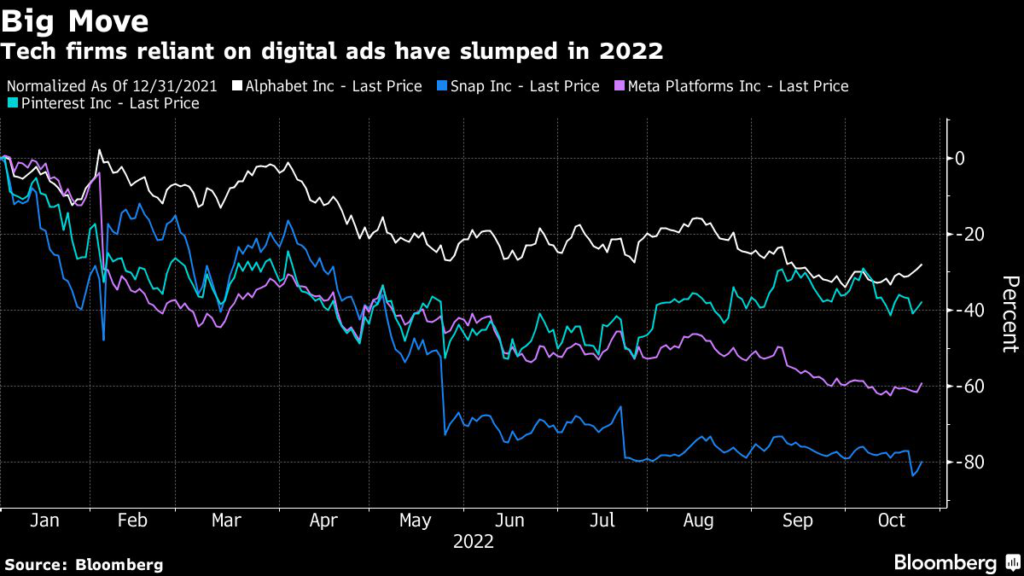
At Alphabet’s most important financial engine, the search and related businesses, sales rose less than analysts estimated as spiraling inflation crimped growth in digital advertising. Microsoft sank 7.7% while Alphabet declined 9.1% for its worst day since March 2020.

The selloff extended to other consumer and tech giants, with Amazon dropping 4.1%. Those that derive sales from online advertising followed Alphabet lower, with Meta and Pinterest Inc. dropping 5.6% and 2.4%, respectively. 

The Nasdaq 100 has plunged 30% this year, on course for its worst annual performance since 2008.

The demand outlook was particularly dire in the semiconductor industry, which had been one of the hottest sectors during the pandemic. Texas Instruments, whose chips go into everything from home appliances to missiles, saw shares tumble after its weak forecast signaled that the chip slump is spreading beyond computing and phones into other businesses. The stock lost 2.7%, while Analog Devices Inc. and Marvell Technology Inc. also dipped.

Tech Chart of the Day

Top Tech Stories

  • After reporting earnings and revenue that missed expectations, Alphabet said Tuesday it would slow hiring and control expenses, signaling that it was girding for tough times ahead as the economy falters.
  • Microsoft gave a lackluster forecast for sales growth in its Azure cloud-computing services business, a closely watched measure of corporate demand, sending the shares reeling in early trading Wednesday.
  • Mobileye Global Inc., the self-driving technology company owned by Intel Corp., priced one of the biggest US initial public offerings of the year above its marketed range to raise $861 million.
  • Elon Musk pledged to close the acquisition of Twitter Inc. by Friday in a video conference call with bankers helping fund the deal, according to people with knowledge of the matter.
  • Foxconn Technology Group is seeing a “small number” of Covid cases at its main campus in China, as the world’s biggest maker of iPhones aims to maintain production amid tightening restrictions in one of the country’s largest cities.
  • Texas Instruments and SK Hynix Inc. offered a gloomy view of the chip market in their latest quarterly reports, dashing hopes of a quick rebound for the $550 billion industry.
  • Billionaire Snap Inc. founder Evan Spiegel rubbished the idea that future computing will migrate into a virtual world dubbed the metaverse, arguing most people prefer a lighter touch known as augmented reality.
  • Spotify Technology SA tumbled as much as 10% in late trading after the company, the leader in music streaming, said profit margins may narrow this quarter because of programming costs, and that it’s considering raising prices in the US.

–With assistance from Sohee Kim, Ishika Mookerjee and James Cone.

(Updates stock moves throughout.)

More stories like this are available on bloomberg.com

©2022 Bloomberg L.P.

Bitcoin Rally Spurs Optimism for Early Thaw to Crypto Winter

(Bloomberg) —


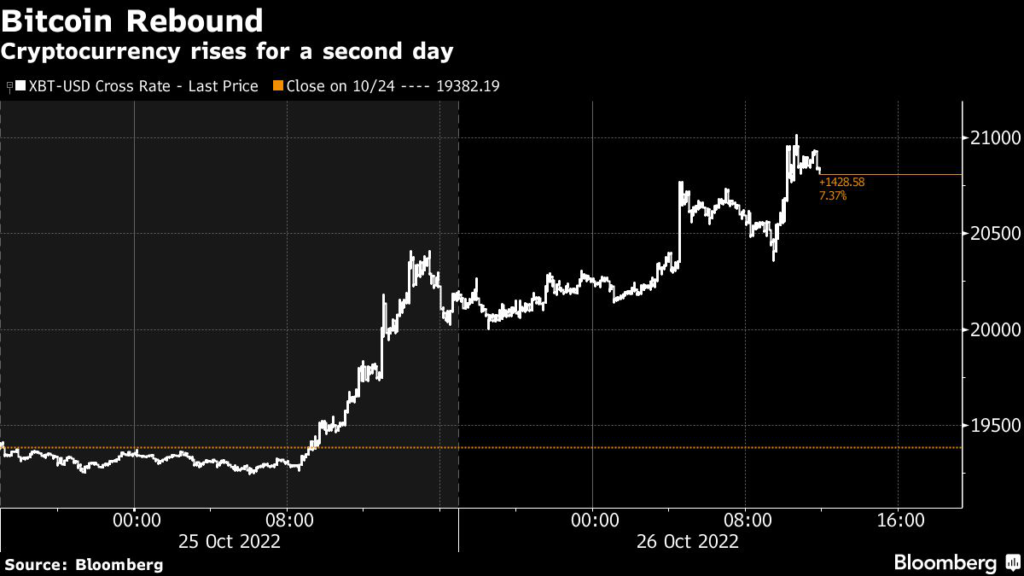
Bitcoin gained for a second day, spurring optimism among the almost always bullish advocates of the bellwether cryptocurrency for an end to the months-long decline known as crypto winter. 

The virtual currency rose as much as 4.1% to $21,018, bringing its increase since Monday to as much as 7.8%. That’s helped to reduce this year’s decline to about 55%. Other digital tokens gained more on Wednesday, with Ether jumping 6.4% and Dogecoin increasing 13%. 

Crypto traders celebrated the advances, a welcome change after months of limited price action. Bitcoin broke above $20,000 for the first time in more than two weeks on Tuesday, ending its longest run below that price level since the token first breached the threshold in late 2020.

The upward movement could point to “a building crypto sentiment shift,” according to Noelle Acheson, author of the “Crypto is Macro Now” newsletter. 

“It remains to be seen whether this is enough to awaken the momentum traders, but it does feel like something has changed,” she said. Acheson pointed to high open interest, “hinting at more activity ahead as traders come back into the market.”

Bitcoin saw its largest amount of short liquidations since July 2021, she said. That suggests “at least some of the rise has been fueled by short-covering,” Acheson said. 

Aggregate short liquidations on exchanges hit $700 million during Tuesday’s crypto specific surge, with the highest levels for Ether and Bitcoin since May and July 2021 respectively, according to data from Genesis.

“On the surface, this appears to be a short squeeze, given the significant amount of liquidations across a number of venues; but there are encouraging signs that we may be stabilizing or even building towards a modest rally as we head into November,” said Steven McClurg, co-founder and chief investment officer at digital-asset fund manager Valkyrie Investments.

The lack of downward movement, at least, is a positive sign, said Michael Purves, founder of Tallbacken Capital Advisors. In October, the coin has kept above $19,000, although it has not posted the large gains typical for the start of the fourth quarter.

Others tried to keep the two-day rally in perspective, noting that most digital assets have dropped by more than 50% this year as central banks increased borrowing rates, lowering the appeal of riskier assets such as cryptocurrencies.

The recent narrow trading range could be a result of seller exhaustion. According to Purves, it’s possible that the majority of people who want to sell the token have already done so. “It could be showing signs of a bottom here,” said Purves.

For the token to break out of the doldrums, Purves said the digital asset will need new money, ideally from institutional investors. Unfortunately, he doesn’t see significant action on that front. “I think the bulls need to see a lot more,” he said.  

Dogecoin, the Shiba Inu meme coin that was initially launched as a joke in 2013, gained as much as 13% to around 7 cents. Tesla CEO Elon Musk, an ardent supporter of the token, pledged to close his acquisition of Twitter Inc. by Friday. Musk has talked about using cryptocurrency as a payment method for the social media platforms.   

–With assistance from Vildana Hajric.

More stories like this are available on bloomberg.com

©2022 Bloomberg L.P.

Microsoft, Apple Push Stocks Lower; Bonds Rally: Markets Wrap

(Bloomberg) — US stocks dropped as investors parsed fresh economic data and disappointing earnings while mulling the Federal Reserve’s path after the Bank of Canada announced a smaller-than-expected rate hike. 

The S&P 500 and the Nasdaq 100 pushed lower, dragged by losses in Microsoft Corp. and Apple Inc. US Secretary of State Antony Blinken’s comments also dampened sentiment in the afternoon after he said he doesn’t see Iran nuclear talks advancing in the short term.

Treasuries rallied after data showed the US merchandise-trade deficit widening. Sales of new US homes fell in September, another indication that the economy is starting to see the effects of the Fed raising rates sharply. A gauge of the dollar declined for a second day to its lowest level in three weeks.

Stocks had been buoyed in recent days by mostly solid earnings and speculation the Federal Reserve may curb the pace of rate increases. Sentiment took a hit on Wednesday after earnings from megacap companies including Alphabet Inc. and Microsoft highlighted the impact the Fed, and consequently the surging dollar, had on the economy. 

The Bank of Canada unexpectedly slowing its pace of interest-rate hikes amid fears of a recession briefly boosted markets. But that wore off as some investors decided that it doesn’t necessarily mean the Fed will follow suit. 

In any case, it’ll be challenging for the Fed to announce that they’re going to be less hawkish, as they have to manage investors’ expectations along the way, according to Dustin Thackeray, chief investment officer at Crewe Advisors.

“They obviously don’t want to be too dovish and the market is obviously looking for any sort of a sign from the Fed that we’re hitting the break, so to speak, on rate increases,” he said by phone. “If they continue on their too hawkish stance, there is a risk that things kind of get out of hand on that end as well. So they’re definitely walking a very fine line.”

Key events this week:

  • Earnings due this week include: Apple, Exxon Mobil, Ford Motor, Credit Suisse, Airbus, Amazon, Bank of China, Boeing, Caterpillar, Cnooc, Intel, McDonald’s, Merck, Samsung Electronics, Shell, Vale, Volkswagen
  • ECB rate decision, Thursday
  • US GDP, durable goods orders, initial jobless claims, Thursday
  • Bank of Japan policy decision, Friday
  • US personal income, personal spending, pending home sales, University of Michigan consumer sentiment, Friday

Some of the main moves in markets:

Stocks

  • The S&P 500 fell 0.7% as of 2:54 p.m. New York time
  • The Nasdaq 100 fell 2.1%
  • The Dow Jones Industrial Average was little changed
  • The MSCI World index rose 1.6%

Currencies

  • The Bloomberg Dollar Spot Index fell 0.9%
  • The euro rose 1.1% to $1.0079
  • The British pound rose 1.3% to $1.1621
  • The Japanese yen rose 1.1% to 146.29 per dollar

Cryptocurrencies

  • Bitcoin rose 2.6% to $20,705.85
  • Ether rose 5.5% to $1,555.3

Bonds

  • The yield on 10-year Treasuries declined eight basis points to 4.02%
  • Germany’s 10-year yield declined six basis points to 2.11%
  • Britain’s 10-year yield declined six basis points to 3.58%

Commodities

  • West Texas Intermediate crude rose 3% to $87.86 a barrel
  • Gold futures rose 0.8% to $1,670.60 an ounce

–With assistance from Allegra Catelli, Abigail Moses, Robert Brand, Vildana Hajric and Peyton Forte.

More stories like this are available on bloomberg.com

©2022 Bloomberg L.P.

Chinese Stocks in US Extend Rally Nearly Erasing Record Selloff

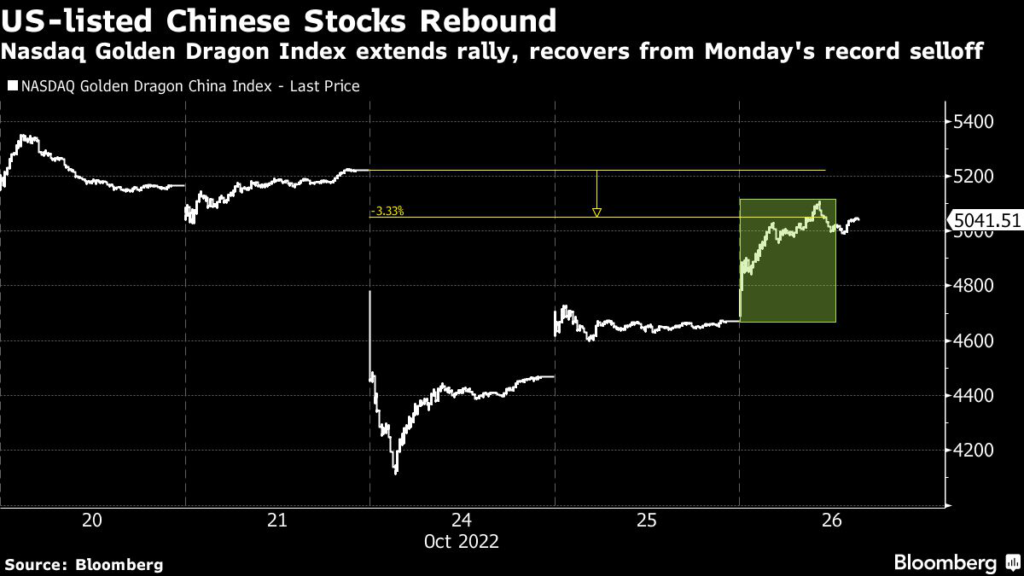
(Bloomberg) — Chinese stocks in the US are extending their rally after a record selloff on Monday, as Beijing’s pledge to support its financial markets lifted investor confidence and retail traders bought the dip. 

The Nasdaq Golden Dragon China Index, rose as much as 9.3% on Wednesday, bringing its two-day gain to more than 14%, the most since March. The index has already erased over two-thirds of its losses from Monday’s session. Among the top performers, Alibaba Group Holding Ltd., JD.com Inc. and Pinduoduo Inc. jumped more than 9%, while Nio Inc. advanced 2.5%. 

Some investors saw a glimmer of hope after China’s central bank and foreign-exchange regulator vowed to ensure the healthy development of financial markets and reiterated that the yuan would be “basically stable.” The comments followed President Xi Jinping’s tightening of control over the government, which spurred fears among foreign investors that his strategy will stifle the nation’s economy and private enterprise. 

“While sentiment is likely to stay depressed and markets could remain volatile until concrete policy actions emerge, pro-growth announcements could lead to sharp rallies, as happened in May or June,” UBS Global Wealth Management Chief Investment Officer Mark Haefele wrote in a note Wednesday. 

The risks and upsides for China equities are balanced, and investors should consider sticking to benchmark allocations for Chinese stocks rather than going underweight, according to Haefele. “Those with a lower allocation could consider buying on dips, and we continue to recommend positioning in sectors with resilient earnings given the prevailing headwinds,” he wrote.

That’s exactly what some traders did during Monday’s epic selloff. The American depositary receipts of Chinese companies were among the most heavily purchased stocks this week as retail investors sought to “buy the dip,” Vanda Research analysts including Marco Iachini wrote in a note on Wednesday.

Retail investors’ purchase of the top Chinese ADRs Monday surpassed levels last seen during the Shanghai lockdowns in March, with more than $157 million of net flows, according to Vanda. Alibaba, Nio and Pinduoduo were the biggest beneficiaries with $92 million, $32 million and $12 million of net inflows, respectively, the report said, noting that Alibaba attracted close to 60% of the inflows on that day.

Still, China’s equity markets remain fragile and are at risk of being bogged down by the nation’s Covid-zero policy. Reports of a lockdown in one of Wuhan city’s central districts dealt a blow to indexes in China and Hong Kong early Wednesday.

More stories like this are available on bloomberg.com

©2022 Bloomberg L.P.
Elon Musk to Address Twitter Staff During Visit Friday

(Bloomberg) — Elon Musk, the world’s richest man, changed his public profile descriptor to “Chief Twit” on Twitter, and is visiting the social network’s San Francisco office this week ahead of a court-imposed deadline to buy the company by Friday.

The company is expected to come under Musk’s ownership by 5 p.m. New York time on Oct. 28, as lawyers and bankers on both sides race to finalize paperwork. Leslie Berland, Twitter’s chief marketing officer and head of people, sent a memo to employees Wednesday saying that Musk was visiting the company’s headquarters this week, according to people who received the note.

“Elon is in the SF office this week meeting with folks, walking the halls, and continuing to dive in on the important work you all do,” Berland wrote in the memo. “For everyone else, this is just the beginning of many meetings and conversations with Elon, and you’ll all hear directly from him on Friday.”

On Tuesday, Bloomberg reported that Musk has told bankers he expected the $44 billion deal to close by the deadline. Banks were expecting a borrowing notice from Musk for $13 billion in debt financing, with the intention of the funds going into escrow Thursday.

More stories like this are available on bloomberg.com

©2022 Bloomberg L.P.
Nigeria to Replace High-Value Currency to Reign in Cash

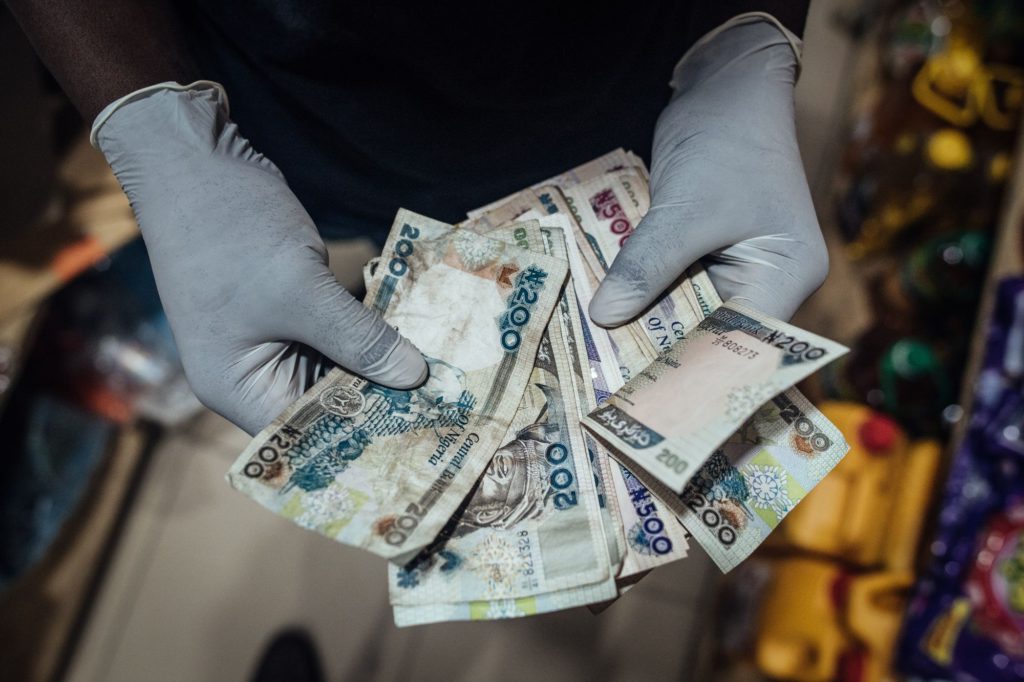
(Bloomberg) — Nigeria’s central bank will replace high-value currency notes starting Dec. 15 in a bid to mop up excess cash, rein in inflation and target rising insecurity in Africa’s largest economy. 

The country’s banking regulator plans to issue redesigned 200, 500 and 1,000 naira notes, Central Bank Governor Godwin Emefiele said at a briefing in Abuja, the capital, on Wednesday. The old notes will cease to be legal tender starting Jan. 31, giving citizens of the West African country, where cash dominate transactions, six weeks to exchange their notes. 

Emefiele said 85% of cash in the country is held outside commercial banks, which is undermining the efficacy of monetary policy and the integrity of the country’s currency. He said the amount of cash in circulation has more than doubled since 2015 to 3.23 trillion naira ($7.3 billion)as of September. 

“It is unacceptable and indeed it takes the control of money supply out of the hands of the central bank,” Emefiele said. “No doubt we believe it has positive impact on inflation,” which hit a 17-year high in September, he said.

The move to switch the notes may lead to chaos in a country where majority of the population live in rural areas away from bank branches. In 2016, Indian Prime Minister Narendra Modi’s move to ban high-value currency led to a prolonged scramble for cash and slowed economic growth.

Emefiele also argued that reducing the amount of cash in circulation would minimize “access to large volume of money outside the banking system used as source of funds for ransom payments.” 

Africa’s most populous country has been faced with widespread abduction-for-ransom crisis. 

The bank also plans to mint more of its eNaira digital currency, which launched a year ago but has struggled to gain traction. Only 1 million people have downloaded an eNaira wallet since its introduction and transaction volumes have been negligible. 

Digital-Currency Plan Falters as Nigerians Defiant on Crypto

While the introduction of new naira notes is unlikely to have an impact on the currency’s official exchange rate, which the central bank tightly controls, the move could put pressure on the widely-used black market rate, said Samir Gadio, head of Africa Strategy at Standard Chartered Bank. 

“Old naira notes could be partly converted to USD in the parallel market, but it is still early too tell,” he said.  

Nigeria’s anti-graft agency has warned bureau-de-change operators and lenders not to “assist unscrupulous customers in laundering suspected proceeds of crimes through their system” during the currency exchange process, according to an emailed statement. 

Operators must be “wary of currency hoarders who would attempt to seize this opportunity to offload the currencies they had illegally stashed away,” the agency said. 

–With assistance from Ruth Olurounbi.

(Updates with comments from anti-graft agency in last two paragraphs)

More stories like this are available on bloomberg.com

©2022 Bloomberg L.P.
Nigeria to Replace High-Value Currency to Rein in Cash

(Bloomberg) — Nigeria’s central bank will replace high-value currency notes starting Dec. 15 in a bid to mop up excess cash, rein in inflation and target rising insecurity in Africa’s largest economy. 

The country’s banking regulator plans to issue redesigned 200, 500 and 1,000 naira notes, Central Bank Governor Godwin Emefiele said at a briefing in Abuja, the capital, on Wednesday. The old notes will cease to be legal tender starting Jan. 31, giving citizens of the West African country, where cash dominate transactions, six weeks to exchange their notes. 

Emefiele said 85% of cash in the country is held outside commercial banks, which is undermining the efficacy of monetary policy and the integrity of the country’s currency. He said the amount of cash in circulation has more than doubled since 2015 to 3.23 trillion naira ($7.3 billion)as of September. 

“It is unacceptable and indeed it takes the control of money supply out of the hands of the central bank,” Emefiele said. “No doubt we believe it has positive impact on inflation,” which hit a 17-year high in September, he said.

The move to switch the notes may lead to chaos in a country where majority of the population live in rural areas away from bank branches. In 2016, Indian Prime Minister Narendra Modi’s move to ban high-value currency led to a prolonged scramble for cash and slowed economic growth.

Emefiele also argued that reducing the amount of cash in circulation would minimize “access to large volume of money outside the banking system used as source of funds for ransom payments.” 

Africa’s most populous country has been faced with widespread abduction-for-ransom crisis. 

The bank also plans to mint more of its eNaira digital currency, which launched a year ago but has struggled to gain traction. Only 1 million people have downloaded an eNaira wallet since its introduction and transaction volumes have been negligible. 

Digital-Currency Plan Falters as Nigerians Defiant on Crypto

While the introduction of new naira notes is unlikely to have an impact on the currency’s official exchange rate, which the central bank tightly controls, the move could put pressure on the widely-used black market rate, said Samir Gadio, head of Africa Strategy at Standard Chartered Bank. 

“Old naira notes could be partly converted to USD in the parallel market, but it is still early too tell,” he said.  

Nigeria’s anti-graft agency has warned bureau-de-change operators and lenders not to “assist unscrupulous customers in laundering suspected proceeds of crimes through their system” during the currency exchange process, according to an emailed statement. 

Operators must be “wary of currency hoarders who would attempt to seize this opportunity to offload the currencies they had illegally stashed away,” the agency said. 

–With assistance from Ruth Olurounbi.

(Updates with comments from anti-graft agency in last two paragraphs)

More stories like this are available on bloomberg.com

©2022 Bloomberg L.P.

Close Bitnami banner
Bitnami