Bloomberg

Pro-China Disinformation Blamed US for Nord Stream Explosion

(Bloomberg) — An disinformation campaign that aligns with Beijing’s interests alleged the US was behind the recent explosions of the Nord Stream gas pipelines and that the US is backing a prolific hacking group, according to a report published Wednesday by the cybersecurity firm Mandiant.

The online propaganda campaign, which Mandiant calls “Dragonbridge,” includes social media posts seeking to discredit the US democratic process, including attempts to discourage Americans from voting in the upcoming midterm elections. An English language video posted in September claimed that the “solution to America’s ills is not to vote for someone,” but rather to “root out this ineffective and incapacitated system.”

Dragonbridge also posted content that frequently mentioned civil war and claimed that polarization is now fundamentally entrenched in the US political system, according to the report. 

Dragonbridge relies on thousands of bogus accounts on various social media platforms and has promoted narratives that fit with China’s political interests since Mandiant began tracking it in 2019, researchers said. Even so, Mandiant concluded that the campaign hasn’t been particularly effective.

“The Dragonbridge campaign has continued to exhibit aggressiveness through both the content of its narratives and its willingness to experiment with new tactics to accomplish its aims,” the report says. “Dragonbridge’s attempts to mobilize protesters in the U.S. last year, while failing to meet with any apparent success, was one such demonstration of the campaign’s boldness and interest in influencing real-world activity. Since then, the campaign has continued to fail to garner any significant engagement.”

In a particularly brazen move, the campaign promoted the claim that the hacking group APT41 is backed by the US government by plagiarizing, altering or mischaracterizing news accounts and research by Mandiant and other cybersecurity organizations. APT41 has been previously identified as a “prolific Chinese threat group” by Mandiant.

“The US government network APT41 ‘black hands’ has devastated the world,” said a tweet included in Mandiant’s report.

In October, Dragonbridge accounts promoted the narrative that the US had bombed the offshore Nord Stream pipelines for its own economic benefit, at the expense of Europe and its other NATO allies.

Earlier this year, Mandiant detailed an effort to target rare earth mining companies that posed a threat to “PRC Market dominance.” Accounts linked to the campaign employed similar tactics, including impersonating Texans concerned about the environment.

Influence campaigns promoting the interests of various nations have become increasingly common over the last decade, but as Mandiant identifies with Dragonbridge, they rarely attract much engagement.

More stories like this are available on bloomberg.com

©2022 Bloomberg L.P.

Seagate to Cut 3,000 Jobs, Faces Charge of Violating Sanctions

(Bloomberg) — Seagate Technology Holdings Plc, the biggest maker of computer hard drives, said it’s eliminating about 3,000 jobs and that big buyers of technology are cutting orders on concerns the economy is worsening. The shares fell more than 10% as trading got underway in New York. They have lost more than half their value this year.

“Global economic uncertainties and broad-based customer inventory corrections worsened in the latter stages of the September quarter, and these dynamics are reflected in both near-term industry demand and Seagate’s financial performance,” Chief Executive Officer Dave Mosley said in a statement. “We have taken quick and decisive actions to respond to current market conditions and enhance long-term profitability, including adjusting our production output and annual capital expenditure plans.”

Separately, Seagate said it has been accused by the US Commerce Department of violating US export rules by selling hard drives to a sanctioned entity. Reuters reported that the entity was Huawei Technologies Co. The company denied it violated the rules. 

The US company’s push back may prove a test of tightening restrictions against the provision of technology to China by the Biden administration, which has cited national security concerns in actions it’s taken against companies such as Huawei. Most of the actions to date have focused on semiconductor technology.

“Seagate’s position that it did not engage in prohibited conduct as alleged by the Bureau of Industry and Security, because, among other reasons, Seagate’s HDDs are not subject to the Export Administration Regulations,” the company said in a regulatory filing.

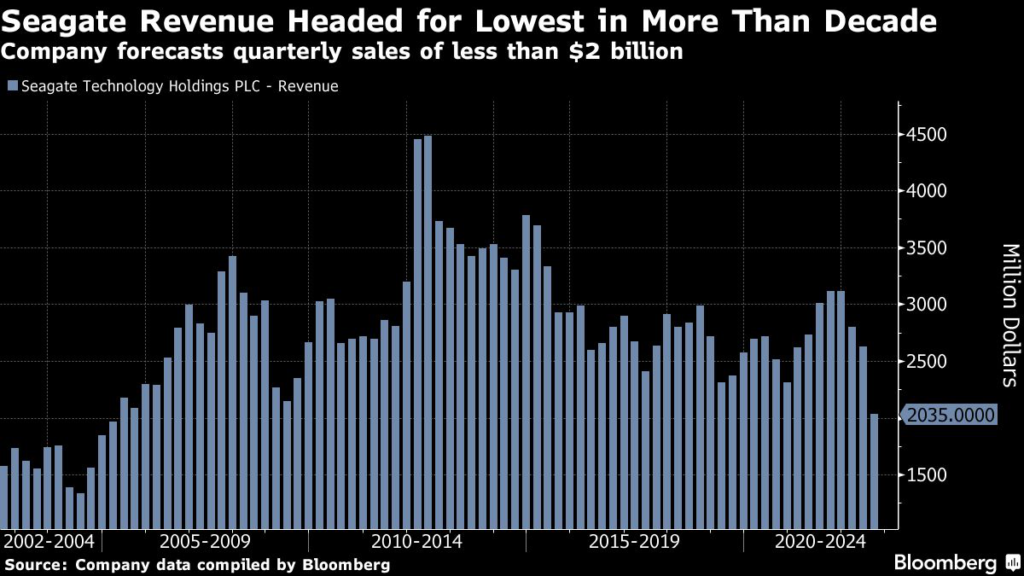
The company also released fiscal first-quarter financial results, which missed analysts’ expectations. Sales in the period ended Sept. 30 were $2.04 billion, missing analysts’ average estimate for $2.12 billion, the Fremont, California-based company said in the statement early Wednesday. That compares with an average analyst estimate of $2.2 billion. Adjusted earnings per share were 48 cents, far below estimates for 75 cents. 

For the current quarter, Seagate said it sees revenue of about $1.85 billion and adjusted earnings per share of about 15 cents. It would mark the first quarter below $2 billion in revenue since 2005.

Like many of its peers in the computer component industry, Seagate has already warned investors that demand is drying up after several quarters of rapid growth. Companies and government departments are slowing their investment in computer networks, causing a buildup in unused parts. Covid lockdowns alongside economic weakness in China weighed on demand for mass capacity storage in recent months, while inflation dampened spending, the company said in a presentation. 

“Customers have grown more cautious with their spending plans, which we believe will extend the recovery in the calendar year ‘23,” Mosley said on a call with investors. The CEO cited interest rates, inflationary pressures, and geopolitical dynamics as contributing to an “intensely challenging macro environment.”

Seagate’s announcement is the latest from a tech company to focus on staffing expenses to cope with an economic slowdown and a squeeze on spending from high inflation. Intel Corp. is planning thousands of job cuts, while Meta Platforms Inc. plans to reorganize teams and reduce headcount for the first time ever. Amazon.com Inc. has frozen corporate hiring in its retail business, and Alphabet Inc.’s Google is making job cuts to Area 120, its in-house incubator for new projects.

Mosley said Seagate’s job cuts, which amount to about 7.5% of total employees, would lead to annualized savings of about $110 million once they were fully realized, in the fiscal third quarter of 2023.

Operating expenses were trimmed in the quarter by lower compensation and “strong controls over discretionary spending,” said Chief Financial Officer Gianluca Romano during the earnings call. Expenses are expected to decline a further $10 million in the current quarter due to the restructuring plan, Roman said.

(Updates with opening shares and earnings outlook in sixth paragraph)

More stories like this are available on bloomberg.com

©2022 Bloomberg L.P.

Shaw Soars as Minister’s Intervention Boosts Odds of Rogers Deal

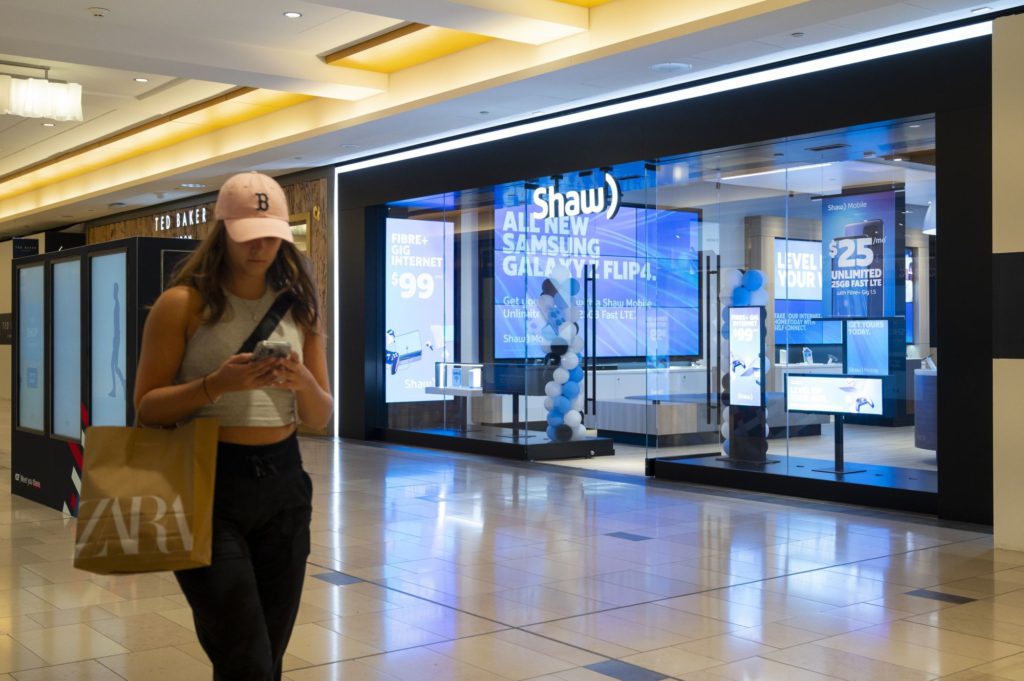
(Bloomberg) — Shaw Communications Inc. jumped 9% after a government minister in Canada clarified the regulatory conditions on its deal with Rogers Communications Inc., improving the odds that the transaction will close.  

Shaw shares rose to C$37.17 as of 9:42 a.m. in Toronto, the highest since July, while Rogers was up 5%.

Rogers agreed to pay C$20 billion ($14.8 billion) for its rival in March 2021, or C$40.50 a share, but the deal has been delayed by Canada’s antitrust regulator, which says it will weaken competition in the wireless sector. The two companies have agreed to sell most of Shaw’s wireless assets to a third Canadian communications firm, Quebecor Inc., to try to solve that problem. 

On Tuesday, Industry Minister Francois-Philippe Champagne said he’d approve the divestiture to Quebecor only if the company promises to keep the wireless licenses for at least 10 years and consumer prices improve in Ontario and Western Canada, where Shaw operates. Quebecor Chief Executive Officer Pierre Karl Peladeau said the company will accept those terms. 

That’s a sign the Rogers-Shaw deal has a path to the finish line, Desjardins analyst Jerome Dubreuil said. The government “is signaling that the deal would be acceptable if QBR competes in the long term,” Dubreuil said in a note, referring to Quebecor’s stock ticker. “Why would Mr. Champagne set conditions if he were about to say no?”

Read more: Rogers Takeover of Shaw Gets New Conditions From Canada

The deal still has to pass the antitrust hurdle. Rogers and Shaw are scheduled for mediation with the Competition Bureau this week. If the two sides can’t reach a settlement, the merger will head to Canada’s Competition Tribunal, a merger court. 

“The odds now seem quite low that the Competition Bureau wouldn’t agree to a settlement” with Shaw and Rogers, said Aaron Glick, a merger arbitrage specialist at Cowen & Co. The base case is for settlement, with the deal closing next week, he said. 

–With assistance from Yiqin Shen.

(Updates share movement, adds comments from merger arbitrage specialist.)

More stories like this are available on bloomberg.com

©2022 Bloomberg L.P.

Saudi Fund Plans to Invest $24 Billion in Regional Countries

(Bloomberg) — Saudi Arabia’s sovereign wealth fund plans to invest $24 billion in Middle Eastern and North African countries as the oil-rich kingdom seeks to bolster regional economies.

The Public Investment Fund plans to set up companies to invest in Bahrain, Oman, Jordan, Iraq and Sudan, according to a statement. It will channel funds into several sectors including infrastructure, heath care, real estate and telecommunications. In August, the PIF started the Saudi Egyptian Investment Co. to invest in Egypt.

Saudi Arabia’s Crown Prince Mohammed bin Salman is sitting on his first budget surplus since becoming the de factor ruler of the kingdom, allowing him to channel billions of dollars into assets globally and to plan ambitious construction projects.

The PIF’s statement had an immediate impact on sovereign bonds in the region. Bahrain’s $1.25 billion Sept. 2044 notes gained one cent to 69 cents on the dollar, while Jordan’s $1 billion Oct. 2047 debt rose for a third consecutive day to reach 72 cents. Meanwhile, Oman’s March 2047 dollar bonds hit their highest level in more than two weeks.

The wealth fund, also chaired by the crown prince, is a key lever for the kingdom’s efforts to revive growth after a recession caused by the coronavirus pandemic and lower oil prices. Since 2015, the PIF has grown assets under management to $620 billion from about $150 billion.

–With assistance from Selcuk Gokoluk.

(Updates with bond moves in 4th paragraph)

More stories like this are available on bloomberg.com

©2022 Bloomberg L.P.

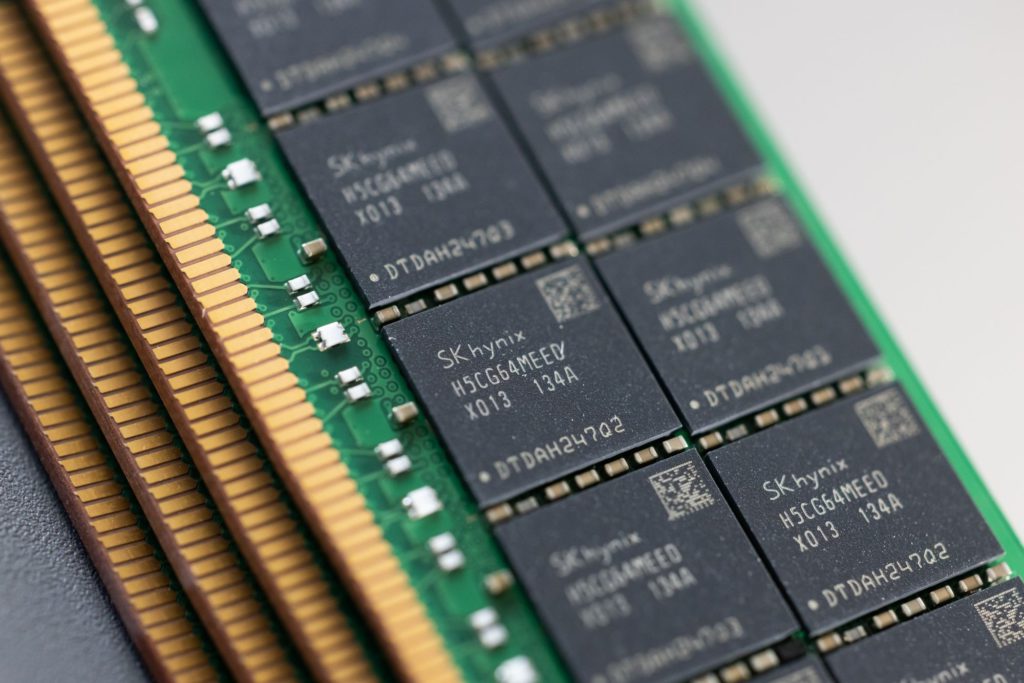
Hynix Warns US Chip Curbs Could Shut Giant China Plant

(Bloomberg) — SK Hynix Inc. warned that the Biden administration’s escalating restrictions could force the closure or sale of a major plant in China, an “extreme situation” or worst-case scenario it hopes to avert.

Hynix told analysts the memory chip giant was preparing for various contingencies, including the possibility that Washington’s curbs could prevent it from getting the gear it needs to sustain its DRAM factory in Wuxi. Hynix would then be forced to sell or move the production equipment to South Korea, Chief Marketing Officer Kevin Noh said.

The US Commerce Department this month unveiled sweeping regulations that limit the sale of semiconductors and chipmaking equipment to Chinese customers, striking at the foundation of the country’s efforts to build its own chip industry.

The curbs have also cast uncertainty over major Chinese operations run by foreign firms including Hynix and larger rival Samsung Electronics Co. Both firms have obtained a one-year waiver that lets them import the equipment they need to maintain or potentially expand their factories. Hynix, which on Wednesday warned it will cut capital spending by half in 2023 to reflect waning electronics demand, is hopeful it can continue to operate in China.

“Comments on the possible transfer of our Chinese facilities are based on outlier scenarios with low probably of occurrence,” Hynix said in a statement after the conference call. “We want to make it clear that we are not actively considering contingency plans, and we have not reviewed such options seriously or in detail.”

But fears persist that the US curbs could curtail production at Hynix and other chipmakers’ factories there. Hynix’s Noh said it was essential for the company to diversify its production bases in the mid- to long-term, but that’s complicated and it was hard to make changes at current facilities at the moment.

“If the time comes when it appears difficult to maintain operation of the fab in Wuxi, then we might have to sell off the fab or move the equipment to Korea,” Noh said. “We are looking into various scenarios, but again, this would amount to a contingency. So this would be an extreme situation.”

Read more: SK Hynix Cuts Capex in Half With ‘Unprecedented’ Drop in Demand

(Updates with additional comment from Hynix in the fifth paragraph. A previous version was corrected to reflect the executive’s proper title.)

More stories like this are available on bloomberg.com

©2022 Bloomberg L.P.

Pimco, Franklin Templeton Warn of Sticky Inflation: FII Update

(Bloomberg) — The second day of Saudi Arabia’s Future Investment Initiative event saw warnings ring out from heads of some of the world’s largest asset managers, who said central banks might struggle to lower inflation.

Speaking at the summit in Riyadh, Pacific Investment Management Co. Vice Chairman John Studzinski and Franklin Templeton CEO Jenny Johnson described inflation in the US as “sticky.” Third Point CEO Daniel Loeb offered a different view, and said “we may have already seen the worst of it.”

Meanwhile, Saudi Arabia’s Finance Minister said the kingdom has made its economy more resilient by identifying risks from global shocks quickly. And Aramco said the global oil market is already adjusting to sanctions on Russia, with Moscow redirecting crude flows to Asia from Europe and other producers making the opposite switch.

Former US Treasury Secretary Steven Mnuchin said market watchers who were too sanguine about risks to the economy a year ago are now being too alarmist. “All of a sudden everybody has turned incredibly negative,” he told the conference. 

Key Highlights:

  • Wall Street Bankers See Darker Economic Outlook, Political Risks
  • Wall Street Targets Saudi Oil Riches as US Spat Simmers
  • Dimon Warns Geopolitical Issues Bigger Worry Than Recession
  • US and Saudi Arabia Will Work Out Spat, Dimon and Falih Say
  • Binance CEO Says He Thinks He’ll Stick With Musk in Twitter Bid
  • Saudi Stock Exchange CEO Sees Strong IPO Pipeline in Busy Year

Brookfield’s Flatt Says Inflation Needs to be Crushed (2:30 pm)

Brookfield Asset Management Inc. CEO Bruce Flatt said inflation was too high, caused by money flooded into the system for a short period of time. The Fed needs to get to a point where the economy slows, he said.

“We need to crush that inflation and central banks are going to do that,” he said. On investments, Flatt said real assets and private capital are the place to be in.

‘Sticky’ Inflation (2:15 pm)

Pimco Vice Chairman Studzinski described inflation in the US as “sticky” and doesn’t expect it to reset to 2% in the foreseeable future. He also expects a series of interest rate hikes in the short term.

“We’re looking at somewhere between 3 to 4% as being a core level of inflation certainly for the next couple of years,” he said. “Until you’ve got some resolution of energy, some resolution of supply chains, and some resolution to some sort of some of the geopolitical tensions that exist, particularly in Europe.”

Franklin Templeton CEO Johnson agreed. She said core inflation “is stickier than most people think” given consumers have very little debt, more money in their bank account than prior to Covid, and unemployment is low.

The asset manager also expects the Fed to “pretty aggressively raise rates.” It sees “75, 50 and then maybe another 50 or two 25s. It will then have to sit on it a while because it’s a lag effect.”

Third Point CEO Loeb offered a different view, saying: “I actually think we may have already seen the worst of it” “It doesn’t mean inflation is going away. It means that our peak inflation is starting to roll over. You’re seeing some improvement.”

However, he raised concerns over the lengths the Federal Reserve may have to go to keep what he called a “flattening off in rates.”

“The next thing to be concerned with is what does this mean? How long does it last, and how much will the Fed have to beat the economy into submission in terms of driving up unemployment?” he said. “I think it’s going to be less bad than people think.”

PIF to Invest $24 Billion in Regional States (2 pm)

Saudi Arabia’s sovereign wealth fund plans to invest $24 billion in Middle Eastern and North African countries as the oil-rich kingdom seeks to bolster regional economies.

The Public Investment Fund plans to set up companies to invest in Bahrain, Oman, Jordan, Iraq and Sudan, according to a statement. It will channel funds into several sectors including infrastructure, heath care, real estate and telecommunications. In August, the PIF started the Saudi Egyptian Investment Co. to invest in Egypt.

Saudi Arabia’s Crown Prince Mohammed bin Salman is sitting on his first budget surplus since coming to power, allowing him to channel billions of dollars into assets globally and to plan ambitious construction projects.

Global Oil Flows Shifting: Aramco (1:30 pm)

Saudi Aramco said the global oil market is already adjusting to sanctions on Russia, with Moscow redirecting crude flows to Asia from Europe and other producers making the opposite switch.

“Realignment is happening,” Amin Nasser, chief executive officer of the world’s biggest oil company, said at the Future Investment Initiative event in Riyadh. “Russians, with the right discount, are able to place their crude in different markets.”

“There are logistical issues, insurance issues,” Nasser said. “But that’s being handled with the right discounts. The flow is going to Asia — though, it takes longer. And crude that used to go to Asia is now being directed to Europe and other parts of the world.”

Oman Wealth Fund Scouts for UK Deals (1:15 pm)

The Oman Investment Authority, which manages funds equivalent to 40% of the sultanate’s economy, is looking for deals in the UK, a senior executive said.

“Problems create opportunities,” Ibrahim Al Eisri, director of private equity at OIA said in an interview. “We see opportunities in Europe in different sectors especially in technology. UK has lots of opportunities due to the falling currency.”

“We have high exposure to the US and we like that market,” he said. 

Saudi Finance Chief Says Economy More Resilient (1 pm)

Saudi Arabia got ahead of the global slowdown and worked to mitigate risks to its economy, Finance Minister Mohammed al-Jadaan said.

“You need to make sure you mitigate early, you are ahead of the curve, as we have done over the past couple of years to make sure you are protected from these shocks,” he told Bloomberg TV in an interview.

He predicted Saudi Arabia’s non-oil GDP would continue to grow at 5% or more next year. Externally, the kingdoom has taken steps to stabilize energy markets and he said US and Saudi Arabia had strong ties despite recent tensions over oil policy.

Aramco Announces $1.5 Billion Sustainability Fund (12:30 pm)

Saudi Aramco started a $1.5 billion sustainability fund to invest in technology that can support energy transition.

Managed by Aramco Ventures, the fund’s initial focus will include carbon capture and storage, greenhouse gas emissions, hydrogen, ammonia and synthetic fuels. The fund will target investments globally.

HSBC CEO: Higher Rates to Make Shift to Clean Energy More Expensive (12 pm)  

Rising interest rates will make the shift away fossil fuels more expensive and so policymakers need to act to get inflation under control, said HSBC Holdings CEO Noel Quinn at the event.

“Building that bridge into the future will be easier if we can collectively get inflation under control. Building that bridge will be very expensive with high inflation and high interest rates,” he said.

Still, banks will also need to continue financing fossil fuels for the next few years to ensure societies basic needs are met.

“We can’t just put all our investment into the future, and ignoring today. There needs to be capacity to survive for society to have some of the basic needs met, not just in 2023 but into 2023, 2024 and 2045. There has to be a bridge into the future.”

“People want to switch off todays energy sources and you can’t,” Quinn said.

Saudi Finance Minister: IMF Meetings No Longer Denying Economic Risks (9:50 am)

Previous International Monetary Fund meetings denied global economic risks but that has now changed, Saudi Arabia’s Finance Minister Al Jadaan said.

“There was to a large extent a denial about the risks we’re seeing today, during previous IMF meetings but that changed during last week’s meetings in Washington,” he said.

Speaking about the region, he said “there’s a lot of commitment to reform and that reform is continuing.”

“We need to be watchful and provide whatever support for the region,” he added.

Mnuchin Expects Significant Slowdown in China (9:45 am)

Former US Treasury Secretary Steven Mnuchin said at the event that China is set to endure a significant slowdown. 

“Clearly China is going to have a significant slowdown and that will have an impact on the world economy,” said Mnuchin, now managing partner at Liberty Strategic Capital. “Things are going to get worse before they get better.”

Mnuchin said he expects 10-year Treasury yields to peak at 4.5%. Treasuries rallied sharply Tuesday amid signs that Federal Reserve rate hikes are beginning to take a toll on the economy.

Mnuchin Says People Underestimated Economic Risks (9:45 am)

Mnuchin said people underestimated economic risks previously but now “we’re overestimating those risks. All of a sudden everybody has turned incredibly negative.”

“I think you are going to see inflation in the US will begin to come under control and it will probably be a two-year period,” he said. “But you’re going to begin to see that tightening relatively regularly. And I think people are overestimating the Federal Reserve’s actions just as they underestimated it.”

Investcorp, Fung Capital to Start $500 Million Greater Bay Fund (9:40 am)

Investcorp, the Middle East’s largest alternative asset management firm, and the private equity arm of the Fung brothers’ family office are setting up a fund to invest in mid-cap companies across China’s Greater Bay Area.

–With assistance from Dinesh Nair, Yousef Gamal El-Din, Sarah Halls, Habiba Basiony, Ben Bartenstein, Shaji Mathew, Dana Khraiche, Matthew Martin, Stefania Bianchi, Adveith Nair, Julia Fioretti, Abeer Abu Omar, Zainab Fattah, Archana Narayanan, Christine Burke, Nicolas Parasie and Salma El Wardany.

More stories like this are available on bloomberg.com

©2022 Bloomberg L.P.

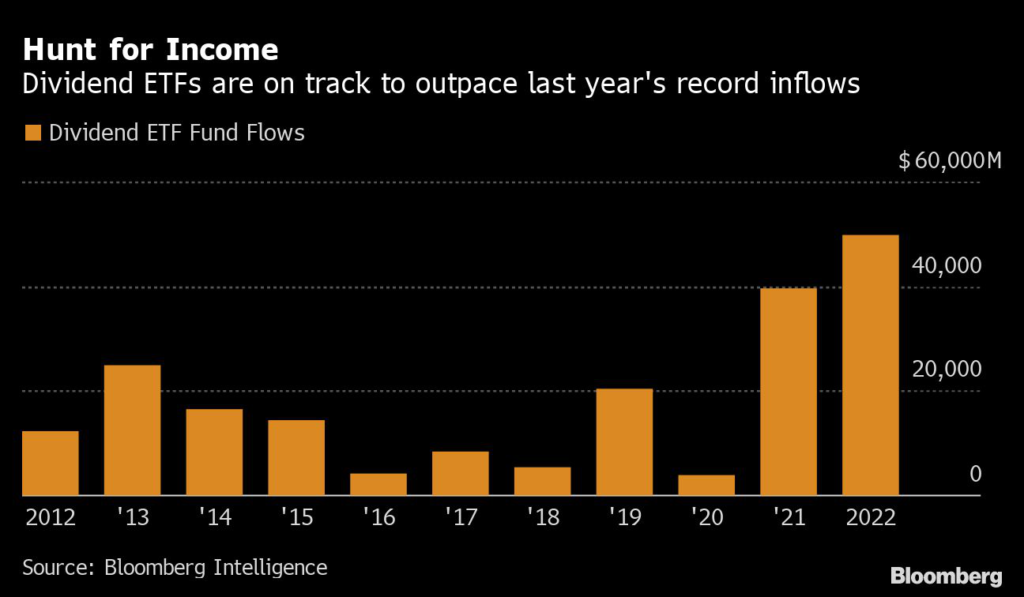
Income-Hunting Investors Are Fueling a $50 Billion ETF Bonanza

(Bloomberg) — In these tumultuous times on Wall Street, at least one investing trend is proving remarkably consistent: Dividend ETFs are notching relentless inflows as traders take refuge in the stock-market storm.

The record $50 billion allocation bonanza so far this year is notable in a world where even cash-like Treasuries are offering income-hungry investors the highest yields in over a decade — giving defensive strategies like dividend funds a run for their money. At least in theory. 

Yet demand for steady income in stocks is booming as money managers bid up companies with a history of paying out profits to shareholders, hoping that will cushion gut-wrenching losses across the broader market. 

All told, the cash flowing into dividend-focused exchange-traded funds is already running 25% higher than the record haul secured in 2021, with positive inflows every month so far this year. 

The deluge has endured even after Federal Reserve monetary tightening pushed the yield on Treasury bills to a beefy 4% and counting. Proponents are casting dividend-chasing strategies as an inflation hedge of sorts in an era where bonds are suffering from an existential crisis.

“We think dividend paying stocks are a little bit more resilient in rocky economic times,” said Kara Murphy, CIO of Austin, Texas-based Kestra Investment Management, when asked if she’d rather buy a Treasury bond or dividend-stock for income over the next year. “We actually think they’re pretty attractive right here.”

As assets like Bitcoin and inflation-hedging ETFs struggle to live up to their billing of protecting from price growth, dividend strategies have history on their side, according to Fidelity. The money manager found that in decades when inflation was above 5%, dividends have powered more than half of the S&P 500’s total return.

The Fed’s aggressive rate hikes have roiled both the stock and bond markets, crushing the traditional portfolio of 60% equities and 40% bonds. Bloomberg Intelligence estimates high-dividend ETFs could ultimately double their inflow record this year as investors — particularly in equities — seek alternatives.

“A lot of people have realized that stocks and bonds become more positively correlated in elevated inflation environments,” said Nick Kalivas, head of factor and core equity product strategy at Invesco. Investors have therefore been looking to high-dividend strategies “as a way to navigate the breakdown in 60/40,” he said.

On average, non-leveraged dividend funds have delivered a trailing 12-month yield of about 4.3%, according to Bloomberg data, well above the S&P 500’s 1.7%. At the same time, surging prices in the energy sector — to which dividend funds are often heavily exposed — have helped protect many products from the worst of the US stock selloff. 

Among the top performing ETFs is the WisdomTree US High Dividend Fund (DHS), which has returned 2.8% this year as it lured $406 million. The biggest winner for flows, the Schwab US Dividend Equity ETF (SCHD), has attracted almost $12 billion even as it lost 8.5%.

That compares to a roughly 18% loss for the S&P 500, which is being beaten by almost all major dividend ETFs, every one of which has posted a net inflow this year so far.

The counterpoint: With interest rates now 300 basis points higher than at the start of the year, the argument is that bonds now offer a more dependable source of income. Rates on three-month Treasury bills are hovering near 3.9%, the highest since 2007. 

“Do you really wanna buy stocks for the dividends when now you can get these interest rates on bonds?” said David Bianco, Americas CIO at DWS Group. “If the income is what you want, then go to where the income is reliable.”

More stories like this are available on bloomberg.com

©2022 Bloomberg L.P.

Tech Giants Weigh on US Futures; Dollar Drops: Markets Wrap

(Bloomberg) — US index futures fell as megacap technology shares slumped in premarket trading, marring a three-day rally on Wall Street and raising new doubts over whether this year’s $5.5 trillion selloff is nearing a bottom.

Contracts on the Nasdaq 100 fell 2% after disappointing quarterly updates from Microsoft Corp., Google parent Alphabet Inc. and Texas Instruments Inc. S&P 500 futures were down about 1%. Treasuries gained, with the 10-year yield falling to around 4.07%, while a gauge of the dollar declined for a second day to its lowest level in three weeks.

Stocks have been buoyed in recent days by mostly solid earnings and speculation the Federal Reserve may curb the pace of rate increases as evidence mounts that its aggressive tightening is starting to weigh on the economy.  About a quarter of S&P 500 companies have reported third-quarter results, with more than two-thirds beating analysts’ estimates despite the big-tech setback. But concern is mounting that slowing output will dent corporate profits in coming months.

“Yes we’re seeing earnings beats at the moment,” Mike Ingram, a senior market strategist at ActivTrades, said on Bloomberg TV. “But where I do start to have a bit of a problem at this juncture is that some earnings expectations going into next year are looking still a bit punchy.”

Goldman Sachs Group Inc. strategists said conditions for a trough in US equities are not visible yet as the asset class doesn’t fully reflect the latest rise in real yields and odds of a recession. In case of a severe economic downturn, the Goldman team said it expects the S&P 500 Index to drop to 2,888, implying 25% fall from Tuesday’s close.

The Stoxx Europe 600 index fluctuated amid a raft of mostly positive earnings from heavyweights including Barclays Plc, Deutsche Bank AG and Mercedes-Benz Group AG. The technology sector dropped more than 1%, weighing on the benchmark, while brewer Heineken NV plunged after missing analysts’ estimates for volume growth.

Meanwhile, the British pound held an advance against the greenback after the government said a much-anticipated fiscal statement will be delayed until November. Sterling rallied earlier after New Prime Minister Rishi Sunak named an experienced Cabinet to lead the UK through what he called a “profound economic crisis.”

Yuan Surges

Equities advanced in China, Japan and South Korea. Positive signs for Asia included China’s central bank and foreign-exchange regulator indicating it would maintain the healthy development of stock and bond markets, while reiterating that the yuan would be “basically stable.”

A near 5% rebound in a gauge of US-listed Chinese stocks on Tuesday helped claw back some of the record loss suffered in the wake of President Xi Jinping breaking with China’s collective leadership. Hong Kong’s tech gauge made strong gains for a second day but was still short of recouping Monday’s near 10% slide. The offshore yuan surged by a record 1.8% against the dollar.

The yen fluctuated ahead of the Bank of Japan’s policy decision Friday, when monetary settings are expected to be kept unchanged. Meanwhile, the central bank boosted purchases of longer-dated government bonds as rising yields threatened to loosen its grip on the yield curve.

While the recent US data haven’t changed expectations that the Fed will hike interest rates by three-quarters of a percentage point next month, they’re fueling speculation that an end to aggressive tightening may come next year. Analysts are also projecting challenges for now in Europe, with a jumbo hike of 75 basis points expected from the European Central Bank on Thursday. That’s even as many economists now reckon a recession has begun in the euro region.

“Sentiment’s still incredibly fragile. We do expect to see further market volatility,” Catherine Yeung, investment director at Fidelity International, said on Bloomberg Radio. “All eyes are still on the rate cycle globally speaking as well as where inflation does go. I think going into the end of the year, again, it’s going to be volatile.”

Elsewhere, oil fluctuated as an industry report showed a rise in US crude stockpiles and investors fretted about weaker demand amid slowing growth. Gold rose as lower Treasury yields supported the precious metal. Bitcoin climbed for a second day, heading toward $21,000.

Key events this week:

  • Earnings due this week include: Apple, Exxon Mobil, Ford Motor, Credit Suisse, Airbus, Amazon, Bank of China, Boeing, Caterpillar, Cnooc, Intel, McDonald’s, Merck, Samsung Electronics, Shell, Vale, Volkswagen
  • ECB rate decision, Thursday
  • US GDP, durable goods orders, initial jobless claims, Thursday
  • Bank of Japan policy decision, Friday
  • US personal income, personal spending, pending home sales, University of Michigan consumer sentiment, Friday

Some of the main moves in markets:

Stocks

  • Futures on the S&P 500 fell 1% as of 8:45 a.m. New York time
  • Futures on the Nasdaq 100 fell 2%
  • Futures on the Dow Jones Industrial Average fell 0.2%
  • The Stoxx Europe 600 fell 0.3%
  • The MSCI World index rose 1.6%

Currencies

  • The Bloomberg Dollar Spot Index fell 0.5%
  • The euro rose 0.4% to $1.0010
  • The British pound rose 0.8% to $1.1568
  • The Japanese yen rose 0.5% to 147.18 per dollar

Cryptocurrencies

  • Bitcoin rose 1.8% to $20,554.36
  • Ether rose 3.3% to $1,521.96

Bonds

  • The yield on 10-year Treasuries declined three basis points to 4.07%
  • Germany’s 10-year yield advanced three basis points to 2.20%
  • Britain’s 10-year yield advanced three basis points to 3.67%

Commodities

  • West Texas Intermediate crude rose 1.3% to $86.45 a barrel
  • Gold futures rose 0.8% to $1,670.60 an ounce

–With assistance from Allegra Catelli and Rheaa Rao.

More stories like this are available on bloomberg.com

©2022 Bloomberg L.P.
BMO to Buy Carbon Credits From Amazon-Backed Technology Company

(Bloomberg) — Bank of Montreal agreed to buy carbon credits from CarbonCure Technologies Inc., a company backed by investors including Amazon.com Inc. 

The Canadian lender will buy 5,750 metric tons of CO2 removal and reductions over the next five years, BMO said in an statement Wednesday. That amounts to over 17% of the direct lender’s emissions from the use of fuel, known as Scope 1, last year but excludes emissions from companies BMO invests in, also known as “financed emissions.”

CarbonCure’s systems inject captured CO2 into a ready-mix concrete used for construction projects, a process that enables less reliance on carbon-intensive cement, fresh water and other materials. In July, the lender agreed to acquire Calgary-based Radicle Group Inc. in a bid to expand its carbon credit development capabilities and the environmental commodity market. 

“We are interested in the growth and development of the carbon markets as a tool to help achieve policy objectives towards net zero,” said Michael Torrance, chief sustainability officer at BMO, in an interview. 

The credits from CarbonCure are expected to be delivered every September from 2022 to 2026, and the firm’s carbon credits have been certified by offset verifier Verra, BMO said. CarbonCure can measure and track the carbon dioxide from point of capture through to mineralization, which provides credit buyers with precise information related to the deployment date and location of the carbon dioxide they paid to remove.

Amazon’s Climate Pledge Fund and Bill Gates-founded Breakthrough Energy Ventures co-led an investment group in CarbonCure, the Canadian clean tech company said in a September 2020 statement. Microsoft and Canada’s government owned BDC Capital also took part in the deal. Amazon is working to lower the embodied carbon footprint by using CarbonCure concrete in many of its new buildings, the Seattle-based online retail giant said at that time in a separate statement.

BMO’s operational greenhouse emissions totaled 100,261 of metric tons last year, the lender said in its 2021 Climate Report. Since 2010, BMO has been carbon neutral in its own operations via a combination of reducing energy use, purchasing renewable energy certificates to match 100% of electricity use and offsetting remaining emissions, Torrance said in a statement Wednesday.

More stories like this are available on bloomberg.com

©2022 Bloomberg L.P.
Seagate to Cut 3,000 Jobs in Restructuring as Demand Slows

(Bloomberg) — Seagate Technology Holdings Plc, the biggest maker of computer hard drives, said it’s cutting about 3,000 jobs in a restructuring plan aimed at reducing costs amid slowing demand.

“Global economic uncertainties and broad-based customer inventory corrections worsened in the latter stages of the September quarter, and these dynamics are reflected in both near-term industry demand and Seagate’s financial performance,” said Chief Executive Officer Dave Mosley. “We have taken quick and decisive actions to respond to current market conditions and enhance long-term profitability, including adjusting our production output and annual capital expenditure plans, and announcing a restructuring plan that will deliver meaningful cost savings while maintaining investments in the mass capacity solutions driving our future growth.”

The company also released its fiscal first-quarter financial results that missed analysts’ expectations. Sales in the period ended Sept. 30 were $2.04 billion, missing analysts’ average estimate for $2.12 billion, the Fremont, California-based company said in a statement early Wednesday. That compares with an average analyst estimate of $2.2 billion. Adjusted earnings per share were 48 cents, far below estimates for 75 cents. The shares fell almost 6% in early trading in New York and have lost almost half their value this year.

Like many of its peers in the computer component industry, Seagate has already warned investors that demand is drying up after several quarter of rapid growth. Companies and government departments are slowing their investment in computer networks, causing a buildup in unused parts. 

More stories like this are available on bloomberg.com

©2022 Bloomberg L.P.

Close Bitnami banner
Bitnami