
Bloomberg

Macron, Scholz Seek a Reset for Europe’s Engine After Tensions

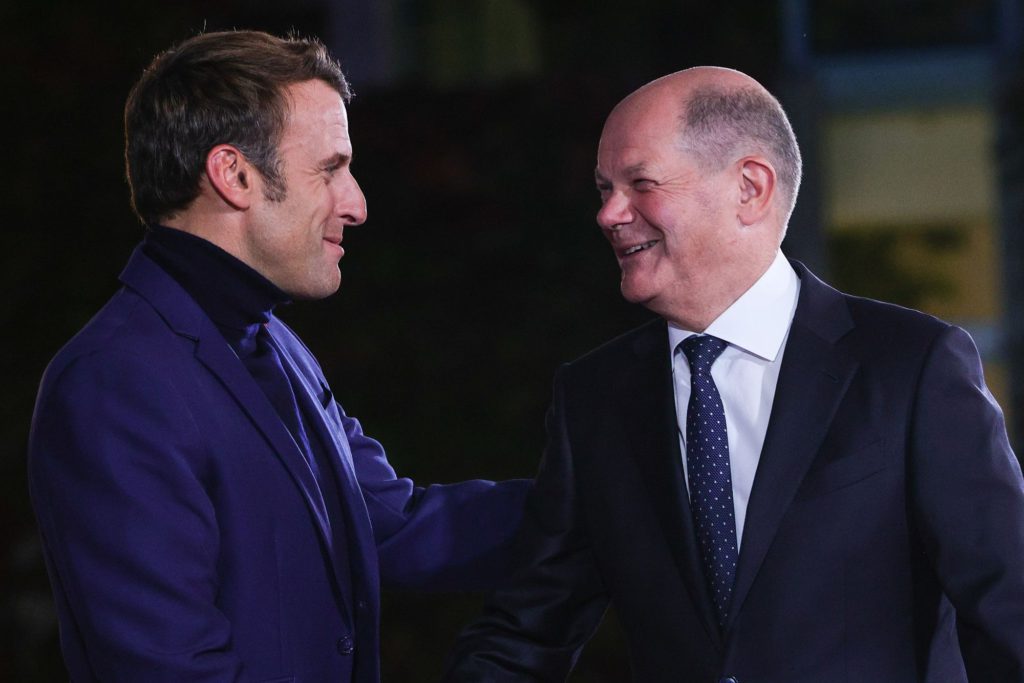
(Bloomberg) — German Chancellor Olaf Scholz and French President Emmanuel Macron meet in Paris Wednesday to try and iron out tensions over energy and the future of European defense.

A Macron aide said the two leaders are set to discuss defense, macroeconomic issues and energy over a working lunch at the presidential palace.

Europe’s two biggest economies have traditionally been the driving force behind key decisions in the European Union including a massive plan to raise billions of euros in joint debt to weather the Covid pandemic. 

But the Franco-German engine appears to have jammed up, potentially delaying decision-making just as the EU grapples with acute challenges from the Russia’s war in Ukraine to soaring energy prices.

Paris and Berlin canceled a joint meeting of government ministers that had been scheduled for Wednesday, to replace it with a Scholz visit and the lunch at the Elysee Palace. 

The decision came after Berlin agreed to build a missile defense shield dubbed the “European Sky Shield Initiative” with other members of the NATO military alliance, that could include German, US and Israeli-made equipment, dubbed the “European Sky Shield Initiative.” 

Ministers Cancel

The project is a blow for France, which has been developing a ground-to-air defense system with Italy known as Mamba.

On the sidelines of a meeting of EU leaders last week, Macron said the joint ministerial gathering had been canceled because German ministers were not available, although he insisted on the significant amount of work ahead for the two partners. 

The next meeting, which is mostly symbolic, is planned in January for the 60th anniversary of the Elysee treaty, a treaty of friendship signed between leaders  Charles de Gaulle and Konrad Adenauer to end years of Franco-German enmity, and which called for regular meetings between the two.

Independence

The missile shield isn’t the only thorn in the relationship, especially in the defense sector. Like his predecessors, Macron argues that Europe should rely on its own defense systems to be independent of the US.

In Paris, officials have privately warned that President Donald Trump, or a figure with similar doubts on the need for a strong transatlantic relationship, could come back to power. They emphasize the need for stronger EU autonomy in defense.

But France, which has Europe’s biggest and strongest defense industry with giants such as Dassault Aviation or Thales SA, is often suspected of pushing its own economic interests when it promotes “strategic sovereignty.”

SpaceX Cooperation

Officials in Paris have privately complained that Germany is working with the US’s SpaceX to launch satellites rather than relying on the European launcher, Ariane, and that it bought F-25 fighter jets from Lockheed Martin. 

Progress is also slow on the Future Combat Air System, known as FCAS. The Franco-German-Spanish project includes a jet fighter meant to replace France’s Rafale and Germany’s Typhoons jets in 2040.

As Berlin readies new legislation on weapons exports, a group of two dozen anonymous French defense experts dubbed Vauban published a column in newspaper La Tribune on Monday to complain about Germany’s “hypocrisy” and “selfishness.” Germany has failed to coordinate with partners including France when banning certain exports while sending weapons to “authoritarian regimes,” they wrote. 

France and Germany are also at odds over how to protect EU economies in the energy crisis, with Germany reluctant to cap gas prices at bloc level because it could limit its access to gas supplies. 

The two have also bickered over energy power sources, with French officials complaining about Berlin’s long-term decisions to rely on Russian gas, while German officials have complained about Electricite de France SA’s nuclear reactors being down this winter due to a lack of investment in the French nuclear industry.

When Berlin unveiled a plan to spend 200 billion euros ($201 billion) to help households and business pay their gas bills last month, European partners including France complained that the scheme could divide the region further.

The announcement sparked resentment especially in France because Berlin didn’t give notify Paris that it was coming, according to French officials. The French government itself has said it will spend over 100 billion euros in 2021-2023 to shelter its economy from soaring energy prices.

–With assistance from Birgit Jennen and Arne Delfs.

More stories like this are available on bloomberg.com

©2022 Bloomberg L.P.

Tech Giants Weigh On US Futures; Treasuries Gain: Markets Wrap

(Bloomberg) — US equity futures fell as megacap technology shares slumped in pre-market trading, marring a three-day rally on Wall Street and raising new doubts over whether this year’s $5.5 trillion selloff is nearing a bottom.

Contracts on the Nasdaq 100 fell more than 1% after disappointing quarterly updates from Microsoft Corp., Google parent Alphabet Inc. and Texas Instruments Inc. S&P 500 futures were down about 0.5%. Treasuries extended gains, with the 10-year yield falling to around 4.04%, and a gauge of the dollar declined for a second day to its lowest level in three weeks.

Stocks have been buoyed in recent days by mostly solid earnings and speculation the Federal Reserve may curb the pace of rate increases amid evidence its aggressive tightening is starting to weigh on the economy.  About a quarter of S&P 500 companies have reported third-quarter results, with more than two-thirds beating analysts’ estimates despite the big-tech setback. But concern is mounting that slowing output will dent corporate profits in coming months.

“Yes we’re seeing earnings beats at the moment,” Mike Ingram, a senior market strategist at ActivTrades, said on Bloomberg TV. “But where I do start to have a bit of a problem at this juncture is that some earnings expectations going into next year are looking still a bit punchy.”

The Stoxx Europe 600 index fluctuated amid a raft of mostly positive earnings from heavyweights including Barclays Plc, Deutsche Bank AG and Mercedes-Benz Group AG. The technology sector, however, weighed on the benchmark as it dropped more than 1%, while brewer Heineken NV plunged after missing analysts’ estimates for volume growth.

Equities advanced in China, Japan and South Korea. Positive signs for Asia included China’s central bank and foreign-exchange regulator indicating they would maintain the healthy development of stock and bond markets, while reiterating that the yuan would be “basically stable.”

A near 5% rebound in a gauge of US-listed Chinese stocks on Tuesday helped claw back some of the record loss suffered in the wake of President Xi Jinping breaking with China’s collective leadership. Hong Kong’s tech gauge made strong gains for a second day but was still short of recouping Monday’s near 10% slide. The offshore yuan gained as much as 1.1% against the dollar.

The yen weakened to around 148 per dollar ahead of the Bank of Japan’s policy decision Friday, when monetary settings are expected to be kept unchanged. Meanwhile, the central bank boosted purchases of longer-dated government bonds as rising yields threatened to loosen its grip on the yield curve.

While the recent US data haven’t changed expectations that the Fed will hike interest rates by 75 basis points next month, they’re fueling speculation that an end to aggressive tightening may come next year. Analysts are also projecting challenges for now in Europe, with a jumbo hike of 75 basis points expected from the European Central Bank on Thursday. That’s even as many economists now reckon a recession has begun in the euro region.

“Sentiment’s still incredibly fragile. We do expect to see further market volatility,” Catherine Yeung, investment director at Fidelity International, said on Bloomberg Radio. “All eyes are still on the rate cycle globally speaking as well as where inflation does go. I think going into the end of the year, again, it’s going to be volatile.”

Elsewhere, oil was steady as an industry report showed a rise in US crude stockpiles and investors fretted about weaker demand amid slowing growth. Gold edged higher in Asia as lower Treasury yields supported the precious metal. Bitcoin climbed for a second day, heading toward $21,000.

Key events this week:

  • Earnings due this week include: Apple, Exxon Mobil, Ford Motor, Credit Suisse, Airbus, Amazon, Bank of China, Boeing, Caterpillar, Cnooc, Intel, McDonald’s, Merck, Samsung Electronics, Shell, Vale, Visa, Volkswagen
  • Bank of Canada rate decision, Wednesday
  • ECB rate decision, Thursday
  • US GDP, durable goods orders, initial jobless claims, Thursday
  • Bank of Japan policy decision, Friday
  • US personal income, personal spending, pending home sales, University of Michigan consumer sentiment, Friday

Some of the main moves in markets:

Stocks

  • The Stoxx Europe 600 was little changed as of 10:11 a.m. London time
  • Futures on the S&P 500 fell 0.6%
  • Futures on the Nasdaq 100 fell 1.5%
  • Futures on the Dow Jones Industrial Average were little changed
  • The MSCI Asia Pacific Index rose 1.3%
  • The MSCI Emerging Markets Index rose 0.9%

Currencies

  • The Bloomberg Dollar Spot Index fell 0.7%
  • The euro rose 0.7% to $1.0033
  • The Japanese yen rose 0.7% to 146.90 per dollar
  • The offshore yuan rose 1.7% to 7.1930 per dollar
  • The British pound rose 1.1% to $1.1599

Cryptocurrencies

  • Bitcoin rose 2.2% to $20,624.15
  • Ether rose 4.1% to $1,534.03

Bonds

  • The yield on 10-year Treasuries declined five basis points to 4.05%
  • Germany’s 10-year yield was little changed at 2.16%
  • Britain’s 10-year yield was little changed at 3.64%

Commodities

  • Brent crude rose 0.1% to $93.62 a barrel
  • Spot gold rose 1.2% to $1,673.22 an ounce

–With assistance from Allegra Catelli and Tassia Sipahutar.

More stories like this are available on bloomberg.com

©2022 Bloomberg L.P.
Bitcoin Rises Toward $21,000 After Rediscovering Seasonal Trend

(Bloomberg) — Bitcoin is back on track to respect a history of climbing in October amid speculation that the Federal Reserve is getting closer to pivoting toward less aggressive interest-rate hikes.

The largest token has jumped nearly 7% in the past two days and is up a similar amount for the month so far. That’s still short of the average 22% gain in October over the past decade, according to data compiled by Bloomberg. 

The picture was less rosy at the start of the week, when Bitcoin was nursing an October loss that suggested it was set to defy the seasonal trend. But some recent Fed comments alongside mixed US economic data have buttressed bets on a slowdown in the monetary tightening that’s pummeled risk assets in 2022.

The Fed may be starting to show some signs of potentially pivoting, Nick Hotz, vice president of research at digital-asset manager Arca, said in an interview. “From a more macro markets standpoint there’s definitely a lot on the short side,” he said. “If people close those shorts, it could drive the price higher.”

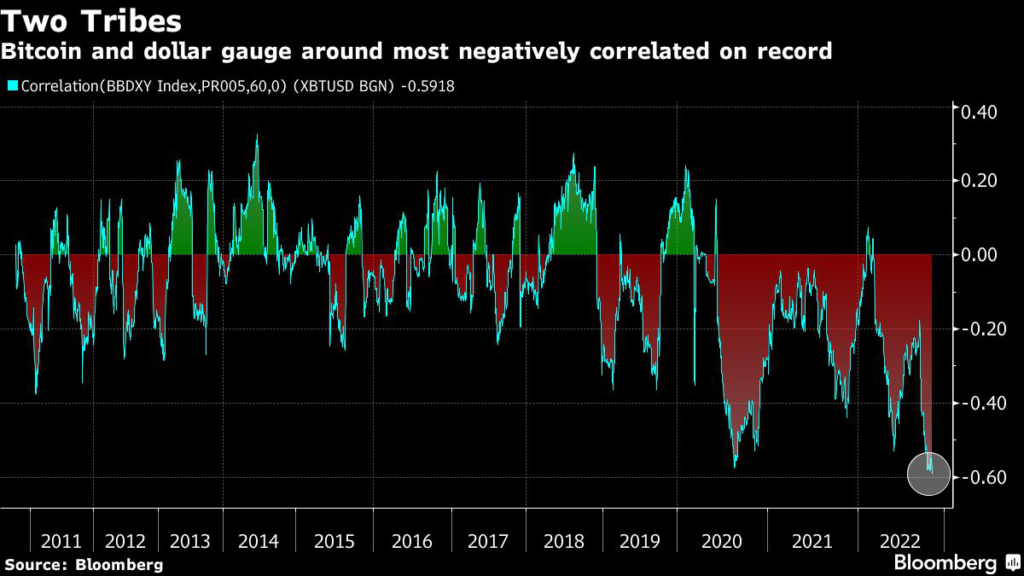
Scaled back Fed expectations are apparent in a slide in the dollar this week. At the same time, a 60-day correlation coefficient between Bitcoin and a dollar gauge is around the most negative on record.

Bitcoin climbed more than 2% to trade around $20,700 as of 10 a.m. in London, while second-ranked Ether added 4% to roughly $1,540. 

More stories like this are available on bloomberg.com

©2022 Bloomberg L.P.
Crypto’s New Class of Kingpins Emerge After The Merge

  • Listen to Bloomberg Crypto on the iHeartRadio App
  • Listen to Bloomberg Crypto on Apple Podcasts
  • Listen to Bloomberg Crypto on Spotify  

(Bloomberg) — The Merge created a new class of blockchain participants, called “builders.” The software upgrade, which refers to the Ethereum blockchain switching to a system called “proof of stake” from “proof of work,” is a significant shift in the current decentralized ecosystem. And now there are a relatively small number of these builders who have a significant amount of power on the blockchain.

What exactly do these builders do? Why are critics so concerned?  

Joining this episode are Bloomberg Crypto reporters Olga Kharif and David Pan. 

Follow us on Twitter @crypto, and subscribe to the Bloomberg Crypto Newsletter at https://bloom.bg/cryptonewsletter

More stories like this are available on bloomberg.com

©2022 Bloomberg L.P.

Meta Slams Apple for ‘Undercutting Others’ With Ad Policy

(Bloomberg) — Meta Platforms Inc. criticized Apple Inc. for changing its App Store terms to take a portion of social-media advertising revenue, saying the iPhone maker was “undercutting others in the digital economy.”

The policy change, disclosed this week, requires users and advertisers to make an in-app purchase when they pay to “boost” posts in apps like TikTok and Meta’s Instagram. Apple takes a commission of as much as 30% on in-app purchases, meaning a company like Meta would lose a portion of its ad revenue to the iPhone maker.

Shares of Meta fell 3.4% during pre-market trading in New York on Wednesday after closing Tuesday at $137.5. The company’s stock is down 59% for the year to date.

“Apple previously said it didn’t take a share of developer advertising revenue, and now apparently changed its mind,” Meta, which also owns Facebook and WhatsApp, said in a statement Tuesday. “We remain committed to offering small businesses simple ways to run ads and grow their businesses on our apps.”

Apple, which is building its own advertising business, said that requiring an in-app purchase for boosts is just an extension of its existing policies — and that other apps already comply.

“For many years now, the App Store guidelines have been clear that the sale of digital goods and services within an app must use in-app purchase,” the company said in a statement. “Boosting, which allows an individual or organization to pay to increase the reach of a post or profile, is a digital service — so of course in-app purchase is required. This has always been the case and there are many examples of apps that do it successfully.”

Other social media companies with the option to boost posts, including TikTok and Twitter Inc., also didn’t immediately respond to requests for comment.

According to Apple’s policy, apps for the sole purpose of letting marketers purchase ads and manage campaigns across different media — say, television and billboards, in addition to apps — aren’t required to give a cut to Apple. But “digital purchases for content that is experienced or consumed in an app, including buying advertisements to display in the same app (such as sales of ‘boosts’ for posts in a social media app) must use in-app purchase,” the company said.

For instance, if an influencer pays Instagram to promote a personal post to more viewers via the iPhone app, Apple would take a cut, according to the new rules. The social media companies haven’t yet said how they will be complying with the change.

Social media companies are already reeling from the impact of recent privacy changes to Apple’s iOS software, which requires that companies ask users for explicit permission to gather data about them. Meta, which relies on such data to better target ads, has said that the change will trim $10 billion from this year’s revenue.

Still, the policy for boosts could be the first time Apple gets a cut of ad revenue directly. Apple has previously touted advertising as an area where it lets developers take in as much revenue as they want from their customers.

–With assistance from Alex Barinka and Mark Gurman.

(Updates with shares in third paragraph.)

More stories like this are available on bloomberg.com

©2022 Bloomberg L.P.
Google Parent Alphabet Drops as Earnings, Sales Miss Estimates 

(Bloomberg) — After reporting earnings and revenue that missed expectations, Google parent Alphabet Inc. said on Tuesday it would slow hiring and control expenses, signaling that it was girding for tough times ahead as the economy falters. 

Google’s advertising juggernaut, which had largely dodged the digital-ad slowdown that hit rivals earlier this year, is no longer immune. Alphabet said third-quarter sales, excluding payments to distribution partners, were $57.27 billion. That compared with the average analyst projection for $58.18 billion. 

Net income was $1.06 per share, less than Wall Street’s estimates for $1.25 per share. 

The stock fell 6% during pre-market trading in New York on Wednesday after closing Tuesday at $104.48. 

As spiraling inflation crimps growth in digital advertising, Google and competitors such as Meta Platforms Inc.’s Facebook and Snap Inc.’s Snapchat are fighting for smaller budgets. Last week, Snap reported its slowest quarterly sales growth ever, which sent its stock plunging and dragged down Alphabet’s shares too. Google’s search business, which is more insulated from economic swings than social media ads, has begun to show signs of weakness.

Alphabet Chief Executive Officer Sundar Pichai said the company was “focused on moderating operating expense growth.” Chief Financial Officer Ruth Porat, meanwhile, said she expected headcount additions to fall by more than half in the fourth quarter compared with the previous period. 

“As we plan for 2023, we’ll continue to make important trade-offs where needed,” Pichai said. “Throughout Google’s history, periods of dedicated focus have enabled us to emerge strongly.”

There were disappointing results across Alphabet’s sprawling portfolio. Search and other related businesses, the company’s financial engine, generated third-quarter sales of $39.54 billion, compared with analyst estimates of $40.87 billion. Philipp Schindler, Google’s chief business officer, said some advertisers have begun to trim spending.

Google’s YouTube missed the mark by an even wider margin, reporting ad sales of $7.07 billion, compared with analysts’ average estimate of $7.47 billion.

YouTube, which also fell short of expectations in the second quarter, is locked in a fierce battle for advertising budgets and users’ attention with ByteDance Ltd.’s TikTok. YouTube released a short-form video platform called Shorts to counter the popularity of TikTok, but analysts say the company still has ground to make up.

“Google needs to salvage stronger growth from YouTube to keep its head above the water,” said Evelyn Mitchell, an analyst with Insider Intelligence. “Being wholly reliant on how search performs, that’s not a good place to be.”

One bright spot was Google’s closely watched cloud offering, which lost $699 million, better than analysts’ projections for a loss of $814.25 million. The unit has yet to turn a profit, and Google is a distant third in the cloud market, trailing Amazon.com Inc. and Microsoft Corp. Yet the cloud business is nonetheless viewed as one of the company’s best bets for growth as the core search business matures.  

Alphabet’s Other Bets — a collection of nascent companies that includes self-driving car company Waymo and life sciences unit Verily — saw $209 million in revenue on losses of $1.61 billion. In September, Verily, which has experimented with diabetes-detecting contact lenses and launched Covid-19 testing programs, said it raised $1 billion in new investments led by its parent company.

While Google has taken steps to control costs during the economic downturn, it will take time for the company to see the benefits, said Tejas Dessai, a research analyst at Global X ETFs.

“It’s a big company — it will take some time to trim fat,” he said.

–With assistance from Mark Bergen.

(Updates with shares in third paragraph)

More stories like this are available on bloomberg.com

©2022 Bloomberg L.P.

Saudi Telecom Doubles Down on Ex-Google Executive’s Tech Firm

(Bloomberg) — Saudi Telecom Co., the kingdom’s largest phone operator, plans to invest an additional $300 million in STV, a venture capital firm started by ex-Google executive Abdulrahman Tarabzouni. 

The backing comes after Saudi Telecom provided all of the $500 million in capital for STV’s first fund when it was formed. The new funding will be used for the firm’s target of “backing and scaling the region’s digital champions,” it said in a statement. 

A computer science graduate from Massachusetts Institute of Technology, Tarabzouni worked at Morgan Stanley and Oracle Corp. before becoming head of emerging Arabia at Google in 2009. He subsequently held a number of roles at the search giant before leaving Silicon Valley to lead the launch of STV.

STV was in talks with Middle East sovereign wealth funds and international pension funds as it sought to raise at least $1 billion for its second Middle East technology investment fund, Bloomberg reported last October. 

Interest in the technology industry in the Middle East has increased the past few years as governments seek to diversify their energy-dependent economies.

Read more: Saudi PIF Offers to Buy Stake in $5.8 Billion STC Towers Unit

More stories like this are available on bloomberg.com

©2022 Bloomberg L.P.

ASM International Plunges After US Curbs on China Hit Orders

(Bloomberg) — ASM International NV’s shares slumped after new US export restrictions on China shrank its orders for the third quarter and are expected to have a negative impact on its business.

Taking into consideration the negative impact from the US restrictions, ASM International said it expects sales of €600 million to €630 million ($599 million to $629 million) in the fourth quarter in comparison to analysts’ average estimate of €609.2 million. 

ASM shares sank as much as 9.9%, the most since January, and were trading down 8% as of 9:07 a.m. local time.

Earlier this month, Washington unveiled sweeping regulations to curb the sale of advanced semiconductors and chipmaking equipment to China and ban US persons from helping with China’s development of chip technologies. BE Semiconductor NV, another Dutch chip-gear maker, said the new rules have added more uncertainty to the industry’s outlook. However, Europe’s largest semiconductor equipment maker ASML Holding NV said it sees a “fairly limited” direct impact from the measures.

ASML Avoids Worst Impact From US Chip Restrictions, for Now

“Our equipment sales in China, at 16% of our total revenue in the first nine months of 2022, have been a growing part of our business with a strong contribution to group profitability,” said the company in a late Tuesday statement. “Based on a conservative scenario, we expect the new export restrictions will affect more than 40% of our sales in China.”

After reducing the backlog with the impacted orders from China, total bookings in the third quarter dropped to €675.5 million compared to a record level of €942.7 million in the second quarter.

More stories like this are available on bloomberg.com

©2022 Bloomberg L.P.
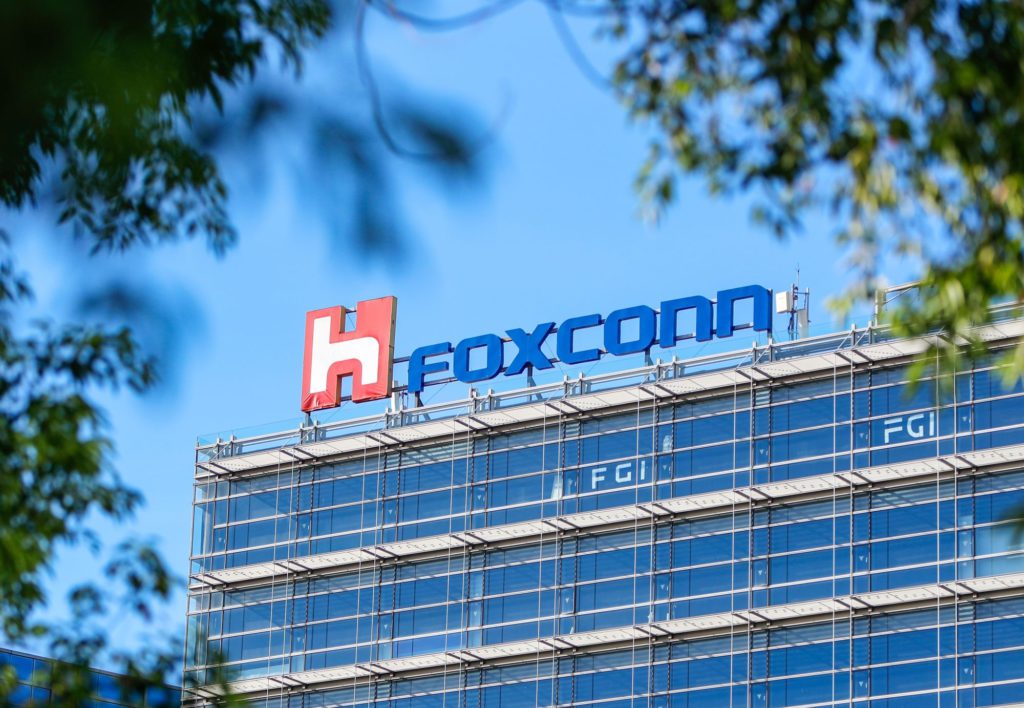
Apple Supplier Grapples with Covid Flare-Up in iPhone City

(Bloomberg) — Foxconn Technology Group is seeing a “small number” of Covid cases at its main campus in China, as the world’s biggest maker of iPhones aims to maintain production amid tightening restrictions in one of the country’s largest cities.

Foxconn is assisting a ”small number of employees affected by Covid” in its Zhengzhou facility, the Taiwanese company said in a statement. The firm, known also as Hon Hai Precision Industry Co., is providing the workers with necessities and counseling, it added.

Foxconn, which assembles the majority of Apple Inc.’s iPhones from Zhengzhou, had shut cafeterias and imposed other curbs on workers at the facility earlier this month. The company was responding to a virus flareup in the central Chinese city.

Zhengzhou reported 23 new local infections for Tuesday. The capital of Henan province locked down one of its most populated districts, Zhongyuan, from Oct. 16, and the city shut non-essential businesses and schools the next day. Other districts also issued stay-at-home orders, with most of the city in effect locking down in the past week. But officials didn’t issue a formal announcement, spurring confusion among residents, according to social media posts.

Neighborhoods that haven’t reported cases for the past seven days have been allowed to resume normal life, and Covid curbs will be adjusted on a district by district basis, the Zhengzhou government said in a statement Monday. But many parts of the city remain in lockdown. The Airport Economy Zone, where Foxconn’s plant is located, said areas with no Covid cases in the past week can resume normal life, but non-essential business and schools continue to be shut.

Virus restrictions seen in Zhengzhou and other parts of China show no sign of a shift from Covid Zero, something the public and investors had hoped for after the Communist Party congress, where President Xi Jinping secured a third term in power. Xi defended the policy in a speech kicking off the political gathering on Oct. 16, saying it has saved lives, but he avoided acknowledging the social and economic costs.

Read more: Xi Starts Third Term With GDP Showing China Economy in Doldrums

More stories like this are available on bloomberg.com

©2022 Bloomberg L.P.

Luna Token’s Vexed Legal Status Dogs Prosecutors Chasing Kwon

(Bloomberg) — South Korean prosecutors trying to build a case against Do Kwon over the $60 billion wipeout of his crypto project made an eye-catching admission this month: the latest court decision seems to support his defense.

They made the comment after a judge rebuffed a request to detain a person linked to Kwon’s collapsed Terraform Labs ecosystem. Part of the judge’s reasoning was that it’s debatable whether the individual had violated the nation’s Capital Markets Act as prosecutors claim — a key charge Kwon also faces, and which he has rejected.

The development highlights disputes over whether the now-collapsed TerraUSD and Luna tokens Kwon created can be regulated as securities under an act developed for assets like stocks and bonds. South Korea, as in the US and elsewhere, has yet to implement a legal code for crypto to cement its status.

“Korean law allows for a more limited range of securities than in the US,” said Kwon Ohoon, a lawyer at Cha & Kwon Law Offices in Seoul. There are six categories under the act and the question is whether the tokens from Terraform Labs fall into a group known as investment contracts, he said.

Investment contract securities, rare in South Korea, are defined as giving a contractual right to profits or liability for losses from a venture run by a third party. Kwon, the lawyer at Cha & Kwon, said the judge who denied the detention request appeared uncertain if the tokens qualify under this statute.

TerraUSD was a stablecoin that was meant to have a constant $1 value via a complex mix of algorithms and trader incentives involving Luna, whose price was meant to go up as the Terraform Labs network became more valuable.

The edifice crashed in May, contributing to a $2 trillion rout in digital assets. Lawyers for Luna investors filed complaints alleging Do Kwon had engaged in fraud and illegal fundraising. Prosecutors last month said Kwon and five others face arrest warrants on charges including breaching the capital-markets law.

Kwon’s whereabouts subsequently became unclear but he has denied any wrongdoing or being on the run. Terraform Labs has said there’s no reasonable basis for accusing Kwon of falling foul of capital markets legislation because Luna doesn’t qualify as a security.

Whether securities law captures crypto is a question officials globally are asking about digital tokens. In the US, for instance, Securities & Exchange Commission Chair Gary Gensler is trying to gain authority over the sector.

“The move to regulate cryptocurrencies through securities-related laws is a worldwide trend and South Korea is set to follow that path,” said Kang Seong-hoo, the head of the Korea Digital Asset Service Provider Association and a former director general at South Korea’s Finance Ministry.

The prosecutors office in Seoul said it’s making its “best efforts” to investigate the case, adding “the fact there is a legal argument does not mean the investigation can’t go on.” A Terraform Labs spokesperson in a statement reiterated its view that neither Kwon nor the company “criminally violated” the Capital Markets Act.

‘Hottest Topic’

The abstruse debate over crypto’s legal status aside, Kwon also faces other charges though the prosecutors’ office hasn’t specified exactly what they are. Some of the estimated 280,000 people in South Korea who bought Luna are also pushing for redress.

The Terraform Labs project blew up just as President Yoon Suk Yeol’s administration took power in May and revived a financial investigation unit in the prosecutors’ office that had been disbanded by the previous government.

The Terraform Labs turmoil was the “hottest topic at the time” and became the first case for a resuscitated team that was under the spotlight, said Kim Hyoung Joong, a professor at Korea University Graduate School of Information Security and chairman of the Korea Fintech Society. 

“Kwon’s case and the political context in Korea are intertwined,” Kim said.

–With assistance from Joanna Ossinger and Sangmi Cha.

(Updates with comment from Terraform Labs in the 11th paragraph.)

More stories like this are available on bloomberg.com

©2022 Bloomberg L.P.

Close Bitnami banner
Bitnami
