Bloomberg

SK Hynix Cuts Capex in Half With ‘Unprecedented’ Demand Drop

(Bloomberg) — South Korean chipmaker SK Hynix Inc. said it will cut its capital expenditure for next year by at least half after reporting a 60% decline in third-quarter profit as memory chip demand plunged.

Hynix’s dramatic cut affirms pessimism about electronics demand in the face of a potential recession as well as uncertainty over Washington’s campaign to smother China’s tech industry. The US curbs on access to advanced chips could curtail production at Hynix and other chipmakers’ factories in China, adding to downbeat forecasts that have come from other chip suppliers like Micron Technology Inc. and Texas Instruments Inc.

Operating profit declined to 1.7 trillion won ($1.2 billion) in the three months ended September, Hynix said on Wednesday, missing analyst estimates of a 2.5 trillion won profit. Revenue was 11 trillion won, missing the estimated 12.2 trillion won.

“SK Hynix diagnosed that the semiconductor memory industry is facing an unprecedented deterioration in market conditions,” the company wrote in its earnings announcement. “Shipments of PCs and smartphone manufacturers, which are major buyers of memory chips, have decreased.”

Prices of DRAM and NAND storage slumped at least 20% on a quarterly basis, Hynix said. The company plans to cut production gradually, starting with less profitable products, though it still expects memory supply will exceed demand for the near term. Fellow memory makers Micron and Kioxia Holdings Corp. recently slashed their output plans in an effort to stabilize the market.

Hynix shares, which declined 29% this year, rose as much as 2% in Seoul on Wednesday, signaling a positive reaction to Hynix’s move to shore up oversupply.

“The market might be taking the supply chain discipline comments well — capex cut and also lowering production of low-margin products,” said Christina Woon, investment director for Asia equities at abrdn plc. “It isn’t a quick fix, but these would be positive steps for addressing supply and demand dynamics.”

Read more: South Korea Cooperating With US on Chips, Still Has Concerns 

The Korean chipmaker also warned that its DRAM production plant in Wuxi, near Shanghai, may be forced to close in an extreme scenario where it’s unable to import the equipment it needs to sustain and expand production. It’s won a one-year reprieve from Washington sanctions on chipmaking within Chinese borders, but the company is now studying contingencies for the longer term. 

“The US export control will have direct repercussions to the chip industry from 2024,” said Greg Roh, head of technology research at HMC Investment & Securities. “There’s limited impact so far, but it could affect server demand in the mid-term and any plans to expand capacity in China could be disrupted within a year.”

Global chip demand cooled dramatically in recent months as soaring inflation and interest rate hikes forced consumers and enterprise clients to cut spending. US supplier Texas Instruments dropped as much as 6% in the hours before Hynix’s release after reporting its own underwhelming projections. TI has the largest customer list in the semiconductor industry, making it a bellwether for the overall sector.

Read more: Texas Instruments Declines on Fears of Deepening Chip Slump

Inventories at Hynix almost doubled to 11.9 trillion won at the end of the second quarter this year from 6.2 trillion won a year earlier. The increase was partly due to its acquisition of Intel Corp.’s NAND business, which became Hynix’s US subsidiary in December last year.

Taiwan Semiconductor Manufacturing Co., the world’s largest contract chipmaker, also cut its capital spending this year by 10% at its last earnings announcement. Hynix’s larger rival Samsung Electronics Co. reported its first profit drop since 2019 this month and has signaled it doesn’t expect a demand recovery throughout next year. Samsung reports its full earnings on Thursday.

–With assistance from Ishika Mookerjee.

(Updates with details from company’s conference call)

More stories like this are available on bloomberg.com

©2022 Bloomberg L.P.

Korea’s Hynix Warns US Curbs Could Shut Giant China Chip Plant

(Bloomberg) — SK Hynix Inc. warned that the Biden administration’s escalating restrictions could force the closure or sale of a major plant in China, an “extreme situation” it hopes to avert.

Hynix told analysts the memory chip giant was preparing for various contingencies, including the possibility that Washington’s curbs could prevent it from getting the gear it needs to sustain its DRAM factory in Wuxi. Hynix would then be forced to sell or move the production equipment to South Korea, Chief Marketing Officer Kevin Noh said.

The US Commerce Department this month unveiled sweeping regulations that limit the sale of semiconductors and chipmaking equipment to Chinese customers, striking at the foundation of the country’s efforts to build its own chip industry.

The curbs have also cast uncertainty over major Chinese operations run by foreign firms including Hynix and larger rival Samsung Electronics Co. Both firms have obtained a one-year waiver that lets them import the equipment they need to maintain or potentially expand their factories. Hynix, which on Wednesday warned it will cut capital spending by half in 2023 to reflect waning electronics demand, is hopeful it can continue to operate in China.

“If the time comes when it appears difficult to maintain operation of the fab in Wuxi, then we might have to sell off the fab or move the equipment to Korea,” Noh said. “We are looking into various scenarios, but again, this would amount to a contingency. So this would be an extreme situation.”

Read more: SK Hynix Cuts Capex in Half With ‘Unprecedented’ Drop in Demand

More stories like this are available on bloomberg.com

©2022 Bloomberg L.P.

Mobileye Global Prices IPO Above Range to Raise $861 Million

(Bloomberg) — Mobileye Global Inc., the self-driving technology company owned by Intel Corp., priced one of the biggest US initial public offerings of the year above its marketed range to raise $861 million.

The company sold 41 million shares for $21 each, according to a statement Tuesday confirming earlier reports. Mobileye had marketed the shares for $18 to $20 apiece. Private equity firm General Atlantic agreed to buy $100 million worth of shares in a private placement in conjunction with the IPO, according to Mobileye’s filings with the US Securities and Exchange Commission.

At the IPO price, the company has a market value of about $16.7 billion. While that tops the $15.3 billion Intel paid for Mobileye in 2017, it’s still short of the $30 billion valuation the company had sought earlier, Bloomberg News has reported.

Despite the drop in valuation, the listing is the fourth-largest in the US this year, as well as only the fourth out of 199 to price above its marketed range, according to data compiled by Bloomberg.

Amid heightened volatility and disappointing debut performances of last year’s listings, IPO volume in the US has plummeted to $22.5 billion since Jan. 1, compared with $279 billion at this point in 2021, the data show.

Only two 2022 listings on US exchanges have topped $1 billion. Corebridge Financial Inc. raised $1.68 billion in September, while private equity firm TPG Inc.’s January listing brought in $1.1 billion.

Awaiting Instacart 

Those may be the only two listings of that size in 2021. Instacart Inc., another highly anticipated listing, decided against an IPO this year after cutting its valuation for the third time, to $13 billion, Bloomberg News reported this month. Last year, 45 companies raised $1 billion or more in IPOs on the New York Stock Exchange and Nasdaq, the data show.

Amnon Shashua co-founded Mobileye in 1999 and and helped take it public in the US in 2014. He has been its chief executive officer since 2017.

In a letter to shareholders included in the prospectus, Shashua said the company’s driver-assistance technology has been used in more than 125 million vehicles. He said he expects the technology to be deployed in 270 million more vehicles by 2030.

“While the core of our business today is making human-driven cars safer, we are working tirelessly to bring about a future of autonomously driven vehicles,” Shashua said.

Intel Chief Executive Officer Pat Gelsinger is seeking to capitalize on the Israel-based business, which makes chips for cameras and drive-assistance features, and is seen as a prized asset as the car industry races toward fully automated vehicles. But the bright future for self-driving vehicles that was prophesied by Intel, Waymo and others has sputtered. A world full of robo-taxis seems at best decades away and the losses for investors who put faith in the field are mounting.

Mobileye said it will use the cash raised to toward net proceeds for working capital and general corporate purposes, as well as repaying a portion of debt owed to Intel. As of July, it had $774 million of cash and cash equivalents. In the 12 months ended Dec. 25, it had a net loss of $75 million on revenue of $1.39 billion, according to its filings.

Intel’s Control

Intel said in its filings that it will continue to hold all of Mobileye’s Class B shares, which will allow it to control the company with 99.4% of the voting power.

Shashua has indicated an interest in purchasing as much as $10 million of shares of Class A common stock, according to the filings. Baillie Gifford and Norges Bank Investment Management, as cornerstone investors, have indicated interest in purchasing up to an aggregate of $330 million shares. Growth equity firm General Atlantic also said it would buy $100 million worth of shares.

Mobileye’s offering is being led by Goldman Sachs Group Inc. and Morgan Stanley. The 23 other underwriters listed in its filings include Evercore Inc., Barclays Plc, Citigroup Inc. and Bank of America Corp.

The company’s shares are expected to begin trading Wednesday on Nasdaq under the symbol MBLY, the same ticker it used when it went public the first time in 2014.

(Updates with statement in second paragraph)

More stories like this are available on bloomberg.com

©2022 Bloomberg L.P.

Old Boys Club at Hong Kong Banking Summit Puts Women on Sidelines

(Bloomberg) — As pandemic restrictions lift, indoor performances and dancing are back in Hong Kong. So is the finance world’s old boys club.

Goldman Sachs Group Inc.’s David Solomon and Morgan Stanley’s James Gorman are set to join 25 other male speakers at the Global Financial Leaders’ Investment Summit, part of a slate of events signaling the resurrection of the financial hub after almost three years of strict Covid quarantines and a political crackdown by Beijing. 

There are just four women in the lineup. Two — Amundi SA’s Valérie Baudson and Citigroup Inc.’s Jane Fraser — will be part of a panel on sustainable finance. BNY Mellon Investment Management’s Hanneke Smits will join a discussion on managing money in volatile markets. Laura Cha, the chair of Hong Kong Exchanges and Clearing Ltd., will make welcome remarks on the event’s final day. 

The sessions about navigating and creating value through uncertain times and how technology is reshaping the future of finance will feature men only, as will the keynote addresses and fireside chat.

“How is it that in this day and age, 87% of the speakers at the conference are men?” Utpal Bhattacharya, a professor of finance at the Hong Kong University of Science and Technology, said in an interview. With this summit, he said, the “good news is that Asia’s financial hub will be humming again. The bad news is that this hub will continue to be male-dominated.”

Nearly half of the speakers come from US financial firms, where women hold roughly one in three C-suite roles. In Hong Kong’s financial sector, women make up more than half of entry-level positions, and one-third of senior management positions, according to research by PwC.

Among the one-third is Hang Seng Bank Ltd. Chief Executive Diana Cesar, who was previously CEO at HSBC Hong Kong. In 2020, Cesar and 15 other female leaders released an International Women’s Day video pledging to boost gender equality in finance. “Why wait?” she asked. “We can make a world without prejudice.”

Two years on, she and others in the clip, including Mary Huen, CEO of Standard Chartered (Hong Kong) and Amy Lo, Chief Executive of UBS Hong Kong, are absent from the summit’s line up. Standard Chartered Plc. CEO Bill Winters and UBS Group AG chair Colm Kelleher are both speakers.

Standard Chartered, Hang Seng and UBS didn’t respond to Bloomberg’s requests for comment, along with Goldman Sachs, Amundi, BNY Mellon and the Hong Kong Exchange. Citigroup and Morgan Stanley declined to comment.

“We are pleased to see a strong line-up of speakers at group chairman or CEO level to share their global perspectives,” organizer Hong Kong Monetary Authority wrote in an email. “The speaking arrangement is a result of discussions with potential speakers having regard to their availability and subject preference.”

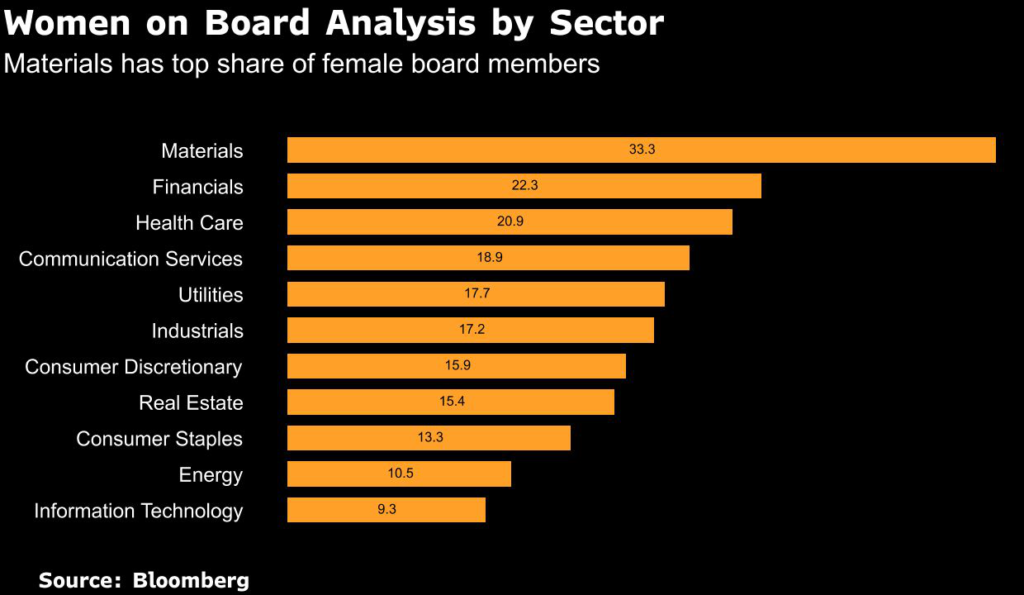
Read more: Women Make Gains on Bank Boards, But Men Still Hold the Power

The landscape in Hong Kong is changing, though. New stock exchange rules for instance require at least one woman on boards of listed companies. That will create more than 1,300 director positions exclusively for women by the end of 2024. 

Cesar’s bank has the highest proportion of women on boards among Hong Kong’s blue chip companies, at two thirds. That compares with an average of 17% for members of the benchmark Hang Seng Index in the third quarter of 2022, according to data compiled by Bloomberg News.

“In business schools, the gender ratio is 1:1; so why are those who rise to the top of the finance world disproportionately male?” said Bhattacharya, who also researches gender issues. “The problem is not with the education system, it’s after they graduate.”

Women held five more seats on the boards of companies in the Hang Seng Index in the third quarter from the previous three-month period, according to data compiled by Bloomberg. The average number of female directors rose to 1.9 from 1.8, out of an average board size of 11.1.

  • The percentage of female directorships increased to 17.1% from 16.5%
    • That is above the 14.6% of the Nikkei 225 in Asia and below the 35.3% of women on boards of the S&P/ASX 200 in Australia, 31.9% of the S&P 500 in the U.S. and 38.8% of the Stoxx 600 in Europe
  • Eight Hang Seng companies increased the number of women on their boards; the top companies by market capitalization were Tencent Holdings Ltd., Alibaba Group Holding Ltd. and China Shenhua Energy Co.
    • China Shenhua no longer has an all-male board
  • Two companies reduced the number of female directors: Bank of China Ltd. and Haidilao International Holding Ltd.
  • Hang Seng Bank Ltd. has the highest percentage of women on its board
  • The communication services sector led the net gain in female board members, with one woman added to the boards at Tencent Holdings Ltd. and NetEase Inc.


  • NetEase Inc. surpassed 30% female board membership for the first time since at least January 2019. The number of Hang Seng companies above this key threshold was 10 in September from eight the previous quarter
    • Eight companies, including Meituan, BYD Co. and Baidu Inc., do not have any female board members
  • The Bloomberg Gender-Equality Index returned -8.3% in the third quarter, underperforming the MSCI World Index, which returned -6.1%

Hang Seng companies with the highest and lowest percentage of female board members:

The Bloomberg Gender-Equality Index is a modified capitalization-weighted index that tracks the financial performance of those companies committed to supporting gender equality through policy development, representation and transparency.

To see the percentage of women on a company board: FA ESGG

To see more on Bloomberg Gender-Equality Index: GEI

To see more on Bloomberg’s ESG fields and sustainable finance solutions: BESG

–With assistance from Denise Wee.

More stories like this are available on bloomberg.com

©2022 Bloomberg L.P.

Rogers Takeover of Shaw Gets New Conditions From Canada

(Bloomberg) — The Canadian government imposed new conditions on Rogers Communications Inc.’s $14.7 billion takeover of rival Shaw Communications Inc., saying that a divestiture of Shaw’s wireless assets to another firm must guarantee better prices for consumers.

Rogers and Shaw have agreed to sell most of Shaw’s wireless division to Quebecor Inc. to resolve a legal challenge from Canada’s Competition Bureau, which is trying to block their merger on the grounds that it will harm competition in the sector. 

Canadian Industry Minister Francois-Philippe Champagne said Tuesday he would approve the Quebecor part of the agreement on two conditions. The Montreal-based company would have to agree to hold the wireless licenses for at least 10 years, and it would have to lower prices in Ontario and Western Canada — Shaw’s territories — to levels similar to those in Quebec.

Quebecor Chief Executive Officer Pierre Karl Peladeau said on Twitter late Tuesday that he plans to accept Champagne’s conditions. Peladeau’s statement appears to set out a possible path for the Rogers-Shaw deal to finally close, more than 18 months after it was first announced. 

But the deal still must get through the hurdle of the Competition Bureau. 

“We will work to deliver better prices for Canadians in the other provinces and to end the reign of the ‘Big Three’ by promoting competition, the public interest and the digital economy in Canada.” Peladeau said. 

That’s a reference to Rogers, BCE Inc. and Telus Corp. — the three companies that dominate Canada’s wireless market with more than 85% combined market share. Shaw is the no. 4 player in Ontario and in parts of Canada’s west. 

Quebecor “is offering prices in Quebec which are on average 20% lower than in the rest of the country so I want to see the same prices being offered in Ontario and Western Canada,” Champagne said during a news conference in Ottawa after the market closed on Tuesday. 

Shaw shares closed up 0.7% at C$34.06 in Toronto, still well below the C$40.50 takeover bid from Rogers. 

Rogers and Shaw are due to enter mediation talks with the Competition Bureau this week, seeking an agreement to resolve the antitrust body’s concerns. Rogers has put forward a settlement proposal, according to a person familiar with the matter, speaking on condition they not be named because the matter is private. The Globe and Mail newspaper reported Tuesday that the proposal involves Quebecor also buying some fiber-optic assets. 

If mediation isn’t successful, Rogers and Shaw may have to try to win their case before the Competition Tribunal, Canada’s merger court. Those hearings would begin in November. 

Shaw has about 2.2 million wireless customers, most of them under the Freedom Mobile brand, according to its fiscal third quarter financial statements. 

(Updates with additional information on the deal)

More stories like this are available on bloomberg.com

©2022 Bloomberg L.P.

The World’s Biggest Source of Clean Energy Is Evaporating Fast

(Bloomberg) — China’s Three Gorges Dam is an awe-inspiring sight, a vast barrier across the Yangtze River that contains enough concrete to fill seven Wembley Stadiums and more steel than eight Empire State Buildings. Its turbines could singlehandedly power the Philippines.

But this summer, the world’s largest power plant was eerily quiet.

On a late August visit to the facility, water on both sides of the dam was still. There was no sign of the white spray that usually rises from the spillway or roar of water emerging from the turbines. Scorching temperatures and a drought upstream have reduced the reservoir to a bare minimum, drastically reducing the plant’s ability to generate electricity.

The water woes of China’s iconic mega-dam are part of a global hydropower crisis that is being made worse by global warming. From California to Germany, heatwaves and droughts have shrunk rivers that feed reservoirs. Hydroelectricity output fell by 75 terrawatt-hours in Europe this year through September — more than the annual consumption of Greece — and fell 30% across China last month. In the US, generation is expected to fall to the lowest level in six years in September and October.

It’s a cruel irony that’s forcing utilities to reconsider the traditional role of hydropower as a reliable and instant source of green energy. Dams are the world’s largest source of clean energy, yet extreme weather is making them less effective in the battle against climate change. 

The cycle is “a warning signal in terms of designing power systems,” said Wenxuan Xie, a managing consultant with Wood Mackenzie Ltd. “You really have to think about the possibilities of extreme events, and that perhaps what you once thought was extreme might happen more frequently.”

The problem is there are few renewable alternatives as flexible or widespread. Globally, hydropower generates more electricity than nuclear and more power than wind and solar combined. In countries like Norway and Brazil, dams generate more than half of total electricity. Moreover, large dams have historically been more reliable, producing power on average about 42% of the time, compared to 25% for wind and 12% for solar, according to BloombergNEF data. And grid operators can use them as a dispatchable source — one that can be almost instantly switched on when it’s needed, similar to coal or gas. 

Except when there’s no water.

“Worsening drought conditions as part of climate change will start to limit the availability and dispatchability of hydro reservoirs and lower the capacity factor in places like Southwest China and Western US, ” said Xizhou Zhou, managing director for power and renewables at S&P Global Commodity Insights. That’s going to affect both the revenue that dams generate and the reliability of the grids they feed, he said. 

The worst drought in 1,200 years this year in the US West means parched reservoirs can only churn out half of the power they normally supply to California, increasing the risk of rolling blackouts across the state. Nationwide hydro generation fell to 17.06 terrawatt-hours in September and was expected to plummet further in October, according to the Energy Information Administration, the lowest since September 2016.

In Europe, dried-up rivers reduced September hydro generation to the lowest since at least 2015, according to climate think tank Ember. That’s forced utilities to rely more on coal and gas, using up stocks of fuel that the continent is trying to conserve to avoid a winter power crunch caused by supply disruptions from Russia

In Brazil, which typically relies on hydro for more than 60% of its electricity, a drought last year brought the country to the verge of power rationing and forced it to rely on increased imports from neighbors Uruguay and Argentina, or to buy expensive fossil fuels to make up the deficit.

Dam operators must also balance competing requirements for their water. Large dams provide irrigation for crops, water supplies for cities and navigation for ships. The primary purpose of the Three Gorges Dam, for example, was to control the annual flooding of the Yangtze that periodically devastated towns and farms downstream. This summer, as drought reduced the flow of water into the river, the dam had to hold back enough water to maintain navigation to Chongqing, central China’s largest city that is almost 2,000 kilometers from the sea. 

Lake Mead, the reservoir behind the Hoover Dam on the Colorado River in the Western US, provides 90% of Las Vegas’s water supply as well as feeding cities such as Los Angeles and irrigating hundreds of thousands of acres of crops. The lake’s level fell so low this summer that that human bones were unearthed from the lake bed, launching police investigations.

No country has built more dams though than China, where the worst drought in at least 60 years in Sichuan, a province the size of Germany, cut generation by 50% in August just as air-conditioning demand soared to counter a heat wave. Officials had to shut off power to many local factories for nearly two weeks, disrupting supplies for manufacturing giants including Apple Inc. and Tesla Inc.

“When such an event takes place, it does two things — it reduces power supply and enhances power demand, so there’s a double whammy,” said Li Shuo, an analyst with Greenpeace.

Even after Sichuan’s drought ended in late August, the effects are lingering. In neighboring Yunnan province, aluminum smelters are being forced to operate at reduced capacity to conserve power and give reservoirs a chance to refill before the drier winter months, when electricity supplies could be tested again by high demand. To meet the energy shortfall, China has had to rely more on polluting coal and gas, even as global costs of the fuels soared to records.

“An extended severe drought such as we’ve seen this year can have a crippling effect,” said David Fishman, a Shanghai-based analyst with The Lantau Group. “Reservoirs take progressively longer to refill and be ready to generate again.”

Short of reverting to using more coal or gas, nations grappling with less reliable supply from hydro turbines can invest in nuclear power or battery storage for wind and solar. Another option is to build more power lines to spread the load over more power sources in different regions. 

Floating solar panels on hydro reservoirs can help too, generating power when it’s sunny and slowing evaporation, said Lei Xie, energy policy manager at the International Hydropower Association. “The combination of hydropower together with solar works well,” she said, and the Chinese government has employed the strategy to increase the flexibility of hydro installations. 

Yet extreme weather can affect all clean-energy sources. Wildfire smoke and dust storms dim solar panels, while plummeting winter temperatures can freeze up wind turbines. Europe’s drought curbed output from nuclear plants that rely on river water for cooling.

Concern about the reliability of dams as the planet warms is compounding growing resistance to new hydropower projects in many countries. Dams have been blamed for disrupting ecosystems, loss of wetlands and the extinction of aquatic species. Big projects displace local populations to make way for reservoirs — more than 1.3 million people in the case of the Three Gorges.

Those headwinds mean that hydropower is unlikely to keep its lead role in clean power for long. BloombergNEF expects an 18% increase in global hydropower capacity between now and 2050, compared to a more than 8-fold increase for solar and at least 3-fold rise in wind power.

In fact, hydro development may be shifting to what was once a niche role in the industry: pumped storage. For these, water is pushed back up into the reservoir during times of excess electricity generation and then allowed to flow down through the turbines when more electricity is needed. The technology can be paired with intermittent wind and solar power to provide carbon-free electricity around the clock. Because pumped systems operate on a closed loop, they’re less affected by droughts, according to the hydropower association.

China may develop 270 gigawatts of such projects by 2025, according to the top state-owned dam builder, compared to the nation’s plans to add 60 gigawatts of traditional hydro generation over the same period.

Hydro’s struggles underline the difficulty of building a robust renewable energy network to replace fossil fuels, especially in developing nations that must also contend with soaring electricity demand as per-capita consumption rises. At the same time the drought issues underscore the need to speed up efforts to curb rising temperatures as the cost of making the energy transition mounts, said Greenpeace’s Li.

“If we don’t address the issue at the root of climate change and reduce emissions, then we need to admit there will be things we can’t plan for or are too expensive to plan for,” he said. “There will be catastrophic losses.”

–With assistance from Mark Chediak.

More stories like this are available on bloomberg.com

©2022 Bloomberg L.P.

Ukraine Latest: Sunak Expresses Support in Call With Zelenskiy

(Bloomberg) — On the day he became the UK prime minister, Rishi Sunak spoke to Ukrainian President Volodymyr Zelenskiy and reiterated British support for Ukraine.

President Joe Biden warned Russia against using a nuclear or radioactive weapon in Ukraine and said he’s been in discussions Tuesday about the possibility. 

“I spent a lot of time today talking about that,” Biden told reporters after receiving a Covid-19 booster shot, his fifth dose of the vaccine. “Let me just say, Russia would be making an incredibly serious mistake were it to use a tactical nuclear weapon.”

Russian defense chief Sergei Shoigu alleged to his US and European counterparts over the weekend that Kyiv might use a so-called “dirty bomb” in the war — an explosive device combined with radioactive material. Alarmed US and European officials rejected the claim, saying it may indicate that the Kremlin is planning a so-called “false flag” operation in which its forces use such a weapon and try to blame it on Ukraine.

(See RSAN on the Bloomberg Terminal for the Russian Sanctions Dashboard.)

Key Developments

  • Biden Warns Russia Against ‘False Flag’ Nuke Attack in Ukraine
  • Biden Says Russia Has Given Cold Reception to Griner Diplomacy
  • One Missile Shook Ukraine’s Grain Trade. Another Might Kill It
  • Too Much Gas. Europe’s Energy Crisis Takes a Surprise Turn 
  • What Is a ‘Dirty Bomb’ and Why Is Ukraine Worried?: QuickTake

On the Ground

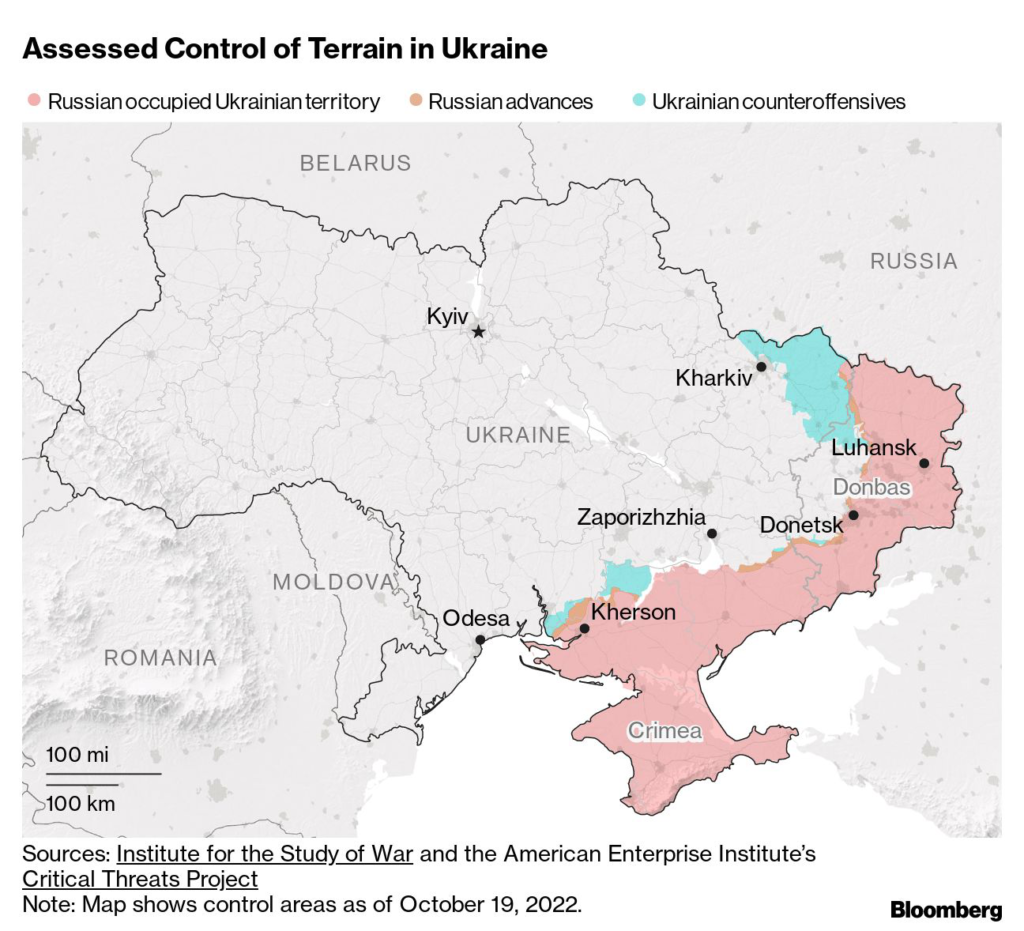
Russian troops shelled the Nikopol district of the Dnipropetrovsk region overnight, local authorities said on Telegram. Analysts at the US-based Institute for the Study of War said that the slower pace of Russian air, missile, and drone strikes may reflect “decreasing missile and drone stockpiles and the strikes’ limited effectiveness of accomplishing Russian strategic military goals.” 

(All times CET)


Possible Mine Reported on Grain-Export Sea Route (1:20 a.m.)

A report of a possible mine-like object is being investigated in Ukraine’s grain-export corridor on the Black Sea, according to the Joint Coordination Center in Istanbul.

The suspicious object was reported earlier Tuesday by a vessel in the area, said the center, which facilitates the Black Sea Grain Initiative. A tugboat and search-and-rescue boat will be dispatched from Odesa to look into the matter.

The finding risks further disrupting crop exports from Ukraine, which have already been slowed by a lengthy vessel-inspection holdup in Istanbul. The crop-export deal that has revived Ukraine’s seaborne trade is up for renewal in mid-November, and officials have yet to verify an extension.

Sunak Speaks With Zelenskiy, Expresses Support for Ukraine (11:50 p.m.) 

Sunak tweeted on Tuesday that he had spoken with Zelenskiy and “both he and the Ukrainian people can count on the UK’s continued solidarity and support.”

In his own Twitter post, Zelenskiy described the encounter as “an excellent conversation” and that the two leaders had agreed “to write a new chapter” in relations between their countries. He added that “the story is the same — full support in the face of Russian aggression.’

Sunak became prime minister earlier Tuesday after meeting with King Charles III. 

Biden Says Russia Has Given Cold Reception to Griner Diplomacy (8:04 p.m.)

Biden said US efforts to secure the release of WNBA star Brittney Griner are ongoing but have not swayed the Kremlin, hours after a Russian appeals court rejected her appeal of a nine-year drug smuggling sentence.

“We are in constant contact with Russian authorities to get Brittney and others out, and so far we’re not meeting with much positive response,” Biden told reporters Tuesday at the White House. “But we’re not stopping.”

Zelenskiy Sees Turnaround In Germany’s Rhetoric on Ukraine (7:46 p.m.)

Berlin’s rhetoric on Ukraine has significantly improved, Zelenskiy said, as he was receiving Germany’s President Frank-Walter Steinmeier in Kyiv on Tuesday.

“In general I think that rhetoric both in Europe and in Germany on Ukraine has changed,” Zelenskiy said. “It is warmer than the weather outside today.”

Zelenskiy praised Germany’s anti-missile systems Iris-T for their “impressive results,” urging Berlin to provide more to Ukraine, as the nation is still suffering from often Russia’s air-raids that are targeting the country’s power infrastructure.

Putin Pursuing War With ‘Religious’ Zeal, Estonia Spy Chief Says (7:25 p.m.)

Russian President Vladimir Putin is pursuing his war aims in Ukraine with a “religious” fervor and is unlikely to change course even as his eight-month invasion is beleaguered by setbacks, Estonia’s spy chief said.

Mikk Marran, Estonia’s outgoing espionage chief, said that the Baltic nation’s intelligence indicated that the Russian president isn’t having second thoughts about the conflict, despite the lack of strategic accomplishments and a firmer line from an expanded NATO.

“He’s still on a kind of a religious or a Messianic mission — and we see that Putin is preparing his country and its army to continue fighting for a long time,” Marran, 44, told a group of reporters in Tallinn on Tuesday.

Zelenskiy Seeks $17b in Financing to Close Budget Gap (6:15 p.m.)

Zelenskiy said his government needs $17 billion in immediate financing to cover Ukraine’s budget gap as global leaders met in Berlin to map out the nation’s postwar reconstruction. 

German Chancellor Olaf Scholz, who hosted the conference, reinforced his message about creating a “Marshall Plan” for Ukraine as delegates work to support the war-battered nation for decades to come. 

European Commission President Ursula von der Leyen said the EU will develop funding for around 18 billion euros ($17.7 billion) for next year, with the Ukrainian government estimating overall needs at $38 billion. Talks on the EU funding are ongoing, even as the disbursement of loans for this year has been halted — partly because of resistance from Germany. 


Putin Chairs First Meeting of Special War Needs Council (5:02 p.m.) 

President Vladimir Putin chaired the inaugural meeting of a new coordination council on military needs — and conceded it had missed its first deadline.

“I remind you that today the coordination council was to have fixed the targets for individual areas of activity,” Putin said. “These targets aren’t ready yet, but I have no doubt they will be soon.”

The Russian leader has escalated his faltering invasion of Ukraine after a series of reverses, mobilizing at least 300,000 reservists, declaring martial law in certain regions and carrying out a devastating bombardment aimed at crippling Ukrainian power and other infrastructure.

Ukraine Former Central Bank Chief Says Graft Probe Politicized (4:20 p.m.) 

Ukraine’s former central bank Governor Kyrylo Shevchenko, who is being sought by anti-corruption investigators for his alleged involvement in embezzlement, called the probe against him politically motivated. 

In his first comments after Ukraine’s National Anti-Corruption Bureau placed him on a wanted list, Shevchenko told Bloomberg News on Tuesday that being added was “further evidence of the prosecution being biased and politicized.” He didn’t elaborate. NABU, as the bureau is known, wasn’t immediately able to comment on his statement.

Ukraine Documenting Russian Hacks, Eyeing International Charges (3:51 p.m.) 

Ukrainian officials are documenting suspected Russian hacking incidents as part of a plan to prosecute Moscow in an international court, according Victor Zhora, chief digital transformation officer of Ukraine’s special communications and information protection service. The government in Kyiv is collecting evidence of malicious cyber activity and sharing the data with the International Criminal Court, he said. 

“Our intention is to bring this to justice after the war, and perhaps this will be the first prosecution of the first global cyber-war and cybercrimes that were conducted with kinetic operations and war crimes in Ukraine,” Zhora said during an interview at a cybersecurity conference in Singapore. 

Russian Envoy Says Moscow Backs Nuclear Plant Safe Zone (3:15 p.m.) 

A Russian diplomat said that Moscow in principle backs a United Nations proposal to set up a security zone around Ukraine’s Zaporizhzhia nuclear plant.

“It’s a reasonable idea, which we support in general,” Mikhail Ulyanov, Russia’s ambassador to international organizations in Vienna, said on state television on Tuesday. “The devil, as always, lies in the details.”

The Zaporizhzhia plant, Europe’s largest atomic energy station, has been occupied by Russian troops since March and heavy fighting around the facility has raised fears that power disruptions could endanger its safety.

Russian Court Rejects Appeal of Jailed US Basketball Star Griner (2:37 p.m.) 

A Russian court rejected an appeal by WNBA star Brittney Griner against her nine-year sentence for drug smuggling. The ruling means Griner, 32, a two-time Olympic gold medalist, will leave pre-trial detention near Moscow and be sent to serve her prison term in a penal colony elsewhere in Russia.

President Joe Biden has made a priority of securing the release of Griner and another jailed American in Russia, former US Marine Paul Whelan. Amid a vocal campaign from the basketball star’s supporters, the US leader has denounced Griner’s prison sentence as “unacceptable.”

Akhmetov’s Metinvest Sues Russia in European Court (2:24 p.m.) 

Ukrainian steel company Metinvest, owned by the country’s richest tycoon, Rinat Akhmetov, filed a case against Russia with the European Court of Human Rights, according to an emailed statement.

Metinvest is suing for damages caused by Russian forces in its eight-month invasion of the country, including for the destructions of the company’s steel mills in the port city of Mariupol. Akhmetov also filed a case against Russia in June.

IMF Chief Says Ukraine Manages Well, But Needs Huge Sums (1:58 p.m.)  

International Monetary Fund Managing Director Kristalina Georgieva said that while Ukraine had managed its economy “responsibly,” huge sums would be needed to support the country.

Ukraine would require $3 billion a month in a “best-case scenario,” though with additional gas imports and reconstruction funding, that figure could climb to $5 billion, Georgieva said at the Berlin conference. 


(An earlier version corrected spelling of Zelenskiy’s name, in Sunak item.)

More stories like this are available on bloomberg.com

©2022 Bloomberg L.P.

Australia’s Square Peg Raises $550 Million to Bet on Startups

(Bloomberg) — Square Peg Capital, the Australian venture capital firm co-founded by Paul Bassat, raised $550 million for its fifth fund, a rare sign of confidence in the technology sector during a tumultuous year.

The Melbourne-based firm will allocate $350 million of the total to early-stage deals and $200 million to later-stage investments, Bassat said in an interview. Square Peg, founded in 2012, will invest the money across Southeast Asia, Australia and Israel.

“This feels like the perfect size relative to our team size and relative to an ambition to maximize our returns,” Bassat said in the interview. “Ultimately the fund size should be a construct that maximizes the likelihood of delivering outstanding returns.”

Square Peg was an early investor in companies such as software maker Canva Inc. and digital payments firm Airwallex Pty, which went on to become two of Australia’s most valuable startups and have expanded globally. Bassat started the firm after 14 years of building the job-search site Seek Ltd., taking inspiration from Apple Inc.’s Think Different ad and aiming to support founders who could think differently about business.

Square Peg has garnered an internal rate of return of 43% based on all exits to date, according to the company. Its first pool of capital of about $120 million has returned more than 3.5 times cash.

With the fresh capital, the company plans to bet on emerging winners in software-as-a-service, consumer internet, fintech, education tech, health tech and future of work technologies, according to Singapore-based partners Tushar Roy and Piruze Sabuncu.

“Southeast Asia will breed many big companies in the next five years that are very unique to this region,” said Sabuncu, who joined Square Peg in 2020 after building Stripe Inc.’s business in the region. “There is a huge gap in basic services that growing middle class would need in countries like Indonesia and Vietnam.”

Many of its portfolio companies are already expanding globally. They include LottieFiles, a motion graphics platform that streamlines the animation workflow. LottieFiles serves more than 135,000 companies including Google, Airbnb Inc. and Netflix Inc.

Square Peg’s other portfolio companies include digital lending unicorn FinAccel Pte, telemedicine app Doctor Anywhere Pte, online real estate marketplace PropertyGuru Group Ltd., and Pluang, an investment platform in Indonesia.

Bassat represents the first generation of internet entrepreneurs in Australia. When the former lawyer launched Seek with his brother in 1997, there were hardly any tech startups in the country. Bassat’s influence helped spur new companies.

Airwallex co-founder Jack Zhang first met Bassat in 2006 when he was a university student. Then a co-founder of Seek, Bassat spoke at a Goldman Sachs Group Inc. event in Melbourne about his entrepreneurial journey. In the audience was Zhang, who was inspired enough that he decided to become an entrepreneur one day.

Their paths crossed again 11 years later, this time as a founder and investor. By then, Zhang had launched Airwallex and Bassat was running Square Peg. Bassat was drawn to Zhang’s ambition to target the global market and invested in Airwallex’s Series A+ funding round in late 2017.

“I don’t know if Airwallex could have existed today without Paul’s investment at the time,” said Zhang, chief executive officer of Airwallex. “Because Paul is an ex-entrepreneur, he has a strong instinct about people.”

Square Peg joined Airwallex’s most recent funding round at a $5.5 billion valuation, unchanged from the previous round at a time when many tech companies see their valuations plunge.

Airwallex reflects Square Peg’s investing approach, said Roy. The firm typically does three to five deals a year in Southeast Asia and then works with them for years.

“You’re not going to see us doing 50 investments a year in Southeast Asia,” he said. “We want to do venture differently.”

More stories like this are available on bloomberg.com

©2022 Bloomberg L.P.

Biden Spokeswoman Unaware of Talks on Musk Security Review

(Bloomberg) — President Joe Biden’s spokeswoman said Tuesday she’s unaware of any discussions about a potential national security review of Elon Musk, yet acknowledged that there are concerns in the US government about the Tesla Inc. CEO’s remarks on Ukraine.

Press Secretary Karine Jean-Pierre was asked about a Bloomberg News report last week on unease within the Biden administration about Musk’s ventures in light of recent comments he’s made about Russia’s invasion of Ukraine.

Biden administration officials have discussed whether the US should subject some of Musk’s ventures — including his bid to acquire Twitter Inc. and his SpaceX’s Starlink satellite network — to national security reviews, according to people familiar with the matter.

“I’m saying I don’t know of any such discussions,” Jean-Pierre told reporters during a briefing at the White House.

The people familiar with the discussions said again this week that the deliberations are continuing, though no decisions have been made.

Some US officials have become alarmed by Musk’s recent threat to stop supplying the Starlink satellite service to Ukraine — he said it had cost him $80 million so far — and what they see as his increasingly Russia-friendly stance following a series of tweets that outlined peace proposals favorable to President Vladimir Putin. They are also concerned by his plans to buy Twitter with a group of foreign investors.

Jean-Pierre was asked if the administration is concerned about Musk’s Twitter purchase or his comments on Russia.

“On the first piece, on the Twitter purchase, that’s something that we would not comment on from here. We do not comment on transactions,” she said.

“On his comments about Ukraine and giving up territory I know that Mr. Musk has been very, very vocal about that,” she said. “He’s a private citizen, with a private company, and our position and the government’s position has been very clear, as I have laid out many times here before on how we see that process moving — it is up to Ukraine.”

One possibility is that the Committee on Foreign Investment in the United States, a panel that reviews acquisitions of US companies by foreign buyers, could probe Musk’s activities, according to the people familiar with the discussions. They added that it’s not clear such a review would be legal.

The panel operates behind closed doors and rarely confirms when it is conducting reviews. CFIUS also holds the power to review deals that have already been consummated. 

Musk is a US citizen, but some of the investors partnering with him for the Twitter purchase are foreign, including Prince Alwaleed bin Talal of Saudi Arabia, Binance Holdings Ltd. — a digital-asset exchange founded and run by a Chinese native — and Qatar’s sovereign wealth fund.

Musk said Sunday that he would not discontinue Starlink service in Ukraine. He pledged Monday to close the Twitter transaction by Friday in a video conference call with bankers helping to fund the deal, according to people familiar with the matter.

More stories like this are available on bloomberg.com

©2022 Bloomberg L.P.

Texas Instruments’ Forecast Signals Chip Demand Slump Is Spreading

(Bloomberg) — Texas Instruments Inc., whose chips go into everything from home appliances to missiles, dropped as much as 6.1% in late trading after its quarterly forecast signaled that the semiconductor industry’s slump is spreading beyond computing and phones.

The company said Tuesday that it expects revenue of $4.4 billion to $4.8 billion in the fourth quarter, short of the $4.93 billion average estimate from analysts. Profit will be $1.83 to $2.11 a share, also missing projections.

While Texas Instruments has the largest customer list in the semiconductor industry — making its projections an indicator of demand across the economy — producers of cars and industrial machinery contribute more than 60% of revenue. Some industrial customers are now slowing their orders, joining makers of computers and phones in cutting back. But demand from the automotive market remains strong, the company said. 

“During the quarter, we experienced expected weakness in personal electronics and expanding weakness across industrial,” Chief Executive Officer Rich Templeton said in the statement. Overall, orders have worsened and cancellations have increased as the current quarter has progressed, Texas Instruments said.


Many of the largest companies in the industry — Samsung Electronics Co., Intel Corp. and Nvidia Corp. among them — have warned that demand is dropping steeply. But investors have been hoping that the industry is nearing a low point.

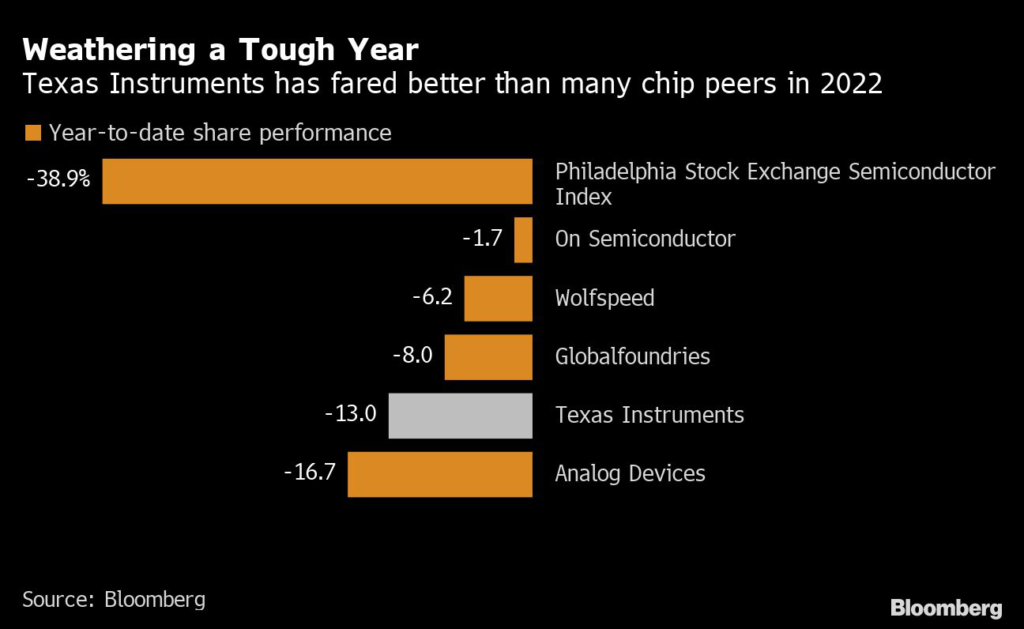
Though the Philadelphia Stock Exchange Semiconductor Index lost 40% of its value in 2022, it climbed seven days in a row through Tuesday, suggesting that investors think the industry may have bottomed out.

Texas Instruments shares have fallen this year as well, though they’ve performed better than most peers. They’re down 14% in 2022, making Texas Instruments the fourth best stock in the index this year.

Chief Financial Officer Rafael Lizardi said it’s impossible to say whether the current decline in demand is simply customers cutting back to reduce inventory or if there’s deeper concern about the economy.

Even when the economy is the steady, “you still have semiconductor cycles,” he said. “Over the last two years I wouldn’t be surprised if customers have built too much inventory. Now we’re going the other way.”

Third-quarter net income rose to $2.47 a share, Texas Instruments said. Revenue climbed 13% to $5.24 billion. The company had posted double-digit percentage increases for six straight quarters coming in to Tuesday’s results.

One of the pioneers of the chip industry, Texas Instruments is the largest maker of analog and embedded processing chips, which go into products as varied as factory equipment and space hardware. Such chips generally require less advanced production than Intel Corp. processors or other digital products. That focus has allowed Texas Instruments to become one of the most profitable companies in the industry and to devote its cash to dividends and share buybacks.

Texas Instruments’ management typically refuses to give predictions about future demand for electronics, outside of its basic forecasts. Executives have argued that, while there will always be fluctuations in the semiconductor industry, its chips have lasting value.

Unlike digital semiconductors such as microprocessors, Texas Instruments’ products take years to become obsolete, meaning that accumulating inventory in times of weaker demand isn’t the danger sign that it is for other chipmakers.

The company ended the quarter with $2.4 billion of inventory, up from $1.86 billion at the same point a year earlier. Lizardi said that increase still leaves the company with a smaller stockpile than it’s aiming for. Texas Instruments could further increase inventory by as much as a billion dollars.

Texas Instruments manufactures about 80% of its chips in its own factories, and the company is expanding that footprint. It has said that will result in higher levels of capital spending over the next couple of years, causing some analysts to express concern that the expenditures will crimp its budget for buybacks.

Unlike peers, Texas Instruments has no plans to reduce capital spending or slow the buildout of new plants, Lizardi said.

(Updates with additional CFO comments starting in eighth paragraph.)

More stories like this are available on bloomberg.com

©2022 Bloomberg L.P.

Close Bitnami banner
Bitnami