Bloomberg

Microsoft’s Profits Hurt by European Energy Crisis, CFO Says

(Bloomberg) — Rising energy prices in Europe are eroding profitability at Microsoft Corp., which is paying more to deliver cloud-computing services to customers in the region, the software giant’s chief financial officer said.

The company on Tuesday posted its weakest quarterly revenue growth in five years, sending shares down more than 4%. In an interview after the company released fiscal first-quarter results. CFO Amy Hood said Microsoft was seeing a steeper-than-expected jump in expenses to power, heat and cool the company’s servers and data centers across Europe. On a conference call later, she estimated the company will pay $800 million in extra energy costs this fiscal year.

“A lot of it is in Europe,” she said. “And it’s not just for the winter.”

Power prices have been soaring in much of the world since economies started recovering from pandemic lockdowns and as Russia’s war in Ukraine forces Europe to find new sources of natural gas, driving up the price of a key fuel for generating plants. Over the summer, several tech companies had services shut down in London as data centers overheated during a record heat wave in the city. 

Microsoft is working with customers to help them find ways to save money, Hood said, which they may be able to do by shifting applications to the cloud and out of their out corporate data centers.

Although there are still risks, for the time being European gas prices have fallen back sharply, and are less than a third of their summer peak, thanks to efforts to import gas to fill up storage and unusually warm weather.

–With assistance from Joe Ryan.

More stories like this are available on bloomberg.com

©2022 Bloomberg L.P.

Spotify Tops Subscriber Forecasts, Sees Margin Pressure This Quarter

(Bloomberg) — Spotify Technology SA tumbled as much as 10% in late trading after the company, the leader in music streaming, said profit margins may narrow this quarter because of programming costs, and that it’s considering raising prices in the US.

Shares of Spotify fell as low as $87 after reporting results Tuesday before partly rebounding. The stock rose 2.5% to $97.05 at the close on Tuesday.

The sell-off shows how investors have become less interested in the pace of subscriber growth and more focused on whether Spotify becomes profitable. That has put pressure on management to make a strong case for investments in newer businesses like original podcast programming. 

On a conference call with investors Tuesday, Chief Executive Officer Daniel Ek said he was mulling a price increase for its streaming product in the US, but wanted to first discuss the move with the record labels that provide the company’s music. 

Apple Inc., a rival in music streaming, raised the price of its service this week by $1 to $10.99 a month for individuals, citing costs. Spotify, based in Stockholm, charges $10.

Earlier, Spotify reported third-quarter ad revenue increased 19%, but said sales were slower than expected due to a “challenging macro environment.” The company joins other tech giants, including Alphabet Inc. and Snap Inc., in reporting slower ad sales. 

On the call, Ek said he wasn’t worried about ad sales slowing because the business is still a small one for Spotify. 

Spotify’s gross margin in the quarter failed to meet the average 25.2% estimate of analysts, coming in at 24.7%, which Spotify attributed to the ad slowdown and increased content spending — like its recent move into audiobooks.

The company forecast a gross margin of 24.5% in the fourth quarter, and an operating loss of 300 million euros, both below consensus expectations.

The company has been taking steps to diversify its revenue. Spotify began selling audiobooks in September in an effort to enter the “substantially untapped” market, according to Nir Zicherman, global head of audiobooks and gated content.

Spotify continues to wrestle with its podcasting business, terminating employees at its Gimlet Media and Parcast studios this month, following layoffs of other podcast staff in September.

The company reported 456 million monthly average users for the third quarter, beating analysts’ projections of 450.7 million. It surpassed paid subscriber predictions as well, confirming some investors’ beliefs that the business can weather a shaky economy and inflationary environment. 

Third-quarter revenue reached 3.04 billion euros ($3.03 billion), exceeding analysts’ expectations of 3.02 billion euros. Paid subscribers totaled 195 million, beating Wall Street projections of 194.2 million. The company generated 385 million euros in advertising sales in the quarter, representing 13% of its revenue. 

(Updates with CEO comments in third paragraph.)

More stories like this are available on bloomberg.com

©2022 Bloomberg L.P.

Microsoft Tops Profit Estimates Even as Strong Dollar Hurts Sales Growth

(Bloomberg) — Microsoft Corp. posted its weakest quarterly revenue growth in five years, throttled by the surging U.S. dollar and a slump in sales of Windows software to personal-computer makers. Shares slipped in late trading.

Sales in the first quarter, which ended Sept. 30, rose 11% to $50.1 billion, the software maker said Tuesday in a statement. Net income was $17.6 billion, or $2.35 a share. While both numbers topped analysts’ average estimates, revenue from Microsoft’s closely watched Azure cloud-computing services decelerated to 35% — partly because of foreign-currency exchange rates.

Excluding the impact of the rising dollar, Azure sales rose 42%, below some predictions. Demand has held up for Azure services, which run and store businesses’ software applications, and web-based versions of Office productivity programs, even as customers pare some other corporate spending while the global economy teeters on the brink of a recession. Still, Microsoft gets almost half of its revenue overseas. The U.S. dollar soared to new highs against a basket of foreign currencies last month, meaning Microsoft’s international sales were worth less when brought back home. 

Revenue from sales of Windows software to PC makers swooned 15% in the recent period. That mirrored the quarterly contraction in PC shipments reported this month by market research firm IDC, which cited “cooling demand and uneven supply.”

“The tone has definitely changed,” said Dan Morgan, a senior portfolio manager at Synovus Trust Co. “We’ve started to get a big change-up in software spending surveys — there’s a general consensus of ‘hey, you know, the economy is slowing down and we’re watching our expenses.’”

Microsoft shares slipped about 2.2% in extended trading following the report, after rising to $250.66 at the close in New York. While the stock jumped 51% in 2021, it has fallen 25% so far this year amid a rout in large technology stocks. During the recent quarter, the company’s shares declined 9.3%, while the Standard & Poor’s 500 Index dropped 5.3%.

On average, analysts had estimated fiscal first-quarter sales of $49.6 billion and profit of $2.29 a share, according to a Bloomberg survey. Demand remained strong for cloud services, with Office 365 sales to businesses performing slightly better than expected, and the majority of large customers that signed up for Microsoft 365 licenses opting for the higher-end version, Chief Financial Officer Amy Hood said in an interview. 

The company also saw growth in large and long-term contracts for Azure, she said. At the same time, economic uncertainty is hurting sales of PCs as well as advertising revenue, which affected Microsoft’s Search and LinkedIn businesses. 

“While we are not immune, of course, from macroeconomic impacts, we really feel good about the businesses we are investing in, the strong growth rate, the position in the market,” Hood said.

Total cloud revenue in the period rose 24% to $25.7 billion, Microsoft said in slides posted on the company’s website. Gross margins in those businesses widened because of an accounting change; excluding that change, margins would have narrowed by 1 percentage point because Microsoft is getting more sales from Azure, which generally has higher costs. Microsoft also noted that cloud service costs are rising because of increasing energy prices.

Hood said higher energy prices are increasing the cost of delivering cloud services, mainly in Europe — an issue that is having a greater impact than Microsoft had expected. She anticipates that will continue into the second half of the company’s fiscal year.

Sales in the productivity group, largely Office software, rose to $16.5 billion, above the $16.1 billion average estimate of analysts polled by Bloomberg. Intelligent Cloud revenue, made up of Azure and server software, came in at $20.3 billion, matching projections. In More Personal Computing, consisting of businesses like Windows, Surface devices and Xbox, sales were $13.3 billion. That compares with the $13.1 billion average estimate of analysts.

Some analysts have cautioned that Microsoft’s annual revenue forecast, which it will update later on Tuesday, is at risk. In a research note before the report, Guggenheim analysts questioned the company’s ability to maintain full-year guidance of double-digit revenue growth if the dollar continues to strengthen and economic conditions get worse.

(Updates with comments from CFO in eighth paragraph.)

More stories like this are available on bloomberg.com

©2022 Bloomberg L.P.

Stock Surge Is Pared After Hours on Tech Earnings: Markets Wrap

(Bloomberg) — US stocks rose on Tuesday after a fresh batch of corporate earnings largely beat estimates even as investors weighed risks to economic growth from the Federal Reserve raising interest rates to combat inflation. About half the gain was retraced after 4 p.m. in New York when a handful of technology results disappointed investors.

The S&P 500 and the Nasdaq 100 rose for a third straight session. The Coca-Cola Co. and General Motors Co. closed the session in green after topping analysts’ earnings estimates. Google parent Alphabet Inc. fell postmarket after missing estimates. Microsoft Corp. which also reported earnings after markets closed, topped expectations but cited the impact the surging US dollar had on revenue growth. 

Treasuries rallied, with the 10-year yield falling to around 4.08%. The dollar dropped after data on Tuesday showed that home-price growth in the US slowed as high borrowing costs sapped demand.

Investors still expect the Fed to raise rates by three-quarters of a percentage point during its meeting next week. But recent economic data is already showing that Fed tightening has started to weigh on the US economy, leading investors to speculate that the central bank may be approaching the end of its aggressive tightening campaign. This renewed expectation of less hawkishness from the Fed, as well as a better-than-expected earnings season so far, have pushed stocks higher in recent days.

“The big thing is what we’re seeing from earnings, and as we get more and more, the market is coming around to this sense that the outlooks aren’t nearly as bad as some had feared,” Shawn Cruz, head trading strategist at TD Ameritrade, said in an interview. “The market was actually bracing itself for more pessimistic tones from companies as we got through earnings and it’s not coming out that way right now. It’s mixed too, but even being mixed is ahead of expectations.”

Roughly 28% of S&P 500 companies have reported earnings, with around 70% outperforming estimates, according to data compiled by Bloomberg.

Analysts are also expecting a jumbo hike of 75 basis points from the ECB on Thursday, even as many economists now reckon a recession has begun in the euro region. German business confidence improved in October, data showed Tuesday, though remained at depressed levels as Europe’s largest economy heads into a challenging winter.

Elsewhere in markets, the British pound gained as Rishi Sunak formally took over as UK prime minister on Tuesday, vowing to “fix” the mistakes made by his predecessor, Liz Truss. 

Key events this week:

  • Earnings due this week include: Apple, Exxon Mobil, Ford Motor, Credit Suisse, Airbus, Amazon, Bank of China, Boeing, Caterpillar, Cnooc, Intel, McDonald’s, Mercedes-Benz, Merck, Samsung Electronics, Shell, Vale, Visa, Volkswagen
  • Bank of Canada rate decision, Wednesday
  • ECB rate decision, Thursday
  • US GDP, durable goods orders, initial jobless claims, Thursday
  • Bank of Japan policy decision, Friday
  • US personal income, personal spending, pending home sales, University of Michigan consumer sentiment, Friday

Some of the main moves in markets:

Stocks

  • The S&P 500 rose 1.7% as of 4 p.m. New York time
  • The Nasdaq 100 rose 2.1%
  • The Dow Jones Industrial Average rose 1.1%
  • The MSCI World index rose 0.8%

Currencies

  • The Bloomberg Dollar Spot Index fell 0.8%
  • The euro rose 0.9% to $0.9967
  • The British pound rose 1.7% to $1.1471
  • The Japanese yen rose 0.7% to 147.93 per dollar

Cryptocurrencies

  • Bitcoin rose 4.6% to $20,274.81
  • Ether rose 11% to $1,493.73

Bonds

  • The yield on 10-year Treasuries declined 16 basis points to 4.08%
  • Germany’s 10-year yield declined 16 basis points to 2.17%
  • Britain’s 10-year yield declined 11 basis points to 3.64%

Commodities

  • West Texas Intermediate crude rose 0.5% to $85.02 a barrel
  • Gold futures rose 0.2% to $1,657.90 an ounce

–With assistance from Emily Graffeo and Peyton Forte.

More stories like this are available on bloomberg.com

©2022 Bloomberg L.P.

Smartphone Storage Space Is the New Turf War for Game Makers

(Bloomberg) — From Tokyo to San Francisco, mobile game studios have sparred for years to captivate a fickle audience, fostering an overlooked problem — the average title has become so huge that players can no longer fit more than a few on their phones.

Japanese games publisher Gree Inc. expects an impending reckoning over escalating costs and ballooning file sizes, as developers pack their games with increasingly intricate graphics, voice acting and larger storylines, all to get players spending. That’s creating a winner-takes-all situation that could winnow out smaller studios in coming years, Gree Senior Vice President Yuta Maeda said in an interview. The situation will only get worse as console veteran Sony — no stranger to space-hogging hits — prepares to invade the mobile arena.

“Production of mobile games can’t avoid becoming more complex, time-consuming and larger-scale, which will inevitably result in bigger app sizes,” Maeda said. “Companies that survive in the market will only be the ones that can keep up with that trend.”

The spending poured into today’s A-list mobile titles — MiHoYo Co.’s Genshin Impact, for instance, started with a $100 million budget — rivals Hollywood blockbusters and is yielding better production values than ever, but also an outsized footprint. That game can occupy upwards of 20 gigabytes of storage, which is a huge chunk of what most people have available on their phones. With memory upgrades not keeping pace, the result is fewer games can vie for attention.

“Even if gamers show interest in our games, we have found some of them are giving up on installing the apps because their phones are already full,” said Gree’s Yoshihide Koizumi, who leads marketing for the company’s latest game, Heaven Burns Red.

Sony, one of the giants of console gaming, has laid out plans to bring its high-profile PlayStation franchises to mobile platforms. Rival Microsoft Corp. is also building an Xbox mobile gaming store. All of that piles pressure on the entrenched free-to-play business model followed by Gree and others. These publishers rely on monetizing in-game items and upgrades, regularly adding more content players can buy and play with.

The most common workaround from game studios is to put only a basic installer in app stores, which then downloads further game assets once the player starts. Gree uses it with Heaven Burns Red, which is an initial 1GB and grows beyond 10GB for players who want the full experience.

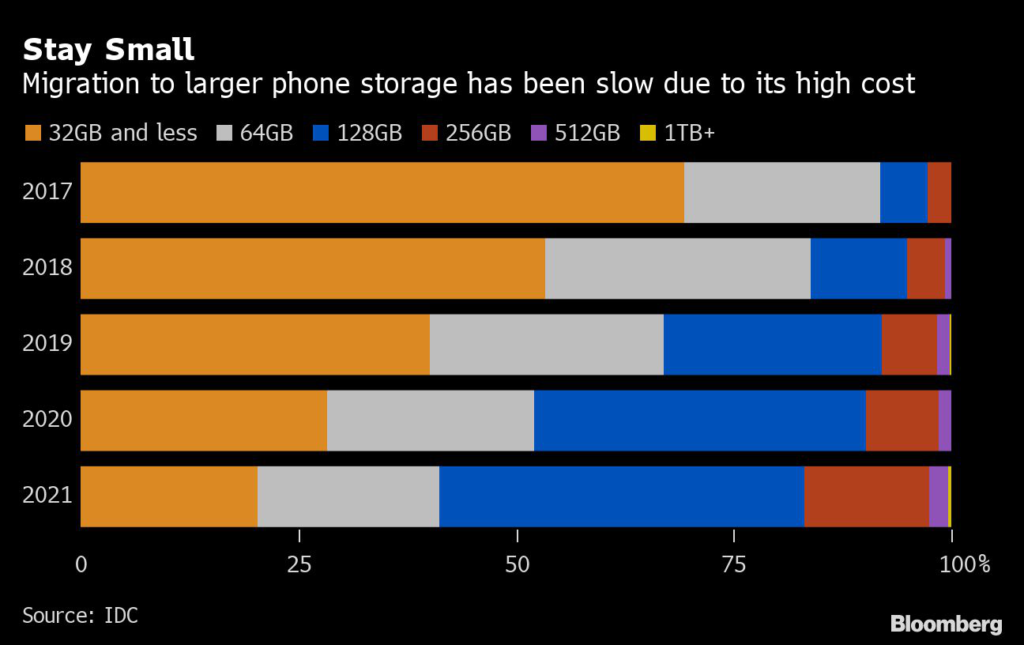
The typical flagship smartphone today starts with 128GB of storage, but many devices already in people’s hands have far less. Necessary operating system files also take up a significant chunk of the basic allowance, leaving even less room for large games. But memory upgrades are costly.

“As smartphone prices have come up significantly over the years, users tend to buy the cheapest versions of the latest devices, which have lower storage,” said Francisco Jeronimo, a vice president of analytics at IDC. “Devices with more storage can cost up to 50% more, and most users don’t realize that apps require a lot more space and they will be downloading a lot more apps.”

Gree’s Maeda and Koizumi said cutting data demands at the cost of game quality is not an option. Surpassing player expectations is now seen as the minimum requirement for a game to stick around for the long term, driving studios to be more aggressive in their spending and marketing.

To fan attention, the company hired a celebrated writer to pen the script for Heaven Burns Red. Fellow mobile publishers have been pushing the envelope with higher-fidelity graphics, video and voice actors in their titles — and Gree’s chunky 10GB game won’t be the exception but the rule going forward, Maeda said. He expects mobile games to keep growing as expectations ratchet up with more big-budget console and PC games on mobile.

“Most of the big-size mobile game hits are from Asian developers, but I think the Western studios are poised to follow that trend,” said Tokyo-based industry analyst Serkan Toto. “Users expect better and better quality from mobile games. File sizes definitely only have one direction in the future: up and to the right.”

Cloud gaming, the long-promised next stage in connected play that would host all game progress, assets and computationally intensive work in remote servers, has yet to materialize in a meaningful fashion to rectify the storage crunch. Alphabet Inc.’s Google Stadia service was one of the best-funded such initiatives, but the company recently decided to shut it down due to lack of player adoption — it now serves as a cautionary tale.

Read: Google to Shut Down Unpopular Stadia Cloud Gaming Service

Offloading other phone content like photos and videos — which are also growing larger with more advanced cameras — to the cloud is becoming an expensive affair. Free online storage from the likes of Google, Apple Inc. and Microsoft Corp. is inadequate for the job, in part because those companies want to push users to subscribe for paid storage.

The threat to smaller companies now is that ever grander game productions will simply take over with the brute force of their marketing budgets and reach.

“The only hope would be handset makers realizing that this is a critical issue to their ecosystem and offering larger-storage models,” said Toyo Securities analyst Hideki Yasuda. “Without them changing course, the future for mobile game companies is grim and consolidation of the industry is likely ahead.”

More stories like this are available on bloomberg.com

©2022 Bloomberg L.P.

Fed’s Waller ‘Not a Big Fan’ of Central Bank Digital Currencies

(Bloomberg) — Federal Reserve Governor Christopher Waller is again pushing back on arguments that the US central bank should issue a digital dollar.

“It’s just a checking account at the Fed,” Waller said in remarks during the Money 20/20 conference in Las Vegas. “I’m not a big fan of it, but I’m open to having someone convince me that this is something that’s really valuable.” 

Waller has emerged as a skeptical voice about the utility of a central bank digital currency, or CBDC, at a time when lawmakers and Biden administration officials weigh moving ahead with one. The Fed issued a discussion paper in January, calling it a “first step” in a public discussion.

Supporters say a Fed-backed digital currency would help ensure the dollar’s dominance as countries including China move forward with their own versions. But, Wall Street lenders have asked the US to hold off, arguing that a virtual currency backed by the Fed risks draining hundreds of billions of dollars out of the banking system.

“It’s not clear why China giving their citizens a checking account at the People’s Bank of China, why that’s going to undermine the reserve role of the dollar in the global payments system,” Waller said. 

–With assistance from Allyson Versprille.

More stories like this are available on bloomberg.com

©2022 Bloomberg L.P.

Bitcoin Advances Above $20,000 to Break Out of Trading Range

(Bloomberg) — Bitcoin broke above $20,000, ending its longest run below that price level since the token first breached the threshold in late 2020. 

The largest cryptocurrency by market value, rose as much as 5.3% to $20,412 Tuesday, posting its biggest one-day gain since Sept. 27. The token has traded below $20,000 for nearly three weeks, breaking from the coin’s trademark volatility. Other digital assets followed with Ether gaining as much as 12.8% to trade at $1,525, its highest price in more than a month. And so-called alt-coins like Solana and Dogeoin also advanced.

“You’ve got to be encouraged by this,” said Stephane Ouellette, chief executive of FRNT Financial Inc, adding that the token “is rallying with risk assets.”

Despite the gains, Bitcoin still remains in its multi-month price slump as central banks hike interest rates to curb rising inflation. The token has lost close to 60% of its value since the start of the year.

US stocks also rose on Tuesday as investors assess mixed corporate earnings and weighed risks to economic growth. New economic data revealed slumping US consumer confidence, a sign that buyers may slow spending amid recessionary fears and aggressive interest-rate hikes. 

Bitcoin’s strong correlation to risk assets like tech stocks has dashed hopes that Bitcoin would serve as a hedge against inflation. The coin has traded in line with US stocks for much of the year. The S&P 500 Index rose 1.6% on Tuesday. And a 60-day correlation coefficient for Bitcoin and contracts on the S&P 500 hovered around 0.63. (A coefficient of 1 means the assets are moving in lockstep, while minus-1 would show they’re moving in opposite directions.) 

Bitcoin’s 30-day volatility is near a six-year low, according to a note by Arcane Crypto’s Vetle Lunde and Bendik Norheim Schei, and that could mean a breakout is due. The last time it reached those levels was in the summer of 2020. Bitcoin maintained levels below its current price at the time for four days before “the price exploded up,” said the note. 

But whether the token can maintain trading above $20,000 remains to be seen.

“Some people are watching $20,000 for the psychological significance of it,” said Katie Stockton, co-founder of Fairlead Strategies. She said that based on her firm’s models, she would need to see “consecutive daily closes” above roughly $19,600 to “confirm a minor breakout.”

(Updates with prices and more commentary. Adds S&P 500 performance to paragraph 6.)

More stories like this are available on bloomberg.com

©2022 Bloomberg L.P.

Block Taps Former Argo Technology Chief Hothi for Bitcoin Mining

(Bloomberg) — The payments-processing company Block Inc. has hired Perry Hothi, the former chief technology officer at Argo Blockchain PLC, to help develop its Bitcoin mining division, according to people familiar with the matter. 

Hothi will advise the new unit while it considers initiatives ranging from designing a Bitcoin mining rig, the integration between its wallet and mining services to energy management, said the individuals, who asked not to be named. Block and Hothi declined to comment on the move. 

The hiring comes as the firm, formally known as Square, hunts for veterans from crypto-mining services companies to build out its mining division. Alejandro De La Torre, who was the vice president of Poolin for two years, joined Block in August. The firm posted several open positions with its mining unit on LinkedIn last week.  

Block Chief Executive Jack Dorsey tweeted that the firm is considering building a Bitcoin mining system based on custom silicon and open source for individuals and businesses worldwide last October. The firm decided to move forward with the plan in January, Thomas Templeton, Block’s general manager for hardware, said in a thread on Twitter. 

Read more: Bitcoin Miners Go From Bad to Worse: Bloomberg Crypto

The initiative aims to makes the capital-intensive Bitcoin mining sector more decentralized. Only a handful of manufacturers with proprietary chip designs are able to mass produce pricey specialized computers for Bitcoin mining. “For most people, mining rigs are hard to find. Once you’ve managed to track them down, they’re expensive and delivery can be unpredictable.” Templeton said in the thread earlier this year. 

The new hires are also the latest efforts from the firm to develop crypto-related services. Along with the mining division, Block also detailed its plan for its hardware Bitcoin wallet in March. Block has teamed with crypto firm Blockstream Corp. to build a Bitcoin mining facility with Tesla’s solar-powered battery in Texas. 

Listen: Stressed Miners Strategize to Survive Crypto Downturn (Podcast)

The mining industry has been battered by low Bitcoin prices, soaring energy costs and steep competition among miners. Shares of large-scale mining companies such as Argo and Core Scientific Inc have tumbled this year.

More stories like this are available on bloomberg.com

©2022 Bloomberg L.P.
Musk Tells Bankers He Plans to Close Twitter Deal on Friday

(Bloomberg) — Elon Musk pledged Monday to close the acquisition of Twitter Inc. by Friday in a video conference call with bankers helping fund the deal, according to people with knowledge of the matter.

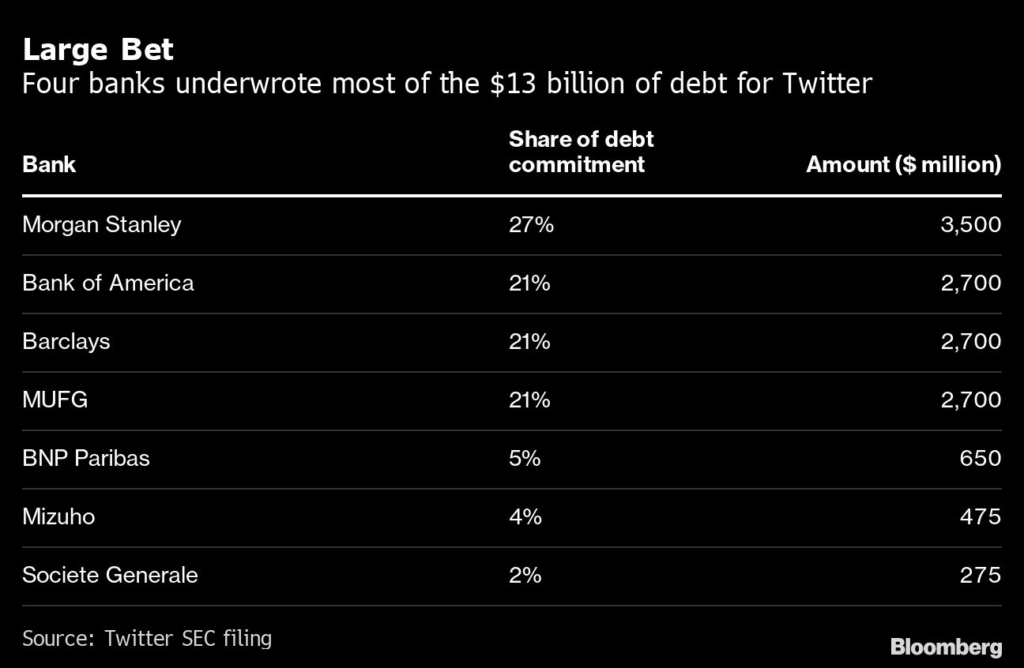
The banks, which are providing $13 billion of debt financing, have finished putting together the final credit agreement and are in the process of signing the documentation, one of the last steps before actually sending the cash to Musk, said the people, who asked not to be named discussing a private transaction.

Twitter shares jumped on the news and traded as high as $53.18, approaching Musk’s $54.20 acquisition price.

The Wall Street lenders, led by Morgan Stanley, had already been preparing in recent weeks to fund the debt, Bloomberg previously reported. But nothing is ever certain with Musk, the mercurial billionaire who only weeks ago was seeking to back out of the deal. These latest developments suggest he is in the final stages of closing the transaction by a court-issued Oct. 28 deadline.

The banks are expected to receive one of the last formalities — a borrowing notice — on Tuesday, and the cash is expected to be held in escrow on Thursday, the people said.

Morgan Stanley and Twitter declined to comment, while representatives for Musk didn’t respond to a request seeking comment.

Bank Pain

On the call, Musk also promised to help the banks market the debt to money managers after the deal closes, the people said.

That is key for the group of seven banks, which have been left in a lurch after Musk’s sudden reversal to go through with buying Twitter in early October. Normally the banks would offload debt commitments to money managers in the form of junk bonds and leveraged loans before a deal closes, but the compressed timeline and a global deterioration of credit conditions have forced them to keep the debt on their books. 

In a normal buyout transaction, the banks, new owner, and company management would come together to hold calls with investors to sell the debt and pitch the business. But the original debt commitment letter stipulated that Musk’s side would help for up to 30 days after closing, and that Musk would participate for at most two hours in any investor meetings.

Banks are facing paper losses of roughly $500 million on the transaction — pain that would be realized once the debt is sold to institutional investors. The average cost of borrowing spiked this year along with accelerating inflation, recession fears, and geopolitical turmoil, well above the 11.75% maximum interest rate that the banks promised Musk on the riskiest tranche of the debt, leaving them on the hook for the difference. Triple-C rated junk bonds are trading at about 15.8% on average, according to Bloomberg index data.

Wall Street banks have already had to use about $30 billion of their own cash this year to fund loans for acquisitions and buyouts that they weren’t able to offload to investors. That would swell to over $40 billion once banks fund the Twitter deal on Friday, as expected.

Read more: Banks Saddled With $30 Billion in Unwanted Debt in Risk Exodus

Twitter’s total purchase price is $44 billion. The banks committed to provide the debt financing in April — when investor appetite for risky assets was more robust — and originally hoped to sell $6.5 billion of leveraged loans and $6 billion of junk bonds, split equally into secured and unsecured tranches.

They also provided $500 million of a special type of loan typically held by banks called a revolving credit facility, which Twitter will be able to borrow from and pay back until maturity.

(Updates beginning in paragraph three with stock move, more context on debt.)

More stories like this are available on bloomberg.com

©2022 Bloomberg L.P.

BitMex’s Alexander Hoeptner Is Latest Crypto CEO to Depart

(Bloomberg) — BitMex said Chief Executive Officer Alexander Hoeptner has left after less than two years at the pioneering cryptocurrency exchange, joining the list of recent executive departures in the embattled industry. 

Stephan Lutz was named interim CEO, and will also continue to serve as chief financial officer, the exchange said in a statement. BitMex didn’t provide a reason for Hoeptner’s departure, and said it “won’t be commenting any further at this time.” Hoeptner declined to comment. 

Hoeptner became CEO in early 2021, soon after co-founder and CEO Arthur Hayes, along with other executives, resigned from BitMex’s parent company. The Commodity Futures Trading Commission sued the exchange and its officials for unlawfully accepting orders and funds from US customers to trade cryptocurrencies, including derivatives. BitMex-related companies agree to pay a $100 million fine to the CFTC.

Hoeptner follows Kraken’s Jesse Powell, Celsius Network’s Alex Mashinsky and FTX US’s Brett Harrison in stepping aside from leadership roles. While the reasons for the exits vary, underlying them all is the collapse in crypto prices. Most crypto exchanges have seen their trading volume plummet this year with most digital assets down by more than 50%.

BitMex was once the world’s biggest crypto derivatives exchange, thanks to its pioneering perpetual futures products that didn’t have an expiration date. BitMex has fallen far behind rivals like Binance and FTX in recent years in terms of volume, according to tracker CoinMarketCap. 

(Adds in the second paragraph that Hoeptner declined to comment.)

More stories like this are available on bloomberg.com

©2022 Bloomberg L.P.
Close Bitnami banner
Bitnami