
Bloomberg

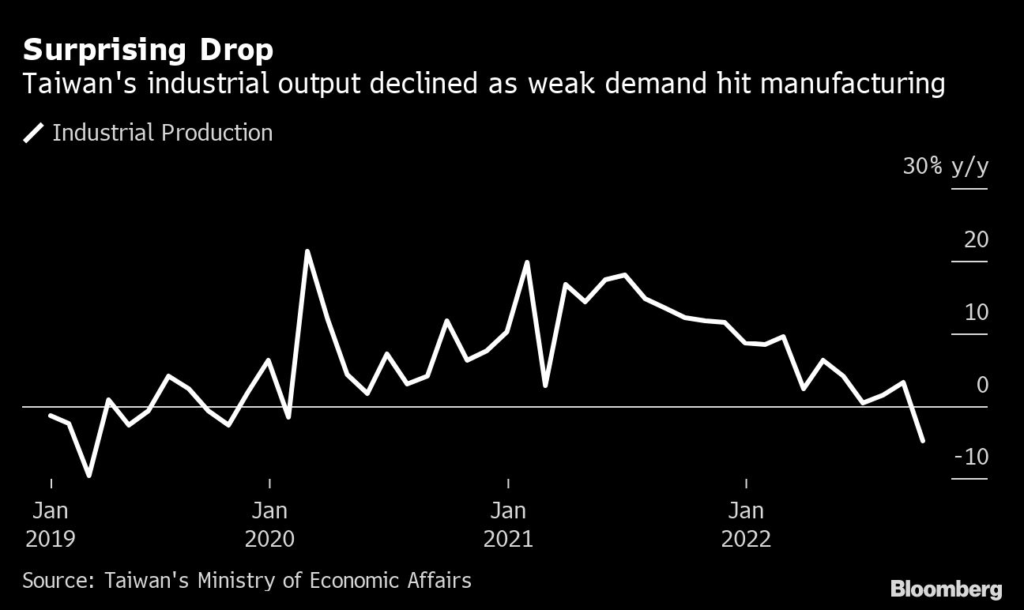
Taiwan Industrial Production Posts Surprise Fall on Weak Demand

(Bloomberg) — Taiwan’s industrial production unexpectedly dropped in September as a slump in global demand and especially in China continued to hurt the economy.

Industrial production fell 4.8% last month from a year ago, data from Taiwan’s Ministry of Economic Affairs showed Monday. That was far lower than the median estimate of 0.4% growth in a Bloomberg survey of economists, and a decline from August’s increase of more than 3%. It was the worst performance since March 2019, when industrial output plunged more than 9% year-on-year.

Manufacturing output makes up the vast majority of industrial production. Demand for manufactured goods was weaker due to a “slowdown in global economic growth, which led to weakening demand from end users for goods, plus industrial chain inventory adjustments,” according to a statement from the ministry accompanying the data. 

China’s lockdowns were a drag on output due to sluggish demand for LCD panels and basic metals, leading to lower product prices, said Kevin Wang, economist at Taishin Securities Investment Advisory Co.

September’s drop “is just the beginning,” he said, adding that “we may see continuing decline for the following months, as Covid lockdowns in China are not over yet.” Those restrictions will affect prices and demand, as will Europe’s economic downturn and a fall in iPhone demand in the US, Wang added.

Taiwan’s economy is under pressure this year, with exports contracting last month for the first time since 2020. Export orders, which are an indicator of future demand, declined in September for the third time this year as demand from China continued to fall.

Read More: Taiwan Needs Diverse Trade Amid US-China Row: Finance Chief

The economics ministry said in its Monday statement that while the manufacturing sector will get some help from “strong demand” for emerging technology such as 5G and high-performance computing, along with the launch of new consumer electronics, there are other challenges to growth. 

High global inflation, the Russia-Ukraine war and China’s Covid Zero strategy “may continue to disrupt the growth outlook of the international market and add to downward pressure on the world economy, in turn affecting the performance of the manufacturing sector,” the statement said. 

–With assistance from Argin Chang and Fran Wang.

More stories like this are available on bloomberg.com

©2022 Bloomberg L.P.

Is October Crypto’s Great Pumpkin?

  • Listen to Bloomberg Crypto on the iHeartRadio App
  • Listen to Bloomberg Crypto on Apple Podcasts
  • Listen to Bloomberg Crypto on Spotify  

(Bloomberg) — September is usually a bad month for crypto. In fact, it’s been a down month for the past five years. But for Bitcoin proponents, October looked more promising — the month of pumpkins and Halloween has typically been one of the best months for Bitcoin price gains. Advocates have been crossing their fingers that the same pattern will repeat this year, especially as Bitcoin’s total market share has risen to 48%, its highest since 2017.  To better understand the dynamics at play, Bloomberg reporters Hannah Miller and Vildana Hajric join this episode.


Follow us on Twitter @crypto, and subscribe to the Bloomberg Crypto Newsletter at https://bloom.bg/cryptonewsletter

More stories like this are available on bloomberg.com

©2022 Bloomberg L.P.

Ethiopia, Tigray Officials Set to Begin Talks in South Africa to End Civil War

(Bloomberg) — Officials from Ethiopia’s government and the dissident Tigray region are scheduled to hold talks in South Africa Monday on ending the nation’s almost two-year civil war, amid continuing violence in the Horn of Africa nation.

A delegation of Ethiopian officials left for South Africa on Monday morning, the Government Communication Service said on Twitter. Senior Tigrayan officials including Getachew Reda, an executive committee of the Tigray People’s Liberation Front, are set to meet Ethiopian National Security Adviser Redwan Hussien and others at the talks, a spokesman for the TPLF said by phone.

South African Department of International Relations & Cooperation spokesman Clayson Monyela declined to comment when contacted by phone. US Secretary of State Antony Blinken said Sunday he had held a “great conversation” with South African Foreign Minister Naledi Pandor on ensuring the success of the talks.

The talks are aimed at hammering out a cease-fire and finding ways out of the conflict, which has left thousands of people dead and displaced hundreds of thousands of others. 

The conflict in Tigray has escalated since the resumption of hostilities in August ended a five-month humanitarian cease-fire. The war has pitted Ethiopian Prime Minister Abiy Ahmed’s federal forces against rebels loyal to the TPLF. Neighboring Eritrea has backed Abiy since the violence first erupted in November 2020, while the fighting has also spilled over into Sudan, where thousands of refugees have fled the fighting.

Read: Eritrea Goes for Broke in Ethiopian Civil War to Crush Old Foe

–With assistance from Paul Vecchiatto.

More stories like this are available on bloomberg.com

©2022 Bloomberg L.P.
Stocks Pare Gains, Futures Drop After China Rout: Markets Wrap

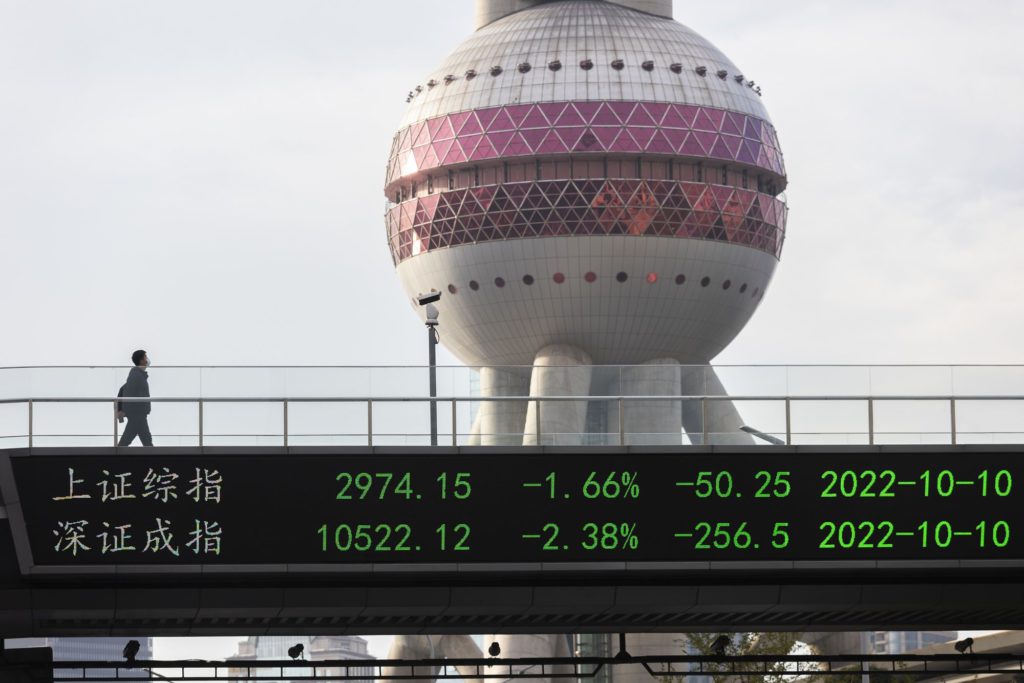
(Bloomberg) — Stocks in Europe pared gains and US futures declined as a rout in Chinese shares weighed on sentiment while investors await the next batch of earnings from some of the world’s biggest companies. Treasury yields dipped and the dollar gained.

The Stoxx Europe 600 Index held an advance of about 0.4% after rising as much as 1.4% at the open, with disappointing data adding to concerns the euro area is heading for a recession. Prosus NV slumped more than 11% as Chinese tech stocks tumbled, while basic resources and energy shares weighed on the benchmark amid a fall in crude oil and gas prices.

Earnings this week from megacap technology companies — among the key profit-growth engines for the S&P 500 — may give more clues on the resilience of the US economy and the trajectory for stocks. The five biggest tech firms by revenue — Apple Inc., Microsoft Corp., Alphabet Inc., Amazon.com Inc. and Meta Platforms Inc. — are projected to report the steepest contraction in earnings in three years, data compiled by Bloomberg show.

“It’s clear demand is slowing but so far we’ve seen pockets of tech like software, cloud computing still being quite resilient,” said Laura Cooper, a senior investment strategist at BlackRock International Ltd., on Bloomberg TV. “We will be watching for any signs of cracks coming through that could put a dent to some of these earnings expectations.”

A gauge of dollar strength rose in choppy trading that saw wild swings in the yen amid signs of a second intervention from Japanese authorities in two sessions. The pound gained against the greenback and gilts rallied after Boris Johnson pulled out of the race to lead the UK’s ruling Conservative Party, putting former chancellor Rishi Sunak closer to becoming the next prime minister.


China’s yuan and the country’s stocks tumbled in Hong Kong to the lowest level since the depths of the 2008 global financial crisis even as economic growth data beat estimates. The onshore yuan depreciated as much as 0.4%, while the Hang Seng China Enterprises Index, a gauge of Chinese stocks listed in Hong Kong, plunged more than 5% as investors reacted to the risks posed by President Xi Jinping’s move to stack his leadership ranks with loyalists. US-listed Chinese stocks tumbled in premarket trading.

“Market sentiment could remain cautious near-term on China, on concerns of a shift of focus toward more state control versus a market-driven approach under the new leadership team,” said Xiaojia Zhi, the chief China economist at Credit Agricole CIB. “The exit path from zero-Covid is not yet clear.”

Chinese economic data that was delayed last week and published Monday showed a mixed recovery, with unemployment rising and retail sales weakening despite a pickup in growth. Yet Xi’s Covid-zero campaign looks likely to continue to drag on the economy and there has been speculation that his “common prosperity” goal may even lead to property and inheritance taxes. 

More broadly, markets had been taking cues from the dip in US bond yields as investors looked beyond the present state of aggressive monetary tightening by the Federal Reserve to the next phase, which may see a slowing or pause in interest-rate hikes.

Purchasing Managers Indexes on Monday showed the euro area’s top two economies worsened in October, with the downturn in Germany intensifying and France failing to grow for the first time in 19 months. The European Central Bank is priming another hefty hike in interest rates this week as the attention increasingly switches to how high it will eventually push.

Key events this week:

  • Earnings due this week include: Apple, Microsoft, Exxon Mobil, Ford Motor, Credit Suisse, Airbus, Alphabet, Amazon, Bank of China, Boeing, Caterpillar, Cnooc, Coca-Cola, HSBC, Intel, McDonald’s, Mercedes-Benz, Merck, Samsung Electronics, Shell, UBS, UPS, Vale, Visa, Volkswagen
  • PMIs for US, Monday
  • US Conference Board consumer confidence, Tuesday
  • Bank of Canada rate decision, Wednesday
  • ECB rate decision, Thursday
  • US GDP, durable goods orders, initial jobless claims, Thursday
  • Bank of Japan policy decision, Friday
  • US personal income, personal spending, pending home sales, University of Michigan consumer sentiment, Friday

Some of the main moves in markets:

Stocks

  • The Stoxx Europe 600 rose 0.4% as of 9:37 a.m. London time
  • Futures on the S&P 500 fell 0.6%
  • Futures on the Nasdaq 100 fell 0.7%
  • Futures on the Dow Jones Industrial Average fell 0.5%
  • The MSCI Asia Pacific Index fell 1.1%
  • The MSCI Emerging Markets Index fell 2%

Currencies

  • The Bloomberg Dollar Spot Index rose 0.6%
  • The euro fell 0.4% to $0.9824
  • The Japanese yen fell 1.2% to 149.35 per dollar
  • The offshore yuan fell 0.9% to 7.2965 per dollar
  • The British pound was little changed at $1.1311

Cryptocurrencies

  • Bitcoin fell 0.9% to $19,322.09
  • Ether rose 0.4% to $1,335.89

Bonds

  • The yield on 10-year Treasuries declined two basis points to 4.20%
  • Germany’s 10-year yield was little changed at 2.41%
  • Britain’s 10-year yield declined 12 basis points to 3.93%

Commodities

  • Brent crude fell 2% to $91.66 a barrel
  • Spot gold fell 0.7% to $1,646.55 an ounce

–With assistance from Charlotte Yang and Brett Miller.

More stories like this are available on bloomberg.com

©2022 Bloomberg L.P.

New ESG Fund Numbers Plunge as Regulators Probe for Greenwashing

(Bloomberg) — The number of new ESG funds is plummeting as asset managers put the brakes on repurposing existing products amid increased regulatory scrutiny.

Reclassifications of funds claiming to target environmental, social or governance goals have fallen 84% compared with a year ago, led by a slowdown in Europe, according to data complied by Jefferies. New ESG funds built from scratch fell 60% over the same period, marking the first time repurposing hasn’t led industry growth.

“Increased regulatory scrutiny and enforcement in this market is changing behavior,” analysts at Jefferies said in the report.

Regulators in the EU, UK and US are investigating ESG funds amid growing concerns that asset managers keen to sell products are promising more than they can deliver. To meet demand, asset managers have tended to rename existing products rather than build new ones. That’s raised questions about the ESG credentials of the funds, and fed concerns of widespread greenwashing.

A recent analysis by PwC showed that of 8,017 so-called Article 8 funds — an EU designation that requires a product to “promote” sustainability — only 989 were new at the end of the second quarter. The rest were reclassifications of existing funds. A similar analysis of 1,061 Article 9 funds — whereby a product needs to have sustainability as its “objective” — showed that only 286 were new.

A probe of Article 9 products by Swedish authorities last month found “many cases” in which managers failed to provide necessary information. The Stockholm-based regulator will meet with industry representatives to discuss its findings, and has warned that it will act to stamp out false ESG claims.

Institutional and retail investors have been calling for regulators to do more to protect against greenwashing after years of unfettered growth in the ESG industry. An analysis by PwC showed that 71% of institutional investors want stronger ESG regulatory requirements to guide the actions of the fund management industry. The hope is that extra rules “can act as an important lever to build trust and decrease the risk of mislabeling,” according to PwC.

Asset managers have blamed an absence of clear and consistent rules. The EU led the world with the March 2021 implementation of its Sustainable Finance Disclosure Regulation, but the groundbreaking framework has since been criticized for lacking clarity around key concepts. For example, EU regulators are still waiting for the European Commission to provide detailed guidance on what it means by a “sustainable investment.” 


More stories like this are available on bloomberg.com

©2022 Bloomberg L.P.
Alibaba, JD.com Tumble in US as Xi Asserts Full Control in China

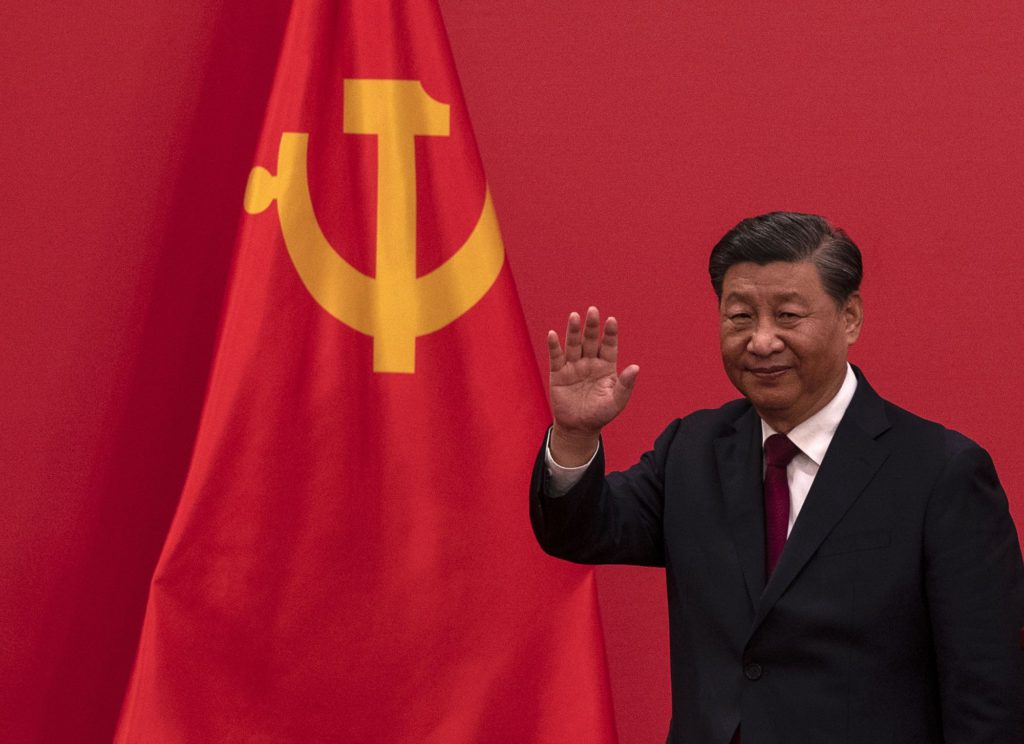
(Bloomberg) — US-listed Chinese stocks tumbled in premarket trading, with investors spooked by President Xi Jinping’s tightening grip on China’s ruling party, as he embarks on a precedent-breaking third term with rivals gone and no successor in sight.

The KraneShares CSI China Internet Fund, an exchange traded fund that includes more than 40 Chinese stocks, slid 13%. Major Chinese internet stocks from Alibaba Group Holding Ltd. to JD.com Inc. saw double-digit declines. In Johannesburg, Tencent Holdings Ltd.’s biggest shareholder Naspers Ltd. plunged 12%. 

Monday’s selloff came after Xi packed the Politburo Standing Committee with six loyalists during the party’s twice-a-decade leadership reshuffle, with the unprecedented power play demonstrating his unchallenged control of the country’s top decision-making body. 

Such dominance, however, adds to concerns that China may hold back for longer on fully reopening its economy, with fewer voices at the apex of power to question Xi’s Covid Zero policies. Investors also worry the ruling party may stick to its hard-liner approach toward domestic private enterprises and tech entrepreneurs, while ramping up military pressure on Taiwan.

“The concern is that absolute power may lead to harsh policy both locally and internationally,” said Sharif Farha, head of investments at HB Investments. “On a local level, zero covid policy or tougher regulations on China tech may not go away. On an international level, the market is definitely concerned about political tensions.”

Sharp Drops

Today’s declines for US-listed stocks follow a sharp retreat for Hong Kong-listed peers, which sent the Hang Seng Index down to its lowest level since 2009. The CSI 300 Index fell nearly 3%, as foreign investors sold a record $2.5 billion of mainland shares via exchange links in Hong Kong. Meanwhile, the offshore yuan declined to the weakest level against the dollar on record.

Elsewhere, a raft of delayed economic data showed a mixed recovery in China in the third quarter, with unemployment rising and retail sales weakening in September despite a pickup in growth. The ailing real estate sector — a key risk factor denting investor sentiment toward Chinese equities — contracted for a fifth quarter, extending its longest slump in history. 

More stories like this are available on bloomberg.com

©2022 Bloomberg L.P.
Atos Says IT Unit Has Bidder Interest From ‘Several Players’

(Bloomberg) — Atos SE said it’s been approached by “several players” that are potentially interested in buying its legacy IT outsourcing unit after the French technology company announced plans to split up in June.

The company made the statement on Monday in response to media “rumors.” An earlier report from French newsletter, La Lettre de l’Expansion, said that private equity firms Apollo and Cerberus had expressed interest in a potential deal. 

A representative for Apollo declined to comment. A spokesperson for Cerberus didn’t immediately respond to a request. 

Atos said the expressions of interest in its Tech Foundations business wouldn’t necessarily lead to a deal. The French IT group announced plans to break apart earlier this year, separating its historic IT outsourcing unit from its faster-growing cybersecurity business, which it’s re-branded as Evidian. 

Read More: Atos CEO Leaves Company Earlier Than Planned in Reshuffle

The company has suffered from a series of profit warnings and setbacks that sent its market value plummeting and got it removed from France’s benchmark CAC 40 Index. Executives have disagreed on how to revive the company, and former Chief Executive Officer Rodolphe Belmer left his position months earlier than planned. He said he had “no choice” but to resign after the restructuring plan was announced. 

Atos shares rose 1.5% in Paris trading at 9:30 a.m. The stock has declined about 73% this year. 

More stories like this are available on bloomberg.com

©2022 Bloomberg L.P.
Philips CEO Starts Tenure by Cutting 4,000 Jobs Amid Recall Woes

(Bloomberg) — Royal Philips NV will cut 4,000 jobs just days after a new chief executive officer took over, as the Dutch company seeks to reduce expenses while it wrestles with a costly recall of a consumer medical device.

The cuts amount to about 5% of Philips’s workforce, and the company will book severance and termination-related costs of about €300 million ($295 million) in the coming quarters, Philips said Monday. The company announced the steps a good week after Roy Jakobs took over from Frans van Houten, who had held the CEO position for 12 years. 

Philips’s priority is “to improve execution so that we can start rebuilding the trust of patients, consumers and customers,” Jakobs said in a statement. These steps include strengthening patient safety and quality management as well as “urgently improving our supply chain operations.”

The restructuring also seeks to combat inflation, Jakobs said in a phone interview after the earnings report. The CEO vowed to continue tackling product quality and supply chain issues as well as simplifying the organization. 

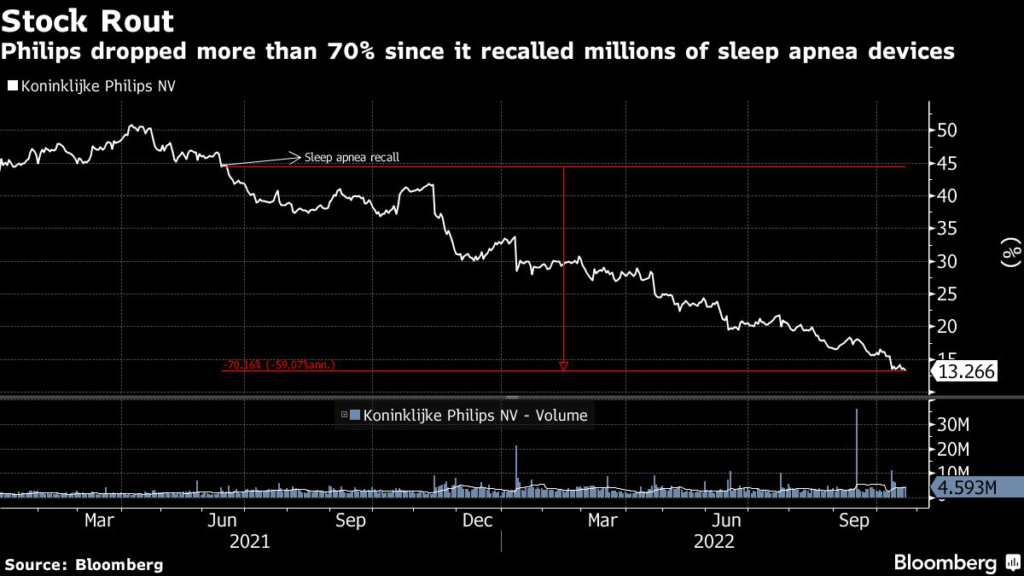
Jakobs was put in charge of turning around the company’s Connected Care businesses in early 2020, managing the response to the Covid-19 crisis and the growing issues around the recall of medical devices to treat sleep apnea. The healthcare giant’s shares have dropped 60% this year. 

Philips rose as much as 20 cents, or 1.6%, to 13.47 euros in Amsterdam, after falling as much as 1.8% in early trading.

Philips Names New CEO Who Has Led Respiratory Device Recall 

The company continues to face court cases over noise-dampening foam prone to disintegrating inside the ventilators that allegedly pose a cancer risk when inhaled. Philips started its first recall of the devices in June of last year and has made financial provisions of about €885 million.

Philips has also taken a €1.3 billion impairment charge for its sleep and respiratory care business. The writedown reflects factors including changing estimates of a proposed settlement with US authorities over the sleep-apnea devices. 

The company reported a net loss of €1.33 billion in the third quarter, compared with a profit of €2.97 billion in the same period a year earlier. Earlier this month, the maker of medical devices cut its outlook on the back of worse-than-expected supply-chain issues that are affecting deliveries and customer installations.

–With assistance from April Roach.

(Updates with CEO comment and stock move)

More stories like this are available on bloomberg.com

©2022 Bloomberg L.P.
After $50 Billion Slide, More Pain Ahead for Kakao Investors

(Bloomberg) — After a $50 billion wipeout in market value this year, more pain may be in store for investors in Kakao Corp. and its affiliates as the Korean tech group’s monopoly-like status draws a steady stream of criticism.

Once hailed as a symbol of Korean innovation, Kakao’s market value reached a peak of over $60 billion last year on a pandemic boost as a “stay-at-home” beneficiary and gains from the listing of several subsidiaries.

Its fall from grace mirrors moves to minimize the power of tech giants from the US to China. A recent data center fire that caused an outage of South Korea’s No. 1 messaging app added force to a public campaign since last year to curb Kakao’s influence. 

Company founder Brian Kim as well as executives from SK Group, an affiliate of which operated the stricken datacenter, apologized and promised compensation during a parliamentary hearing Monday, without elaborating. The founder of rival Naver Corp., Lee Hae-jin, told lawmakers his own company was affected but managed to swiftly restore data.

“Kakao has become a monopoly so the perception has changed,” said Hong Chunuk, chief executive at Frism Investment Advisory Inc. and former economist at National Pension Service. “It has become a target of public disdain.” 

Read more: Kakao Co-CEO Resigns After Outage Hit Millions in Korea

The blackout of Kakaotalk, which is used by the nation’s central bank to announce rate decisions and by government officials to discuss national security issues, heightened calls for oversight. Rival Telegram said it saw a surge in downloads in South Korea as users sought alternatives.

The company’s recent fintech spinoffs have seen the steepest declines, with shares of Kakaopay Corp. plunging 80% since the start of the year and KakaoBank Corp. down more than 70%. Combined market cap loss for Kakao, KakaoBank, Kakaopay and Kakao Games Corp. reached $50 billion this year through last Friday.

“They are some of the stocks that surged the most last year,” said Frism’s Hong. “There is also the issue of an increased number of stocks in the market after split-offs and listings of units, which also give a holding company discount to Kakao.”

Shares of Kakao and Naver, which has also been a target of criticism for market dominance, have fallen about 56% each this year.

Margin Calls 

The sharp share-price losses appear to already have triggered margin calls for highly leveraged retail traders, as Kakao and its affiliates are popular among South Korean retail investors, Hong said.

Kakaopay and KakaoBank separately confirmed to Bloomberg that they took measures to help employees who may be facing margin calls after buying shares in the initial public offerings. Investors can sometimes be forced to sell shares to meet margin calls. 

Less Bullish 

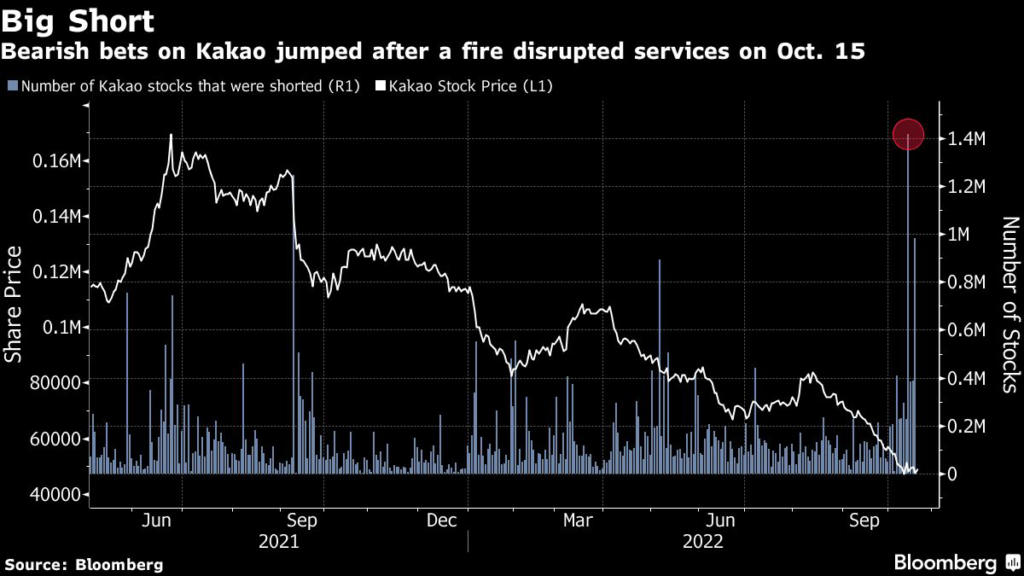
A flurry of brokerages lowered their price targets on Kakao following the Oct. 15 fire. JPMorgan analyst Stanley Yang slashed his target 39% to 46,000 won, the lowest among 33 analysts polled by Bloomberg.

Credit Suisse lowered its rating to neutral from outperform last week, a rare downgrade for a stock that still has 27 buy ratings. Analysts are less sanguine on the listed units, with four sells on Kakaopay and three on KakaoBank.

Big Short

In another bearish sign, daily short sales of on Kakao’s stock jumped to the highest on record last Monday and remained elevated through the rest of the week.

Kakao may struggle to gain new users as public opinion sours, said Gu Sungjoong, an analyst at DS Investment & Securities Co. “There’s potential concern about increased regulations on platform services that could limit its service expansion.” 

–With assistance from Filipe Pacheco, Karen Yang and Sohee Kim.

(Updates with details of Monday’s hearings in the fourth paragraph)

More stories like this are available on bloomberg.com

©2022 Bloomberg L.P.

Korea $35 Billion Aid Plan Spurs Relief Rally in Stocks, Bonds

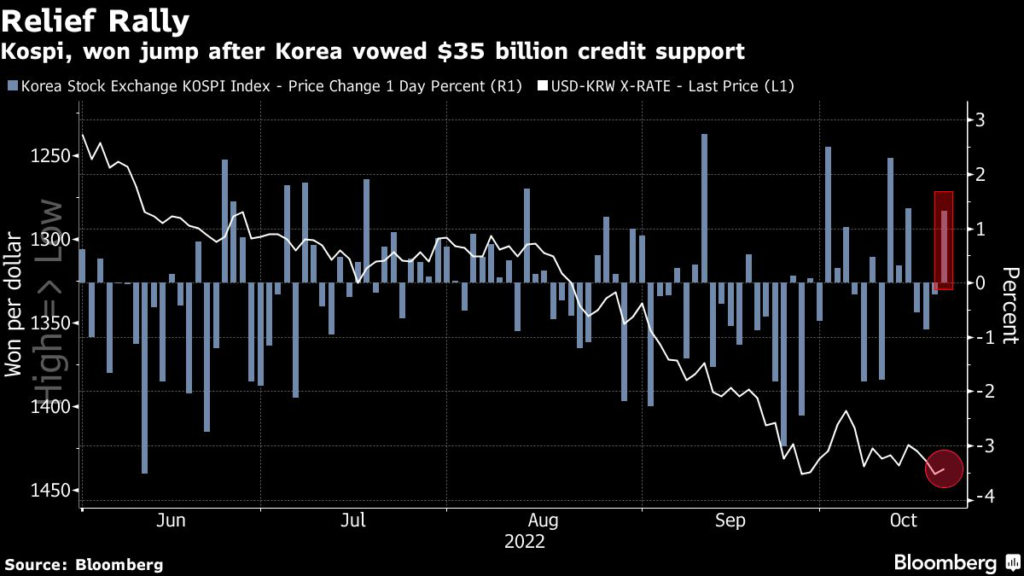
(Bloomberg) — South Korean assets rallied on Monday after the government pledged at least 50 trillion won ($34.8 billion) to prop up credit markets, easing concerns about rising default risks in key sectors including real estate.

The Kospi index advanced as much as 2%, with shares of brokerages and builders such as Kiwoom Securities Co., Meritz Securities Co. and Dongbu Corp. notching up gains. Government bonds rose across the curve while the won jumped as much as 0.8% against the dollar before paring its rise.  

South Korea will expand its “liquidity supply program” to prevent a credit squeeze roiling corporate bonds and other short-term money markets, Finance Minister Choo Kyung-ho said on Sunday. The move marks one of the biggest rounds of financial support for markets since steps at the onset of the pandemic. Some analysts cautioned that even more may be needed ahead.

Risks rose recently in Korea’s local credit market as yields spiked to the highest in more than a decade, after a rare default on commercial paper by the developer of Legoland Korea theme park in Gangwon province late last month. That fueled broader worries about real estate firms already weakened by surging borrowing costs, as the central bank hikes interest rates to fight inflation. Property debt strains are spreading in Asia following a crisis in the sector in China.  


In a sign of the particular concern regarding commercial paper — which property and other companies use to meet short-term payments — the nation will resume purchasing such securities along with corporate bonds from Monday, first injecting 1.6 trillion won from a 20 trillion won bond stabilization fund. 

The latest government moves “will help stabilize market sentiment but there is a problem with policy consistency at a time of aggressively hiking rates to tame inflation,” said Heo Pil-Seok, chief executive officer at Midas International Asset Management. 

The Bank of Korea raised its seven-day repurchase rate by a half-percentage point to a 10-year high of 3% earlier this month.

The Kospi Index got a boost on expectations that the credit pledge would offer support to brokerages with exposure to commercial paper and builders that depend on developers for business.

Among the brokers, Meritz Securities gained as much as 10.5%, Kiwoom Securities jumped 9.9% while Samsung Securities Co rallied 5.5%. Construction company Dongbu surged 24.3%, the biggest advance in six years, and its peer DL E&C Co. climbed the most since February 2021.

Commercial Paper

Three-year government bond yields slid 19 basis points to 4.31% while 10-year rates dropped 16 basis points to 4.49%.

But, caution persisted in some markets, with the yield on three-month commercial paper rising eight basis points to 4.33%, the highest since January 2009. Some of that may have been due, however, to the fact that yields on such instruments often have a time lag between actual trades in the securities and the publication of their market rates. There were few credit transactions on Monday morning after the government steps were unveiled.

“It’s not a fundamental solution but it seems to give markets time to breathe,” said Huh Jae-Hwan, an analyst at Eugene Investment & Securities Co.

South Korean President Yoon Suk Yeol said the government will implement the measures starting Monday to help resolve the financial difficulties faced by small and medium-sized companies.


–With assistance from Kyungji Cho.

(Updates throughout with background on property sector challenges)

More stories like this are available on bloomberg.com

©2022 Bloomberg L.P.

Close Bitnami banner
Bitnami