
Bloomberg

Global Stocks Rally Fizzles on China; Dollar Rises: Markets Wrap

(Bloomberg) — A rally in global equities faltered Monday under the weight of declines in Chinese shares, with US futures and key Asian indexes losing a large part of earlier gains that were made amid a dip in Treasury yields.

A gauge of dollar strength advanced in choppy trading that saw wild swings in the yen amid signs of a second intervention from Japanese authorities in two sessions.

The pound was a notable exception in rising against the greenback after Boris Johnson pulled out of the race to lead the UK’s ruling Conservative Party, putting Rishi Sunak closer to becoming the next prime minister. 

China’s yuan also weakened along with the nation’s equities as investors reacted to the risks posed by President Xi Jinping’s move to stack his leadership ranks with loyalists. Hong Kong’s Hang Seng Index dropped about 6%, with technology companies among the worst affected.

“The Hong Kong market is seeing a panic selling moment,” said Dickie Wong, executive director of research at Kingston Securities Ltd. “While China reported macro data that beat expectations, the market is on a way down, as the leadership reshuffle and tensions between China and US continue to drag down sentiment and add uncertainty.” 

Chinese economic data that was delayed last week and published Monday showed a mixed recovery, with unemployment rising and retail sales weakening despite a pickup in growth. Yet Xi’s Covid-zero campaign looks likely to continue to drag on the economy and there has been speculation that his “common prosperity” goal may even lead to property and inheritance taxes. 

More broadly, markets had been taking cues from the dip in US bond yields as investors looked beyond the present state of aggressive monetary tightening by the Federal Reserve to the next phase, which may see a slowing or pause in interest-rate hikes.

Ten-year Treasury yields fell further on Monday, to around 4.15%, after reversing a surge on Friday. Yields also dropped in Australia, led by the policy-sensitive three-year maturity.

St. Louis Fed President James Bullard and his San Francisco counterpart Mary Daly last week made clear they expect the discussion at the November gathering to include debate on how high to raise rates and when to slow the pace of increases. They stressed the need to keep tightening for now.

Gains for share gauges in Japan and South Korea fell to less than 1% while the advance in US futures was almost entirely eroded as momentum waned after strong openings that followed stocks on Wall Street having their best week since June. 

Key events this week:

  • Earnings due this week include: Apple, Microsoft, Exxon Mobil, Ford Motor, Credit Suisse, Airbus, Alphabet, Amazon, Bank of China, Boeing, Caterpillar, Cnooc, Coca-Cola, HSBC, Intel, McDonald’s, Mercedes-Benz, Merck, Samsung Electronics, Shell, UBS, UPS, Vale, Visa, Volkswagen
  • PMIs for Eurozone, US, Monday
  • US Conference Board consumer confidence, Tuesday
  • Bank of Canada rate decision, Wednesday
  • ECB rate decision, Thursday
  • US GDP, durable goods orders, initial jobless claims, Thursday
  • Bank of Japan policy decision, Friday
  • US personal income, personal spending, pending home sales, University of Michigan consumer sentiment, Friday

Some of the main moves in markets:

Stocks

  • S&P 500 futures rose 0.1% as of 6:51 a.m. London time. The S&P 500 rose 2.4% Friday
  • Nasdaq 100 futures rose 0.3%. The Nasdaq 100 rose 2.4%
  • Australia’s S&P/ASX 200 Index rose 1.5%
  • The Topix index rose 0.4%
  • South Korea’s Kospi index rose 0.9%
  • The Hang Seng Index fell 5.9%
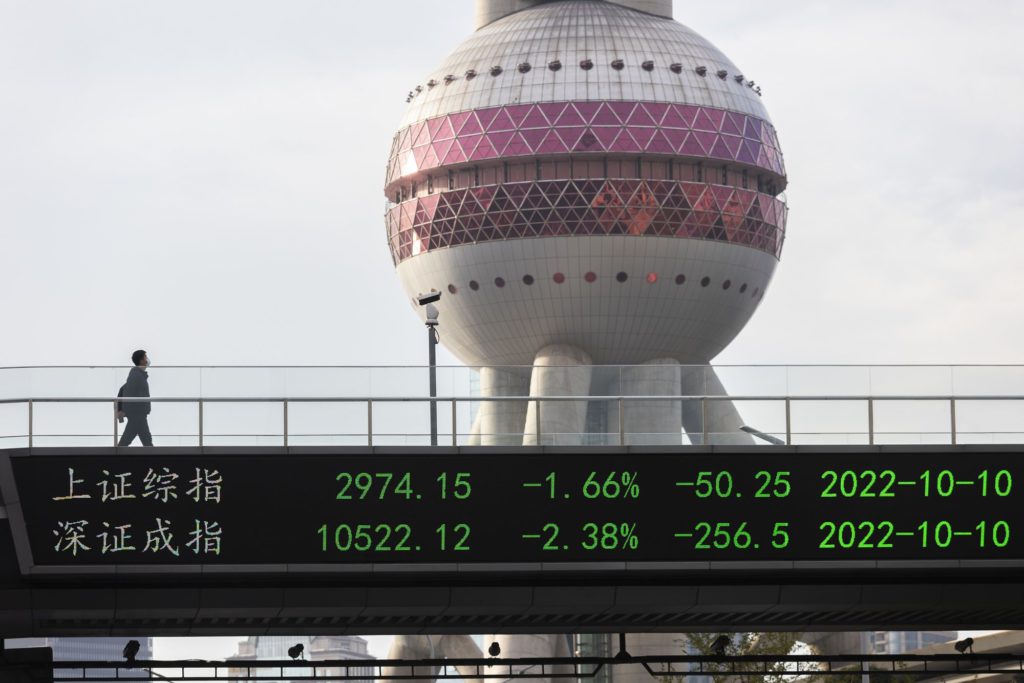
  • Shanghai Composite Index fell 1.6%
  • Euro Stoxx 50 futures rose 0.7%

Currencies

  • The Bloomberg Dollar Spot Index rose 0.3%
  • The euro fell 0.1% to $0.9848
  • The Japanese yen fell 0.9% to 148.94 per dollar
  • The offshore yuan fell 0.5% to 7.2677 per dollar
  • The British pound rose 0.5% to $1.1354

Cryptocurrencies

  • Bitcoin fell 0.8% to $19,344.42
  • Ether rose 0.9% to $1,342.40

Bonds

  • The yield on 10-year Treasuries declined seven basis points to 4.15%
  • Australia’s 10-year bond yield fell five basis points to 4.15%

Commodities

  • West Texas Intermediate crude fell 0.9% to $84.27 a barrel
  • Spot gold fell 0.1% to $1,655.73 an ounce

–With assistance from Charlotte Yang.

More stories like this are available on bloomberg.com

©2022 Bloomberg L.P.
Philips to Cut Jobs Among ‘Urgent’ Steps to Improve Performance

(Bloomberg) — Royal Philips NV will reduce its workforce by 4,000 jobs as the Dutch company aims to reduce operating expenses while wrestling with a costly recall of its sleep-apnea treatment devices.

The severance and termination-related costs are expected to be approximately €300 million ($295 million) in the coming quarters, Philips said Monday. The restructuring comes as Roy Jakobs replaced Frans van Houten as chief executive officer this month, who had held the position for 12 years. 

Philips’s priority is “to improve execution so that we can start rebuilding the trust of patients, consumers and customers,” Jakobs said in a statement. These steps include strengthening patient safety and quality management as well as “urgently improving our supply chain operations.”

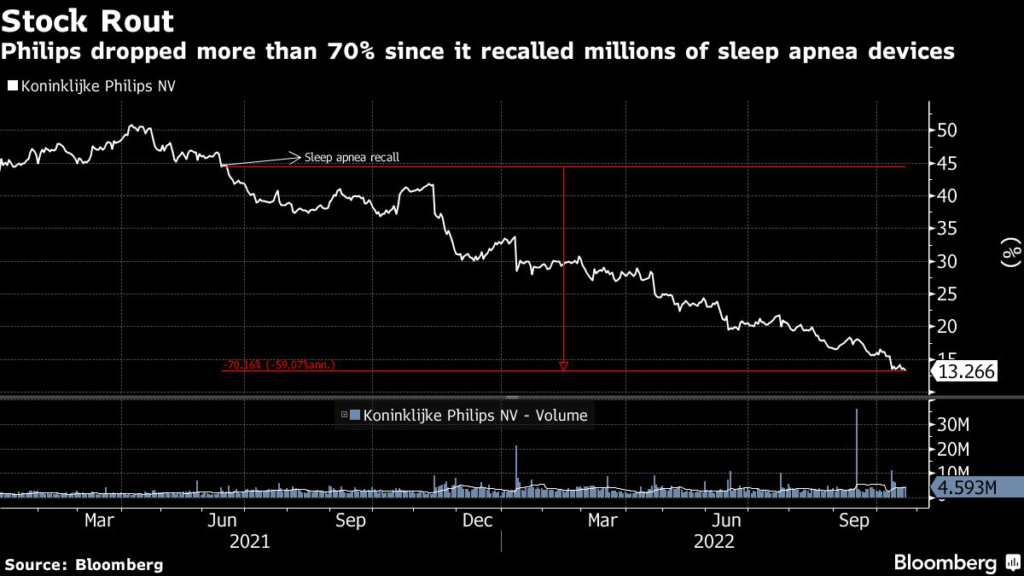
Jakobs was put in charge of turning around the company’s Connected Care businesses in early 2020, managing the response to the Covid-19 crisis and the growing issues around the recall of medical devices to treat sleep apnea. The healthcare giant’s shares have dropped 60% this year. 

Philips Names New CEO Who Has Led Respiratory Device Recall 

The company continues to face court cases over noise-dampening foam prone to disintegrating inside the ventilators that allegedly pose a cancer risk when inhaled. Philips started its first recall of the devices in June of last year and has made financial provisions of around €885 million.

Philips has also taken a €1.3 billion impairment charge for its sleep and respiratory care business. The write-down reflects factors including changing estimates of a proposed settlement with US authorities over the sleep-apnea devices.

The company reported a net loss of €1.33 billion in the third quarter, compared with a profit of €2.97 billion in the same period a year earlier. Earlier this month, the maker of medical devices cut its outlook on the back of worse-than-expected supply-chain issues that are affecting deliveries and customer installations.

–With assistance from April Roach.

(Updates with CEO comment in third paragraph)

More stories like this are available on bloomberg.com

©2022 Bloomberg L.P.
China Builder Yango’s Unit Gets Wind-Up Order in First in HK

(Bloomberg) — A Hong Kong court has issued an order that a Chinese developer’s unit that defaulted on offshore debt be wound up, the first such instance against a major builder during the country’s property-debt crisis and opening the door to more such decisions.

The order regarding Yango Justice International Ltd. was dated Oct. 17, according to a winding up search report done through the website of Hong Kong’s Official Receiver’s Office. The case’s first hearing date was Sept. 14 and the adjourned hearing was Oct. 17, the same day of the order. The firm is a unit of Yango Group Co. 

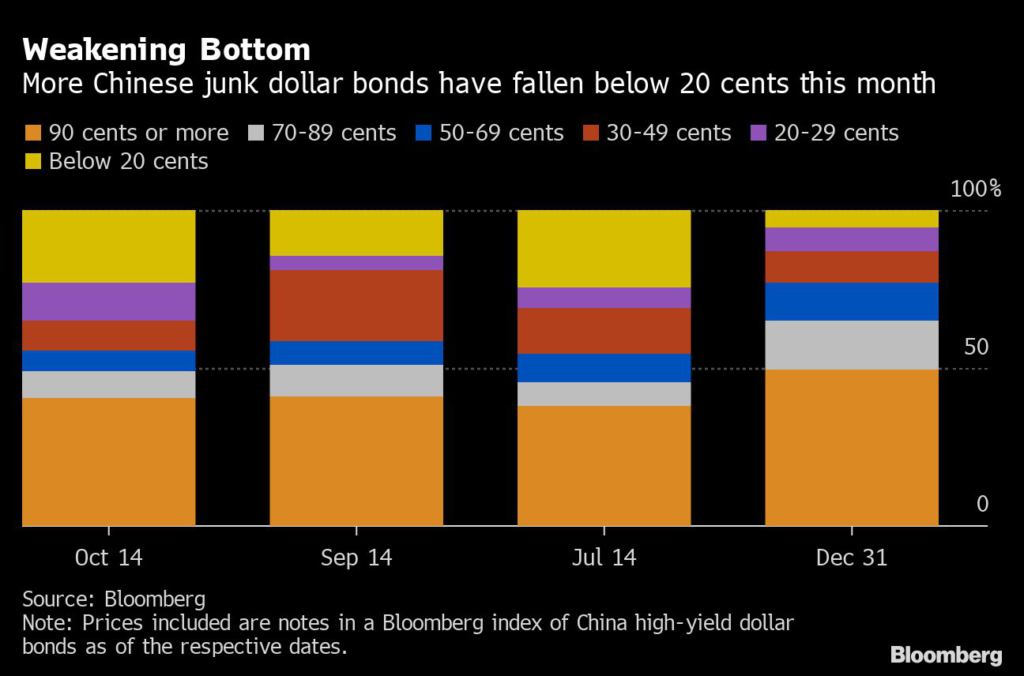
Hong Kong has acted as a gateway for investors to access China’s high-yield credit, a market dominated by builders but which has slid into unprecedented distress this year, reversing what was once one of the world’s most lucrative debt trades. 

The tumble comes as China grapples with a real estate crisis fueled in part by a clampdown started in 2020 on excessive borrowing by property firms and speculation by home buyers. Some builders have left projects unfinished as they struggle to pay suppliers and creditors, causing defaults to surge. 

That’s sparked a flurry of winding-up petitions filed in Hong Kong or Cayman Islands courts against developers, including China Evergrande Group — the giant whose default on dollar notes in late 2021 exacerbated the broader industry crisis. Evergrande has said that it’s actively pushing forward offshore debt restructuring work with its financial and legal advisers.

Creditors file winding-up petitions when they get frustrated with the lack of restructuring progress at a firm, fixed-income research analysts at BOC International Holdings Ltd. including Wu Qiong wrote in an Oct. 13 report. “In most cases, creditors seek more serious negotiations with the debtor by putting the debtor company under pressure or a solution through the court process,” they said.

If a Hong Kong court gives a winding-up order and appoints a provisional liquidator, the latter takes control of the firm in question and disposes of realizable assets, according to an explanation posted on the Official Receiver’s Office website. Any remaining funds are distributed to creditors whose claims have been admitted.

When Yango Group was asked by Bloomberg News on Friday whether it could confirm the winding-up order, the company wouldn’t comment on any issuance of an order, but said it is still actively negotiating and handling matters with creditors. 

The search report from Hong Kong’s Official Receiver’s Office lists “official receiver” in the line for provisional liquidator, without giving further details. 

Yango Justice defaulted for the first time in February when it missed paying $27.3 million of interest on two dollar bonds within a 30-day grace period, capping months of debt struggles that included seeking payment extensions. 

Parent Yango disclosed a winding-up petition against its unit in July involving an $8.5 million payment for offshore notes and said it “strongly” opposed the filing. It’s unclear whether the order is related to that case. 

Yango Group was China’s 19th-largest builder by contracted sales in 2021 but has fallen to 36th so far this year, according to China Real Estate Information Corp. 

The developer said in a July exchange filing that Hong Kong-incorporated Yango Justice made up less than 10% of its net assets as of the end of 2021.

Below is a table of some winding-up petitions filed in Hong Kong against Chinese builders. Some of the creditor information is based on court records.

–With assistance from Emma Dong.

(Updates with comments in the sixth paragraph and adds table of winding-up petitions.)

More stories like this are available on bloomberg.com

©2022 Bloomberg L.P.
Tesla Cuts China Prices, Partly Reversing Previous Increases

(Bloomberg) — Tesla Inc. cut the price of its cars in China by about 5% as it ramps up production at its Shanghai factory, partly reversing price hikes imposed earlier this year.

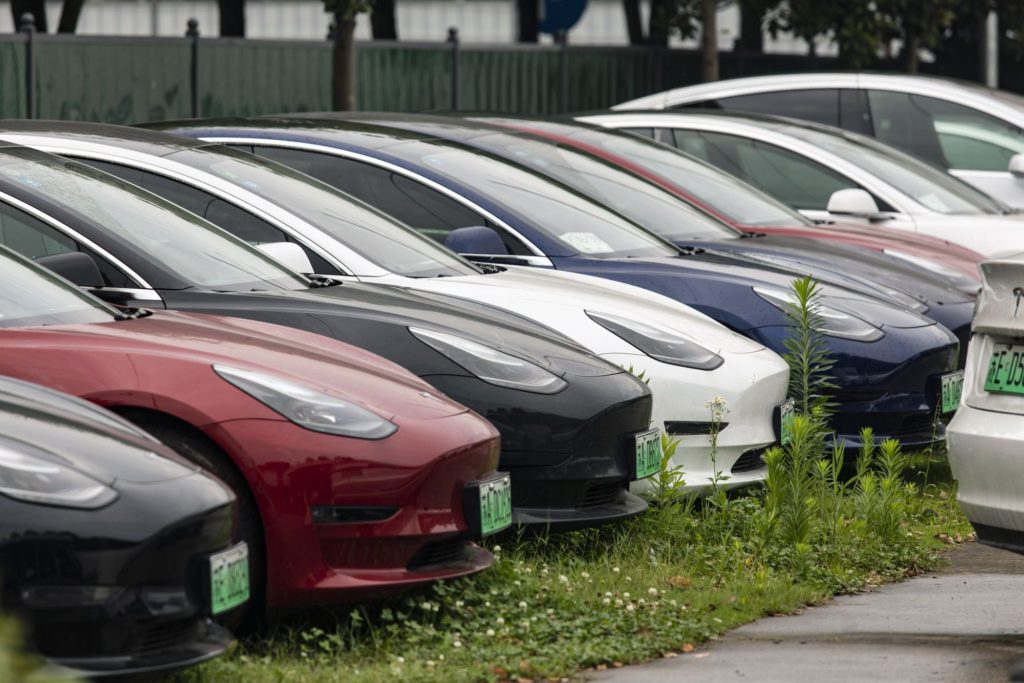
The US-based electric vehicle pioneer lowered the price of its locally-built basic Model 3 to 265,900 yuan ($36,774) from 279,900 yuan effective Monday, its website shows. The starting price of a Model Y SUV was cut to 288,900 yuan from 316,900 yuan.

The cuts come as Tesla faces hotter competition from local EV makers such as BYD Co., which sold a record 200,973 vehicles last month, and upstarts like Nio Inc. and Xpeng Inc., which are expanding their line-ups. Domestic automakers accounted for almost 80% of EV sales through the first seven months of the year, according to data compiled by the China Passenger Car Association. 

Read more: China’s Love of Local EVs Is Bad News for Foreign Carmakers

Tesla may also be looking to goose sales in one of its key markets after last week reporting lower-than-expected revenue. Chief Executive Officer Elon Musk said that China is in a “recession of sorts” and that in general, demand is harder to come by.  

“EV competition this year is very fierce, and Tesla’s performance may not match its expectations,” said Yale Zhang, managing director at Shanghai-based consultancy Autoforesight Co. “Hence, it decided to hit its rivals with a direct blow by cutting prices to further boost sales in the last two months of the year.”

The price cuts contrast with several increases carried out earlier this year, when Musk said both Tesla and his space exploration company SpaceX were “seeing significant recent inflation pressure” in raw materials and logistics.

Tesla delivered a record 83,135 cars in September, including 5,522 for export, after upgrading production capacity at the Shanghai factory. The plant can now produce about 1 million cars a year. 

Read more: Tesla’s Record Sales After Shanghai Upgrade Lead China EV Surge

“It is an expected price cut,” said Wang Hanyang, an automotive analyst at Shanghai-based 86Research Ltd. “Order inflow for Model 3s and Ys haven’t fulfilled the expanded production capacity, as you can tell from the shortened wait time. The company needs to secure more orders by cutting prices.” 

Delivery times for a Model Y in China is just one to four weeks now, and four-to-eight weeks for a Model 3, according to the company’s website. That compares with up to 12 weeks before the Shanghai factory upgrade. In the US, wait times for a Model Y stretch from December to as late as April 2023. 

A representative for Tesla China said the “improvement of production capacity utilization of Tesla’s Shanghai factory and relative stability of the supply chain have contributed to lower costs. Tesla has always priced according to the cost.” 

(Adds analyst comment in eighth paragraph.)

More stories like this are available on bloomberg.com

©2022 Bloomberg L.P.
Chinese Markets Tumble as Xi’s Tightening Grip Alarms Investors

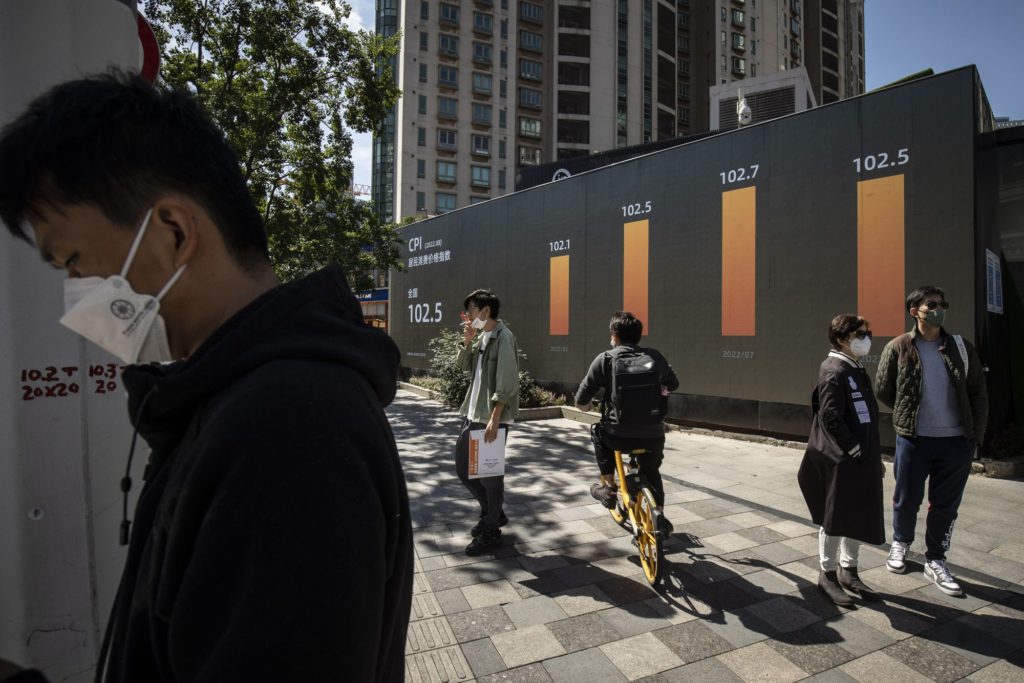
(Bloomberg) — China’s yuan weakened and country’s stocks tumbled to the lowest level since the depths of the 2008 global financial crisis in Hong Kong, a stark rebuke of President Xi Jinping’s move to stack his leadership ranks with loyalists.

The offshore yuan weakened as much as 0.7% to 7.2782 per dollar Monday morning to approach a record low seen last week. The Hang Seng China Enterprises Index, a gauge of Chinese stocks in the city, plunged more than 5% to the lowest since 2008 even as economic growth data beat estimates. China’s benchmark CSI 300 Index fell as much as 1.9%.     

Read: China Economy Shows Mixed Recovery as Industrial Activity Climbs

Market setbacks following the reshuffle, which highlighted Xi’s unquestioned grip over the ruling party, show deep disappointment over a likely continuation of policies staked on Covid Zero and state-driven companies. Tech giants Alibaba Group Holding Ltd., Tencent Holdings Ltd. and Meituan all tumbled as investors remained skeptical that Xi and his allies will seek a rejuvenation of private enterprise.

“The market is concerned that with so many Xi supporters elected, Xi’s unfettered ability to enact policies that are not market friendly is now cemented,” said Justin Tang, head of Asian research at United First Partners. 

While the appointment of Xi’s allies may help accelerate key agendas, the addition of Covid Zero advocates to the Politburo Standing Committee diminishes the chance of any early loosening of Covid restrictions. 

“The more centralized power becomes, the more the risk of overzealous policy implementation based on directives from the top,” said Duncan Wrigley, chief China economist at Pantheon Macroeconomics Ltd. “This happened in some of the lockdowns in the second quarter.”

Investors were disappointed during the congress last week as Xi defended his Covid Zero policy and fell short of offering stimulus to shore up the property market. The onshore yuan fell to the weakest level in 14 years and the CSI 300 slumped in all but one session last week.    

A slew of China’s key economic data — released Monday after an abrupt delay lat week — showed a mixed recovery.   

The economy grew faster than expected in the third quarter with industrial activity improving despite Covid restrictions and a property slump, but retail sales weakened. 

Meantime, the People’s Bank of China set the yuan fixing at 7.1230 per dollar, away from the recent pattern of near 7.11 per dollar. 

“The yuan fixing above 7.12 implies that the PBOC may start to loosen its tight grip on the CNY fixing,” said Ken Cheung, chief Asian FX strategist at Mizuho Bank. Solid GDP figures highlighted rebound momentum after the Shanghai lockdown, but weak retail sales indicate Covid restrictions are still weighing on consumption and growth, he said. 

–With assistance from Lin Zhu, Tania Chen and Jeanny Yu.

More stories like this are available on bloomberg.com

©2022 Bloomberg L.P.
China Builder Yango’s Unit Gets Winding-Up Order in First in HK

(Bloomberg) — A Hong Kong court has issued an order that a Chinese developer’s unit that defaulted on offshore debt be wound up, the first such instance against a major builder during the country’s property-debt crisis and opening the door to more such decisions.

The order regarding Yango Justice International Ltd. was dated Oct. 17, according to a winding up search report done through the website of Hong Kong’s Official Receiver’s Office. The case’s first hearing date was Sept. 14 and the adjourned hearing was Oct. 17, the same day of the order. The firm is a unit of Yango Group Co. 

Hong Kong has acted as a gateway for investors to access China’s high-yield credit, a market dominated by builders but which has slid into unprecedented distress this year, reversing what was once one of the world’s most lucrative debt trades. 

The tumble comes as China grapples with a real estate crisis fueled in part by a clampdown started in 2020 on excessive borrowing by property firms and speculation by home buyers. Some builders have left projects unfinished as they struggle to pay suppliers and creditors, causing defaults to surge. 

That’s sparked a flurry of winding-up petitions filed in Hong Kong or Cayman Islands courts against developers, including China Evergrande Group — the giant whose default on dollar notes in late 2021 exacerbated the broader industry crisis. Evergrande has said that it’s actively pushing forward offshore debt restructuring work with its financial and legal advisers.

If a Hong Kong court gives a winding-up order and appoints a provisional liquidator, the latter takes control of the firm in question and disposes of realizable assets, according to an explanation posted on the Official Receiver’s Office website. Any remaining funds are distributed to creditors whose claims have been admitted.

When Yango Group was asked by Bloomberg News on Friday whether it could confirm the winding-up order, the company wouldn’t comment on any issuance of an order, but said it is still actively negotiating and handling matters with creditors. 

The search report from Hong Kong’s Official Receiver’s Office lists “official receiver” in the line for provisional liquidator, without giving further details. 

Yango Justice defaulted for the first time in February when it missed paying $27.3 million of interest on two dollar bonds within a 30-day grace period, capping months of debt struggles that included seeking payment extensions. 

Parent Yango disclosed a winding-up petition against its unit in July involving an $8.5 million payment for offshore notes and said it “strongly” opposed the filing. It’s unclear whether the order is related to that case. 

Yango Group was China’s 19th-largest builder by contracted sales in 2021 but has fallen to 36th so far this year, according to China Real Estate Information Corp. 

The developer said in a July exchange filing that Hong Kong-incorporated Yango Justice made up less than 10% of its net assets as of the end of 2021.

–With assistance from Emma Dong.

More stories like this are available on bloomberg.com

©2022 Bloomberg L.P.

Stock Rally Loses Its Shine as China Shares Plunge: Markets Wrap

(Bloomberg) — A slump in Chinese stocks took the shine off a rally in equities in other major Asia markets Monday while Treasury yields slipped from multiyear highs. 

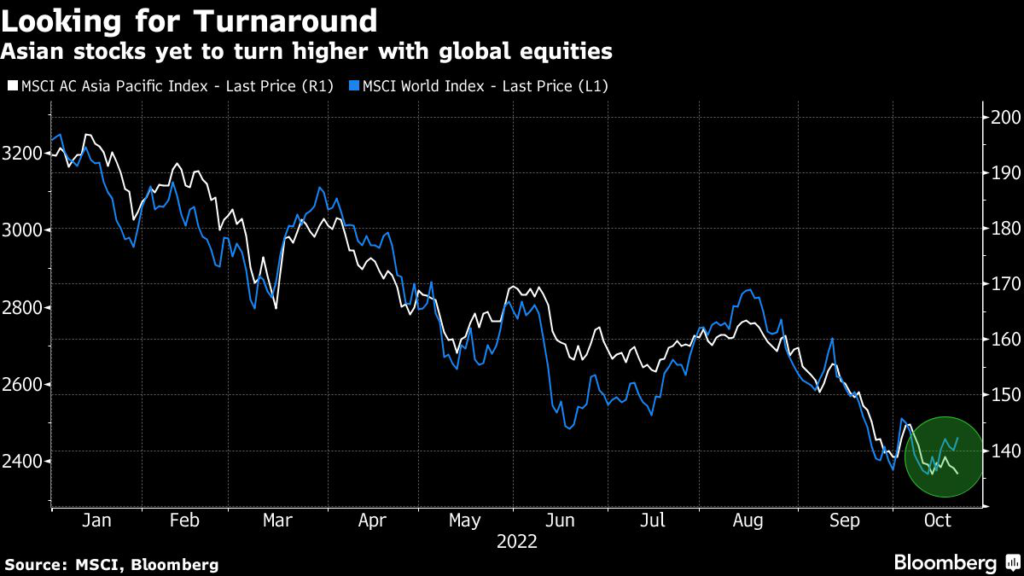
Hong Kong’s benchmark share index dropped more than 4% as investors contended with the delayed release of China’s economic growth data and the conclusion of the party congress in Beijing, which saw Xi Jinping tighten his grip on power. 

Equities were higher in Japan, South Korea and Australia while US futures advanced after stocks on Wall Street had their best week since June. 

Trading in major currencies was choppy, with the yen swinging between gains and losses amid signs of a second intervention from Japanese authorities in two sessions. Volatility is set to continue, with the government’s efforts to curb rapid depreciation running counter to the Bank of Japan’s ultra-loose monetary policy.

The pound lost most of an earlier spike higher that came as Boris Johnson pulled out of the race to lead the UK’s ruling Conservative Party, putting Rishi Sunak closer to becoming the next prime minister. 

More broadly across markets, investors are looking beyond the present state of aggressive monetary tightening by the Federal Reserve to the next phase, which may see a slowing or pause in interest-rate hikes.

That’s providing support amid headwinds from the war in Ukraine to risks from China. The outcome Sunday of the party congress in Beijing suggests Xi’s Covid-zero campaign will continue to slow the economy and has also fueled speculation that his “common prosperity” goal may even lead to property and inheritance taxes. 

The offshore yuan weakened to approach a record low seen last week. The People’s Bank of China set the yuan fixing at 7.1230 per dollar, away from the recent pattern of near 7.11 per dollar. 

The S&P 500 jumped 2.4% Friday amid an increase in appetite for bullish US equity wagers following an equity rout that’s already erased $13 trillion in market value this year.

Ten-year Treasury yields fell further on Monday, to below 4.20%, after reversing a surge on Friday. Yields also opened lower in Australia, led by the policy-sensitive three-year maturity.

St. Louis Fed President James Bullard and his San Francisco counterpart Mary Daly made clear they expect the discussion at the November gathering to include debate on how high to raise rates and when to slow the pace of increases. They stressed the need to keep tightening for now.

Key events this week:

  • Earnings due this week include: Apple, Microsoft, Exxon Mobil, Ford Motor, Credit Suisse, Airbus, Alphabet, Amazon, Bank of China, Boeing, Caterpillar, Cnooc, Coca-Cola, HSBC, Intel, McDonald’s, Mercedes-Benz, Merck, Samsung Electronics, Shell, UBS, UPS, Vale, Visa, Volkswagen
  • PMIs for Eurozone, US, Monday
  • US Conference Board consumer confidence, Tuesday
  • Bank of Canada rate decision, Wednesday
  • ECB rate decision, Thursday
  • US GDP, durable goods orders, initial jobless claims, Thursday
  • Bank of Japan policy decision, Friday
  • US personal income, personal spending, pending home sales, University of Michigan consumer sentiment, Friday

Some of the main moves in markets:

Stocks

  • S&P 500 futures rose 0.3% as of 11:20 a.m. Tokyo time. The S&P 500 rose 2.4% Friday
  • Nasdaq 100 futures rose 0.4%. The Nasdaq 100 rose 2.4%
  • Australia’s S&P/ASX 200 Index rose 1.7%
  • The Topix index rose 0.8%
  • South Korea’s Kospi index rose 1.1%
  • Hang Seng Index fell 4.2%
  • Shanghai Composite Index fell 0.7%
  • Euro Stoxx 50 futures rose 1%

Currencies

  • The Bloomberg Dollar Spot Index rose 0.4%
  • The euro fell 0.3% to $0.9832
  • The Japanese yen fell 0.9% to 148.95 per dollar
  • The offshore yuan fell 0.6% to 7.2742 per dollar
  • The British pound rose 0.1% to $1.1315

Cryptocurrencies

  • Bitcoin fell 0.3% to $19,437.66
  • Ether rose 2% to $1,356.22

Bonds

  • The yield on 10-year Treasuries declined four basis points to 4.18%
  • Australia’s 10-year bond yield fell two basis points to 4.18%

Commodities

  • West Texas Intermediate crude rose 0.2% to $85.24 a barrel
  • Spot gold fell 0.3% to $1,652.85 an ounce

More stories like this are available on bloomberg.com

©2022 Bloomberg L.P.
Asia Earnings Week Ahead: HSBC, Samsung, SK Hynix, Canon, BYD

(Bloomberg) — It’s been an unusually exciting weekend for traders as Chinese President Xi Jinping unveiled the country’s new set of decision makers over the next five years on Sunday and told journalists that the nation’s economy is “resilient” with ample potentials. He also stressed that the country will keep deepening reform and opening up of its economy as China and the world need each other. 

Meanwhile, South Korea policy makers held an emergency meeting on the same day and pledged at least 50 trillion won ($34.7 billion) in support for credit markets to reduce default risks. In UK, Boris Johnson pulled out of the contest to lead the ruling Conservative Party, leaving Rishi Sunak, the former chancellor of the exchequer, on the brink of becoming the next prime minister.

Investors may also want to keep a close eye on several of Asia’s key earnings reports this week, as the market looks to assess the impact of a strong dollar amid increasing expectation that the Federal Reserve will continue to tighten monetary policy.

HSBC Holdings is set to report Tuesday and it is worth watching out for whether a weaker pound has affected its group profit. Analysts are also keen to hear comments from Samsung Electronics, SK Hynix and Canon on the Korean won and the yen to see whether benefits brought by currency depreciation are enough to offset the impact of sluggish demand and lower product prices.

On the ESG front, Longi Green, the world’s biggest solar panel maker, and Chinese electric carmaker BYD are scheduled to release results on Friday. The spotlight will be on any mention of benefits associated with the Chinese government’s push for a low-carbon economy, as well as cost reduction measures and market demand outlook.

  • To subscribe to earnings coverage across your portfolio or other earnings analysis, run NSUB EARNINGS function on the Bloomberg terminal.
  • For more on what’s going on in other regions, see the US Earnings Week Ahead or the EMEA Earnings Week Ahead, and see the ESG Stock Watch for a selection of the environmental, social and governance themes that may come up on this week’s earnings calls.
  • Follow results, analysis and market reaction to reports by HSBC and Samsung in real-time on the TOPLive blogs this week.

Highlights to look for this week:

Monday: No major earnings expected.

Tuesday: HSBC (5 HK) is due to announce results around noon. The bank’s profit is likely to suffer from sterling weakness as its cost-to-income ratio is below 100% in the UK, according to Bloomberg Intelligence. Consensus estimate shows a 1.6% sequential growth in its third-quarter adjusted pretax profit amid increasing uncertainty in the global economy. Cost outlook and credit-loss charges are also in focus. Further cost savings beyond the $5.5 billion currently targeted could be required, analysts including Jonathan Tyce wrote. Helped by rising interest rates and a prime rate hike in Hong Kong, its mortgage rates may become a key driver of earnings growth. HSBC is now shifting its focus to Asia while culling some operations that are no longer deemed relevant. Investors are also closely monitoring any further comments from the bank on a push by some shareholders including Ping An Insurance Group to spin off its Asian operations. Any new net-zero commitments would be of interest as well, especially after a UK watchdog recently reprimanded HSBC for violating environmental advertising rules in a poster campaign.

Wednesday: SK Hynix (000660 KS) is set to release third-quarter results before market open. The world’s second-largest memory chipmaker may report a 39% decline in operating profit for the three months ended September, while sales are expected to gain 4.8% from a year earlier, according to consensus estimate in a Bloomberg survey. The market is watching for comments on possible output cuts, its forecast for 2023, the timing of a chip price rebound and impact from the US’s export curbs on China. A bigger-than-expected decline in average selling prices of DRAM and NAND offset the benefit from weaker won, according to EBEST Investment & Securities. The brokerage also estimated that SK Hynix may post 247 billion won in operating loss next year after a 9 trillion won profit this year.

  • FX Factor: Canon (7751 JP) is set to announce third-quarter results after market close. The Japanese imaging solutions company is expected to report a 59% surge in operating profit, according to consensus estimate in a Bloomberg survey. Bloomberg Intelligence said cameras and printers will be key sales growth drivers this year as the trend for office reopenings and live-video streaming accelerates, while medical and chipmaking equipment may be muted coming off a strong base in 2021. With the yen having weakened past 149 to the dollar, investors will also be curious to learn whether the company will revise its assumed rate of 133 yen and boost its full-year forecast accordingly.

Thursday: Samsung Electronics (005930 KS) is due to provide net income and details of divisional performance with its full quarterly earnings report in the morning. When announcing third quarter earnings guidance earlier this month, South Korea’s largest company said operating profit fell by 32% to 10.8 trillion won for the three months ended September, missing analysts’ estimate of 12.1 trillion won. Sales also missed estimates, coming in at 76 trillion won. Its third-quarter operating profit disappointment could lead to a decrease in fourth-quarter profit expectations by 5%-10% on weak memory chip demand and won depreciation might not be enough to offset that, according to Bloomberg Intelligence. During its conference call scheduled at 10 a.m. local time, investors will likely focus on the company’s comments on M&A, shareholders return plan and any possible production cut.

Friday: BYD (1211 HK) plans to release third-quarter results after market close. The Warren Buffett-backed company expected as much as a 365% jump in third-quarter profit to 5.9 billion yuan ($815 million). The ability to make batteries and semiconductors on its own helped BYD avoid disruptions that have hurt rivals including Tesla. Robust order backlog suggests its new models are driving demand despite higher vehicle prices, Bloomberg Intelligence wrote. The Shenzhen-based group and other Chinese EV makers such as Xpeng and Nio are benefiting from their ability to pass on surging raw material costs and from higher demand, which could extend into 2023 with zero purchase tax for EVs, BI added. 

  • ESG in focus: Longi Green Energy Technology (601012 CH) is due to report earnings after market close in Shanghai. The solar panel maker on Oct. 13 reported an up to 48% year-on-year increase in preliminary net income for the first nine months ended September. It cited rising sales of silicon wafers and modules, and significant increases of investment returns and foreign exchange income as contributors to the profit gain. Citi analyst Pierre Lau wrote in a note that the company’s earnings should rise quarter-on-quarter in the October-December period on the back of growth in solar installations globally. The bullish dollar will also help due to Longi Green’s strong export focus, he added.

–With assistance from Charlotte Yang.

(Updates top graphs with details on China Party congress and South Korea credit support.)

More stories like this are available on bloomberg.com

©2022 Bloomberg L.P.
Taiwan Needs Diverse Trade Amid US-China Row: Finance Chief

(Bloomberg) — Taiwan needs to diversify its trade away from China, the island’s finance minister said, citing uncertainties created by Covid Zero and rising geopolitical tensions between Washington and Beijing.

The recent US technology curbs imposed on China have “increased the uncertainty of the market,” Finance Minister Su Jain-Rong said in an interview on Friday, after the APEC finance ministers’ meetings in Bangkok. He added that one of Taiwan’s goals is to “try to diversify our trade partners, our trade market, so that we are not going to put all our eggs in one basket.”

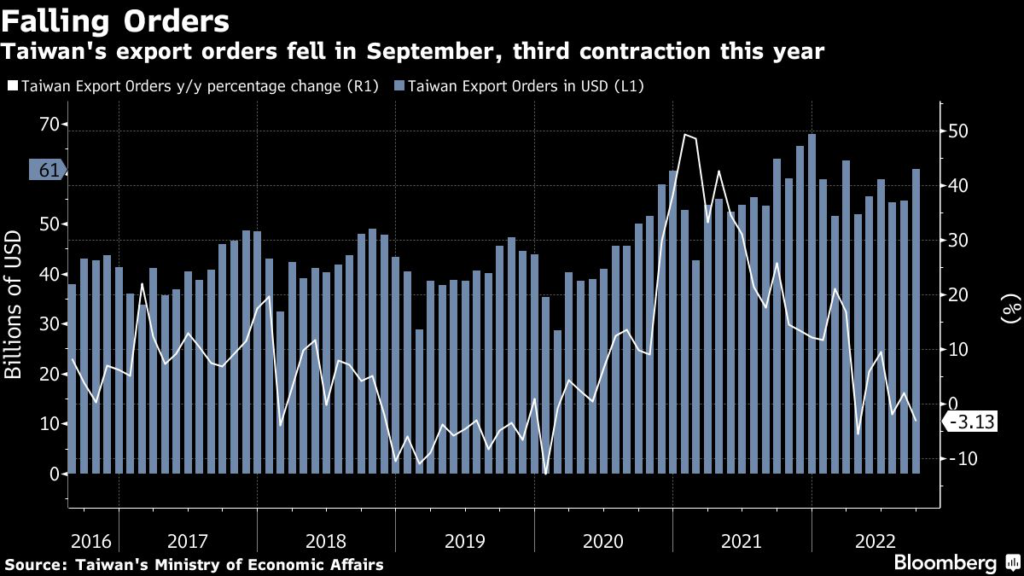
Taiwan’s trade has been pressured this year by waning demand from China and around the world, which has weighed on the export-dependent economy. Overseas shipments contracted in September for the first time since 2020, while export orders declined for the third time this year. 

Officials have largely attributed the drop-off to China as Covid restrictions and a property slump are depressing consumer and business confidence there.

Escalating US-China tensions have further clouded Taiwan’s outlook and rattled the global semiconductor industry. After the US announced tighter controls over chip exports to China this month, shares in Taiwan Semiconductor Manufacturing Co. fell the most in 28 years. The Taiwanese firm makes chips for major companies that rely on the Chinese market for much of their business, while also taking in about 10% of its own revenue from China-based customers.

Su said he had not talked formally during the week with US Deputy Treasury Secretary Wally Adeyemo, but said he thinks both sides are looking at the US-China relationship.

“The United States is concerned about the supply chains of advanced chips,” he added.

Taiwan’s exports to China and Hong Kong, he added, have declined over the past couple of years due to Covid restrictions and US-China disputes, slipping below 40% of the island’s total exports.

Su said Taiwanese businesses have already started relocating factories from China to Southeast Asia — not so much in the semiconductor industry, but in machinery and other labor-intensive sectors. Vietnam and Thailand are targets, he added.

Taiwan has been looking to diminish its dependence on China in recent years, and has explored ways to bolster trade and investment with Southeast Asia, India, Australia and New Zealand. Taipei last year asked to join one of the Asia-Pacific’s biggest working trade deals, though its application is still pending.

The finance minister also said Taiwan is looking “very carefully” at how to manage financial stability, as the local dollar has weakened this year and as the benchmark Taiex Index has declined. Global funds have pulled a net $47 billion from local equities in 2022, putting Taiwan on track for its biggest annual outflow in more than two decades.

Taiwan’s financial regulator ratcheted up rules on short selling Friday as a way to stabilize its equities market amid a continued global rout. The tightening, which is the third such measure since the end of September, comes as the benchmark Taiex has tumbled nearly 30% this year, ranking among the world’s worst-performing gauges.

The Taiex was up 1.3% as of 9:16 a.m. Monday morning after gaining as much as 1.6% earlier, the first gain in four days, after those regulatory curbs were announced.

The Federal Reserve’s interest rate hikes cause “a lot of problems for financial markets around the world, not just Taiwan,” he said. Another issue is the increasing costs of imports – since Taiwan brings in a lot of its raw materials from abroad, imported inflation is another risk, he said.

Should the Fed continue raising rates, the “Taiwanese dollar and financial stability may be affected significantly,” Su said. “It’s not easy to handle it, but we have to face it.”

(Updates with market reaction to regulatory curbs in paragraph 13.)

More stories like this are available on bloomberg.com

©2022 Bloomberg L.P.

After $50 Billion Wipeout, More Pain Ahead for Kakao Investors

(Bloomberg) — After a $50 billion wipeout in market value this year, more pain may be in store for investors in Kakao Corp. and its affiliates as the Korean tech group’s monopoly-like status draws a steady stream of criticism.

Once hailed as a symbol of Korean innovation, Kakao’s market value reached a peak of over $60 billion last year on a pandemic boost as a “stay-at-home” beneficiary and gains from the listing of several subsidiaries.

Its fall from grace mirrors moves to minimize the power of tech giants from the US to China. A recent data center fire that caused an outage of South Korea’s No. 1 messaging app added force to a public campaign since last year to curb Kakao’s influence. Lawmakers will question company founder Brian Kim in a hearing on Monday.

“Kakao has become a monopoly so the perception has changed,” said Hong Chunuk, chief executive at Frism Investment Advisory Inc. and former economist at National Pension Service. “It has become a target of public disdain.” 

The blackout of Kakaotalk, which is used by the nation’s central bank to announce rate decisions and by government officials to discuss national security issues, heightened calls for oversight. Rival Telegram said it saw a surge in downloads in South Korea as users sought alternatives.

The company’s recent fintech spinoffs have seen the steepest declines, with shares of Kakaopay Corp. plunging 80% since the start of the year and KakaoBank Corp. down more than 70%. Combined market cap loss for Kakao, KakaoBank, Kakaopay and Kakao Games Corp. reached $50 billion this year through last Friday.

“They are some of the stocks that surged the most last year,” said Frism’s Hong. “There is also the issue of an increased number of stocks in the market after split-offs and listings of units, which also give a holding company discount to Kakao.”

Shares of Kakao and rival Naver Corp., which has also been a target of criticism for market dominance, have fallen about 56% each this year.

Margin Calls 

The sharp share-price losses appear to already have triggered margin calls for highly leveraged retail traders, as Kakao and its affiliates are popular among South Korean retail investors, Hong said.

Kakaopay and KakaoBank separately confirmed to Bloomberg that they took measures to help employees who may be facing margin calls after buying shares in the initial public offerings. Investors can sometimes be forced to sell shares to meet margin calls. 

Less Bullish 

A flurry of brokerages lowered their price targets on Kakao following the Oct. 15 fire. JPMorgan analyst Stanley Yang slashed his target 39% to 46,000 won, the lowest among 33 analysts polled by Bloomberg.

Credit Suisse lowered its rating to neutral from outperform last week, a rare downgrade for a stock that still has 27 buy ratings. Analysts are less sanguine on the listed units, with four sells on Kakaopay and three on KakaoBank.

Big Short

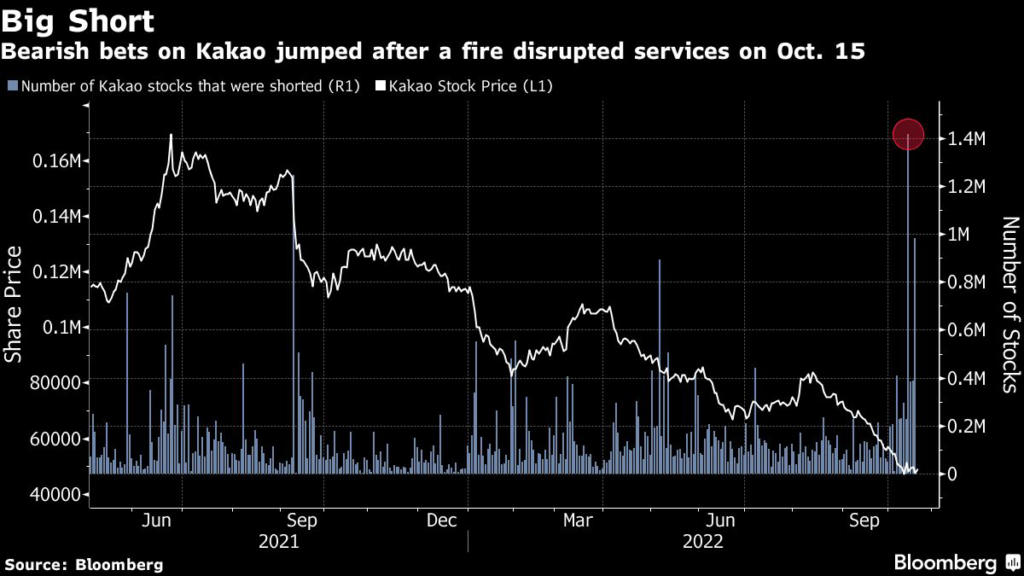
In another bearish sign, daily short sales of on Kakao’s stock jumped to the highest on record last Monday and remained elevated through the rest of the week.

Kakao may struggle to gain new users as public opinion sours, said Gu Sungjoong, an analyst at DS Investment & Securities Co. “There’s potential concern about increased regulations on platform services that could limit its service expansion.” 

–With assistance from Filipe Pacheco and Karen Yang.

More stories like this are available on bloomberg.com

©2022 Bloomberg L.P.

Close Bitnami banner
Bitnami