Bloomberg

The Bitcoin Futures ETF at 1: $1.8 Billion Lured, Over Half Lost

(Bloomberg) — A year on from its blistering debut, America’s first Bitcoin futures ETF has been an almost unqualified success, unless of course you’re invested in it. 

Operationally speaking, it’s performance has been near-flawless. A slew of worries over cryptocurrency volatility, the depth of the market for futures and the cost of rolling its underlying contracts have all fallen by the wayside in 12 months of solid functioning for the ProShares Bitcoin Strategy ETF (ticker BITO).

The ETF has enjoyed strong demand from loyal investors and in return has — as promised — successfully tracked the biggest digital asset.

It’s performance, on the other hand, is another story.

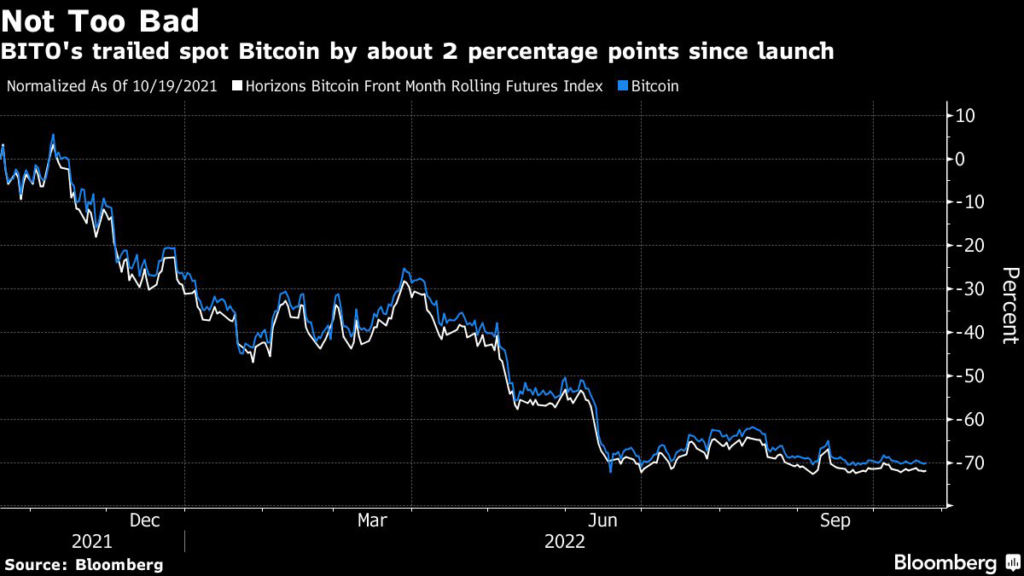
The fund has slumped over 70% since its launch, tracking a crypto collapse that dragged Bitcoin to around $20,000. At a year old, BITO has posted cumulative inflows of more than $1.8 billion, and yet as of Friday had just $619 million left. 

“It’s been a bad year — we’re looking at $1.2 billion burned,” said James Seyffart, a Bloomberg Intelligence analyst. “But if you just want exposure to Bitcoin, BITO is the best option in the ETF landscape, at least in the US.”

And investors have piled in. In the 12 months since the launch, only two saw outflows, even as digital-asset prices cratered. 

BITO’s inauguration last year was a watershed moment that saw the fund notch a number of superlatives: its debut was the second-most heavily traded on record, and it reached $1.1 billion under management in just two days, a record. For crypto investors, it was memorable because it marked a big step by the industry into the staid world of traditional finance. On the back of the enthusiasm surrounding the launch, Bitcoin’s price rallied to new peaks, touching nearly $69,000 a few weeks later. 

But, the ETF wasn’t exactly what die-hard fans had wanted. The fund doesn’t hold Bitcoin directly. Instead, it is based on futures contracts and was filed under mutual fund rules that Securities and Exchange Commission Chairman Gary Gensler had said provided “significant investor protections.” 

US regulators have been hesitant to approve a product that tracks the real coin, citing volatility and manipulation, among other things. 

Luckily for BITO, fears about its roll costs — which are associated with having to continually roll futures forward as they expire, and which was a feature that proved to be a source of much hand-wringing at the fund’s debut — have been largely unfounded. 

“One could certainly argue that BITO has actually worked and performed as intended all while offering investors an SEC-approved wrapper with the convenience, liquidity and transparency of an investable ETF,” said Gregory d’Incelli, co-founder of Scenius Capital Management. 

Bloomberg Intelligence had estimated that maintaining exposure to the front-month contract would cost investors 10 to 20 percentage points of performance per year, and issuers such as Bitwise Asset Management nixed plans on their own Bitcoin futures ETF over those potentially expensive costs. Instead, BITO has trailed the performance of spot Bitcoin by just about two percentage points in the past year, Bloomberg data show.

The late 2021 premiere was also inopportune as crypto prices have since floundered. Bitcoin has suffered as the Federal Reserve and other central banks raised interest rates, creating a less-favorable environment for riskier assets. 

“BITO is one of the most ill-timed ETF launches in history, with its debut nearly perfectly coinciding with the price of spot Bitcoin topping out,” said Nate Geraci, president of The ETF Store, an advisory firm. “The upside of that extremely poor timing is that the Bitcoin futures curve flattened out, minimizing the negative impact of rolling contracts every month.”

But overall, all the pearl clutching over the fund’s suboptimal futures-based structure is still warranted, according to Geraci. 

“The bottom line is that BITO still underperformed — even during an absolutely brutal crypto winter.” If, and when, the crypto space turns around, he said, “expect the futures curve to steepen and the negative performance gap between BITO and spot Bitcoin to widen.”

“Meanwhile…Still. No. Spot. Bitcoin. ETF.”

–With assistance from Sam Potter.

More stories like this are available on bloomberg.com

©2022 Bloomberg L.P.

Ukraine Latest: ‘Massive’ Russian Strikes Target Power Equipment

(Bloomberg) —

Russia launched dozens of rockets against Ukraine in a “massive attack” on Saturday, said President Volodymyr Zelenskiy. Although “most” were struck down, missiles hit key energy targets across several cities, leaving some 1.5 million Ukrainians without power. Ukraine’s foreign minister called the deliberate strikes on critical civilian infrastructure “part of Russia’s genocide.” 

Russian annexation authorities issued an urgent evacuation order for the city of Kherson, telling civilians to depart immediately. 

Zelenskiy said Moscow is deliberately slowing exports of grain from Ukrainian ports in a bid to prolong a global food crisis, with more than 150 ships waiting to gain access to Black Sea ports. Putin has repeatedly criticized the grain shipment agreement his government agreed to in July.  

(See RSAN on the Bloomberg Terminal for the Russian Sanctions Dashboard.)

Key Developments

  • Blinken Says Iran May Be Sending More Drones to Russia
  • Russian Strikes Cause Massive Damage to Ukraine’s Power Grid 
  • Ukraine Crop Deal Fears Boost Food Costs and Slow Shipments
  • IMF to Advance Monitoring Program Work as Ukraine Seeks Aid
  • The Private Jet That Took 100 Russians Away From Putin’s War

On the Ground

Ukrainian troops shelled Shebekino in Russia’s Belgorod region near the Ukrainian border, killing two people, the area’s governor said. There was no comment from Ukraine and no confirmation. Regions across Ukraine faced airstrikes overnight as the Kremlin continues to deliberately target civil infrastructure. Many missiles were shot down; others hit energy facilities. Kharkiv, Ukraine’s second largest city, was also hit in past day, with 11 civilians injured after a missile attack on an industrial facility, according to local governor. The Ukrainian aviation carried out 16 strikes on Russian military facilities, air defense shot down a Russian Su-25 aircraft and one Orlan-10 unmanned complex.

(All times CET)

Electricity Services Resume in Some Regions (4:07 p.m.)

The lights were back on as Ukrainian repair workers fixed damages to local power grid in southern Mykolaiv region, one of several that faced missile attacks from Russia Saturday morning. 

“Connection plus, light plus,” regional governor Vitaliy Kim wrote on his Telegram-account.

Annexation Authorities Order Rapid Kherson Evacuation (3:33 p.m.)

Russian-installed authorities ordered all civilians in the southern city of Kherson to leave “immediately” ahead of an expected advance by Ukrainian troops and take “documents, money, valuables and clothes.”

In a Telegram post that added urgency to previous statements, the pro-Kremlin administration called on civilians to use boat crossings over the Dnipro River to move deeper into Russian-held territory, citing a tense situation at the front. 

There was no immediate comment from Ukrainian authorities. Kyiv has warned that Russia has mined and may attempt to blow up the Kakhovka dam on the Dnipro River above Kherson, causing massive flooding downstream. 

Zelenskiy Says Russia Launched 36 Rockets on Saturday (3 p.m.)

Ukraine’s president said Russia “launched a massive attack” on Saturday of some 36 rockets, most of which were shot down by Kyiv’s air defenses. Some missiles hit key energy targets, though, in a continuation of the Kremlin’s attack on civilian infrastructure. 

“To all energy workers and services that are currently working at the sites of impact and restoring our infrastructure. You are our heroes!” Zelenskiy said on his Telegram channel. 

Kyiv Stocks Up on Mobile Power Supplies (2:41 p.m.)

Authorities in Kyiv are buying mobile boiler-rooms amid fears that Russian air strikes on energy infrastructure may lead to a temporary collapse of its centralized heating, Ukrayinska Pravda reported, citing Deputy Mayor Petro Panteleyev. 

Kyiv started its new heating season — which typically runs from late October through mid-April — on Friday despite relatively mild weather that’s eased some pressure on the grid. Authorities have called on residents to conserve power amid heavy shelling from Russia on the country’s energy infrastructure in recent weeks.

Ukraine’s government has warned citizens to prepare for a difficult winter marked by potential rolling blackouts. 

Almost 1.5 Million Ukrainians Facing Blackouts (1:44 p.m.)

More than 1.4 million Ukrainians are without power after Russia’s repeated missile strikes on the country’s energy infrastructure on Saturday, said a top aide to President Volydymyr Zelenskiy. Water supplies have also been disrupted. 

Extensive power cuts were reported is Khmelnytskyi, about 350 km (217 miles) southwest of Kyiv and even further from the front lines in the Donbas and Kherson regions. More than 670,000 residents are without power there, or more than half the region’s population, said Kyrylo Tymoshenko, deputy head of the presidential office. Explosions were also reported in the Volyn and Rivne regions, even further west. 

Biden Focuses on Ukraine in Message to Italy’s Meloni (2 p.m.)

US President Joe Biden focused on the war in Ukraine as he lauded Giorgia Meloni on becoming Italy’s new prime minister, the first woman to hold that role. 

“As leaders in the G-7, I look forward to continuing to advance our support for Ukraine, hold Russia accountable for its aggression, ensure respect for human rights and democratic values, and build sustainable economic growth,” Biden said in a statement. 

Ukraine President Volodymyr Zelenskiy also offered congratulations, saying he looked forward to “continued fruitful cooperation to ensure peace and prosperity in Ukraine.” 

Germany’s Scholz Says Rebuilding Ukraine Must be Global Effort (10 a.m.) 

Rebuilding Ukraine will be a task the European Union can’t shoulder alone as it’s an effort that will require financing for decades, German Chancellor Olaf Scholz said in a video statement. 

Scholz, as part of Germany’s G7 presidency, will host a conference in Berlin on Tuesday to discuss what investments are needed and how to organize funding, he said. 

The gathering is meant to send “a sign of hope now, in the midst of the horror of war, that things are looking up again,” he said.

Widespread Strikes Continue on Energy Facilities (9:30 a.m)

Russian forces made multiple strikes on Ukraine’s power plants and other energy infrastructure on Saturday, including in western and central regions as well in the Odesa region on the Black Sea coast. Targeting of power and water facilities increased on Oct. 10 and has continued. 

Ukraine’s power grid operator NPC Ukrenergo limited electricity supplies in Kyiv and at least ten other regions.  

Targeting of civilian infrastructure has increased as Kremlin troops have suffered multiple setbacks on the battlefield, including what now looks like a retreat from the southeastern Kherson region. 

Russian Forces in Kherson Prepare for Street Battles, Withdrawal (8:30 a.m.) 

A significant part of the population of Kherson has left, and remaining Russian military in the city dress in civilian clothes and have moved into abandoned buildings in the southeastern city, Ukraine’s military said.  

The Institute for the Study of War said Russia’s withdrawal from western Kherson oblast has begun, weeks after the region was illegally annexed by Putin. The troops likely intend to continue their retreat for several weeks, “but may struggle to withdraw in good order if Ukrainian forces choose to attack,” the US-based think tank said. 

Russia “will likely attempt to blow up the dam at the Kakhovka hydroelectric power plant to cover their withdrawal,” ISW said. Zelenskiy and other officials have warned of the potential for Russia to blow up the dam and called for urgent international intervention. 

Zelenskiy Blames Russia for Massive Grain Ship Backlog (8 a.m.) 

President Volodymyr Zelenskiy said Russia is attempting to undermine the safe-transit deal for three Black Sea ports it agreed to in late July and creating a backlog of “more than 150 ships” waiting to load wheat, corn and other products. 

“This is an artificial queue,” Zelenskiy said Friday in his nightly video address. “It arose only because Russia is deliberately delaying the passage of ships.”

Ukraine has shipped more than 8 million tons of farm products since August, but “under-exported” about 3 million tons because of the shipment delays, Zelenskiy said, estimating that at “the annual volume consumption of 10 million people.” 

Read more: Ukraine Crop Deal Fears Boost Food Costs and Slow Shipments

Blinken Warns of More Iranian Drones on Battlefield (3:30 a.m.)

Blinken said more Iranian military drones may be on their way to Russian forces, as the US reiterated its condemnation of Tehran for aiding President Vladimir Putin’s invasion. 

“We believe that Russia’s received dozens of these UAVs so far from Iran, with more potentially in the works,” Blinken told reporters at a briefing alongside French Foreign Minister Catherine Colonna on Friday, referring to unmanned aerial vehicles. 

Blinken spoke a day after the White House accused Iran of sending trainers and technicians to Crimea to help advise and support Russian attacks on Ukrainian targets. He added that the US was working to counter Iran’s efforts and bolster Ukraine’s ability to ward off attacks.

Russian, US Defense Chiefs Speak for First Time Since May (3:22 p.m.)

Russian Defense Minister Sergei Shoigu discussed the Ukraine war and other global security issues with US counterpart Lloyd Austin, Tass said, citing the Russian Defense Ministry.

The brief report provided no other details of the phone call. In a separate readout, the Pentagon said Austin “emphasized the importance of maintaining lines of communication amid the ongoing war.” The US last announced a call between the two on May 13.

Austin also spoke on Friday with Ukraine’s Defense Minister Oleksii Reznikov, the Pentagon said.   


More stories like this are available on bloomberg.com

©2022 Bloomberg L.P.

Economy Moves to Front for Democrats Trying to Hold on in Key Midterm Races

(Bloomberg) — Sign up for the New Economy Daily newsletter, follow us @economics and subscribe to our podcast.

From hardscrabble mining communities to affluent New Jersey suburbs, GOP attacks on the economy are forcing Democratic House candidates in must-win Northeast districts to confront an issue that has bedeviled them.

Persistent inflation and fears of a recession have become a simple rallying cry for Republicans who blame economic woes on spending by President Joe Biden and Democrats. For Democrats, the counterattack is more complicated. 

The party’s incumbents in three toss-up districts in Pennsylvania and New Jersey — Tom Malinowski, Matt Cartwright and Susan Wild — are rushing to write closing arguments on the make-or-break issue of the November election. 

In dozens of interviews, voters brought up issues including abortion, gun rights and crime. But they all eventually come back to the economy. Inflation is running near a 40-year high, and Bloomberg Economics projects the US will slip into a recession next year as the Federal Reserve combats rising prices by lifting interest rates. 

Malinowski-Kean

At a recent event at a home in Readington, Malinowski highlighted recently passed laws to lower drug prices and boost semiconductor manufacturing.

“I have something to talk about and it feels so good,” Malinowski told dozens of Republicans and Democrats over cocktails and finger food.

But Steve Foster, a retired marketing executive and Malinowski supporter, worries it won’t work. Malinowski’s policy-heavy message, he said, is no match against GOP challenger Tom Kean Jr.’s simple argument that Malinowski helped Biden and Speaker Nancy Pelosi drive inflation. 

“I can’t tell what Tom’s 20-second story is,” Foster said.

The two-term congressman’s central New Jersey district now includes more GOP-leaning rural areas, further giving Republicans an edge. 

Malinowski gained ground against Kean — the former state Senate GOP leader and son of a popular former governor — amid backlash to the Supreme Court’s decision overturning national abortion rights. But voter attention is shifting back to what Republicans have dubbed “Bideninflation.” 

Malinowski ardently defends Covid-era federal spending while campaigning, saying he makes “no apology” for preventing another Great Depression.

“Everything is going up. The only thing going down is politicians’ poll numbers,” Craig Halloran, 68, said outside an Oct. 13 debate at a Holiday Inn in Clark.

During a debate with Malinowski, Kean said he wants to “break the back of inflation” by reversing “out-of-control” spending and lowering taxes. But he refused later to answer questions about what spending cuts he would make. His campaign also declined an interview request.   

His spokesman, Harrison Neely, said Kean would prioritize cutting the Internal Revenue Service tax audit budget and clawing back Covid-era relief given to deserving businesses like golf courses, neither of which would put much of a dent in the federal budget. 

Neely also said, “Tax relief for the middle class should be part of the equation.” Cutting taxes, though, could stoke inflation further. 

Malinowski says he wants to combat inflation by cracking down on price gouging, boosting legal immigration to address worker shortages and punishing OPEC nations to motivate them to lower oil prices. 

Many economists say price-gouging isn’t the root cause of today’s inflation. And Malinowski’s plan to bring more manufacturing to the US isn’t a quick inflation fix.


Some local Republicans said they liked the policy-heavy pitch and are enthused about an immigration deal to add more workers.

“I guess he’s made me into a RINO,” Readington resident John Reardon said, using the acronym for Republican in name only.

Wild-Scheller

Wild’s district is centered in the Lehigh Valley, — Pennsylvania’s third-largest metro area which includes Allentown, Bethlehem and Easton. Redistricting added struggling former coal mine communities in mountainous Carbon County — a boon for Republicans who are confident they can win there. 

“People, whether you are a Republican that made the mistake of not supporting Donald Trump in 2020 or independents or some Democrats, they have realized what a disaster the Biden economy is,” Lehigh Valley GOP Chair Joe Vichot said in an interview. 

Although Democrats in some races focus on abortion rights, Wild tells voters she’s primarily focused on lowering prices. 

“I feel the pain of people right now,” Wild said in a WFMZ-TV Allentown debate. “I pump my own gas, I buy my own groceries.” 

Wild says the area, which is home to Lafayette and Lehigh universities, needs higher-paying jobs. She envisions transforming the region into a high-tech manufacturing hub. 

The jobs issue is where she attacks GOP challenger Lisa Scheller, the chief executive of Silberline Manufacturing Co. Inc., which makes aluminum pigments. At an event with union workers at a shuttered Silberline plant in Lansford, Wild blasted Scheller for outsourcing jobs to China. 

“Personally I think it is always all about the money,” said Francis Loughney, 58. “If you look around town here you can see it is a depressed area.”

Scheller says it’s a “lie” to say she has sent US jobs overseas and touts her remaining factory with more than 160 workers. She said in an interview she’s growing her domestic business and that Wild doesn’t understand the difficulties businesses face. 

“We have been creating jobs in the United States since 1945 and in Pennsylvania continuously since 1963,” she said.

Scheller said she would block Democratic attempts to increase spending, cut the IRS budget and root out waste. 

Cartwright-Bognet

Pennsylvania’s northeast Eighth District race is a rematch between Cartwright and Jim Bognet. The district, which twice backed Donald Trump, was reconfigured to become slightly more Democrat-leaning. 

In his ads, Bognet blames Cartwright for inflation and reprises many of the attacks from the 2020 campaign. 

Cartwright, a five-term incumbent, says he can direct federal dollars to the Scranton area, which has yet to reclaim its coal-era glory, and the Poconos, where good-paying jobs are scarce. 

“Nobody expects a local congressman to revive an entire local economy but there’s a lot you can do as a senior member of the House Appropriations Committee,” he said. 

Cartwright claimed credit for millions in local projects, including $16.6 million to build a science and cybersecurity research facility at the University of Scranton. 

At an NAACP event in Stroudsburg, residents peppered Cartwright about plans to increase federal subsidies for home heating and housing. He said both were on the table. He rejects excess federal spending as a cause for inflation. 

“You would have to have something wrong with you to believe that, given that Europe and every other nation is experiencing the same post-pandemic inflation,” he said. 

Bognet, who declined an interview request, has stuck by the GOP inflation script. 

“We are about to enter a recession,” Bognet said at an Oct. 20 televised debate. “This recession is caused by the Biden-Pelosi-Cartwright inflation.”

More stories like this are available on bloomberg.com

©2022 Bloomberg L.P.
Polish Retailer CCC Seeks to Widen Investor Pool for Share Sale

(Bloomberg) —

CCC SA has changed plans for an upcoming share sale to broaden the offering to investors other than just its founder Dariusz Milek.

Shareholders in the Polish fashion retailer will on Nov. 17 vote on a new proposal to sell as many as 14 million shares to Milek and other selected investors. CCC will seek to sell the shares at 36.11 zloty ($7.45) apiece, an average price from the last two weeks. 

The Polkowice-based retailer previously planned to raise 500 million zloty from Milek alone. While selected investors will now be offered as many as 9.64 million of the shares on offer, Milek remains ready to buy them all if necessary. 

The change reflects “expectations of broader group of shareholders,” the company said in a draft resolution of the November meeting. 

CCC is facing a growing debt burden after years of spending on expanding into e-commerce and new brands. Its business, which operates in 28 countries, is also recovering from the impact of lockdowns during the Covid-19 pandemic. The retailer’s net debt stood at 1.8 billion zloty at the end of the year. 

Earlier this month, CCC reached an agreement with banks to change covenants on loans signed in 2021. It’s scheduled to meet with bondholders next week to seek agreement for no testing of bond covenants.

The company has said other funding options, including an initial public offering of e-commerce unit Modivo SA, remain difficult amid challenging conditions in the s.

Read more: Polish Bond Selloff Makes Equity Investors Even Pickier

More stories like this are available on bloomberg.com

©2022 Bloomberg L.P.
Charting the Global Economy: UK Recession Awaits Truss Successor

(Bloomberg) — Sign up for the New Economy Daily newsletter, follow us @economics and subscribe to our podcast.

Escalating inflation, higher borrowing costs and a likely recession are in store for Liz Truss’s successor as Britain’s prime minister.

UK consumer prices rose 10.1% last month, the first double-digit reading in four decades, and energy costs are set to soar further this winter. Euro-area inflation just managed to slip below the 10% mark, and the bloc’s economy is seen shrinking next year, led by a contraction in Germany.

Here are some of the charts that appeared on Bloomberg this week on the latest developments in the global economy:

UK

No matter who replaces Truss, the next British prime minister will inherit an economy damned for the immediate future by rising borrowing costs, crippling energy bills, high taxes and no strategy about how to revive growth. The incoming premier will struggle to craft a plan to rescue the UK from the recession it may already be in or its longer-term limits, no matter what’s said on the campaign trail.

Soaring food prices drove UK inflation back into double digits in September, intensifying pressure on the government and central bank to act. The Consumer Prices Index rose 10.1% last month from 9.9% the month before. That matched a 40-year high reached in July and exceeded economists expectations for 10%.

Europe

The euro-area economy is expected to shrink next year as it battles surging energy costs and the risk of shortages following Russia’s invasion of Ukraine. Output in the currency bloc will drop by 0.1% in 2023 — led by a 0.5% contraction in Germany — according to economists polled by Bloomberg who were still predicting growth of 0.3% a month ago.

The euro zone’s first-ever brush with double-digit inflation was revised away by a fraction in a fuller sample of data for September that still revealed rampant price pressures bearing down on the region. The annual rate of increase, which remains a record in the history of the single currency, is now measured at 9.9% instead of 10%, Eurostat said in a statement on Wednesday in Luxembourg.

Euro-area consumer confidence stayed close to a record low in October, highlighting the continued risk of a recession this winter as households struggle with surging inflation and an acute cost-of-living crisis.

US

US factory utilization last month matched the highest level in more than two decades, raising the risk that inflationary pressures will remain elevated in the near term. Some of the worst bouts of inflation in US history, such as the late 1970s, have emerged after utilization rates surpassed 80%.

Many Wall Street economists are holding firm to their bet that US inflation will slow substantially over the next year even as they’re being forced to keep raising their predictions for coming months.

Emerging Markets

Satellite images, loading and unloading data compiled from ports and vessel-location transmissions obtained by Bloomberg place ships like Amur 2501 at the heart of what industry experts say is Russian shippers’ illicit commodities trade. The exporters are mixing grain from multiple ports and vessels, obscuring the origin of commodities like wheat and barley, and allowing large volumes to be sold abroad without detection.

Asia

Japan’s inflation hit 3% for the first time in over three decades excluding the impact of tax hikes, an acceleration that adds to the doubts over the need for continued central bank stimulus.

Young Kiwis are increasingly opting out of workplace pensions in an early warning sign that the global cost-of-living crisis could have lasting consequences. With prices surging for everything from gas and rent to groceries and child care, Kiwis are taking more of their pay to cover expenses rather than putting it away for retirement, even though unemployment remains at a record low.

World

In the all-hands-on-deck economics of the pandemic, governments and their central banks shared the same goals. Now they’re starting to pull in different directions.

Turkey’s central bank lowered its benchmark interest rate for the third time in a row and by a bigger magnitude than forecast.

–With assistance from Philip Aldrick, Amy Bainbridge, Liz Capo McCormick, Samuel Dodge, David Goodman, Ben Holland, William Horobin, Harumi Ichikura, Reed Landberg, Yoshiaki Nohara, K. Oanh Ha, Reade Pickert, Áine Quinn, Augusta Saraiva, Craig Stirling, Liza Tetley, Ainsley Thomson, Alexander Weber and Erica Yokoyama.

More stories like this are available on bloomberg.com

©2022 Bloomberg L.P.
Chinese Chip Startup Shows Key Gap in Biden Export Curbs

(Bloomberg) — One of China’s most promising chip designers has already navigated through the Biden administration’s export restrictions and concluded it will be able to continue tapping Taiwan Semiconductor Manufacturing Co. to produce its advanced silicon.

Biren Technology develops artificial intelligence chips and is considered a promising domestic contender to compete with graphics chips from Nvidia Corp., which has said it can no longer sell its most advanced AI products into China. The US measures were designed to limit China’s development of technology that may be used in aid of its military, and appeared to rule out access to advanced fabrication, but Biren believes its AI chips produced by TSMC are not covered by the sanctions, according to people with direct knowledge of the matter.

Shanghai-based Biren, founded in 2019, made bold claims in the summer about its chips outperforming Nvidia’s market-leading A100 AI accelerator — the very product that can no longer be sold in China. But after reviewing the designs, TSMC and Biren concluded that the specs of the Chinese chip don’t meet the criteria for restriction, according to one of the people, who asked not to be named discussing a sensitive matter. That suggests Washington’s controls may not capture all alternatives to Nvidia’s hardware.

“Biren has a chip fortunately just below the threshold and the chip hence can still be made by TSMC,” Bernstein analysts led by Mark Li wrote in a report that analyzed chips against the export control.

The US Commerce Department’s Bureau of Industry and Security, which plays a key role in designing and enforcing export controls, announced the semiconductor restrictions on Oct. 7.

“While BIS cannot comment on company-specific actions, we expect all companies to comply with export controls,” a Commerce Department spokesperson said in an emailed response to a Bloomberg query. “Since the release of the rule on October 7, BIS has been undertaking a vigorous outreach effort to educate those impacted by it to aid compliance efforts.”

TSMC, the world’s largest contract chipmaker, complies with all relevant rules and regulations and “will continue to serve all customers around the world,” Chief Executive Officer C.C. Wei said in response to a question about China during its earnings call last week.

Biren believes everything it’s doing is in compliance with legal regulations, according to one of the people. TSMC is reviewing products from other Chinese chip developers to see whether it can continue their production under the new export controls, another person said.

Representatives for Biren and TSMC declined to comment. 

As the US banned exports of Nvidia and Advanced Micro Devices Inc.’s high-end AI-training chips to China, it set a performance threshold above which no semiconductors made with US technology can be sold in the country. The metrics include a combination of connectivity speeds and operations per second. Bernstein’s analysis shows the Biren BR100 falls just shy of that control cutoff.

Bernstein’s Li saw limited revenue exposure for TSMC from the new controls, stressing that “only very high-end compute chips are restricted” and estimating a hit of 0.4% to the Taiwanese company’s 2023 sales.

Still, while Biren may continue building its current generation of semiconductors, Washington’s curbs are likely to effectively cap its progress up the technology ladder. Additional improvements from Biren are liable to fall foul of the high-performance silicon restriction.

Biren, backed by the likes of IDG Capital and Walden International, was seeking new funds earlier this year at a valuation of $2.7 billion, Bloomberg News reported. Its flagship BR100 and BR104 processors are designed along similar lines to the graphics chips that Nvidia and AMD have adapted to AI purposes and are used to train artificial intelligence models and algorithms. Those include computer vision, natural language processing and conversational AI.

Washington’s latest salvo of restrictions triggered a selloff in Chinese tech stocks and narrowed the ability of international suppliers to sell or support chipmaking equipment in China. Netherlands-based ASML Holding NV withdrew support by US employees due to a new measure that precludes US citizens or green card holders from helping to make semiconductors that may have a military use in China. American suppliers like KLA Corp. and Lam Research Corp. also distanced themselves from the country’s top chip plants.

China’s Ministry of Industry and Information Technology summoned representatives from across its semiconductor sector to review the fallout from the latest US restrictions. Lawyers and executives at those firms are still assessing the full impact of the measures.

–With assistance from Eric Martin.

(Updates with Commerce Department comment in sixth paragraph)

More stories like this are available on bloomberg.com

©2022 Bloomberg L.P.

Bitcoin’s Changing Correlations May Mean It’s Becoming a Haven Again, BofA Says

(Bloomberg) — Bitcoin’s movements in relation to other assets may indicate that investors see it becoming a haven again, after a stretch where it’s traded basically as a risk asset, according to Bank of America Corp.

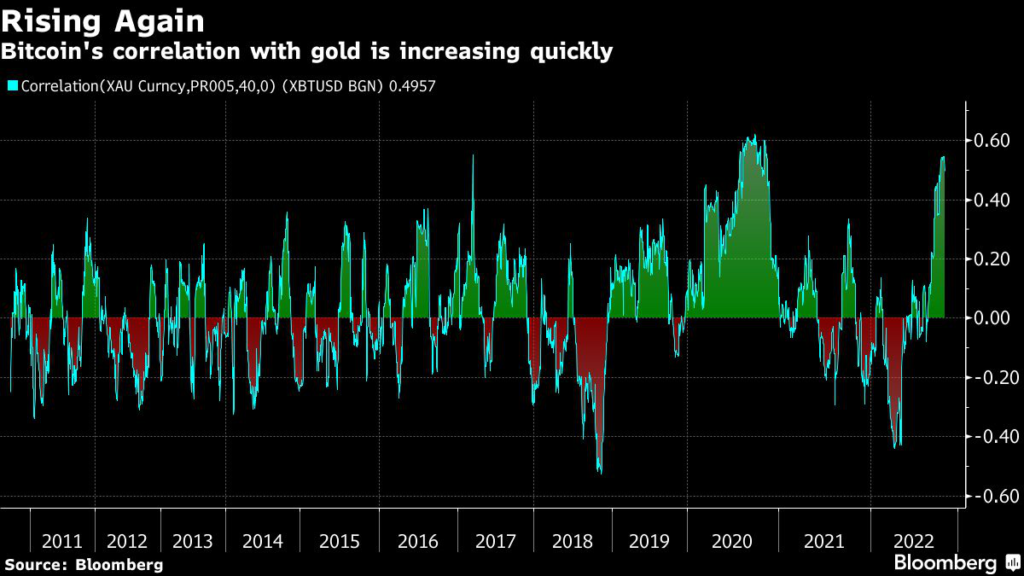
The largest cryptocurrency has a 40-day correlation with gold of about 0.50, up from around zero in mid-August. While the correlations are higher with the S&P 500, at 0.69, and Nasdaq 100 at 0.72, they’ve flattened out and are below record levels from a few months ago. BofA digital strategists Alkesh Shah and Andrew Moss see that as a sign that things could be changing.

“A decelerating positive correlation with SPX/QQQ and a rapidly rising correlation with XAU indicate that investors may view Bitcoin as a relative safe haven as macro uncertainty continues and a market bottom remains to be seen,” the strategists wrote.

Bitcoin has traded in near lockstep with risk assets in the past couple of years, as pandemic-era stimulus flooded the global economy, and then as central banks like the Federal Reserve hiked rates to combat worsening inflation. That’s contradicted one of the main investment narratives put forward by crypto believers, which is that the asset with a fixed supply could serve as “digital gold,” a safe haven free from the influence of decisions by central banks and governments.

The BofA note dovetails with recent comments from the likes of Mike Novogratz, who said on Thursday that he sees Bitcoin as “the canary in the coal mine” alongside gold and expects it to rally before other tokens, as well as Lauren Goodwin from New York Life Investments, who has said that Bitcoin and gold could both be perceived as a central-bank hedge.

More stories like this are available on bloomberg.com

©2022 Bloomberg L.P.
Winding-Up Order Made Against Unit of Chinese Developer Yango

(Bloomberg) — A winding-up order has been issued in Hong Kong against Chinese developer Yango Group Co.’s unit that defaulted on offshore bonds, as debtholders of distressed builders increasingly seek court help in recovering funds amid record missed payments.

The order regarding Yango Justice International Ltd. was dated Oct. 17, according to a winding up search report done through the website of Hong Kong’s Official Receiver’s Office. The case’s first hearing date was Sept. 14 and the adjourned hearing was Oct. 17, the same day of the order.

The development makes Yango one of the first major Chinese developers to receive a winding-up order for a unit via the courts in Hong Kong, a city which has acted as a gateway for investors to access China’s high-yield credit. 

Those bonds, largely issued by builders, have slid into unprecedented distress this year, reversing what was once one of the world’s most lucrative debt trades. The tumble comes as China grapples with a real estate crisis fueled in part by a clampdown started in 2020 on excessive borrowing by property firms and speculation by home buyers. Some builders have left projects unfinished as they struggle to pay suppliers and creditors, causing defaults to surge. 

That’s sparked a flurry of winding-up petitions filed in Hong Kong or Cayman Islands courts against developers, including China Evergrande Group — the giant whose default on dollar notes in late 2021 exacerbated the broader industry crisis. Evergrande has said that it’s actively pushing forward offshore debt restructuring work with its financial and legal advisers.

If a Hong Kong court gives a winding-up order and appoints a provisional liquidator, the latter takes control of the firm in question and disposes of realizable assets, according to an explanation posted on the Official Receiver’s Office website. Any remaining funds are distributed to creditors whose claims have been admitted.

When Yango Group was asked by Bloomberg News on Friday whether it could confirm the winding-up order, the company wouldn’t comment on any issuance of an order, but said it is still actively negotiating and handling matters with creditors. 

The search report from Hong Kong’s Official Receiver’s Office lists “official receiver” in the line for provisional liquidator, without giving further details. 

Yango Justice defaulted for the first time in February when it missed paying $27.3 million of interest on two dollar bonds within a 30-day grace period, capping months of debt struggles that included seeking payment extensions. 

Parent Yango disclosed a winding-up petition against its unit in July involving an $8.5 million payment for offshore notes and said it “strongly” opposed the filing. It’s unclear whether the order is related to that case. 

Yango Group was China’s 19th-largest builder by contracted sales in 2021 but has fallen to 36th so far this year, according to China Real Estate Information Corp. 

The developer said in a July exchange filing that Hong Kong-incorporated Yango Justice made up less than 10% of its net assets as of the end of 2021.

–With assistance from Emma Dong.

More stories like this are available on bloomberg.com

©2022 Bloomberg L.P.
GOP Accuses Google in Suit of Routing Donation Emails to Spam

(Bloomberg) — The Republican National Committee sued Google, claiming it can’t communicate with party members to raise money because the internet giant is routing its email messages to spam folders.

The committee accuses the Alphabet Inc. unit of political discrimination, saying its messages sent through Gmail reach supporter inboxes most of the time — except at the end of the month, when nearly all of its emails end up in spam folders where users are unlikely to read them.

“Critically, and suspiciously, this end of the month period is historically when the RNC’s fundraising is most successful,” according to the complaint filed Friday in federal court in Sacramento, California.

The RNC said the problem has persisted for about 10 months despite its best efforts to work with Google. The committee is seeking unspecified monetary damages and a court order to “remedy Google’s violations of state and federal law.”

The lawsuit was filed less than three weeks before midterm elections that will determine control of both houses of Congress.

José Castañeda, a Google spokesperson, said in an email late Friday night that “as we have repeatedly said, we simply don’t filter emails based on political affiliation. Gmail’s spam filters reflect users’ actions.”

The company added that “at the end of the month political bulk senders and some commercial ones send more emails, which makes it more likely that users will mark them as spam.”

Republicans have long accused the technology giants of censoring conservatives and their views, something that the companies deny.  

–With assistance from John Harney.

More stories like this are available on bloomberg.com

©2022 Bloomberg L.P.
Ambani to List Financial Services, Rejig Engineering Business

(Bloomberg) — Reliance Industries Ltd., will create a financial services unit to feed its consumer businesses that are contributing an increasing share of profits to the retail-to-refining conglomerate.

It will also restructure the engineering and projects divisions as it sets about carrying out large infrastructure investments including the rolling out an ambitious 5G network in the country.

Jio Financial Services will be spun off and listed in India, Reliance said in an exchange filing Friday. It will lend to consumers and merchants based on proprietary data analytics and will eventually branch out to insurance, payments, digital broking and asset management.

Every Reliance shareholder will get one share of the new firm for every share held in the parent.

The spinoff will complement Reliance Chairman Mukesh Ambani’s consumer businesses, which include India’s largest wireless operator with almost 428 million users, top retail chain with over 16,000 stores. Owning the levers of credit in a nation with more than a billion consumers could also help the billionaire tycoon bolster his ambitions to take on Amazon.com Inc. in e-commerce.

‘Uniquely Positioned’

Jio Financial “will be a technology-led business, delivering financial products digitally by leveraging the nationwide omni-channel presence of Reliance’s consumer businesses,” Ambani said in the statement. It is “uniquely positioned” to capture opportunities and bring “millions of Indians into formal financial institutions.”

No time line was announced by the company for Jio Financial’s listing. Regulatory licenses for the key businesses are in place, according to the filing which followed the flagship’s quarterly earnings.

Rejigs Engineering 

The group will separate the engineering and infrastructure departments of its unit Reliance Projects and Property Management Services Ltd. and merge them with the parent company.

Reliance seeks to leverage its engineering strength through this restructuring for implementing large projects across oil-to-chemicals, new energy and the 5G roll-out, the company said in a separate statement late Friday evening. 

Billionaire Ambani has pledged to invest $75 billion in renewables infrastructure, $25 billion in rolling out 5G services across India and another $9 billion in its oil-to-chemical business in next five years.

The company is known for its project execution skills and has built the world’s biggest oil refining complex in western India.

Reliance Profit Beats as Jio, Retail Offset Refining Blues

Reliance, India’s largest company by market value, posted a larger-than-expected quarterly profit as a robust performance by its consumer units offset the weakness in its traditional energy business. Its refining business was hit by a new local windfall tax on fuel exports.

–With assistance from Debjit Chakraborty and Anirban Nag.

(Updates with details about restructuring of engineering resources from eighth paragraph.)

More stories like this are available on bloomberg.com

©2022 Bloomberg L.P.
Close Bitnami banner
Bitnami