Bloomberg

Hormel Is Said in Talks to Acquire CVC’s Stake in GarudaFood

(Bloomberg) — Hormel Foods Corp. is in advanced talks to buy a minority stake in Indonesia’s top snack-food maker PT GarudaFood Putra Putri Jaya from private equity firm CVC Capital Partners, according to people familiar with the matter.

The US food giant has emerged as the likeliest buyer of the GarudaFood stake after outbidding rivals, the people said, asking not to be identified because the matter is private. Hormel and CVC are hammering out the details of a transaction that could be worth a few hundred million dollars, the people said.

Talks are advanced and an agreement could be reached soon, though as in any deal, negotiations could still fall apart, the people said. Representatives for CVC and GarudaFood declined to comment, while Hormel didn’t immediately respond to requests for comment. 

Hormel, based in Austin, Minnesota, has a portfolio of brands including its eponymous deli meats as well as SPAM, Skippy and Planters, and generates more than $11 billion in annual revenue, according to a recent press release. Its shares have slipped about 8% this year, valuing the firm at about $24.6 billion.

GarudaFood, which has a market value of about $1.2 billion, sells branded products including peanuts, potato chips, wafer sticks, crackers, cheese and biscuits, its website shows. It also sells milk drinks for children. Its products are sold in more than 20 countries, with a focus on Southeast Asia, China and India.

CVC invested about $150 million in GarudaFood as the London-based buyout firm sought to deepen its exposure to fast-growing Southeast Asia back in 2018, Bloomberg News reported at the time. The company went public in Jakarta later that year.

–With assistance from Fathiya Dahrul, Cathy Chan and Crystal Tse.

More stories like this are available on bloomberg.com

©2022 Bloomberg L.P.

This Chinese Province Has More EV Chargers Than All of the US

(Bloomberg) — Range anxiety is a thing of the past for electric vehicle owners in the Chinese province of Guangdong.  

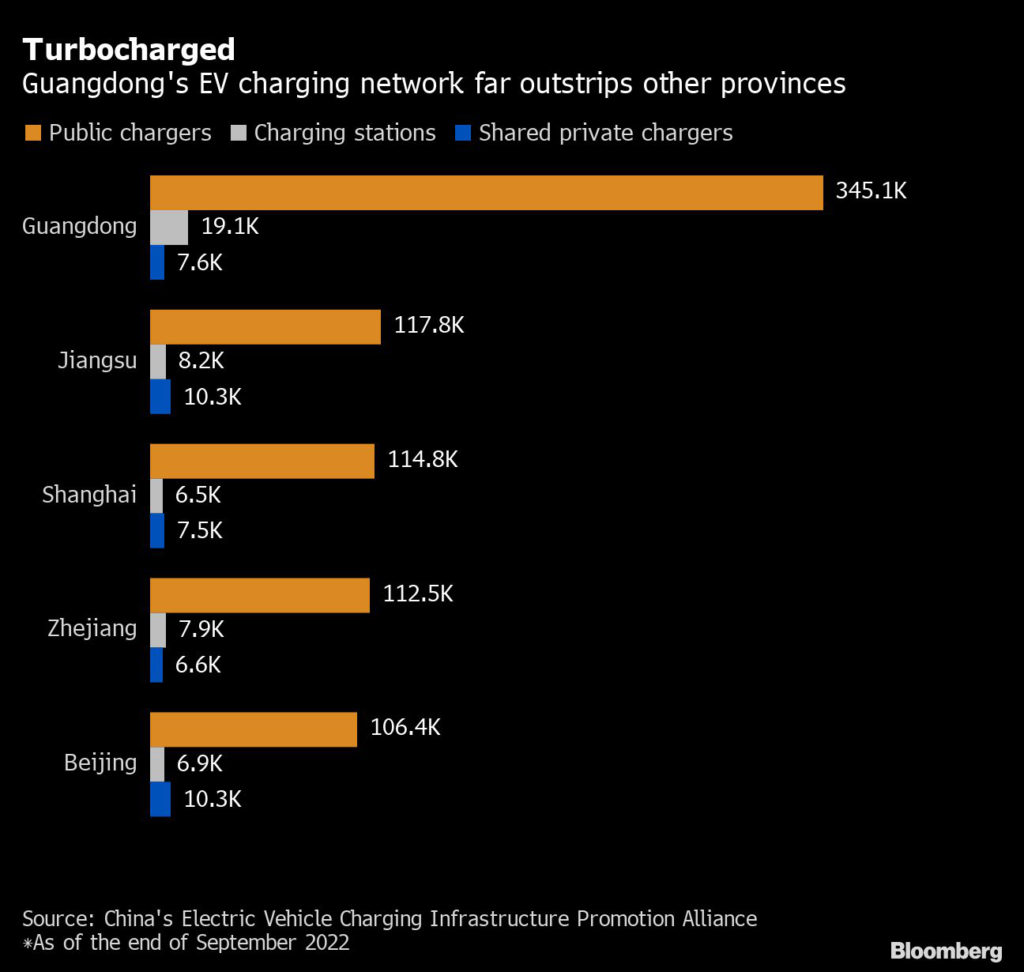
The coastal region, which borders Hong Kong, has built hundreds of thousands of public charging points — the EV equivalent of gas pumps — over the past few years. With 345,126 public chargers and 19,116 charging stations as of the end of September, Guangdong has the largest EV charging network in China, one that has more than doubled from a year ago, according to the China Electric Vehicle Charging Infrastructure Promotion Alliance. That’s around three times as many public chargers in the whole of the US, according to BloombergNEF data.    

In a push to electrify their nations’ car fleets, governments around the world are trying to roll out and scale their public charging infrastructure swiftly enough to service new battery-powered cars. President Joe Biden’s infrastructure law devotes $5 billion to building a nationwide network of EV charging ports along major travel corridors in the US, while Germany has spent or pledged $6.4 billion to support the charging industry. But both the US and Europe have fallen well behind China in building out their networks. A BloombergNEF analysis counted 112,900 public chargers deployed across the US and 442,000 in Europe by the end of 2021, compared with 1.15 million in China. 

That gap is only growing. In just the past 12 months, China added 592,000 public chargers — more than the total number the Biden administration wants by 2030. The government plans to build enough charging stations for 20 million electric vehicles by 2025, according to a January document by the National Development and Reform Commission and nine other ministries. 

These charging pylons are installed by third-party utility operators, state-owned electric companies — the two biggest of which are State Grid Corp. of China and China Southern Power Grid — as well as EV automakers like Tesla Inc. and China’s Nio Inc. and Xpeng Inc. Tesla operates more than 8,700 Supercharger stalls across 370 cities in China — roughly a quarter of its global Supercharger network.     

China’s efforts to forge a green infrastructure are paying off: domestic demand for cleaner cars now dramatically dwarfs that of Europe and the US. A quarter of all new cars purchased in China are new-energy vehicles, and NEV sales are forecast to hit a record 6 million this year. 

In Guangdong, ubiquitous charging is also boosting electric car ownership. EV sales jumped 151% in the first half of the year, according to the Guangdong Bureau of Statistics. The province now has over 1.4 million electric vehicles, the highest share in the country, according to the National Monitoring and Management platform for New-Energy Vehicles. 

“With more chargers, there’s less range anxiety. EV sales therefore go up,” said David Zhang, an automotive analyst who is also dean of the Jiangxi New Energy Technology Institute. “Having so many chargers is definitely a breakthrough, but we’ve got to remember that charging still takes a lot longer than refilling the gas tank. That’s now the real obstacle.” 

Guangdong’s provincial government is also doubling down on EV manufacturing. One-in-eight electric cars sold in China is now made in Guangdong. From January to July, local EV production jumped more than two-fold from a year before. Strong production capabilities can have a spillover effect, improving customer experience and aftersales service and even lowering pricing within the province, said Zhang. 

Yoyo Gu, a 40-year-old housewife from Guangdong, traded in her Dongfeng Citroen C4 internal-combustion sedan for a GAC AION V Plus electric SUV earlier this year as part of a provincial subsidy program to bolster EV adoption. 

“I got around 8,000 yuan off the bill,” said Gu. That’s on top of the EV purchase-tax exemption, which the government has extended until the end of 2023.

For the first few months, she recharged her SUV overnight at public charging stations in her neighborhood, before finally installing a private charging outlet in the parking lot of her residential complex. 

“When my friends talk about buying an electric car, no one worries about charging anymore,” said Gu. “The car park below our apartment added five new chargers in the past couple of months and we can easily find one on the road.”

More stories like this are available on bloomberg.com

©2022 Bloomberg L.P.

Siris Capital Set to Close California Office After Lack of Deals

(Bloomberg) — Private equity firm Siris Capital Group is closing its office near San Francisco by year’s end as part of a reorganization, according to people familiar with the matter.

Siris opened the office in Palo Alto, California, in 2018 but hasn’t bought any Bay Area businesses since then, said the people, who asked not to be identified because the information was private. Deal opportunities involving West Coast companies that reached Siris’s executive committee represented only about 10% of the non-disclosure agreements signed by the firm, they said.

Partner Hilton Romanski and Mike Hulslander, a managing director, are separating from the firm as a result of the closure, the people said. Some junior staffers will move to its headquarters in West Palm Beach, Florida, the people added.

A representative for Siris declined to comment.

Siris, which focuses on technology and telecom, has raised more than $5.9 billion since 2011 and is currently targeting investments with transaction values of $500 million to $5 billion, according to its website.

As part of the reorganization, Tyler Sipprelle is being promoted to partner, the people said. He and partner Eli Mendoza are joining the executive committee as voting members, they said.

The firm is retaining its office in New York, where it was based before opening the Florida location during the coronavirus pandemic.

More stories like this are available on bloomberg.com

©2022 Bloomberg L.P.

Australia to Introduce Tougher Penalties for Data Breaches

(Bloomberg) — The Australian government will next week introduce legislation to significantly increase penalties for privacy breaches after the huge hack at mobile-phone operator Optus.

The legislation will boost the maximum penalty for serious or repeated privacy breaches to A$50 million ($32 million); three times the value of any benefit obtained through the misuse of information; or 30% of a company’s adjusted turnover in the relevant period, whichever is greater. The current level is a A$2.22 million penalty.

Australia needs better laws to regulate how companies manage the large amount of data they collect and bigger penalties to incentivize good behavior, Attorney General Mark Dreyfus said in a statement on Saturday.

“Unfortunately, significant privacy breaches in recent weeks have shown existing safeguards are inadequate,” Dreyfus said. “It’s not enough for a penalty for a major data breach to be seen as the cost of doing business.”

The bill will also provide the Australian Information Commissioner with greater powers to resolve privacy breaches.

Optus, an Australian subsidiary of Singapore Telecommunications Ltd., last month revealed a vast security breach had exposed details of 9.8 million former and current customers in one of the country’s biggest-ever hacks. More than 2 million people had identity document numbers compromised, triggering concerns about widescale financial fraud.

The hack is threatening to become a crisis for Optus and its Singapore parent. The company is already paying for replacement drivers licenses and passports, and total costs including bills and fines could stretch into hundreds of millions of dollars, according to some estimates.

Read more: Giant Optus Hack May Swallow a Quarter of Singtel Profits

SingTel then this month said a second Australian business, Dialog, also suffered a cyberattack. Data on fewer than 20 clients and 1,000 current and former staff may have been accessed in the hack.

Earlier this month, Australian phone company Telstra Corp. called for a review of laws governing data retention after scams targeting customers reached new highs.

More stories like this are available on bloomberg.com

©2022 Bloomberg L.P.
Fed-Obsessed Traders Lift Stocks as Yields Slide: Markets Wrap

(Bloomberg) — Wall Street saw another day of big reversals, with stocks notching their best week since June after a Treasury rout sputtered. The yen jumped as Japan intervened again to prop up the currency.

At a time when traders have been fixated on the outlook for interest rates, it’s no surprise that all the drama in the world’s biggest bond market would dictate sentiment. After being all over the place in early trading, equities climbed strongly as US yields fell from multiyear highs.

“The story this week is all about the volatility in rates, huge volatility in Treasuries,” said Keith Lerner, chief market strategist at Truist Advisory Services. “But I would say, overall, relative to how much interest rates have moved up, I would say the market has held in there pretty well.”

Traders also kept a close eye on the latest Fedspeak.

US central bankers said the next phase in their campaign to curb inflation will be to debate how high to raise rates and when to slow the pace of increases. St. Louis Fed President James Bullard and his San Francisco counterpart Mary Daly made clear they expect the discussion to be on the table at the November gathering while stressing the need to keep tightening.

Read: Fed’s Evans Sees Further Rate Hikes Ahead, Policy Then on Hold

Equity funds are still seeing inflows, with “final capitulation” not yet here, said Bank of America Corp. strategists. Global stock funds had inflows of $9.2 billion in the week through Oct. 19, according to a note from the bank citing EPFR Global data.

“The equity market is trying to form a bottom to get to the last leg of the bear market,” said David Donabedian, chief investment officer of CIBC Private Wealth US. “It feels like a two-way market right now. We have a tug of war going on between the skeptics and those who think it is time to own equities.”

He noted that the Fed is not done raising rates and valuations are still not as low as he would expect to see at the bottom of a bear market. 

“We are just not there yet,” Donabedian added.

Some of the main moves in markets:

Stocks

  • The S&P 500 rose 2.4% as of 4 p.m. New York time
  • The Nasdaq 100 rose 2.4%
  • The Dow Jones Industrial Average rose 2.5%
  • The MSCI World index rose 1.5%

Currencies

  • The Bloomberg Dollar Spot Index fell 0.8%
  • The euro rose 0.8% to $0.9862
  • The British pound rose 0.6% to $1.1301
  • The Japanese yen rose 1.7% to 147.66 per dollar

Cryptocurrencies

  • Bitcoin rose 0.9% to $19,201.33
  • Ether rose 1.7% to $1,304.22

Bonds

  • The yield on 10-year Treasuries declined one basis point to 4.22%
  • Germany’s 10-year yield advanced one basis point to 2.42%
  • Britain’s 10-year yield advanced 14 basis points to 4.05%

Commodities

  • West Texas Intermediate crude rose 0.8% to $85.17 a barrel
  • Gold futures rose 1.4% to $1,660.30 an ounce

–With assistance from Vildana Hajric and Emily Graffeo.

More stories like this are available on bloomberg.com

©2022 Bloomberg L.P.

Twitter-Musk Deal Spread Widens on Government Scrutiny Fears

(Bloomberg) — Market skepticism surrounding Elon Musk’s $44 billion buyout of Twitter Inc. is back amid concerns that the deal may come under government scrutiny.

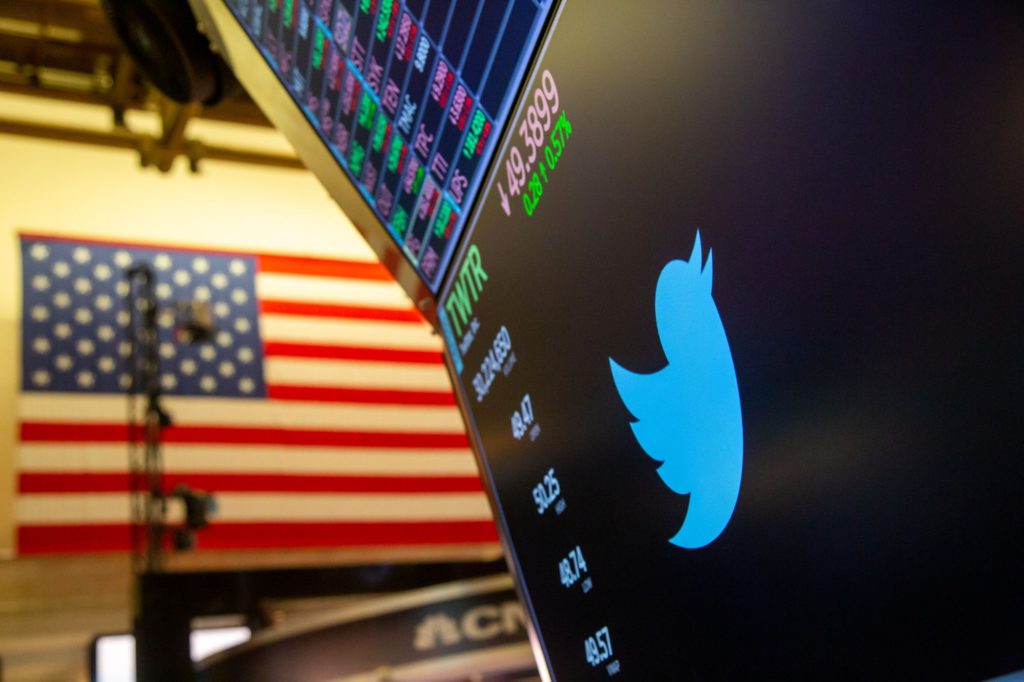
The stock dropped 4.9% to $49.89, falling further away from the $54.20 offer and putting the deal’s arbitrage spread at the widest level in two weeks. The move came after Bloomberg News reported that the Biden administration is mulling whether the US should subject some of the billionaire’s ventures, including the deal for the social media company, to national security reviews. 

Although Twitter shares plunged as much as 16% in premarket trading, some of the losses were pared after a White House spokesperson said they were unaware of such discussions.

“The spread is widening because the market is confused about the latest conflicting headlines surrounding a possible national security review of the deal. Could a [national security] or similar review prompt Musk to once again try to delay or get out of the deal, or prompt the banks to pull financing?” said Frederic Boucher, a risk arbitrage analyst at Susquehanna International Group. 

Boucher, however, thinks the scenario is unlikely. “I think the most probable event at this point is the deal closes next week. But this is Musk, and predicting his moves has been hazardous,” he said. Susquehanna is a market maker in the securities of Twitter. Susquehanna and/or its affiliates beneficially own 1% or more of the securities.

Some US officials may be concerned about foreign investors backing Musk’s bid, including Prince Alwaleed bin Talal of Saudi Arabia, Binance Holdings Ltd. — a digital-asset exchange founded and run by a Chinese native — and Qatar’s sovereign wealth fund, Tradition event-driven analyst Gregory Lafitte said in written comments.

If the Committee on Foreign Investment in the United States, known as CFIUS, starts a national-security review it would delay the deal, which likely wouldn’t close before the end of this year, Lafitte added.

Twitter had inched closer to Musk’s $54.20 a share offer price before the report, with Wall Street appearing increasingly confident that the deal would close. On Thursday, the arbitrage spread on the proposed takeover was at its narrowest since the deal was announced. 

Both sides’ bankers and lawyers are preparing paperwork for the buyout to be completed by the Oct. 28 court-issued deadline, according to people familiar with the matter.

Some are less worried about a review. “It does seem fanciful that the U.S. Government would view Twitter as a national security asset,” Canaccord Genuity’s Quest analyst Graham Simpson said in an email. Still, “the jury is still out” on the deal because of questions about Musk’s ability to finance it after Tesla Inc.’s share price halved this year, he said.

Cabot Henderson, a merger strategist at JonesTrading echoed a similar point. “This news is probably more of a warning shot after Musk’s erratic behavior, and at around 90% implied probability here seems a clear buy, especially after continued reports that the deal close is proceeding apace. That said, there might be severe choppiness given the high profile and broad ownership of this name,” he said. 

(Updates share move at close)

More stories like this are available on bloomberg.com

©2022 Bloomberg L.P.

Apple’s Industrial Design Chief Hankey to Leave Three Years After Ive

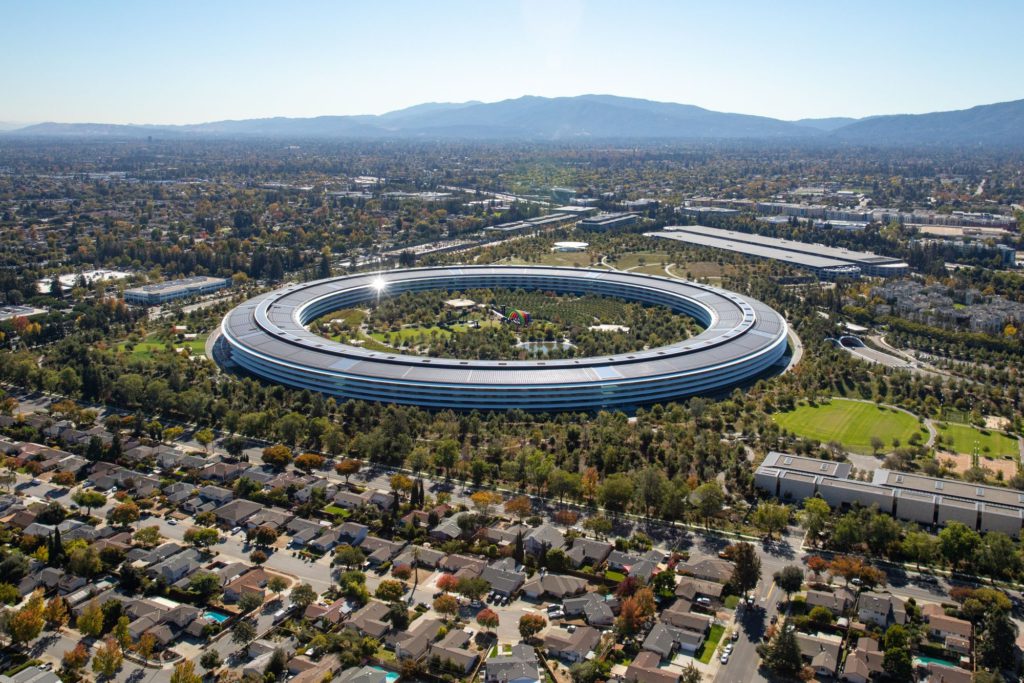
(Bloomberg) — Apple Inc.’s head of hardware design, Evans Hankey, is leaving the iPhone maker three years after taking the job, creating a significant hole at the top of a company famous for its slick-looking products, according to people with knowledge of the matter. 

Hankey was named to the post in 2019 to replace Jony Ive, the company’s iconic design chief for two decades. Before taking her current role as vice president of industrial design, Hankey spent several years at Apple reporting to Ive. Since then, she has reported to Chief Operating Officer Jeff Williams. 

The departure was announced inside the Cupertino, California-based technology giant this week, with Hankey telling colleagues that she will remain at Apple for the next six months. Hankey oversees several dozen industrial designers, and the company hasn’t named a replacement.

Her pending exit marks the first time that Apple will be without a de facto design chief since co-founder Steve Jobs retook control of the company in the late 1990s and appointed Ive to the job. Richard Howarth, a key designer on both Ive’s and Hankey’s teams, briefly held the role of head of industrial design, reporting to Ive, between 2015 and 2017.

Apple confirmed Friday that Hankey is stepping down.

“Apple’s design team brings together expert creatives from around the world and across many disciplines to imagine products that are undeniably Apple,” a spokesman said in a statement. “The senior design team has strong leaders with decades of experience. Evans plans to stay on as we work through the transition, and we’d like to thank her for her leadership and contributions.”

The elegance of Apple’s products — including the once-revolutionary idea of a phone that was just a screen — helped fuel the company’s comeback under Jobs. And it’s continued to be a key differentiator under Chief Executive Officer Tim Cook, helping ward off rivals such as Samsung Electronics Co. and Amazon.com Inc., and turning Apple into the world’s most valuable business. The company is on track to approach $400 billion in sales this year, according to analyst estimates, a new record.

Apple has weathered this year’s tech downturn better than most. Its shares have fallen almost 17% in 2022, compared with a 31% drop for the tech-heavy Nasdaq Composite Index. Apple rose 2.7% to $147.27 on Friday.

The void left by Hankey could affect Apple’s future design plans and raises fresh questions about how its products will evolve in the post-Ive era. It’s unclear whether Hankey is heading to a different company. 

Ive has cast a large shadow over Apple, even after his 2019 departure. The British-born executive left to start his own design firm called LoveFrom, and Apple became a top client. But that arrangement ended this year. 

Apple has been working on key new devices, including a mixed-reality headset for next year and augmented reality glasses that will come at a later date. There’s also the possibility of an electric car sometime this decade.

Alan Dye, Apple’s head of design for software and user interfaces, isn’t going anywhere and still reports to Williams, said the people, who asked not to be identified because the matter is private. Dye was also promoted in 2019 upon Ive’s departure. Gary Butcher, a former top designer within Dye’s division and currently Airbnb Inc.’s vice president of design, is returning to Apple, they added.

(Updates with shares in seventh paragraph.)

More stories like this are available on bloomberg.com

©2022 Bloomberg L.P.

‘Wellness Month’ at Twitter Turns Frantic as Musk Deal Looms

(Bloomberg) — For national emotional wellness month, Twitter Inc. has stuffed employee inboxes with tips on self care and balance. The outgoing messages, however, are frantic.

With Elon Musk’s deal to buy the company set to close in one week, employees are bracing for layoffs — which Musk has been telling investors could slash 75% of staff, according to people familiar with the matter. That pain will coincide with likely changes in leadership, priorities and values under Musk. 

This week was also a “focus week” at Twitter, periodic week-long stretches where employees take fewer meetings so they can get more done. Many staff members said they used the extra time to look for other jobs, as well as to consult personal lawyers about severance and stock compensation. 

Employee equity awards are due to vest early next month but there’s confusion about whether the vest date will change, or even occur. Concern is growing that the stock awards will not be paid, the people said. Twitter froze employee equity award accounts on Monday in anticipation of the deal with Musk closing, Bloomberg reported. Some employees are discussing and researching labor laws to ensure they get the correct type of severance, said another person familiar with the matter, who also asked to remain anonymous discussing private information.

Twitter and Musk are working to close the deal by Oct. 28, after months of legal back-and-forth. But there’s still the possibility something will get in the way — such as a potential national security review by the Joe Biden administration, Bloomberg reported Thursday. 

Employees are still going through their regularly-scheduled performance reviews in the final three months of the year, albeit more informally, multiple people said. Employees submitted self-evaluations earlier this month, and this week managers graded staff on a curve, with only 3% of employees in a bottom tier. Next week, as the deal is set to close, employees will be checking in with their managers.

With or without Musk, Twitter’s tough economic position may make raises scarce. Some managers got an email this week from the operations team that included a “Non-Monetary Retention Playbook” on how managers could try and retain people without adding compensation.

Teams have continued with product planning and reviewing proposed changes to Twitter’s functionality. However, the mood is starting to sour across Twitter’s engineering teams, people familiar with the matter said. Engineers are hesitant to begin major projects that may ultimately be scrapped if Musk does complete a takeover of the company.

Musk has tweeted that when he starts, “software engineering, server operations & design will rule the roost.” He’s also discussed turning the company into “X,” an everything app. “We don’t even know what that is,” one staffer said. 

On Blind, the anonymous employee discussion app, one Twitter employee asked whether it would be possible to organize about 200 engineers to quit at once and start a competitor, leaving Musk without an engineering team.

More stories like this are available on bloomberg.com

©2022 Bloomberg L.P.
Snap’s Latest Cut: Its San Francisco Office

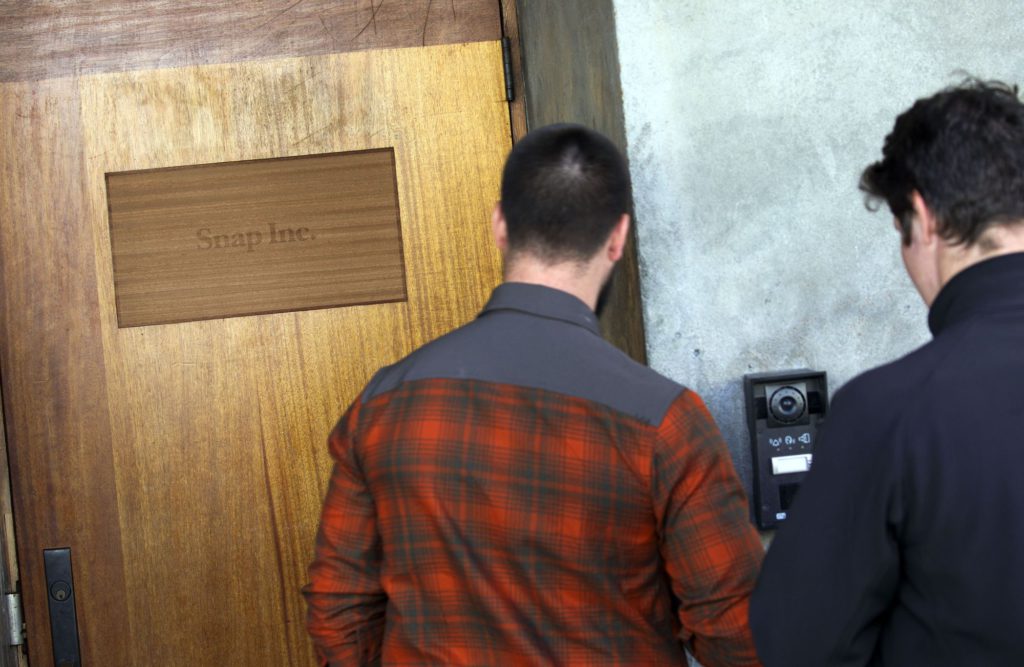
(Bloomberg) — Snap Inc., which is cutting costs and relying more on remote work, is closing its office in San Francisco, dealing a fresh blow to a city trying to revive its business district.

The San Francisco office is one of several in the Bay Area, including one that opened recently in Palo Alto, the company said. Snap will continue to let San Francisco employees use a coworking space in the city. 

“Our San Francisco location was lightly used by team members following our move to flexible work,” said the company, which makes the Snapchat social-media app. Snap has switched more aggressively to a work-anywhere philosophy, unlike some tech peers such as Apple Inc. that are still requiring office employees to show up a few days a week.

Snap also is making broader cutbacks as it copes with a sales slump. The Santa Monica, California-based company just reported its slowest quarterly revenue growth ever, saying that a decline in advertising spending continues to drag on results. Snap has been refocusing its business and announced plans in August to cut 20% of its workforce. 

Though the San Francisco location is small, the closure marks a setback for the city’s efforts to lure back workers. Return-to-office rates have been stuck around 40% of pre-pandemic levels, according to security company Kastle Systems. That puts it among the lowest of the 10 major US metro areas.

Social-media rival Twitter, based in San Francisco, also may soon be scaling back workers. Elon Musk, who is buying the company for $44 billion, has told potential investors that he’s planning to cut as much as 75% of the staff. 

Snap plans to continue to monitor office usage in other cities where it operates. Insider previously reported on the plan to close the San Francisco location.

(Updates with Twitter in sixth paragrph.)

More stories like this are available on bloomberg.com

©2022 Bloomberg L.P.
Stocks See Big Gains After U-Turn in Bond Yields: Markets Wrap

(Bloomberg) — Wall Street saw another day of stunning reversals, with stocks pushing higher and higher after a Treasury selloff sputtered. The yen jumped as Japan intervened again to prop up the currency.

The many twists and turns in the S&P 500 gave way to a 2% surge Friday that put the US equity benchmark on track for its best week since June. It’s worth noting that some of that volatility was caused by the $2 trillion options expiration.

For a financial world that’s been driven by the global rate outlook, certainly what happens in the biggest bond market matters a lot. Stocks pushed decidedly into the green when Treasury 10-year yields retreated from the highest since 2007.

“The story this week is all about the volatility in rates, huge volatility in Treasuries,” said Keith Lerner, chief market strategist at Truist Advisory Services. “But I would say, overall, relative to how much interest rates have moved up, I would say the market has held in there pretty well.”

Equities also managed to climb despite the drumbeat of Federal Reserve speakers signaling monetary policy will remain tight to fight scorching inflation.

Fed Bank of San Francisco President Mary Daly said officials should start planning for a reduction in the size of rate increases — though it’s not yet time to “step down” from large hikes. Her St. Louis counterpart James Bullard said the strong US labor market gives the central bank room to raise rates.

Equity funds are still seeing inflows despite deeply pessimistic sentiment, with “final capitulation” not yet here, said Bank of America Corp. Global stock funds had inflows of $9.2 billion in the week through Oct. 19, according to a note from the bank citing EPFR Global data.

“The equity market is trying to form a bottom to get to the last leg of the bear market,” said David Donabedian, chief investment officer of CIBC Private Wealth US. “It feels like a two-way market right now. We have a tug of war going on between the skeptics and those who think it is time to own equities.”

He noted that the Fed is not done raising rates and valuations are still not as low as he would expect to see at the bottom of a bear market. 

“We are just not there yet,” Donabedian added.

Some of the main moves in markets:

Stocks

  • The S&P 500 rose 2.1% as of 2:09 p.m. New York time
  • The Nasdaq 100 rose 2%
  • The Dow Jones Industrial Average rose 2.2%
  • The MSCI World index rose 1.2%

Currencies

  • The Bloomberg Dollar Spot Index fell 0.6%
  • The euro rose 0.5% to $0.9835
  • The British pound rose 0.3% to $1.1266
  • The Japanese yen rose 1.6% to 147.80 per dollar

Cryptocurrencies

  • Bitcoin rose 0.9% to $19,201.32
  • Ether rose 1.6% to $1,303.25

Bonds

  • The yield on 10-year Treasuries was little changed at 4.22%
  • Germany’s 10-year yield advanced one basis point to 2.42%
  • Britain’s 10-year yield advanced 14 basis points to 4.05%

Commodities

  • West Texas Intermediate crude rose 0.4% to $84.85 a barrel
  • Gold futures rose 1.3% to $1,658.20 an ounce

–With assistance from Vildana Hajric and Emily Graffeo.

More stories like this are available on bloomberg.com

©2022 Bloomberg L.P.
Close Bitnami banner
Bitnami