Bloomberg

DeFi App Maple Tightens Lending Standards After Crypto Shakeout

(Bloomberg) — Decentralized finance app Maple Finance has introduced tougher requirements for borrowers on its platform, moving to reduce counterparty risk after a wave of defaults swept the crypto industry this year. 

Borrowers must now sign legal agreements that include a provision for submitting independently audited financial accounts annually, Chief Executive Officer Sid Powell said in an interview. The also have to submit monthly reports outlining their financial health, including balance sheet information. 

Maple Finance, whose app connects institutional lenders and borrowers, has suffered along with the wider DeFi market as crypto prices crashed. The total value locked on its platform has dropped to $22.5 million from $153 million at the end of June. 

Its tightening of standards highlights the unease that persists in crypto markets months after hedge fund Three Arrows Capital collapsed, setting off a chain of defaults that brought down digital-asset lenders like Celsius Network. 

Borrowers on Maple Finance will also be required to sign up to credit risk data platform Credora, which provides lenders with real-time information to help them assess what level of risk a borrower has accumulated across different crypto exchanges. 

“This type of view would have been powerful for the centralized lenders who had exposures to 3AC,” said Powell, using the acronym for Three Arrows Capital.

Read more: DeFi App Maple Finance Warns of ‘Insufficient Cash’ (1)

Powell said Maple Finance has recorded a single $10 million default out of $1.8 billion of loans originated on is platform, and that it didn’t facilitate any loans to 3AC. “But the increased reporting requirements enhance the ability to monitor borrower health in a volatile market,” he said.

Maple Finance’s clients include Genesis Trading, Alameda Research and Wintermute, which recently repaid a loan on the platform following a hack that saw $160 million stolen from its DeFi unit. 

More stories like this are available on bloomberg.com

©2022 Bloomberg L.P.

Crypto’s $2 Trillion Wipeout Is Coming for the C-Suite

(Bloomberg) — The convulsions that set the cryptocurrency market tumbling earlier this year and delivered shock waves through the industry have subsided. Now comes the shakeup in the C-suite.

More than two dozen high-ranking executives — from Alex Mashinsky, the charismatic and controversial co-founder of now-bankrupt crypto lender Celsius Network to Brett Harrison of digital-asset exchange FTX US and Jesse Powell, the outspoken head of FTX’s rival Kraken — have vacated their posts in the past two months alone.

While an assortment of idiosyncratic reasons has been given for the exodus, it’s clear the turbulence that shook the market starting in the spring has taken a toll. It would be hard for it not to, after $2 trillion worth of crypto evaporated in the rout. Yet market observers also see another common thread: The combination of a larger presence of institutional investors, heightened regulatory scrutiny and tighter purse strings at venture-capital firms is causing a reassessment of the type of management needed for the next phase of crypto. The recent calm that has settled over the market may itself herald a transition, some say, as traditional finance takes a bigger stake. 

Gone are some of the founders famous for bombastic personalities and social-media feuds with competitors and skeptics — replaced, in some cases, by a more buttoned-up style of executive from the world of traditional finance. Mashinsky, for example, was replaced on an interim basis during Celsius’ bankruptcy proceedings by Chris Ferraro, whose resume includes 18 years at JPMorgan Chase & Co.  

“In down markets, people restructure management for a bunch of reasons, one definitely being that the business and industry has matured and they are putting in a new management team to fit the environment,” said Stephane Ouellette, chief executive of FRNT Financial Inc. Some founders could be “moving on because the industry is getting more professional and they come from an era where it was more tin-hat.”

Crossing the Chasm

Among other high-profile shifts in recent months: Michael Saylor, the software executive-turned-Bitcoin evangelist, gave up his CEO title at MicroStrategy Inc.; Sam Trabucco departed his co-CEO position at crypto trading firm Alameda Research; Michael Moro left as CEO of Genesis Global Trading and Michael Patchen exited his position of chief risk officer at the same firm after just three months, according to a person familiar with the matter; Aya Kantorovich left FalconX Ltd., where she was head of institutional coverage; and Voyager Digital Chief Financial Officer Ashwin Prithipaul stepped down from his post at the crypto broker, which also succumbed to bankruptcy.

For R.A. Farrokhnia, professor at Columbia Business School, the changing of the guard is not a unique phenomenon when considering the history of high-tech products. The current crypto environment looks to him like a new chapter out of the 1991 business classic Crossing the Chasm.

In that book, author Geoffrey A. Moore discusses the “diffusion of innovations” theory, which attempts to explain how new technologies spread, and describes the chasm that emerges between innovators, early adopters and the more pragmatic mainstream users who come later. 

“All of a sudden, you are not just dealing with your early adopters, you are starting to slowly cross the chasm,” said Farrokhnia, who is executive director of Columbia’s Fintech Initiative.

‘Finger-Pointing’ in Play?

Even before this year’s carnage, crypto was undergoing this type of evolution; the rout has acted as an accelerant. In particular, the collapse of the Terra blockchain’s UST stablecoin helped send Celsius and Voyager Digital as well as hedge-fund Three Arrows Capital into bankruptcy proceedings while also causing pain for many other firms. Suddenly issues like budgets, controversial personalities and questionable business practices are much more acute problems than they were during last year’s raging bull market. 

“There’s definitely finger-pointing in organizations,” said Wilfred Daye, chief executive officer of Securitize Capital, a digital-asset management firm. “Somebody has to take the hit. That’s the sentiment I’ve seen.”

To be clear, not all shifts have meant outright departures, and some say they were a while in the making. Kraken’s Powell remains at the company as chairman, while MicroStrategy’s Saylor — now executive chairman — relinquished his CEO role in part so he could focus on the company’s Bitcoin strategy. But taken together, the changes may still signal a modulation in tenor within crypto.

The maturation of the industry, according to Daye, will manifest itself as more endowment funds and other large institutional investors continue to arrive, “giving that golden stamp of approval.” Already, giants from BlackRock Inc. to Fidelity Investments and Bank of New York Mellon Corp. are making their own inroads. In fact, while concerns about layoffs are swirling around crypto startups, Fidelity said this week that it’s hiring an additional 100 people for its digital-asset unit. 

It’s not just the new management teams that are getting toned down in order, perhaps, to avoid scaring away a pension fund or endowment looking to dip a toe into crypto. Even the market’s recent tame price action bears the fingerprint of increasing involvement by institutions, some traders say.

‘Playing Chess’

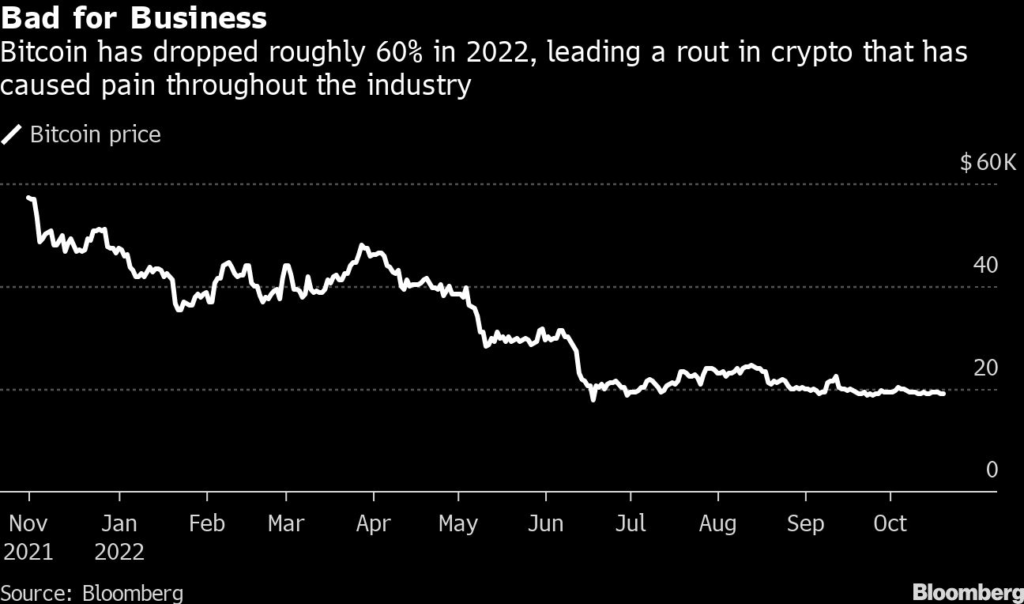
After crashing from its record of almost $69,000 some 11 months ago, Bitcoin has been mired in a trading range — slightly above $20,000 and below it — since June. That, plus the tendency for crypto to move in the same direction as stocks, is a result of the growing influence of institutional investors and the exodus of retail traders, according to Michael Safai, co-founder of trading firm Dexterity Capital.

“We’re seeing a lot more institutional flow than we did over the course of the past five years,” Safai said on a recent episode of the “What Goes Up” podcast. “Now, institutional players are smart. So when we might have been playing checkers two years ago, we’re playing chess now. And when you’re playing chess, things tighten up and these guys are keeping things in the same range while we do price discovery.”

For venture capitalists investing in the crypto space, the growing presence of major financial institutions represents a rare bright spot that helps legitimize an industry rattled by hacks and scams. 

“Clearly, it’s robust enough and we have enough liquidity now in this space to make it attractive to larger institutions,” said Lauren Stephanian, partner at crypto VC firm Pantera Capital. “It’s been something that the industry’s been striving for, for many years.”

BlackRock’s partnership with Coinbase Global Inc. to help its clients trade Bitcoin and BNY Mellon’s launch of a crypto custody platform are promising signs for crypto, according to Matt Walsh, founding partner at crypto VC firm Castle Island Ventures. He said that growing institutional interest sets this current bear market apart from previous “crypto winters” — industry parlance for a prolonged downturn — indicating a greater maturity for the industry. And the recent swath of executive departures? They represent a “natural ebb and flow,” he says.

“We’ll probably see more high-profile management talent enter the space — folks that have taken companies public before, folks that have run very large, regulated financial institutions,” Walsh said. 

Still, for many venture capitalists, the downturn has caused a reassessment of the sector. Once the industry’s biggest cheerleaders, VCs are pulling back, with funding for crypto startups plunging 37% to $4.44 billion in the third quarter compared with the same period in 2021, according to research firm PitchBook. 

“These markets make it challenging for all companies to raise capital,” said David Pakman, managing partner at VC firm CoinFund. While crypto deals are still happening, they are fewer in number and include valuations far lower than the sky-high price tags that many crypto companies were able to obtain last year. 

Pakman pointed to growing regulatory oversight as one catalyst for what’s driving changes in crypto C-suites. Yuga Labs, creator of the Bored Ape Yacht Club nonfungible-token collection, and crypto exchange Coinbase have each caught the attention of the US Securities and Exchange Commission over potentially offering unregistered securities. Greater scrutiny often “requires a different type of executive” who has more experience and is better equipped to handle this type of situation, he said.

For Thomas Klocanas, general partner and head of venture for BlockTower Capital, this crypto winter is a mixed bag. His firm raised a $150 million fund this month dedicated to crypto investments, but Klocanas said BlockTower is planning to deploy the capital over a period of two-and-a-half to three years as the market settles — a slow pace for crypto, but typical for standard venture capital. He’s advising firms that are part of his investment portfolio to have 18 to 24 months of financial cushion as a reinforcement and said that he expects to see more layoffs down the line. Companies like Blockchain.com, Gemini Trust Co. and Crypto.com have already slashed their workforces. 

Klocanas still sees significant promise in crypto and welcomes the greater regulatory scrutiny the industry’s new maturity has brought. He said proper regulation would have prevented crises like Celsius. The collapse and subsequent bankruptcy filing of the crypto-lending platform locked customers out of $200 million worth of their digital-asset holdings. He said these kinds of platforms cannot exist if the crypto industry wants to survive and eventually usher in billions of users. 

“No one wants their life savings to be able to disappear at any moment when they thought they were using a savings account,” he said.

But if a housecleaning is in order to get to the next level, that means changes at the top. 

–With assistance from Stephanie Davidson and Carly Wanna.

(Updates sixth paragraph with departure of Genesis chief risk officer, and 13th paragraph with Fidelity hiring plans)

More stories like this are available on bloomberg.com

©2022 Bloomberg L.P.

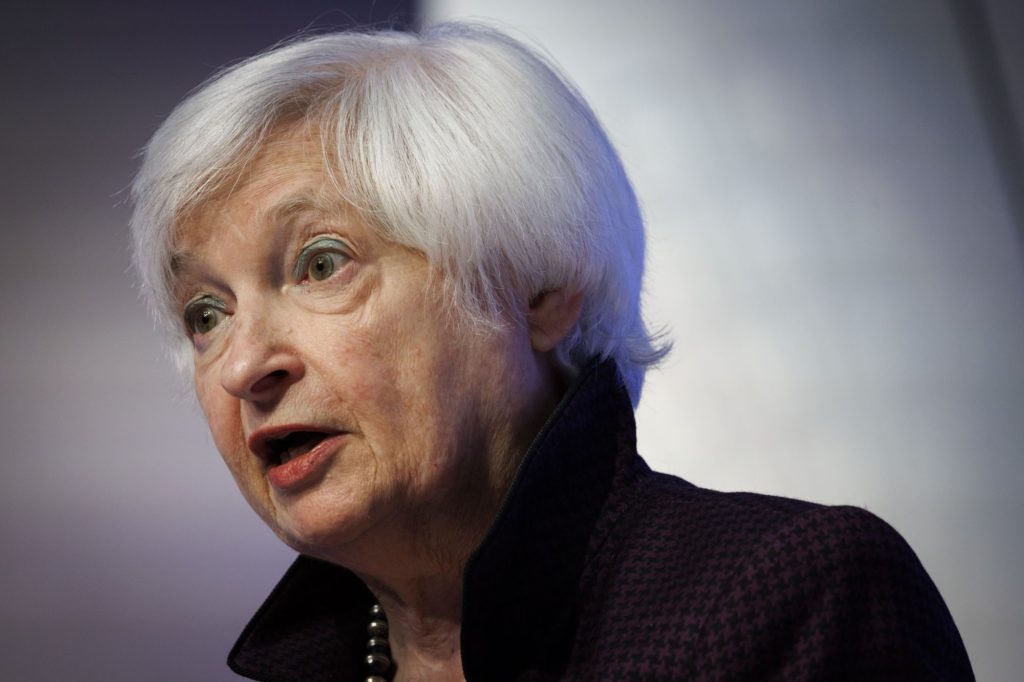
Yellen Says Biden Investments Will Lift Weak US Productivity

(Bloomberg) — Treasury Secretary Janet Yellen said the Biden administration’s investments in semiconductors and clean energy will help address sluggish productivity and labor force growth that have dogged the US economy.

“With an economy at full employment, I argued that now is the right time for a supply-side expansion that increases our productive capacity and reduces inequality,” Yellen said, according to the text of remarks she’s scheduled to deliver Friday, at the Virginia Innovation Partnership Corp., in Herndon, Virginia.

Legislation pushed by the Biden administration, she said, represents “among the most meaningful investments we’ve ever made in our economic strength.”

The staff of the Federal Reserve recently downgraded its estimate for the US’s potential growth rate, or how fast the economy can run without a tightening resources and higher inflation.

Yellen blamed this on a failure to invest public money in science and technology, noting that federal R&D spending had dropped to a third of 1960s levels and the domestic share of semiconductor manufacturing had declined to 12% from 37% over the past three decades.

“Our government’s failure to invest in innovation has had wide-ranging impacts on our long-term economic wellbeing,” she said.

Increases in that spending won by the Biden administration, she said, would spur additional private-sector investment, lift potential output by raising productivity, lower inequality by providing more jobs and reduce US reliance on China for critical supplies.

The Biden administration championed legislation signed into law in August designed to spur domestic manufacturing of semiconductors, a key component of high-tech goods. It’s part of an effort to move critical supply chains away from China.

In the same month it secured passage of another law, the so-called Inflation Reduction Act, ramping up investment in clean energy technology.

More stories like this are available on bloomberg.com

©2022 Bloomberg L.P.

Verizon Falls to 11-Year Low After Stumble on Subscriber Growth

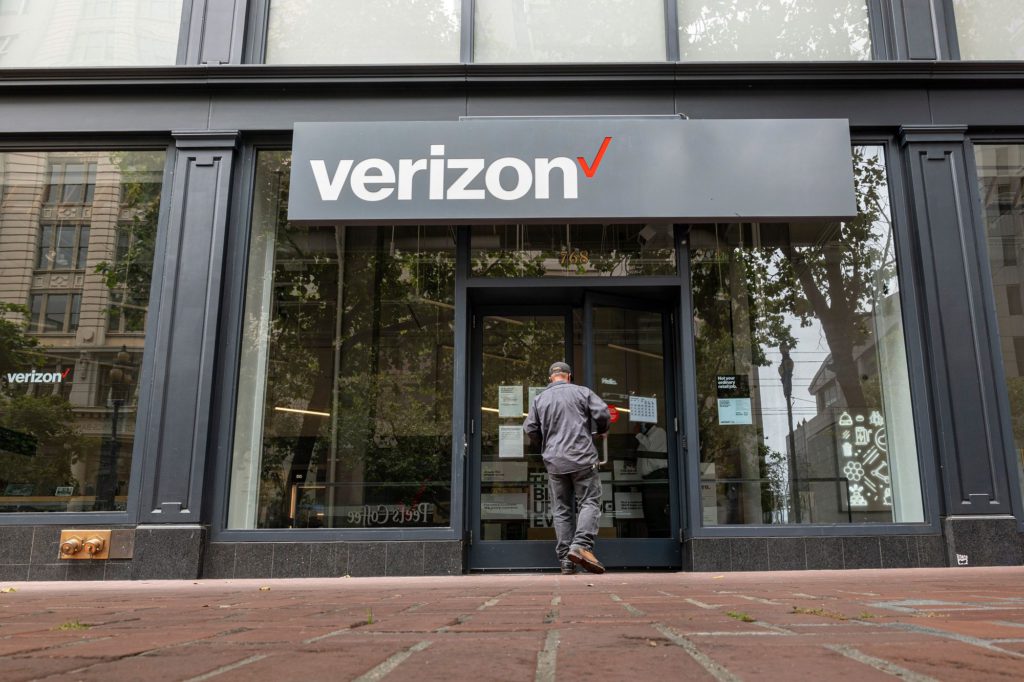
(Bloomberg) — Verizon Communications Inc. missed subscriber estimates for the second straight quarter as the largest US wireless carrier struggles to keep pace with rivals that have made gains by offering deep discounts and improved mobile service.

The company added only 8,000 monthly wireless phone subscribers in the third quarter, according to a statement Friday, well below analysts’ predictions for 38,500 new phone customers.

Its shares fell as much as 5.3% to $35.03, the lowest level since September 2011. The stock declined 29% this year through Thursday’s close.

The results point to Verizon’s challenges in a much more competitive market, contrasting with rival AT&T Inc., which reported strong profit and subscriber growth Thursday.

Verizon has been working on its approach, Chief Financial Officer Matt Ellis said in an interview. With the introduction of new service plans in the past few months, “we’re seeing more foot traffic in stores and it’s starting to build some momentum,” Ellis said.

He also pointed to price and fee increases earlier in the year that are expected to boost revenue by $1 billion in the second half.

The subscriber challenges marred results for a quarter in which profit and sales were better than expected. Adjusted earnings for the period were $1.32 a share, ahead of the average analyst estimate of $1.28. Revenue of $34.2 billion topped estimates of $33.8 billion.

Restructuring Plan

The company says it plans a cost-savings program that will reduce annual expenses between $2 billion and $3 billion by 2025. 

“We are restructuring some of the groups,” Ellis said. “We’re moving some functions into the new global services group to take advantage or our scale in a way we haven’t in the past.”

Ellis said there weren’t specific job-cut numbers related to the restructuring. “As we work to streamline the processes, we’ll see what the impacts are.”

Verizon is hoping to find customer growth in the prepaid market where it has launched Total, a new pay-as-you-go mobile brand, and a prepaid wireless broadband service it is selling at Walmart.

A bright spot: the company added another 342,000 wireless home internet customers in the quarter. This broadband service beams signals directly to a home Wi-Fi router. The service rivals a similar offer by T-Mobile US Inc. and both companies are using the lower-cost internet access to take broadband customers from cable and other providers.

More stories like this are available on bloomberg.com

©2022 Bloomberg L.P.
Fidelity Deepens Crypto Push With 100 More Hires for Unit

(Bloomberg) — Fidelity Investments is hiring an additional 100 people for its digital assets unit, stepping up an expansion that started in May and taking advantage of turmoil among crypto firms to lure talent. 

The new round of hiring will bring Fidelity Digital Assets’s headcount to roughly 500 by the end of next year’s first quarter, according to a company representative. The division had already doubled its workforce since late May, when it announced plans to hire tech and customer service staff. 

Fidelity Digital Assets is adding staff in client services, operations, technology, business development, marketing and compliance, the person said. Hires will be spread across several regions, with Fidelity’s existing crypto team based in locations including Boston, New York, London and Dublin.

The hires come as the crypto industry weathers a period of significant turnover, with companies like Crypto.com, Coinbase Global Inc. and BlockFi Inc. collectively laying off thousands of employees this year. That’s opened a fresh supply of crypto talent for traditional financial companies, who are also rehiring staff who had decamped for digital-asset firms.  

Fidelity’s expansion underscores how large financial institutions haven’t been deterred by a $2 trillion meltdown in cryptocurrencies since the market peaked almost a year ago. 

Read more: Spat Out by Crypto, Tech Staff Find They Are in High Demand

Founded in 2018, Fidelity Digital Assets has been one of the most visible institutional advocates for crypto investing. It initially offered digital assets trading and custody for institutions, but has been expanding its suite of services. The company announced plans earlier this year to allow 401(k) plan participants to direct a portion of their savings into Bitcoin, and launched two exchange-traded funds tracking companies in the metaverse and crypto industries in April.

Fidelity Investments is one of the world’s largest investment managers and has more than $10.3 trillion assets under administration. 

More stories like this are available on bloomberg.com

©2022 Bloomberg L.P.
Snap, Twitter Trigger $35 Billion Rout in Social Media Stocks

(Bloomberg) — Anxious investors are selling out of social media stocks Friday, with the group losing about $35 billion in market value in a broad selloff.

First came Snap Inc.’s disappointing results. Shares of the Snapchat parent plunged as much as 28% after it reported its slowest quarterly sales growth ever, saying a decline in advertising spending continues to drag on results. It’s the latest hit to the stock, which is now down more than 80% this year and trading at its lowest level since February 2019.

The weakness spread to its peers amid concerns that an economic slowdown is deepening and that could hurt companies that rely on digital advertising for revenue. Meta Platforms Inc., Alphabet Inc., Pinterest Inc., and Trade Desk Inc. all tumbled.

Snap was the first of the big internet companies to report, setting the stage for what investors can expect when larger players like Alphabet and Meta Platforms report next week. 

The group is competing for a shrinking pool of advertising dollars as spiraling inflation and weaker economic growth is putting pressure on companies and consumer spending. Meanwhile, new rules from Apple Inc. that require all apps to get smartphone users’ permission to be tracked online have made it more difficult for advertisers to measure and manage their ad campaigns.

“Weakness in brand advertising appears to be the main source of the steep deceleration,” Brent Thill, analyst at Jefferies, wrote in a note. “It’s difficult to parse out how many of Snap’s issues are transitory.”

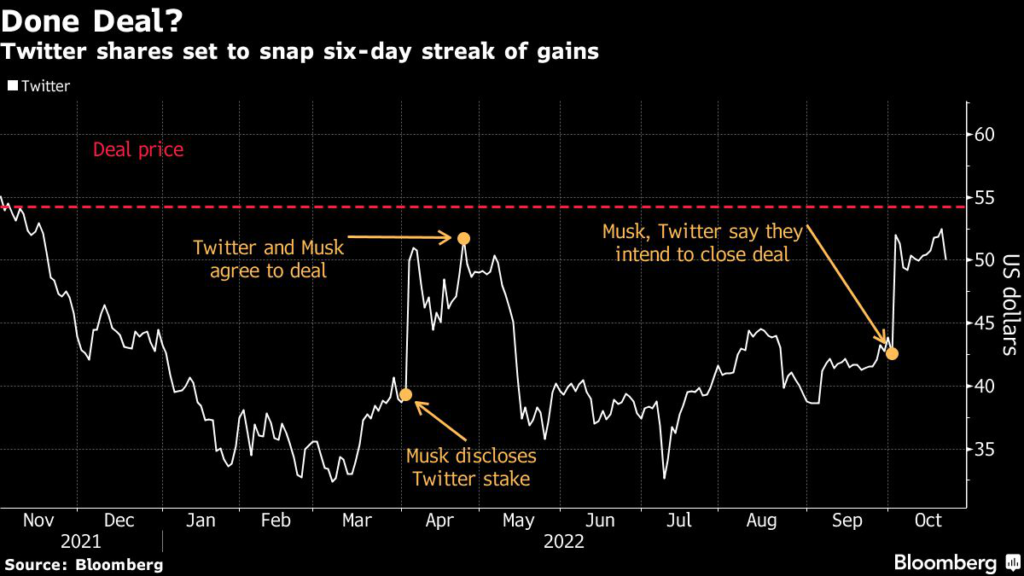
Meanwhile, news that US officials were discussing whether they should subject some of Elon Musk’s ventures to national security reviews, including the deal for Twitter Inc. roiled its shares. Twitter, which had tanked as 16% to $43.91 in premarket trading, pared a bulk of those losses when the White House said it was not aware of a national security review for Musk’s ventures. It was about 4.5% lower at the market open.

The stock’s wild ride since Musk announced his offer to purchase the social media platform in April has been on display throughout the year. On Thursday, the arbitrage spread on the proposed takeover was at its narrowest since the deal was announced as Wall Street appeared increasingly confident that the deal would close. Now it’s on pace to fall further below Musk’s offer price of $54.20, on concern that the deal may come under government scrutiny.

Adding to that heap of bad news for tech investors, the possibility that the US could consider expanding its China ban to some of the most powerful emerging computing technologies has put pressure on stocks across the group, with the Nasdaq 100 Index down about 0.4% Friday.

–With assistance from Alex Barinka, Phil Serafino and Abhishek Vishnoi.

(Updates price moves throughout.)

More stories like this are available on bloomberg.com

©2022 Bloomberg L.P.
UK’s Ofcom Proposes Easing Net Neutrality Rules Following Brexit

(Bloomberg) — UK regulator Ofcom proposed changes to net neutrality rules carried over from the European Union to give telecommunications and internet providers more flexibility.

Internet service providers should be allowed to offer a broader range of premium packages on a wider variety of parameters such as latency, and could include discounted tariffs during off-peak hours, according to proposals from the watchdog published Friday.

“The net neutrality rules constrain the activities of broadband providers, and could be restricting their ability to develop new services and manage their networks,” Ofcom said in the report. 

Net neutrality is shorthand for rules that intend to ensure traffic carried over telecom networks is treated equally, without favoring certain services or content. Debates over such regulations often prove controversial due to tensions over what constitutes an open and free internet and fears consumers could suffer if it becomes harder to compare prices.

The report proposed that telecom providers be allowed to not charge a customer’s overall allowance for certain services, like public health advice.  

UK internet service provider TalkTalk Telecom Group Ltd welcomed the guidance. 

“We think the rules can and should support innovation and network efficiency,” a spokeswoman said. “In addition, content providers should in some cases be able to support network capacity growth while also ensuring consumers continue to have unrestricted access to content.”

On a wider debate over getting Big Tech to pay phone companies for carrying traffic, Ofcom said it hadn’t “yet seen sufficient evidence that this is needed and believe there is sufficient flexibility provided for internet service providers in our other proposals.”

Ofcom is soliciting responses to the proposals until Jan. 13 and plans revised guidance in the second half of 2023. It added that changes in the rules would ultimately be a matter for the government. 

More stories like this are available on bloomberg.com

©2022 Bloomberg L.P.
Twitter Tumbles as US Weighs Security Reviews for Musk Deals

(Bloomberg) — Biden administration officials are discussing whether the US should subject some of Elon Musk’s ventures to national security reviews, including the deal for Twitter Inc. and SpaceX’s Starlink satellite network, according to people familiar with the matter.

Twitter shares fell 5.1% as the market opened in New York on Friday. 

US officials have grown uncomfortable over Musk’s recent threat to stop supplying the Starlink satellite service to Ukraine — he said it had cost him $80 million so far — and what they see as his increasingly Russia-friendly stance following a series of tweets that outlined peace proposals favorable to President Vladimir Putin. They are also concerned by his plans to buy Twitter with a group of foreign investors.

The discussions are still at an early stage, the people familiar said on condition of anonymity. Officials in the US government and intelligence community are weighing what tools, if any, are available that would allow the federal government to review Musk’s ventures. 

One possibility is through the law governing the Committee on Foreign Investment in the United States to review Musk’s deals and operations for national security risks, they said.

Read more: Twitter, Musk Talks Warm Up as Buyout Closing Deadline Nears

The interagency panel, known as CFIUS and overseen by the Treasury Department, reviews acquisitions of US businesses by foreign buyers. It is not clear if a CFIUS review — which would involve assessments by the Departments of State, Defense, and Homeland Security, among others — would offer the government a legal way to conduct a review, the people said. 

Twitter is also confronting reports that Musk aims to gut its workforce as part of his takeover. The Washington Post reported that Musk’s plan for Twitter involve slashing its staff by 75% in a matter of months. Bloomberg News confirmed that potential investors were told of the plan for cuts, along with an effort to double revenue within three years. 

One element of the $44 billion Twitter deal that could trigger a CFIUS review is the presence of foreign investors in Musk’s consortium. The group includes Prince Alwaleed bin Talal of Saudi Arabia, Binance Holdings Ltd. — a digital-asset exchange founded and run by a Chinese native — and Qatar’s sovereign wealth fund.

The panel operates behind closed doors and rarely confirms when it is conducting reviews. CFIUS also holds the power to review deals that have already been consummated. 

A US Treasury Department spokesperson said CFIUS doesn’t publicly comment on any transactions that may or may not be under review. A spokesperson for the National Security Council said they can’t speak for CFIUS. As for the White House, “we do not know of any such discussions,” spokesperson Adrienne Watson said.

Musk, the world’s richest person, has taken to Twitter in recent weeks to announce proposals to end Russia’s war and threaten to cut financial support for Starlink internet in Ukraine. His tweets and public comments have frustrated officials in the US and Europe and drawn praise from America’s rivals.

Musk later backed down from his threat to stop deploying Starlink and said he would continue to bear the costs of the service. Starlink has become an essential tool for communications in Ukraine during the Russian invasion. Musk has been providing the service for free but has said SpaceX loses $20 million a month providing it to Ukraine and he cannot be responsible for that cost indefinitely.

The US government would also use Starlink in the event of a telecommunications outage, according to people familiar with the matter.

Musk did not respond to multiple e-mailed requests for comment.

He tweeted in reply to a fellow reader’s reaction to the Bloomberg article. 

Widely known as the chief executive officer of electric automaker Tesla Inc., Musk is no stranger to Washington, where he is a major player in government contracts. 

Musk forced his way into the business of military and intelligence satellite launches after lobbying vigorously in Congress and suing the US Air Force for the right to compete with a longstanding joint venture of defense giants Boeing Co. and Lockheed Martin Corp. 

In 2019, the Pentagon said it was reviewing Musk’s federal security clearance after he smoked marijuana on a podcast, though the results of that investigation are unclear. A SpaceX official at the time, who asked not to be identified, said the review had not had an impact on the company.

SpaceX flies astronauts to the International Space Station as part of a long-standing partnership with NASA and launches top secret satellites for the Pentagon. The US Agency for International Development, or USAID, has also paid for some of SpaceX’s Starlink satellites that have made their way to Ukraine.

From the archive: All About Cfius, Trump’s Watchdog on China Dealmaking

–With assistance from Dana Hull.

(Updates with opening shares in second paragraph.)

More stories like this are available on bloomberg.com

©2022 Bloomberg L.P.
Bitcoin Lingers Under $20,000 for Longest Stretch Since Late 2020

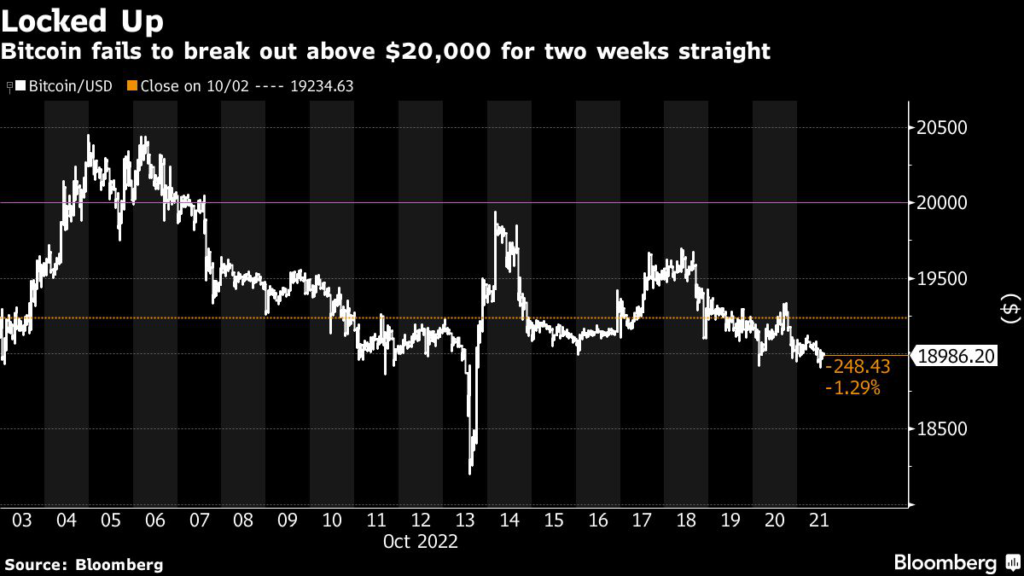
(Bloomberg) — Bitcoin has spent more than two weeks trading below a key threshold of $20,000 for the first time since breaching that level in late 2020, indicating a lack of optimism among traders as the asset class’s trademark volatility dissipates in the face of rising interest rates.

The largest cryptocurrency by market value edged lower for a fourth trading session, dropping less than 1% to $18,969 as of 9:33 a.m. in New York. Other tokens were stuck in a similar malaise, with Ether down 0.25% and altcoins including Cardano, Solana and Avalanche all marking falls of between 1.2% and 3% in the last 24 hours.

Once billed by advocates as a hedge against inflation, Bitcoin has failed to break away from its strong correlation with other risk assets like tech stocks as the broader macroeconomic environment pushed investors toward safer havens. The crypto’s correlations with the S&P 500 and Nasdaq 100 traded above 0.6 on Friday, where a level of 1 would mean the two are trading in lockstep. 

In the absence of volatility, traders have also turned to more active bets like US Treasuries and FX for profits. The T3 Bitcoin Volatility Index is down 37% in the last year, compared to the J.P. Morgan Global FX Volatility Index which is up 80.55%.

“Bitcoin has been stuck in a consolidation pattern since the summer and that seems like it will continue until investors can confidently believe the Fed will stop hiking once rates get to 5%,” Edward Moya, senior markets analyst at Oanda Corp., said in a note Thursday.

Bitcoin is going to be the “canary in the coal mine” alongside gold, Galaxy Digital CEO Mike Novogratz told the C4K Investors Conference on Thursday, suggesting that it is likely to rally before the rest of cryptoassets do. Novogratz himself is a major supporter of the token, while his company offers businesses ranging from digital asset trading and investment to crypto mining.

Novogratz also repeated an earlier prediction that Bitcoin’s price will start to recover when people perceive the Federal Reserve as flinching on rising interest rates.

Bitcoin is down about 70% from a record high of almost $69,000 reached in November 2021. The digital token first broke above the $20,000 mark in December 2020.  

More stories like this are available on bloomberg.com

©2022 Bloomberg L.P.

Snap Plunges on Slowest Sales Growth as Advertisers Retreat

(Bloomberg) — Snap Inc. reported its slowest quarterly sales growth ever, saying that a decline in advertising spending continues to drag on results. Shares plunged 28% at the open in New York, the most since July.

The maker of the Snapchat app said third-quarter sales increased 6% to $1.13 billion. That was just shy of analysts’ average estimate of $1.14 billion, according to projections compiled by Bloomberg. 

The social media company spent the quarter shrinking and refocusing its business, announcing in August that it was cutting 20% of its workforce and slashing projects that don’t contribute to ​​user or revenue growth, or to the company’s augmented reality efforts. The changes were in response to plunging sales, which Snap attributed to a slowdown in marketer spending.

Revenue growth “continues to be impacted by a number of factors we have noted throughout the past year, including platform policy changes, macroeconomic headwinds, and increased competition,” Snap said in its prepared remarks for investors. “We are finding that our advertising partners across many industries are decreasing their marketing budgets, especially in the face of operating environment headwinds, inflation-driven cost pressures, and rising costs of capital.”

Snap shares traded at $7:98 at 9:32 a.m. The stock is down about 83% this year.

Read More on Snap’s plans to cut 20% of its workforce

The Snapchat app, popular with young people for sending disappearing messages and augmenting videos with special effects, reported a total of 363 million daily active users in the quarter, up 57 million from a year earlier. That topped the 358.7 million estimate. Still, Snap’s average revenue per user slid 11% to $3.11, missing the $3.19 average analyst projection.

Users in a key market, the US, spent 5% less time watching content than in the same quarter of last year. American Snapchatters aren’t viewing as many Stories posted by friends, the company said. That trend could concern advertisers.

“Facing an economic downturn, marketing teams are feeling the pressure to prove the ROI of every single line item on their media plans, and they’re going to consolidate spend to fewer, stronger channels and partners as a result,” Kelsey Chickering, an analyst at Forrester, said in an email. “Unfortunately for Snapchat, their share of advertiser budgets will likely shrink further, as marketers shift into the most efficient and proven channels.” 

The company is prioritizing efforts that can boost revenue. In the third quarter, Snap grew its nascent subscription service, Snapchat+, to 1.5 million users who pay for early access to exclusive or pre-release features, Snap said Thursday. The app maker has also been investing in improving measurement tools for ads on its platform.

Snap posted a net loss of $360 million in the quarter, or 22 cents per share. The loss includes $155 million in restructuring costs. The board also authorized a $500 million share repurchase plan for its Class A stock over the next 12 months, Snap said.

Investors were watching Santa Monica, California-based Snap for clues on the performance of other advertising-dependent social media businesses. Next week, Meta Platforms Inc. and Alphabet Inc. report earnings.

Snap and platforms like Meta’s Facebook and Alphabet’s Google are competing for a shrinking pool of advertising dollars this year. Spiraling inflation is putting pressure on companies and consumer spending. Meanwhile, new rules from Apple Inc. that require all apps to get smartphone users’ permission to be tracked online have made it more difficult for advertisers to measure and manage their ad campaigns.

Shares of Meta, Alphabet and Pinterest Inc., another advertising reliant site, all fell in after-market trading following Snap’s report.

(Updates shares in first, fifth paragraphs.)

More stories like this are available on bloomberg.com

©2022 Bloomberg L.P.

Close Bitnami banner
Bitnami