Bloomberg

Amazon to Take Hawaiian Airlines Stake in Cargo-Hauling Deal

(Bloomberg) — Amazon.com Inc. is poised to take a stake in the parent of Hawaiian Airlines as part of a deal to expand the e-commerce giant’s cargo-hauling operations.

Hawaiian Holdings Inc. issued warrants allowing Amazon to acquire as much as 15% of the carrier’s outstanding shares, according to a statement Friday. The warrants are exercisable over the next nine years.

Hawaiian’s shares climbed 4.3% as of 9:17 a.m. before regular trading in New York, while Amazon was little changed. The airline company’s market value was about $724 million as of Thursday’s close.

More stories like this are available on bloomberg.com

©2022 Bloomberg L.P.

Driverless Car Development Sets Ablaze a Bonfire of Billions

(Bloomberg) —

Autonomous vehicle companies and suppliers have collectively spent around $75 billion developing self-driving technology, with scant sign of meaningful revenue emerging from robo-car services after all that cash incineration.

This has spelled disaster for Aurora Innovation, TuSimple Holdings and Embark Technology, whose shares have each plunged at least 80% this year. It’s no wonder Intel just slashed the targeted valuation for its autonomous-driving business Mobileye to about $16 billion, a fraction of the more than $50 billion it reportedly had in mind 10 months ago. Cruise, owned by General Motors, raised money at a roughly $30 billion valuation early last year. In March, GM bought out SoftBank Vision Fund at a price implying the venture was worth around $19 billion.

This is what happens when long-gestating new technology meets the short patience of public markets and harsh reality of rising interest rates. Many of these companies raised tens of billions of dollars long before their technology was proven or their businesses came close to being self-sustaining.

The hype of the last decade or so and crash of late is calling into question whether self-driving cars will ever work. Anthony Levandowski, one of Google’s early autonomy pioneers, who left for Uber Technologies and was later convicted for stealing trade secrets, now runs a startup developing autonomous trucks for industrial sites. In a Businessweek cover story this month, he argued that less-complex use cases will be the way forward for the foreseeable future.

Morgan Stanley’s Adam Jonas, who seven years ago ascribed massive value to a Tesla mobility service that’s still nowhere to be found, said in a note recently that autonomy could be a 10- or 20-year proposition.

Companies in the space are now being forced to contemplate drastic measures. Aurora Chief Executive Officer Chris Urmson sent out an internal memo in September raising the prospect of cost cuts, taking the company private, spinning off assets or even trying to sell the company to Apple or Microsoft.

Others have seen high-level turnover. GM CEO Mary Barra dismissed Cruise counterpart Dan Ammann late last year. TuSimple replaced founder and CEO Cheng Lu in March, and its general counsel James Mullen resigned in September. Alphabet-owned Waymo lost its chief product officer Dan Chu last month to 23andMe.

While executives and investors alike are in some cases heading for the exits, well-capitalized companies in the space are plowing ahead into new markets and projects. Cruise plans to replicate its San Francisco robo-taxi service in Phoenix and Austin, Texas. Waymo will start offering rides in Los Angeles and also has been hauling beer between Dallas and Houston.

Startup Kodiak Robotics raised $30 million in private capital this week and ran its freight trucks 8,000 miles from Texas to Florida. While there was a test driver at the wheel, the human ceded to the robot 94% of the time, Kodiak CEO and founder Don Burnette told me in an interview. The company is starting to haul furniture for Ikea.

I asked Burnette if Kodiak will be ready to ditch the safety driver anytime soon.

“We’re pretty close,” he said. “It seems like we always say this. It’s a couple years out.”

It may take even longer, but the market getting the timing of autonomy wrong doesn’t mean it will never work. The lesson is that technology as radical as robotic driving was always better off in the incubators of daring venture capitalists, not the portfolios of trigger-happy stock traders.

More stories like this are available on bloomberg.com

©2022 Bloomberg L.P.

Verizon Misses on Subscriber Gain Despite Sales, Profit Beat

(Bloomberg) — Verizon Communications Inc. missed quarterly subscriber estimates for the second straight quarter as the largest US wireless carrier struggles to keep pace with rivals that have made gains by offering deep discounts and improved mobile service.

The company added only 8,000 monthly wireless phone subscribers in the third quarter, according to a statement Friday, well below analysts’ predictions for 38,500 new phone customers.

The results point to Verizon’s challenges in a much more competitive market, contrasting with rival AT&T Inc., which reported strong profit and subscriber growth Thursday.

Verizon has been working on its approach, Chief Financial Officer Matt Ellis said in an interview. With the introduction of new service plans in the past few months, “we’re seeing more foot traffic in stores and it’s starting to build some momentum,” Ellis said.

He also pointed to price and fee increases earlier in the year that are expected to boost revenue by $1 billion in the second half.

The subscriber challenges marred results for a quarter in which profit and sales were better than expected. Adjusted earnings for the period were $1.32 a share, ahead of the average analyst estimate of $1.28. Revenue of $34.2 billion topped estimates of $33.8 billion.

Its shares declined 4.7% in early trading at 8:49 a.m. in New York. The stock fell 29% this year through Thursday’s close.

Restructuring Plan

The company says it plans a cost-savings program that will reduce annual expenses between $2 billion and $3 billion by 2025. 

“We are restructuring some of the groups,” Ellis said. “We’re moving some functions into the new global services group to take advantage or our scale in a way we haven’t in the past.”

Ellis said there weren’t specific job-cut numbers related to the restructuring. “As we work to streamline the processes, we’ll see what the impacts are.”

Verizon is hoping to find customer growth in the prepaid market where it has launched Total, a new pay-as-you-go mobile brand, and a prepaid wireless broadband service it is selling at Walmart.

A bright spot: the company added another 342,000 wireless home internet customers in the quarter. This broadband service beams signals directly to a home Wi-Fi router. The service rivals a similar offer by T-Mobile US Inc. and both companies are using the lower-cost internet access to take broadband customers from cable and other providers.

(Updates with CFO comments starting in the fourth paragraph.)

More stories like this are available on bloomberg.com

©2022 Bloomberg L.P.

Stocks Drop as Yields Keep Rising; Pound Weakens: Markets Wrap

(Bloomberg) — Stocks dropped as Treasury yields continued to climb, with traders betting the Federal Reserve will keep raising interest rates until inflation is defeated, and as investors assessed companies’ resilience to a multitude of headwinds in the latest earnings reports. 

US equities were set to trim a weekly advance, with S&P 500 and Nasdaq 100 contracts sliding. American Express Co. fell in premarket trading after it set aside more for bad loans than analysts expected, suggesting rising rates could start crimping customers’ ability to pay their bills. European stocks fell 1.8% as sportswear maker Adidas AG plunged the most since March 2020 after a profit warning. 

Investor attention is still keenly focused on the UK, where the Conservative Party is desperate to draw a line under Liz Truss’s disastrous premiership with a rapid leadership contest. The pound slumped more than 1% and yields on 10-year UK government debt rose following reports that a detailed fiscal plan may be delayed by the selection process.

The dollar was boosted by hawkish US central bank comments. Yields on US 5-year and 10-year notes both rose to levels last seen in 2007 as traders priced in a higher peak Fed policy rate. The yen weakened further beyond the closely watched 150 per dollar level, fueling speculation that more intervention will be needed to support the Japanese currency.

“The move for US Treasuries is reminiscent of 2007 and we may see the pressure on the market persist until yields reach levels last seen just before the 2008 crisis, where the 2-year topped out at just over 5% and the 10-year nearly reached 5.30%,” economists at Rand Merchant Bank said in a note Friday. “With yields at current levels, it is not surprising to see that the greenback remains supported –pressuring most risk assets — while equity market volatility remains high.“

Remarks from Fed officials supporting further rate hikes and swaps pricing in a 5% peak policy rate in 2023 should continue to buoy the dollar. The yield on 10-year Treasuries headed for a 12-week streak of increases that would match the duration of the 1984 episode when then-Fed Chairman Paul Volcker was carrying out a series of rapid rate increases.


Meanwhile, US equity volatility is showing no signs of abating ahead of Friday’s $2 trillion options expiration and amid another raft of corporate earnings. While the S&P 500 index is higher on the week, it has struggled to rise for two consecutive weeks since mid-August.

In New York premarket, Snap Inc. sank as much as 29% after the social-media company missed third-quarter revenue estimates, a sign of weakness for the online ad market. Twitter Inc., Meta Platforms Inc., Pinterest Inc. and Google parent Alphabet Inc. were also lower. 

Despite deeply pessimistic sentiment, equity funds are still seeing inflows, with “final capitulation” not yet here, according to strategists at Bank of America Corp. Global stock funds had inflows of $9.2 billion in the week through Oct. 19, according to a note from the bank citing EPFR Global data. With inflation remaining persistently high and risks of a recession growing, stock markets have more room to fall, strategist Michael Hartnett wrote.

Hartnett said he remains negative “despite ubiquitous bear sentiment,” with global recession and credit shocks just starting.

Elsewhere, oil fluctuated at the end of a rocky week as traders weighed concerns over a global economic slowdown against signs of crude market tightness. Iron ore was on track for its longest stretch of weekly declines since 2016 amid mounting worries over the global outlook for steel demand.


Some of the main moves in markets:

Stocks

  • Futures on the S&P 500 fell 0.8% as of 8:29 a.m. New York time
  • Futures on the Nasdaq 100 fell 1.3%
  • Futures on the Dow Jones Industrial Average fell 0.7%
  • The Stoxx Europe 600 fell 1.8%
  • The MSCI World index fell 0.8%

Currencies

  • The Bloomberg Dollar Spot Index rose 0.7%
  • The euro fell 0.7% to $0.9715
  • The British pound fell 1.4% to $1.1075
  • The Japanese yen fell 1.1% to 151.81 per dollar

Cryptocurrencies

  • Bitcoin fell 1.3% to $18,773.71
  • Ether fell 1.4% to $1,263.7

Bonds

  • The yield on 10-year Treasuries advanced nine basis points to 4.31%
  • Germany’s 10-year yield advanced 11 basis points to 2.51%
  • Britain’s 10-year yield advanced 19 basis points to 4.10%

Commodities

  • West Texas Intermediate crude was little changed
  • Gold futures fell 0.7% to $1,625.10 an ounce

–With assistance from Tassia Sipahutar.

More stories like this are available on bloomberg.com

©2022 Bloomberg L.P.

Hacking Tools, Stolen Credit Cards Advertised on Facebook Groups

(Bloomberg) — One user offered hacking services, both ethical and not. Another claimed to be able to change school grades. And several others peddled stolen credit cards and IDs.

Such illegal products and services have long been offered on the dark web, a murky section of the internet that’s populated with illicit forums. But these offers were being made on Facebook, despite repeated efforts by the social media giant to curb illegal behavior on its site.

A Bloomberg News analysis found more than 45 groups and pages — with more than 1 million combined members — where the spoils of cyber crimes and the tools needed to carry them out were offered for sale. Some of the sites were revealed by Facebook’s own discovery mechanism, which recommends groups based on those who have already joined, but Bloomberg discovered others through keyword searches and referrals from other groups. 

Among the most common were hacking-for-hire services, with 11 of the groups and pages specifically dedicated to facilitating the practice, including three with more than 100,000 members. Those groups averaged between 12,000 and 18,000 posts per month, according to data from the Facebook-owned analytics platform CrowdTangle. One tool, listed on a group called Hacker Hub, promises to deliver credentials for popular social media sites and victims’ financial information. 

Alexander Leslie, a researcher at the threat intelligence firm Recorded Future Inc., said the volume of illicit offers on Facebook “way, way overshadows what we see on the dark web in other forums that deal with similar content.”

While hardly definitive given Facebook’s massive size, the Bloomberg analysis indicates the social media platform’s efforts to stop illicit behavior haven’t kept pace. The company now known as Meta Platforms Inc. removed the content in question when reached by Bloomberg News. 

“We take significant steps to stop criminal activity on our platforms and have removed this content,” a spokesperson said via email. “We invest heavily in technology to tackle illegal content and we encourage people to report activity like this to us and the police, so we can take action.”

Since its earliest days, Facebook has emphasized its commitment to keeping its platform safe. When sporadic reports of criminality on Facebook have emerged in the media, the company has usually expressed its commitment to working with law enforcement to bring any alleged perpetrators to justice.

Under Meta’s community standards, users are banned from trying to gain access to Facebook accounts “through deceptive means or without explicit permission from the account” and they are not supposed to “sell, buy or exchange site privileges.” Credit card fraud, counterfeit currency and money laundering are among the many crimes that are specifically prohibited in the fraud and deception section of the company’s rules.

When specific examples have been brought to its attention, the company has usually acted swiftly in addressing the offending content. Facebook’s security staff quickly removed similar groups and pages brought to their attention in the past, by cybersecurity journalist Brian Krebs in 2018 and in 2019 by researchers at Cisco Talos. The groups uncovered by Bloomberg News were created after Cisco Talos and Krebs published their research.

In a recent interview with Bloomberg News, Jason Schultz, one of two researchers behind the work at Cisco Talos, said he wasn’t surprised to learn that hacking tools again were for advertised for sale. 

“The unfortunate thing is that Facebook relies on other users to report this content,” Schultz said. “Now from the standpoint of an illegal group that is operating inside of Facebook, obviously none of these people are going to self-report other people in the group.”

In one public hacking group, simply called Programmers and Hackers, a user stated that they were open to ethical and non-ethical activity. Members promised WhatsApp and Telegram hacking “via cloning, spoofing, remote exploit and server penetration.” Such services would theoretically allow a potential buyer to gain access to otherwise protected messages on the two apps. 

In another post to the same group, a different user advertised ATM hacks, online record changes and the ability to change school grades. In this case, like many others, interested customers were directed off Facebook to place orders. They were asked to message a UK number on WhatsApp, while others were asked to use email, Telegram and other services moderated less than Facebook. 

Bloomberg also found 15 groups that promised to provide cloned credit and debit cards, as well as stolen identification documents, among other nefarious services. 

In several posts, CCs, as cloned cards are often abbreviated, loaded with $4000 were going for as little as $350. Cloned cards are copies of credit or debit cards made without the owner’s permission. The copies are often obtained through “skimming,” or the unauthorized insertion of scanners into ATMs or gas station pumps.

Both customers and vendors often take steps to protect themselves when participating in the illicit marketplaces on Facebook. Much like the dark web proper, transactions are usually conducted either via direct message or on a third-party messaging app, in part to avoid being busted in an undercover sting.

“Every cybercriminal in general cares about their operational security,” said Leslie, of Recorded Future. “They don’t want to be engaging with a researcher, law enforcement or intelligence official on Facebook directly.”

Often, customers say that they will only pay for services upon delivery. Some hackers, in an apparent attempt to demonstrate their legitimacy, include this condition in their own posts,  saying that they will happily accept payment after a task has been completed.

Such offers however were often limited to the seemingly less credible posts, with one example, from a member of a group called Word Hackers Group, advertising Gmail hacking “in just 2-4 minutes,” while noting that payment would be after work. Like many similar offers, no other conditions would be given.

Bloomberg News has not verified the authenticity of the offers seen in these groups. Complaints that hacking services or stolen credit cards weren’t delivered as promised were common. In posts to a number of different groups, users complained of being scammed multiple times and even attempted to identify the alleged perpetrators.

A number of posts even attempted to use it as a marketing tactic, with several users offering up the “only trustworthy hacker I know” as the antidote to people’s previous misfortune. The rest of the Facebook groups may be full of scams and con artists, but their recommendations were always the real deal. 

As one user wrote, they were “legit and trusted and reliable.” 

More stories like this are available on bloomberg.com

©2022 Bloomberg L.P.

Twitter Tumbles After US Weighs Security Reviews for Musk Deals

(Bloomberg) — Biden administration officials are discussing whether the US should subject some of Elon Musk’s ventures to national security reviews, including the deal for Twitter Inc. and SpaceX’s Starlink satellite network, according to people familiar with the matter.

Twitter shares fell as much as 16% in pre-market trading in New York. 

US officials have grown uncomfortable over Musk’s recent threat to stop supplying the Starlink satellite service to Ukraine — he said it had cost him $80 million so far — and what they see as his increasingly Russia-friendly stance following a series of tweets that outlined peace proposals favorable to President Vladimir Putin. They are also concerned by his plans to buy Twitter with a group of foreign investors.

The discussions are still at an early stage, the people familiar said on condition of anonymity. Officials in the US government and intelligence community are weighing what tools, if any, are available that would allow the federal government to review Musk’s ventures. 

One possibility is through the law governing the Committee on Foreign Investment in the United States to review Musk’s deals and operations for national security risks, they said.

Read more: Twitter, Musk Talks Warm Up as Buyout Closing Deadline Nears

The interagency panel, known as CFIUS and overseen by the Treasury Department, reviews acquisitions of US businesses by foreign buyers. It is not clear if a CFIUS review — which would involve assessments by the Departments of State, Defense, and Homeland Security, among others — would offer the government a legal way to conduct a review, the people said. 

Twitter is also confronting reports that Musk aims to gut its workforce as part of his takeover. The Washington Post reported that Musk’s plan for Twitter involve slashing its staff by 75% in a matter of months. Bloomberg News confirmed that potential investors were told of the plan for cuts, along with an effort to double revenue within three years. 

One element of the $44 billion Twitter deal that could trigger a CFIUS review is the presence of foreign investors in Musk’s consortium. The group includes Prince Alwaleed bin Talal of Saudi Arabia, Binance Holdings Ltd. — a digital-asset exchange founded and run by a Chinese native — and Qatar’s sovereign wealth fund.

The panel operates behind closed doors and rarely confirms when it is conducting reviews. CFIUS also holds the power to review deals that have already been consummated. 

A US Treasury Department spokesperson said CFIUS doesn’t publicly comment on any transactions that may or may not be under review. A spokesperson for the National Security Council said they can’t speak for CFIUS. As for the White House, “we do not know of any such discussions,” spokesperson Adrienne Watson said.

Musk, the world’s richest person, has taken to Twitter in recent weeks to announce proposals to end Russia’s war and threaten to cut financial support for Starlink internet in Ukraine. His tweets and public comments have frustrated officials in the US and Europe and drawn praise from America’s rivals.

Musk later backed down from his threat to stop deploying Starlink and said he would continue to bear the costs of the service. Starlink has become an essential tool for communications in Ukraine during the Russian invasion. Musk has been providing the service for free but has said SpaceX loses $20 million a month providing it to Ukraine and he cannot be responsible for that cost indefinitely.

The US government would also use Starlink in the event of a telecommunications outage, according to people familiar with the matter.

Musk did not respond to multiple e-mailed requests for comment.

He tweeted in reply to a fellow reader’s reaction to the Bloomberg article. 

Widely known as the chief executive officer of electric automaker Tesla Inc., Musk is no stranger to Washington, where he is a major player in government contracts. 

Musk forced his way into the business of military and intelligence satellite launches after lobbying vigorously in Congress and suing the US Air Force for the right to compete with a longstanding joint venture of defense giants Boeing Co. and Lockheed Martin Corp. 

In 2019, the Pentagon said it was reviewing Musk’s federal security clearance after he smoked marijuana on a podcast, though the results of that investigation are unclear. A SpaceX official at the time, who asked not to be identified, said the review had not had an impact on the company.

SpaceX flies astronauts to the International Space Station as part of a long-standing partnership with NASA and launches top secret satellites for the Pentagon. The US Agency for International Development, or USAID, has also paid for some of SpaceX’s Starlink satellites that have made their way to Ukraine.

All About Cfius, Trump’s Watchdog on China Dealmaking: QuickTake

–With assistance from Dana Hull.

(Updates with White House statement in 10th paragraph.)

More stories like this are available on bloomberg.com

©2022 Bloomberg L.P.
Snap, Twitter News Spark $45 Billion Rout in Social Media Stocks

(Bloomberg) — Anxious investors are selling out of social media stocks Friday, putting them on track to lose about $45 billion in market value as they tumbled in premarket trading.

First came Snap Inc.’s disappointing results. Shares of the maker of the Snapchat platform plunged as much as 29%, after it reported its slowest quarterly sales growth ever, saying a decline in advertising spending continues to drag on results. The selloff spread to peers including Meta Platforms Inc., Alphabet Inc., Pinterest Inc. and Trade Desk Inc. amid concerns that an economic slowdown is deepening and could hurt companies that rely on digital advertising for revenue.

Snap’s quarterly results were the first from big internet companies that depend on advertising, setting the stage for what investors can expect when larger players like Alphabet and Meta Platforms report next week. 

The maker of Snapchat as well as platforms like Meta’s Facebook and Alphabet’s Google are competing for a shrinking pool of advertising dollars this year. Spiraling inflation is putting pressure on companies and consumer spending. Meanwhile, new rules from Apple Inc. that require all apps to get smartphone users’ permission to be tracked online have made it more difficult for advertisers to measure and manage their ad campaigns.

“Weakness in brand advertising appears to be the main source of the steep deceleration,” Brent Thill, analyst at Jefferies, wrote in a note. “It’s difficult to parse out how many of Snap’s issues are transitory.”

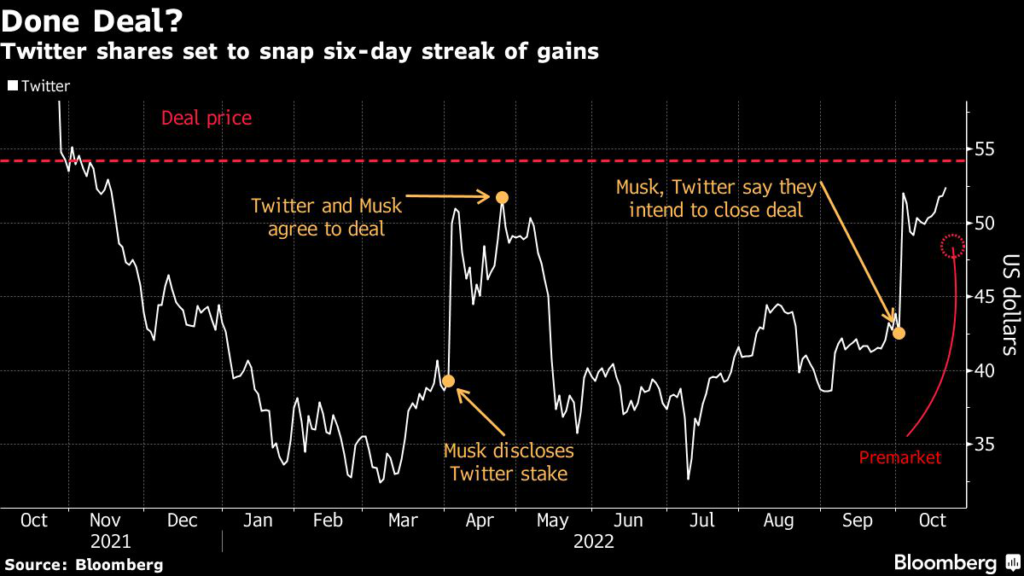
News that US officials were discussing whether they should subject some of Elon Musk’s ventures to national security reviews, including the deal for Twitter Inc. roiled its shares, fueling a rollercoaster ride in early trading. Twitter had tanked as much as 16% to $43.91 earlier before paring a bulk of those losses when the White House said it was not aware of a national security review for Musk’s ventures. 

The stock’s wild ride since Musk announced his offer to purchase the social media platform in April has been on display throughout the year. On Thursday, the arbitrage spread on the proposed takeover was at its narrowest since the deal was announced as Wall Street appeared increasingly confident that the deal would close. Now it’s on pace to fall further below Musk’s offer price of $54.20, on concern that the deal may come under government scrutiny.

Adding to that heap of bad news for tech investors, the possibility that the US could consider expanding its China ban to some of the most powerful emerging computing technologies has put pressure on stocks across the group, with futures contracts on the Nasdaq 100 Index down about 1% lower.

–With assistance from Alex Barinka, Phil Serafino and Abhishek Vishnoi.

(Updates with added details and latest share price moves.)

More stories like this are available on bloomberg.com

©2022 Bloomberg L.P.

Tweeting Praise for Putin Ally, Musk Wades In on Ukraine Again

(Bloomberg) — Elon Musk says he has not spoken with Vladimir Putin since the Russian president sent his troops into Ukraine. But the billionaire’s warm words for a tweet from a top Kremlin official drew him into an unusual back-and-forth over the war.

The SpaceX Chief Executive Officer praised a snarky post by Dmitry Medvedev on Thursday about the UK Prime Minister Liz Truss, known for her tough stance against Russia’s invasion and strong support for Ukraine. 

Medvedev was referring to a Daily Star online campaign that had run for about a week asking if Truss would beat the 10-day shelf life of a lettuce. She didn’t.

Musk quickly followed up with a barbed question for Medvedev, a former president who’s now deputy head of Russia’s Security Council and known for his often-threatening posts in social media.

Bakhmut is a city in the Donbas region in eastern Ukraine where Russian troops have struggled for weeks to make headway against Kyiv’s forces.

Musk’s Twitter comments earlier this month suggesting Ukraine negotiate with Russia and cede territory to end the war drew sharp criticism from Kyiv and its allies. Since then, he’s been undaunted, repeatedly taking to social media to argue that some kind of compromise needs to be reached – probably allowing Putin to keep Crimea, which he annexed in 2014 – in order to keep him from using nuclear weapons in Ukraine.

Musk has rejected allegations he’s just a messenger for the Russian leader. 

But he’s further alienated Ukraine and its supporters with threats to cut funding to Starlink terminals used by Kyiv’s military in areas that lack cellular service. Musk said SpaceX was losing $20 million a month providing satellite internet services and called on others to step in. 

In the end, Musk reversed course and said he would continue to fund Starlink in Ukraine. 

More stories like this are available on bloomberg.com

©2022 Bloomberg L.P.

Twitter Drops Further Below Musk Offer Price on US Review Report

(Bloomberg) — Twitter Inc. shares tumbled in premarket trading, falling further below Elon Musk’s offer price, on concern the deal may come under government scrutiny.

The stock fell as much as 16% to $43.91, before paring declines, after Bloomberg News reported that the Biden administration is mulling whether the US should subject some of the billionaire’s ventures, including the deal for the social media company, to national security reviews.

Some US officials may be concerned about foreign investors backing Musk’s bid, including Prince Alwaleed bin Talal of Saudi Arabia, Binance Holdings Ltd. — a digital-asset exchange founded and run by a Chinese native — and Qatar’s sovereign wealth fund, Tradition event-driven analyst Gregory Lafitte said in written comments.

If the Committee on Foreign Investment in the United States, known as CFIUS, starts a national-security review it would delay the deal, which likely wouldn’t close before the end of this year, Lafitte added.

Twitter had inched closer to Musk’s $54.20 a share offer price before the report, with Wall Street appearing increasingly confident that the deal would close. On Thursday, the arbitrage spread on the proposed takeover was at its narrowest since the deal was announced. 

Both sides’ bankers and lawyers are preparing paperwork for the buyout to be completed by the Oct. 28 court-issued deadline, according to people familiar with the matter.

Some are less worried about a review. “It does seem fanciful that the U.S. Government would view Twitter as a national security asset,” Canaccord Genuity’s Quest analyst Graham Simpson said in an email. Still, “the jury is still out” on the deal because of questions about Musk’s ability to finance the deal after Tesla Inc.’s share price halved this year, he said.

If premarket losses hold, Twitter will snap its six-day streak of gains. Also weighing on social media stocks on Friday, Snap Inc. reported its slowest quarterly sales growth ever, saying a decline in advertising spending continues to drag on results.

(Adds analyst comments.)

More stories like this are available on bloomberg.com

©2022 Bloomberg L.P.

Drilling 12 Miles Down to Tap Geothermal Energy

(Bloomberg) — Most geothermal power today comes from natural geysers or drilling operations that plunge a few miles down to harness heat from buried rock. 

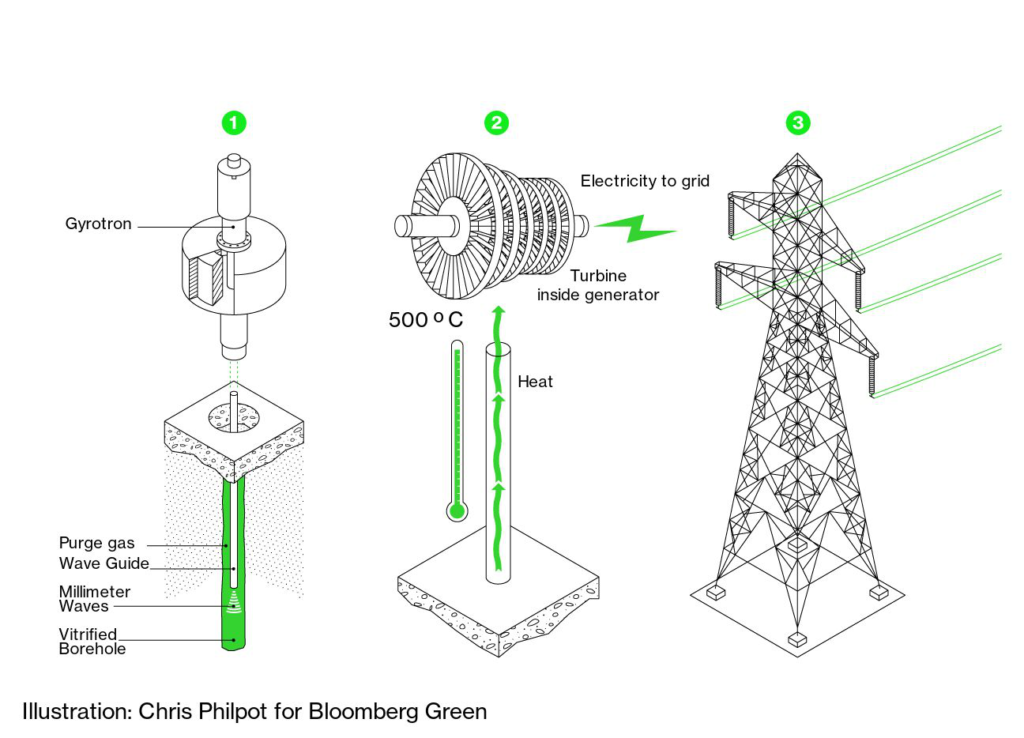
Quaise Energy, a startup based in Boston, is taking a third approach: digging deeper—and using more heat—than any company has before. To do so, it’s refashioning a millimeter-wave drilling technique from nuclear fusion experiments.

Carlos Araque, Quaise’s chief executive officer, likens it to “a big cousin of the microwave in your kitchen”—only with 1,000 times more power. “It’s a fairly mature technology,” he says. “We just use it for this purpose.” 

Geothermal is an also-ran of renewables. It only accounts for 0.2% of the world’s power supply, according to BloombergNEF, a clean energy research group. It’s a risky business, but one with the capacity produce terrific amount of energy with limited emissions. But geothermal operators often struggle to find fruitful places to dig and few have tried digging much below a few miles down.

Araque, a former engineer for oil services company Schlumberger, says that’s because it hasn’t made financial sense. For years, oil and natural gas has been cheaper to produce and easier to sell. Once a drill gets a few miles down into the Earth’s crust, the high temperature and pressure start to damage the equipment.

“It’s very simple,” Araque says. “It’s risk-reward. It’s the economics.”

Those economics are changing as ESG standards and new legislation reward buying cleaner energy. Quaise plans to start testing its drills in fields near Albuquerque, New Mexico, and Bend, Oregon in 2024.

The company’s drill—it is building three prototypes in laboratories—is about 100 feet tall and looks like conventional equipment used in the oil and gas industry. Except built into the center of the drill is a gyrotron, an electrical vacuum designed to heat plasma in thermonuclear fusion machines. It’s designed to go as much as 12 miles deep and access steam as hot as 500C. 

Right now, experts consider 150C an extraordinarily high temperature for such operations, says Maria Richards, who runs the Geothermal Laboratory at Southern Methodist University.

She applauds Quaise’s ambition, but is skeptical that it can dig as deeply as advertised in its designated areas, where the terrain is volcanic and tough. “All of a sudden, the equipment fails,” Richards says. “It’s not an easy area to drill.”

Quaise has an aggressive timeline. By 2026, the startup hopes to have the “first super-hot” system producing 100 megawatts of power—Araque estimates this will take less than 10 geothermal wells. By 2028, Quaise wants to retrofit an entire fossil fuel power plant with geothermal. 

Araque says Quaise has held talks with power plant owners and other energy providers, although he isn’t ready to share names. The company has raised $75 million since spinning out of MIT, where the initial concept for the drilling tech was formed. To fully retrofit a first power plant, Araque estimates that the overall process will cost $1 billion. 

He says he isn’t worried about capital. Quaise counts several individual investors who, according to Araque, know that a clean energy economy requires taking some technical risks. “We’re not doing this because it’s cool,” he says. “We do this because there are very few other options.”

More stories like this are available on bloomberg.com

©2022 Bloomberg L.P.
Close Bitnami banner
Bitnami