Bloomberg

Twitter Veers Off From Musk’s Offer Price on Report of US Review

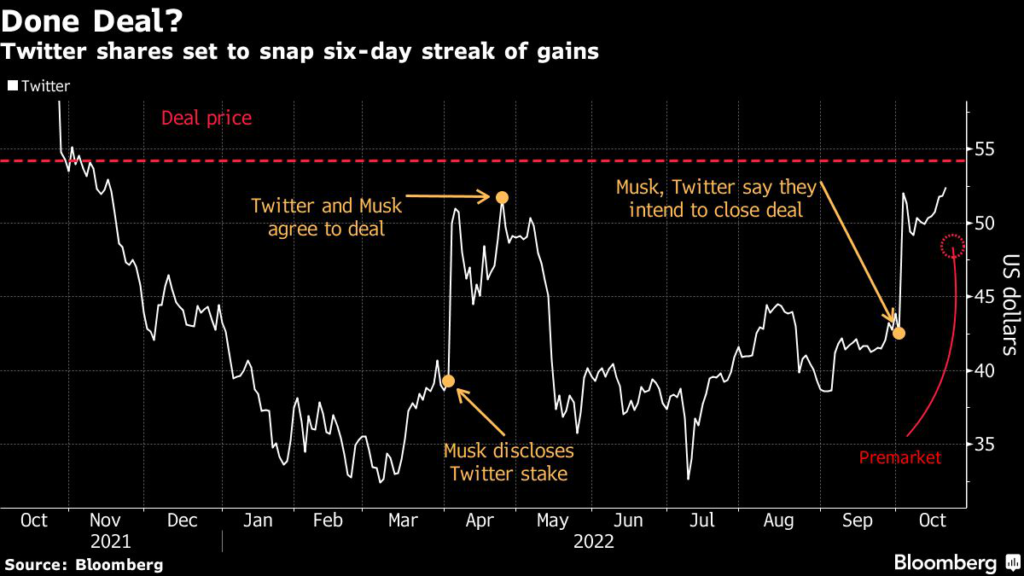
(Bloomberg) — Twitter Inc. shares tumbled in premarket trading, falling further below Elon Musk’s offer price, on concern the deal may come under government scrutiny.

The stock fell as much as 16% to $43.91 after Bloomberg News reported that the Biden administration is mulling whether the US should subject some of the billionaire’s ventures, including the deal for the social media company, to national security reviews.

Twitter had inched closer to Musk’s $54.20 a share offer price before the report, with Wall Street appearing increasingly confident that the deal would close. On Thursday, the arbitrage spread on the proposed takeover was at its narrowest since the deal was announced. 

Both sides’ bankers and lawyers are preparing paperwork for the buyout to be completed by the Oct. 28 court-issued deadline, according to people familiar with the matter.

However, Gregory Lafitte, analyst at Tradition, says it looks hard for the Twitter deal to close on the deadline. 

“Investors could be concerned about the timing of the transaction” while there is a possibility that the Delaware court could reopen the court case, he said. If premarket losses hold, Twitter will snap its six-day streak of gains. 

Also weighing on social media stocks on Friday, Snap Inc. reported its slowest quarterly sales growth ever, saying a decline in advertising spending continues to drag on results.


More stories like this are available on bloomberg.com

©2022 Bloomberg L.P.

How it Started… How it’s Going: 100 Episodes of ‘Bloomberg Crypto’

  • Listen to Bloomberg Crypto on the iHeartRadio App
  • Listen to Bloomberg Crypto on Apple Podcasts
  • Listen to Bloomberg Crypto on Spotify  

(Bloomberg) — This is episode 100 of the Bloomberg Crypto podcast. When we launched, in June, Bitcoin was trading around $30,000. Celsius and Three Arrows Capital hadn’t yet filed for bankruptcy. People knew where Do Kwon was. Celebrities cared about NFTs. It was a different time.

When we launched, we knew what we wanted to do: every day, we’d take a look at all things digital assets. And we’d talk to reporters, editors, analysts, investors,  industry experts, academics, policymakers – all in service of helping you better understand how crypto is shaping (and being shaped by) finance and culture. For this hundredth episode, we’re flipping the focus just a little. We’re going to spend some time answering your questions, and hearing from Bloomberg senior executive editor Chris Nagi about how he thinks this whole crypto thing is going. 

Follow us on Twitter @crypto, and subscribe to the Bloomberg Crypto Newsletter at https://bloom.bg/cryptonewsletter

More stories like this are available on bloomberg.com

©2022 Bloomberg L.P.

Snap Shocks Market Again, Fueling $42 Billion Social Media Slump

(Bloomberg) — For the third time in as many quarters, disappointing results from Snap Inc. are roiling social media stocks and adding to signs that the economic slowdown is deepening.

The maker of the Snapchat app reported its slowest quarterly sales growth ever on Thursday, saying a decline in advertising spending continues to drag on results.

Shares of Snap plunged as much as 27% in premarket trading, with the selloff spreading to peers including Meta Platforms Inc., Alphabet Inc. and Pinterest Inc. The companies were set to lose a combined market value of about $42 billion. Futures on the Nasdaq 100 Index fell 1%, signaling further pain for a tech-heavy benchmark that has plunged 32% this year.

Twitter Inc., meanwhile, slumped as much as 16% after news that Biden administration officials are discussing whether the US should subject some of Elon Musk’s ventures to national security reviews, including the deal for Twitter.

Snap spent the quarter shrinking and refocusing its business, announcing in August that it was cutting 20% of its workforce and slashing projects that don’t contribute to ​​user or revenue growth, or to the company’s augmented reality efforts. The changes were in response to plunging sales, which Snap attributed to a slowdown in marketer spending.

“Weakness in brand advertising appears to be the main source of the steep deceleration,” Brent Thill analyst at Jefferies wrote in a note. “It’s difficult to parse out how many of Snap’s issues are transitory.”

Snap and platforms like Meta’s Facebook and Alphabet’s Google are competing for a shrinking pool of advertising dollars this year. Spiraling inflation is putting pressure on companies and consumer spending. Meanwhile, new rules from Apple Inc. that require all apps to get smartphone users’ permission to be tracked online have made it more difficult for advertisers to measure and manage their ad campaigns.

Revenue growth “continues to be impacted by a number of factors we have noted throughout the past year, including platform policy changes, macroeconomic headwinds, and increased competition,” Snap said in its prepared remarks for investors. “We are finding that our advertising partners across many industries are decreasing their marketing budgets, especially in the face of operating environment headwinds, inflation-driven cost pressures, and rising costs of capital.”

Snap’s quarterly results were the first from big internet companies that depend on advertising, setting the stage for what investors can expect when larger players like Alphabet and Meta Platforms report next week.

“The net ad sector is negative, but most of the Snap headwinds appear to be Snap specific,” Mark Mahaney analyst at Evercore ISI wrote in a note. It is “highly likely” the ongoing market conditions are leading to a consolidation of ad spend with the largest platforms like Google and Facebook, he added.

–With assistance from Alex Barinka, Phil Serafino and Abhishek Vishnoi.

(Updates stock moves and adds analyst comments)

More stories like this are available on bloomberg.com

©2022 Bloomberg L.P.

Toyota Warns of Falling Short of Output Goal on Chip Shortages

(Bloomberg) — Toyota Motor Corp. warned it expects to miss its fiscal-year target of assembling 9.7 million vehicles, as a persistent shortage of semiconductors and other parts weighs on the carmaker and its global rivals. 

The world’s biggest auto manufacturer said it will produce 800,000 units in November and suspend operations at several of its plants in Japan due to the impact of supply constraints, Toyota said in a statement Friday. Of the total output, 550,000 vehicles will be exported and the rest will be for the domestic market.

The auto industry faces a string of headwinds, including rising costs on materials and logistics, global supply-chain breakdowns and parts shortages stemming from the spread of Covid-19. Toyota will discuss details on its earnings Nov. 1 when it unveils half-year results. 

Read more: Toyota Output Shrinks for Fourth Month on Shortages, China

“It remains difficult to look ahead due to the impact of semiconductor parts and other factors,” Toyota said in the statement. “We will continue to closely examine the supply of parts and work with related parties to consider all possible measures.” 

Toyota shares closed down 0.8% in Tokyo on Friday before the announcement of the vehicle production. The stock has declined 5.6% this year.

More stories like this are available on bloomberg.com

©2022 Bloomberg L.P.

Renault Slips as Inflation Worries Offset Revenue Gains

(Bloomberg) — Renault SA shares slipped after third-quarter revenue gains failed to offset wider investor worries about the impact of higher inflation and continued supply-chain disruptions on the carmaker.

Renault reaffirmed its full-year guidance on Friday, as it reported group revenue of €9.8 billion ($9.6 billion) for the third quarter — a 21% gain from last year and in line with analyst estimates.

Shares declined as much 2.8% and were trading 1.5% lower as of 9:44am in Paris.

Stifel analyst Pierre-Yves Quemener said investors were selling after gains in recent weeks and that the decline “should not last.”

Renault saw revenues helped by the French automakers’ biggest ever pricing boost and strong demand for new electric models such as the Megane E-Tech. But a persistent shortage of semiconductors contributed to a 2.4% decline in commercial sales, Chief Financial Officer Thierry Pieton told analysts on a call on Friday.

“Pricing and productivity more than offset inflation” so far this year and the positive sales trends seen in the third quarter are continuing, Pieton said. 

The CFO said he’s confident Renault will be able to navigate the tough inflationary environment in the months ahead, also helped by Renault’s less expensive Dacia models. 


Renault raised its full-year outlook in July as it sought to move past a costly withdrawal from Russia that led to a first-half loss. Chief Executive Officer Luca de Meo and his team are now working to carve out the company’s electric-vehicle and combustion engine businesses, a plan they will give more details on next month. 

Renault also is in ongoing talks with with Japanese partner Nissan Motor Co. to reshape their two-decade old alliance, with the two companies closing in on an agreement, Bloomberg reported earlier this week.

Under the possible deal with Nissan, Renault would reduce its stake over time to 15% from the current 43%, people familiar with the situation have said. In return, Nissan is planning to invest $500 million to $750 million for about 15% of Renault’s EV business Ampere, which is being split from the combustion-engine and powertrain operations as part of de Meo’s strategy. 

The company is due to hold a capital markets day Nov. 8 to give an update on its mid-term financial targets and more details on the carve-out plans. 


(Updates with analyst comment in fourth paragraph.)

More stories like this are available on bloomberg.com

©2022 Bloomberg L.P.

Twitter Shares Tumble After US Weighs Reviews for Musk Deals

(Bloomberg) — Biden administration officials are discussing whether the US should subject some of Elon Musk’s ventures to national security reviews, including the deal for Twitter Inc. and SpaceX’s Starlink satellite network, according to people familiar with the matter.

Twitter shares fell as much as 16% in pre-market trading in New York. 

US officials have grown uncomfortable over Musk’s recent threat to stop supplying the Starlink satellite service to Ukraine — he said it had cost him $80 million so far — and what they see as his increasingly Russia-friendly stance following a series of tweets that outlined peace proposals favorable to President Vladimir Putin. They are also concerned by his plans to buy Twitter with a group of foreign investors.

The discussions are still at an early stage, the people familiar said on condition of anonymity. Officials in the US government and intelligence community are weighing what tools, if any, are available that would allow the federal government to review Musk’s ventures. 

One possibility is through the law governing the Committee on Foreign Investment in the United States to review Musk’s deals and operations for national security risks, they said.

Read more: Twitter, Musk Talks Warm Up as Buyout Closing Deadline Nears

The interagency panel, known as CFIUS, reviews acquisitions of US businesses by foreign buyers. It is not clear if a CFIUS review — which would involve assessments by the Departments of State, Defense, and Homeland Security, among others — would offer the government a legal way to conduct a review, the people said. 

Twitter is also confronting reports that Musk aims to gut its workforce as part of his takeover. The Washington Post reported that Musk’s plan for Twitter involve slashing its staff by 75% in a matter of months. Bloomberg News confirmed that potential investors were told of the plan for cuts, along with an effort to double revenue within three years. 

One element of the $44 billion Twitter deal that could trigger a CFIUS review is the presence of foreign investors in Musk’s consortium. The group includes Prince Alwaleed bin Talal of Saudi Arabia, Binance Holdings Ltd. — a digital-asset exchange founded and run by a Chinese native — and Qatar’s sovereign wealth fund.

The panel operates behind closed doors and rarely confirms when it is conducting reviews. CFIUS also holds the power to review deals that have already been consummated. 

A US Treasury Department spokesperson said CFIUS does not publicly comment on any transactions that may or may not be under review.

Musk, the world’s richest person, has taken to Twitter in recent weeks to announce proposals to end Russia’s war and threaten to cut financial support for Starlink internet in Ukraine. His tweets and public comments have frustrated officials in the US and Europe and drawn praise from America’s rivals.

Musk later backed down from his threat to stop deploying Starlink and said he would continue to bear the costs of the service. Starlink has become an essential tool for communications in Ukraine during the Russian invasion. Musk has been providing the service for free but has said SpaceX loses $20 million a month providing it to Ukraine and he cannot be responsible for that cost indefinitely.

The US government would also use Starlink in the event of a telecommunications outage, according to people familiar with the matter.

Musk did not immediately respond to multiple e-mailed requests for comment.

He tweeted in reply to a fellow reader’s reaction to the Bloomberg article. “It would be hysterical if the government stopped Elon from over paying for Twitter ????,” the reader tweeted. “????????,” Musk replied.

Widely known as the chief executive officer of electric automaker Tesla Inc., Musk is no stranger to Washington, where he is a major player in government contracts. 

Musk forced his way into the business of military and intelligence satellite launches after lobbying vigorously in Congress and suing the US Air Force for the right to compete with a longstanding joint venture of defense giants Boeing Co. and Lockheed Martin Corp. 

In 2019, the Pentagon said it was reviewing Musk’s federal security clearance after he smoked marijuana on a podcast, though the results of that investigation are unclear. A SpaceX official at the time, who asked not to be identified, said the review had not had an impact on the company.

SpaceX flies astronauts to the International Space Station as part of a long-standing partnership with NASA and launches top secret satellites for the Pentagon. The US Agency for International Development, or USAID, has also paid for some of SpaceX’s Starlink satellites that have made their way to Ukraine.

–With assistance from Dana Hull.

(Updates with Musk reaction, in 13th paragraph. Shares in 2nd.)

More stories like this are available on bloomberg.com

©2022 Bloomberg L.P.

Bitcoin Group Weighs Bid for 268-Year-Old Bank in Germany

(Bloomberg) — Bitcoin Group SE is considering a bid for Bankhaus von der Heydt, the 268-year-old German bank that’s stumbled with its own moves into cryptocurrencies and digital assets.

The crypto and blockchain investor is in negotiations with several potential targets, including Bankhaus von der Heydt, the company said in a statement late Thursday that confirmed a Bloomberg News report.

Founded in 1754, Munich-based Bankhaus von der Heydt has been talking to potential buyers after a deal to sell itself to crypto-derivatives exchange BitMEX fell through, people familiar with the matter have said. A sale may value the bank at around €20 million ($19.6 million), the people said, asking not to be identified discussing confidential information.

Bitcoin Group, also based in Germany, owns futurum bank AG, a trading platform for digital currencies. Deliberations are ongoing and there’s no certainty they’ll result in any transaction. 

A spokeswoman for Bankhaus von der Heydt declined to comment.

Bankhaus von der Heydt became one of the first lenders in Germany to offer trading and custody services for digital assets, betting that demand for cryptocurrencies would help it reverse years of losses. But costs to build out the technology have pushed the bank further into the red. 

Owner Dietrich von Boetticher is reluctant to continue injecting capital and without a fresh source of cash, the bank may be forced to shut down, according to the people. Bankhaus von der Heydt recently cancelled servicing contracts with several crypto funds in a step that would facilitate an orderly wind-down, they said.

The BitMEX deal collapsed after that company’s backers agreed to pay $100 million to settle allegations that they allowed years of illegal trades, and two founders admitted they failed to establish an anti-money-laundering program at the exchange.

Any bidders for Bankhaus von der Heydt will have to pass muster with German regulator BaFin, which is monitoring the situation, the people said.

–With assistance from Nicholas Comfort.

More stories like this are available on bloomberg.com

©2022 Bloomberg L.P.
One Chinese Chip Startup Shows Key Gap in Biden Export Curbs

(Bloomberg) — One of China’s most promising chip designers has already navigated through the Biden administration’s export restrictions and concluded it will be able to continue tapping Taiwan Semiconductor Manufacturing Co. to produce its advanced silicon.

Biren Technology develops artificial intelligence chips and is considered a promising domestic contender to compete with graphics chips from Nvidia Corp., which has said it can no longer sell its most advanced AI products into China. The US measures were designed to limit China’s development of technology that may be used in aid of its military, and appeared to rule out access to advanced fabrication, but Biren believes its AI chips produced by TSMC are not covered by the sanctions, according to people with direct knowledge of the matter.

Shanghai-based Biren, founded in 2019, made bold claims in the summer about its chips outperforming Nvidia’s market-leading A100 AI accelerator — the very product that can no longer be sold in China. But after reviewing the designs, TSMC and Biren concluded that the specs of the Chinese chip don’t meet the criteria for restriction, according to one of the people, who asked not to be named discussing a sensitive matter. That suggests Washington’s controls may not capture all alternatives to Nvidia’s hardware.

“Biren has a chip fortunately just below the threshold and the chip hence can still be made by TSMC,” Bernstein analysts led by Mark Li wrote in a report that analyzed chips against the export control.

TSMC, the world’s largest contract chipmaker, complies with all relevant rules and regulations and “will continue to serve all customers around the world,” Chief Executive Officer C.C. Wei said in response to a question about China during its earnings call last week.

Biren believes everything it’s doing is in compliance with legal regulations, according to one of the people. TSMC is reviewing products from other Chinese chip developers to see whether it can continue their production under the new export controls, another person said.

A Biren representative declined to comment. TSMC didn’t immediately respond to a request for comment.

As the US banned exports of Nvidia and Advanced Micro Devices Inc.’s high-end AI-training chips to China, it set a performance threshold above which no semiconductors made with US technology can be sold in the country. The metrics include a combination of connectivity speeds and operations per second. Bernstein’s analysis shows the Biren BR100 falls just shy of that control cutoff.

Bernstein’s Li saw limited revenue exposure for TSMC from the new controls, stressing that “only very high-end compute chips are restricted” and estimating a hit of 0.4% to the Taiwanese company’s 2023 sales.

Still, while Biren may continue building its current generation of semiconductors, Washington’s curbs are likely to effectively cap its progress up the technology ladder. Additional improvements from Biren are liable to fall foul of the high-performance silicon restriction.

Biren, backed by the likes of IDG Capital and Walden International, was seeking new funds earlier this year at a valuation of $2.7 billion, Bloomberg News reported. Its flagship BR100 and BR104 processors are designed along similar lines to the graphics chips that Nvidia and AMD have adapted to AI purposes and are used to train artificial intelligence models and algorithms. Those include computer vision, natural language processing and conversational AI.

Washington’s latest salvo of restrictions triggered a selloff in Chinese tech stocks and narrowed the ability of international suppliers to sell or support chipmaking equipment in China. Netherlands-based ASML Holding NV withdrew support by US employees due to a new measure that precludes US citizens or green card holders from helping to make semiconductors that may have a military use in China. American suppliers like KLA Corp. and Lam Research Corp. also distanced themselves from the country’s top chip plants.

China’s Ministry of Industry and Information Technology summoned representatives from across its semiconductor sector to review the fallout from the latest US restrictions. Lawyers and executives at those firms are still assessing the full impact of the measures.

More stories like this are available on bloomberg.com

©2022 Bloomberg L.P.

Stocks Retreat Amid High Bond Yields, China Risks: Markets Wrap

(Bloomberg) — Stocks extended declines in Asia as Treasury yields held at the highest level since the global financial crisis and investors weighed risks to Chinese markets. 

A gauge of Asian equities headed for a second week of declines, with chip giant Taiwan Semiconductor Manufacturing Co. and major Australian banks among the biggest drags. European and US stock futures dropped amid wariness around economic challenges.

Traders are being challenged by mixed signs from the Chinese government and the twice-a-decade party congress. A report that officials were considering relaxing quarantine rules was positive for sentiment while negative signals came from news that the Biden administration planned additional export controls on China’s access to powerful computing technologies.

The dollar rose amid elevated Treasury yields. The yield on the 10-year US note went above 4.25% for the first time since 2008 as traders started to price in a higher peak Federal Reserve policy rate.  

The yen remained weaker than the closely-watched 150 per dollar level. Ten-year yen swap rates broke above 0.6% to a more than eight-year high while Japan’s benchmark 10-year bond yield was at the top of the central bank’s 0.25% trading band, underscoring global pressure on rates.

The pound remained under duress as the UK looks for a new leader to succeed Liz Truss.

“The Bank of England was probably on the hook in terms of having to hike rates aggressively to counter some of the inflationary impulses from tax cuts and fiscal spending,” Mitul Kotecha, chief emerging markets Asia and Europe strategist at TD Securities, said on Bloomberg Television. While some of that pressure has gone away, it doesn’t mean the BOE can stop hiking, he said. 

Hawkish remarks from Fed officials and swaps pricing in a 5% peak policy rate in 2023 should continue to support the greenback against its major peers and emerging-market currencies.

Shares of some Chinese chip-related stocks fell as the US was said to be considering new export controls that would limit China’s access to powerful computing technologies.

Meanwhile, US equity volatility is showing no signs of abating ahead of Friday’s $2 trillion options expiration and another raft of corporate earnings. 

Elsewhere, oil edged higher after a rocky week as concerns over a global economic slowdown continue to weigh on the market. Iron ore was on track for its longest stretch of weekly declines since 2016 amid mounting worries over the global outlook for steel demand.

Some of the main moves in markets:

Stocks

  • S&P 500 futures fell 0.3% as of 7:24 a.m. London. The S&P 500 fell 0.8% on Thursday
  • Nasdaq 100 futures were down 0.6%. The Nasdaq 100 fell 0.5%
  • Japan’s Topix index dropped 0.7%
  • South Korea’s Kospi index lost 0.2%
  • Hong Kong’s Hang Seng Index fell 0.7%
  • China’s Shanghai Composite Index fell 0.2%
  • Australia’s S&P/ASX 200 Index lost 0.8%
  • Euro Stoxx 50 futures fell 0.9%

Currencies

  • The Bloomberg Dollar Spot Index rose 0.2%
  • The euro fell 0.1% to $0.9773
  • The Japanese yen fell 0.1% 150.42 per dollar
  • The offshore yuan fell 0.2% to 7.2652 per dollar
  • The British pound weakened 0.5% to $1.1181

Cryptocurrencies

  • Bitcoin rose 0.2% to $19,063.00
  • Ether rose 0.6% to $1,290.22

Bonds

  • The yield on 10-year Treasuries advanced three basis points to 4.26%
  • Australia’s 10-year yield advanced 14 basis points to 4.20%

Commodities

  • Spot gold fell 0.4% to $1,620.91 an ounce

–With assistance from Masaki Kondo and Naomi Tajitsu.

More stories like this are available on bloomberg.com

©2022 Bloomberg L.P.

Silver Lake Backs Abu Dhabi Firm Bayanat’s $171 Million IPO

(Bloomberg) — Bayanat, a geospatial and data analytics firm owned by Abu Dhabi’s G42, is set to raise $171 million in an initial public offering backed by US private equity firm Silver Lake and the United Arab Emirates’ most valuable company. 

G42 is selling 571.4 million shares in Bayanat at 1.10 dirhams ($0.27) each. Silver Lake and Abu Dhabi’s International Holding Co. will invest at that price, though the size of the commitment wasn’t immediately clear.  

An offering of 534.3 million shares for professional investors was covered within hours of the IPO opening for subscription on Friday, Bayanat said. The subscription period closes on Tuesday and trading is set to start on Oct. 31. 

Artificial intelligence firm G42, which has operations spanning from energy to healthcare, will hold 77% in Bayanat after the listing.

G42 and IHC — the UAE’s most valuable listed company that’s worth $193 billion — are part of a business empire overseen by UAE national security adviser Sheikh Tahnoon Bin Zayed. Silver Lake bought a stake in G42 last year, and the firm also counts Abu Dhabi wealth fund Mubadala Investment Co. as an investor. 

Bayanat last year started trials for the Middle East’s first driverless ride-sharing service in Abu Dhabi. The firm reported revenue of 490.6 million dirhams and a 225.9 million-dirham profit for the nine months to Sept. — more than double from a year ago. 

Its IPO is the latest sign of continuing investor demand for new share sales in the Gulf, even as listings falter globally. Abu Dhabi healthcare provider Burjeel Holdings Plc raised $300 million earlier this month.

Read More: Middle East IPO Momentum Undeterred by Global Lull

(Updates with professional investors’ tranche getting covered in third paragraph)

More stories like this are available on bloomberg.com

©2022 Bloomberg L.P.

Close Bitnami banner
Bitnami