Bloomberg

FTX US Will Decide What Counts as a Crypto Security, CEO Bankman-Fried Says

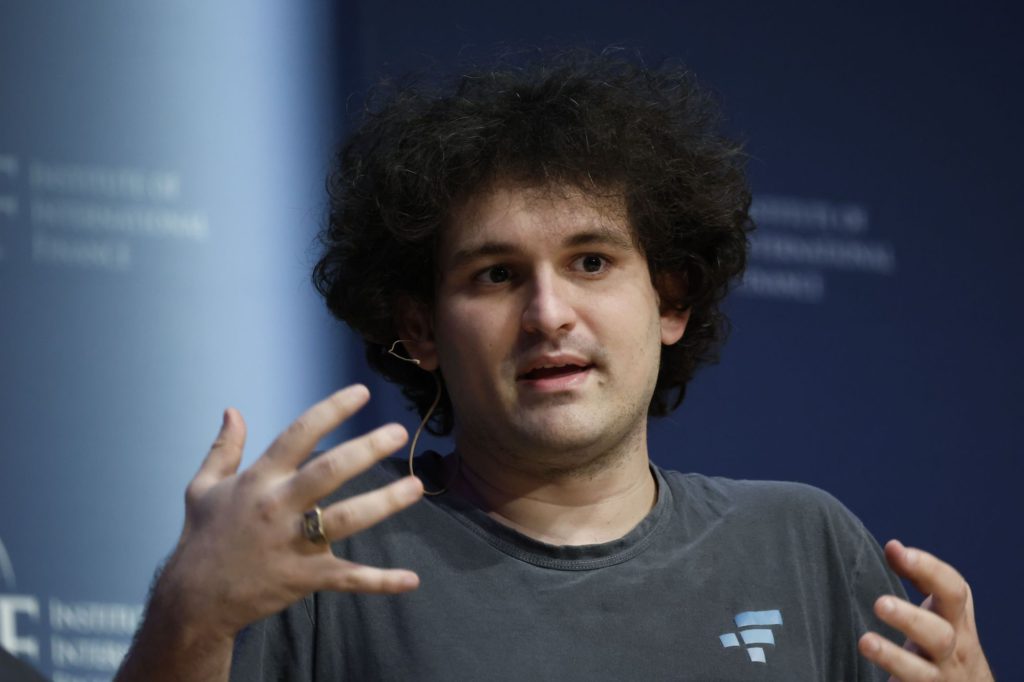
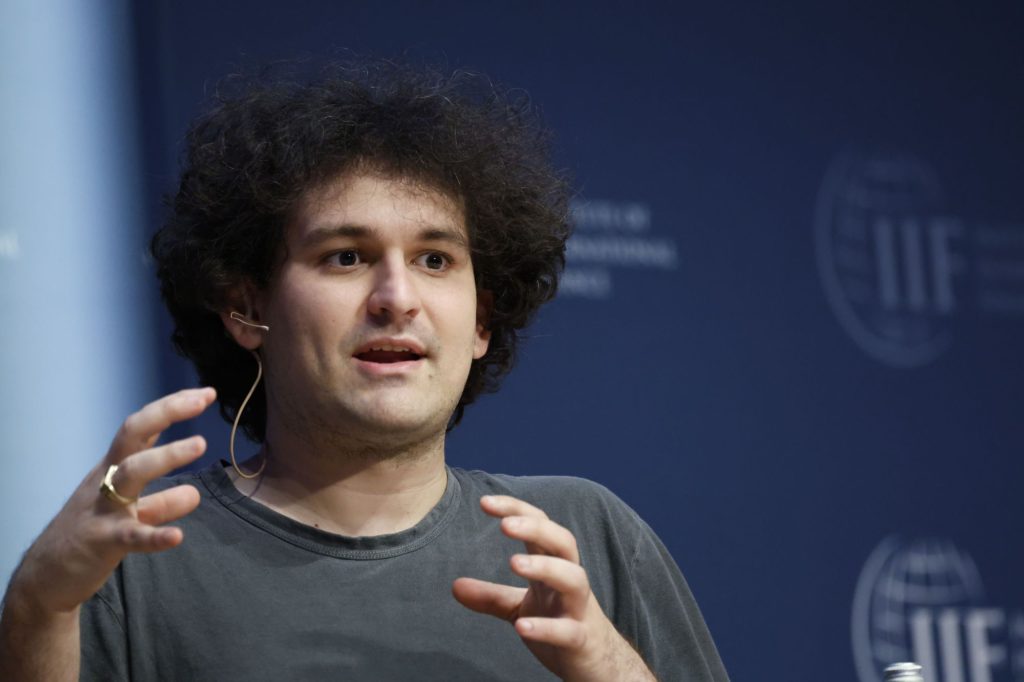
(Bloomberg) — The US arm of crypto trading giant FTX will begin conducting its own analysis to determine whether assets are securities before listing them, founder Sam Bankman-Fried said in a blog post published on Wednesday. 

While US regulators have said some tokens, like Bitcoin, aren’t securities, “there are a number which are unclear,” the crypto executive wrote. Until there’s more clarity on the issue, FTX US will have its legal team conduct an analysis of each asset it wants to list under a decades-old framework for assessing whether something is a security, known as the Howey Test, Bankman-Fried added. 

The company’s statements come during a regulatory turf war in the US: Securities and Exchange Commission Chair Gary Gensler has said most digital assets are securities that are subject to his agency’s rules, while the Commodity Futures Trading Commission is pushing for legislative changes that would give it more direct authority to oversee the asset class. 

Bankman-Fried said if FTX’s internal analysis finds a token isn’t a security, it’ll be treated as a commodity unless the SEC or a court finds otherwise. And if the company determines the asset may be a security, it won’t list the token in the US unless there’s a clear path for registration, he said. 

This type of internal vetting doesn’t guarantee that an exchange will be spared from regulatory scrutiny. The SEC in July identified several crypto assets as securities as part of an insider trading case against a former Coinbase employee and two others. The regulator is separately probing whether Coinbase improperly let Americans trade unregistered securities; that review predated the insider trading investigation.

In a blog post published after the insider trading allegations against its former employee, Coinbase maintained that none of the assets identified by the regulator and listed on its exchange were securities. “[In] the absence of a concrete digital asset securities regulatory framework from the SEC, we remain confident that Coinbase’s rigorous review process keeps securities off Coinbase’s platform,” Paul Grewal, the company’s Chief Legal Officer wrote. 

Coinbase said Thursday in response to questions after Bankman-Fried’s post that it already analyzes and reviews digital assets before making them available on its exchange. Most assets are rejected for listing, the firm added.

A spokesperson for Binance — the world’s largest crypto exchange — said in emailed responses that for now it isn’t “actively engaged” in the US discussion over the status of tokens. The firm added that “we believe 99% of crypto assets should be classified as commodities based on their use case.”

The US arm of Binance announced in August that it was delisting the Amp token, which the SEC had identified as a security. 

(Updates with Coinbase, Binance comments from the seventh paragraph.)

More stories like this are available on bloomberg.com

©2022 Bloomberg L.P.

US Calls for Security Council Briefing on Russia, Iranian Drones

(Bloomberg) — The US, along with France and the UK has called for a special United Nations Security Council briefing regarding evidence that Russia has procured Iranian drones for its war on Ukraine.

The US Mission to the UN said in a statement Wednesday that the so-called expert briefing would look into Russian procurement of Iranian unmanned aerial vehicles “in open violation” of a Security Council resolution. 

“There is ample evidence that Russia is using Iranian-made UAVs in cruel and deliberate attacks against the people of Ukraine, including against civilians and critical civilian infrastructure.”

Drones have been deployed in recent Russian attacks on power plants and other installations across Ukraine. About 30% of the country’s power stations have been destroyed since Oct. 10, President Volodymyr Zelenskiy said Wednesday.

Iran’s Foreign Ministry has repeatedly denied that any of the country’s weapons have been exported for use in Ukraine, but Ukrainian officials have on several occasions identified what they say are Iranian-manufactured Shahed suicide drones. 

Ned Price, a State Department spokesman, said in a statement that “as Iran continues to lie and deny providing weapons to Russia for use in Ukraine, we are committed to working with allies and partners to prevent the transfer of dangerous weaponry to Russia.”

Earlier Wednesday, Iran’s Supreme Leader Ayatollah Ali Khamenei boasted of the reputation of military drones produced in his country,

“When images of Iranian drones were published a few years ago, they would say they’re photo-shopped. Now they say Iranian drones are dangerous, why do you sell them or give them to so-and-so?” according to a report in the state-run Islamic Republic News Agency.  

His reported comments came after a person with knowledge of the matter told Bloomberg that the European Union proposed sanctioning three Iranian generals and one entity for providing drones and other military support to Russia for its invasion of Ukraine. 

–With assistance from Arsalan Shahla.

(Updates with State Department statement, in sixth paragraph.)

More stories like this are available on bloomberg.com

©2022 Bloomberg L.P.

Billionaire Bankman-Fried Tries to Fix Crypto’s Hacking Problem

(Bloomberg) — Crypto billionaire Sam Bankman-Fried has outlined a framework for limiting the impact of the hacks and exploits plaguing the industry, including capping the maximum bounty for attackers at $5 million. 

His intervention comes just days after a hacker got to keep $50 million of the roughly $100 million drained from the Mango decentralized-finance application under a deal with the platform after the heist. Over $3 billion has been looted from the crypto sector this year, which is set to be a record for hacking.

Bankman-Fried, co-founder of digital-asset exchange FTX, proposed in a blog post what he called a “5-5 standard” where hackers keep either 5% of the amount they’ve taken from a protocol or $5 million, whichever is smaller.

Other key provisos are that customers must be made whole and that the hacker is acting in “good faith” and fully intended to cooperate and return most of the assets. In crypto, attackers are sometimes viewed as white-hat hackers who seek to expose vulnerabilities in return for a reward rather than to make malicious gains.

“Hacks are extremely destructive to the digital asset ecosystem,” Bankman-Fried wrote, adding his 5-5 approach would have curbed the impact of hacks “more than 98%” but that he’s still unsure what the right standard would be.

Data from blockchain specialist Chainalysis Inc. show most of the exploits and hacks this year have targeted decentralized finance — or DeFi. DeFi protocols offer software-based algorithms that enable crypto investors to trade, borrow and lend on digital ledgers without using a central intermediary. 

The spate of attacks is putting the onus on crypto players to find solutions given that DeFi is touted as important for the wider adoption of digital tokens, which are also reeling from this year’s rout in coin prices.

Bankman-Fried’s comments were part of a broad post that addressed issues like sanctions, tokenization of stocks and what makes an asset a security. 

More stories like this are available on bloomberg.com

©2022 Bloomberg L.P.

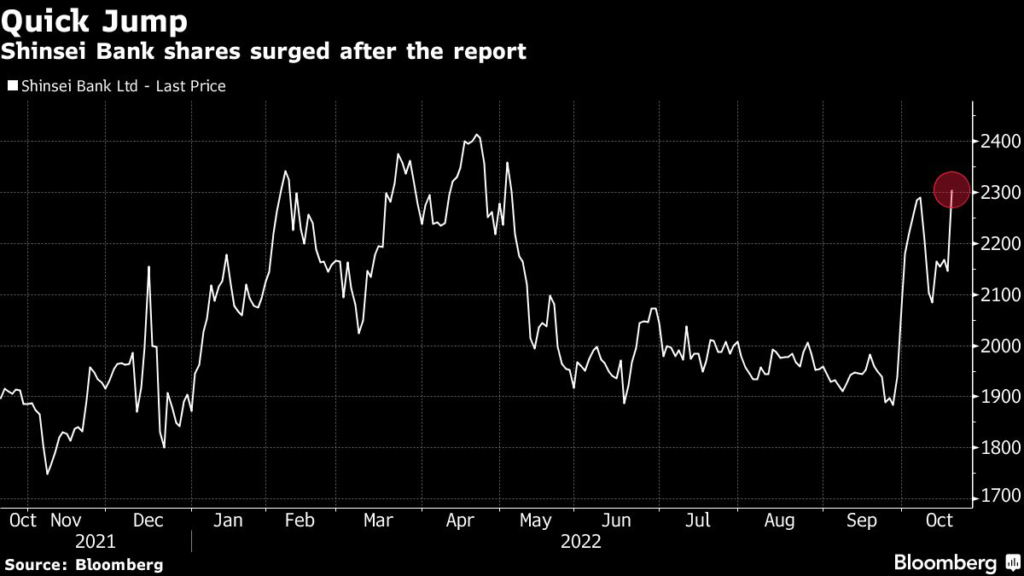
Shinsei Bank Share Rally Fades as SBI Denies Privatization Plans

(Bloomberg) — SBI Holdings Inc. said it doesn’t have concrete plans to take consumer lender Shinsei Bank private, denying a local media report that sent shares up by the most in 14 months in early Tokyo trading. 

The response came after Kyodo reported that Japan’s largest online brokerage will hold discussions with the nation’s Financial Services Agency to draft a detailed plan.

SBI, which is planning to increase its stake in Shinsei to above 50% said while it’s true it’s looking at various options to improve the lender’s performance, it doesn’t have specific plans to delist the company. Shinsei Bank also denied any concrete plans to go private.

Shinsei Bank shares pared earlier gains to trade 7.7% higher in Tokyo after the statements, while SBI shares traded 1% lower. 

This marks the latest twist in a saga that began more than a year ago when SBI launched a rare unsolicited tender offer to increase its stake to a level that would give it effective control of Shinsei without having to go through additional regulatory hurdles. 

SBI’s Chief Executive Officer Yoshitaka Kitao previously said the brokerage, in conjunction with the government, has the option to delist Shinsei Bank in order to pay back funds the lender owes to taxpayers. 

–With assistance from Takashi Nakamichi and Catherine Ngai.

More stories like this are available on bloomberg.com

©2022 Bloomberg L.P.

China City Eases Rules to Address Population, Property Slowdown

(Bloomberg) — A Chinese city near Shanghai has relaxed rules to allow property owners to become permanent residents, a move that may help to address a housing slump and slowing population growth. 

The eastern city of Ningbo will give so-called hukou, a passport-style regional permit allowing access to better medical and education resources, to anyone who purchased properties there, according to a rule posted on the local government’s website last week. The previous rule required applicants to work in the city. 

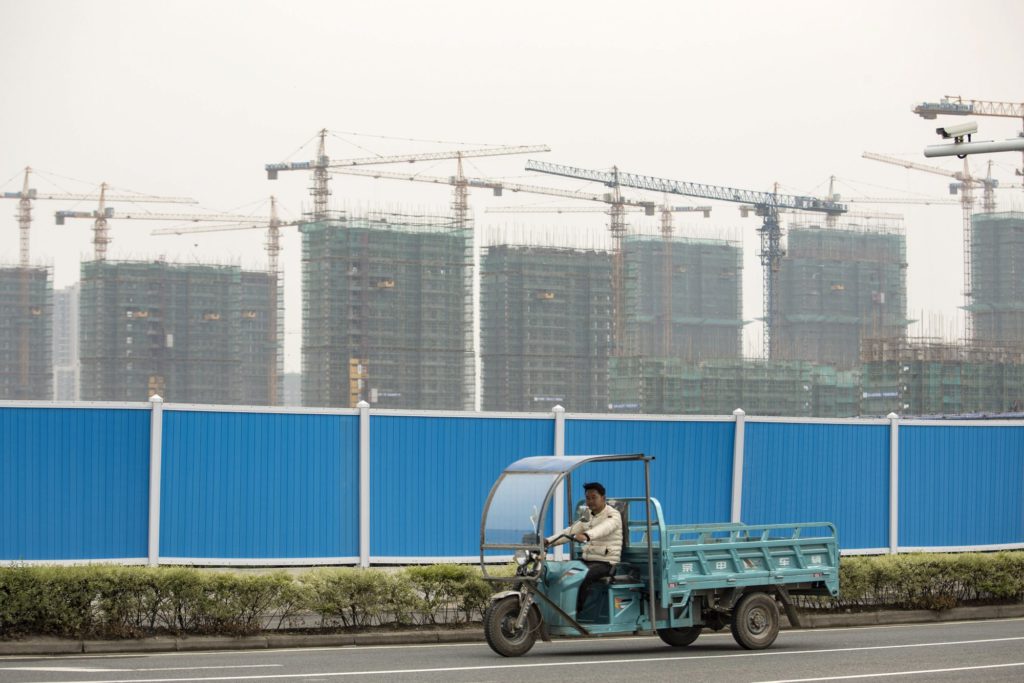
The move may add to incentives to purchase a home in the city, where property sales are plunging in tandem with a nationwide rout. It could also help Ningbo maintain residents as China’s population is poised to peak this year, weighing on demand and economic growth prospects. 

Home sales in Ningbo plunged 58% by area in the first three quarters, steeper than a 46% average seen in similar cities, according to China Real Estate Information Corp. data. Second-hand home prices fell the most in more than seven years in the city in August, government figures show. 

Ningbo’s population is also under strain. Births in the city plunged 12% in the first half from a year earlier, authorities said in August, forecasting a 10% drop for the full year. 

Since 2019, China has promoted freer movement of labor to cushion slowing growth, including by easing the hukou system. For cities with more than 5 million people, such as Ningbo, the system will be simplified, the State Council has said. 

Ningbo, home to the world’s third-largest container port, also plans to grant hukou to tenants who have rented apartments for a year, shortening the prerequisite from two years previously, according to the new rules. 

China’s home sales have been falling for more than a year, hurt by a crackdown on leverage and the nation’s Covid Zero policy. Sales of new homes by the 100 biggest real estate developers dropped 25.4% in September from a year earlier, CRIC figures show. 

(Updates with home sales data in the last paragraph)

More stories like this are available on bloomberg.com

©2022 Bloomberg L.P.

China Gathers Chip Firms for Emergency Talks After Biden Curbs

(Bloomberg) — China’s top technology overseer convened a series of emergency meetings over the past week with leading semiconductor companies, seeking to assess the damage from the Biden administration’s sweeping chip restrictions and pledging support for the critical sector.

The Ministry of Industry and Information Technology has summoned executives from firms including Yangtze Memory Technologies Co. and supercomputer specialist Dawning Information Industry Co. into closed-door meetings since Washington unveiled measures to contain China’s technological ambitions.

MIIT officials appeared uncertain about the way forward and at times appeared to have as many questions as answers for the chipmakers, people familiar with the discussions said. While they refrained from hinting about counter-measures, officials stressed the domestic IT market would provide sufficient demand for affected companies to keep operating, the people said, asking to remain anonymous on a sensitive issue.

Many of the participants argued US curbs collectively spell doom for their industry, as well as China’s ambitions to un-tether its economy from American technology. Yangtze Memory, among China’s best hopes of getting into cutting-edge chipmaking, warned the MIIT its future may be in jeopardy, according to one of the people.

AI chipmaker Biren is a telling example of how Chinese semiconductor startups went from stardom to crisis in a matter of days. The chip designer was eyeing a $2.7 billion valuation and declared in August it had released the first general-purpose graphics processing unit, “setting a new record in global computing power.”

But Biren had contracted with Taiwan Semiconductor Manufacturing Co. to produce its chips, using advanced 7-nanometer technology. Now TSMC may have to stop working with the startup under Biden’s regulations, and no company in China has the capabilities to replace it. 

Biren declined to comment on the discussions but said in a statement the company was operating normally, and it determined the curbs would have no impact on their business after checking with lawyers. The ministry didn’t respond to a faxed request for comment. Yangtze Memory and Dawning Information representatives didn’t respond to requests for comment. 

US firms have withdrawn employees from promising firms including top memory maker Yangtze, while non-American suppliers such as ASML Holding NV have halted support for local customers. Dawning Information, China’s leading builder of supercomputers, and its unit Hygon are scrambling to find alternatives to the American silicon they need to keep going. 

Hygon spokespeople didn’t immediately reply to emails seeking comment. But the company said in a filing last week it was evaluating the longer-term impact of the sanctions.

“Biden’s new chip export controls are a huge blow to the CCP’s science and technology ambitions,” Jordan Schneider, an analyst at Rhodium Group, wrote on Twitter, referring to the Communist Party.

Why Making Computer Chips Has Become a New Arms Race: QuickTake

It’s unclear how Beijing will react to the new restrictions, the Biden administration’s most aggressive yet as it tries to stop China from developing capabilities it sees as threatening. 

Xi Jinping, in a landmark address over the weekend, pledged tech self-reliance to prevail in a battle with the US for technological supremacy — which many took as a sign Beijing will redouble policy and financial support for sectors such as AI and chips. China’s leader however stopped short of directly addressing Washington’s latest moves or outlining new aid. Officials haven’t indicated whether they were considering measures to retaliate.

Earlier this month, the US Commerce Department unveiled sweeping regulations that limit the sale of semiconductors and chip-making equipment to Chinese customers, striking at the foundation of the country’s efforts to build its own chip industry. The US also added 31 organizations to its unverified list, including Yangtze Memory and chip equipment maker Naura Technology Group Co., severely limiting their ability to buy hardware from abroad.

“We find the newly-announced restrictions well thought-out and plugs many loopholes that the prior restrictions failed to cover,” Bernstein analysts led by Mark Li wrote last week. “China won’t be able to advance in semiconductor technologies as fast as before and probably has no choice but to focus on the mature part.”

The global chip industry, which relies on China as the world’s biggest single consumer of semiconductors, has been bracing for retaliation of some fashion from Beijing. US firm Lam Research Corp. warned its revenue could halve in China — a market that yields roughly 30% of its overall business. ASML however suggested “fairly limited” impact from the export controls.

Read more: Chip Industry’s China Crisis Hammers Lam But May Spare ASML

Local firms are meanwhile counting on tangible support. 

Many technology powerhouses in China rely on government-backed projects for growth. The country’s massive wireless network construction yielded hefty profits for Huawei Technologies Co. and ZTE Corp. Data center construction in the less-developed western part of the country is set to benefit an array of server makers including Sugon and Inspur Group. This year, Beijing ordered government agencies and state firms to replace foreign personal computers, potentially creating demand for 50 million Chinese-branded PCs, Bloomberg News has reported.

But depending on how broadly Washington enforces the restrictions, the impact could extend well beyond semiconductors and into industries that rely on high-end computing, such as electric vehicles, aerospace and smartphones. Chip sector leaders from Intel Corp. to TSMC have sold off in recent days, spooked by the growing uncertainty at a time the world is bracing for a potential recession.

“When Beijing is caught flat-footed, its initial reaction is always slow,” according to a note from Fathom China. “Ministers are not authorized to make decisions on their own, they need the big bosses to decide. And right now, the big bosses are busy with the Party Congress.”

How Biden’s Chip Actions May Be Broadest China Salvo Yet

–With assistance from Debby Wu.

More stories like this are available on bloomberg.com

©2022 Bloomberg L.P.

Asian Stocks Slump Amid Elevated Bond Yields: Markets Wrap

(Bloomberg) — Stocks slumped in Asia and bond yields spiked higher amid concern that strong inflation and hawkish monetary policy will further slow the global economy.

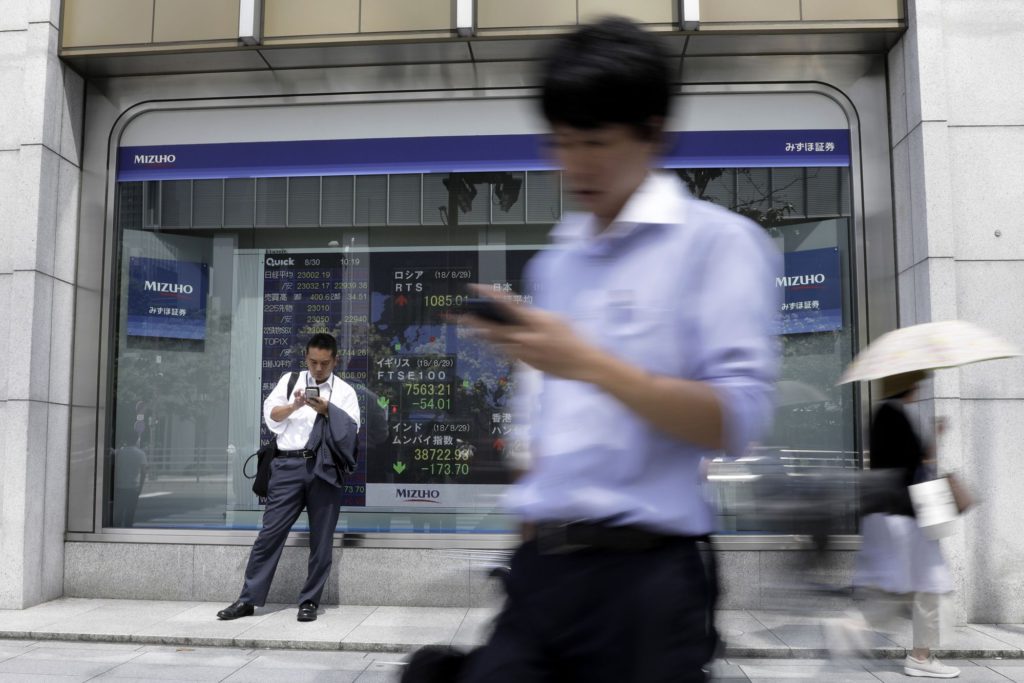
Shares dropped in Japan, Australia and China, with Hong Kong’s equity benchmark headed for the lowest close since 2009. 

Fears over slowing growth and rising Covid cases in China are adding to worries of investors amid the twice-a-decade party congress in Beijing. The offshore yuan traded around a fresh record low while an index of US-listed Chinese companies slumped more than 7% on Wednesday to the lowest in nine years.

Meanwhile in Japan, the 10-year yield again pushed above the 0.25% upper limit of the central bank’s target range, triggering it to announce unscheduled bond purchases to rein it back in.

Adding to the challenge for policy makers, the yen traded at levels last seen in 1990 and remained within a whisker of the key mark of 150 versus the greenback. This has traders on guard for potential government intervention to shore up the currency.

Government bond yields jumped more than 10 basis points in Australia and New Zealand, as US Treasury yields held near recent highs. The policy-sensitive two-year Treasury yield was near the highest since 2007. 

This in turn was supporting the dollar, which was higher against its major counterparts and emerging-market currencies in Asia. 

The Philippine peso dropped to a record low against the greenback while in South Korea credit strains prompted authorities to revive a $1.1 billion bond stabilization fund.

Federal Reserve Bank of St. Louis President James Bullard said he expected the central bank to end its ‘’front-loading” of aggressive interest-rate hikes by early next year and shift to keeping policy sufficiently restrictive with small adjustments as inflation cools.

The Fed is expected to raise interest rates by 75 basis points at its Nov. 1-2 meeting — its fourth straight increase of that size — as central bankers seek to cool the hottest inflation in four decades. 

US equity futures fell in Asia after stocks on Wednesday halted a back-to-back rally, making any calls for a bottom look elusive. Not even bright earnings spots like Netflix Inc. and United Airlines Holdings Inc. were able to enthuse investors about more gains in the S&P 500. A late day rout in Tesla Inc. on disappointing sales could further weigh on sentiment.

“As we look at third-quarter results, we think there are going to be more misses than the market is currently expecting,” Ellen Hazen, chief market strategist at F.L.Putnam Investment Management, said on Bloomberg Radio. “If you look at GDP for this year, it keeps getting revised downward and it’s really hard for companies to keep growing their earnings in the face of that.”

Elsewhere in markets, oil held gains as the market shrugged off measures from US President Joe Biden to tame rising energy prices that have fueled inflation. Gold dipped to hold at a three-week low.

Key events this week:

  • US existing home sales, initial jobless claims, Conference Board leading index, Thursday
  • Euro area consumer confidence, Friday

Some of the main moves in markets:

Stocks

  • Futures on the S&P 500 fell 0.6% as of 12:17 p.m. Tokyo time. The S&P 500 fell 0.7% Wednesday
  • Nasdaq 100 futures fell 1%. The Nasdaq 100 fell 0.4%
  • Japan’s Topix index fell 0.6%
  • The Hang Seng Index fell 2.3%
  • The Shanghai Composite Index fell 0.4%
  • Australia’s S&P/ASX 200 Index fell 1.2%

Currencies

  • The Bloomberg Dollar Spot Index rose 0.2%
  • The euro fell 0.1% to $0.9760
  • The Japanese yen was little changed at 149.92 per dollar
  • The offshore yuan was little changed at 7.2620 per dollar

Cryptocurrencies

  • Bitcoin fell 0.8% to $19,039
  • Ether fell 1.1% to $1,280.82

Bonds

  • The yield on 10-year Treasuries advanced one basis point to 4.14%
  • Australia’s 10-year yield climbed 13 basis points to 4.08%

Commodities

  • West Texas Intermediate crude rose 0.6% to $86.08 a barrel
  • Spot gold fell 0.2% to $1,625.84 an ounce

–With assistance from Tassia Sipahutar.

More stories like this are available on bloomberg.com

©2022 Bloomberg L.P.
Key iPhone Supplier Warns Smartphone Demand Will Continue to Fall

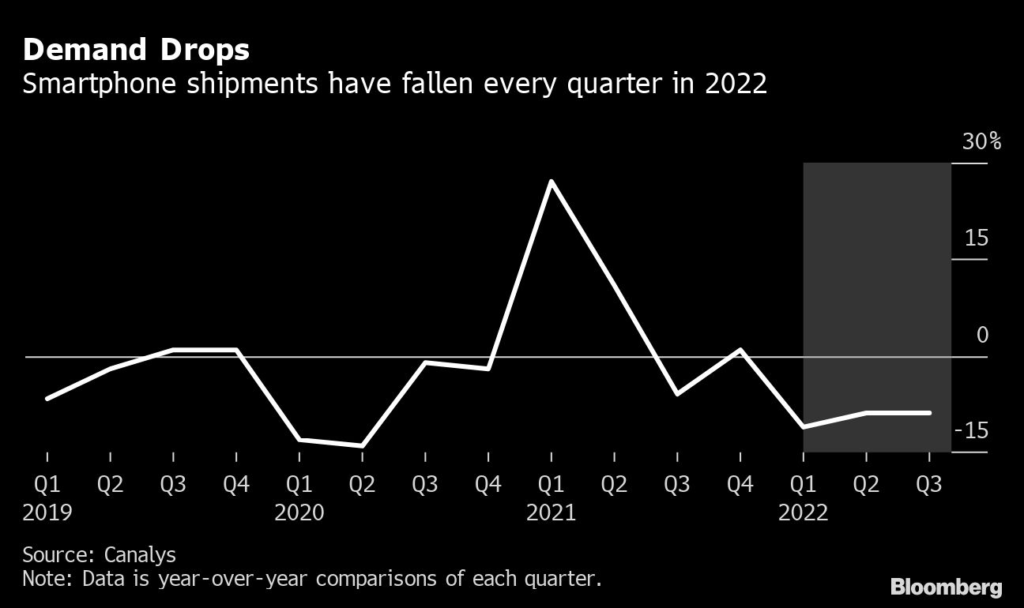
(Bloomberg) — Murata Manufacturing Co. expects this year’s drop in smartphone sales to keep going well into 2023, led by a sharp downturn in China.

The company’s outlook has dimmed dramatically from a quarter ago, when it looked forward to a bounceback in Chinese demand after the end of Covid-19 lockdowns in major cities. Consumers in the world’s biggest smartphone market haven’t responded with a spending spree and Murata sees little prospect for a rally over the next year, President Norio Nakajima told Bloomberg News in an interview. 

“The momentum will not come back at least during fiscal 2022 and the situation is not that positive going into the next term,” Nakajima said. “Demand for consumer electronics has dropped drastically and these Chinese makers are not feeling well.”

Kyoto-based Murata is a linchpin of the smartphone industry, providing electronic modules and components for Apple Inc.’s iPhones, Samsung Electronics Co.’s Android devices and China’s leading device makers. Its shares have slumped more than 20% this year as key customers have weathered double-digit declines in shipments, especially in China.

“Consumers might have been willing to buy new phones even with small upgrades if the economy were in a better shape,” Nakajima said, pointing to interest rate hikes by central banks around the world as a big factor. “What I’m afraid will happen is smartphones get further commoditized and people will wait even longer before upgrading.”

Read more: Global Smartphone Demand Continues Fall as Economic Woes Hit

The global handset market was 1.36 billion units last fiscal year, according to Murata estimates, but the figure for the current term is likely to fall short of 1.2 billion, Nakajima said. The biggest downside risk is a further slump in overseas sales for Chinese firms.

“Chinese makers pushed hard to sell outside their home turf, but due to various issues including intellectual property infringements, consumers like those in India began to avoid Chinese phones,” he said.

One silver lining seen by Murata’s president is sustained demand for high-end phones even during the economic downturn. The weakened yen, which now approaches 150 yen to a US dollar, is also helping prop up the company’s bottom line as 65% of its production is done in Japan but more than 90% of sales are made overseas.

Read more: Stealth Intervention Talk Permeates Market as Yen Approaches 150

“The weak yen gives us a breather as it will make our earnings look good,” Nakajima said, without elaborating as the company is still calculating the latest figures. Previously, Murata guided its revenue would increase by 11 billion yen ($74 million) per year with every one yen weakening against the greenback. “But this is dangerous, because the impact from foreign exchange rates masks falling factory operating rates stemming from weakening demand.”

Rising energy costs due to the Russia-Ukraine war will also weigh on profits over the long term because increasing prices is unfeasible for some competitive products, including Murata’s main offering of ceramic capacitors, Nakajima said.

Outside the consumer realm, Murata is enjoying robust demand from clients erecting 5G wireless base stations, following big investments in building out network capacity across Asia. The auto industry, riding a boom in electric vehicle development, is another bright spot.

Read more: Sony Honda to Make Premium EVs in North America From 2025

“Power-management chips are the only bottleneck in car production right now, and that jam is likely to go away sometime early next fiscal year,” Nakajima said.

More stories like this are available on bloomberg.com

©2022 Bloomberg L.P.

Chip Industry’s China Crisis Hammers Lam But May Spare ASML

(Bloomberg) — The Biden administration’s trade restrictions on China are wreaking havoc with the chip-equipment industry, but a pair of company forecasts shows that the pain won’t be spread evenly. 

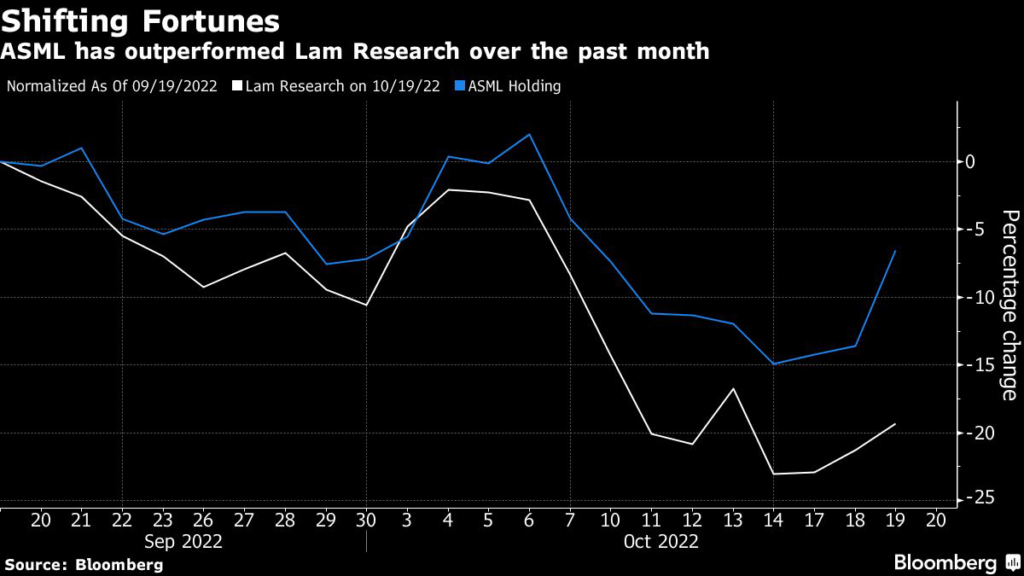
ASML Holding NV, a Dutch maker of semiconductor manufacturing gear, reassured investors with its latest outlook Wednesday, saying it sees “fairly limited” impact from the export controls. As a European company, ASML expects to be spared from the brunt of the restrictions, which are aimed at keeping cutting-edge US technology out of China and away from the country’s military.

Later in the day, Lam Research Corp. gave a less upbeat assessment. Revenue from China, which accounts for about 30% of the US company’s sales, will be $2 billion to $2.5 billion lower in 2023, Lam said. The chip-equipment maker is expected to generate more than $18 billion for the year, suggesting its China sales could be nearly cut in half. Lam has to halt supplying gear and services to some customers in the country, marring its otherwise-positive performance.

Sales in the current quarter will be about $5.1 billion, but that number would have been “decently higher” without the new restrictions, Chief Financial Officer Doug Bettinger said.

ASML’s remarks helped send its shares up more than 8% on Wednesday, marking their biggest one-day gain of 2022. Lam, meanwhile, slipped 1.2% in late trading following its report.

Washington unveiled the sweeping regulations earlier this month, aiming to curb the sale of advanced semiconductors and equipment to China and ban Americans from helping with the country’s development of chip technologies.

The move sent shockwaves through the $550 billion industry, and companies are still evaluating the impact. Already, US businesses such as Lam, Applied Materials Inc. and KLA Corp. have stopped employees from working with China’s top memory chipmaker. 

The Biden administration is pushing for allies to collaborate on export controls, which could spread the impact further. 

ASML, based in Veldhoven, Netherlands, has told its workers in the US to refrain from servicing customers in China. The company expects the total indirect impact from US measures to be roughly 5% of its backlog, Chief Executive Officer Peter Wennink said on Wednesday.

While ASML still cannot ship its most advanced machines to China, Chief Financial Officer Roger Dassen said that the company can continue to offer less sophisticated tools to Chinese customers. 

“The fact that we are a European company with limited US technology in it of course creates this situation where a direct impact on us is fairly limited,” he said in a video that the company released with its earnings. He added that ASML will comply with US regulations.

The company said its fourth-quarter sales would likely be higher than analyst estimates, helped by strong demand for its advanced chipmaking machines.

It’s a different situation for Lam, which is based in Fremont, California. Though its latest results handily beat expectations — with both earnings and sales topping Wall Street projections — its remarks about China cast a pall on the report. 

Sales in the current period will be about $5.1 billion, but that number would have been “decently higher” without the new restrictions, Chief Financial Officer Doug Bettinger said.

Gross margin, the percentage of revenue remaining after deducting the cost of production, will narrow as the company loses profitable Chinese customers, it said. The outlook suggests the impact on sales will be more than twice as big for Lam as for ASML.

Lam follows Applied Materials — its larger US peer — in detailing the financial hit from the restrictions. That company, based in Santa Clara, California, said last week that the restrictions would reduce revenue by $400 million in the current quarter. Its fiscal first quarter, which ends next January, will be hurt to a similar extent.

Lam’s machines are used to deposit materials on disks of silicon, part of the process of building semiconductors. The company has a relatively high dependence on China and memory chipmakers for its orders, making it vulnerable to the new rules. The curbs limit the supply of machines used for advanced manufacturing of both types of memory.

“We now have additional restrictions for certain domestic Chinese customers and expect the revenue in this region will be significantly lower as we go into next year,” Bettinger said.

(Updates with more on Lam’s outlook in third paragraph.)

More stories like this are available on bloomberg.com

©2022 Bloomberg L.P.
Meta Executive Behind Instagram, WhatsApp Acquisitions Leaves

(Bloomberg) — A Meta Platforms Inc. executive who was instrumental in the acquisitions of Instagram, WhatsApp and Oculus said he is leaving the social media giant.

Amin Zoufonoun, the company’s vice president of corporate development, will be taking a break after almost 12 years, he said today in a post on Meta’s Facebook. “Strategic technology deal work is pretty intense,” he said.

The acquisition strategy helped propel Meta to its current dominance in social media. It has also attracted intense antitrust scrutiny — especially around the deals for photo-sharing app Instagram and messaging service WhatsApp, which the U.S. Federal Trade Commission is seeking to unwind. Pressure from regulators in recent years is making it more difficult for Meta to pursue those kinds of deals.

More stories like this are available on bloomberg.com

©2022 Bloomberg L.P.
Close Bitnami banner
Bitnami