Bloomberg

‘New Version’ of Netflix Lures Wall Street Bulls Back to Stock

(Bloomberg) — A slew of bullish calls on Netflix Inc. from “back on track” to “rise of a new version” by Wall Street brokers confirm that a change in tack and rebound in user growth are likely to set the stock off to a sustainable recovery.

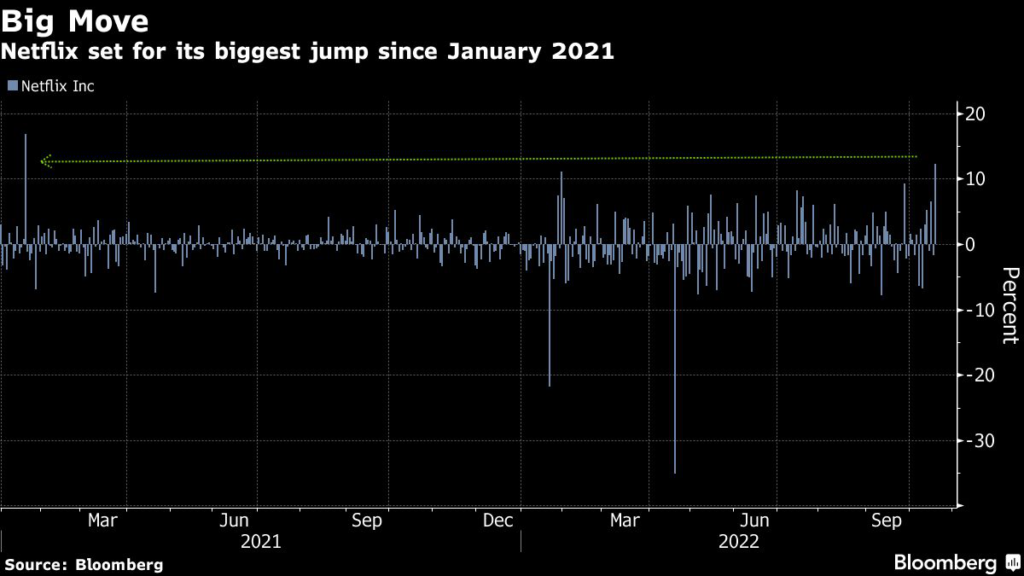
Shares in the video streaming giant surged 14% Wednesday, set for its biggest jump since January 2021. JPMorgan Chase & Co., Deutsche Bank AG and KGI Securities Co Ltd upgraded their recommendations on the stock, while at least a dozen other analysts boosted their target price. Netflix shares have lost over 60% this year. 

An upcoming advertising-supported streaming plan and crackdown on password-sharing as well as a cut in content spending have been some of the drivers behind a 45% rally in the stock from its May 11 low. Though the company’s user base isn’t growing at the pace that it was a couple years ago, the world’s most popular streaming TV network is back on a positive trajectory. 

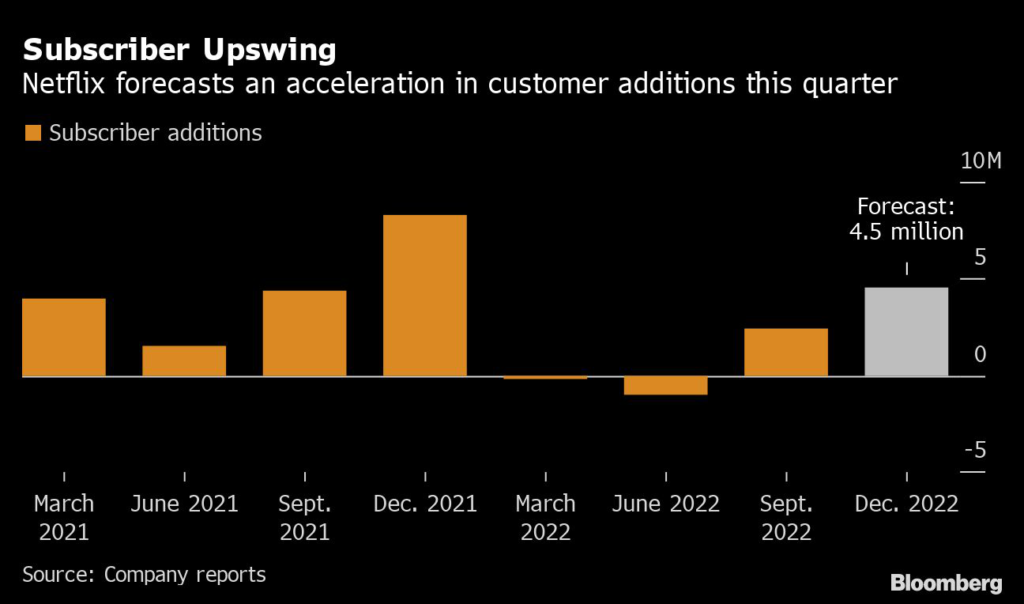
Netflix added 2.4 million customers in the third quarter, exceeding analysts’ expectations and said it expects to add another 4.5 million in the current quarter. 

The company “may be getting back on track in terms of content consistency, & it carries good momentum into 4Q,” said JPMorgan Chase’s Doug Anmuth, in a note on Wednesday. Anmuth returned to an overweight rating on the stock, six months after downgrading it to neutral. 

“Thank God we’re done with shrinking quarters,” Netflix co-founder and Chairman Reed Hastings said during a webcast interview with Anmuth on Tuesday.

“‘Crawl, walk, run’ seems to be management’s mantra here,” Anmuth said, highlighting how the ad-supported product will launch just six months from conception. 

Netflix’s solid subscriber numbers also offer a relief to its peers such as Roku Inc. and Walt Disney Co.  

There is now “visibility into a subscriber growth inflection point next year,” Deutsche Bank, which upgraded Netflix to buy, said in a note. 

Still, it might be too early to go all bullish on the stock. It’s an “increasingly complicated challenge” to model these “new moving pieces,” MoffettNathanson said in a research note, referring to Netflix’s new low-priced ad-tier offering and other recent changes.

But “to the company’s credit, we are witnessing a rise of a new version of Netflix,” Michael Nathanson of MoffettNathanson said.

More stories like this are available on bloomberg.com

©2022 Bloomberg L.P.

Inflation Forces Over Half of Americans to Consider Second Jobs

(Bloomberg) — Over half of working Americans have considered holding multiple jobs to pay their living expenses as inflation remained stubbornly high in September and real wages fell.

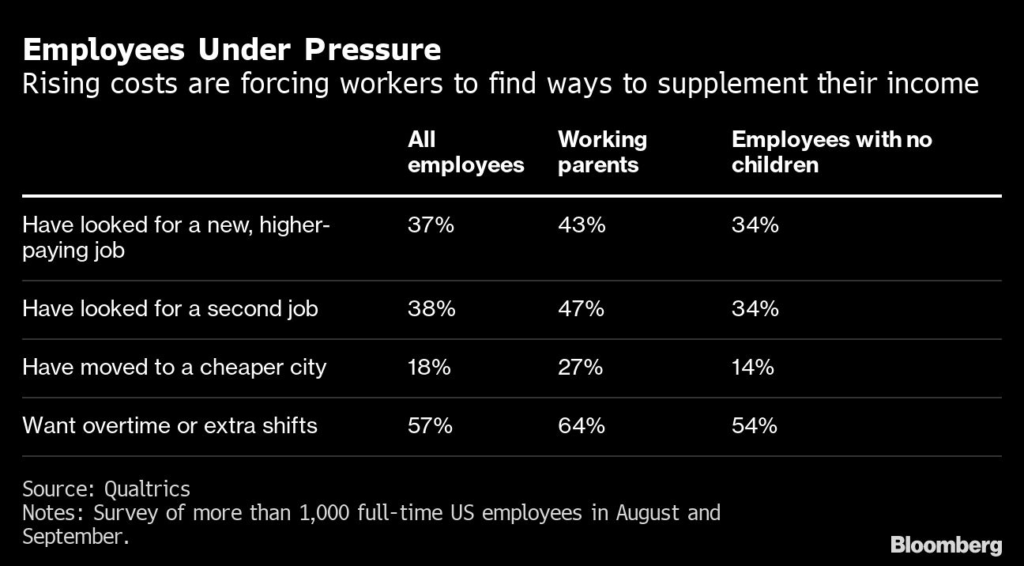
About 38% of workers have looked for a second job, while an additional 14% have plans to do so, according to a survey of more than 1,000 full-time US employees by Qualtrics International Inc., which makes software used by over 16,000 organizations. At the same time, 18% of working adults said they had moved to an area with a lower cost of living to cut expenses, and another 13% plan to do so. 

Working parents, in particular, are in the hot seat. About 70% say their pay isn’t keeping up with rising expenses. A recent Brookings Institution study estimated that the current spike in prices means it will now cost more than $300,000 to raise a child to age 17, up $26,000 since inflation took hold. 

Nearly half of working parents have looked for a second job and are almost twice as likely to have moved to cheaper cities than employees without children.

“With budgets tightening, workers are searching for ways to meet the rising cost of living, including finding new jobs,” said Benjamin Granger, chief workplace psychologist at Qualtrics. “Employee turnover is a huge cost for companies, so it’s business critical for organizations to understand which of their employees are likely to leave and why.”

Holding two or more jobs is nothing new, especially for low-income workers struggling to cover basic living expenses. For many office workers, however, work-from-home arrangements have opened up novel opportunities to make extra money on the side. According to a May survey by Zapier, a tech company specializing in automation, 40% of Americans have a side hustle, up from about a third before the pandemic.

Not all bosses support employees’ side hustles: A recent Society for Human Resources magazine piece offered employers advice on how to handle it, especially if outside work saps a worker’s time and energy. Last week, Business Insider reported that Equifax fired two dozen employees for having second full-time jobs. Meanwhile, recent ramp-ups in return-to-office mandates may make taking on outside work more difficult, while at the same time increasing costs previously offset by remote work—like commuting, midday meals and child care. 

For Jordan Parker, 28, skyrocketing rent, food and gas costs have made it virtually impossible to build a nest egg, even with a relatively well-paying 9-to-5 marketing job in San Antonio. As a result, she’s considering building her own business to market her digital-media services.

“It’s put me in this position of recognizing, wait a minute, I can’t afford—even on a good full-time salary—I cannot actually save to set myself up in my 30s to live the life that I dream about.”

Though her manager supports her doing other work outside of normal business hours, Parker said she’ll be disappointed if the company doesn’t offer her a raise that keeps up with inflation.

“I know that not everyone can get what they ask for in that regard,” she said. “But knowing that you do a good job and that you are a good employee, and it’s just kind of like, ‘Well, good luck.’”

More stories like this are available on bloomberg.com

©2022 Bloomberg L.P.

TikTok Deal Likely to Leave US Data Leaking to China

(Bloomberg) — TikTok users would still risk having personal data exposed to hacking and espionage by China even if the Biden administration forges a security agreement designed to spare the video platform from a total US ban.

That’s the conclusion of former national security officials and other experts as the Justice Department reviews an accord that would keep the popular video-streaming app, which is owned by China’s ByteDance Ltd., accessible to its millions of US users. 

TikTok has been under US scrutiny since 2019 over concerns that Chinese actors might tap those users’ information for espionage or other harmful purposes.

“They built the whole system in China,” said Stewart Baker, a national security lawyer at Steptoe & Johnson LLP. “Unless they’re going to rebuild the system in the United States at great expense, sooner or later, when something goes wrong, there’s going to turn out to be only one engineer who knows how to fix it. And he or she is likely to be in China.”

This analysis of the agreement is based on interviews with former national security officials, lawyers who have worked on similar deals and experts who have studied data security, social media platforms and telecommunications companies. There’s no indication a decision has been made.

Brooke Oberwetter, a spokesperson for TikTok, said that while the company would not comment on the specifics of its discussions with the US government, “We are confident that we are on a path to fully satisfy all reasonable U.S. national security concerns.” 


TikTok is routing all its US user traffic through servers maintained by Oracle Corp. and the database giant is auditing the app’s algorithms. Still, additional restrictions on how US user data is stored and accessed will be necessary — and might not resolve US security concerns no matter how strong a deal looks on paper, the experts said.

Oberwetter said that while some employees based in China would have access to public data posted by users, they would not have access to private user information, and their use of the public data — including videos and comments — would be very limited. In a July letter, TikTok Chief Executive Shou Zi Chew told nine US senators that use would be subject to a “robust data access protocol” developed by Oracle and the US.


The experts’ skepticism is shared by Senator Mark Warner, the Virginia Democrat who chairs the Senate Intelligence Committee. He said he’s aware of the conversations around TikTok and couldn’t give details. Nonetheless, he said the company has “a big mountain to climb with me to prove the case that it can really be safe.”

Warner said China has a bad track record on protecting users’ privacy. “They’ve shown repeatedly the ability to create this surveillance state that ought to scare the dickens out of all of us.”

He added that it’s much harder today to wall off TikTok’s data technically or ban it outright than it was five or six years ago as the popularity of the app has surged. “The burden of proof that you can really segregate American data, particularly if the code is still being written in China — that would be a tough case to make.”

While TikTok’s owner ByteDance has tried to distance itself from Chinese state influence, President Xi Jinping has launched a sweeping crackdown on private enterprises, particularly in the tech sector.

The video-streaming app, which has about 1 billion users but is banned in China, has been under scrutiny by US officials since 2019, when the Committee on Foreign Investment in the US began reviewing a merger between ByteDance and Musical.ly.

The Biden administration re-opened a national security review of TikTok after former President Donald Trump stopped short of banning the app in an effort to broker a deal to sell the platform to a US buyer, which never came to fruition. ByteDance had sought US approval to sell a stake in the app to Oracle and Walmart Inc., but the transaction didn’t materialize. A US court blocked efforts by the Trump administration to boot TikTok from app stores operated by Apple Inc. and Alphabet Inc.’s Google. 

Cfius, which is chaired by the Treasury Department but includes members from across the government, has the power to reject or modify transactions involving foreign companies that purchase US entities. 

The agency is “committed to taking all necessary actions within its authority to safeguard U.S. national security,” said Treasury spokesperson Michael Kikukawa, declining to comment further. 

For more: TikTok Names New Head of Security Amid Heightened US Scrutiny

If the companies that come under review are able to make concessions to sell or cordon off US assets that raise security concerns, including data, it’s possible to work out an agreement with the security panel to allow the transaction to proceed. These arrangements can include establishing a new board of directors and an oversight board that reports to Cfius.

“You’ll get an agreement that commits the company to behave responsibly and transparently,” said James Lewis, the director of the Strategic Technologies Program at the Center for Strategic and International Studies. “And you’ll have the ability to pull the plug if it looks like anything’s not being honored.”

Lewis pointed to the purchase of T-Mobile USA Inc. by Germany’s Deutsche Telecom AG in 2001 and Sprint Corp.’s 2013 sale to Japanese investment firm Softbank Group Corp. In both those deals, the US put in place monitoring to ensure the data of US citizens wasn’t being misused, Lewis said.

Nova Daly, a senior public policy adviser for Wiley Rein LLP, and a former Treasury official who worked on Cfius deals, said in some instances, it’s better to have the foreign company retain ownership of the US company because it allows for more robust scrutiny of that data.

TikTok COO Pressured to Stop China’s Access to US User Data

“Sometimes this kind of data is more securely protected by the enforcement powers of a mitigation agreement, rather than an owner that isn’t compelled by law to protect it,” said Daly, pointing out that it will still be hard to secure the data against determined efforts to steal it or use it for nefarious purposes.

If national security concerns can’t be resolved, Cfius can force the companies to walk away from a deal or unwind a transaction.

Lawmakers pressed TikTok Chief Operating Officer Vanessa Pappas during a Senate hearing last month about whether the company would seal off Chinese access to all US data. Pappas said the company has strict controls over access to data and where it’s stored, and that the company wouldn’t give that data to the Chinese government.

She said that the company will continue cooperating with federal agencies to secure US data and said a final agreement “will satisfy all national security concerns.”

Steptoe’s Baker said that argument suggests that while TikTok may believe it’s satisfied reasonable national-security concerns, “they shouldn’t have to sign in blood that there will never be access.” 

–With assistance from Emily Birnbaum, Alex Barinka and Brody Ford.

(Updates with TikTok CEO letter to senators in 8th paragraph. A previous version of ths story was corrected to delete a reference to an oversight board.)

More stories like this are available on bloomberg.com

©2022 Bloomberg L.P.

UAE Seeks to Lure Tech Firms With Special Visas, Financing

(Bloomberg) — The United Arab Emirates is trying to lure advanced technology companies away from hubs in Asia and Europe by fast-tracking business licenses and offering long-term residency for employees.

The Gulf country is targeting more than 300 digital firms under a program launched in July and about 40 companies are in the process of moving, Minister of State for Foreign Trade, Thani Al Zeyoudi, said in an interview. 

The UAE’s nimble handling of the pandemic and liberal visa policies have already made it an attractive destination for bankers and hedge fund managers to commodity traders. Authorities now want to attract firms in sectors including food technology, robotics and blockchain, and encourage them to set up global or regional headquarters in the Middle Eastern business hub.

Dubai and Abu Dhabi already host the Mideast headquarters of an array of global financial firms. Still, there is competition from global hubs and from Saudi Arabia, which is trying to get firms to move their regional headquarters there by 2024. 

“The timing was very crucial because what we noticed from the beginning of the year was that many companies would like to move because of inflation, the tighter regulatory environment in many parts of the world, including Asia – especially Singapore and Hong Kong,” Al Zeyoudi said. 

UAE Opens Citizenship to Select Foreigners to Boost Economy

Under the scheme, digital companies get faster business licensing and easier access to banking and financing. Employees can be offered 10-year UAE residency “golden visas” and in some cases the program — which unifies government bodies, freezones and institutions — helps find accommodation and admissions to schools. 

The so-called “golden visa” allows foreigners to work, live and study without needing a UAE work sponsor in a country where expatriate residents make up nearly 90% of the population. 

UAE Unveils New Residency Guidelines to Attract Foreigners 

As the UAE seeks to further diversify away from oil income, the aim is to create more high-skilled jobs in futuristic industries, Al Zeyoudi said.

“We want to make sure we are harnessing the fourth industrial revolution – so the latest technology, whether it’s the Internet of things, blockchain, AI,” he said. “We are redefining the way FDI is usually done.” 

The program groups together freezones in Abu Dhabi, Dubai and Sharjah. Lenders connecting with businesses under the scheme include Emirates NBD, Sharjah Investment Bank, and Wio — a digital bank backed by Abu Dhabi wealth fund ADQ.  

Two privately-held US companies are among those already in the process of moving, Al Zeyoudi said. Food-tech group Change Foods is working on technology to produce animal-free milk and other dairy products from casein proteins and plans to base the first commercial manufacturing plant for it in Abu Dhabi, and Gecko Robotics, a firm that designs, builds and operates robots.

European software development company Softserve is relocating technical staff, coders, consultants and executives to the UAE while two fintech firms, Currency.com and Capital.com, are setting up a regional headquarters under the program. 

Separately, cryptocurrency exchanges have flocked to Dubai this year as the emirate steps up efforts to attract companies in that industry. Exchange Bybit announced plans to move its headquarters to Dubai from Singapore in March, joining rivals like Binance Holdings Ltd. and FTX in expanding in the UAE. More bankers have also headed to the city with the gradual demise of Hong Kong as Asia’s top finance hub. 

–With assistance from Leen Al-Rashdan.

(Adds more details on Change Foods plans to expand, paragraph 11)

More stories like this are available on bloomberg.com

©2022 Bloomberg L.P.
Wall Street Dealmakers Are Entering a New Era for Buyouts

(Bloomberg) — Long maligned as the debt-addicted corporate raiders of Wall Street, private equity firms are resorting to an unusual maneuver to get deals done as borrowing costs spiral. They’re taking the leverage out of leveraged buyouts.

Francisco Partners, Thoma Bravo and Stonepeak Partners are among those that announced new acquisitions in recent weeks without debt financing in place, effectively backstopping the entire purchase price — in some cases worth north of $2 billion — with cash from their own funds.

Though likely temporary, the all-equity move is a dramatic departure for an industry famously hooked on leverage and constantly on the hunt for ever-more creative ways to boost returns.

Some of the firms held lending discussions with banks and private credit providers, but they ultimately deemed the terms they were offered unattractive, according to people with knowledge of the matter, who asked not to be identified because they’re not authorized to speak publicly.

The sponsors may ultimately replace some of the equity with loans or bonds at a later date. Yet the fact big-name private equity firms have been willing to underwrite leverage-free buyouts underscores how these stressed times are forcing debt-guzzling financiers on Wall Street to adapt their playbook.

“Sponsors want maximum flexibility,” said Richard Farley, a partner at Kramer Levin Naftalis & Frankel LLP who works on buyout financings. “They don’t want to be locked into very expensive debt if they think they are going to have access to the debt market at more attractive rates in a short period of time.”

Representatives for Francisco, Thoma Bravo, TPG and Stonepeak declined to comment. 

Read more: Brightspeed Debt-Sale Failure Slams Banks Anew After Citrix Flop

Interest rates are rising relentlessly and big banks are failing to offload the tens of billions of dollars worth of sinking buyout debt that’s still stuck on their own books. Even capital-rich private credit funds, long-heralded as the savior of LBO financing, have cut back on new commitments.

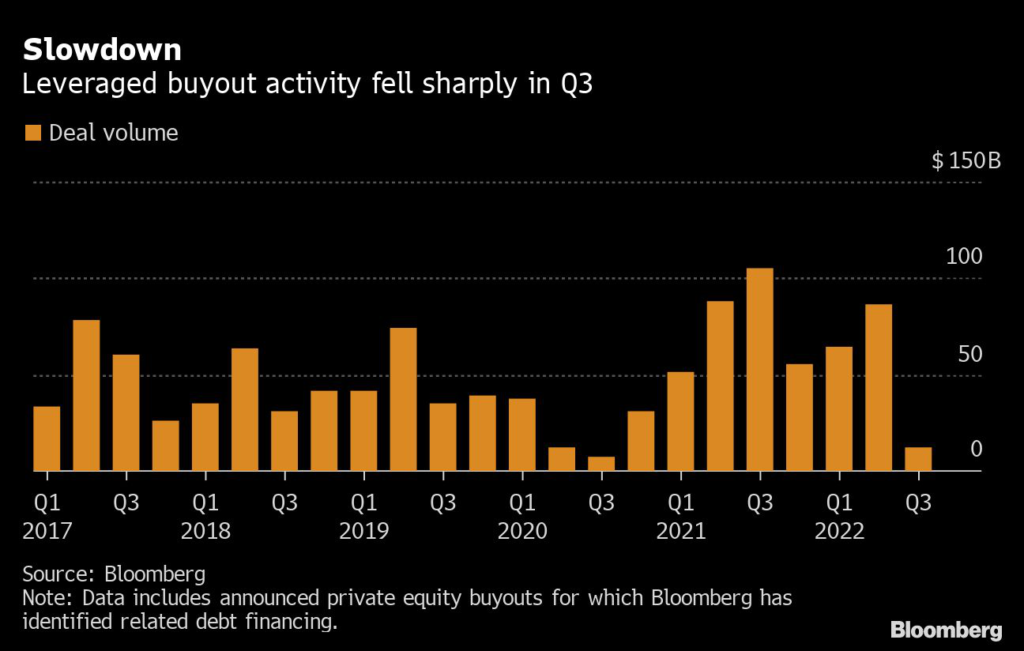
After a boom in 2021 and during the first half of this year, private equity buyout activity slowed significantly in the third quarter, with only $12 billion of deals announced globally, according to data compiled by Bloomberg. The likes of Apollo Global Management Inc. to Blackstone Inc. have pointed to a more difficult financing environment ahead. 

Financing deals with 100% equity isn’t entirely new. When debt markets were wide open and M&A volumes were at a record last year, some firms used the tactic as a way to sweeten their offers when bidding for companies in particularly competitive sales processes. That allowed some eager managers to move quickly, beating out rivals who needed time to speak with lenders and seek approvals from committees. TPG used that playbook to prevail over other sponsors in the competition to buy LifeStance Health in 2020, one of the people said. A representative for TPG declined to comment. 

The buyers almost always replaced some of their equity with debt before closing. For now with interest rates sharply on the rise and banks unable to offer commitments at attractive levels, some private equity firms are finding even more reasons to go all-equity when they submit their bids.

Francisco Partners agreed earlier this month to purchase benefits technology firm bswift from CVS Health Corp. only with an equity commitment, according to people with knowledge of the transaction. It was the firm’s willingness to use the so-called equity backstop that allowed it to beat out competitors that were struggling to find financing, the people said, though it intended to ultimately replace some of the equity with debt.

Thoma Bravo similarly signed up its $2.3 billion acquisition of ForgeRock Inc., a maker of identity-verification software, with 100% equity even after holding discussions with some private credit firms about potential debt financing, according to a person with knowledge of the deal. Last month, Stonepeak used all-equity for its $2.4 billion acquisition of Intrado Corp.’s safety unit, according to people with knowledge of that deal. The company, once part of West Corp., provides telecommunications services used by 911 emergency responders and has traditionally supported elevated debt levels.

Private equity sponsors can easily replace some of the equity with debt before their deals close or whenever credit markets improve, the people said.

Pitfalls

For sponsors, paying entirely with equity comes with key pitfalls. If they actually have to fund the commitments it by definition becomes a drag on the returns of their funds, which typically rely on leverage to deliver the kind of double-digit returns their investors are promised. While the commitment is in place, it also ties up equity that the fund could be using to make other investments. Making large equity investments into a single company may also require special approval from a fund’s ultimate investors.

All that creates a strong incentive for them to add debt back to their investment at a later date.

“It’s a temporary fix,” said Farley at Kramer Levin. “It’s not a new normal.”

–With assistance from Paula Seligson and Michael Hytha.

More stories like this are available on bloomberg.com

©2022 Bloomberg L.P.
Netflix Returns to Growth, Saying the Worst of Slowdown Is Over

(Bloomberg) — Netflix Inc. is growing again, and Hollywood can breathe a sigh of relief.

The streaming leader added 2.41 million customers in the third quarter, exceeding internal forecasts as well as expectations on Wall Street. Netflix grew in all regions of the world and said in a shareholder letter on Tuesday that it expects to sign up another 4.5 million globally this period.

While Netflix isn’t growing as quickly it was a couple years ago, the world’s most popular TV network is back on a positive trajectory. More customers are signing up than earlier in the year, the company said Tuesday. That’s good news for investors in Netflix and its peers who suffered steep stock-market losses earlier in the year. 

“Thank God we’re done with shrinking quarters,” co-founder and Chairman Reed Hastings said during a webcast interview with analyst Doug Anmuth. 

Shares of Netflix rose as much as 13% to $271.39 on Wednesday in New York trading — the most since January 2021. The stock had fallen 60% this year through Tuesday’s close. Analysts at several Wall Street firms raised their price targets for Netflix, with JPMorgan Chase & Co. and Deutsche Bank upgrading their ratings on the company. Other streaming companies, such as Roku Inc. and Walt Disney Co., also rose. 

Read More: Netflix Jumps 14% on Strong User Growth Forecast: Street Wrap

A strong slate of fresh programs attracted millions of new viewers in the third quarter. The period started with new episodes of Stranger Things, one of the most popular TV series in the world. Netflix also released the Korean smash hit Extraordinary Attorney Woo, the movies The Gray Man and Purple Hearts, and the true crime drama Monster: The Jeffrey Dahmer Story, its second-most-popular English-language original series.

Revenue for the quarter grew 5.9% to $7.93 billion, beating analysts’ projections. Profit of $3.10 a share also topped estimates, and the number of paying customers increased to 223.1 million.

“If there’s a unifying narrative for Netflix in 3Q22, it’s that the worst appears behind it,” Wells Fargo analyst Steven Cahall wrote in a note to clients.


Dollar Dilemma

It won’t be all rosy going forward. Netflix is still on pace for the slowest growth in years. The company lost 1.2 million customers during the first half of the year — a decline that led investors and peers to reconsider their streaming investments. Its customer base has shrunk in the US this year.

The soaring dollar is taking a bite out of revenue and earnings. While Netflix said it can adjust content spending and pricing accordingly, its forecast for fourth-quarter sales and profit fell short of Wall Street estimates. The company estimates sales of $7.78 billion this quarter, below the $7.98 billion forecast by analysts. Earnings are expected to come in at 36 cents a share, a fraction of the $1.20 estimated on Wall Street.

“We’re still not growing a fast as we’d like,” Chief Financial Officer Spencer Neumann said in the same interview.

Revenue Initiatives

Nonetheless, Hastings and Ted Sarandos, the company’s co-chief executive officers, argue Netflix has plenty of room to grow. The service accounts for about 8% of TV viewing in the US and UK, two of its largest markets, and is adding market share every year, the company said in the letter. Netflix is also profitable, unlike the streaming services operated by most rivals.

Management plans to increase sales by introducing an advertising-supported version of the streaming service in November and charging for password sharing next year. Customers willing to watch Netflix with five minutes of advertising per hour can pay $7 a month, less than half of the cost of the most-popular plan.

A lower-priced tier could help Netflix reduce the number of people canceling service or appeal to new customers in markets where growth has slowed. As viewership of linear TV falls off a cliff, Netflix also argued it would capture billions of dollars in sales once earmarked for live TV channels.

While investors have long judged Netflix based on the number of customers it adds every quarter, the company is trying to get them to consider more traditional financial metrics like revenue and operating income. As a result, Netflix said it will no longer provide subscriber forecasts.

–With assistance from Jonathan Roeder.

(Updates share trading)

More stories like this are available on bloomberg.com

©2022 Bloomberg L.P.
BMW CEO Says US Curbs on China Could Detract From EV Demand

(Bloomberg) — BMW AG Chief Executive Officer Oliver Zipse said US policies toward China risk creating a “dangerous” game of trade barriers that could thwart adoption of electric vehicles.

Global automakers are lobbying the Biden administration to loosen restrictions in climate legislation that aim to curb China’s control over global supply chains from battery materials to semiconductors. BMW is pushing to change a provision that withholds part of a $7,500 consumer EV tax credit if car companies use critical minerals sourced from China and other “foreign entities of concern.”

“We would of course like to get all the raw materials from Europe or the US,” Zipse said in an interview. At the same time, “to think you can do that inside of 10 years to 100% in a fast-growing industry, I think that is not possible.”

Read more: Hyundai pleads case to ease US rule on EVs


More stories like this are available on bloomberg.com

©2022 Bloomberg L.P.

Tesla Needs Musk to Convince Doubters It Has No Demand Issue

(Bloomberg) — Three months ago, Elon Musk sounded a bit exasperated again with the analyst he once cut off for asking what he dismissed as “boring, bonehead” questions.

“I mean, I think we’ve said this now for many years, and I know it has proven true: Tesla does not have a demand problem,” Musk told AllianceBernstein’s Toni Sacconaghi on the company’s last earnings call. “We have a production problem.”

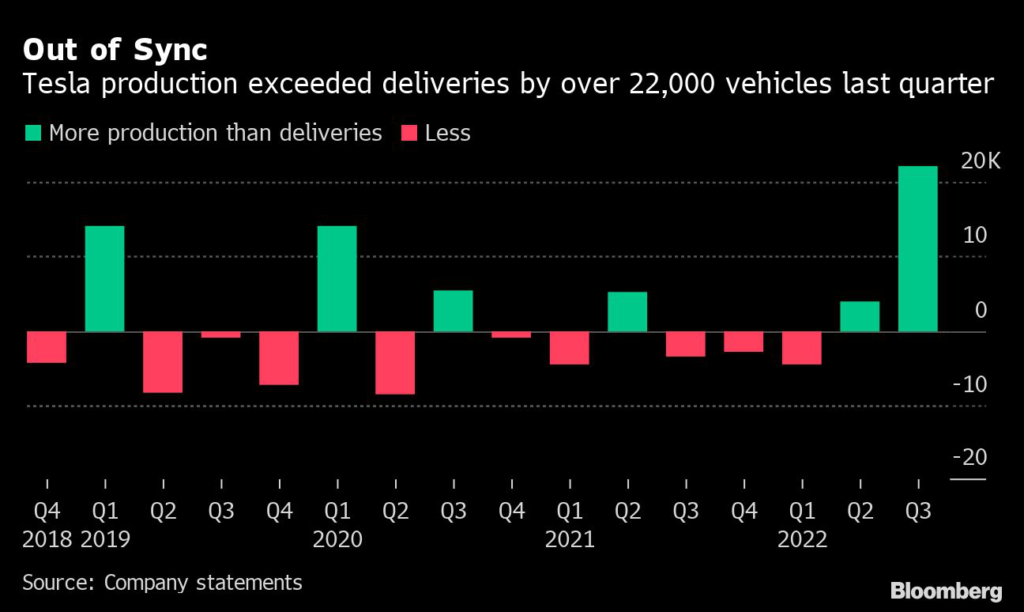
Whether he likes it or not, Musk is almost certainly going to have to address this topic again. Some investors will be seeking more reassurance during the third-quarter earnings call this evening that customers are still clamoring for more cars than Tesla’s plants can crank out, after deliveries fell short of estimates and lagged behind production by more than 22,000 vehicles.

Tesla suggested in its quarterly production and deliveries release that this was purely a logistics issue. Transporting vehicles from factories to showroom floors has gotten increasingly challenging and expensive as volumes have grown, so the company ended the quarter with more cars in transit than in the past.

With borrowing costs increasing, a US recession looking inevitable and the cheapest Tesla starting at $48,490, the market didn’t take this explanation in stride. Tesla’s stock has been the second-worst performer on the S&P 500 this month, dropping 17% through Tuesday’s close.

Here’s what else analysts and investors are looking and listening for from Tesla’s earnings report and conference call:

Batteries

It’s time for Musk and one of his top deputies, Drew Baglino, to give a substantial update about the status of Tesla’s effort to make its own battery cells in-house.

Musk and Baglino have variously described the more energy-dense, powerful and longer-range 4680 cells — 46 millimeters in diameter, 80 millimeters in height — as key to Tesla one day producing a $25,000 car and crucial to putting the Semi truck into production. As the effort to make these cells in volume fell behind schedule, Musk suggested early this year that the cheaper model was put on the back burner, and it’s not clear what type of batteries will go into the small batch of Semis shipping to PepsiCo in December.

In response to one of the many questions about 4680s during last quarter’s earnings call, Musk said they’ll be important to Tesla in 2023, but not this year. Any sign of further slippage in the timeline for these cells would be a letdown.

China

Wait times for Tesla Model 3s in China shrank as the quarter came to a close, and the company reportedly offered an insurance subsidy of 8,000 yuan ($1,100) to stimulate sales. That’s spooked some analysts, with Joe Spak of RBC Capital Markets calling demand in the market “a top concern.”

It also will be interesting if Musk’s recent wading into foreign policy is giving any analysts pause. The chief executive officer recently recommended that Taiwan hand some control of the island to China to ease rising tensions between Beijing and much of the rest of the world. While this was well received by China, from which Tesla derives almost a quarter of its revenue, the company also has several suppliers in Taiwan and could come under greater scrutiny from Washington.

Guidance

Tesla’s deliveries were up about 45% through the first nine months of the year, shy of the 50% average annual growth rate the company has targeted over the course of several years.

If demand isn’t a concern, as Musk has repeatedly said, the key question is whether Tesla is ramping up production quickly enough at its newest plants in Austin, Texas, and near Berlin to close the gap in this year’s growth rate and meet that lofty goal again in 2023.

Twitter

Musk’s $44 billion deal to buy the social media service he uses to keep himself and his companies in the headlines looks back on.

While it’s gotten surprisingly little airtime on Tesla’s earnings calls, it may come up now that Musk appears to have abandoned his attempt to walk away from a merger agreement. The acquisition has been a drag on the carmaker’s stock because of worries Musk will be spread too thin and may need to sell more shares to fund the purchase.

More stories like this are available on bloomberg.com

©2022 Bloomberg L.P.
Uber Launches Advertising Arm to Tap Lucrative Revenue Stream

(Bloomberg) — Uber Technologies Inc. is launching a dedicated advertising arm in a push to cash in on a captive audience and tap the higher-margin revenue stream. 

The new division encompasses ad offerings on Uber’s ride-hailing and food-delivery apps. On Uber Eats, for example, brands will be able to pay for sponsored listings, prominent placing on the homepage or checkout, and featured menu items. Uber also rolled out Journey Ads, a new service that runs advertisements for ride-share users while they wait for their driver and during their trip. More than 40 brands have partnered with Uber to run Journey Ads, including NBCUniversal and Heineken NV, Uber said in a statement on Wednesday.

The move expands Uber’s prior efforts to monetize an audience of 122 million monthly active users. In 2020, Uber starting placing ad displays atop drivers’ cars and last year began testing ads in its ride-hailing app. Uber’s ad chief, Mark Grether, said at the company’s investor day in February that the goal is to grow the advertising business into “a $1 billion-plus revenue opportunity by 2024.” 

Uber’s new division will have competition from peers like Lyft Inc., DoorDash Inc., and Instacart Inc. who are also vying for a growing pool of advertising dollars from brands eager to reach customers online. 

In July, Lyft, which acquired a company in 2019 that builds monitors to run on top of cars, launched an advertising business of its own. Last year, DoorDash started selling sponsored listings. 


More stories like this are available on bloomberg.com

©2022 Bloomberg L.P.
Stocks Slip Amid Inflation Worries; Pound Weakens: Markets Wrap

(Bloomberg) — Stocks retreated as investors weighed concerns about scorching inflation and a looming recession against a strong start to the earnings season. The pound fell after UK inflation rose faster than economists expected.

Contracts on the S&P 500 and the Nasdaq 100 fell by 0.7%. Netflix Inc. rallied in early New York trading after reporting a surge in subscribers. United Airlines Holdings Inc. jumped after its profit exceeded estimates, while Procter & Gamble Co. rose after a beat on sales. Tesla Inc. is among companies with earnings due later Wednesday. European stocks looked set to miss out on a fifth day of gains.

Treasury yields climbed to multi-year highs, extending the move after stronger-than-forecast inflation data out of Canada. US housing starts were also in focus, with figures showing new home construction declined in September. A gauge of the dollar strengthened.

The pound weakened after soaring food prices drove UK inflation back into double digits in September, matching a 40-year high of 10.1% and intensifying pressure on the central bank and Liz Truss’s government to act. Gilts were broadly lower.

“The outlook for the UK is very, very difficult and certainly when focusing on our asset allocation it’s predominantly in the US where we have much higher conviction and certainty of outcome,” Grace Peters, JPMorgan Private Bank’s head of investment strategy, said on Bloomberg Television.


Upbeat company results, cheaper valuations and UK policy reversals have helped buoy risk appetite in recent sessions. Investors are racing to put on options trades, so they don’t miss out on the next big stock-market rally, according to Charlie McElligott, cross-asset macro strategist at Nomura Securities International Inc.

The focus in the options market is chasing the upswing, McElligott said. Client demand is “totally focused” on preparing for a big move up in stocks, and in general, investors are already well-hedged against losses, he said.

At the same time, investors are having to keep track of weakness in the global economy and the impact of persistent inflation on decisions by policymakers at the Federal Reserve and other central banks. US equities are pricing in the highest odds of a recession than any other asset class and may be poised for more losses, according to Citigroup Inc.’s quantitative strategists.

“US equities have priced the most (but not enough) recession risk, and earnings estimates have further to adjust,” strategists including Alex Saunders wrote in a note. “US bonds have priced the least risk, but it will take some time before bonds react to recession risks given the hawkish Fed.”

Some regional Fed directors last month favored raising a key interest rate by a smaller or larger amount than the 75 basis points that policy makers ultimately decided was needed to curb persistent inflation, according to minutes of discount-rate meetings released Tuesday.

Fed’s Bostic Says Slowing Inflation Best for Long-Run Employment

Elsewhere in markets Wednesday, oil extended its volatile run as continued US efforts to curb prices and concerns over a global recession countered signs of tight supply. Gold declined and Bitcoin slid below $19,200. 

Key events this week:

  • EIA crude oil inventory report, Wednesday
  • US MBA mortgage applications, building permits, housing starts, Fed Beige Book, Wednesday
  • Fed’s Neel Kashkari, Charles Evans, James Bullard speak, Wednesday
  • US existing home sales, initial jobless claims, Conference Board leading index, Thursday
  • Euro area consumer confidence, Friday

Some of the main moves in markets:

Stocks

  • Futures on the S&P 500 fell 0.7% as of 8:40 a.m. New York time
  • Futures on the Nasdaq 100 fell 0.7%
  • Futures on the Dow Jones Industrial Average fell 0.6%
  • The Stoxx Europe 600 fell 0.4%
  • The MSCI World index fell 0.4%

Currencies

  • The Bloomberg Dollar Spot Index rose 0.6%
  • The euro fell 0.9% to $0.9766
  • The British pound fell 0.9% to $1.1223
  • The Japanese yen fell 0.3% to 149.77 per dollar

Cryptocurrencies

  • Bitcoin fell 1.2% to $19,136.7
  • Ether fell 1.4% to $1,296.36

Bonds

  • The yield on 10-year Treasuries advanced 10 basis points to 4.11%
  • Germany’s 10-year yield advanced eight basis points to 2.37%
  • Britain’s 10-year yield advanced six basis points to 4.01%

Commodities

  • West Texas Intermediate crude rose 1.6% to $84.13 a barrel
  • Gold futures fell 1.1% to $1,638.40 an ounce

More stories like this are available on bloomberg.com

©2022 Bloomberg L.P.

Close Bitnami banner
Bitnami