Bloomberg

Gaming Companies Are Not Sure They Need an NFT Strategy

  • Listen to Bloomberg Crypto on the iHeartRadio App
  • Listen to Bloomberg Crypto on Apple Podcasts
  • Listen to Bloomberg Crypto on Spotify  

(Bloomberg) — It’s October 2021. Crypto prices are rocketing. Celebrities can’t stop talking about NFTs. There’s packed conferences in glitzy venues attended by people wearing t-shirts with cartoon monkeys on them. If you’re an executive at a big gaming studio, you might be forgiven – maybe – for sending one of those emails with the subject line: NFT strategy question mark.And several executives at these gaming companies did indeed send those emails. And some of their companies even announced plans to make blockchain gaming happen.Flash forward about a year. Celebrities aren’t talking about their NFTs. People are trying to sell their Apes. And gaming studios don’t seem quite so convinced that they need an NFT strategy.Joining this episode are Bloomberg reporter Emily Nicolle and Mark Venturelli, CEO and creative director at game studio Rogue Snail, who’s also a game developer.

Follow us on Twitter @crypto, and subscribe to the Bloomberg Crypto Newsletter at https://bloom.bg/cryptonewsletter

More stories like this are available on bloomberg.com

©2022 Bloomberg L.P.

Pound and UK Bonds Rally; Stocks, Futures Advance: Markets Wrap

(Bloomberg) — The pound rallied and UK bonds surged amid expectations that more of Prime Minister Liz Truss’s package of unfunded tax cuts will be reversed. Stocks rose, with investors preparing for a number of key earnings reports this week.

Chancellor Jeremy Hunt is expected to make a statement at 11 a.m. London time on measures to support fiscal sustainability, a UK official said. It’s the start of what may be a particularly torrid week for UK assets, with the beleaguered Truss battling to rescue her premiership after the Bank of England ended its emergency bond-buying program on Friday and as mutinous backbenchers plot to oust her.

US equity contracts gained as investors turned their focus to earnings — including from Bank of America Corp., Goldman Sachs Group Inc. and Tesla Inc. US-listed Chinese shares rose in premarket trading, while Chinese stocks erased declines as President Xi Jinping reiterated that economic development is the party’s top priority and offered support for the tech sector in a speech, but disappointed investors hoping for signs of a shift away from Covid Zero. Utilities and insurance stocks led gains in Europe.

The yield on 10-year gilts fell 28 basis points to 4.05% and the pound traded 0.8% higher at $1.1264. Treasury yields and the dollar eased against its Group-of-10 counterparts, providing a touch of respite to harried currency markets.

“I think we’re in for a period where UK credibility is continually questioned and UK assets remain incredibly volatile for a significant period of time,” Benjamin Jones, Invesco Director of Macro Research, said on Bloomberg Television. “Watching the gilt market will be absolutely key in understanding if the market does believe Hunt to be more stable and if he will be able to push these policies through.”

Hunt will also speak to the House of Commons at 3:30 p.m. London time and Truss is due to host a reception for the Cabinet at 10 Downing Street on Monday evening. While early gains for the pound suggested confidence in Hunt’s alternative approach, economists still warn there is a budget hole ranging from £28 billion to £50 billion to fill, depending on the pace of debt falling.

Meanwhile, the outlook for consumer prices in the US continues to fuel bets that the Federal Reserve may make jumbo rate hikes at its next two meetings, weighing broadly on the outlook for global economic growth and markets. 

Fed officials in their latest comments suggested they were ready to hike rates higher than previously planned. Kansas City Fed President Esther George said the terminal rate may need to be higher to cool prices. San Francisco Fed’s Mary Daly said she’s “very supportive” of raising to restrictive levels and to between 4.5% and 5% “is the most likely outcome.”

Morgan Stanley strategist Michael J. Wilson, a long-time equities bear, said US stocks are ripe for a short-term rally in the absence of an earnings capitulation or an official recession. A 25% slump in the S&P 500 this year has left it testing a “serious floor of support” at its 200-week moving average, which could lead to a technical recovery, he wrote in a note on Monday.

Elsewhere in markets, oil fluctuated after a weekly slump as fears over an economic slowdown continue to weigh on the outlook for demand. Gold rose on weakness in the US dollar and as rising fears of a global economic slowdown boost the precious metal’s haven status.

Key events this week:

  • Earnings this week will provide clues on the strength of a swathe of companies, including Bank of America Corp., China Telecom Corp., Contemporary Amperex Technology Co., Hindustan Unilever Ltd, Hong Kong Exchanges & Clearing Ltd., Goldman Sachs Group Inc., Johnson & Johnson, Netflix Inc., Tesla Inc. and United Airlines Holdings Inc.
  • US empire manufacturing, Monday
  • ECB Vice President Luis de Guindos speaks, Monday
  • China retail sales, industrial production, GDP, surveyed jobless, Tuesday
  • US industrial production, NAHB housing market index, Tuesday
  • Fed’s Neel Kashkari speaks, Tuesday
  • Euro area CPI, Wednesday
  • UK CPI, PPI, retail price index, Wednesday
  • US MBA mortgage applications, building permits, housing starts; Fed Beige Book, Wednesday
  • Fed’s Neel Kashkari, Charles Evans, James Bullard speak Wednesday
  • US existing home sales, initial jobless claims, Conference Board leading index, Thursday

Some of the main moves in markets:

Stocks

  • The Stoxx Europe 600 rose 0.5% as of 9:55 a.m. London time
  • Futures on the S&P 500 rose 1%
  • Futures on the Nasdaq 100 rose 1.2%
  • Futures on the Dow Jones Industrial Average rose 0.8%
  • The MSCI Asia Pacific Index rose 1.5%
  • The MSCI Emerging Markets Index rose 1%

Currencies

  • The Bloomberg Dollar Spot Index fell 0.2%
  • The euro rose 0.2% to $0.9737
  • The Japanese yen was little changed at 148.71 per dollar
  • The offshore yuan was little changed at 7.2152 per dollar
  • The British pound rose 0.8% to $1.1264

Cryptocurrencies

  • Bitcoin fell 0.4% to $19,264.42
  • Ether fell 0.1% to $1,309.29

Bonds

  • The yield on 10-year Treasuries declined six basis points to 3.96%
  • Germany’s 10-year yield declined 10 basis points to 2.24%
  • Britain’s 10-year yield declined 28 basis points to 4.05%

Commodities

  • Brent crude fell 0.3% to $91.39 a barrel
  • Spot gold rose 0.6% to $1,654.91 an ounce

More stories like this are available on bloomberg.com

©2022 Bloomberg L.P.

Philippine Telecom Firm PLDT Weighing $300 Million Tower Sale, Sources Say

(Bloomberg) — PLDT Inc. is considering selling an additional 2,000 telecommunications towers, according to people with knowledge of the matter, extending the Philippine firm’s recent digital infrastructure asset divestments.

The country’s second-biggest telecom and digital services provider by market value is talking to banks for the potential disposal, said the people. A transaction would involve PLDT selling the towers and then leasing them back, and could value them at about $300 million, they said, asking not to be identified as the process is private.

PLDT divested half its towers in April for 77 billion pesos ($1.3 billion) in two portfolios to units of Edotco Group Sdn. and EdgePoint Infrastructure, according to a company statement in April. 

Deliberations are still ongoing and PLDT could decide to keep the business, the people said. A representative for PLDT couldn’t immediately comment.

Should PLDT proceed with the planned sale, it would be joining its rival Globe Telecom Inc. in selling three portfolios of towers. Globe signed a sale and leaseback deal worth 20 billion pesos last month with a company backed by Macquarie Capital and Global Network Inc. The deal followed the disposal in August of two other tower portfolios to a KKR & Co.-backed company and a Stonepeak joint venture for about 71 billion pesos. 

PLDT, which has a market value of about 321 billion pesos, is backed by Japan’s Nippon Telegraph & Telephone Corp. and Hong Kong-based investment firm First Pacific Co., according to data compiled by Bloomberg. The company’s total mobile subscribers stood at about 69 million by the end of June, while its broadband services had around 4.1 million users, its latest investor presentation shows.

More stories like this are available on bloomberg.com

©2022 Bloomberg L.P.

Data-Center Fire Deepens Kakao Selloff as Public Opinion Sours

(Bloomberg) — Kakao Corp. shares tumbled after a weekend data-center fire disrupted service at the internet giant, intensifying scrutiny of its outsized importance in Korean life.

The company’s stock dropped as much as 9.5% to the lowest since May 2020 before closing 5.9% lower. It was one of the biggest drags on the benchmark Kospi on Monday, along with affiliates Kakaopay Corp. and KakaoBank Corp.   

The blaze halted messaging, payment, gaming and other popular services for hours on Saturday. As of Monday morning, major services of KakaoTalk, Korea’s No. 1 messenger app, had been mostly restored, while mail and map services remained limited, Kakao said. KakaoBank said all of its services had returned to normal. 

The incident drew further criticism of the nation’s dependence on the group, which has met with public complaints and regulatory crackdowns over its market dominance after rapid growth. Kakao’s stock is nearly 60% this year while KakaoBank has shed more than 70% and Kakaopay has plunged 80%.  

“We will do our best to improve until the services are fully recovered,” Kakao said Monday. The company expects limited impact from the disruption on its revenue, it said in a regulatory filing. 

Kakao Group Shares Hit Record Lows in Seoul on Broker Downgrades 

Government Reaction

South Korean President Yoon Suk Yeol on Sunday ordered the government to support recovery of operations and called for an investigation into the cause of the incident.

“Although the network is run by a private company, it’s practically national communications infrastructure,” he told reporters on Monday. “If a monopoly or an oligopoly causes market distortions and acts like national infrastructure, I think the government should take action,” he said. 

Lawmakers from ruling and opposition parties slammed Kakao for the lack of a contingency plan and warned they could roll out new regulations, including revising the existing broadcasting communications development law. The presidential office said it would establish a cybersecurity taskforce led by Yoon’s national security director, as the Kakao incident amounted to “a matter of national security.”

“It has solely engaged in reckless business expansion such as M&As and IPOs,” said ruling party spokeswoman Yang Kumhee, referring to initial public offerings by several Kakao units in recent years. “If the principal of self-regulation leads to a loss of such, there is no choice but to reconsider the government’s management and supervision methods.”

Peer Moves

Peer Naver Corp., whose services were also affected by the fire, slipped in early trading before recovering to a small gain. SK Inc., which operates the data center where the fire occurred, slid 3.6%. SK said it expects limited impact on its sales from the fire.

Meanwhile, shares of NHN Corp., which operates data centers along with an online game service, briefly soared by an intraday daily record of 18% before closing 5.6% higher. KakaoTalk rival Telegram Messenger said in a tweet that it saw a jump in new users.

Some analysts see a negative impact on Kakao’s fourth-quarter earnings as it may have to compensate for service disruptions and as rivals gain traction. The incident is also seen worsening sentiment toward Kakao and its affiliates, which have high ownership among the nation’s day traders.

“The incident comes as public opinion is low on Kakao, as share prices have slumped since last year and some executives have sold shares at affiliates after going public,” said Ahn Jae-Min, an analyst at NH Investment & Securities Co. “We expect the short-term sentiment toward Kakao could be negative.” 


(Updates with closing share-price moves, remarks by lawmakers, the presidential office’s move to create taskforce.)

More stories like this are available on bloomberg.com

©2022 Bloomberg L.P.

Kakao Plunges as Anger Grows Over Mass Outage, Users Switch to Telegram

(Bloomberg) — Kakao Corp. shares tumbled after a weekend data-center fire disrupted service at the internet giant, intensifying scrutiny of its outsized importance in Korean life.

The company’s stock dropped as much as 9.5% to the lowest since May 2020 before closing 5.9% lower. It was one of the biggest drags on the benchmark Kospi on Monday, along with affiliates Kakaopay Corp. and KakaoBank Corp.   

The blaze halted messaging, payment, gaming and other popular services for hours on Saturday. As of Monday morning, major services of KakaoTalk, Korea’s No. 1 messenger app, had been mostly restored, while mail and map services remained limited, Kakao said. KakaoBank said all of its services had returned to normal. 

The incident drew further criticism of the nation’s dependence on the group, which has met with public complaints and regulatory crackdowns over its market dominance after rapid growth. Kakao’s stock is down nearly 60% this year while KakaoBank has shed more than 70% and Kakaopay has plunged 80%.  

“We will do our best to improve until the services are fully recovered,” Kakao said Monday. The company expects limited impact from the disruption on its revenue, it said in a regulatory filing. 

Kakao Group Shares Hit Record Lows in Seoul on Broker Downgrades 

Government Reaction

South Korean President Yoon Suk Yeol on Sunday ordered the government to support recovery of operations and called for an investigation into the cause of the incident.

“Although the network is run by a private company, it’s practically national communications infrastructure,” he told reporters on Monday. “If a monopoly or an oligopoly causes market distortions and acts like national infrastructure, I think the government should take action,” he said. 

Lawmakers from ruling and opposition parties slammed Kakao for the lack of a contingency plan and warned they could roll out new regulations, including revising the existing broadcasting communications development law. The presidential office said it would establish a cybersecurity taskforce led by Yoon’s national security director, as the Kakao incident amounted to “a matter of national security.”

“It has solely engaged in reckless business expansion such as M&As and IPOs,” said ruling party spokeswoman Yang Kumhee, referring to initial public offerings by several Kakao units in recent years. “If the principal of self-regulation leads to a loss of such, there is no choice but to reconsider the government’s management and supervision methods.”

Peer Moves

Peer Naver Corp., whose services were also affected by the fire, slipped in early trading before recovering to a small gain. SK Inc., which operates the data center where the fire occurred, slid 3.6%. SK said it expects limited impact on its sales from the fire.

Meanwhile, shares of NHN Corp., which operates data centers along with an online game service, briefly soared by an intraday daily record of 18% before closing 5.6% higher. KakaoTalk rival Telegram Messenger said in a tweet that it saw a jump in new users.

Some analysts see a negative impact on Kakao’s fourth-quarter earnings as it may have to compensate for service disruptions and as rivals gain traction. The incident is also seen worsening sentiment toward Kakao and its affiliates, which have high ownership among the nation’s day traders.

“The incident comes as public opinion is low on Kakao, as share prices have slumped since last year and some executives have sold shares at affiliates after going public,” said Ahn Jae-Min, an analyst at NH Investment & Securities Co. “We expect the short-term sentiment toward Kakao could be negative.” 


(Updates with closing share-price moves, remarks by lawmakers, the presidential office’s move to create taskforce.)

More stories like this are available on bloomberg.com

©2022 Bloomberg L.P.

A Rare Bitcoin Intraday Swing Is a Fillip for Jaded Crypto Bulls

(Bloomberg) — Weary cryptocurrency investors pining for a recovery in beaten-down Bitcoin can take some solace from an unusual intraday price recovery that’s tended to presage rallies in the largest digital token.

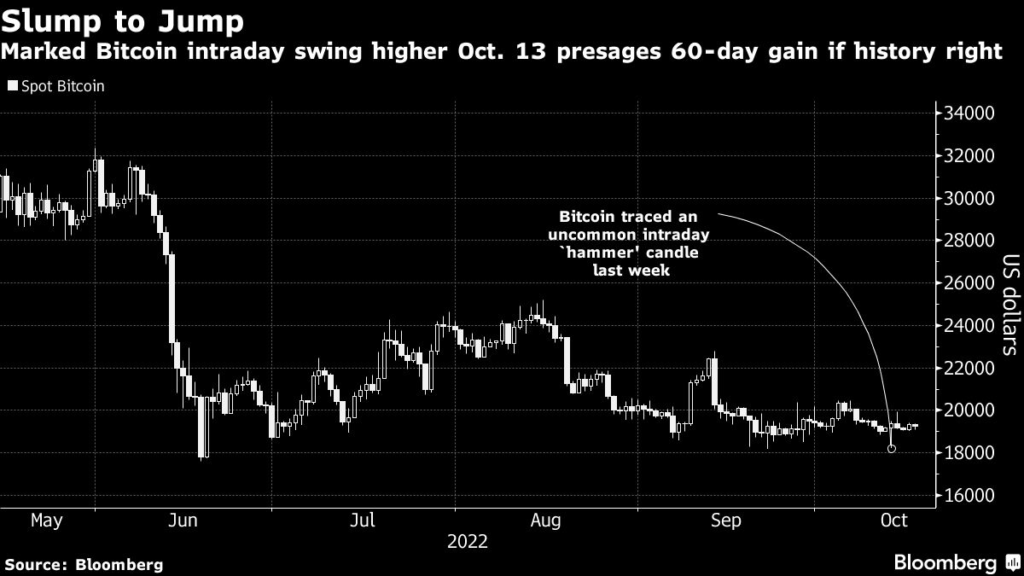
The pattern emerged on Oct. 13, when Bitcoin stormed back from a 5% swoon during the trading session to end up more than 1%. The about-face was overshadowed by a five-percentage-point turnaround in the S&P 500 equity index on the same day, a revival that left strategists open-jawed.

There have been 15 sessions since December 2018 when Bitcoin wiped out a minimum 5% intraday slide to finish with a gain of at least 1%. It averaged a 19% advance 60 days after such signals, data compiled by Bloomberg shows. 

Bitcoin slid to about $18,201 last Thursday before closing at roughly $19,387. The token has shed 58% in 2022, hurt but rapid-fire central bank interest-rate hikes that drained liquidity from markets in a fight against inflation. 

It’s been stuck in a low-volume, low-volatility trading range since mid-June, leaving some onlookers fretting that the overall weight of evidence raises the risk of further declines.

“The current inflationary environment remains challenging for risk assets, including cryptocurrencies,” but Bitcoin has continued to respect a support level around $18,000, said John Toro, the head of trading at digital-asset exchange Independent Reserve in Sydney.

More stories like this are available on bloomberg.com

©2022 Bloomberg L.P.

Mercedes Unveils New Electric SUV Aimed at Tesla’s Model Y

(Bloomberg) — Mercedes-Benz Group AG is broadening its battery-powered lineup with a sport utility vehicle that will take on Tesla Inc.’s Model Y in another step toward the automaker’s goal to go all-electric by the end of the decade.

The EQE SUV, unveiled on the eve of the Paris car show, will edge out the cheaper Model Y with 590 kilometers (367 miles) of driving range and start at around €70,000 ($68,000) when sales begin late this year. It’s the fourth model to use Mercedes’ dedicated EV platform, which also underpins the flagship EQS sedan.


“It’s the latest proof that we’re consistently executing on our strategy to go all-electric,” Mercedes Chief Executive Ola Kallenius said in a statement.

The SUV features a 141-centimeter (55.5-inch)-wide screen, and the high-performance AMG version will reach a top speed of 210 kilometers per hour. The carmaker also announced its vehicles will be the first non-Apple devices to offer a surround-sound system developed by Dolby Laboratories. 

Mercedes plans to offer electric siblings for all combustion-engine models in its portfolio by the end of the year, then introduce three new platforms to underpin its cars, AMGs and vans by 2025. By 2030, it will only sell EVs in markets where phasing out engines entirely is possible.

To help fund this ambitious rollout, Mercedes plans to weed out lower-margin vehicles in favor of more profitable G-Wagon SUVs and performance models.

Chinese Competition

The EQE SUV, which will be manufactured at Mercedes’ US plant in Alabama, debuted at the Musée Rodin in Paris ahead of a show lacking many western carmakers, including Volkswagen AG and BMW AG. Among those filing the void will be Chinese manufacturers led by BYD Co., the country’s biggest EV maker.

China’s EV manufacturers are increasingly seeking to make inroads into Europe. Nio Inc. this month announced plans to start sales in Germany, Denmark, Sweden and the Netherlands after modest success in Norway. Great Wall Motor Co. and Seres Group Co. also are part of the Chinese contingent exhibiting at the Paris show.

After many false starts by Chinese brands over the years, the transition to EVs could pry open the door to competitive European markets. British brand MG, owned by China’s SAIC Motor Corp., last year sold some 40,000 vehicles in Europe.

‘Robust’ Sales

The carmakers proffering shiny new models in Paris are contending with low consumer confidence amid surging inflation and rising interest rates.

While its archrival BMW recently warned orders have started to slow, Mercedes said last week that sales jumped by 21% during the third quarter, with China leading a strong showing of growth across all key regions.

In an interview with Bloomberg Television, Kallenius called the third-quarter deliveries “robust” and said that while the economy “might cool down,” Mercedes will be prepared.

“We’re also looking at finishing this year off in a robust fashion, and then we’ll see what next year brings,” he said.

(Updates with Apple partnership in the fourth paragraph.)

More stories like this are available on bloomberg.com

©2022 Bloomberg L.P.

Vodafone Plans €7 Billion German Fiber Venture With Altice

(Bloomberg) — Vodafone Group Plc will roll out fiber to the home in Germany in a deal with Altice Europe NV to share a €7 billion ($7 billion) investment in its biggest market.

The 50-50 fiber venture with French billionaire Patrick Drahi’s Altice will build fiber optic lines to as many as 7 million homes in Germany, the companies said in a statement Monday. About 70% of the cost will be financed through debt raised against the new company, they said. The deal is expected to close in the first half of next year.

The deal could net the British telecommunications company as much as €1.2 billion in cash proceeds from Altice, which are expected to be higher than Vodafone’s share of equity contributions, according to the statement. The proceeds include €120 million at closing, deferred payments of much as €487 million as more homes are connected and another €595 million based on performance.

Four-fifths of the proposed network will focus on large housing associations within Vodafone’s current footprint, and the rest would focus on neighboring homes. It will sell wholesale access to rival telecommunication providers. 

As data demand booms, telcos are sharing infrastructure projects with high costs and long-term paybacks with financial investors and rival operators. Fiber is often seen as the most reliable technology, and even cable-heavy groups like Liberty Global Plc have started overlaying cable networks with fiber.

Germany became Vodafone’s biggest market after it bought cable operator Unitymedia along with other units from Liberty for €18.4 billion in 2019. Since then, Vodafone has been hit by technology and regulatory hiccups which have hurt performance in the country. 

In 2021, Liberty returned to Germany and started a fiber optic joint venture, underscoring the opportunity. 

Vodafone shares fluctuated in early trading and were little changed at 8:03 a.m. in London.

(Updates with details on the deal from fourth paragraph)

More stories like this are available on bloomberg.com

©2022 Bloomberg L.P.

Ban on US Talent at China Chip Firms Thwarts Xi’s Key Ambition

(Bloomberg) — China will speed its efforts to build a legion of talent and win the battle to develop homegrown technologies, President Xi Jinping pledged at the Communist Party’s twice-a-decade congress on Sunday. But new US restrictions issued a week earlier are already undercutting those plans.

The Biden administration’s latest salvo of sanctions includes restrictions on so-called US persons supporting the development, production or use of integrated circuits at some chip plants located in China. Effective Oct. 12, the measures are broad enough to encompass holders of US green cards as well as US residents and American citizens, capturing a wide swath of senior executives at Chinese semiconductor firms.

The country will “attract the best minds from all areas to the cause of the Party and the people,” Xi said, reiterating the need to strengthen international talent exchange. Senior Chinese officials have repeatedly sought to assure overseas researchers that China is a better place for their work. Beijing pledged to beef up its push to lure talent back to China despite tight Covid-19 restrictions that have mostly sealed the country off from the rest of the world.

Read more: China’s Xi Vows Victory in Tech Battle After US Chip Curbs

Foreign-born designers and engineers, along with Chinese people with foreign passports or residency, have long played an instrumental role in the nation’s technological development. In consumer electronics, Huawei Technologies Co. accelerated its efforts to catch up to the iPhone by hiring a former Apple Inc. creative director, Abigail Brody, as its chief designer in 2015. The company also recruited internationally to build up its in-house chip and audio engineering and 5G wireless technology.

Six of the seven key research and development executives of China’s leading semiconductor equipment maker Piotech Inc. are American citizens, per its Star Markets filing in early 2022. Many of Piotech’s top management, including its chairman and general manager, are also Americans.

Source: Tianyancha, company filings; Company representatives did not respond to requests for comment.

Previously, US measures to rein in China’s ascent have focused on a particular technology — such as banning Huawei from accessing advanced chipmaking by the likes of Taiwan Semiconductor Manufacturing Co. — but the new personnel restriction will hurt by depriving China of a deep pool of experience obtained in the US.

“The control on ‘US person’ is the biggest surprise to us from the announcement,” Bernstein analysts including Stacy Rasgon wrote in response to Washington’s move. “Some Chinese companies have been progressing better, often thanks to founding members or executives bringing their experience from years of working in the US. Many of them hence are US citizens or green card holders.”

Anyone falling under the classification will require a license to continue working in China or in support of chipmakers there, with a heavy burden of proof to show that their work wouldn’t go toward military end uses. Given the variety of applications for any given semiconductor, that makes it challenging for US persons to demonstrate they wouldn’t be aiding China’s military, Bernstein said.

What Bloomberg Intelligence Says

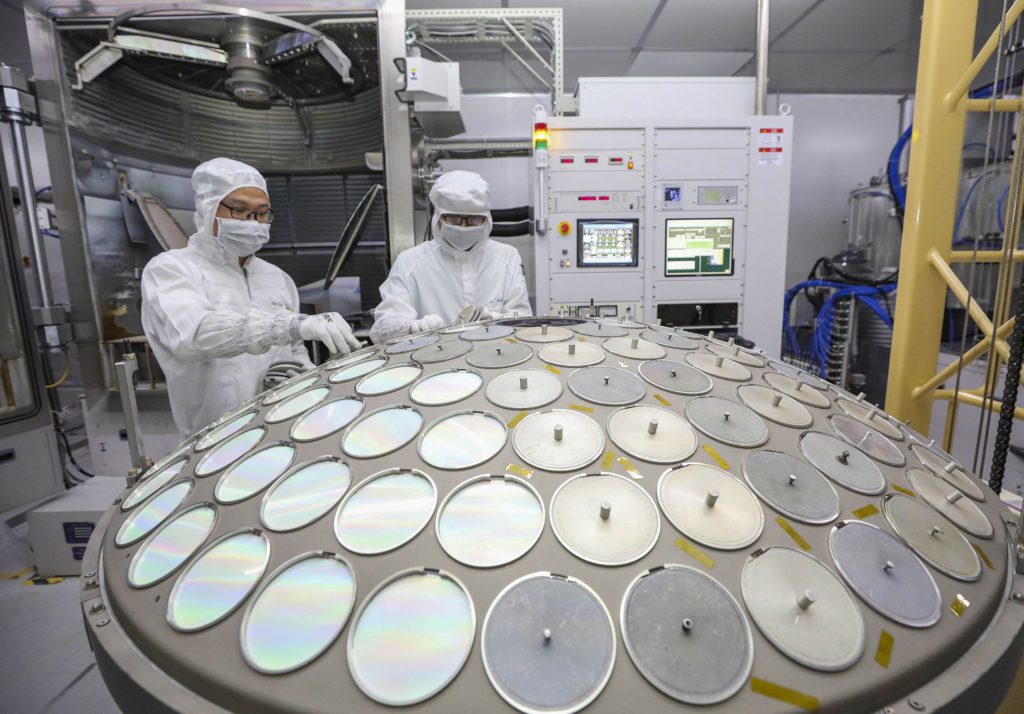
Chinese companies still concentrate on the assembly and testing segments of the industry’s global supply chain, missing out from the 90% of total chain value that’s in the design and manufacturing segments dominated by the US. Non-tariff barriers are the largest obstacle to the rise of the Chinese semiconductor industry.

— Clelia Imperiali, BI analyst

Click here for the full research

Companies like Dutch chip equipment maker ASML Holding NV have now prohibited American staff from supporting Chinese customers, dashing hopes in Beijing that international chip industry players would remain neutral. Meanwhile, Beijing-based semiconductor equipment maker Naura Technology Group Co. has told its US employees in China to withdraw from component and machinery development to comply with Washington’s restrictions, South China Morning Post reported.

“We scoped our measures narrowly,”  US Assistant Secretary of Commerce for Export Administration Thea D. Rozman Kendler told an audience on a public call on Thursday. “That ensures that our actions will have the least possible impact on commercial activity and not cause disruptions to the global supply chain.”

Read more: Biden Chip Rules Aim to Give US an Advantage, Official Says

Citi analysts said in a note about the new set of US rules this week that Naura and fellow domestic chipmaking gear provider Advanced Micro-Fabrication Equipment Inc. “both believe that even though it applies to their staffs with US citizenship or Green Cards, those staffs should still be allowed to participate in the development or production of mature-node ICs.”

Still, the US curbs are a roadblock for China’s bid to achieve technological self-sufficiency. The measures not only cut the country’s access to advanced chips used in supercomputers and artificial intelligence research, such as those provided by Nvidia Corp., but also impede the arrival of researchers and engineers capable of designing such systems within its borders.

More stories like this are available on bloomberg.com

©2022 Bloomberg L.P.

Coinbase Hires Fintech Executive to Lead European Expansion

(Bloomberg) — Coinbase Global Inc. has hired Daniel Seifert, a senior executive from German financial technology company Solarisbank AG, to lead its European expansion while contending with a protracted downturn in cryptocurrency markets and trading.

Seifert will join the San Francisco-based crypto exchange as regional managing director in Europe after serving for more than two years as chief operating officer for Solarisbank, the company said in a statement. Coinbase plans to fill core roles on the continent and has recently secured regulatory registration in Italy and the Netherlands, according to the firm’s vice president of international and business development Nana Murugesan. 

“International expansion is an existential priority for us,” Murugesan said in an interview. “Whether it’s a bull market or bear market, that’s where most of our upside is.”


Murugesan said Coinbase intends to expand its services to France and Spain next year pending regulatory approvals. Beyond existing payment licenses, the firm is also seeking registration and holding discussions in Ireland and the UK about joining the countries’ respective cryptoasset regulatory regimes. 

Like other crypto exchanges, Coinbase has suffered a drop in trading volumes and revenues, caused by a rout in digital-asset prices. The company laid off almost a fifth of its staff earlier this year, while its shares are down more than 70% in the last year.

Read more: Coinbase Renews Overseas Expansion Plan After Cutting US Staff

Seifert’s hiring comes as executives at the top of several major crypto firms have either resigned or shifted from their roles, creating a changing of the guard as the sector weathers the prolonged bear market. Kraken, OpenSea, Genesis and Alameda Research are among the companies that have seen significant leadership changes in the last two months.

Murugesan said Coinbase was hiring in a “very focused way,” having begun the hunt for Seifert’s position early this year as the bear-market period set in. “We’ve been watching all this turnover — it has been surprising to see at this level.”

In June, the European Union reached a provisional agreement on its landmark Markets in Cryptoassets (MiCA) directive, bringing years of debate on how to regulate the digital-asset industry to an informal close. Murugesan said that Coinbase welcomed the bloc-wide approach. 

More stories like this are available on bloomberg.com

©2022 Bloomberg L.P.

Close Bitnami banner
Bitnami