Bloomberg

Hunt Readies Commons Speech to Calm Markets: The London Rush

(Bloomberg) — Jeremy Hunt, the UK’s fourth chancellor in as many months, will attempt to tame its wild gilt and currency markets today when he stands up in the House of Commons. He will outline more details on the governments plans for tax and spending. The pound rallied in early trading this morning. Remember, there’s no guarantee this week will be quieter than the last.

Here’s the key business news from London this morning:

In The City

Vodafone Plc: The telecommunications giant will create a 50:50 joint venture with Altice that will invest 7 billion euros in rolling out fibre connections to up to 7 million homes in Germany.

  • Vodafone will receive up to 1.2 billion euros as part of the joint venture

Made.com Group Plc: The online seller of trendy homeware has received a number of proposed takeover offers as part of its formal sales process.

  • The company is being squeezed by twin pressures of a worsening consumer environment and higher costs, forcing it to consider a sale and review its headcount

Hargreaves Lansdown Plc: The retail investing platform’s CEO Chris Hill will leave the company in November 2023, once a successor has been appointed.

  • It came as the company added 17,000 new clients in the first quarter and increased its full year revenue margin outlook, despite turbulent markets disrupting consumer confidence

In Westminster

The new Chancellor will today accelerate plans to bring order to the UK’s public finances in a fresh bid to reassure markets still skittish about Liz Truss’s premiership. He will make a statement mid-morning on measures to support fiscal sustainability and then speak to the House of Commons in the afternoon.

UK financial markets will get a fresh opportunity to pass judgment on Truss’s economic program today without the Bank of England around to offset any turmoil. The pound rose in Asia trading as investor confidence was bolstered by expectations that more of Truss’s package of unfunded tax cuts may be reversed.

Meanwhile, as many as seven million homes in the UK will experience dire fuel poverty this winter if the government doesn’t roll out a further £14 billion to protect them, campaigners said.

In Case You Missed It 

UK property sellers boosted prices at the strongest pace in five months in October, led by a jump in the most expensive homes in London. The figures indicate it’s still too early to call an end to Britain’s property price boom, which lasted through the pandemic.

The number of jobs available in the City of London fell by almost a third in the third quarter, as holidays and economic uncertainty hit hiring.

Looking Ahead 

As the new earnings season picks up pace, here’s a look at what to expect next week: 

This evening: Mining company Rio Tinto Plc will report its third quarter operations review in the evening. That follows a soft first-half update where the firm halved its dividend and reported a sharp decline in profit. Concerns about slowing demand have led to lower prices for commodities like iron.

Tuesday: Homebuilder Bellway Plc’s update will be closely watched for further signs of storm clouds gathering over Britain’s housing market. Barratt Developments Plc flagged this week that private reservations, the average weekly number of homes reserved at its sales sites, has dropped more than 30%.

Wednesday: Asos Plc’s full-year results will likely provide an important insight into the state of the consumer. Most spending with the online fashion website is discretionary, and it warned last month that sales in August were weaker than expected as shoppers cut back.

Thursday: Alongside a trading update, Jupiter Fund Management Plc’s new boss Matthew Beesley is expected to announce his turnaround plans for the London-based asset manager which has been grappling with years of outflows. 

Friday: Deliveroo Plc’s results will follow those of food delivery rival Just Eat Takeaway.com earlier in the week. London-based Deliveroo has set its eyes on achieving adjusted Ebitda profitability and after that, free cash flow generation, but is facing headwinds from a worsening consumer environment. Bloomberg Intelligence analyst Diana Gomes suggests the company could narrow its gross transaction value guidance range, which at 4%-12% appeared too wide. 

For a news fix when the day is done, sign up to The Readout with Allegra Stratton, to make sense of the day’s events.

More stories like this are available on bloomberg.com

©2022 Bloomberg L.P.

Stocks Drop in Asia, Dollar Dips Amid Wary Trading: Markets Wrap

(Bloomberg) — Asian equities fell while major currencies made gains against the dollar in a cautious open to the week following further weakness on Wall Street and a defiant message to the world from China’s Communist Party congress.

A gauge of the region’s stocks slumped about 1%, led by technology companies in Hong Kong, while futures pointed to declines in Europe. Contracts for the S&P 500 and Nasdaq 100 rose after tumbling Friday amid elevated Treasury yields and expectations for faster inflation. US yields trimmed that move in Asia on Monday.

The dollar eased against its Group-of-10 counterparts, providing a touch of respite to harried currency markets, with the pound rallying on expectations that Britain may reverse more of its unfunded tax cuts. Traders remained on guard for possible intervention to support the yen, which is near a 32-year low and within reach of the key 150 level versus the greenback. 

UK markets may be in for a particularly torrid week, with beleaguered Prime Minister Liz Truss battling to rescue her premiership after the Bank of England ended its emergency bond-buying program on Friday. Chancellor Jeremy Hunt was due to make a statement later on Monday, “bringing forward measures from the medium-term fiscal plan that will support fiscal sustainability.”

The outlook for consumer prices in the US continues to fuel bets that the Federal Reserve may make jumbo rate hikes at its next two meetings, weighing broadly on the outlook for global economic growth and markets. 

Against this negative backdrop, investors have to contend with news from Beijing, where President Xi Jinping said China’s global power had increased while warning of “dangerous storms” ahead. There were few signs of any let up in the Covid-Zero campaign or housing market policies that are weighing on the economy. Xi also said China would prevail in its fight to develop strategically important technology amid rising tension with the US.

The offshore yuan extended gains versus the dollar after China’s central bank halted its cash withdrawal via medium term loans for the first time in three months in a bid to boost the economy.

Fed officials in their latest comments suggested they were ready to hike rates higher than previously planned. Kansas City Fed President Esther George said the terminal rate may need to be higher to cool prices. San Francisco Fed’s Mary Daly said she’s “very supportive” of raising to restrictive levels and to between 4.5% and 5% “is the most likely outcome.”

“Sticky, persistent, and broad-based inflation means the Fed has to continue to hike rates aggressively,” Victoria Greene, founding partner and chief investment officer at G Squared Private Wealth, wrote in a note. “Bonds continue to be a difficult investment due to the rapid Fed rate hikes, but we have seen a lot get priced in and market expectations are improving.”

Elsewhere in markets, oil clawed back some losses after a weekly slump as fears over an economic slowdown continue to weigh on the outlook for demand. Gold edged up in Asia on weakness in Treasuries and the US dollar, as rising fears of a global economic slowdown boost the precious metal’s haven status.

Key events this week:

  • Earnings this week will provide clues on the strength of a swathe of companies, including Bank of America Corp., China Telecom Corp., Contemporary Amperex Technology Co., Hindustan Unilever Ltd, Hong Kong Exchanges & Clearing Ltd., Goldman Sachs Group Inc., Johnson & Johnson, Netflix Inc., Tesla Inc. and United Airlines Holdings Inc.
  • US empire manufacturing, Monday
  • ECB Vice President Luis de Guindos speaks, Monday
  • China retail sales, industrial production, GDP, surveyed jobless, Tuesday
  • US industrial production, NAHB housing market index, Tuesday
  • Fed’s Neel Kashkari speaks, Tuesday
  • Euro area CPI, Wednesday
  • UK CPI, PPI, retail price index, Wednesday
  • US MBA mortgage applications, building permits, housing starts; Fed Beige Book, Wednesday
  • Fed’s Neel Kashkari, Charles Evans, James Bullard speak Wednesday
  • US existing home sales, initial jobless claims, Conference Board leading index, Thursday

Some of the main moves in markets:

Stocks

  • S&P 500 futures rose 0.7% as of 6:53 a.m. London time. The S&P 500 fell 2.4% on Friday
  • Futures on the Nasdaq 100 rose 0.8%. The Nasdaq 100 fell 3.1%
  • Euro Stoxx 50 futures fell 0.3%
  • The Topix Index fell 0.9%
  • The S&P/ASX 200 fell 1.4%
  • The Hang Seng Index fell 0.3%

Currencies

  • The Bloomberg Dollar Spot Index fell 0.3%
  • The euro rose 0.3% to $0.9753
  • The Japanese yen was little changed at 148.69 per dollar
  • The offshore yuan rose 0.2% to 7.2064 per dollar
  • The British pound rose 1% to $1.1286

Cryptocurrencies

  • Bitcoin fell 0.4% to $19,264.94
  • Ether fell 0.3% to $1,306.87

Bonds

  • The yield on 10-year Treasuries fell four basis points to 3.98% Friday
  • Australia’s 10-year bond yield rose two basis points to 4.02%

Commodities

  • West Texas Intermediate crude rose 0.8% to $86.28 a barrel
  • Spot gold rose 0.6% to $1,653.60 an ounce

More stories like this are available on bloomberg.com

©2022 Bloomberg L.P.

Blibli Owner Seeks $530 Million in Indonesia’s Second-Largest IPO of 2022

(Bloomberg) — Global Digital Niaga PT, the owner of e-commerce group Blibli, is set to raise up to 8.17 trillion rupiah ($530 million) through an initial public offering, poised to be Indonesia’s second-largest this year.

The firm is offering as many as 17.77 billion new shares, or a 15% stake, at a price between 410 rupiah and 460 rupiah apiece, according to a prospectus published on Monday. This values the group at up to $3.5 billion. 

Bookbuilding ends on Oct. 24, with tentative offering period between Nov. 1-3. It is expected to list on Nov. 7.  

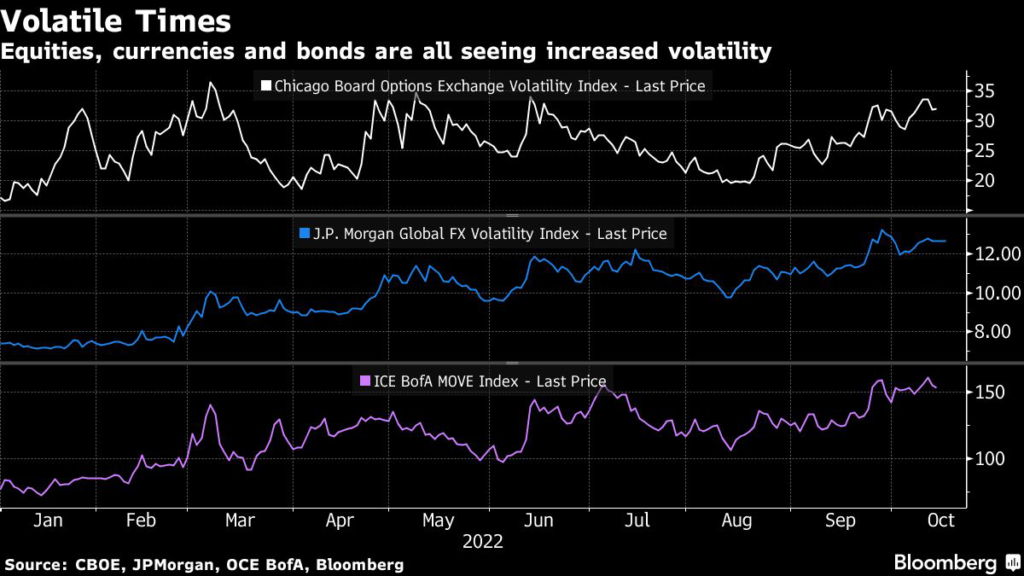
Even if priced at the bottom of the marketed range, it is set to be the largest IPO in the Southeast Asian country after tech company PT GoTo Gojek Tokopedia Tbk raised $959 million in an April listing. Since then, Indonesia’s exchange hasn’t hosted any new equities sale larger than $100 million as proceeds slumped globally amid a spike in volatility, high inflation and rising rates. 

Global Digital Niaga, which is controlled by Djarum Group, aims to use the proceeds to repay debt and for working capital. There is a 12-month voluntary lock-up period on the company, and an eight-month mandatory lock-up for principal and other existing shareholders, according to terms of the deal obtained by Bloomberg News. 

Shares of PT Supra Boga Lestari Tbk, a food seller in which Blibli is a main shareholder, jumped as much as 25% in Jakarta on Monday following news of the IPO. 

Joint bookrunners in the offering are BRI Danareksa Sekuritas PT, BCA Sekuritas PT, Credit Suisse Group AG, Morgan Stanley and DBS Group Holdings Ltd. 

(Adds stock performance of Blibli’s unit in sixth paragraph)

More stories like this are available on bloomberg.com

©2022 Bloomberg L.P.

Asian Stocks Drop, Dollar Slips Amid Wary Trading: Markets Wrap

(Bloomberg) — Asian equities fell while major currencies made gains against the dollar in a cautious open to the week following further weakness on Wall Street and a defiant message to the world from China’s Communist Party congress.

Stocks dropped in Japan, Australia and Hong Kong, where technology companies led declines. Contracts for the S&P 500 and Nasdaq 100 rose after tumbling Friday, when Treasury yields climbed as year-ahead inflation expectations increased. US Yields trimmed that move in Asia on Monday.

The dollar eased against its Group-of-10 counterparts, providing a touch of respite to harried currency markets. Traders remained on guard for possible intervention to support the yen, which is near a 32-year low and within reach of the key 150 level versus the greenback. The pound rallied on expectations that the UK may reverse more of its unfunded tax cuts.

The outlook for consumer prices in the US continues to fuel bets that the Federal Reserve may make jumbo rate hikes at its next two meetings, further challenging global growth. 

Against this negative backdrop, investors have to contend with news from Beijing, where President Xi Jinping said China’s global power had increased while warning of “dangerous storms” ahead. There were few signs of any let up in the Covid-Zero campaign or housing market policies that are weighing on the economy. Xi also said China would prevail in its fight to develop strategically important technology amid rising tension with the US.

The offshore yuan extended gains versus the dollar after China’s central bank halted its cash withdrawal via medium term loans for the first time in three months in a bid to boost the economy.

UK markets may be in for a particularly torrid week, with Britain’s beleaguered prime minister Liz Truss battling to rescue her premiership after the Bank of England ended its emergency bond-buying program on Friday. 

Fed officials in their latest comments suggested they were ready to hike rates higher than previously planned. Kansas City Fed President Esther George said the terminal rate may need to be higher to cool prices. San Francisco Fed’s Mary Daly said she’s “very supportive” of raising to restrictive levels and to between 4.5% and 5% “is the most likely outcome.”

“Sticky, persistent, and broad-based inflation means the Fed has to continue to hike rates aggressively,” Victoria Greene, founding partner and chief investment officer at G Squared Private Wealth, wrote in a note. “Bonds continue to be a difficult investment due to the rapid Fed rate hikes, but we have seen a lot get priced in and market expectations are improving.”

Corporate America offered some bright spots Friday, with big banks including JPMorgan Chase & Co. and Wells Fargo & Co. rising after reporting results, while Morgan Stanley fell as equity trading revenue disappointed. 

Elsewhere in markets, oil clawed back some losses after a weekly slump as fears over an economic slowdown continue to weigh on the outlook for demand. Gold steadied in Asia after a volatile week in which expectations of more aggressive rate hikes by the Fed boosted the dollar, weighing on the precious metal.

Key events this week:

  • Earnings this week will provide clues on the strength of a swathe of companies, including Bank of America Corp., China Telecom Corp., Contemporary Amperex Technology Co., Hindustan Unilever Ltd, Hong Kong Exchanges & Clearing Ltd., Goldman Sachs Group Inc., Johnson & Johnson, Netflix Inc., Tesla Inc. and United Airlines Holdings Inc.
  • China medium-term lending, Monday
  • US empire manufacturing, Monday
  • ECB Vice President Luis de Guindos speaks, Monday
  • China retail sales, industrial production, GDP, surveyed jobless, Tuesday
  • US industrial production, NAHB housing market index, Tuesday
  • Fed’s Neel Kashkari speaks, Tuesday
  • Euro area CPI, Wednesday
  • UK CPI, PPI, retail price index, Wednesday
  • US MBA mortgage applications, building permits, housing starts; Fed Beige Book, Wednesday
  • Fed’s Neel Kashkari, Charles Evans, James Bullard speak Wednesday
  • US existing home sales, initial jobless claims, Conference Board leading index, Thursday

Some of the main moves in markets:

Stocks

  • S&P 500 futures rose 0.4% as of 12:51 p.m. Tokyo time. The S&P 500 fell 2.4% on Friday
  • Futures on the Nasdaq 100 rose 0.4%. The Nasdaq 100 fell 3.1%
  • The Topix Index fell 1.1%
  • The S&P/ASX 200 fell 1.4%
  • The Hang Seng Index fell 1.1%

Currencies

  • The Bloomberg Dollar Spot Index fell 0.2%
  • The euro rose 0.2% to $0.9743
  • The Japanese yen was little changed at 148.61 per dollar
  • The offshore yuan rose 0.3% to 7.2004 per dollar
  • The British pound rose 0.6% to $1.1238

Cryptocurrencies

  • Bitcoin fell 0.7% to $19,202.36
  • Ether fell 0.7% to $1,301.75

Bonds

  • The yield on 10-year Treasuries fell three basis points to 3.99% Friday
  • Australia’s 10-year bond yield rose three basis points to 4.04%

Commodities

  • West Texas Intermediate crude rose 0.6% to $86.15 a barrel
  • Spot gold rose 0.4% to $1,650.88 an ounce

More stories like this are available on bloomberg.com

©2022 Bloomberg L.P.

Toshiba Sale Faces Delay as Banks Wary on Financing, Sources Say

(Bloomberg) — A takeover of Toshiba Corp., which could be the biggest buyout in Asia this year, is at risk of slipping behind schedule as the bidding groups run into obstacles securing financing commitments from banks.

The consortium led by Japan Industrial Partners Inc. and a rival group led by state-backed investment fund Japan Investment Corp. will find it hard to meet a Nov. 7 deadline, set by the iconic conglomerate, to line up commitment letters, according to people familiar with the matter. Some global banks have turned cautious over backing large buyouts like Toshiba amid rising borrowing costs in the US and elsewhere, the people said. Inflation has even increased in Japan, though the central bank is an outlier in maintaining a loose monetary policy.

Shares in Toshiba fell as much as 3% in Tokyo on Monday following the Bloomberg News report. The company has a market value of about $16 billion.

Read More: Season of Shelved M&A Surpasses $150 Billion as Credit Woes Bite

Four major Japanese lenders have only submitted indications of their interest in providing financing to the groups, the people said, asking not to be identified as the information is private. The banks cannot make binding commitments as neither JIP nor JIC have finalized details such as deciding on the lineup of their equity partners, the people added.

The logjam illustrates the broader challenges of putting together an offer for a national icon like Toshiba. JIP’s bid has been named as Toshiba’s preferred bidder, Bloomberg News has reported. Both groups are still holding talks with prospective co-investors to help fund the deal, the people said. 

Considerations are still ongoing and there’s no certainty that talks will lead to any transaction, the people said. Toshiba could still decide to explore certain asset sales instead of a full sale of the business, they said.

Representatives for JIP and JIP declined to comment. Midori Hara, a Toshiba spokesperson, declined to comment on candidates including co-investors, saying to do so could undermine a fair process.

JIP is in talks to form a partnership with domestic companies including Orix Corp. and Chubu Electric Power Co. as well as global investment firms such as Baring Private Equity Asia and CVC Capital Partners, Bloomberg News has reported.

Investors including Bain Capital and MBK Partners have discussed being involved in JIC’s rival bid group, people familiar with the matter have said.

The Japanese conglomerate has solicited proposals to shape its future strategy, including potential buyout bids. Such a deal could be private equity’s largest ever in Japan.

(Updates with share price move in third paragraph.)

More stories like this are available on bloomberg.com

©2022 Bloomberg L.P.

China Locks Down Almost 1 Million People Near iPhone Factory

(Bloomberg) — The iPhone manufacturing hub of Zhengzhou locked down one of its most-populated districts to tame a virus flareup, with creeping restrictions throughout China underscoring the constant threat of disruption companies face while the country sticks to Covid Zero.

Almost 1 million residents of Zhongyuan district were ordered to stay at home starting Monday, except for when they need to undergo Covid testing, and non-essential businesses have been shut, according to a government notice. The wider restrictions follow the lockdown of some neighborhoods last week, catching many people by surprise after officials had said there wouldn’t be a citywide lockdown.

Read more: Xi Defends Covid Zero Without Showing China Path Out of Pandemic 

IPhone maker Foxconn Technology Group’s plants aren’t located in the district that’s been locked down. Representatives for the company didn’t immediately respond to a request for comment from Bloomberg News.

The city reported 6 new local cases for Sunday, down from a recent peak of 40 on Oct 9. Nationwide, cases declined to 697, the lowest in two weeks, as outbreaks in Inner Mongolia and Xinjiang came under control. Beijing posted 13 new cases, and Shanghai had 32.

China is sticking to the Covid Zero pillars of lockdowns and mass testing to tame its biggest flareup in two months, despite the heavy cost. The policy has dragged on growth in the world’s second-biggest economy and roiled global supply chains as important manufacturing hubs — from cars, to phones and Christmas trees — contend with the disruption of shutdowns and reopenings. 

President Xi Jinping on Sunday signaled no looming change to the approach, disappointing investors who had hoped for some signs of loosening. During a speech opening the twice-a-decade Party Congress in Beijing, he said the strict rules protect people’s lives, though Xi avoided mentioning the economic toll.

Economists surveyed by Bloomberg predict growth of just 3.3% this year, the second-weakest pace in more than four decades. 

Read more: China Stocks Slide as Xi Disappoints on Covid Zero Policy

The stringent Covid curbs have also been stoking public discontent. Censorship went into overdrive late last week, with words such as “Beijing” and “bridge” restricted on social media platforms like Weibo after two banners criticizing Xi and Covid Zero were displayed on a bridge in the capital. One read: “We want food, not PCR tests. We want freedom, not lockdowns and controls.”

While China’s most important cities have so far avoided large-scale lockdowns, officials have instead being quietly halting a growing list of activities. Several schools in Shanghai have suspended in-person classes as the fear of infection spread grows, according to parents and social media posts. The port city of Tianjin last week announced a lockdown of one district and the southern megacity of Guangzhou shut schools in one area.

More stories like this are available on bloomberg.com

©2022 Bloomberg L.P.

China’s Xi Vows Victory in Tech Battle After US Chip Curbs

(Bloomberg) — Chinese President Xi Jinping pledged his nation will prevail in its fight to develop strategically important tech, underscoring Beijing’s concern over a US campaign to separate it from cutting-edge chip capabilities.

“We will focus on national strategic needs, gather strength to carry out indigenous and leading scientific and technological research, and resolutely win the battle in key core technologies,” Xi said in a speech Sunday at the opening of the ruling Communist Party’s twice-a-decade congress in Beijing.

Xi said the world’s No. 2 economy will speed up innovation in areas that are vital to “technology self-reliance,” adding that “China will move faster to launch a number of major national projects that are of strategic, big-picture and long-term importance.” He didn’t give details on those efforts.

Xi Says China’s Power Has Increased, Warns of ‘Dangerous Storms’

The comments illustrate how China plans to deal with the US placing new restrictions on tech exports that could undercut its ability to develop broad sections of its economy such as semiconductors, supercomputers, surveillance systems and advanced weapons.

The focus on science was “a reflection on just how much Xi Jinping is betting on innovation as a solution to China’s economic problems and to its reliance on Western technology,” said Neil Thomas, a China analyst at Eurasia Group Ltd., a political risk advisory firm.

“That’s super significant. It really shows his increasing priority that this is his big bet basically for the future of China.”

Xi’s Vow to ‘Stand Tall’ Has China on Collision Course With US

Earlier this month, the US Commerce Department unveiled sweeping regulations that limit the sale of semiconductors and chip-making equipment to Chinese customers, striking at the foundation of the country’s efforts to build its own chip industry. The US also added 31 organizations to its unverified list, including Yangtze Memory Technologies Co. and a subsidiary of leading chip equipment maker Naura Technology Group Co., severely limiting their ability to buy hardware from abroad.

Those moves were the Biden administration’s most aggressive yet as it tries to stop China from developing capabilities it sees as threatening. The US is seeking to ensure that Chinese companies don’t transfer technology to the People’s Liberation Army, and that chipmakers in China don’t develop the capability to make advanced semiconductors themselves.

Depending on how broadly Washington enforces the restrictions, the impact could extend well beyond semiconductors and into industries that rely on high-end computing, such as electric vehicles, aerospace and smartphones. 

Xi Says Economic Development Is Communist Party’s Top Priority

Beijing has criticized the expanded US curbs on its access to semiconductor technology, saying they will harm supply chains and the global economy. Foreign Ministry Spokeswoman Mao Ning said the measures — which start to go into force this month — are unfair and will “also hurt the interests of US companies.”

In the speech to the party congress that’s expected to result in him getting more time in power, Xi said China was now one of the world’s great innovating nations, lauding its capabilities in areas such as space exploration and biomedicine.

China and the US are in an increasingly fierce competition over space as Beijing sends probes to the moon, builds its own space station and sets its sights on Mars. NASA Administrator Bill Nelson has accused China of stealing space technology, and the country has been criticized over its handling of debris falling back to earth.

Last month, China said it plans to launch three unmanned missions to the moon over the next decade, an announcement that came a day after saying it discovered a new lunar mineral via samples retrieved by its Chang’e-5 mission.

(Updates with more context.)

More stories like this are available on bloomberg.com

©2022 Bloomberg L.P.

Singapore Digital Wealth Startup Endowus Buys Carret Private

(Bloomberg) — Digital wealth platform Endowus Pte acquired a majority stake in an independent wealth manager in Hong Kong as the Singaporean company builds out its business beyond the city-state. 

The deal to buy more than 60% of Carret Private Investments Asia Ltd. brings together Endowus’s digital wealth technology with Carret Private’s ultra-high-net-worth customers across Asia. Together, they will serve tens of thousands of clients with assets of more than $4 billion, said the firms’ executives, who didn’t disclose terms.  

“This is one of the first times a fintech startup has gone and bought a traditional player in the space,” Gregory Van, chief executive officer of Endowus, said in a joint interview with Chairman Samuel Rhee and Carret Private Managing Partner Kenneth Ho. 

The acquisition underscores Endowus’s ambition to cater to the growing number of affluent Asians seeking independent wealth advice using digital technology.

“The independent wealth management business is at a very nascent stage in Asia,” with private banks dominating the industry, said Rhee, a former CEO of Morgan Stanley Investment Management in Asia who also serves as chief investment officer at Endowus. “There is a tremendous upside to scale into one of the largest independent wealth managers for the ultra-high-net-worth segment in Asia.” 

Endowus, which has raised S$67 million ($47 million) in funding from investors including UBS AG, EDBI, Prosus Ventures and Samsung Ventures, has been looking to gain a foothold in Hong Kong. For Ho, a veteran banker who leads Carret Private, it was the strategically right fit. 

“We needed to get into the new age,” Ho said. “But Endowus is much more than a digital company. It’s got an extremely strong investment team, led by Sam as the CIO.” 

Endowus helps investors in Singapore access their financial portfolio across cash savings, pension and retirement plans. The total amount of assets Endowus is offering advice on reached more than S$2 billion in August.

Endowus and Carret Private will continue to operate under their own brands. Carret Private has a minority shareholding in Singapore-based Lumen Capital Investors Pte, a multi-family office that was founded by Wilfried Kofmehl, a former CEO of Bank Julius Baer Singapore.  

(Updates with Endowus’s assets under advice in 8th paragraph. The first photo caption in an earlier version was corrected.)

More stories like this are available on bloomberg.com

©2022 Bloomberg L.P.

South Korea Aims to Boost Economy With Digital ID on Blockchain

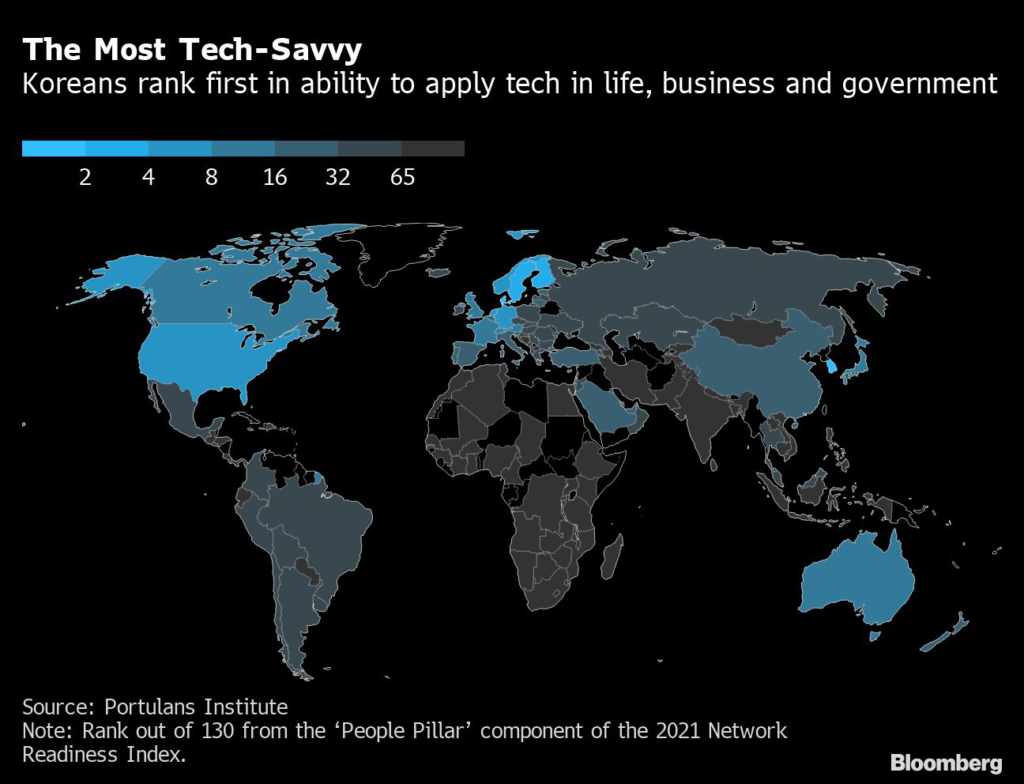
(Bloomberg) — South Korea plans to offer a digital identity secured by blockchain to citizens with a smartphone as it taps into the world’s most tech-savvy population to boost economic growth.

Smartphone-implanted IDs are among the latest emerging technology underpinning a digital economy that has expanded as more people work from home, make cashless payments and explore the metaverse. 

Digital IDs simplify verification on the web, removing the need to photograph certificates or log-in via authentication codes sent by text. Instead, activities like applying for state benefits, transferring money or even casting a vote are just a pin or fingerprint away. 

“Digitals IDs can yield huge economic benefits in finance, healthcare, taxes, transportation and other areas and may catch on quickly among the Korean population,” said Hwang Seogwon, an economist at Korea’s Science and Technology Policy Institute. 

“But there has to be more risk assessment technologically to make sure the danger doesn’t outweigh the benefits,” he said.

The World Bank calls digital IDs a “game-changer” and McKinsey & Co. sees their potential to increase a nation’s gross domestic output by up to 13% and cut business costs by trillions of dollars.

McKinsey’s estimate is based on wide take-up of digital IDs, saving time in administrative work, reducing payroll fraud, expanding consumer credit, facilitating trade and spawning new markets.

“Every service that hasn’t been able to fully transition online will now be able to do so,” said Suh Bo Ram, director-general of Korea’s digital-government bureau, who is spearheading the plan. 

Korea could reap at least 60 trillion won ($42 billion), or 3% of GDP, in economic value within a decade, he said.

Koreans’ zeal for early adoption may help, too. They rank No. 1 in the world when it comes to the enthusiasm and ability to apply tech in everyday life, businesses and government, according to the Portulans Institute, a Washington-based thinktank.

Koreans currently rely on resident registration cards — similar to a US social security card — to identify themselves. Under the proposal, an app would embed those IDs into mobile devices.

Korea will launch digital IDs in 2024 and seeks their adoption by 45 million citizens within two years. That ambition may be hampered by each individual needing to travel to a town office and paying a fee to renew their registration card.

Suh acknowledged the concerns while expressing confidence that the hurdles will pale in comparison to the benefits. The government, he said, is also aware of “big brother” concerns, referring to George Orwell’s 1949 novel. 

Under the plan, the government will have no access to information stored on individual phones, including details of whose digital IDs are used, how they are used and where, because the system will rely entirely on decentralized identity, an advanced strand of blockchain technology, he said.

Blockchain, widely known as the engine behind Bitcoin, refers to a digital log of data verified by devices on the network whenever it’s updated. Hackers would have to break into each individual device to manipulate data, while the chance of theft is reduced because there’s no central server storing information.

“Korea is becoming a quiet power showing the future of global tech,” said Heather Vescent, president of Oregon-based IDPro, an association for digital ID professionals. 

Other governments have also recognized the benefits of digital IDs.

In Estonia, where most of its eligible 1.3 million people have a digital ID to vote, pay bills and sign documents, the government allows phones to be used for verification if a special SIM card is attached, according to its website. Germany has a similar chip-based program.

According to proponents, other benefits of digital IDs include:

  • Facilitating online medical services without visiting doctors in person
  • Entering hotel rooms by just scanning smartphones over kiosks
  • Preventing ID forgery and theft
  • Approving contracts remotely without the need to sign them
  • Enhanced fast-track boarding processes at airports

More stories like this are available on bloomberg.com

©2022 Bloomberg L.P.

Ukraine Latest: Iran Arms Sales; Russian Training Camp Killings

(Bloomberg) —

At least 11 soldiers and possibly far more were killed after two men, said to be from an ex-Soviet state, opened fire at a Russian military training camp near the border with Ukraine, according to state-run media. Russia is intensifying mobilization efforts and has deployed thousands of new recruits into combat. 

Iran plans to sell ballistic missiles to Russia for the first time to help the Kremlin replenish its depleted arsenal, the Washington Post reported, citing US intelligence sources. Tehran is also expected to supply more kamikaze drones for Russia’s war effort. Iran has denied it’s supplying weapons. The UK on Sunday said Russia is now probably incapable of producing precision-guided cruise missiles at the rate they’re being expended.

President Vladimir Putin plans a security council meeting in the coming week, state media reported. The group last met on Oct. 10, the day Moscow launched dozens of missile strikes across Ukraine. 

(See RSAN on the Bloomberg Terminal for the Russian Sanctions Dashboard.) 

Key Developments

  • Russia Failed to Swap Out Western Military Parts: 2021 Audit
  • Ukraine IT Sector Tested as Putin Bombs Civilian Infrastructure
  • G-20 Divisions Over War, Oil Laid Bare in Days-Late Statement
  • Putin Says Has No Regrets About Ukraine Invasion After Reverses
  • Elon Musk Backs Down From Demands for Starlink Funding 

On the Ground

Four people were injured in a strike on Russia’s Belgorod region, about 50 km north of the border with Ukraine, the region’s governor said. There are reports Belgorod airport was heavily damaged; social media posts suggested a dozen or more explosions and showed smoke billowing. Ten Ukrainians were killed and 14 injured in Saturday strikes, the president’s office said. Heavy fighting was reported near Bakhmut in Donetsk, on of the few areas Russian troops are still advancing. Moscow’s forces are building defensive positions near Kreminna and Svatove, east and northeast of recently liberated Lyman. 

(All times CET)

Baltic Nations Call for War Crimes Tribunal (8:02 p.m.)

The three Baltic countries are calling on all European Union members to lead a drive for a war crimes tribunal to bring Russian leaders to justice, Latvian Foreign Minister Edgars Rinkevics said. 

EU foreign ministers are scheduled to meet on Monday in Luxembourg.

“Currently there is no international court or tribunal that could bring Russia’s top political and military leadership to account for committing the crime of aggression against Ukraine,” Rinkevics and his colleagues from Lithuania and Estonia said in a joint statement he posted on Twitter. This “jurisdictional loophole” must be filled, they said.

Ukraine Ramps Up Air Offensive (6:05 p.m.)

Ukraine’s air force delivered over 20 strikes on Sunday, hitting 17 Russian areas of concentration of weapons and military equipment and four positions of anti-aircraft missile systems, officials said in an evening update.  

A Russian command post was hit by Ukrainian artillery, according to the dispatch. No details were provided on the location of the activity, and the claims can’t be verified. Ukraine’s General Staff said some Russian annexation officials have started evacuating to Crimea. 

Ukrainian troops launched a “general counteroffensive” in the northern Kherson region on Saturday, according to the Institute for the Study of War, which cited Russian sources. 

G-20 Divisions Over War, Oil Laid Bare in Days-Late Statement (4:33 p.m.)

Officials from the world’s biggest economies were divided on issues including Russia’s war in Ukraine, according to a Group of 20 statement released three days later than usual. 

“Many members strongly condemned Russia’s war against Ukraine and expressed the view that Russia’s illegal, unjustified and unprovoked war of aggression against Ukraine is impairing the global economic recovery,” according to the G-20 “Chair’s Summary” issued on Sunday by Indonesia. 

Read more: G-20 Divisions Over War, Oil Laid Bare in Days-Late Statement

Ukraine, Turkish Officials Meet on Grain Deal (2:50 p.m.)

Oleksander Kubrakov, Ukraine’s infrastructure minister, held talks Sunday with Hulusi Akar, Turkey’s defense minister, on the Black Sea safe-transit deal that’s seen over 7.5 million tons of Ukrainian farm products shipped since August. 

Separately, in Moscow, UN Deputy Secretary General Martin Griffiths held talks on the deal with Deputy Foreign Minister Sergei Vershinin, according to Tass. There was no immediate word on the outcome. 

Kubrakov said there was “no doubt” the initiative, which runs through Nov. 22, will continue. Ukraine is keen to speed up vessel inspections by the Turkish-run co-ordination center, Tass reported. Over 340 ships have sailed under the initiative so far, including another four on Sunday. 

Belarus Says Russia Sending 9,000 Troops for Joint Force (2:12 p.m.)

Moscow plans to send about 9,000 troops to Belarus for a new joint force, while warplanes are also en route, Tass reported, citing officials in Minsk. A Belarusian monitoring group spotted Russian MiG-31 fighters flying into Minsk. 

The first of the trains carrying the Russians have begun to arrive and the process will take several days, Belarusian officials said. 

Belarus announced the force last week, fueling fears it could be a cover for a new move by Russian troops into Ukraine from the north. Moscow launched its failed drive toward Kyiv in February from Belarusian territory. 

Mayor’s Office in Russian-Annexed Hit By Missile Strike (11:35 a.m.)

The mayor’s office in the Russian-annexed Ukrainian city of Donetsk was hit by a missile Sunday, injuring four people and causing substantial damage, state news agencies reported.

RIA said the attack was a direct hit on the building in downtown Donetsk, capital of one of the self-declared separatist zones in the Donbas region. Local officials also reported one person was killed in another attack in the area Sunday.

The strike comes as several explosions were heard in the Belgorod region of Russia, about 50 km north of the Ukrainian border. Social media posts show smoke billowing from around the city’s airport.  

Forced Deportations Amount to Ethnic Cleansing of Ukrainians, ISW Says (10 a.m.)

Massive, forced deportations of Ukrainians, including children subsequently put up for adoption, “likely amount to a deliberate ethnic cleansing campaign” and a violation of the Convention on the Prevention and Punishment of the Crime of Genocide, said the Institute for the Study of War. 

Moscow may be carrying out a wider ethnic cleansing campaign “by depopulating Ukrainian territory through deportations and repopulating Ukrainian cities with imported Russian citizens,” the US-based military analysts said in a report. 

Ukrainian sources have said that reconstruction projects in Mariupol, the southern city mostly razed by Russia bombardments in the spring, are intended to house “tens of thousands of Russians.”

Gazprom Threatens to Cut Gas Supplies to Countries That Cap Prices (9:30 a.m.)

Gazprom CEO Alexey Miller said the Russian gas giant would suspend supplies to countries that impose a price cap, reiterating a threat made by the Kremlin.

Miller said any cap would be a breach in contract terms and thus lead to a halt in deliveries, Tass reported. With European leaders discussing a possible limit on prices for fuel from Russia, Vladimir Putin and his government have said they would cut shipments in retaliation.

Most of Russia’s gas exports to western Europe, once its largest export market, have been suspended amid ongoing tensions over Moscow’s invasion of Ukraine. 

Iran Steps Up Arms Deliveries to Russia: WaPo (9 a.m.) 

Tehran will supply Russia with what officials describe as the first Iranian-made surface-to-surface missiles, in addition to replenishing its supply of attack drones, the Washington Post reported, citing US and allied security officials. 

Iran is preparing for the first time to send Fateh-110 and Zolfaghar short-range ballistic missiles, the newspaper reported, citing officials briefed on the matter. Such missiles would help Moscow replenish a fast shrinking supply of precision-guided munitions, such as those used in last week’s strikes against several Ukrainian cities. 

Iran has repeatedly denied supplying drones to Russia despite mounting evidence of their use in the war. Ukraine’s military estimates Russian still has about 300 Iranian-made drones with plans to buy thousands more. Separately, the UK defence ministry said on Sunday that Russia is probably incapable of producing advanced munitions at the rate they’re being expended.

Read more: Russia Failed to Swap Out Western Military Parts: 2021 Audit

Eleven Killed at Shooting at Russian Training Base (8 a.m.)

At least 11 people were killed and 15 wounded at a training base in the Belgorod region near the Ukrainian border Saturday, Russia’s Defense Ministry said, according to Interfax. Unconfirmed reports on Telegram put the death toll much higher. The Belgorod region’s governor called the incident “terrorism.”

The two citizens of another unnamed ex-Soviet state who opened fire at the weapons training session for “volunteers” headed to Ukraine were killed, the ministry said. Calling the attackers “terrorists,” it provided few other details. The region’s governor said all the dead and wounded were military personnel.

Moscow has sought to build up the ranks of its military by offering citizens of former Soviet states the chance to get Russian passports in return for serving in its military.

Ukraine’s Naftogaz in Talks to Market Gas Reserves: Telegraph (7:42 a.m.)

Ukraine is in talks with US drillers to pump gas from its untapped reserves to Europe and ease the region’s energy crisis by the end of the decade, the Telegraph reported, citing an interview with an adviser to Naftogaz’s chief executive.

“We have a number of resources and gas reserves there that are basically the second largest in Europe,” said Myron Wasylyk. “We estimate there could be up to 40 billion cubic meters.”

Musk Signals He’s Backing Off Starlink Threat (8:42 p.m.)

Elon Musk said Saturday he’d continue to fund Starlink satellites in Ukraine “for free” after a standoff with the US Defense Department over the cost of their deployment.

Musk threatened a day earlier to cut financial support for SpaceX’s satellite internet service in Ukraine, claiming that the operation had cost his company $80 million so far. The Pentagon said it was in talks with SpaceX, while saying the US is looking at other options. 


More stories like this are available on bloomberg.com

©2022 Bloomberg L.P.

Close Bitnami banner
Bitnami