Bloomberg

Abu Dhabi G42-Owned Bayanat Seeks to Raise $171 Million From IPO

(Bloomberg) — Bayanat, a geospatial and data analytics firm owned by Abu Dhabi’s G42, plans to raise $171 million from an initial public offering, joining a steady flow of Gulf companies tapping the capital markets.

The firm plans to sell a 28.5% stake, or 571.4 million shares, at 1.1 dirhams a share, according to an advertisement in Gulf News. The IPO will open Oct. 21 and close Oct. 25, and will be managed by First Abu Dhabi Bank PJSC and International Securities LLC among others.

Investor demand for listings in the Gulf has been strong, with the region emerging as a bright spot in a quiet IPO market globally. Still, the outlook is darkening with oil falling about 40% since June on fears that a global economic slowdown caused by central banks’ aggressive policy tightening will hurt energy consumption.

  • Read more: Middle East IPO Momentum Undeterred by Global Lull: ECM Watch

Abu Dhabi healthcare provider Burjeel Holdings Plc earlier this month raised $300 million from a scaled-down IPO and its shares closed 20% higher last week. In Saudi Arabia, oilfield-services firm Arabian Drilling Co. drew $43 billion in orders for its $710 million IPO this month, while utility Marafiq secured enough investor demand to fully cover its $897 million listing within hours.

Bayanat provides geospatial data, geo-intelligence and AI-powered data analytics, according to its website. The company expects to list its shares on the Abu Dhabi stock exchange on Oct. 31.

Bayanat’s owner G42, backed by Abu Dhabi wealth fund Mubadala Investment Co., is as an artificial intelligence and cloud computing firm, with operations spanning from energy to healthcare. Sheikh Tahnoon bin Zayed Al Nahyan, the United Arab Emirates’ influential national security adviser, is its chairman.

  • Read more: Abu Dhabi AI Firm Sets Up $10 Billion Fund for Tech Deals

More stories like this are available on bloomberg.com

©2022 Bloomberg L.P.

Hong Kong to Outline Ambition to Become Top Virtual Asset Hub

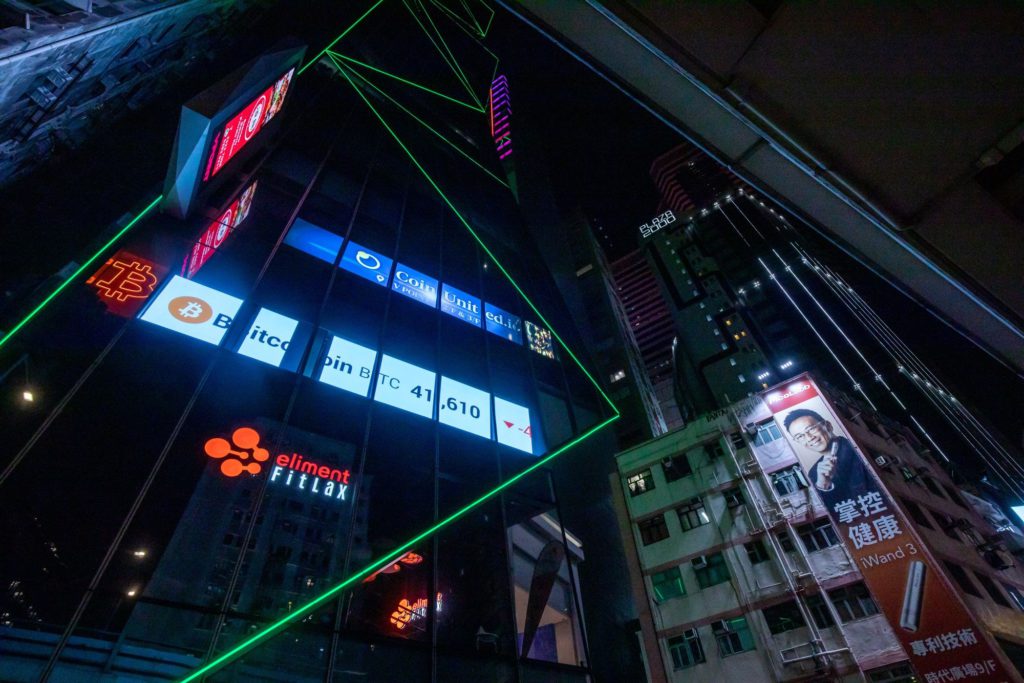
(Bloomberg) — Hong Kong wants to become an international center for virtual assets as the city seeks to bolster its status as a global financial hub following the disruptions caused by the pandemic.

The government will announce its framework for developing virtual assets, such as cryptocurrencies and non-fungible tokens, during Hong Kong’s Fintech Week from Oct. 31 to Nov. 4, Financial Secretary Paul Chan said in a blog post on Sunday. The policies will include a regulatory system and trial programs for the assets, Chan said. 

Fintech Week has attracted participants from more than 500 organizations and over 200 speakers from China and abroad, Chan said. 

Hong Kong has lost its crown as Asia’s top financial center to long-time rival Singapore, after years of political turmoil and Covid-19 restrictions caused the economy to slow and talent to flee. The city last month scrapped its hotel quarantine requirements for visitors arriving via the airport, and is considering a package of policies including easing property taxes and visa restrictions to attract workers from mainland China and overseas. 

More stories like this are available on bloomberg.com

©2022 Bloomberg L.P.

South Korea Orders Support for Outage-Hit Messenger App, Portal

(Bloomberg) — South Korean President Yoon Suk Yeol ordered the government to support the recovery of full operations at the nation’s biggest mobile messenger and the top portal website after a power outage disrupted some services for hours.

“I feel a very heavy heart for the inconvenience and damage experienced by people,” he said, according to a statement from his office. Yoon asked the science minister to personally oversee the recovery after an SK C&C data center housing Kakao Corp. and Naver Corp. servers was hit by a fire on Saturday.

Yoon also called for an investigation into the cause of the incident and for measures to prevent similar outages, the presidential office said.

The instruction by the president reflects the public outrage over the disruption to everything from communications to banking at the weekend. Services on Korea’s No. 1 messenger app, KakaoTalk, had been partially restored as of Sunday midday, while operations at affiliates such as KakaoBank, Kakao Mobility and Kakao Games remain limited.

Naver Corp., a rival tech giant that runs Korea’s biggest portal website, has also experienced disruptions in operations including news, blogging and shopping. Most are back online now, the company said Sunday on its website.

Both companies have apologized for the disruption, with Kakao’s co-chief executive officers saying the fire cut power supply to servers. Kakao said it had data backed up at sites across the nation but didn’t explain why it wasn’t able to get its emergency system running immediately after the fire.

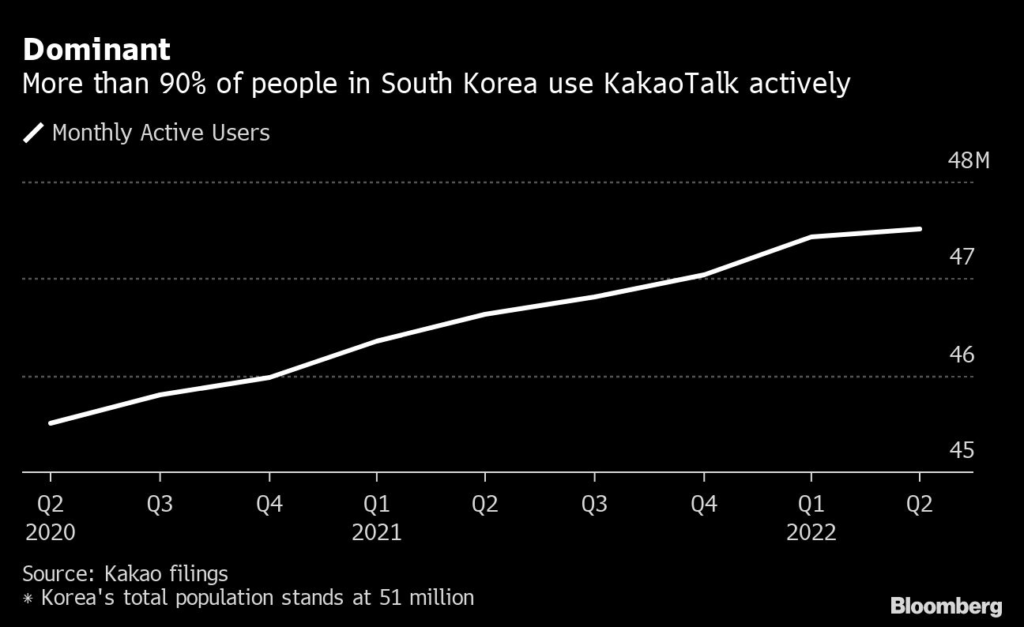
The disruption has sparked an angry reaction from the Korean public online, with one lawmaker saying he plans a probe into the incident. It also laid bare Korea’s deep reliance on a messenger app that has allowed Kakao to expand into internet banking, taxi hailing, mobile shopping, cryptocurrency trading and even character merchandise through its growing number of affiliates.

Similar to WeChat in China or Line in Japan, the app has seeped into almost every aspect of public life in Korea since being launched in 2010 by former Samsung SDS worker Brian Kim. Government adoption has boosted its usage, with Koreans allowed to pay bills and taxes on it. The central bank has also announced its interest-rate decisions via KakaoTalk since Covid outbreaks made public events difficult.


(Updates with statement from president from first paragraph.)

More stories like this are available on bloomberg.com

©2022 Bloomberg L.P.

Apple, Amazon Facing Emboldened Labor Movement After Key Inroads

(Bloomberg) — The labor movement is gaining momentum at big tech companies, with an Apple Inc. store voting to unionize Friday and unrest spreading through Amazon.com Inc. distribution sites in Southern California. Organizers say it’s just the beginning. 

Long seen as invulnerable to unions, Apple saw its staff in Oklahoma City vote overwhelmingly to join the Communications Workers of America, becoming the second store to unionize among the company’s roughly 270 US outlets. Amazon workers, meanwhile, walked off the job Friday in San Bernardino, California — the kind of workplace mobilization that used to be all but unheard of at the e-retailer, but became increasingly common during the pandemic.

Amazon faces an important test on Tuesday when the US National Labor Relations Board is scheduled to tally votes for an election at a warehouse near Albany, New York.

Labor activists are taking the fight to other tech giants as well. A CWA affiliate organizing at Google filed the latest in a series of NLRB complaints this month accusing the Alphabet Inc. unit of violating the rights of its subcontracted staff. But the unionization at Apple’s stores — with their gleaming designs and prominent locations — could become one of the most high-profile symbols of labor inroads in the tech world.

“For decades, the modern retail industry has been entirely immune to even the most tentative unionizing impulse,” said Nelson Lichtenstein, a labor historian at the University of California, Santa Barbara. “Now that is changing.”

Apple, the world’s most valuable company, has been increasing pay and adding new benefits in the face of the unionization efforts. In May, Apple boosted its national minimum retail wage to $22 an hour. Just this past week, the company announced a suite of new benefits, but told its unionized employees they wouldn’t be receiving the perks without negotiating first.

The CWA, which represents workers in industries ranging from media and tech to airlines and health care, alleged that Apple also held a slew of anti-union meetings in the run-up to the election. Management threatened staff, the CWA said in a complaint with the NLRB, and said that organizing would be futile.

But when the NLRB counted ballots Friday night, it wasn’t close: Fifty-six workers supported the union, with 32 voting against it. The CWA is now poised to negotiate on behalf of the staff, whose store is located in Oklahoma City’s upscale Penn Square Mall. The first Apple store to unionize was in Towson, Maryland, last June, and those workers helped advise the Oklahoma City location on how to handle the election.

In response to Friday’s vote, Apple said it believed that an “open, direct and collaborative relationship” with employees was the best way to serve customers and the workers themselves.

“We’re proud to provide our team members with strong compensation and exceptional benefits,” the Cupertino, California-based company said. “Since 2018, we’ve increased our starting rates in the US by 45% and we’ve made many significant enhancements to our industry-leading benefits, including new educational and family support programs.”

The company has made its opposition to unions clear. Apple warned against putting “another organization in the middle of our relationship” in a spring video message to employees. In that address, Senior Vice President Deirdre O’Brien described a union as “an organization that doesn’t have a deep understanding of Apple or our business, and most importantly, one that I do not believe shares our commitment to you.”

The CWA describes Apple’s response as intimidation, comparing it to moves by Starbucks Corp. and Amazon to push back on unionization. 

“Workers are seeing these tactics for what they are — desperate attempts to prevent them from having a real say in their working conditions,” CWA Secretary-Treasurer Sara Steffens said in a statement. “Money is no match for workers who are ready to claim their power.”

Apple retail workers will continue to organize across the country, she said, “especially after this momentous victory.” It’s not clear which Apple store could be next to attempt an election. A vote at a store in Atlanta was scrapped, with the union claiming that pressure from Apple prevented a fair election. Locations in New York City also could be key battlegrounds.

Wage Push

At Amazon, management is contending with union campaigns around the country. In recent days, workers at a warehouse in Moreno Valley, California — about 20 miles from the San Bernardino site — filed paperwork to join the upstart Amazon Labor Union.

Workers at a Staten Island warehouse in New York voted in April to join the union, but the company is seeking to overturn the results. The union lost a subsequent election at a smaller facility nearby.

Dozens of workers at the San Bernardino facility — an air hub — participated in the one-day strike Friday, demanding better working conditions and raises of $5 per hour. Carrying signs and chanting “living wages now,” they marched in front of the facility, which employs more than 1,500 people. Many of the workers at the site load and unload cargo planes.

Workers said they gave Amazon an Oct. 10 deadline to increase starting wages to about $22 per hour. Daniel Rivera, 28, who participated in the strike, said he received a $1 per hour raise in September that pushed his hourly earnings to $18.50.

“Even with the dollar raise, it’s not a livable wage for us,” he said. Amazon workers at facilities near Atlanta and Chicago staged similar protests earlier in the week demanding better pay.

Amazon said wages at its US facilities range from $16 to $26 an hour depending on position and location. Employee benefits include medical coverage and 401(k) retirement plans, the company said in a statement.

“While we are always listening and working on ways to improve the experience, we’re proud to offer compensation packages that not only include great pay, but also provide comprehensive benefits for regular full-time employees,” spokeswoman Mary Kate Paradis said Friday.

Tech companies aren’t the only ones facing an emboldened labor movement. At Starbucks, union activists turned an initial victory in Buffalo, New York, into hundreds of successful votes around the country — illustrating just how galvanizing a win can be. The labor movement also has scored victories at Trader Joe’s and Chipotle Mexican Grill Inc., other chains that had seemed off-limits before.

Those wins represent landmark events for the long-shrinking US labor movement, even if securing actual collective bargaining agreements may be months or years from happening.

Patrick Hart, a leader in the Apple campaign in Oklahoma City, said he’s now eager to advise other company stores on how to organize.

“I want this to become a labor movement,” he said. “We’re going to be that catalyst for people.”

More stories like this are available on bloomberg.com

©2022 Bloomberg L.P.

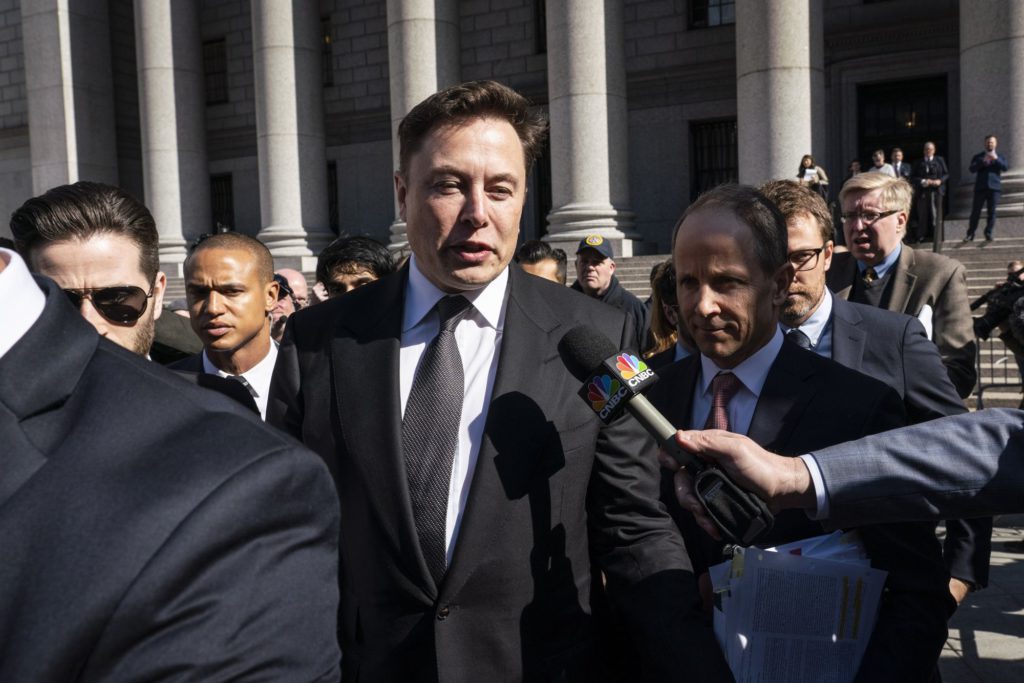
Elon Musk Backs Down From Demands for Starlink Funding

(Bloomberg) — Elon Musk said Space Exploration Technologies Corp. will continue to fund its Starlink broadband service in Ukraine in an apparent step back from seeking support from the US Defense Department.

The shift comes a day after Musk confirmed on Twitter that the closely held company had told the Pentagon it couldn’t indefinitely fund the system that’s helped Ukraine combat against Russia’s invasion. The Defense Department confirmed Friday it was in talks with SpaceX while pointedly adding that the US is looking at other options.

“The hell with it,” Musk tweeted Saturday. “Even though Starlink is still losing money & other companies are getting billions of taxpayer $, we’ll just keep funding Ukraine govt for free.”

Read more: Musk Tweets Complicate US Diplomacy From Ukraine to Taiwan

Withdrawing support of Starlink threatened a key means of communication used by Ukraine’s military forces in areas that don’t otherwise have cellular service. 

Ukraine has 20,000 Starlink terminals that have been provided evenly by USAID, Poland, the European Union and private companies, according to an Oct. 5 report from state-run news agency Ukrinform that cited Ministry of Digitalization data.

Poland purchased 11,700 Starlink terminals for Ukraine, including 5,000 acquired by state-controlled refiner PKN Orlen SA, according to Janusz Cieszynski, the government official in charge of cybersecurity.

Musk angered Ukrainians by suggesting last week that the country should seek a negotiated solution to the invasion by Russia that would include ceding Crimea — which was annexed by Moscow in 2014 — for good. He also tweeted a poll on whether citizens of recently annexed and occupied parts of eastern Ukraine and Crimea should decide if they want to live in Russia or Ukraine, days after Ukraine, Europe and the US denounced annexation moves by President Vladimir Putin.

Read more: Musk Sets Off Uproar in Ukraine by Tweeting His ‘Peace’ Plan

Earlier on Saturday, Musk stated that the amount SpaceX was requesting to give Ukraine a “major battlefield advantage” was less than the cost of one new GPS satellite.

To view the source of this information click here

(Updates with background on Musk angering Ukrainians in the seventh paragraph.)

More stories like this are available on bloomberg.com

©2022 Bloomberg L.P.

Ukraine Latest: Power Cuts Threaten Capital; Musk Shifts Course

(Bloomberg) —

Russian forces caused “serious damage” to an electrical installation near Kyiv on Saturday, grid operator Ukrenegro said, with emergency blackouts possible even after power was restored. 

Residents in the Kyiv area and in neighboring regions were urged to immediately cut their electricity use. “If we don’t follow this advice, we will have to take out the candles and suffer all the consequences,” said Kyrylo Tymoshenko, deputy head of Ukraine’s presidential administration.

Ukraine’s battlefield effort got a potential boost when Elon Musk said he’d keep providing SpaceX’s Starlink satellite-based internet service “for free.” South Korea’s central bank head called on China to persuade Russia to end the war.  

(See RSAN on the Bloomberg Terminal for the Russian Sanctions Dashboard.) 

Key Developments

  • Russia Failed to Swap Out Western Military Parts: 2021 Audit
  • Ukraine IT Sector Tested as Putin Bombs Civilian Infrastructure
  • Saudi Arabia Announces $400M in Aid to Ukraine
  • Putin Says Has No Regrets About Ukraine Invasion After Reverses
  • Musk Tweets Complicate US Diplomacy From Ukraine to Taiwan
  • Canada Wants ‘Arsonist’ Russia to Be Barred From IMF and G-20

On the Ground

Russian forces launched missiles at the Kyiv region again overnight, with damage reported to energy systems. Kamikaze drone attacks also took place in the Dnipro regions and Zaporizhzhia regions. Ukraine’s military estimates Russian still has about 300 Iranian-made drones with plans “to buy several thousand more.” A large number of wounded people are being admitted to medical facilities in the regions annexed by Russia last month after a vote called illegal by the UN. Several people were wounded by Russian shelling in the Nikopol region in southern Ukraine that a regional administrator said were designed to cause “maximum damage to civilians.” 

(All times CET)

Musk Signals He’s Backing Off Starlink Threat (8:42 p.m.)

Elon Musk said Saturday he’d continue to fund Starlink satellites in Ukraine “for free” after a standoff with the US Defense Department over the cost of their deployment.

Musk threatened a day earlier to cut financial support for SpaceX’s satellite internet service in Ukraine, claiming that the operation had cost his company $80 million so far. The Pentagon said it was in talks with SpaceX, while saying the US is looking at other options. 

S. Korean Central Banker Calls on China’s Help to End War (5:30 p.m.)

Bank of Korea Governor Rhee Chang-yong urged Beijing to take on a more active role in trying to end the Russian war in Ukraine and calm the world’s geopolitical situation. 

“I really hope that China can play a very important role,” Rhee said in Washington on Saturday. “I really hope that my old friends in China can step up efforts to stop the Russian war.” 

If any country can talk to Russian President Vladimir Putin, it’s China, he said, adding that Beijing can be a “bridge between Russia and the West” and help its own relations with Washington in the process.  

More Ships Sail With Ukrainian Farm Products (5:25 p.m.)

Another seven vessels with a total of 101,000 tons of agriculture products left Ukraine’s Odesa-area ports on Saturday for destinations in Asia and Europe, Ukraine’s infrastructure ministry said on Facebook.

Since the safe-transit agreement was reached with Russia in late July, 7.5 million tns of grains and other farm products have departed on 341 ships, the ministry said. 

Fire at Oil Depot in Russia’s Belgorod (5 p.m.)

A major fire at an oil depot near the Russian city of Belgorod was caused by a second day of Ukrainian cross-border shelling, the region’s governor said. 

Social media posts showed black smoke billowing in the area. Belgorod is about 60 miles north of the Ukrainian border.  Ukraine hasn’t commented.   

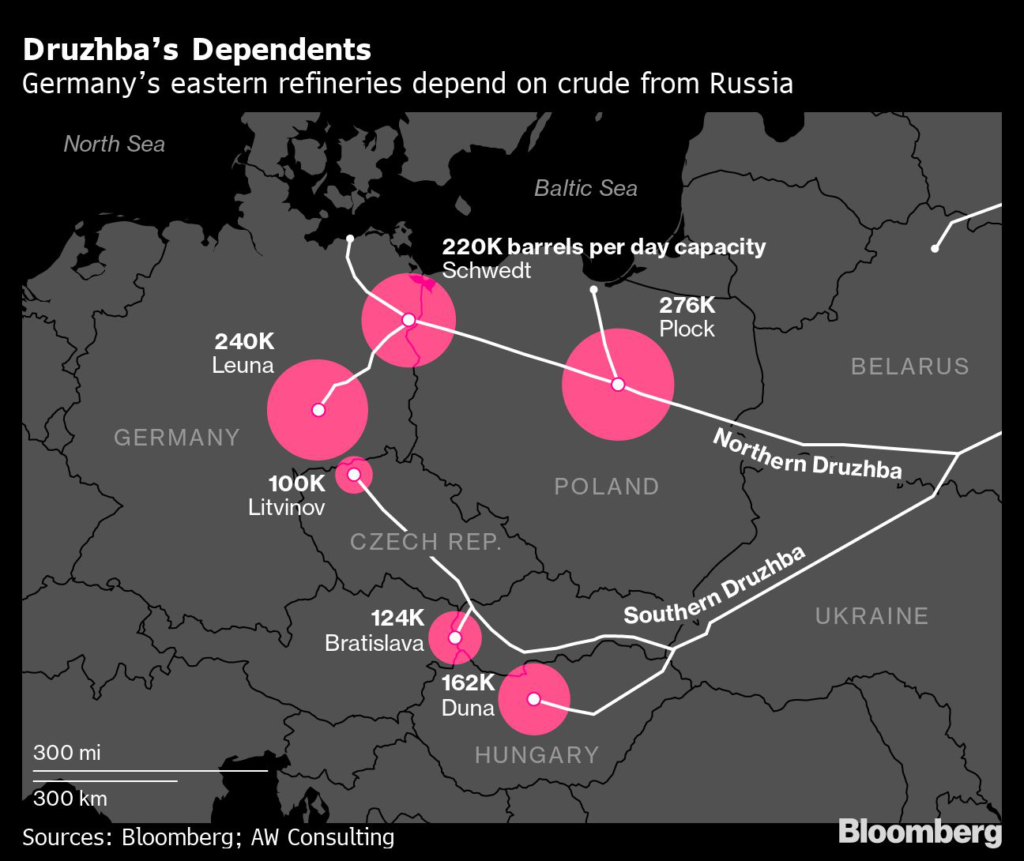
Poland Says Oil Flows Resume on Druzhba Pipeline (4:14 p.m.)

Oil flows via the northern leg of the Druzhba pipeline, which supplies, Germany and Poland with Russian crude oil, resumed in full on Saturday after an accident earlier in the week, according to Poland’s pipeline operator PERN. 

Poland early ruled out third-party involvement in the incident, at a time Europe is on high alert about potential sabotage to infrastructure. 

Ukraine Expects Red Cross Officials in East on Monday (1:57 p.m.)

Ukraine expects representatives of International Committee of the Red Cross to reach the “contact line” in the country’s east on Monday, Andriy Yermak, head of Ukraine’s Office of the President, said on a video call with new ICRC President Mirjana Spoljaric Egger.

Yermak urged Egger, who took up her post this month, to do everything possible to send the ICRC mission to the penal colony in Olenivka in the Donetsk region and to have access to prisoners of war. “This is my priority,” Egger said on the call, according to a post on the presidential website. 

In late July, more than 50 Ukrainian POWs were killed in shelling at the prison that Ukraine has blamed on Russia. Moscow has said Kyiv was responsible for the attack. 

First Russian Troops Arrive in Belarus for Joint Force (11:22 a.m.)

Russian forces have started arriving in Belarus to man the new joint force with troops there, the defense ministry in Minsk said on Saturday.

“The first convoys of Russian servicemen from the regional force group have arrived in Belarus,” the ministry said, saying their mission was to “strengthen the protection and defence of the border.” 

Belarusian President Alexander Lukashenko said Monday that he and Russia’s president had agreed to deploy a regional grouping of forces. Moscow launched its failed push toward Kyiv in February from Belarusian territory. Observers this week have cited the movement of Belarusian military equipment to Russia, potentially to shore up dwindling supplies. 

Grid Operator Reports Russian Strike on Kyiv Region (9:10 a.m.)

Russian forces struck “critical” energy infrastructure in the Kyiv region, causing “severe destruction,” the grid operator Ukrenergo said on Facebook. Repairs are under way. 

Ukrenegro warned of potential emergency shutdowns and asked consumers to use power sparingly. “Such measures give our specialists the opportunity to stabilize the situation as soon as possible and carry out the necessary restorative work,” it said.  

The strike comes after Russian President Vladimir Putin said on Friday that seven of 29 of sites targeted in a mass bombing of Ukraine earlier in the week “were not damaged as planned by the Defence Ministry,” and that “the attacks will be renewed.”  

Russian Reservists Buy Own Body Armor at Inflated Prices, UK Says (8 a.m.) 

Many newly-mobilized Russian reservists have been deployed to Ukraine this month with personal equipment “almost certainly lower than the already poor provision of previously deployed troops,” the UK defence ministry said. 

Many reservists are likely being required to buy their own body armor including 6B45 vests, which are currently selling online in Russia for 40,000 rubles ($640), up from about 12,000 rubles in April, the UK said on Twitter. 

Russian authorities in 2020 announced that 300,000 sets of the armor had been supplied to the Russian military, the UK said, suggesting much of the equipment has since gone astray. 

Canada Wants ‘Arsonist’ Russia Banned From IMF, G-20 (6 a.m.)

Canada is pushing for Russia to be shunned from the international community entirely over its invasion of Ukraine, now approaching the eight-month mark. 

Finance Minister and Deputy Prime Minister Chrystia Freeland didn’t hold back on her opposition to Russian officials being at the International Monetary Fund and World Bank meetings this week. 

“The IMF and World Bank meetings are meetings of the firefighters — of ministers and central bank governors, whose jobs is to protect the global economy,” Freeland, who’s of Ukrainian heritage, said Friday. “Russia right now is the arsonist. Russia shouldn’t have been at the IMF meetings. Arsonists have no place in meetings of the firefighters.”  

Russia Failed to End Reliance on Western Parts, Audit Shows (3:20 a.m.)

Even before sanctions cut off access to vital components and technologies for Putin’s defense industry, an internal Russian government review found years of attempts to reduce reliance on imports had largely failed.

Previously unreported assessments show a program with specific targets was put in place from 2019 to slash Russia’s dependence on Western parts for its arsenal by 2025 — everything from radar to advanced submarines to anti-missile defense systems. But an internal review of the plan 10 months before Putin invaded Ukraine found it was falling short on almost every metric.

Read more: Russia Failed to Swap Out Western Military Parts: 2021 Audit

Zelenskiy Speaks to Saudi Crown Prince (5 a.m.) 

Ukrainian President Ukrainian President Volodymyr Zelenskiy said he had spoken to Mohammed bin Salman, the crown prince of Saudi Arabia, and expressed gratitude for his support of “Ukraine’s territorial integrity.”  

Following Zelenskiy’s reference to “macro-financial aid,” the Saudi Press Agency reported that Riyadh will give $400 million in humanitarian aid to Ukraine.  

US to Give Another $725 Million in Security Aid (2:55 a.m.) 

The Biden administration on Friday announced $725 million in additional security aid for Ukraine. The package includes more ammunition for the HIMARS long-range artillery systems, which Ukraine has credited with helping its military counteroffensive in the east and south of the country by striking deep behind Russian lines.  

“In the wake of Russia’s brutal missile attacks on civilians across Ukraine, the mounting evidence of atrocities by Russia’s forces, and the firm and unequivocal rejection by 143 nations at the United Nations of Russia’s illegal attempted annexation of parts of Ukraine, the United States is offering additional military assistance to help Ukraine’s proud defenders protect their country,” Secretary of State Antony Blinken said in a statement.


More stories like this are available on bloomberg.com

©2022 Bloomberg L.P.

Musk Tweets Complicate US Diplomacy From Ukraine to Taiwan

(Bloomberg) — Elon Musk often wields his Twitter account as a weapon — threatening to back out of his deal to buy Twitter or insulting President Joe Biden as a damp sock puppet “in human form.”

More recently, the world’s richest person veered into more treacherous geopolitical territory by offering head-scratching proposals to end Russia’s invasion of Ukraine and settle questions about Taiwan’s sovereignty. His tweets and other public comments have angered presidents and foreign ministers across Europe and, awkwardly, won praise from America’s rivals.

Now Musk is escalating again, putting his money where his mouth is: On Friday, he threatened to cut financial support for SpaceX’s Starlink satellite Internet service in Ukraine, a move that would deny the country a key means of communication in the fight against Russian forces. He reversed course on Saturday, saying he supports doing “good deeds” and that the company will keep funding the satellites “for free.”

While Musk is hardly the first American business executive or celebrity to get tangled up in foreign policy, his wealth and penchant for mischief — not to mention his multibillion-dollar defense contracts — make him harder to ignore. 

It’s a phenomenon that will only become more pronounced if Musk’s $44 billion bid to buy Twitter Inc. outright goes through. Such a move would allow him to shape the debate in ways he hasn’t had the power to do — by controlling the platform directly.

Asked in an email about criticism that his comments touch on sensitive diplomatic and geopolitical matters, Musk answered: “When did Bloomberg News become worthless trash?”

American diplomats are well-aware of Musk’s controversial comments, a State Department official said, discussing the situation on condition of anonymity, and they make clear to allies and close partners that the high-profile executive’s comments are those of a private citizen and don’t reflect the Biden administration’s thinking. 

“Starlink and Twitter are both small in global terms but have outsize importance for key countries and constituencies,” said Jon​ Bateman, a senior fellow for technology and international affairs at the Carnegie Endowment for International Peace. “All this means that Musk’s pronouncements on international affairs, which have lately been naive at best, cannot simply be ignored.”

Whether or not he’s acting in any official capacity, there’s no question that Musk’s words carry weight.

With his high-level connections around the world and his vast economic influence, there have been lots of questions about his motives for getting involved, particularly after Eurasia Group president Ian Bremmer said in a widely disseminated newsletter that Russian President Vladimir Putin and the SpaceX founder had spoken. 

Musk later tweeted this claim was false, and that he hadn’t spoken to Putin in 18 months — and even then, that it was about space. Bremmer later doubled down, tweeting that Musk had “told me he had spoken with putin and the kremlin directly about ukraine.” 

“He also told me what the kremlin’s red lines were,” Bremmer said, suggesting that Russian officials, at least, may have seen him as some sort of a back channel.

“I’ll let Mr. Musk speak for his conversations,” White House National Security Council spokesman John Kirby replied when asked about a possible call between the billionaire and Putin. “Obviously, he’s not representing the United States government in those conversations.”

Celebrity Politics

Celebrities of all stripes have long waded into politics and foreign policy. Former basketball star Dennis Rodman partied in Pyongyang with North Korean leader Kim Jong Un. 

But Musk’s influence goes far beyond basketball infamy, with a sprawling digital reach fueled by his contrarianism and his vast wealth — a fortune of about $209 billion, according to the Bloomberg Billionaires Index. 

His company SpaceX has won Pentagon contracts for national security satellite launches, and his Tesla electric vehicle factory in Shanghai is the company’s biggest. Starlink has also been proposed as a way to help protesters in Iran — a notion Musk helped promote when he tweeted that SpaceX would seek an exemption to US sanctions to deploy there. 

And most significant of all, he’s pursuing his purchase of the social media site Twitter Inc. after threatening — on Twitter, of course — to back out in May.

“Billionaires often seek to influence public discourse on global affairs,” Bateman of the Carnegie Endowment said. “Elon Musk may be the only ultra-rich person, other than Donald Trump, who shapes conversations so directly through his personal cultural power.” 

Ukraine Feud

The latest back-and-forth over Starlink took on a threatening sheen after a previous Twitter spat he’d had with Ukraine. Last week, he’d tweeted a proposal that Ukraine cede territory that Russia claimed to have annexed in order to end the war. 

Finland’s former prime minister said Musk’s intervention made him Putin’s “useful idiot.” One Ukrainian diplomat, Andrij Melnyk, was more blunt, tweeting “F**k off is my very diplomatic reply to you @elonmusk.”

On Friday, Musk said on Twitter his company SpaceX couldn’t keep carrying the cost of Starlink in Ukraine indefinitely, adding that the operation had cost SpaceX $80 million so far. He later sent another tweet saying that Russia is “actively trying to kill Starlink” and that he has had to divert “massive resources” toward defending the service. 

When Musk was asked what was behind the warning over Starlink, Musk tweeted — in an apparent joke — that he was just following Melnyk’s recommendation. 

Underscoring Ukraine’s reluctance to get into a Twitter flame war with Musk, the country’s leaders blinked on Friday.

“Let’s be honest. Like it or not, @elonmusk helped us survive the most critical moments of war,” Mykhailo Podolyak, an adviser to President Volodymyr Zelenskiy, tweeted. Ukraine “will find a solution to keep Starlink working. We expect that the company will provide stable connection till the end of negotiations,” he wrote.

Musk backed off on Saturday, saying he’ll maintain free Starlink service for Ukraine, while complaining that “other companies are getting billions” in taxpayer dollars. He followed up with a tweet to a follower saying, “Even so, we should still do good deeds.”

Taiwan’s Future

Musk had also suggested, in comments to the Financial Times, that self-ruled Taiwan agree to become a special administrative zone of China, angering Taiwanese officials and leading the island’s defense minister to declare the military would no longer purchase any Tesla products.

Musk’s Tesla electric-vehicle company derives about 25% of its revenue from China.

His suggestion certainly cheered the Chinese ambassador to Washington, who praised Musk in a series of tweets, because they dovetailed with Beijing’s longstanding desire to “reunify” Taiwan with China.

“I would like to thank @elonmusk for his call for peace across the Taiwan Strait and his idea about establishing a special administrative zone for Taiwan,” Ambassador Qin Gang wrote. 

“Disentangling Musk’s economic interests from what he is saying is hard enough,” says Ivo Daalder, president of the Chicago Council on Global Affairs and a former US ambassador to NATO. “But the fact that basically he’s becoming a mouthpiece, at least in these two instances, of two governments whose behavior is diametrically against the interests of the United States is problematical.”

(Updates with new tweets about Starlink in third and 25th paragraphs.)

More stories like this are available on bloomberg.com

©2022 Bloomberg L.P.

Hacker Gets $50 Million in Heist of DeFi’s Mango

(Bloomberg) — The community of decentralized-finance application Mango DAO on Saturday got back a portion of about $100 million stolen this week after letting the hacker keep about $50 million of the funds.

The settlement wraps up several days of tense negotiations between the hacker and Mango, which is governed by its community of token holders who vote on any changes. Soon after the theft, the hacker posted a proposal in the app’s governance forum asking for bad debts on the platform to be erased — a deal that was not approved by the majority of Mango token holders even after the hacker voted for it with some of the stolen tokens. 

The Mango team then posted a counter proposal, offering to let the hacker keep around $50 million for the return of the rest of the funds while promising no criminal prosecution and to erase the bad debt.

“We just got notice of the funds being returned,” Maximilian Schneider of Mango said in a Discord message to Bloomberg on Saturday. Community members are expected to meet to discuss how to refund the returned $67 million to users, with votes on the plans taking place next week, according to Mango’s Twitter.

In a series of tweets Saturday, an individual took responsibility for the hack, saying he was “involved with a team that operated a highly profitable trading strategy last week” on Mango. 

“I believe all of our actions were legal open market actions, using the protocol as designed, even if the development team did not fully anticipate all the consequences of setting parameters the way they are,” according to the account who claims to be Avraham Eisenberg.  

When reached on Twitter, the user didn’t immediately provide evidence of his identity. Mango’s Schneider pointed to the Tweet as coming from the hacker, saying he disagreed that the actions were legal.

The payout is likely one of the biggest ever to a hacker. More than a year ago, PolyNetwork offered an attacker who drained $610 million from the platform a job and a bounty for returning the funds, which were eventually reimbursed. Bounties can run into millions — but they are typically offered to coders who point out vulnerabilities, not to hackers who steal funds.

“This is a clear failure of secure governance,” said Michael Lewellen, head of solutions architecture at crypto security provider OpenZeppelin. “If an attacker can steal enough tokens to vote themselves a reward, it sends a signal that DAOs can be hacked successfully using stolen tokens to avoid repercussions. This signals the need for better governance security that accounts for malicious token voters.”

In the Mango heist, two accounts funded with the stablecoin USD Coin took large positions in Mango perpetual futures, causing the price of the Mango token to spike. The price jump stoked an unrealized profit from the futures. The attacker used that to borrow and withdraw about $100 million, leaving depositors with nothing. 

The hacker stole more than 10% of all value locked on the Solana blockchain that Mango is based on, according to DeFi Llama. Just how much the hacker will profit from the hack is unclear, as the attacker invested millions into executing the attack.

Hacks in crypto are common, with at least $718 million stolen so far in October alone, taking the gross tally for the year past $3 billion and putting 2022 on course to be a record for the total value hacked, according to blockchain specialist Chainalysis Inc. 

(Updates with additional information in fourth and sixth paragraphs)

More stories like this are available on bloomberg.com

©2022 Bloomberg L.P.
Elon Musk Backs Down From Demands for US Funding for Starlink

(Bloomberg) — Elon Musk said he will continue to fund Starlink satellites in Ukraine “for free” after a recent standoff with the US Department of Defense over the cost of their deployment.

The shift comes a day after Musk threatened to cut financial support for SpaceX’s Starlink satellite internet service in Ukraine, claiming that the operation had cost his company $80 million so far. The Pentagon had responded by confirming it’s in talks with SpaceX, while adding that the US is looking at other options. 

Read more: Musk Tweets Complicate US Diplomacy From Ukraine to Taiwan

“The hell with it,” Musk tweeted Saturday. “Even though Starlink is still losing money & other companies are getting billions of taxpayer $, we’ll just keep funding Ukraine govt for free.”

He followed up with a later tweet to a follower saying, “Even so, we should still do good deeds.”

Withdrawing StarLink terminals would deny Ukraine a key means of communication in the fight against Russia’s invasion. As well as helping Ukraine’s forces on the ground, the terminals have supported infrastructure across the country. 

Earlier Musk stated that the amount SpaceX was requesting to give Ukraine a “major battlefield advantage” is less than the cost of one new GPS satellite.

To view the source of this information click here

More stories like this are available on bloomberg.com

©2022 Bloomberg L.P.
Apple’s Oklahoma City Store Is Second to Unionize After Vote

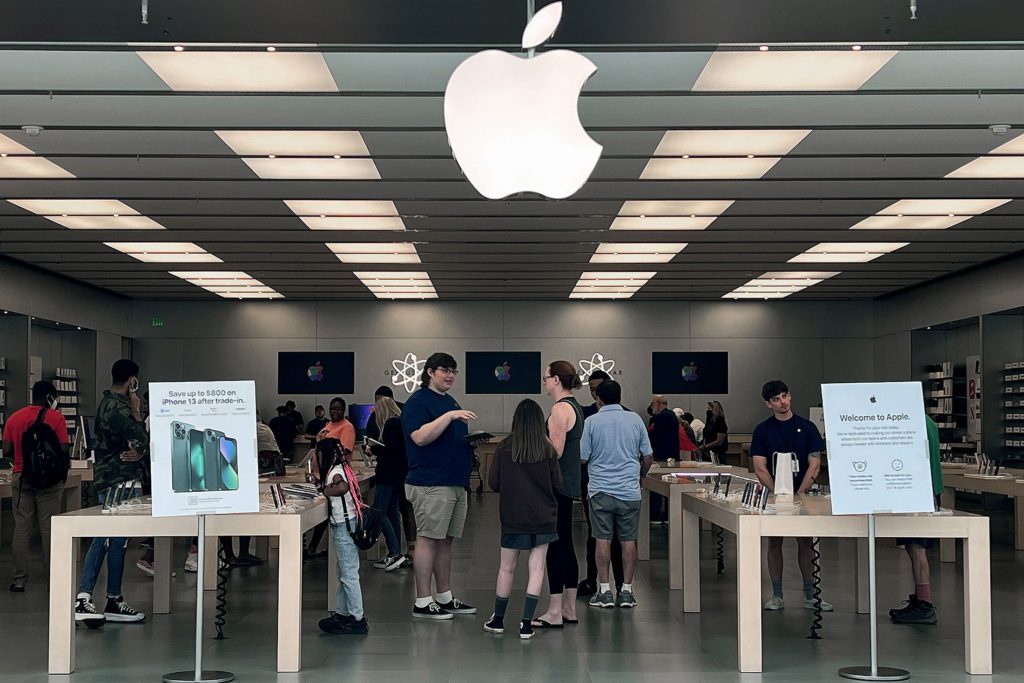
(Bloomberg) — Apple Inc. retail workers at a store in Oklahoma City have voted to unionize, expanding labor’s foothold at the world’s most valuable company and raising the prospect of further gains in other cities.

The US National Labor Relations Board counted ballots Friday night from an election held among employees at the store, located in the city’s upscale Penn Square Mall. The staff voted to join the Communications Workers of America, making theirs the second store to unionize among Apple’s roughly 270 US outlets. The vote was 56 in favor and 32 against.

The CWA’s win follows a June vote by staff at a Maryland store to join another labor group — the International Association of Machinists — marking one of several groundbreaking victories this year at previously union-free US companies.

Labor organizers have also made inroads at Amazon.com Inc., Trader Joe’s and Chipotle Mexican Grill Inc. — as well as Starbucks Corp., where the union’s swift spread from one initial victory in Buffalo, New York, to hundreds of successful votes around the country illustrated just how galvanizing a win can be.

In response to the Oklahoma City vote, Apple said it believed that an “open, direct and collaborative relationship” with employees was the best way to “provide an excellent experience for our customers and for our teams.” 

“We’re proud to provide our team members with strong compensation and exceptional benefits,” the company said. “Since 2018, we’ve increased our starting rates in the US by 45% and we’ve made many significant enhancements to our industry-leading benefits, including new educational and family support programs.”

As with the Machinists’ victory in Towson, Maryland, the Oklahoma vote could quickly embolden Apple workers who have been privately discussing organizing elsewhere. The fact that the effort prevailed in a deep-red state, whose unionization rate is only around half the US average, underscores the campaign’s potential to spread nationwide.

Patrick Hart, a leader in the Oklahoma City campaign, said he’s now eager to advise other Apple stores on how to organize.

“I want this to become a labor movement,” he said. “We’re going to be that catalyst for people.”

With two stores unionizing, Apple will have a tougher time maintaining the status quo, said Epstein Becker & Green attorney Steven Swirsky.

“If I lost one, it could concern me,” Swirsky, who advises companies on how to avoid unionization, said prior to the vote. “If you lose more than one, then it starts to become hard to explain away.”

The Oklahoma City win is a watershed moment for the CWA as it faces off against Apple and competes with the Machinists to organize the company. The group has said that it’s in touch with Apple store workers around the country and has filed unionization petitions at two locations so far: the Oklahoma site and one in Atlanta. In the latter case, the union withdrew its petition for an election the week before a scheduled vote, citing alleged misconduct by Apple.

At the Oklahoma City store — one of two Apple locations in the state — employees said they built an organizing committee of about 20 people and signed up 70% of the workforce over the course of five days before filing for this week’s vote.

The company has made its opposition to the union clear. Apple warned against putting “another organization in the middle of our relationship” in a spring video message to employees. In that address, Senior Vice President Deirdre O’Brien described a union as “an organization that doesn’t have a deep understanding of Apple or our business, and most importantly, one that I do not believe shares our commitment to you.”

The Cupertino, California-based company has also increased employee benefits and pay this year, potentially undercutting the union’s case. In May, Apple said it was hiking its national minimum retail wage to $22 an hour. Just this week, the company announced a suite of new benefits, but told its unionized store in Maryland that employees there wouldn’t be receiving the perks without negotiating first.

The CWA has filed claims with the NLRB accusing Apple of breaking the law in its efforts to stop the union, including through threats, interrogations, surveillance and mandatory anti-union meetings in Oklahoma.

Earlier this month, the agency’s general counsel issued a complaint against Apple in a New York City case, accusing the company of interrogating employees about their workplace activism and discriminating against union supporters by selectively enforcing a no-soliciting policy. Apple has said that it disagreed with those allegations. 

The CWA’s victory is no guarantee of an actual contract with Apple. Under US labor law, management is required to hold contract talks “in good faith” once workers vote to unionize, but there’s no obligation to make substantial concessions on the issues workers want addressed.

Securing a collective bargaining agreement tends to take more than a year after workers vote to unionize, and the process can drag on much longer — especially if a company is motivated to avoid encouraging further organizing efforts elsewhere.

Leaders of the Oklahoma City union campaign have said they hope to secure more transparency and input on issues like safety, scheduling and pay.

“We like our jobs,” Leigha Briscoe, a member of the store’s organizing committee, said in an interview last month. “And we know that it can be better. We know that it can be more equitable.”

(Updates with vote tally in second paragraph.)

More stories like this are available on bloomberg.com

©2022 Bloomberg L.P.
Close Bitnami banner
Bitnami