Bloomberg

Stocks Defy Rates Outlook as Risk Assets Rebound: Markets Wrap

(Bloomberg) — Equities in Asia extended the remarkable rebound that saw US stocks roar back from losses sparked by a hot inflation reading. The dollar fell against most of its peers.

An index of the region’s shares headed for the biggest gain in seven months, led by a surge of as much as 5% in Hong Kong-listed technology companies. Futures contracts for US and European shares also pushed higher in the face of consumer price data that cemented bets for the Federal Reserve to deliver another jumbo rate hike in November. 

The yen resumed its drop in Asia after falling to its lowest level in more than 30 years after US CPI, only to reverse the move in a whiplash trade. Treasuries fluctuated after the policy-sensitive two-year yield soared 17 basis points Thursday.

With higher interest rates piling pressure on an already struggling global economy, the latest moves underscore the difficulties traders face in volatile markets. Speculation the yearlong selloff in equities had reached a bottom was cited as one potential reason for the rebound. Others included short covering, less-than-terrible earnings reports and sturdy positioning including well-provisioned hedges.

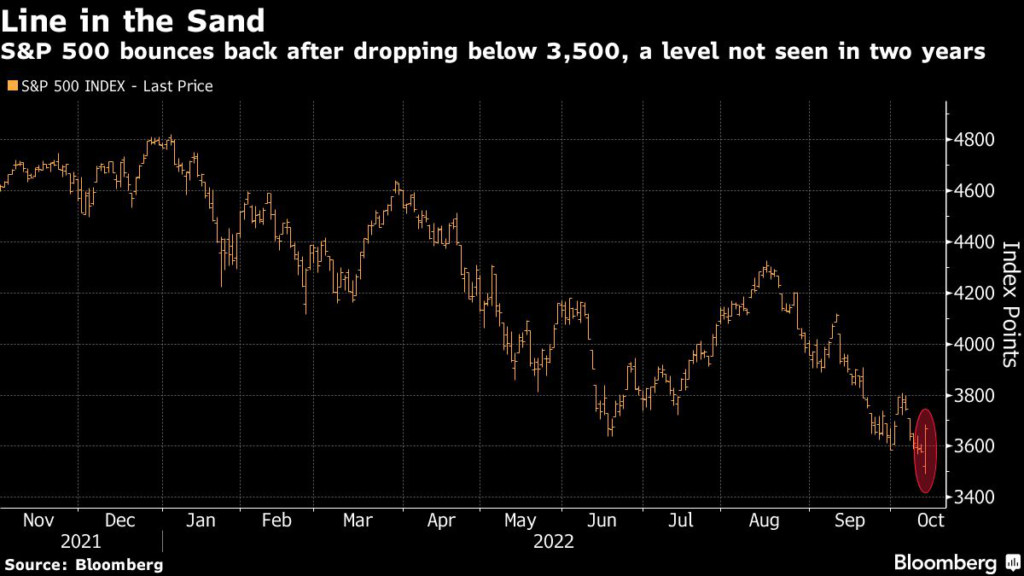
Technical levels factored into the bounce. At one point, the benchmark S&P 500 had given back 50% of its post-pandemic rally, triggering programmed buying. A wave of put options bought to protect against such a rout moved into the money, and as profits were booked, that prompted dealers to buy stocks to remain market neutral.

Cryptocurrencies also got a boost from the improved risk appetite in global markets, lifting Bitcoin to a one-week high and putting the largest token on the cusp of retaking the $20,000 level.

“I expect inflation to come down significantly on a year-over-year basis by the middle of next year,” David Chao, a global market strategist at Invesco, said by email. “Typically, that creates a nice backdrop for equities and credit but there will likely be more downside between now and then.”

Market bets on rates still lean toward back-to-back 75 basis-point hikes at the next two Fed meetings and expect the central bank to push rates past 4.85% before the tightening cycle ends.

Investors will have a chance to hear more from the Fed on Friday, with Esther George, Lisa Cook and Christopher Waller scheduled to speak later in the day.

Inflation figures in China proved relatively subdued, as a pickup in food prices countered the effects of lockdowns that are crimping economic activity. Traders were looking to China’s twice-a-decade Party Congress for policies to help revive its economy and markets.

One of the biggest challenges for investors in Asia is the ongoing strength in the dollar, according to Isaac Poole, chief investment officer at Oreana Financial Services. “Inflation print makes it more likely the global reserve remains elevated in the near term,” he said. “It is not time to be adding lots of risk, but also not time to be dialing risk back massively.”

The pound steadied on Friday in Asian trade as investors girded for more turmoil in UK markets, with Bank of England’s emergency bond buying entering its last day. 

Elsewhere, both oil and gold headed for weekly losses as signs of a global economic slowdown and tighter monetary policy threaten to sap energy consumption. The International Energy Agency earlier warned production cuts agreed by OPEC+ risked causing oil prices to spike and tipping the global economy into recession. 

Key events this week:

  • Earnings on Friday: JPMorgan Chase & Co., Citigroup Inc., Morgan Stanley, UnitedHealth Group Inc., U.S. Bancorp, Wells Fargo & Co.
  • US retail sales, business inventories, University of Michigan consumer sentiment, Friday
  • BOE emergency bond buying is set to end, Friday

Some of the main moves in markets:

Stocks

  • S&P 500 futures rose 0.5% as of 7:22 a.m. London time. The S&P 500 rose 2.6% Thursday
  • Nasdaq 100 futures rose 0.5%. The Nasdaq 100 rose 2.3%
  • Japan’s Topix index surged 2.4%
  • South Korea’s Kospi index rose 2.3%
  • Hong Kong’s Hang Seng Index gained 2.5%
  • China’s Shanghai Composite Index was up 1.9%
  • Australia’s S&P/ASX 200 added 1.8%
  • Euro Stoxx 50 futures gained 1.6%

Currencies

  • The Bloomberg Dollar Spot Index was little changed
  • The euro rose 0.1% to $0.9787
  • The Japanese yen fell 0.2% to 147.48 per dollar
  • The offshore yuan was little changed at 7.1760 per dollar
  • The British pound was little changed at $1.1315

Bonds

  • The yield on 10-year Treasuries was at 3.93%
  • Australia’s 10-year yield was at 4.01%

Cryptocurrencies

  • Bitcoin rose 2.2% to $19,804.97
  • Ether rose 2.6% to $1,326.97

Commodities

  • West Texas Intermediate crude rose 0.3% to $89.42 a barrel
  • Spot gold rose 0.3% to $1,670.59 an ounce

More stories like this are available on bloomberg.com

©2022 Bloomberg L.P.

Kraken Poaches Gemini Executive in UK Crypto Shake-Up

(Bloomberg) — Crypto exchange Kraken hired a new managing director for its UK operations from one of its closest rivals.

Blair Halliday, previously UK managing director for the Winklevoss twins’ exchange Gemini, is taking over the same role at Kraken, according to a statement published Friday. Halliday will replace Curtis Ting, who has been appointed global senior managing director, covering multiple jurisdictions. 

Halliday, who had been with Gemini since 2020, will oversee Kraken’s “commercial, regulatory and political relationships in the UK,” as well as its 350-strong employee base, the statement said. He will be replaced at Gemini by Stephanie Ramezan, formerly the exchange’s director of business development, according to a spokesperson for the firm.

  • Read more: Crypto Shakeout Engulfs the C-Suite as CEOs Start Leaving (1)
  • Listen: What’s Driving Crypto’s C-Suite ‘Great Resignation’? (Podcast)

The changes add to a growing list of top crypto executives who have exited or shifted their roles, marking a changing of the guard as crypto weathers a downturn in prices and demand. Kraken’s CEO Jesse Powell stepped away from his position last month, and is now serving as the exchange’s executive chairman.

More stories like this are available on bloomberg.com

©2022 Bloomberg L.P.

Big Tech Firms Hid Lobbying Efforts, European Parliament Says

(Bloomberg) — Meta Platforms Inc., Amazon.com Inc. and Alphabet Inc.’s Google funded an outside lobbying group to sway lawmakers on a major European tech law, but failed to disclose the connections, according to complaints filed by members of the European Parliament. 

In the complaints, three members of parliament said the big tech companies broke transparency rules for lobbyists and failed to list their members correctly, according to documents seen by Bloomberg and filed to the EU’s Transparency Register on Thursday.

The lawmakers are asking the transparency register to revoke the companies’ access to lobbying EU institutions if they’re found to violate the rules. 

The tech companies are accused of lobbying under the guise of a group that said it represents small and medium-sized businesses to try to influence the Digital Markets Act and Digital Services Act. The acts take aim at so-called gatekeepers, preventing them from giving preference to their own services and requiring the largest platforms to make messaging services interoperable. 

Read more: Big Tech Shadow Lobbying Campaigns Under Fire in EU Parliament

Lawmakers wrote they were unaware that messages from a group called the Connected Commerce Council during the run up to the DMA and DSA votes came from the likes of Google, Amazon and Meta.

“After the votes on both laws we learned the funding and source of these messages comes from a different angle,” they wrote.

In a statement, Amazon denied working with the Connected Commerce Council on European issues, though it has partnered with the group in the US. “In the EU, Amazon has not asked the Connected Commerce Council to lobby on the DMA, DSA or any other European legislation,” the company said.

Google, meanwhile, said its work with the council “is clearly and transparently listed on our declaration.”

“We are committed to transparent engagement and declare our sponsorship and partnerships with various organizations in a comprehensive list on the register’s website,” Google said.

Meta and the Connected Commerce Council didn’t immediately respond to requests for comment on the news, which was first reported by Politico.

More stories like this are available on bloomberg.com

©2022 Bloomberg L.P.

Texas Pension With $184 Billion to Halve China Stock Allocation

(Bloomberg) — The manager of a $184 billion public pension fund for Texas public education employees is halving its target allocation to Chinese stocks, potentially cutting billions of dollars of such holdings over months.

Teacher Retirement System of Texas is switching to a new tailored emerging markets stock benchmark to reduce China’s “outsized weight” in the MSCI Emerging Markets Index it once relied upon, according to a previously unreported proposal approved at a mid-September meeting. The move will effectively see China’s long-term target weight in its portfolio cut to about 1.5%, a size similar to or even smaller than Taiwan.

The new benchmark which took effect Sept. 19 is an equal mix of the MSCI emerging markets indexes with and without China, according to a document submitted to the meeting. The pension, also known as TRS, is committed to maintaining a “prudent” 9% target allocation to emerging markets stocks. 

The change was made to improve the diversification of the benchmark, Katy Hoffman, chief of staff of its investment management division, said in a video recording of the meeting posted on the pension’s website. There is a six-month transition period to adjust its current portfolio accordingly, intended to reduce negative price impact.

A year in the making, the change came at a time of heightened tensions between the US and China. An index of Chinese companies listed in Hong Kong is the third-worst performing primary global gauge tracked by Bloomberg this year, as they have come under the combined pressure of domestic regulatory reforms and tightening, geopolitical tensions and a pandemic-induced slowdown.

TRS is Texas’s largest public retirement system and among the top 25 in the world, according to its website. Trade journal Pensions & Investments ranked it the sixth-largest defined benefit pension plan in the US by 2021 assets. In an emailed response to Bloomberg News questions, TRS declined to say whether the China allocation change was driven by recent under-performance of the nation’s stocks or political considerations.

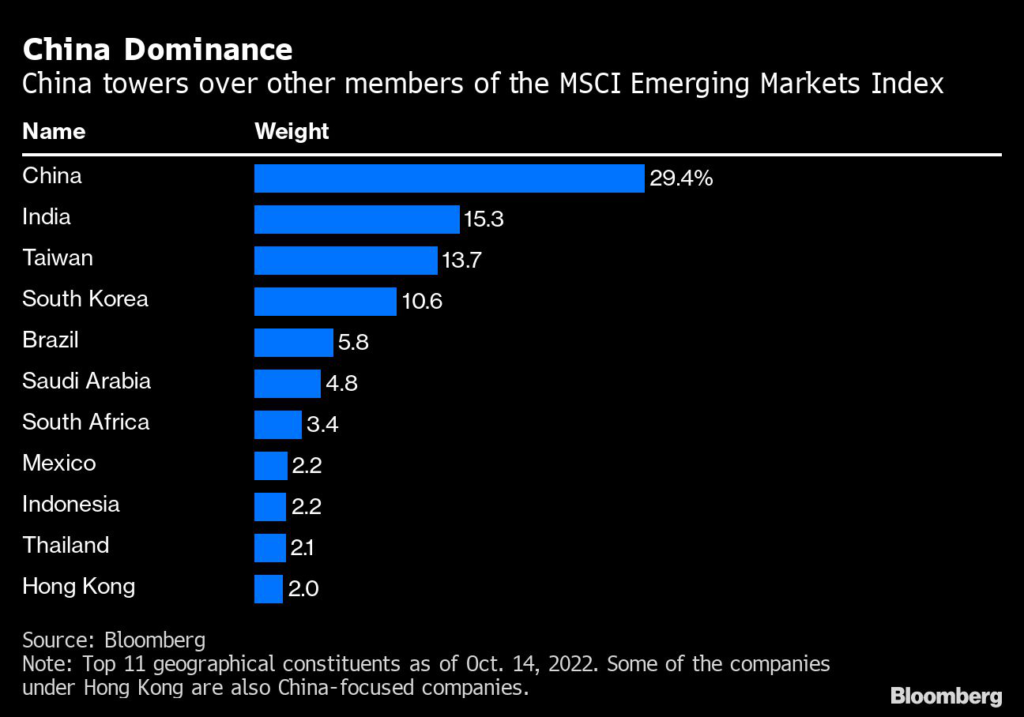
China had a 35.4% weight in the MSCI Emerging Markets Index, more than double the 14.5% for the next largest market: Taiwan, according to another document submitted to the TRS meeting. China’s weight would drop to 17.7% under the new benchmark, a touch below Taiwan’s 18.5%. 

TRS held nearly $14.8 billion worth of emerging markets stocks at the end of June, or 8% of the total market value of investments, according to a financial report. It doesn’t specify how much of that was parked in Chinese stocks. TRS makes such investments both directly with internal staff and through external managers, including passive funds, it said in the email.

Shelved Plans

In 2019, TRS revealed a plan to open a Singapore office, seeking to join the small rank of North American retirement systems with a regional presence to boost Asia investments. It has shelved the plan for the moment, the email said.

TRS allows its emerging markets investments to vary between 4% to 14% of assets, with a long-term target of 9%. While such short-term “tactical” flexibility exists, the latest change was made as a strategic asset allocation shift, with long-lasting impact. Institutional investors use strategic allocation targets to guide long-term investments, regardless of short-term market volatility. Actual allocations may temporarily over- or under-shoot the targets, because of the availability of investment opportunities and assets price moves. 

China and the US have ratcheted up their spat over a widening range of issues, including technology, accounting disclosure of US-listed Chinese companies, political freedom in Hong Kong and the future of Taiwan. The US has sanctioned Chinese officials over the treatment of Uighurs in Xinjiang, and curbed the Asian country’s access to semiconductor technology. The Trump Administration in 2019 weighed ways to limit US investors’ portfolio flows into China. Among the options was restricting Americans’ exposure to the Chinese market through public pension funds.

China’s weight in the MSCI Emerging Markets Index has since dropped to 29%. The gauge has tumbled 31% this year.

More stories like this are available on bloomberg.com

©2022 Bloomberg L.P.

Asian Stocks Climb After CPI, Dollar Extends Loss: Markets Wrap

(Bloomberg) — Asian equities and US stock futures advanced in the wake of a shock rebound in US stocks that roared back from losses sparked by a hot inflation reading. That triggered a broader risk rally that also saw currencies gain against the greenback.

An index of the region’s equities extended gains and was poised to snap a five-day losing streak. The S&P 500 defied expectations to rally 2.6% after consumer price data cemented bets for the Federal Reserve to deliver another jumbo rate hike in November. 

Currencies in the G-10 strengthened against the US dollar, but the yen remained on the back foot after falling to its lowest level in more than 30 years after the US CPI data release, only to reverse the move in a whiplash trade that raised chatter of potential intervention. 

Treasuries fluctuated after the policy-sensitive two-year yield soared 17 basis points Thursday. The 10-year yield was slightly down, trading at about 3.92% in Asian hours.

Cryptocurrencies also got a boost from the improved risk appetite in global markets, lifting Bitcoin to a one-week high and putting the largest token on the cusp of retaking the $20,000 level.

With higher interest rates piling pressure on an already struggling global economy, the surge on Wall Street underscores the difficulties traders face in volatile markets. Speculation the yearlong selloff in equities had reached a bottom was cited as one potential reason for the rebound. Others included short covering, less-than-terrible earnings reports and sturdy positioning including well-provisioned hedges.

Big Hedges, 50% Charts, Decent Earnings: Behind the Stock Bounce

Technical levels factored into the bounce. At one point, the benchmark S&P 500 had given back 50% of its post-pandemic rally, triggering programmed buying. A wave of put options bought to protect against such a rout moved into the money, and as profits were booked, that prompted dealers to buy stocks to remain market neutral.

Market bets on rates still lean toward back-to-back 75 basis-point hikes at the next two Fed meetings and expect the central bank to push rates past 4.85% before the tightening cycle ends.

Meanwhile, the two-year Treasury note’s yield jump to 4.48% before the US inflation data was out implied rate hikes of 75 basis points at the November FOMC meeting and 50 basis points in December, a Yardeni Research team wrote in a note. “Perhaps the market is starting to discount the notion that the Fed is getting closer to its terminal rate.”

One of the biggest challenges for investors in Asia is the ongoing strength in the dollar, according to Isaac Poole, chief investment officer at Oreana Financial Services. “Inflation print makes it more likely the global reserve remains elevated in the near term,” he said. “It is not time to be adding lots of risk, but also not time to be dialing risk back massively.”

Inflation figures in China proved relatively subdued, as a pickup in food prices countered the effects of lockdowns that are crimping economic activity. 

Singapore’s central bank tightened monetary policy settings, keeping up its fight against inflation amid a darkening global economic outlook. The Singapore dollar rose by the most in more than a week.

Meanwhile, UK markets remained in turmoil almost two weeks after the government unveiled a plan to drastically cut taxes. The pound posted its biggest gain since March 2020 on Thursday after the government signaled a U-turn on a central part of its tax agenda. The currency steadied on Friday.

Traders will have a chance to hear more from the Fed on Friday, with Esther George, Lisa Cook and Christopher Waller scheduled to speak later in the day.

Elsewhere, both oil and gold headed for a weekly loss as signs of a global economic slowdown and tighter monetary policy threaten to sap energy consumption. The International Energy Agency earlier warned production cuts agreed by OPEC+ risked causing oil prices to spike and tipping the global economy into recession. 

Key events this week:

  • Earnings on Friday: JPMorgan Chase & Co., Citigroup Inc., Morgan Stanley, UnitedHealth Group Inc., U.S. Bancorp, Wells Fargo & Co.
  • US retail sales, business inventories, University of Michigan consumer sentiment, Friday
  • BOE emergency bond buying is set to end, Friday

Some of the main moves in markets:

Stocks

  • S&P 500 futures rose 0.5% as of 11:51 a.m. Tokyo time. The S&P 500 rose 2.6% Thursday
  • Nasdaq 100 futures rose 0.5%. The Nasdaq 100 rose 2.3%
  • Japan’s Topix index surged 2.6%
  • South Korea’s Kospi index rose 2.5%
  • Hong Kong’s Hang Seng Index gained 3.1%
  • China’s Shanghai Composite Index was up 1.6%
  • Australia’s S&P/ASX 200 added 1.9%

Currencies

  • The Bloomberg Dollar Spot Index was down 0.1%
  • The euro rose 0.2% to $0.9792
  • The Japanese yen fell 0.1% to 147.32 per dollar
  • The offshore yuan was little changed at 7.1795 per dollar
  • The British pound strengthened 0.1% to $1.1331

Bonds

  • The yield on 10-year Treasuries fell two basis points to 3.92%
  • Australia’s 10-year yield declined two basis points to 3.99%

Cryptocurrencies

  • Bitcoin rose 2.3% to $19,826.04
  • Ether climbed 2.8% to $1,330.25

Commodities

  • West Texas Intermediate crude rose 0.2% to $89.32 a barrel
  • Spot gold was little changed at $1,667.97 an ounce

More stories like this are available on bloomberg.com

©2022 Bloomberg L.P.

Twitter Seeks Documents Related to Federal Investigation of Musk

(Bloomberg) — Twitter Inc.’s lawyers tried again last week to learn what Elon Musk had told federal authorities who were investigating his attempt to take the social media company private.

Attorneys for Twitter wrote to a Delaware judge on Oct. 6 saying they needed documents about the probes, according to a letter unsealed in court Thursday. Musk had by that point reversed himself on walking away from the $44 billion takeover, but he and the social media company were still adversaries in court — and their fight had not yet been officially put on hold. 

Read the letter from Twitter attorneys

Twitter officials had been pushing since July for their counterparts on the Musk side to turn over “all communications with any governmental authority concerning the merger.” The billionaire’s lawyers sought to limit their hand-over of files about contacts with the government, citing confidentiality rules around communications with attorneys. 

“This game of hide-the-ball must end,” Twitter’s lawyers said in the unsealed filing. “Twitter therefore seeks the court’s assistance in obtaining” the files about the Musk side’s contacts with government regulators.

The letter referenced communications between Musk and the US Securities and Exchange Commission and the Federal Trade Commission.

The SEC sent a query earlier this year to Musk over how he initially disclosed his major stake in Twitter.

Musk disclosed on April 4 that he had acquired more than 9% of Twitter, a week later than regulations allow and by using a filing typically reserved for passive investors. He later embarked on a highly public on-again-off-again takeover bid. 

Read More: Musk Faces FTC Antitrust Review on Twitter Alongside Stock Probe

The FTC was separately probing whether the 9% stake should have been disclosed, and also conducting an antitrust review of the proposed acquisition.

Alex Spiro, a lawyer for Musk, on Thursday called the letter a “misdirection by Twitter.”

“It’s actually Twitter’s executives that are under federal investigation,” he told Bloomberg News, without explaining further. 

Twitter denied Thursday that the company is under investigation by federal authorities.

Also unsealed was an Oct. 6 letter by Twitter lashing back at Musk’s Oct. 3 claim that the company had a whistle-blower burn notebooks documenting its alleged misdeeds as part of a $7.8 million severance package it gave him.

Twitter said in the letter it had no role in the “supposed conflagration,” saying that its former security chief apparently “took it upon himself to burn what he described as his ‘personal notebooks.’”

Delaware Chancery Judge Kathaleen St. J. McCormick set an Oct. 28 deadline for the two sides to agree on terms, canceling an Oct. 17 trial date, but said she was ready to hold a trial in November if they can’t close the deal.

The case is Twitter v. Musk, 22-0613, Delaware Chancery Court (Wilmington).


(Updates with background on dispute)

More stories like this are available on bloomberg.com

©2022 Bloomberg L.P.

Bitcoin Still Guzzles Power But Can Be Greener: Crypto IRL

(Bloomberg) — The CEO of one crypto mining company says Bitcoin’s staggering energy consumption is a feature, not a bug. And despite Ethereum’s recent shift from “proof-of-work” to “proof-of-stake,” which will greatly reduce the blockchain’s power consumption, there’s no plan for such a move coming for Bitcoin.

“There is no CEO of Bitcoin,” Zach Bradford, chief executive of publicly traded Bitcoin miner CleanSpark, told Katie Greifeld and me in the third episode of the Bloomberg QuickTake series “Crypto IRL.” “It’s fully decentralized, and really proof of work is really the only good way to truly secure a blockchain without an overseer.”

Digiconimist founder Alex De Vries, a researcher who studies the environmental impact of cryptocurrencies, is also featured in the episode. 

Watch “Crypto IRL” on Thursdays at 8:30 p.m. New York time on Bloomberg Quicktake, and Fridays at 8:30 p.m. on Bloomberg TV. And it’s always streaming at https://www.bloomberg.com/qt/series/crypto-irl.

More stories like this are available on bloomberg.com

©2022 Bloomberg L.P.

IMF Latest: Some EU Countries Seen Making Wrong Fiscal Choices

(Bloomberg) — The European Union’s Economic Affairs Commissioner Paolo Gentiloni cautioned that not all countries in the bloc are managing to avoid a clash between fiscal and monetary policies.

Speaking to Bloomberg Television on the sidelines of the International Monetary Fund meetings in Washington, Gentiloni said that while government support for households and firms is necessary, it must be temporary and targeted to avoid fueling inflation that central banks are trying to combat.

“I don’t’ think that all the measures taken are going exactly in this direction, so we have to make further efforts,” Gentiloni said. “If we give the impression to our citizens that we can support each and every activity, as it was the case during the lockdowns, I think we make the wrong choice.”

He said the EU cannot repeat the historic move it took during the pandemic, of issuing joint debt on a massive scale to invest in boosting and rebuilding their economies. But, he said some kind of common tool is needed to help manage bridge the gaps between countries afflicted by different inflationary pressures.

The IMF is holding its annual meetings this week, bringing global finance and central bank chiefs — along with their development and banking counterparts — to the US capital at a fragile moment for the global economy. Among the key events taking place Thursday is the Group of 20 forum of nations comprising the world’s largest economies. 

Even after the misery of this year — surging inflation, war in Ukraine, China’s slowdown — Bloomberg Economics expects next year could be even worse. The IMF on Tuesday cut its forecast for worldwide growth in 2023 and said that policies to tame high inflation may add risks to the global economy. Even President Joe Biden said this week that the US, the world’s biggest economy, could suffer a “very slight” recession.  

(All times Eastern) 

Rich Nations’ Rate Hikes Cause Collateral Damage (4:44 p.m.)

Emerging markets have become “collateral damage” in developed nations’ aggressive interest-rate hiking cycles, and a failure to consider and address the spillover effects will have costly spillback consequences, Kenya’s central bank chief said. 

“It is very very difficult for emerging markets — I don’t think there’s that appreciation,” Central Bank of Kenya Governor Patrick Njoroge said in an interview in Washington Thursday. “To be shut out of the capital markets because of actions of others” means “you’re actually collateral damage,” he said adding that this is “punishing those that are the innocent bystanders” 

Embattled Global Corporate-Tax Deal Wins Support (4:34 p.m.) 

The global corporate-tax agreement that’s become mired in implementation challenges since it was struck last year has received some much-needed support.

The European Union’s economy commissioner, Paolo Gentiloni, pledged on Thursday to “never give up” seeking to bring to life what he called a “historical agreement.” He spoke during a meeting with US Treasury Secretary Janet Yellen.

Indonesian Finance Minister Sri Mulyani Indrawati separately said the Group of 20, which her nation currently heads, remains committed to the deal. She said progress was “slightly delayed,” but added, “we also reaffirm our commitment to the implementation of the international tax package. This is very important.”

Almost 140 countries last year backed a plan to revamp the way multinational companies are taxed. But it hasn’t garnered necessary approvals from EU member countries — where unanimity is required — or from the US Congress. The delays have threatened to kill the agreement before it even comes into force.

Irish Finance Minister Paschal Donohoe, who runs the meetings of his counterparts in Europe’s common currency area, also said Thursday the EU shouldn’t wait for the US Congress to move forward in approving the deal before implementing a global minimum tax.

“What we need to do in Europe, as opposed to folks in other parts of the world, we need to play our part now and reach an agreement on the implementation,” Donohoe said in an interview with Bloomberg News. “We now are nearly there in reaching unanimity.”

Investors Urge More Support for Distressed Nations (4:13 p.m.)

Investors are calling on multilateral lenders to do more to support countries that are struggling to repay debts as global funding conditions dry up. 

How to help indebted countries regain access to credit markets was a common theme of discussion in panels at International Monetary Fund meetings in Washington Thursday.

“I’m just hoping there’s some leadership from Washington now, especially the multilaterals, in terms of acknowledging there’s a chock in many parts of the world which needs to be released,” said Hari Hariharan, the chief executive officer of New York-based hedge fund NWI Management. “But, we’ll see. I’m not very hopeful.”

Typically, an IMF loan helps restore market access for countries that have been shut out, according to Gorky Urquieta, a money manager at Neuberger Berman. That hasn’t been the case for some high-yielding nations working with the IMF this year. 

“That means that they’re going to have to do more, or they’re going to have to rely more on their domestic markets,” he said. 

IMF Cautions Latin America on Any Early Rate Cuts (3:14 p.m.)

Latin American central banks should beware not to cut interest rates too early as inflationary pressure will remain elevated for some time, according to a new International Monetary Fund report.

The average inflation rate in Latin America and the Caribbean will rise to 14.6% by the end of this year, slowing to 9.5% in 2023, the fund said, with most of the countries registering inflation rates above their central bank targets.

“Going forward, monetary policy should stay the course and not ease prematurely,” according to the report prepared by the IMF’s Western Hemisphere director Ilan Goldfajn, together with economists Santiago Acosta Ormaechea, Gustavo Adler, and Anna Ivanova. “Price pressures have recently broadened, affecting items of the consumption baskets beyond food and energy.”

European Commission’s McGuinness Says Russia Sanctions Here to Stay (14:45 p.m.)

Mairead McGuinness, the European Union’s commissioner for financial services, said the bloc’s sanctions against Russia are “here to stay.” There is no appetite for appeasement of Vladimir Putin’s regime and “no going back,” she said, speaking at the Institute of International Finance’s annual meeting on Thursday.

The commissioner also said the EU’s regulation of crypto assets was being broadly welcomed by participants who valued the clarity offered by a legal framework. She said a move to digital central bank currencies was inevitable.

G-20 Warns of Rising Risks, Calls for Coordinated Responses (2:36 p.m.)

The Group of 20 finance chiefs warned that risks to the global economy will likely continue into next year and called for coordinated responses from policymakers.

“The world is in a dangerous condition,” Finance Minister Sri Mulyani Indrawati of Indonesia, the current G-20 host nation, told reporters in Washington on Thursday, summing up discussions following a meeting of finance ministers and central bankers. 

“We are now facing increasing and compounding risk, high inflation rate growth, energy and food insecurity or crisis, climate risk and geopolitical fragmentation,” she said. She also warned of an increasing risk of recession.

Policymakers in the world’s largest economies need to be “very mindful about the potential spillover effects for other countries,” Indrawati said. 

Dimon Says ‘Soft Landing’ Is Unlikely for US Economy (2:34 p.m.)

JPMorgan Chase & Co. Chief Executive Officer Jamie Dimon said the Federal Reserve is unlikely to engineer a “soft landing” for the US economy as it raises interest rates to choke off inflation.

Central bank policy makers probably can’t cool the red-hot economy without bringing on a recession, Dimon at an industry conference in Washington Thursday. He also said his “gut” tells him that the Fed’s benchmark rate will probably have to rise higher than the 4% to 4.5% level many economists are predicting, as inflation persists.

The Wall Street chief still said he has “total faith and trust” in Fed Chair Jay Powell, and that stagflation would be far worse than most of the other potential outcomes as the Fed works to cool price pressures. 

Georgieva Welcomes Reports of U-turn on UK Tax Plan (1:10 p.m.) 

International Monetary Fund Managing Director Kristalina Georgieva welcomed reports that the UK is preparing to abandon a central part of its tax-cutting agenda in an attempt to stabilize markets.

UK Treasury and 10 Downing Street officials are drafting options for Prime Minister Liz Truss, but no final decision has been taken, Bloomberg reported. Truss could scrap her pledge to keep corporation tax unchanged next year, and instead raise it as previously planned, the Sun said.

“It is correct to be led by evidence, and if the evidence is that there has to be a recalibration it is right for governments to do so,” Georgieva said at the IMF’s annual meeting in Washington Thursday.

Georgieva met UK Chancellor Kwasi Kwarteng and Bank of England Governor Andrew Bailey Wednesday. “I had a very constructive meeting,” she said. “We discussed the importance of policy coherence and communicating clearly,” Georgieva said, adding “so in this jittery environment, there could be no reasons for more jitter.”

Yellen Seeks More G-20 Debt Rework as Distress Rises (12:38 p.m.)

Treasury Secretary Janet Yellen said the Group of 20 should expand its plan to help vulnerable nations restructure their debt amid a “sharp rise in risks of debt distress among developing and emerging-market economies.” 

“I am concerned by the slow progress in resolving the first cases under the Common Framework,” she said in a joint statement with the International Monetary and Financial Committee, the main steering panel of the IMF’s member countries. The framework is the G-20 initiative that brings the Paris Club of traditional rich debtor countries together with China to try to restructure the debts of low-income countries on a case-by-case basis. 

Three nations have signed up, and none have reached resolution. Yellen asked creditors to conclude debt treatments for Chad and Zambia by year-end, and expand the framework to include middle-income countries. 

Yellen repeated calls for an end of Russia’s war in Ukraine, which has shocked food, fertilizer and energy prices globally. She called for “collective action to address food insecurity by increasing the supply of food worldwide and committing to its free movement across the globe.” 

Calling for broad reform of the World Bank, she said the lender should more effectively deploy its convening and financing role to advance climate goals and integrate adaptation and resilience across all its lines of effort, while also making progress to align its operations to the Paris Agreement.

EU Seeks US Talks Over Biden Climate-Law Concerns (10:48 a.m.) 

The European Union is ready to engage in ad-hoc talks with the US to prevent its concerns over President Joe Biden’s stimulus package spiraling into a trade dispute, the bloc’s trade commissioner said. 

Speaking on the sidelines of the International Monetary Fund meetings in Washington, European Commission Vice President Valdis Dombrovskis said the EU is concerned that several provisions in the recently passed Inflation Reduction Act discriminate against European companies. Provisions related to tax credits for American-made electric vehicles are the thorniest issue, since many EU nations have set up subsidies and tax credits that have no requirements for local production. 

“Bilaterally, we may consider some kind of ad-hoc work stream given the urgency and major implications of this issue,” Dombrovskis said at a media briefing. “We hope to resolve these issues before they become disputes.”

ECB’s Nagel Pushes for Robust Interest-Rate Hike (10:14 a.m.)

The European Central Bank should enact another “robust” interest-rate increase at this month’s meeting to ensure price expectations don’t become unmoored, according to Governing Council member Joachim Nagel.

“Permanently higher inflation is the biggest growth decelerator and damper of prosperity,” Nagel said at a briefing in Washington that included German Finance Minister Christian Lindner.

He also said there’s “agreement” within the 25-member Governing Council that officials will next year tackle the issue of shrinking the trillions of euros of bonds the ECB accumulated during recent crises. 

US Has to Focus on Curbing Inflation, Georgieva Says (9:35 a.m.)

The US central bank has to pursue its mandate of controlling inflation because not doing so would have spillover effects for the rest of the world, International Monetary Fund Managing Director Kristalina Georgieva said. 

Both Treasury Secretary Janet Yellen and Federal Reserve Bank Chair Jerome Powell are mindful of the impact their policies may have on other nations’ economies, Georgieva told reporters in Washington Thursday. 

“Think of the the scenario in which inflation in the United States doesn’t get under control for a long period of time — bad for the US, but it also has spillover impacts for the rest of the world,” she said. Her comments came just as the US Labor Department released data showing the core consumer price index for September rose by more than forecast to a 40-year high of 6.6%. That pressures the Fed to keep raising interest rates aggressively.

The IMF is endorsing a strong focus on price pressures because the risk of higher inflation expectations becoming de-anchored has become more visible, Georgieva said. 

“We cannot possibly allow inflation to become a runaway train — it’s bad for growth and bad for people,” she said. “Bad especially for poor people.” 


Cutting Poor Nations’ Debt Under Discussion, World Bank Says (8:44 a.m.)

With debt for a growing number of countries becoming unsustainable, policymakers meeting in Washington this week are talking about finding ways to reduce those debt burdens, World Bank President David Malpass said. 

Arranging help for low-income nations in debt distress through the institutions such as the International Monetary Fund “means that you’re under the gun,” Malpass said in an interview with Tom Keene on Bloomberg Television Thursday. “A better way to do it is to find a way to get to actual debt reduction so that you can you have light at the end of the tunnel, get out from under the debt,” he said, adding that this is “under discussion.”


More stories like this are available on bloomberg.com

©2022 Bloomberg L.P.

Europe Is Likely to Avoid Unusually Cold Winter, Climate Model Says

(Bloomberg) — Europeans and people living on the US East Coast are more likely to experience mild temperatures than a deep freeze this winter, easing any potential heating-fuel constraints at a time when energy costs are soaring.

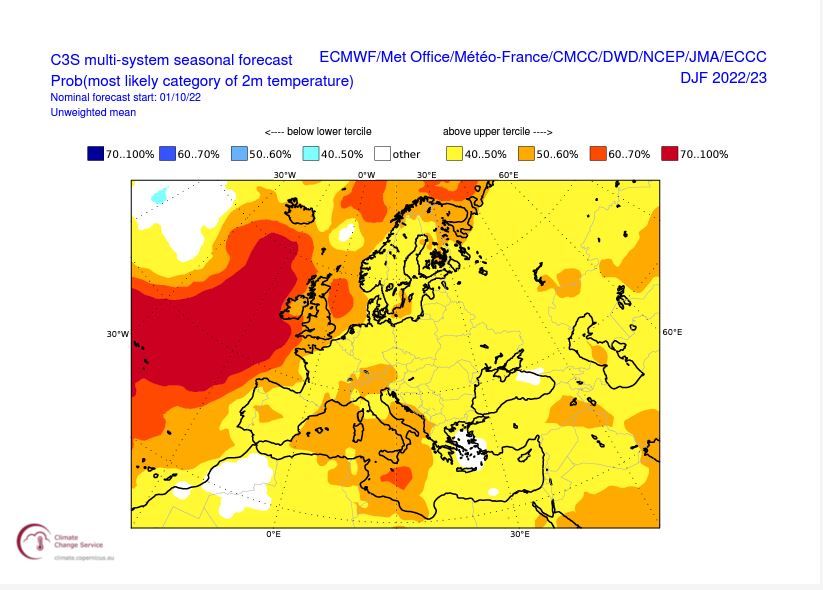
Scientists at the Copernicus Climate Change Service, which updated its seasonal outlook Thursday, said temperatures probably will be significantly above normal during the peak heating season between December and February.

Abnormally high temperatures could slacken demand for natural gas, which European countries have been rushing to put into storage. Russia’s war on Ukraine propelled prices for the fuel to record heights, contributing to a cost-of-living crisis across the region.  

The scientists said there’s a 50%-60% probability that the UK, much of the Mediterranean coast and parts of central Europe will see well-above-average temperatures. The rest of the continent has a 40%-50% chance of significantly exceeding historical averages. 

The Copernicus model brings together data from scientists in the UK, France, Germany, Italy and the US. The European Union program uses billions of measurements from satellites, ships, aircraft and weather stations for its monthly and seasonal forecasts.

Yet the outlook for a mild winter isn’t universal among meteorologists. Commercial US forecaster Commodity Weather Group holds that Europe’s winter likely will be colder than last year and slightly cooler than the 10-year average, as measured by heating degree days.

That’s a way to use temperatures to gauge energy demand, with higher numbers reflecting more cold and more fuel being burned for heating.

Commodity Weather calculates a value of 2,330 this winter, compared with last year’s 2,085 and the 10-year average of 2,233, meteorologist William Henneberg said. Europe’s winter likely will be volatile, marked by shifting periods of cold and mild readings. 

“We certainly can’t rule out a big cold outbreak at some point in the winter, but the overall pattern may be driven more by weak cold fronts moving through frequently,” he said.

The continent is racing to find substitutes for ever-dwindling supplies of natural gas from Russia as the Kremlin’s weaponization of energy boosts consumer bills and shoves economies to the brink of recession.

Gas prices are more than four times higher than usual for the time of year. Germany warns of blackouts and rationing, and the UK has the smallest margin of backup power supplies in seven years.

A colder winter will reduce Europe’s chances of getting through this heating season “relatively unscathed,” said Katja Yafimava, senior research fellow at the Oxford Institute for Energy Studies.

“Blackouts and industry closures could not be ruled out,” she said.

As winter unfolds across the Northern Hemisphere, meteorologists will be closely watching the Arctic. Circling the pole is a girdle of winds called the polar vortex, and if they should weaken, frigid air could come spilling south into the US, Asia or Europe. 

It’s difficult to predict when the vortex may break down, and Judah Cohen, director of seasonal forecasting at Atmospheric and Environmental Research, has spent years searching for hints.

One potential indicator is the amount of snow building up across Siberia in October, he said. If snowfall is strong, somewhere — Europe, North America or Asia — likely will get blasted with an Arctic wave.

Todd Crawford, director of meteorology at commercial forecaster Atmospheric G2, sees no evidence of a breakdown that could foster the type of killer cold that crippled the Texas electrical grid last year.

“At this time, there are no strong reasons to believe a notably weakened vortex is likely this winter,” Crawford said.

Another important piece will be high and low pressure over Greenland called the North Atlantic Oscillation. That’s “one of the main signals affecting Europe,” said Bradley Harvey, a meteorologist with commercial-forecaster Maxar.

Weather watchers should look for signs this is shifting to its negative phase because that means Europe and the eastern US may turn frigid. A positive phase can mean a milder winter.

Copernicus also predicted that temperatures across almost the entire continental US are expected to significantly surpass average, with certainty exceeding 70% in Texas and other parts of the south. The Tokyo and Beijing regions also are predicted to avoid excessive cold.

The chance of below-normal rain and snow across swathes of central Europe is greater than 40%, potentially affecting river flows and ski slopes.

In the US, northern states are projected to receive more precipitation than normal, with parts of Oregon and Washington registering a 60% probability of wet weather.

Rainfall will be influenced by the ongoing La Nina across the equatorial Pacific. The world is poised to have its third La Nina in a row, something that’s only happened twice since 1950. 

More stories like this are available on bloomberg.com

©2022 Bloomberg L.P.

UAW Chides Hyundai, Kia for Ties to Supplier in Child-Labor Case

(Bloomberg) — Hyundai Group is coming under fire from organized labor for using a supplier to their non-union US plants that allegedly hired underage workers.

The United Auto Workers’ union called out Hyundai Motor Co. and Kia Corp. on Thursday for the sister companies’ ties to an Alabama parts maker which the Department of Labor alleged earlier this week uses child labor. 

“Exploitation of children is shameful in any circumstance, but it is especially distressing to see it take place at a supplier to a major automotive company such as Hyundai,” UAW President Ray Curry said in a statement. 

The Department of Labor ordered SL Alabama LLC to cease production and shipment of components allegedly manufactured by children aged 13-15 years-old employed at its Alexander City, Alabama, parts facility, according to an Oct. 11 statement. The federal government fined SL Alabama LLC $30,076 and the Alabama Department of Labor levied a separate fine on the company and a temporary employment agency of $17,800 each for child labor violations. 

Hyundai said it will work to monitor operations of its suppliers and noted in an emailed statement SL Alabama has “changed its leadership and introduced additional screening methods to ensure its labor practices are consistent with local, state and federal law.” SL Alabama and Kia did not immediately respond to requests for comment. 

Hyundai had previously said in July that it was “unaware of any evidence” of child labor being used at another Alabama parts facility, after Reuters reported Smart Alabama LLC employed immigrant workers as young as 12. Smart Alabama has denied it knowingly employed anyone ineligible for employment. 

The South Korean automaking group’s factories in Alabama and Georgia are not unionized, drawing a rebuke from President Joe Biden who asked Hyundai’s Executive Chairman Euisun Chung to reconsider at a meeting in May.

More stories like this are available on bloomberg.com

©2022 Bloomberg L.P.

Close Bitnami banner
Bitnami