
Bloomberg

Ukraine Latest: Zelenskiy Demands Red Cross Mission to POW Camp

(Bloomberg) — Ukrainian President Volodymyr Zelenskiy said the Red Cross should have access to a prisoner of war camp, where at least 50 Ukrainians were killed in a July blast.  

President Recep Tayyip Erdogan met Thursday with Russia’s Vladimir Putin in Kazakhstan, where the pair discussed a potential Turkish gas hub. Before the meeting Erdogan said Ankara’s goal is to help stop the “bloodshed” in Ukraine, and that “a fair peace can be achieved through diplomacy.” More grain vessels sailed Thursday under the safe-transit deal that Turkey helped to broker. 

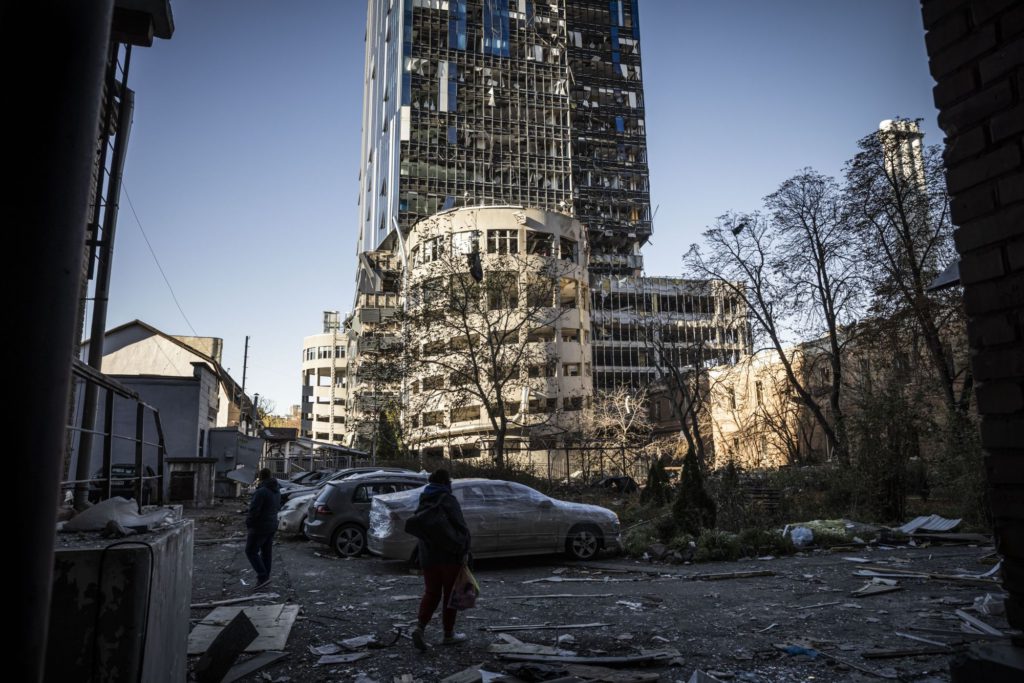
The Kyiv region — although not Ukraine’s capital itself — was struck by Iranian-made drones on Thursday morning as air raid sirens rang out across much of the country for a fourth morning. Air strikes continued in the south, including Mykolaiv, where a multi-story apartment building was destroyed. 

Ukraine’s allies gathered for a NATO defense ministers’ meeting in Brussels that’s expected to result in the offer of more air defense capabilities. The UK got things started by pledging Amraam rockets capable of shooting down cruise missiles.  

(See RSAN on the Bloomberg Terminal for the Russian Sanctions Dashboard.) 

Key Developments

  • Putin Says All Infrastructure at Risk After Nord Stream Hit
  •  Russia, NATO Both Holding Nuclear Drills Despite Rising Tensions
  • Russia Sends More Fuel to Army in Ukraine Amid Mobilization
  • US Officials Fret Over Russia Oil Cap Failing After OPEC Cut
  • NATO States Back German-led Anti-Missile Shield for Europe 

On the Ground

Russia launched missile and drone strikes on more than 40 settlements overnight, notably around Makariv in the Bucha district to the northwest of the capital. Other cities, including Mykolaiv, Vinnytsya and Cherkasy also sustained damage, Ukraine’s military said. On Thursday, Russia carried out one missile attack, 15 airstrikes and 22 shellings from multiple launch rocket systems, the Ukrainian General Staff said on Facebook. Five Russian Kalibr missiles were shot down by Ukraine’s air defenses, according to Facebook postings from Ukraine’s West and South commands. 

(All times CET) 

Zelenskiy Calls for Red Cross Mission to POW Camp (12:50 a.m.)

Zelenskiy said a Red Cross mission should have have access to Ukrainian prisoners of war held in Olenivka, in the occupied part of the Donetsk region. An explosion there killed at least 50 prisoners and wounded more in July, and Ukrainian intelligence described the episode as a provocation by Russian forces. 

Olenivka is “de facto a concentration camp, where Ukrainians are kept,” Zelenskiy said in his evening address. “There must be an access to them, as discussed. The Red Cross is able to provide it. But there must be attempts to provide it.”

Tech Giant Microsoft Channels Its Resources to Aid Ukraine (8:19 p.m.)

As US and NATO defense contractors work to speed up production lines to send weapons to Ukraine, Microsoft Corp. has provided more than $250 million in tech support to the country since Russia’s invasion, according to a senior company official.

That has included secure communications lines set up with Ukraine’s cyber officials “to rapidly respond to and defend against Russian malware attacks,” Wes Anderson, the vice president for Microsoft’s defense unit, said in an interview.

He said the software giant has completed more than 173 “emergency support missions that provided 23,000 person-hours of technical support” to other companies and nonprofits aiding Ukraine. He said Microsoft also has made as much as 43 million free hours of Skype time available to Ukraine residents and their families outside the country to get in touch.

Boxing Champ Klitschko Calls Putin’s Nuclear Threat a Bluff (7:29 p.m.)

Vitali Klitschko, the former world heavyweight boxing champion who’s now mayor of Kyiv, said Russian Putin’s threats to use nuclear arms in Ukraine were only a “big bluff.

“If Putin talks about nuclear weapon, it shows a weakness” because his “army isn’t successful in the east or south” of Ukraine, Klitschko told Bloomberg Television.

Putin has threatened to use “all weapons systems available to us” as Russia’s invasion of Ukraine faced growing setbacks against a military deploying powerful modern arms supplied by its US and European allies. 


Russia, NATO to Hold Nuclear Drills Despite Rising Tensions (6:49 p.m.)

Moscow and NATO are both proceeding with nuclear exercises, even as tensions escalate over Putin’s threats to use “all means available” — including atomic weapons — to defend land he claims to be Russian.

The drills come as Russia steps up its missile attacks on Ukraine, nearly eight months into its invasion and as its troops struggle to make headway on the ground. 

In Washington, John Kirby, spokesman for the National Security Council, told reporters that the annual NATO exercise to be conducted later in the fall was planned “even in advance of the Feb. 24 invasion of Ukraine by Russia” and will be held more than 600 miles (1,000 kilometers) from Russia. He said Russia’s planned exercise occurs every two years and is also “within the normal bounds of what Russia has done in the past.”

NATO Vigilant in Monitoring Any Change in Russia’s Nuclear Posture (6:00 p.m.)

The alliance will be especially vigilant when Russia starts an expected annual exercise of its nuclear forces, Jens Stoltenberg, its chief told reporters after a two-day meeting of NATO defense ministers in Brussels.

Asked how allies will be able to distinguish preparations for a nuclear exercise from preparations for an attack, Stoltenberg said “we have very good intelligence,” adding allies have monitored Russian nuclear forces for decades. “Of course we will remain vigilant, not least in light of the veiled nuclear threats and the dangerous nuclear rhetoric we have seen from the Russian side.” 

Russian Attacks Damaged 30% of Ukrainian Energy Infrastructure (5:10 p.m.)

Russian missiles and drones damaged energy capacity and facilities, including transmission stations and generating companies, in the attacks that started Monday and continued throughout the week, Ukraine’s Energy Minister Herman Halushchenko said on Bloomberg TV. 

“The main target, as we understand, was just to make it difficult for us to survive this winter,” Halushchenko said. 

He also said Ukrainian officials expect to meet IAEA Director General Rafael Mariano Grossi in Kyiv Thursday, just days after he held a similar meeting with Putin. Grossi will bring the Russian response to Ukrainian demands as he meets with officials from both countries.

Ukraine Sees Possible Russian Gas Transit Halt (5:07 p.m.)

That is one possible scenario after missile and drones attacks on Ukrainian energy infrastructure this week, Energy Minister Herman Halushchenko said on Bloomberg TV Thursday. “Today transit is going on, though it decreased dramatically,” Halushchenko said. “We consider the scenario when Russia stops the transit.”

Russia, Ukraine Agree on Another Prisoner Swap (4:05 p.m.)

Russia and Ukraine have struck another prisoner swap agreement involving more than 70 military personnel.

The Russian Defense Ministry said Thursday that 20 troops had been freed from Ukrainian captivity. The Ukrainian presidency on Thursday and earlier this week announced the liberation of a total of 52 soldiers by Russia.

The deal comes after the countries last month conducted a major exchange of captives. Ukraine turned over 55 prisoners, including pro-Russian tycoon Viktor Medvedchuk, while Russia handed over 215 soldiers, the majority of whom were involved in the defense of Ukraine’s Azovstal steel plant, and 10 foreigners.

Occupation Chief Says Residents Should Leave Kherson (2:20 p.m.)

The head of the Russian occupation administration in Ukraine’s Kherson region asked Kremlin authorities to help organize the departure of residents “because of the daily missile attacks by the Ukrainian military.”

Vladimir Saldo made the unusual appeal in an address on state television, less than two weeks after Putin signed annexation documents declaring Kherson and three other Ukrainian regions part of Russia “forever.” Russian forces don’t fully control any of the four regions and Ukraine’s military has been gradually advancing toward Kherson in recent weeks.

Russia Limits Heavy Traffic On Damaged Crimea Bridge (12:08 p.m.)

Russia has barred heavy freight trucks from using the damaged bridge linking it with the annexed Crimea peninsula, forcing them to travel by ferry or use a land detour via other occupied Ukrainian regions.

A queue of 900 trucks has built up waiting to cross the Kerch Strait by ferry, state TV reported. Vehicles traveling to Crimea through Ukrainian regions recently annexed by Russia, in a move condemned as illegal by the UN, have a security escort. 

Moscow blamed Ukrainian military intelligence for the Oct. 8 explosion on the 19-kilometer (12-mile) bridge across the Kerch Strait.

Zelenskiy Asks Cabinet to Consider Ending Visa-Free Regime With Belarus (11:40 a.m.) 

Zelenskiy asked Ukraine’s cabinet to consider the cancellation of Kyiv’s visa-free arrangement with Belarus, according to the statement on the President’s website. The move came after a public e-petition launched in July and supported by more than 25,000 people.

Zelenskiy said all checkpoints on Ukraine-Belarus border are closed, except one in Volyn, which is used for Ukrainian citizens returning back to the country from abroad.

Scholz Deplores Putin’s ‘Crusade’ (11:30 a.m.)

German Chancellor Olaf Scholz accused Russia’s president of waging a “crusade” against Europe and its liberal order of peace and prosperity, in some of his strongest comments about the almost 8-month invasion of Ukraine. 

“Vladimir Putin and his enablers made one thing very clear: This war is not only about Ukraine,” Scholz told a conference in Berlin. “They consider their war against Ukraine to be part of a larger crusade, a crusade against liberal democracy, a crusade against the rules-based international order.” 


More stories like this are available on bloomberg.com

©2022 Bloomberg L.P.

Meta Calls FTC Suit to Block VR Fitness Deal ‘Ill-Conceived’

(Bloomberg) — Meta Platforms Inc. urged a judge to reject the US Federal Trade Commission’s attempt to block the company’s acquisition of virtual reality app Within Unlimited, saying the agency’s claims about competition in the area are based on “pure speculation.”

Meta argued the FTC hasn’t laid out the elements to show the deal announced in October 2021 would hurt potential competition in a still-young VR fitness space, according to a court filing Thursday. The company’s argument to US District Judge Edward Davila follows the FTC’s move last week to narrow its rationale for blocking the deal.

The FTC’s newly amended complaint dropped allegations that Meta’s virtual-reality game, Beat Saber, directly competes with Within’s Supernatural fitness app. Supernatural is a subscription fitness service where users can work out or meditate to music in immersive environments. The FTC’s complaint now calls Beat Saber an “incidental fitness app” and argues that before the acquisition Meta was likely to create its own dedicated fitness app to compete with Within’s offering.

Virtual reality is Meta’s next big bet as Chief Executive Officer Mark Zuckerberg believes that people will want to spend time in a digital universe, called the metaverse. The company previously bought Oculus, which makes VR headsets. Acquisitions like Within are meant to add to the portfolio of experiences for users, bringing them back repeatedly to Meta’s products and services.

The Facebook-parent featured Within’s Supernatural multiple times during its annual product conference Monday and is making announcements on its behalf, saying that users, for example, will soon be able to add a “knee strike” movement.

The FTC alleges that Meta would kill future competition in a new market, often referred to as “nascent competition.” A suit on these grounds is rare, given the difficulty in proving a deal would suppress the potential of a young industry. The last time the FTC brought such a case, in a 2015 instance involving sterilization technology, the agency lost.

“The FTC’s attempt to fix its ill-conceived complaint still ignores the facts and the law and relies on pure speculation of a hypothetical future state,” a Meta spokesperson said in an email. “There is vibrant competition in the fitness space and across VR, and our acquisition of Within will be good for people, developers, and the VR space. For these reasons, the complaint should be dismissed.”

The FTC expects the lawsuit to move forward. “The Commission voted to authorize FTC staff to file an amended complaint against Meta in federal district court,” according to an FTC spokesperson. “We are confident that the district court complaint will not be dismissed and this case will be heard.”

FTC Chair Lina Khan has taken a more aggressive approach to antitrust enforcement than her predecessors. The agency sued July 27 to stop Meta’s purchase of Within. Davila has scheduled a two-week hearing in December on the FTC’s request for an injunction to block the deal. The judge can decide whether to rule on Meta’s motion to dismiss the case, schedule a separate hearing on the issue, or wait until the previously scheduled evidentiary hearing.

Separately, the FTC filed a complaint against the merger in its in-house court, and an administrative judge has scheduled a trial to start in January. Even if the injunction is dismissed or if Meta prevails before Davila, the agency could decide to proceed with its administrative process.

(Updates with FTC comment in the eighth paragraph.)

More stories like this are available on bloomberg.com

©2022 Bloomberg L.P.
Stocks Surge in Wild Ride After CPI Data Selloff: Markets Wrap

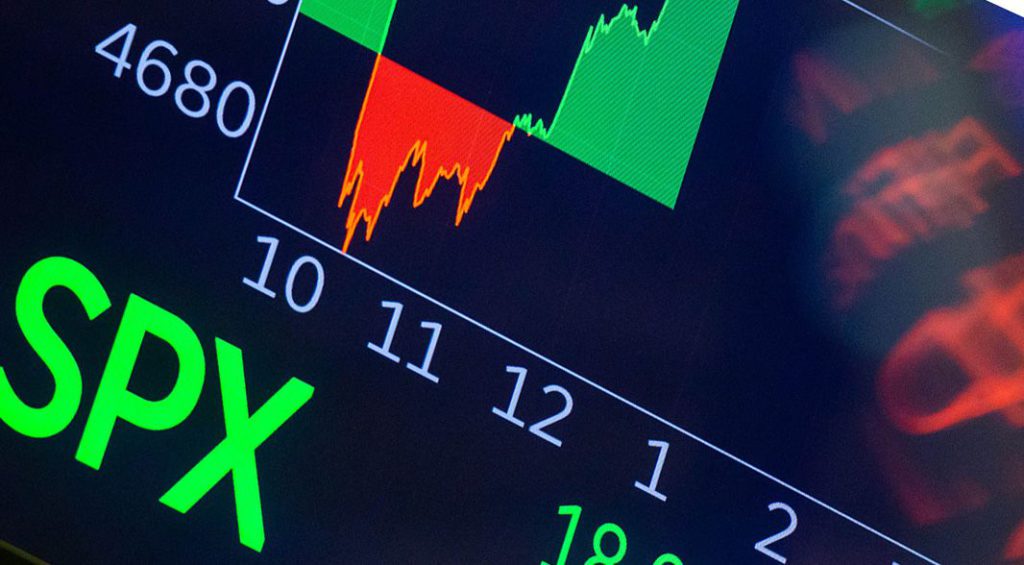
(Bloomberg) — US stocks roared back from losses sparked by a hot inflation reading on speculation the yearlong selloff had potentially reached a bottom. 

The S&P 500 closed up 2.6% after swinging more than 5% during a wild trading day. The benchmark clawed back more than 40% of the losses over a six-day selloff that took it to a two-year low. 

Technical levels factored into the bounce. At one point, the benchmark S&P 500 had given back 50% of its post-pandemic rally, triggering programmed buying. A wave of put options bought to protect against such a rout moved into the money, and as profits were booked, that prompted dealers to buy stocks to remain market neutral. 

A gauge of consumer price growth rose to a 40-year high last month, sealing the case for the Fed to deliver a large rate hike in November. Stocks plunged 25% this year before Thursday’s rebound, as the central bank tightened policy to curb inflation, leaving investors to weigh how much damage is left for share prices.

“There may be some short covering going on, but also, a lot was priced in,” said Michael Contopoulos, director of fixed income at Richard Bernstein Advisors. “There has likely been a fair amount of defensive positioning lately in equities and on the rates side, higher policy rates means higher probability of a hard landing.”

Read more: Big Hedges, 50% Charts, Okay Earnings: Behind the Stock Bounce

Read more: Hot Inflation Torches Bears in a Stock Reversal for the Ages

Risk assets have been under pressure all year as central banks around the world attempt to tame runaway inflation. The latest data added to evidence the harsh monetary medicine has yet to take hold and comes on the heels of last week’s payrolls figures that showed unemployment rate at a five-decade low in September.

The Treasury curve flattened, with the yield on policy-sensitive two-year notes up 18 basis points at 4.47%. Market bets on rates now lean toward back-to-back 75 basis-point hikes at the next two Fed meetings and expect the central bank to push rates past 4.85% before the tightening cycle ends. The current rate is 3.25%.

On the earnings front, Delta Air Lines Inc., Domino’s Pizza Inc. and Walgreens Boots Alliance Inc. gained on better-than-expected results. Big banks including JPMorgan Chase & Co. and Citigroup Inc. are due to report on Friday.

More market commentary

  • “If you had some levered CTA who had a big buy program set to start around 3,505 and then another levered short who doubled down on the CPI print that could have created this snowball where market just ripped as other levered technical systematic traders piled in,” Max Gokhman, chief investment officer for AlphaTrAI, said. “Or someone just got a fat margin call. We may find out after the dust settles.”
  • “There’s so much uncertainty in the market and so many data points are conflicting that the market responds to whatever is the most recent data point,” said Ellen Hazen, chief market strategist and portfolio manager at F.L.Putnam Investment Management. “So this morning with the reversal in the UK the market was up pre-open, then we got CPI and then it was down. And then we look at the fact that we bounced off of this support level and that becomes self-fulfilling.”
  • “This isn’t the CPI report markets or the Fed were hoping for,” said James Athey, investment director at abrdn. “Inflation pressures remain stubbornly high. The reality is that for the foreseeable future the Fed is locked into a stance of unequivocal hawkishness. This will support bond yields and the US dollar but its yet more bad news for equities.”
  • “After today’s inflation report, there can’t be anyone left in the market who believes the Fed can raise rates by anything less than 75bps at the November meeting,” Seema Shah, strategist at Principal Global Investors wrote. “In fact, if this kind of upside surprise is repeated next month, we could be facing a fifth consecutive 0.75% hike in December with policy rates blowing through the Fed’s peak rate forecast before this year is over.”
  • Given the latest CPI report, “any continued pick-up in energy prices can get us to a new high” in headline inflation, said Steve Chiavarone, senior portfolio manager at Federated Hermes. That “could very well spook markets as it pushes back any expectation of peak inflation, peak Fed hawkishness and could force the market to contemplate a terminal fed funds rate above 5%. All that would raise the risks of more bond pain, more equity pain, and a greater risk of financial accident.”

Meanwhile, UK markets remained in turmoil almost two weeks after the government unveiled a plan to drastically cut taxes. The pound surged back above $1.13, buoyed by reports that government officials are working on a U-turn of tax cuts. Gilts also rallied, with the yield on 30-year debt dropping as much as 46 basis points.

The yen sank to its lowest level in more than 30 years after the US inflation report, before reversing the move in a whiplash trade that raised market chatter of potential intervention

Elsewhere, oil gained for the first time this week, with crude in New York rising back above $89 a barrel after a US crude report flagged potential bullish drivers, shrugging off inflation data. The International Energy Agency earlier warned production cuts agreed by OPEC+ risked causing oil prices to spike and tipping the global economy into recession. 

Key events this week:

  • Earnings on Friday: JPMorgan Chase & Co., Citigroup Inc., Morgan Stanley, UnitedHealth Group Inc., U.S. Bancorp, Wells Fargo & Co.
  • G-20 finance ministers and central bankers meet, Thursday
  • China CPI, PPI, trade, Friday
  • US retail sales, business inventories, University of Michigan consumer sentiment, Friday
  • BOE emergency bond buying is set to end, Friday

Some of the main moves in markets:

Stocks

  • The S&P 500 rose 2.6% as of 4 p.m. New York time
  • The Nasdaq 100 rose 2.3%
  • The Dow Jones Industrial Average rose 2.8%
  • The MSCI World index rose 1.7%

Currencies

  • The Bloomberg Dollar Spot Index fell 0.4%
  • The euro rose 0.8% to $0.9776
  • The British pound rose 2% to $1.1317
  • The Japanese yen fell 0.2% to 147.26 per dollar

Cryptocurrencies

  • Bitcoin rose 1% to $19,369.94
  • Ether fell 0.9% to $1,287.49

Bonds

  • The yield on 10-year Treasuries advanced six basis points to 3.96%
  • Germany’s 10-year yield declined three basis points to 2.29%
  • Britain’s 10-year yield declined 24 basis points to 4.20%

Commodities

  • West Texas Intermediate crude rose 2.2% to $89.15 a barrel
  • Gold futures fell 0.4% to $1,671 an ounce

More stories like this are available on bloomberg.com

©2022 Bloomberg L.P.
Hot Inflation Torches Bears in a Stock Reversal for the Ages

(Bloomberg) — It was a stock reversal for the ages: A near-uniform plunge followed by an everything rally made for a dizzying day on Wall Street.

The S&P 500 wiped out a 2.4% loss, marking the first time since July that it reversed a decline of 2%, and closed a whopping 2.6% higher. The initial rush to sell, followed by a dash to buy, was best illustrated by the second-to-second readings on share moves. The so-called Tick index, which compares the number of equities rising versus those falling in any moment, hit minus 1,900 before surging past 1,900. 

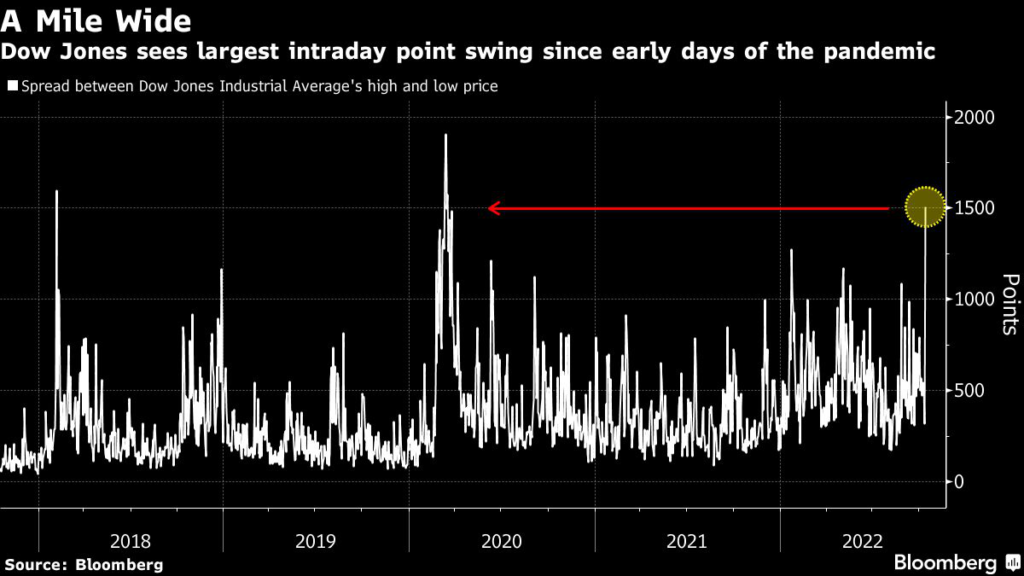
Never before has the market experienced such extreme readings in both directions in one day, according to Bloomberg data going back to 1990. Meanwhile, the Dow Jones Industrial Average surged about 1,400 points from the day’s low.

What’s behind the turnaround is debatable. Some point to chart support or options hedgers, who needed to unwind short positions when investors booked profits from put options during the earlier selloff. Others say early results from the earnings season offer bulls hope. 

Whatever the reason, it’s pain for bears who found their stance validated by a stronger print on the consumer price index, only to see their profits evaporate in a matter of hours. As the market bounced back, short sellers were forced to cover their positions to limit losses, a process that only added fuel to the gains. 

“There were so many people set-up for a big decline after the CPI number that when it didn’t see any downside follow-through, the short sellers panicked and started buying,” said Matt Maley, chief market strategist at Miller Tabak & Co. “There’s no question that traders got caught offside in a major way. In football, offside is a only five-hard penalty, but today, it was like they got penalized for a 40-yard pass interference penalty.”

A Goldman Sachs Group Inc. basket of most-shorted stocks dropped as much as 5.4%, before paring all the losses to end Thursday up 1.4%. 

The session offered a dramatic lens into the harsh life of equity skeptics in 2022’s bear market. While their cautious stance has reaped gains during the nine-month, $15 trillion selloff, sporadic agony like this has occurred when the market made sudden turns. 

This time, the stress was more abrupt and pronounced, spanning almost every stock during the course of one single day. During the morning selloff, more than 400 members in the S&P 500 saw their shares in red, potentially handing wins for short sellers. At the close, however, 470 stocks were in green. 

Read more: Big Hedges, 50% Charts, Decent Earnings: Behind the Stock Bounce

An all-or-nothing market has become a feature for 2022. The number of days where more than 400 companies of the S&P 500 move in the same direction have shown up more often than any years since at least 1997. That pattern was just on display within hours, exacting a harsh toll on anyone who dare to time the market. 

Maley says the dramatic reversal didn’t change his pessimistic view on the market, though the about-face highlights the importance of paying attention to dynamics like investor positioning and chart patterns.

“Those people should have known that the technical setup made the market ripe for a bounce and so they should have covered their shorts at/near the opening,” he said. “Bear markets do not bottom until the stock market becomes cheap. With earnings very likely to fall in the coming weeks and months, this market is not cheap at all.”

More stories like this are available on bloomberg.com

©2022 Bloomberg L.P.

‘Top Gun’ Producer Skydance Worth $4 Billion After Latest Funding Round

(Bloomberg) — Skydance, the Hollywood studio run by David Ellison, was valued at more than $4 billion after raising $400 million in a strategic investment round led by KKR & Co.

The valuation makes Skydance, founded in 2010, one of the larger independent studios in Hollywood. The money will be used to further expand its work in sports, interactive entertainment and animation, the company said Thursday.

“We’re incredibly excited to have a partner like KKR,” Ellison said in an interview. “The capital’s going to be used to grow and scale our different business, including across interactive and animation.”

The Ellison family, which derives most of its fortune from David’s billionaire father, Oracle Corp. founder Larry Ellison, also invested in the round and remains the company’s largest shareholder. Existing investors RedBird Capital Partners and Tencent Holdings Ltd. participated too, the company said.

Skydance has produced a string of successful projects including Top Gun: Maverick, the Tom Cruise fighter-jet film that generated more than $1 billion in global ticket sales this year. It was also behind The Adam Project, The Old Guard  and 6 Underground  for Netflix Inc., with each appearing on the streaming platform’s list of top-10 most-watched films. 

The company’s interactive division has made popular video games including The Walking Dead: Saints & Sinners, which was released in 2020, and Archangel, a virtual-reality game released in 2017.

The deal expands KKR’s media-sector presence, which has included funding companies such as TikTok parent ByteDance Ltd, publisher Axel Springer SE and Epic Games Inc. Goldman Sachs Group Inc. advised Skydance on the deal, while Moelis & Co. served as an adviser to KKR. 

More stories like this are available on bloomberg.com

©2022 Bloomberg L.P.
There’s a Billion-Dollar Bidding War for EV Plants Across the US

(Bloomberg) — Michigan Governor Gretchen Whitmer wasn’t happy. Ford Motor Co., a company whose very name is synonymous with Detroit, had just announced it had chosen two southern states, Tennessee and Kentucky, as sites for an $11 billion electric-vehicle project.

They had won Ford over by dangling huge incentives, and Whitmer knew Michigan needed to do more to compete. So she pleaded with lawmakers in a letter last October to put “more tools in our economic toolbox to attract private investment.” Two months later, they delivered, handing her a $1 billion fund for corporate subsidies. And a month after that, Whitmer dipped into the fund to net a giant deal from General Motors Co.: a $6.6 billion electric-truck factory and battery plant.

Michigan’s largesse — and Tennessee’s and Kentucky’s — was made possible in part by hundreds of billions in federal aid pumped into US states as part of President Joe Biden’s American Rescue Plan. The money was meant to soften the blow of a pandemic-induced fiscal apocalypse that never happened. Instead, it’s left states flush with cash, supercharging competition to win the automotive jobs of the future and cushioning the bottom lines of companies like Ford, GM, and Panasonic Holdings Corp., a battery supplier to Tesla Inc. 

There’s a risk that all the money sloshing around amid the EV development frenzy will fund boondoggles, like Foxconn Technology Group’s heavily subsidized television factory in Wisconsin that never materialized.

To counter that risk, state and local officials helping to fund this EV boom say they built in protections to keep taxpayers from getting fleeced. But the stakes are getting bigger: The cost per permanent job for some projects is now eight times the average seen less than a decade ago.

Ford’s Tennessee hub will cost about $414,000 for each direct job, Michigan is contributing $450,000 per GM job, while Georgia committed to forgo revenue that amounts to $212,000 per job to win megaprojects from Rivian Automotive Inc. and Hyundai Motor Co. in the past two years, according to data compiled by Bloomberg. The average per-job cost of economic incentives in the US was about $52,000 in 2015, measured in today’s dollars, according to a study by Tim Bartik, an economist at the W.E. Upjohn Institute for Employment Research in Kalamazoo, Michigan.

States have been competing to lure companies since at least the Great Depression. But the scale and the ferocity of it now — for EV plants, semiconductor factories and other megaprojects — are unprecedented. 

“I have never seen the same kind of surge in subsidies all across the US all happening at the same time,” said Michael Farren, a senior researcher at the Mercatus Center at George Mason University and a critic of corporate incentives. “It’s pretty clear that there’s an external motivating factor, and that is the American Rescue Plan relief funds.”

Companies that receive incentives saved an average of 30% on state and local taxes as of 2015, a rate that had tripled since 1990, according to the study by Bartik. The same study found incentives don’t correlate strongly with states’ current or past unemployment levels, or future economic growth.

To skeptics, of whom there are many in academia and policy circles, these subsidies are a poor use of state resources that could otherwise be earmarked to hospitals or schools. The incentives create a race-to-the-bottom effect where local governments furiously try to one-up each other on handouts that deliver unproven payoffs. There’s also a question as to whether EV and battery plants will employ as many people or pay as well as combustion-engine cars.

“States have justified huge subsidy packages for assembly plants in part to capture the more numerous upstream jobs, but those jobs are clearly going to shrink a great deal,” said Greg Leroy, the executive director of Good Jobs First, which has written a report on the subject. 

Read: EV Era Imperils Thousands of Jobs as Cars Simplify and Oil Fades

The $350 billion that Congress set aside for states and municipalities in May 2021 is coinciding with a once-in-a-century transformation of the auto industry, as carmakers prepare to retire the combustion engine in favor of battery power. While there are strict limits on how local governments can use the Covid relief money, the aid helped free up cash for corporate incentives.

Financial disclosures vary by state, and some withhold data at the behest of a company or to stay competitive against other states. This makes the full picture of corporate incentives incomplete.

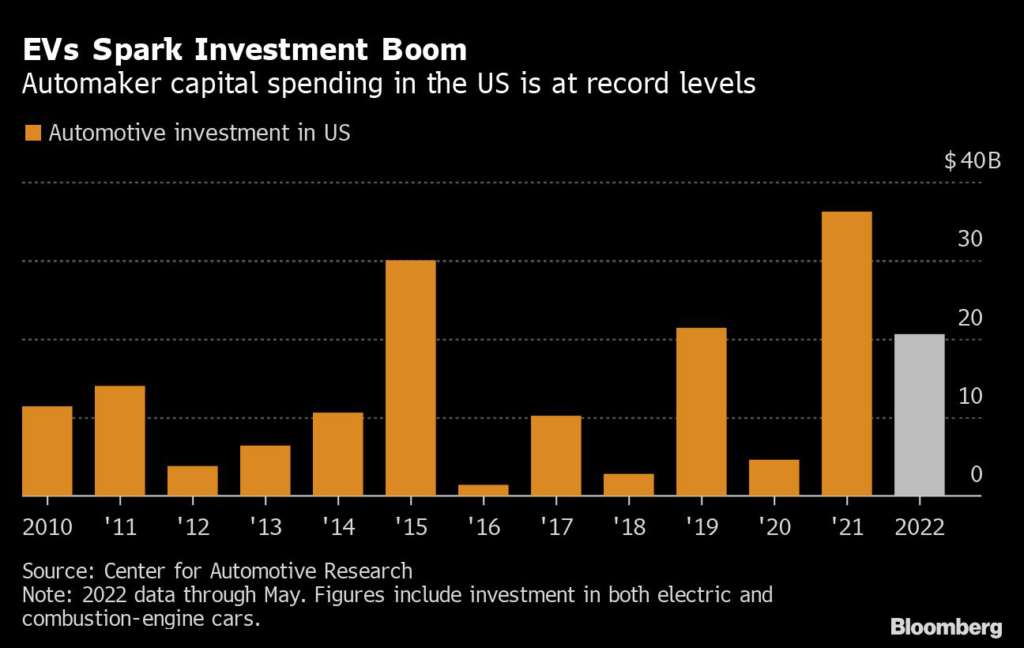
What is known is that global carmakers and established battery manufacturers have announced plans to invest at least $50 billion into at least 10 states to build EV assembly and battery plants since the start of 2021, and states have made commitments totaling at least $10.8 billion to lure those investments, according to a tally of publicly disclosed incentives by Bloomberg and Good Jobs First. That figure almost certainly underestimates the actual number.

Blue Oval City

The electric-vehicle hub that Ford and battery partner SK Innovation Co. chose to locate in Tennessee is a good example of how the full cost of an incentive package typically isn’t made plain to the public. 

Blue Oval City, a six-square-mile site an hour’s drive northeast of Memphis, will house an assembly plant making the new electric F-150 pickup and a battery plant that together promise to create 5,800 jobs. Construction will generate 33,000 temporary jobs; once completed, the twin plants and their suppliers will support 27,000 direct or indirect positions, and add $3.5 billion annually to Tennessee’s economy, state officials have said.

When the project was announced, state officials disclosed a $500 million cash grant to be approved by the legislature; local press reports later pegged the cost at $884 million. 

In fact, contract documents obtained by Bloomberg show the value of the package is at least $2.4 billion, which includes tax breaks, donated land, infrastructure improvements and short-term wage subsidies from the federal government. 

Even that figure is an undercount. It excludes an electricity subsidy provided by the Tennessee Valley Authority, the largest federal utility.

Tennessee officials said Bloomberg’s incentives calculation is “misleading” because some infrastructure investments were made years earlier, and some of the workforce training costs are estimates. They also argue that new property tax revenue, even at a reduced rate, is more than local governments would get without the project.

“Blue Oval City will be transformational for West Tennessee,” said Lindsey Tipton, a spokeswoman for the state’s economic development department. “For future projects, we will offer grant assistance, but at a much lower cost-per-job and more in line with a typical incentive package from our department.”

Ford said its decision was influenced by many factors beyond financial incentives.

“Public-private partnerships are essential for the United States to be a leader in the global transition to electric vehicles,” the company said in a statement. 

Even states that have tried to move away from incentives have caved to the pressure to compete for jobs, said Dennis Cuneo, a former Toyota Motor Corp. executive and site consultant who has helped automakers pick locations.

“Incentives are like free agency in baseball — nobody likes it, but you’ve got to do it if you want to win,” he said.

Georgia and Rivian

Georgia, which has emerged as a big winner in the current investment surge, landed two $5 billion EV deals from Rivian and Hyundai that promise to create more than 15,000 jobs. The state offered incentives worth $3.3 billion to win the projects. 

State economic commissioner Pat Wilson said Georgia competes by helping companies move fast with shovel-ready sites and limited red tape, rather than putting the most cash on the table. He called Bloomberg’s per-job incentives calculation “terribly misleading” because it includes tax breaks written into state law that aren’t discretionary.

“I view the incentives that we put on the table really as Georgia being part-investor in these projects,” Wilson said in an interview. “We know the payroll for those jobs and the benefits they provide are going to trickle out and benefit the health of communities and families all across the state.”

(Updates with site consultant’s comment in 24th paragraph)

More stories like this are available on bloomberg.com

©2022 Bloomberg L.P.

G-20 Warns of Rising Risks, Calls for Coordinated Responses

(Bloomberg) — The Group of 20 finance chiefs warned that risks to the global economy will likely continue into next year and called for coordinated responses from policymakers.

“The world is in a dangerous condition,” Finance Minister Sri Mulyani Indrawati of Indonesia, the current G-20 host nation, told reporters in Washington on Thursday, summing up discussions following a meeting of finance ministers and central bankers. 

“We are now facing increasing and compounding risk, high inflation, weak growth, energy and food insecurity or crisis, climate risk and geopolitical fragmentation,” she said, speaking alongside Bank Indonesia Governor Perry Warjiyo. She also warned of an increasing risk of recession.

Global fiscal and monetary chiefs have converged on the US capital this week amid warnings the world economy is sliding toward recession as Russia’s war in Ukraine continues to add to high energy and food prices and China’s economy slows, and as central banks raise interest rates to cool inflation. 

Read more: IMF Warns Worst to Come as Steps to Slow Inflation Raise Risks

The G-20 representatives are also gathering as part of the broader International Monetary Fund annual meetings, focused on global challenges such as persistent inflation, record debt that emerging developing nations are struggling to service, climate change and food security.  

The Federal Reserve’s most aggressive monetary tightening since the early 1980s has sent the US currency surging, impacting developing countries that borrowed heavily in greenbacks and raising the cost of dollar-priced energy and food imports. That, in turn, has placed further pressure on many central banks, and triggered a wave of interest-rate increases aimed at curbing the jump in consumer prices.

Read more: Dollar Becomes the Awkward VIP Guest at Global Finance Meetings

Policymakers in the world’s largest economies need to be “very mindful about the potential spillover effects for other countries,” Indrawati said. 

“The room to maneuver is becoming so narrow, or even now has been eliminated, so the trade-off is becoming so painful,” she said. “We have to take a painful step in order for us to be able to restore the stability and recovery of the economy.”

IMF Latest: Georgieva Welcomes Reports of U-turn on UK Tax Plan 

G-20 members — which represent about 85% of the global economy — made the following pledges, according to Indrawati: 

  • Strengthening coordination on issues that are critically important for global economic stability and prosperity, including the food and energy crisis
  • More commitment to ensuring the long-term resilience of international financial architecture, especially when so many low- and middle-income nations are in debt distress amid high interest rates. The G-20 will keep working to ensure the implementation of the Common Framework — which brings the Paris Club of traditional rich debtor countries together with China to try to restructure the debts of low-income countries on a case-by-case basis
  • Making more progress on financial-sector regulation and supervision, especially with the proliferation of crypto assets
  • Advancing climate investment and revitalizing infrastructure in a “sustainable, inclusive and affordable way”
  • Reaffirming commitment to implementing the international tax package

At similar meetings in April, officials from countries including the US walked out when a Russian attendee began speaking in protest over the war. There was no overall communique issued either, given the lack of consensus.

(Updates with more comment from Indrawati in seventh paragraph.)

More stories like this are available on bloomberg.com

©2022 Bloomberg L.P.

Aspiration CEO Cherny Stepping Down as SPAC Merger Faces a Delay

(Bloomberg) — Andrei Cherny, the chief executive officer of financial-technology firm Aspiration, is stepping down from his post at the company he co-founded amid a delay in plans to merge with a special purpose acquisition company.

Olivia Albrecht, who joined earlier this year as the firm’s chief sustainability officer, is taking over as CEO, according to a person familiar with the matter who asked not to be identified discussing the move that hasn’t been announced publicly. Cherny didn’t immediately return a message for comment.

Cherny, who helped found the firm nine years ago, expedited a plan to step down given that a public listing through a merger with SPAC InterPrivate III Financial Partners Inc. has been delayed amid a choppy market environment, the person said. He will keep a board seat and remain as an adviser to Aspiration, the person said. 

Aspiration — which counts actors Orlando Bloom and Leonardo DiCaprio among investors — focuses on sustainability in online banking. Albrecht was appointed to lead sustainability in June. She spent a decade at Pimco and has also worked at TCW Group, where she was global head of environmental, social and governance. 

Aspiration said that revenue rose past $100 million last year, with almost $80 million of gross profit. More than half of its revenue came from working with enterprises on sustainability, according to a February release on its website.

Late last year, the firm also secured an extra $315 million in equity financing from funds tied to investment giant Oaktree Capital Management and billionaire Steve Ballmer. 

More stories like this are available on bloomberg.com

©2022 Bloomberg L.P.

Mormon Church Says It Was Target of Cyberattack

(Bloomberg) — The Church of Jesus Christ of Latter-day Saints was the target of a cyberattack, the church announced Thursday.

The incident, involving basic personal information of “Church members, employees, contractors and friends,” occurred March 23 and was kept confidential at the request of government investigators until Wednesday.

“U.S. federal law enforcement authorities suspect that this intrusion was part of a pattern of state-sponsored cyberattacks aimed at organizations and governments around the world that are not intended to cause harm to individuals,” the Salt Lake City-based church said in a press release.

“The affected data did not include donation history, or any banking information associated with online donations,” the church said, noting “law enforcement authorities believe the risk that the information will be used to harm individuals is low.”

More stories like this are available on bloomberg.com

©2022 Bloomberg L.P.
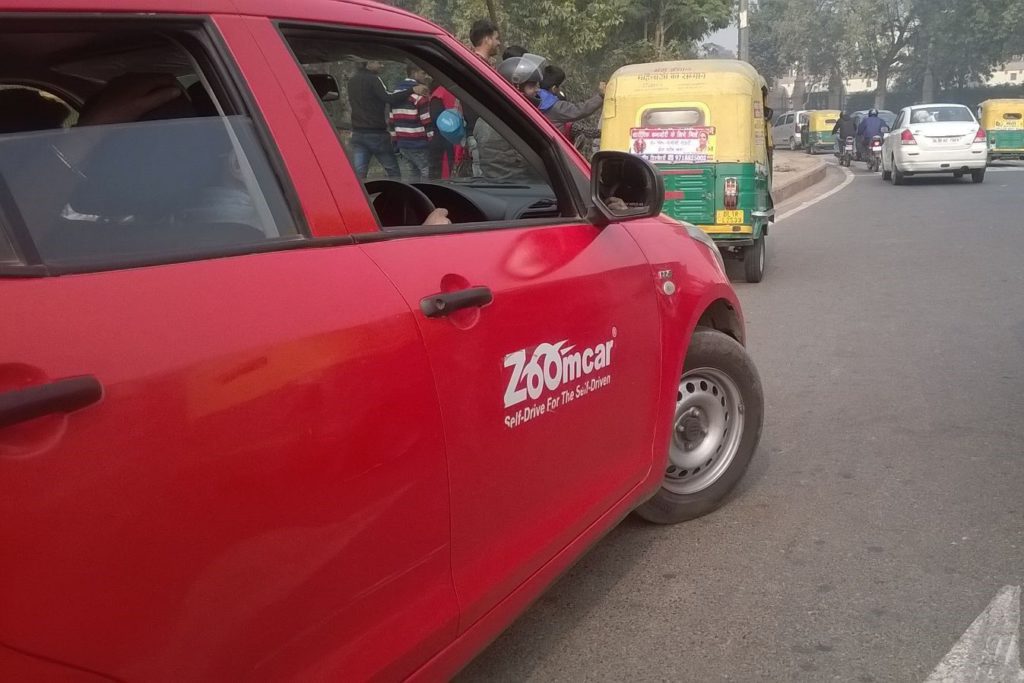
Indian Car-Sharing Platform Zoomcar to Go Public Via SPAC

(Bloomberg) — Zoomcar Inc., an India-based car-sharing platform, has reached an agreement to go public via a merger with blank-check firm Innovative International Acquisition Corp.

Zoomcar operates a marketplace for private vehicles, with owners making their cars available on the platform and users able to rent them by the hour, day, week or month. The company, whose headquarters are in Bangalore, operates in more than 50 cities in India, Indonesia, Vietnam and Egypt.

The merger with the special purpose acquisition company implies a pro forma enterprise value of about $456 million for the business, according to a statement, which confirmed an earlier Bloomberg News report. 

Zoomcar was founded in 2013 by Greg Moran, who is now chief executive officer, and David Back, who is no longer with the company. The platform has more than 3 million active users, with over 25,000 vehicles registered by their owners. The company, which doesn’t own any of the vehicles rented through its platform, takes 40% of each transaction.

Airbnb for cars

Moran describes Zoomcar as an Airbnb for cars and sees it as a complementary service to ride-sharing companies.

“It’s really about how we can bring more and more unique customized, proprietary vehicles and experiences to the end user,” Moran said in an interview. “And that’s really a very powerful engine for growth.”

After the merger is completed, Zoomcar plans to focus on increasing market share in its existing markets. It also has longterm ambitions of expanding into Latin America and Africa, Moran said.

The company is part of a small but burgeoning cadre of companies such as San Francisco-based Turo Inc. that have extended the ride-sharing model to the vehicle itself.

VC backing

Last November, Zoomcar got $92 million in a Series E round led by SternAegis Ventures, bringing the total it has raised to $332 million, according to data provider PitchBook. Sequoia Capital India is an investor and board member. Waze co-founder Uri Levine is chairman of the board.

Innovative International, which is led by Chairman and Chief Executive Officer Mohan Ananda, raised $230 million including so-called greenshoe shares in its initial public offering last year, according to a statement at the time.

Shares of the merged company, to be called Zoomcar Holdings Inc., are expected to trade on the Nasdaq.

(Updates with CEO’s comments in sixth paragraph)

More stories like this are available on bloomberg.com

©2022 Bloomberg L.P.

Close Bitnami banner
Bitnami
