Bloomberg

Take-Two Is Shutting New York Studio Behind Popular Mobile Game Dots

(Bloomberg) — Take-Two Interactive Software Inc. is shuttering the New York-based studio behind the popular mobile game Dots, resulting in the elimination of 65 jobs, according to an advance notice of the job cuts filed with the New York State Department of Labor. A Take-Two representative confirmed the closing Thursday in a statement.

The video game publisher best known for its Grand Theft Auto franchise acquired Playdots for $192 million in 2020. Founded in 2013, Playdots developed four mobile games, including Dots, which launched to enormous fanfare and was played more than 25 million times within the first months of release. Its sequel, Two Dots, has been downloaded more than 50 million times in the Google Play Store.

Take-Two acquired mobile-game maker Zynga in May in a deal valued at $11 billion. Two Dots’s operations will continue at another Zynga studio with “no disruption of service,” a Take-Two spokesperson said.

Playdots employees “will have the opportunity to apply for other jobs at Zynga and those who do not find new roles will be eligible to receive severance,” the spokesperson said. “We believe this difficult decision will better align our resources with the needs of the business in today’s dynamic market.” 

(Updates with company comments in the fourth paragraph.)

More stories like this are available on bloomberg.com

©2022 Bloomberg L.P.

Stocks Roar Back From Inflation-Triggered Losses: Markets Wrap

(Bloomberg) — US stocks stormed back from losses sparked by a hot inflation reading on speculation the yearlong selloff had potentially reached a bottom. 

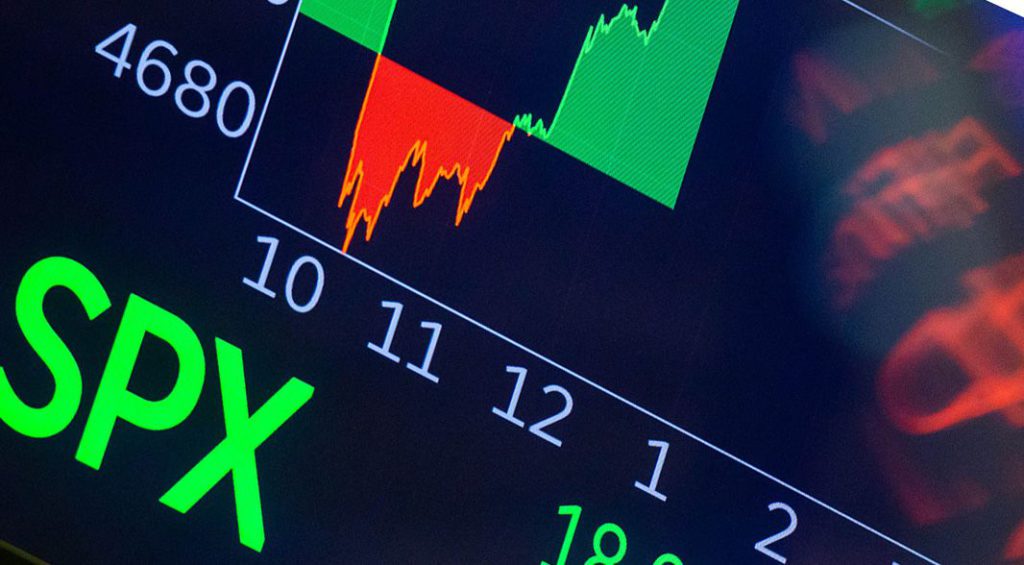
The S&P 500 wiped out a loss that hit 2%, on track to halt a six-day selloff that took it to a two-year low. Technical levels factored into the bounce. At one point, the index had given back 50% of its post-pandemic rally, triggering programmed buying. A wave of put options bought to protect against such a rout moved into the money, and as profits were booked, that prompted dealers to buy stocks to remain market neutral. 

A gauge of consumer price growth rose to a 40-year high last month, sealing the case for the Fed to deliver a large rate hike in November. Stocks plunged 25% this year before Thursday’s rebound, as the central bank tightened policy to curb inflation, leaving investors to weigh how much damage is left for share prices.

“There may be some short covering going on, but also, a lot was priced in,” said Michael Contopoulos, director of fixed income at Richard Bernstein Advisors. “There has likely been a fair amount of defensive positioning lately in equities and on the rates side, higher policy rates means higher probability of a hard landing.”

Read more: Big Hedges, 50% Charts, Okay Earnings: Behind the Stock Bounce

Risk assets have been under pressure all year as central banks around the world attempt to tame runaway inflation. The latest data added to evidence the harsh monetary medicine has yet to take hold and comes on the heels of last week’s payrolls figures that showed unemployment rate at a five-decade low in September.

The Treasury curve flattened, with the yield on policy-sensitive two-year notes rising above 4.5% before pulling back toward 4.4%. Market bets on rates still lean toward back-to-back 75 basis-point hikes at the next two Fed meetings and expect the central bank to push rates past 4.85% before the tightening cycle ends. The current rate is 3.25%.

On the earnings front, Delta Air Lines Inc., Domino’s Pizza Inc. and Walgreens Boots Alliance Inc. gained on better-than-expected results. Big banks including JPMorgan Chase & Co. and Citigroup Inc. are due to report on Friday.

More market commentary

  • “If you had some levered CTA who had a big buy program set to start around 3,505 and then another levered short who doubled down on the CPI print that could have created this snowball where market just ripped as other levered technical systematic traders piled in,” Max Gokhman, chief investment officer for AlphaTrAI, said. “Or someone just got a fat margin call. We may find out after the dust settles.”
  • “There’s so much uncertainty in the market and so many data points are conflicting that the market responds to whatever is the most recent data point,” said Ellen Hazen, chief market strategist and portfolio manager at F.L.Putnam Investment Management. “So this morning with the reversal in the UK the market was up pre-open, then we got CPI and then it was down. And then we look at the fact that we bounced off of this support level and that becomes self-fulfilling.”
  • “This isn’t the CPI report markets or the Fed were hoping for,” said James Athey, investment director at abrdn. “Inflation pressures remain stubbornly high. The reality is that for the foreseeable future the Fed is locked into a stance of unequivocal hawkishness. This will support bond yields and the US dollar but its yet more bad news for equities.”
  • “After today’s inflation report, there can’t be anyone left in the market who believes the Fed can raise rates by anything less than 75bps at the November meeting,” Seema Shah, strategist at Principal Global Investors wrote. “In fact, if this kind of upside surprise is repeated next month, we could be facing a fifth consecutive 0.75% hike in December with policy rates blowing through the Fed’s peak rate forecast before this year is over.”
  • Given the latest CPI report, “any continued pick-up in energy prices can get us to a new high” in headline inflation, said Steve Chiavarone, senior portfolio manager at Federated Hermes. That “could very well spook markets as it pushes back any expectation of peak inflation, peak Fed hawkishness and could force the market to contemplate a terminal fed funds rate above 5%. All that would raise the risks of more bond pain, more equity pain, and a greater risk of financial accident.”

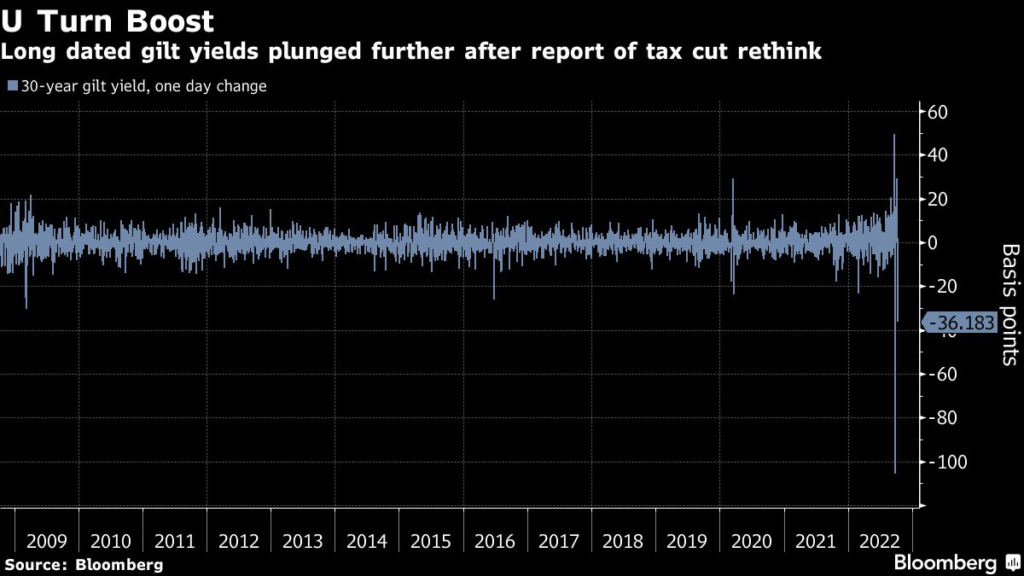
Meanwhile, UK markets remained in turmoil almost two weeks after the government unveiled a plan to drastically cut taxes. The pound surged back above $1.13, buoyed by reports that government officials are working on a U-turn of tax cuts. Gilts also rallied, with the yield on 30-year debt dropping as much as 46 basis points.

The yen sank to its lowest level in more than 30 years after the US inflation report, before reversing the move in a whiplash trade that raised market chatter of potential intervention

Elsewhere, oil gained with crude in rising back above $89 a barrel after a US crude report flagged potential bullish drivers and markets processed hotter-than-expected inflation data. The International Energy Agency earlier warned production cuts agreed by OPEC+ risked causing oil prices to spike and tipping the global economy into recession. 

Key events this week:

  • Earnings on Friday: JPMorgan Chase & Co., Citigroup Inc., Morgan Stanley, UnitedHealth Group Inc., U.S. Bancorp, Wells Fargo & Co.
  • G-20 finance ministers and central bankers meet, Thursday
  • China CPI, PPI, trade, Friday
  • US retail sales, business inventories, University of Michigan consumer sentiment, Friday
  • BOE emergency bond buying is set to end, Friday

Some of the main moves in markets:

Stocks

  • The S&P 500 rose 2.4% as of 2:22 p.m. New York time
  • The Nasdaq 100 rose 2%
  • The Dow Jones Industrial Average rose 2.7%
  • The MSCI World index rose 1.6%

Currencies

  • The Bloomberg Dollar Spot Index fell 0.6%
  • The euro rose 0.9% to $0.9791
  • The British pound rose 1.9% to $1.1316
  • The Japanese yen fell 0.1% to 147.12 per dollar

Cryptocurrencies

  • Bitcoin rose 0.2% to $19,207.49
  • Ether fell 1.8% to $1,275.9

Bonds

  • The yield on 10-year Treasuries advanced four basis points to 3.94%
  • Germany’s 10-year yield declined three basis points to 2.29%
  • Britain’s 10-year yield declined 24 basis points to 4.20%

Commodities

  • West Texas Intermediate crude rose 2.4% to $89.40 a barrel
  • Gold futures fell 0.1% to $1,675 an ounce

More stories like this are available on bloomberg.com

©2022 Bloomberg L.P.

Ukraine Latest: Drone Strikes Near Kyiv; Putin-Erdogan Meeting

(Bloomberg) — President Recep Tayyip Erdogan met Thursday with Russia’s Vladimir Putin in Kazakhstan, where the pair discussed a potential Turkish gas hub. Before the meeting Erdogan said Ankara’s goal is to help stop the “bloodshed” in Ukraine, and that “a fair peace can be achieved through diplomacy.” More grain vessels sailed Thursday under the safe-transit deal that Turkey helped to broker. 

The Kyiv region — although not Ukraine’s capital itself — was struck by Iranian-made drones on Thursday morning as air raid sirens rang out across much of the country for a fourth morning. Air strikes continued in the south, including Mykolaiv, where a multi-story apartment building was destroyed. 

Ukraine’s allies gathered for a NATO defense ministers’ meeting in Brussels that’s expected to result in the offer of more air defense capabilities. The UK got things started by pledging Amraam rockets capable of shooting down cruise missiles.  

(See RSAN on the Bloomberg Terminal for the Russian Sanctions Dashboard.) 

Key Developments

  • White House Weighs Retaliatory Ban on Russian Aluminum
  • Putin Says All Infrastructure at Risk After Nord Stream Hit 
  • Russia Sends More Fuel to Army In Ukraine Amid Mobilization
  • NATO States Back German-led Anti-Missile Shield for Europe 
  • Europe Steps Up Defense of Energy Assets With Show of Force

On the Ground

Russia made missile and drone strikes on more than 40 settlements overnight, notably around Makariv in the Bucha district to the northwest of the capital. Other cities, including Mykolaiv, Vinnytsya and Cherkasy also sustained damage, Ukraine’s military said. On Thursday, Russia carried out one missile attack, 15 airstrikes and 22 shellings from multiple launch rocket systems, the Ukrainian General Staff said on Facebook. Five Russian Kalibr missiles were shot down by Ukraine’s air defenses, according to Facebook postings from Ukraine’s West and South commands. 

(All times CET) 

Tech Giant Microsoft Channels Its Resources to Aid Ukraine (8:19 p.m.)

As US and NATO defense contractors work to speed up production lines to send weapons to Ukraine, Microsoft Corp. has provided more than $250 million in tech support to the country since Russia’s invasion, according to a senior company official.

That has included secure communications lines set up with Ukraine’s cyber officials “to rapidly respond to and defend against Russian malware attacks,” Wes Anderson, the vice president for Microsoft’s defense unit, said in an interview.

He said the software giant has completed more than 173 “emergency support missions that provided 23,000 person-hours of technical support” to other companies and nonprofits aiding Ukraine. He said Microsoft also has made as much as 43 million free hours of Skype time available to Ukraine residents and their families outside the country to get in touch.

Boxing Champ Klitschko Calls Putin’s Nuclear Threat a Bluff (7:29 p.m.)

Vitali Klitschko, the former world heavyweight boxing champion who’s now mayor of Kyiv, said Russian Putin’s threats to use nuclear arms in Ukraine were only a “big bluff.

“If Putin talks about nuclear weapon, it shows a weakness” because his “army isn’t successful in the east or south” of Ukraine, Klitschko told Bloomberg Television.

Putin has threatened to use “all weapons systems available to us” as Russia’s invasion of Ukraine faced growing setbacks against a military deploying powerful modern arms supplied by its US and European allies. 


Russia, NATO to Hold Nuclear Drills Despite Rising Tensions (6:49 p.m.)

Moscow and NATO are both proceeding with nuclear exercises, even as tensions escalate over Putin’s threats to use “all means available” — including atomic weapons — to defend land he claims to be Russian.

The drills come as Russia steps up its missile attacks on Ukraine, nearly eight months into its invasion and as its troops struggle to make headway on the ground. 

In Washington, John Kirby, spokesman for the National Security Council, told reporters that the annual NATO exercise to be conducted later in the fall was planned “even in advance of the Feb. 24 invasion of Ukraine by Russia” and will be held more than 600 miles (1,000 kilometers) from Russia. He said Russia’s planned exercise occurs every two years and is also “within the normal bounds of what Russia has done in the past.”

NATO Vigilant in Monitoring Any Change in Russia’s Nuclear Posture (6:00 p.m.)

The alliance will be especially vigilant when Russia starts an expected annual exercise of its nuclear forces, Jens Stoltenberg, its chief told reporters after a two-day meeting of NATO defense ministers in Brussels.

Asked how allies will be able to distinguish preparations for a nuclear exercise from preparations for an attack, Stoltenberg said “we have very good intelligence,” adding allies have monitored Russian nuclear forces for decades. “Of course we will remain vigilant, not least in light of the veiled nuclear threats and the dangerous nuclear rhetoric we have seen from the Russian side.” 

Russian Attacks Damaged 30% of Ukrainian Energy Infrastructure (5:10 p.m.)

Russian missiles and drones damaged energy capacity and facilities, including transmission stations and generating companies, in the attacks that started Monday and continued throughout the week, Ukraine’s Energy Minister Herman Halushchenko said on Bloomberg TV. 

“The main target, as we understand, was just to make it difficult for us to survive this winter,” Halushchenko said. 

He also said Ukrainian officials expect to meet IAEA Director General Rafael Mariano Grossi in Kyiv Thursday, just days after he held a similar meeting with Putin. Grossi will bring the Russian response to Ukrainian demands as he meets with officials from both countries.

Ukraine Sees Possible Russian Gas Transit Halt (5:07 p.m.)

That is one possible scenario after missile and drones attacks on Ukrainian energy infrastructure this week, Energy Minister Herman Halushchenko said on Bloomberg TV Thursday. “Today transit is going on, though it decreased dramatically,” Halushchenko said. “We consider the scenario when Russia stops the transit.”

Russia, Ukraine Agree on Another Prisoner Swap (4:05 p.m.)

Russia and Ukraine have struck another prisoner swap agreement involving more than 70 military personnel.

The Russian Defense Ministry said Thursday that 20 troops had been freed from Ukrainian captivity. The Ukrainian presidency on Thursday and earlier this week announced the liberation of a total of 52 soldiers by Russia.

The deal comes after the countries last month conducted a major exchange of captives. Ukraine turned over 55 prisoners, including pro-Russian tycoon Viktor Medvedchuk, while Russia handed over 215 soldiers, the majority of whom were involved in the defense of Ukraine’s Azovstal steel plant, and 10 foreigners.

Occupation Chief Says Residents Should Leave Kherson (2:20 p.m.)

The head of the Russian occupation administration in Ukraine’s Kherson region asked Kremlin authorities to help organize the departure of residents “because of the daily missile attacks by the Ukrainian military.”

Vladimir Saldo made the unusual appeal in an address on state television, less than two weeks after Putin signed annexation documents declaring Kherson and three other Ukrainian regions part of Russia “forever.” Russian forces don’t fully control any of the four regions and Ukraine’s military has been gradually advancing toward Kherson in recent weeks.

Russia Limits Heavy Traffic On Damaged Crimea Bridge (12:08 p.m.)

Russia has barred heavy freight trucks from using the damaged bridge linking it with the annexed Crimea peninsula, forcing them to travel by ferry or use a land detour via other occupied Ukrainian regions.

A queue of 900 trucks has built up waiting to cross the Kerch Strait by ferry, state TV reported. Vehicles traveling to Crimea through Ukrainian regions recently annexed by Russia, in a move condemned as illegal by the UN, have a security escort. 

Moscow blamed Ukrainian military intelligence for the Oct. 8 explosion on the 19-kilometer (12-mile) bridge across the Kerch Strait.

Zelenskiy Asks Cabinet to Consider Ending Visa-Free Regime With Belarus (11:40 a.m.) 

Volodymyr Zelenskiy asked Ukraine’s cabinet to consider the cancellation of Kyiv’s visa-free regime with Belarus, according to the statement on the President’s website. The move came after a public e-petition launched in July and supported by more than 25,000 people.

Zelenskiy said all checkpoints on Ukraine-Belarus border are closed, except one in Volyn, which is used for Ukrainian citizens returning back to the country from abroad.

Scholz Deplores Putin’s ‘Crusade’ (11:30 a.m.)

German Chancellor Olaf Scholz accused Russia’s president of waging a “crusade” against Europe and its liberal order of peace and prosperity, in some of his strongest comments about the almost 8-month invasion of Ukraine. 

“Vladimir Putin and his enablers made one thing very clear: This war is not only about Ukraine,” Scholz told a conference in Berlin. “They consider their war against Ukraine to be part of a larger crusade, a crusade against liberal democracy, a crusade against the rules-based international order.” 

Czech Government Bans Russian Entry on Tourist Visas (11 a.m.)

The Czech Republic joined Poland, Finland and the Baltic states in announcing a ban on entry by Russian citizens with Schengen visas issued by other European Union states for the purposes of tourism, sports or culture. 

Foreign Minister Jan Lipavsky told reporters that entry will be denied to Russians arriving by plane from a non-Schengen country starting Oct. 25. The Czech Republic was the first EU country to suspend the issuance of new visas to Russian citizens, days after Moscow’s invasion of Ukraine in February.

European Gas Prices Whipsaw After Putin Infrastructure Comment (11 a.m.) 

European natural gas swung as anxiety mounted over the safety of infrastructure that’s key to ensuring supply to the continent.

Traders are on edge with Russian President Vladimir Putin saying any energy infrastructure in the world is at risk after the recent Nord Stream explosions — regarded by many as a veiled threat of future sabotage efforts. 

Another Six Grain Ships Depart (10:46 a.m.) 

Six vessels carrying a total of 154,000 tonnes of Ukrainian grain sailed early Thursday, taking total foodstuffs shipped under the safe-transit deal brokered by Turkey and the UN for three Black Sea ports to almost 7.4 million tns since early August, Ukraine’s infrastructure minister said on Twitter. 

NATO Countries Back German Plan for Anti-Missile Shield (9:54 a.m.)

At least 15 countries of the NATO military alliance have signed a letter of intent to join a long-term German project to create a European anti-missile shield that would boost protection for much of the continent.

The system will have several layers to intercept various kinds of missiles from different heights, possibly linking up Israeli Arrow 3 air-defense systems as well as US-made Patriots and German Iris-Ts, and would be fully deployable through the North Atlantic Treaty Organization. 

Read more: NATO Countries Back German Plan for European Anti-Missile Shield

UK Providing Air Defense Missiles to Ukraine (7 a.m.) 

The UK said it will donate Amraam air defense missiles to help Ukraine defend against Russian missile strikes. The rockets will be provided in the coming weeks and will help defend Ukrainian infrastructure, Britain’s defence ministry said in a statement. The UK said it would also donate more drones for information-gathering and 18 extra howitzer artillery guns, in addition to 64 already delivered.


More stories like this are available on bloomberg.com

©2022 Bloomberg L.P.

Netflix Plans to Launch $7-a-Month Streaming Plan With Advertising

(Bloomberg) — Netflix Inc. will introduce an advertising-supported plan on Nov. 3, charging $7 a month for a subscription that the company bets will entice new budget-conscious customers and jumpstart growth.

The lower-priced streaming package will debut in the US and 11 other countries, including Japan, France and Brazil, Netflix said Thursday. It will include four to five minutes of commercials per hour and offer a lower video quality than higher-priced tiers. Some programs won’t be available because the company doesn’t have the rights to show them with commercials.

Netflix had long positioned its streaming service as a commercial-free alternative to cable, and has resisted calls to introduce advertising. But with subscriber growth stalled and its stock in the doldrums, the company is looking to the lower-priced version of its service with commercials to deliver added revenue. 

· Read: Netflix Ads Mark Seismic Shift to Raise Stock Price

In a briefing, company officials said they already have hundreds of advertisers and have sold out most of their inventory for the service, called Basic with Ads.

The price gives Netflix a competitive product against similar offerings from newer rivals. It’s $3 a month lower than the price of the ad-backed version of HBO Max, from Warner Bros. Discovery Inc., and $1 less than the forthcoming Disney+ with commercials. The company’s current ad-free packages range from $10 a month for a plan that lets users watch on one screen at a time to $20 a month for a high-definition service with up to four screens going at once.

Shares of Netflix rose as much as 4.4% to $230.51 in New York after the announcement. They are down 62% this year and headed toward their first annual decline since 2014 after peaking above $700.

“They are pricing aggressively,” Bloomberg Intelligence analyst Geetha Ranganathan said on Bloomberg TV. The new tier will “open up the product to a whole new set of subscribers.”

Netflix is starting with a familiar approach to advertising and plans to adjust its offering over time. Ads will be 15 to 30 seconds long and will play before and during TV shows and films, the company said. It plans to use its data on viewers to let sponsors target their audiences based on genre and help them prevent kids from seeing unsuitable content.

A key issue for advertisers will be audience metrics — the data that traditional TV networks use to price their spots. Netflix has partnerships with DoubleVerify and Integral Ad Science to confirm the viewability and traffic validity of ads starting in the first quarter of 2023. Nielsen, the ratings standard bearers, will provide data in the US sometime that year as well.

The company will also make sure viewers don’t see the same ads too many times using frequency caps.

“We’re confident that with Netflix starting at $6.99 a month, we now have a price and plan for every fan,” Chief Operating Officer Greg Peters said in a company statement. “While it’s still very early days, we’re pleased with the interest from both consumers and the advertising community.”

(Updates with analyst’s comment in seventh paragraph.)

More stories like this are available on bloomberg.com

©2022 Bloomberg L.P.

‘Lie After Lie After Lie’: Nikola Founder Vilified in US Closing

(Bloomberg) — “Trevor Milton is a con man.”

With those words, the US launched its closing statement in Milton’s trial on Thursday, as the government sealed its case against the Nikola Corp. founder it claims defrauded investors with breathless hype about the electric truck maker. 

“He lied on Twitter, he lied on podcasts, he lied on TV interviews, he lied to Peter Hicks directly,” Assistant US Attorney Jordan Estes told the federal jury in Manhattan, referring to a real estate investor who accepted millions of dollars in Nikola stock options as partial payment for a ranch. “Lie after lie after lie. His lies may have been on social media, but make no mistake, this was an old-fashioned fraud.”

Estes told the jury Milton’s lies were spread across clear categories: Nikola’s progress in hydrogen fuel, the status of the company’s Badger pickup, the functionality of its debut semi truck, the state of its order book and what he told Hicks. 

Milton, 40, was upbeat as he arrived at court Thursday morning in a navy suit and took a seat with his lawyers. There were at least two dozen people in the courtroom, with his family and friends packing the first two rows behind the defense table.

Just Office Gossip 

Milton is charged with two counts of securities fraud and two counts of wire fraud, in a case that comes as the US Justice Department works to crack down on corporate crime. He faces the possibility of years in prison if convicted. Prosecutors argue he enticed individual investors to buy Nikola shares by making false statements about the company’s products and capabilities in numerous interviews on podcasts and TV.

Milton’s lawyers call the case a “prosecution by distortion,” contending that their client never meant to deceive potential investors and that, in any case, his statements weren’t material, or important enough to influence those investors’ decisions.

Read More: Nikola CEO Says He Learned Truck Had No Power After He Was Hired 

In his own closing, defense attorney Marc Mukasey told the jury it was simple: The prosecution had failed to prove its case. Instead, he said, its evidence “consists of gossipy text messages from low-level employees.”

He called it “the ultimate distortion to say Trevor Milton intended to commit fraud, when the people who worked with him at Nikola came into this courtroom but not a single one of them testified that he intended to commit fraud, or that he had a wrongful purpose, or that he ran a scheme, or that he intended to harm them.” 

As for a pair of investors who testified for the US, he said they couldn’t remember the Milton statements they said pushed them to buy Nikola shares.

“The government never proved fraud,” Mukasey argued. “Period. End of story.”

‘The Future Was Now’

Milton wanted individual investors just as much as he wanted big banks, because he related to them and wanted them to be part of the company’s future, Mukasey told the jurors.

“That’s why Trevor went to a truck stop on Thanksgiving,” he said. “He wanted them to be a part of Nikola.”

Read More: Nikola Whistleblowers Tell Their Side of the Trevor Milton Saga

What Nikola was showing prospective investors was “the business model” and “everything they were doing to get to that plan,” Mukasey told the panel. “At Nikola, at that time, the future was now. The future was the present.” 

At times, Milton “fell into the wrong grammatical tense” in painting this vision, he said, but “so did everyone else, and they’re not under indictment.”

Mukasey replayed a clip from a podcast in which Milton said hydrogen fuel was two years from coming online at Nikola, arguing the clip showed Milton was clear that the company wasn’t actively making the fuel at the time.

‘Imagine the Nightmare’

In a peroration that brought Milton’s wife to tears, Mukasey asked the jurors to put themselves in Milton’s position.

“We’re living in a day and age when everyone is on their phone and their Twitter and their Zoom and their TikTok and their Facebook 24 hours a day,” he said. “And so imagine the nightmare it is for Trevor, at 40 years old, to have his life hang in the balance because of a word choice he made, or pressed Send on his phone, without making sure his grammar was right.”

He said the company was Milton’s “baby,” and “following the ups and downs of your child, and wanting to help your child, and bragging about your child, and even exaggerating about your child — that’s not fraudulent. That is human and natural and 100 percent innocent.”

The case is US v. Milton, 21-cr-478, US District Court, Southern District of New York (Manhattan).

Read More

  • Nikola Investor Lost $160,000 on Milton’s Hype, He Tells Jury
  • Nikola Saw ‘Massive’ Badger Losses But Backed Milton Anyway 
  • Trevor Milton Faces Jury in His Toughest Sales Job Yet 

More stories like this are available on bloomberg.com

©2022 Bloomberg L.P.
Truss Prepares to Abandon Key Tax Cuts Amid Market Turmoil

(Bloomberg) —

UK Prime Minister Liz Truss’s administration is preparing to abandon a central part of its tax-cutting agenda following weeks of chaos in financial markets — a potential shift that sent the pound and gilts surging.

Officials at 10 Downing Street and the Treasury are drafting options for Truss, but no final decision has been taken, according to a person familiar with the matter who asked not to be identified. The premier could scrap her pledge to keep corporation tax unchanged next year, and instead raise it as planned by her predecessor Boris Johnson, the Sun said.

Officials are waiting for Chancellor of the Exchequer Kwasi Kwarteng to return from Washington, where he has been attending meetings of the International Monetary Fund. That means no changes are likely before he and Truss have had the chance to work on new plans over the weekend, the person said. Any announcement is likely well before Oct 31, they said, refusing to be drawn on exact timings because the negotiations are ongoing. 

Reports of a U-turn on a key economic policy while he is abroad sparked speculation Kwarteng will be forced to quit his job. But speaking to broadcasters in the US capital, the chancellor said he’s “not going anywhere” and vowed to press on with his strategy. Yet in an interview with the Telegraph published later, he didn’t rule out raising corporation tax, while saying that keeping the rate competitive is a “great idea.”

“Let’s see,” Kwarteng told the newspaper when asked about a potential U-turn.

Truss’s fledgling administration is scrambling to regain its economic credibility after she took financial markets by surprise with a tax-cutting plan that left, according to the Institute of Fiscal Studies, a £60 billion hole in the public finances. The package roiled markets, sending the pound at one point to an all-time low against the dollar and forcing the Bank of England to intervene in the bond market to prevent a key part of the pensions industry from collapsing. 

The pound jumped as much as 1.8% on Thursday to $1.1295. UK government bonds extended a rally, with 30-year yields falling 46 basis points to 4.36%.

Sterling

“Has the government finally heeded the calls from markets and the Bank of England? Price action in gilts and the pound suggests markets believe so,” said Simon Harvey, head of FX analysis at Monex Europe. 

The plan to freeze corporation tax next year has come in for particular attention from detractors within Truss’s own Tories. Under a strategy set out by the previous Conservative administration, the levy on companies was due to rise to 25% from 19% in April. But scrapping that move was one of the key measures in Kwarteng’s fiscal plan announced Sept. 23.

Tories Demand U-Turn on Tax Cuts as Pressure Builds on Truss

The initial market reaction on Thursday suggests that a U-turn on corporation tax — along with the bank’s greater buying activity this week — could help ease any turbulence next week after the Bank of England halts its bond purchases on Friday. Investors will be focused on the details of the plans the government is drawing up, and that may determine whether the broad market rally can be sustained.

“Given investors are short, the reaction of sterling is not a surprise,” said Gareth Gettinby, portfolio manager at Aegon Asset Management. “Ultimately, the UK has an extremely negative external balance that remains reliant on foreign funding which remains a negative. So a short term bounce on government noise and then expect the currency to weaken.”

BOE

BOE Governor Andrew Bailey had put his credibility on the line this week when he told investors that gilt-buying program will end as planned on Friday, brushing off calls to extend the market support. In response, investors ramped up the volume of bonds that they were selling to the bank. 

That the government is preparing a climbdown on its fiscal plans represents a victory of sorts for the central bank chief after being forced into the emergency bond purchases at the same time as the bank attempted to clamp down on rising prices by lifting interest rates.

After Kwarteng and Truss already U-turned on one of the measures in the so-called mini-budget — a headline promise to scrap the 45% rate of income tax on the UK’s top earners — they now face calls to reverse even more of their fiscal decisions, with the corporation tax plan foremost among them. When Kwarteng unveiled that move last month, the Treasury estimated it would cost £67.5 billion over five years — or more than £13 billion a year.

Senior government figures have already begin distancing themselves from the measure. On Thursday, Foreign Secretary James Cleverly refused to commit to the plan when asked by Sky News whether there would be any more reversals, particularly on corporation tax.

He responded by listing measures the government is determined to keep, but made no mention of corporation tax.

“The foundations of that mini-budget, protecting people from energy bill prices, letting them keep more of their earnings, protecting businesses form those energy prices, making sure that we’re internationally competitive, all those things are really key,” Cleverly said.

Asked again whether the government would stick with the plan on corporation taxes, he replied: “It’s absolutely right that we’ve made it clear that we want to invest in businesses.”

‘Disastrously Bad Idea’

Speaking to reporters at a regular briefing, Truss’s spokesman Max Blain said the government’s position on taxes hasn’t changed.

But Cleverly’s refusal to explicitly back the plan will fuel speculation that the government is preparing to backtrack on more of last month’s fiscal package.

With market uncertainty persisting and the central bank’s intervention due to end Friday, even members of Truss’s party are urging her to unpick her economic strategy and restore the party’s reputation for economic credibility.

Despite the dire polling numbers facing the Tories and Truss personally, Cleverly also told Sky News that changing leader now “would be a disastrously bad idea, not just politically but economically.”

(Updates with Kwarteng comment to Telegraph in fourth paragraph)

More stories like this are available on bloomberg.com

©2022 Bloomberg L.P.

Apple Teams With Goldman Sachs to Offer Savings Accounts

(Bloomberg) — Apple Inc. and Goldman Sachs Group Inc. will team up to offer savings accounts to users of the tech company’s credit card.

“Apple Card users will be able to open the new high-yield savings account and have their daily cash automatically deposited into it  — with no fees, no minimum deposits and no minimum balance requirements,” Apple said in a statement Thursday. Daily cash refers to the rewards that card users generate through their purchases.

The move builds on the existing credit-card partnership between the two companies. The Wall Street titan has pushed in recent years to expand its offerings for consumers, though the effort has been dogged by cost overruns and missed profitability goals. For Apple, Goldman remains a key partner even as the tech company works to shift more of its financial-services offerings in-house.

The move is part of Apple’s bet that services — including financial offerings — will help fuel growth in coming years. Already, services contribute more than 20% of revenue, up from less than 10% in 2015. But an Apple “buy now, pay later” service, announced earlier this year, has taken longer than expected to reach the market. The offering, called Apple Pay Later, had been slated for iOS 16, software released last month in tandem with new iPhones.

Apple and Goldman Sachs have also been working on a more extensive buy now, pay later service for Apple Pay that could handle larger purchase amounts with longer-term payment plans — an expansion over the delayed, short-term Apple Pay Later service. 

Apple’s savings-account offering will allow Apple Card users to generate interest on their cash back, which arrives in 1%, 2% and 3% increments depending on whether the purchases were made via Apple Pay, on Apple products or with select merchants. Apple and Goldman didn’t announce an interest rate, but Marcus, Goldman’s existing savings account, currently gives users an annual percentage yield of 2.15%. 

The partnership could encourage users to store the cash they get back with Goldman rather than Green Dot Bank, Apple’s existing partner for its legacy credit card.

Goldman has been eager to increase its consumer deposits. The firm’s existing savings-account products already hold more than $100 billion. They are complementary to Goldman’s transaction-banking business, which takes in corporate deposits, another source of cheap funding.

(Updates with Apple’s strategy starting in third paragraph.)

More stories like this are available on bloomberg.com

©2022 Bloomberg L.P.
Voyager Creditors Take Issue With Immunity Plans for Execs in Bankruptcy Lawsuits

(Bloomberg) — Voyager Digital Ltd. creditors are taking issue with plans to provide the crypto lender’s directors and officers with immunity from lawsuits tied to its descent into bankruptcy. 

The company’s pending sale to crypto exchange giant FTX appears to be conditioned on Voyager’s top executives being afforded “broad releases” from lawsuits, protecting those “principally responsible” for the firm’s financial problems, lawyers for Voyager’s official committee of unsecured creditors said in court papers filed Wednesday. 

An investigation by the creditors into the circumstances around Voyager’s bankruptcy revealed “sobering” findings, but the releases would prevent claims against the directors and officers in question from being pursued, according to the creditor group. Details of the investigation are redacted from the bankruptcy court filings.

This leaves the creditors with a “Hobson’s choice” — either support the protections to quickly get the sale to FTX over the finish line, or risk costly delays as the Chapter 11 proceedings turn into a “morass of litigation,” wrote the lawyers. 

Two members of Voyager’s board of directors are also investigating the run-up to the bankruptcy, including the loan to now-defunct hedge fund Three Arrows Capital that weighed heavily on the company. If those board members conclude that certain Voyager executives could or should be sued, those people would be excluded from the proposed releases, court papers show. 

Voyager should be forced to better explain the need for protecting the executives, the creditor group argues. Lawsuits against them, if successful, could help get Voyager users more of their money back. 

A representative for Voyager declined to comment. 

The bankruptcy is Voyager Digital Holdings Inc., 22-10943, U.S. Bankruptcy Court for the Southern District of New York (Manhattan).

More stories like this are available on bloomberg.com

©2022 Bloomberg L.P.
DeFi Exchange Uniswap Raises $165 Million From a16z, Polychain

(Bloomberg) — Uniswap Labs has secured more funding even as the crypto market struggles and investors start to lose confidence in decentralized finance.

The exchange, one of the largest decentralized crypto trading platforms by volume alongside Coinbase Global Inc. and Binance, said Thursday it has secured $165 million through a Series B funding round, valuing the company at $1.66 billion. Uniswap said it’s one of the largest funding rounds for a crypto firm since the market downturn earlier this year. 

The investment also bucks fading investor confidence in decentralized finance, or DeFi, which has become targets of a series of hacks. Over $718 million has been stolen across 11 DeFi platforms so far this month, according to a research report by blockchain analytics firm Chainalysis. DeFi users have lost billions of dollars over hacks and manipulative trading activities on such platforms. 

Just this week, users on decentralized trading platform Mango lost over $100 million due to a series of transactions by a savvy trader who manipulated token prices on the exchange. That came days after another $568 million hack of Binance Coin. So far this year, $3 billion has been lost in crypto hacks.    

DeFi applications like Uniswap are built on blockchains, public digital ledgers of crypto transactions. They enable investors to borrow, lend and trade crypto assets without financial intermediaries like banks. Such applications aim to tackle issues associated with traditional finance such as high transaction costs and censorship. 

Uniswap, which is based on the Ethereum blockchain and automates transactions with its protocol, has become a sought-after unicorn since the DeFi boom in the summer of 2020. One of the exchange’s most popular services is yield farming, also known as liquidity harvesting, where users lend crypto to arbitrage different digital tokens or get interest.

Polychain Capital led the latest investment in Uniswap with participation from venture capital giant a16z, Paradigm, SV Angel and Variant, according to a statement from Uniswap’s chief executive Hayden Adams. 

More stories like this are available on bloomberg.com

©2022 Bloomberg L.P.
Dish in Talks With Ergen-Backed SPAC for Wireless Merger

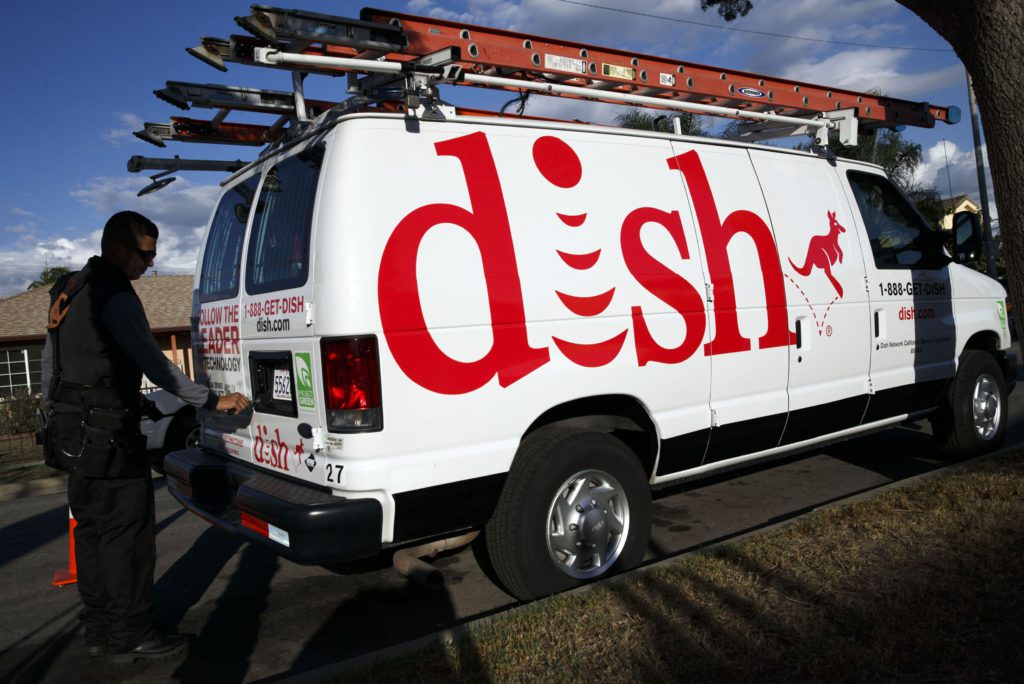
(Bloomberg) — Dish Network Corp. is in preliminary discussions on a complex deal to merge its Boost mobile-phone business with Chairman Charlie Ergen’s blank-check company.

Ergen’s Conx Corp., which went public in 2020, is seeking an extension from shareholders to complete a business transaction so it can keep pursuing the talks, according to a statement released Wednesday. A vote on an extension will take place on Oct. 31.

“We are in regular dialog with interested parties who may assist us in accomplishing our goals, including recently preliminary conversations with Conx,” Dish said in a separate emailed statement. “There can be no assurance that these preliminary discussions will lead to a transaction nor as to the structure or terms of any such transaction.”

A transaction between Ergen’s companies would add a new level of intrigue to the billionaire’s high-stakes plan to build his own mobile-phone network. Ergen acquired prepaid service Boost from T-Mobile US Inc. in 2020 as part of an arrangement with the US government, which sought to preserve competition in the wireless market while allowing T-Mobile to merge with Sprint Corp. Boost has been rolling out 5G services in 120 cities, using airwaves Dish has acquired over the years, so it can stop relying on leased capacity from other carriers’ networks.

If realized, the merger would give Boost money to accelerate its development without tapping too much of Dish’s funds, New Street Research analyst Jonathan Chaplin wrote in a note to clients Thursday.

On an earnings call in August before the Conx proposal, Ergen pointed to the advantages Boost would get as it moved from being a low-margin, prepaid business to attracting a more lucrative and loyal monthly subscriber, which is “materially different in terms of economics.”  

Later in the call addressing a question on whether Dish needed to own the retail wireless business as it pursued a 5G network buildout, Ergen said a separation of Boost was an option. “There’s a lot of synergies and owning that, but the real value of our company is our network,” Ergen said. “We’re in the wholesale business, so our capacity can be sold to others in the industry.”

Ergen concluded his answer about owning Boost by saying: “We’d prefer that it belongs with us.” If the Conx move is successful, Ergen could be able to keep it in the Dish family.

Conx raised $750 million during the heyday of special purpose acquisition companies, or SPACs, saying it would pursue a deal with a company in the telecom, media or technology space. SPACs offer partners a way to go public and secure funding without the traditional hurdles of an IPO.

Chaplin, the New Street analyst, gives the deal 50/50 odds at success. He cites several hurdles ahead, including the need for approvals from the SPAC’s investors, Dish’s board and the US Justice Department. Conx will also likely need to raise additional money from institutional investors.

Shares of Dish, based in Englewood, Colorado, rose less than 1% to $13.33 as of 12:05 p.m. Thursday. Conx, based in Littleton, Colorado, was little changed. 


(Updates with analyst’s comments beginning in fifth paragraph.)

More stories like this are available on bloomberg.com

©2022 Bloomberg L.P.
Close Bitnami banner
Bitnami