
Bloomberg

Stocks Climb in Sharp Reversal; S&P Jumps 2%: Markets Wrap

(Bloomberg) — US stocks bounced higher and the dollar declined in a sharp reversal of risk sentiment. Treasury yields pulled back from highs as investors assessed the impact of the latest hot inflation reading on the Federal Reserve’s policy path.

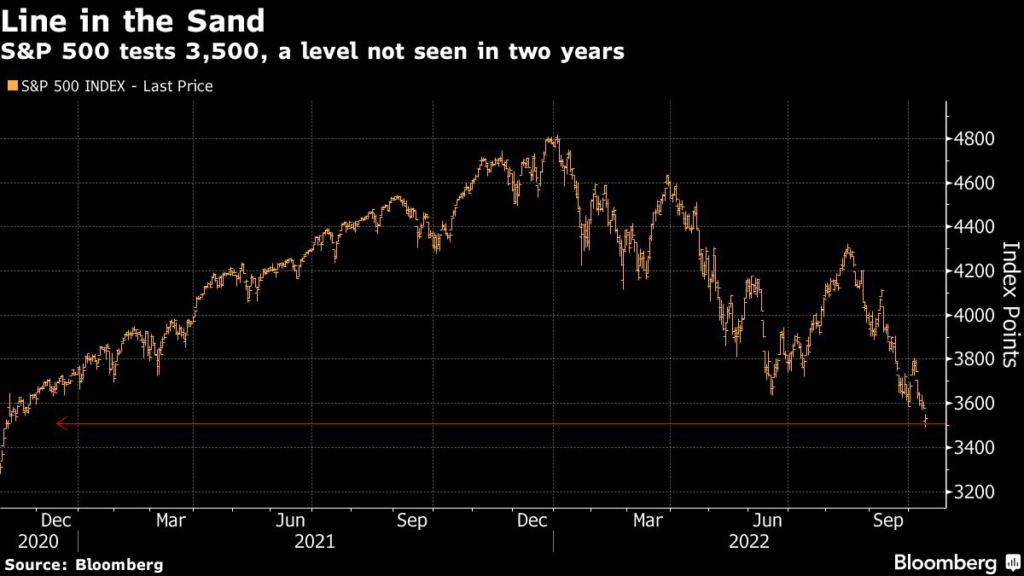
The S&P 500 jumped 2%, reversing losses of more than 2% at the open in a comeback from session lows with gains broadening to all 11 major sectors. The tech-heavy Nasdaq 100 and Dow Jones Industrial Average rose more than 2%. The yield on policy-sensitive two-year notes spiked above 4.5% before dropping back.

A gauge of consumer price growth rose to a 40-year high last month, sealing the case for the Fed to deliver a large rate hike in November. Stocks have plunged more than 25% this year as the central bank began tightening policy to curb inflation, leaving investors to weigh how much damage is left for share prices.

Read more: Core US Inflation Rises to 40-Year High, Securing Big Fed Hike

The latest data added to evidence the harsh monetary medicine has yet to take hold and comes on the heels of last week’s payrolls figures that showed unemployment rate at a five-decade low in September.

Risk assets have been under pressure all year as central banks around the world attempt to tame runaway inflation. The latest data added to evidence the harsh monetary medicine has yet to take hold and comes on the heels of last week’s payrolls figures that showed unemployment rate at a five-decade low in September.

“This isn’t the CPI report markets or the Fed were hoping for,” said James Athey, investment director at abrdn. “Inflation pressures remain stubbornly high. The reality is that for the foreseeable future the Fed is locked into a stance of unequivocal hawkishness. This will support bond yields and the US dollar but its yet more bad news for equities.”

Market bets on rates now lean toward back-to-back 75 basis-point hikes at the next two Fed meetings. They now expect the central bank to push rates past 4.85% before the tightening cyle ends. The current rate is 3.25%.

More market commentary

  • “After today’s inflation report, there can’t be anyone left in the market who believes the Fed can raise rates by anything less than 75bps at the November meeting,” Seema Shah, strategist at Principal Global Investors wrote. “In fact, if this kind of upside surprise is repeated next month, we could be facing a fifth consecutive 0.75% hike in December with policy rates blowing through the Fed’s peak rate forecast before this year is over.”
  • Given the latest CPI report, “any continued pick-up in energy prices can get us to a new high” in headline inflation, said Steve Chiavarone, senior portfolio manager at Federated Hermes. That “could very well spook markets as it pushes back any expectation of peak inflation, peak Fed hawkishness and could force the market to contemplate a terminal fed funds rate above 5%. All that would raise the risks of more bond pain, more equity pain, and a greater risk of financial accident.”

Meanwhile, UK markets remained in turmoil almost two weeks after the government unveiled a plan to drastically cut taxes.

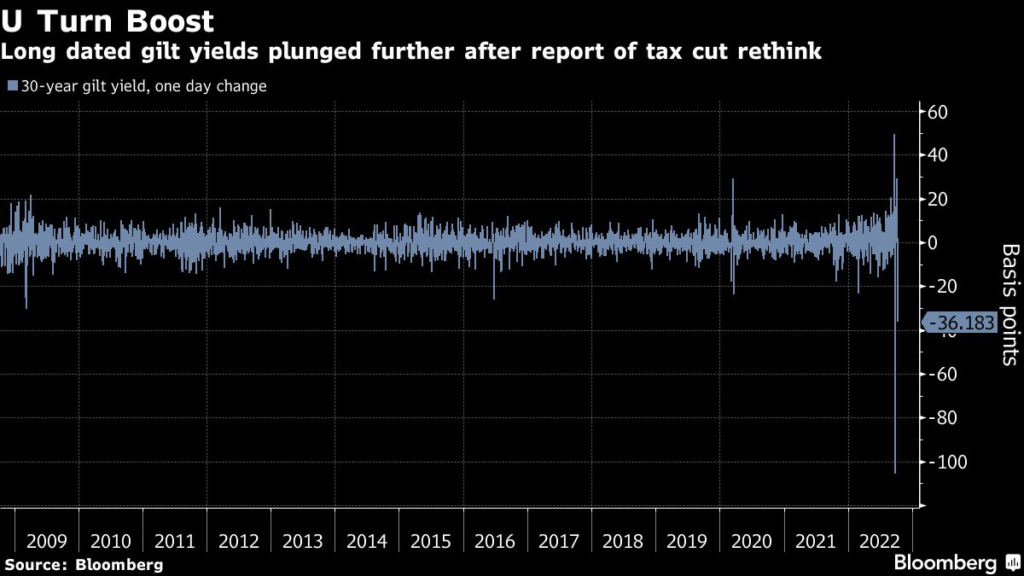
Speculation leaders may reconsider the controversial program sent the pound higher and yields on benchmark gilts tumbling more than 25 basis points.

Key events this week:

  • Earnings this week include: JPMorgan Chase & Co., Citigroup Inc., Morgan Stanley, UnitedHealth Group Inc., U.S. Bancorp, Wells Fargo & Co.
  • G-20 finance ministers and central bankers meet, Thursday
  • China CPI, PPI, trade, Friday
  • US retail sales, business inventories, University of Michigan consumer sentiment, Friday
  • BOE emergency bond buying is set to end, Friday

Some of the main moves in markets:

Stocks

  • The S&P 500 rose 2.1% as of 11:40 a.m. New York time
  • The Nasdaq 100 rose 2.1%
  • The Dow Jones Industrial Average rose 2.2%
  • The Stoxx Europe 600 rose 0.8%
  • The MSCI World index rose 1.4%

Currencies

  • The Bloomberg Dollar Spot Index fell 0.6%
  • The euro rose 0.9% to $0.9794
  • The British pound rose 2.3% to $1.1358
  • The Japanese yen was little changed at 147.01 per dollar

Cryptocurrencies

  • Bitcoin fell 0.9% to $19,000.24
  • Ether fell 2.8% to $1,262.1

Bonds

  • The yield on 10-year Treasuries advanced four basis points to 3.94%
  • Germany’s 10-year yield declined four basis points to 2.28%
  • Britain’s 10-year yield declined 24 basis points to 4.20%

Commodities

  • West Texas Intermediate crude rose 2% to $88.98 a barrel
  • Gold futures fell 0.7% to $1,666 an ounce

More stories like this are available on bloomberg.com

©2022 Bloomberg L.P.

Turkey Criminalizes Spread of ‘False Information’ on Internet

(Bloomberg) — Turkey criminalized the spread of what authorities describe as false information on digital platforms, under an article in a bill that was approved at parliament’s general assembly on Thursday.

The measure, proposed by the governing AK Party and its nationalist ally MHP, is part of a broader draft “disinformation” law. It mandates a jail term of one to three years for users who share online content that contains “false information on the country’s security, public order and overall welfare in an attempt to incite panic or fear.” 

Media groups and opposition parties have decried the bill as censorship, seeing it as a move to stifle critics and journalists. 

“The crime is defined with rather vague and open-ended terms,” said Mustafa Kuleli, vice president of the European Federation of Journalists. “It is not clear how prosecutors will take action against those who allegedly spread false information.”

‘Systematic Censorship’

Reporters Without Borders’ World Press Freedom Index ranks Turkey 149th out of 180 nations, saying 90% of the national media is under state control. The organization has accused President Recep Tayyip Erdogan’s government of stepping up attacks on journalists to deflect attention from economic and other problems ahead of elections set for next year.

In 2020, Turkey passed a contentious law that obligated social-media companies with more than 1 million daily users in the country to appoint local representatives, and gave authorities more power to block access to sites. 

Erdogan has also repeatedly threatened to shut down some social media, citing what he considered to be personal attacks against himself and his family. He’s described the platforms as “a threat to democracy” and “a national security problem.”

Courts banned YouTube and Wikipedia for years, while access to Twitter was slowed to a trickle at times of heightened strife, such as cross-border operations into Syria and terrorist attacks at home. 

Kuleli said the law would “boost systematic censorship and self-censorship in Turkey instead of fighting disinformation.”

More stories like this are available on bloomberg.com

©2022 Bloomberg L.P.

Biden’s Chip-Export Controls Designed to Give US an Advantage, Official Says

(Bloomberg) — The Biden administration’s restrictions on semiconductor technology exports to China are designed to help the US maintain as large a lead in technology as possible over rivals, said an official, who also addressed national security concerns such as China’s efforts to develop artificial intelligence that has military uses.

The new rules laid out last week stem from US concerns that China can use AI to improve military capabilities, support surveillance for human rights abuses and “disrupt or manufacture outcomes that undermine democratic governance and sow social unrest,” Assistant Secretary of Commerce for Export Administration Thea D. Rozman Kendler told an audience on a public call on Thursday.

“China’s military-civil fusion strategy seeks to eliminate barriers between its military and civilian research and commercial sectors, which has resulted in additional controls on China,” she added.

Kendler’s comments were the first since Washington unveiled sweeping regulations to curb the sale of semiconductors and chipmaking equipment to its chief geopolitical rival, sending shockwaves through the $550 billion industry. Markets plummeted as investors pondered the wider impact on China’s economy as well as the fallout for the world’s biggest chip firms. On Thursday, Kendler tried to calm investors.

“We scoped our measures narrowly, to focus only on the equipment, activities and entities of greatest national security concern and that ensures that our actions will have the least possible impact on commercial activity and not cause disruptions to global supply chain,” she said.

The Philadelphia Semiconductor Index turned positive and gained 2.6% after earlier falling as much as 5%.

Kendler also highlighted that the US is working with allies on export control measures, after Taiwan Minister of Economic Affairs Wang Mei-hua said in an interview on Wednesday that Taipei and Washington have been discussing joint steps to verify the end users of the chip technology and ensure key products aren’t sold to the Chinese military.

“We recognize that multilateral controls are more effective than unilateral control,” Kendler said. “And let me assure you foreign engagement on these controls” is a priority for the Bureau of Industry and Security, which is responsible for implementing the US export control policy.

The US’s actions, which incensed Beijing and provoked accusations of unfair targeting, threaten to disrupt a global economy already dealing with a potential recession, soaring inflation and lingering supply chain constraints. 

Signs of trouble are growing. Applied Materials Inc. slashed its outlook for the fourth quarter, Intel Corp. is said to be firing thousands of people, and US firms including Applied Materials, KLA Corp. and Lam Research Corp. are pulling employees from China’s top memory chipmaker. On Thursday, Taiwan Semiconductor Manufacturing Co. cut its 2022 capital spending target — an important indicator of its own expectations for growth across sectors from smartphones to servers and electric vehicles — by roughly 10%.

Depending on how broadly Washington enforces the restrictions, the impact could extend well beyond semiconductors and into industries that rely on high-end computing, from electric vehicles and aerospace to gadgets like smartphones. 

The new US regulations broadly limit chipmakers from selling to China artificial intelligence semiconductors and those that can be used for supercomputers. Nvidia Corp. warned in September that government restrictions on exporting AI chips to China could affect hundreds of millions of dollars in revenue, sending its stock tumbling. 

Chipmakers can request a Commerce Department exception to those rules. But they should presume such requests will be denied, senior officials have said.

Commerce also put in place a raft of restrictions on supplying US machinery that’s capable of making advanced semiconductors. It’s targeting the types of memory and logic chips that are at the heart of state-of-the-art designs. 

Specifically, the restrictions cover production of logic chips using so-called nonplanar transistors made with 16-nanometer technology or anything more advanced than that, 18-nanometer dynamic random access memory chips and Nand-style flash memory chips with 128 layers or more. Generally speaking, the smaller the number of nanometers, the more capable the chip. 

On Thursday, Kendler said the US is also restricting the export of items that will be used to develop or produce indigenous semiconductor manufacturing equipment in China. 

This move could further pummel China’s ambition to build a domestic chip industry as it has been aggressively fostering alternatives to US chip equipment suppliers including Applied Materials and Lam Research.

The new rules also ban “US persons” from supporting chip development or production at Chinese-based plants. 

Kendler said that includes US citizens, a permanent US resident alien, or a protected individual as defined by law, any juridical person organized under the US laws or any jurisdiction within the US, including foreign branches, and any person in the US. 

More stories like this are available on bloomberg.com

©2022 Bloomberg L.P.
CoinShares Develops Twitter Bot to Track ‘Fair’ NFT Prices

(Bloomberg) — CoinShares International Ltd, Europe’s largest digital asset trading house, has spurned its usual diet of exchange-traded and capital markets products for a new project: a Twitter bot that can tell users the true price for a nonfungible token. 

Pricing for NFTs, unique digital collectibles ranging from pixelated artwork to plots of land in video games, is usually driven by how much hype the collection’s creator has generated. Popular collections include Yuga Labs Inc.’s Bored Ape Yacht Club, Larva Labs’ CryptoPunks and Otherdeed, which represents digital land created for Yuga Labs’ virtual world Otherside.

CoinShares said that since demand for NFTs declined in recent months — as much as 97% from the sector’s record highs in January — it’s become harder to figure out exactly what an NFT is worth. So its research team spent time building a bot that can do the hard work for you, assessing attributes from the quantifiable to the abstract.

To decide on an NFT’s price, the bot considers factors like hype, rarity, the access given to exclusive content, overall transaction volume for the collection and previous sales. At the moment, it only engages with listings on NFT marketplace OpenSea, and only for a select number of collections. 

“NFTs are the newest asset to come to crypto markets and it’s important that everyone feels comfortable buying and selling them,” said Jean-Marie Mognetti, chief executive officer at Stockholm-listed CoinShares, in a statement Thursday.

It’s not the first time that CoinShares has dabbled in the world of automated trading intelligence, either. 

The firm also has a subscription service called Hal — coincidentally, the same name as the evil on-board artificial intelligence system from 2001: A Space Odyssey. The platform helps investors by being “the ideal quant trading partner to trade with no emotion, on your behalf, directly on your crypto exchange account,” according to Jean-Charles Dudek, head of consumer solutions at CoinShares, in a video posted on Twitter this week. 

The platform was previously called Napbots, but that name wasn’t as fun. 

More stories like this are available on bloomberg.com

©2022 Bloomberg L.P.

Sneaker Reseller Goat Set to Acquire Streetwear Site Grailed

(Bloomberg) — Sneaker marketplace Goat Group Inc. is set to acquire streetwear-resale site Grailed to expand deeper into the apparel business.

Grailed, a peer-to-peer fashion site, will continue to operate under its own brand and will integrate Goat’s operations infrastructure, including shipping and payments. Financial terms of the deal weren’t disclosed.

Eddy Lu, co-founder and chief executive officer of Goat Group, said Grailed offers unique items such as rare Balenciaga jackets and vintage Coogi sweaters that can’t be found elsewhere. 

Goat Group executives say expansion into fashion and accessories is  a “natural progression” for the company. They’ve also been seeking growth abroad, opening retail and warehouse facilities in Singapore, Tokyo, and Shenzhen, China, over the past year.  In April, the company signed a deal for French football club Paris Saint-Germain to release new merchandise on its e-commerce platform.

Goat first invested in Grailed last year, leading a $60 million funding round along with Groupe Artemis and Gucci CEO Marco Bizzarri. Grailed wasn’t considering a sale at the time, according to a person familiar with the matter.

The resale landscape has changed since then with fashion labels such as Kering Inc.’s Balenciaga and Capri Holdings Ltd.’s Jimmy Choo moving to grab their own slice of a growing secondhand market that’s projected to hit $30 billion in the US next year, according to Coresight Research. Earlier this month, reseller Poshmark Inc. agreed to be acquired by South Korean internet giant Naver Corp. for $1.2 billion in a transaction analysts saw as a kickoff to more deals within the sector.

“We’ve been continuing to see growth across our businesses, especially in apparel and accessories, which have doubled the past 12 months,” said Lu. “When you’re looking to accelerate growth even further, that’s when consolidation makes sense.”

(Corrects the status of the pending acquisition in headline and first paragraph)

More stories like this are available on bloomberg.com

©2022 Bloomberg L.P.

Truss Prepares to Abandon Key Tax Cuts Following Market Turmoil

(Bloomberg) —

UK Prime Minister Liz Truss’s administration is preparing to abandon a central part of its tax-cutting agenda following weeks of chaos in financial markets — a potential shift that sent the pound and gilts surging.

Officials at 10 Downing Street and the Treasury are drafting options for Truss, but no final decision has been taken, according to a person familiar with the matter who asked not to be identified. The premier could scrap her pledge to keep corporation tax unchanged next year, and instead raise it as planned by her predecessor Boris Johnson, the Sun said.

Officials are waiting for Chancellor of the Exchequer Kwasi Kwarteng to return from Washington, where he has been attending meetings of the International Monetary Fund. Reports of a u-turn on a key economic policy in London while he is abroad has sparked speculation he will be forced to quit his job. Speaking from the US capital, Kwarteng said he’s “not going anywhere” and vowed to press on with his strategy.

Truss’s fledgling administration is scrambling to regain its economic credibility after she took financial markets by surprise with a tax-cutting plan that left, according to the Institute of Fiscal Studies, a £60 billion hole in the public finances. The package roiled markets, sending the pound at one point to an all-time low against the dollar and forcing the Bank of England to intervene in the bond market to prevent a key part of the pensions industry from collapsing. 

The pound jumped as much as 1.8% on Thursday to $1.1295. UK government bonds extended a rally, with 30-year yields falling 46 basis points to 4.36%.

“Has the government finally heeded the calls from markets and the Bank of England? Price action in gilts and the pound suggests markets believe so,” said Simon Harvey, head of FX analysis at Monex Europe. 

The plan to freeze corporation tax next year has come in for particular attention from detractors within Truss’s own Tories. Under a strategy set out by the previous Conservative administration, the levy on companies was due to rise to 25% from 19% in April. But scrapping that move was one of the key measures in Kwarteng’s fiscal plan announced Sept. 23.

Tories Demand U-Turn on Tax Cuts as Pressure Builds on Truss

The initial market reaction on Thursday suggests that a U-turn on corporation tax — along with the bank’s greater buying activity this week — could help ease any turbulence next week after the Bank of England halts its bond purchases on Friday. Investors will be focused on the details of the plans the government is drawing up, and that may determine whether the broad market rally can be sustained.

“Given investors are short, the reaction of sterling is not a surprise,” said Gareth Gettinby, portfolio manager at Aegon Asset Management. “Ultimately, the UK has an extremely negative external balance that remains reliant on foreign funding which remains a negative. So a short term bounce on government noise and then expect the currency to weaken.”

BOE Governor Andrew Bailey had put his credibility on the line this week when he told investors that gilt-buying program will end as planned on Friday, brushing off calls to extend the market support. In response, investors ramped up the volume of bonds that they were selling to the bank. 

That the government is preparing a climbdown on its fiscal plans represents a victory of sorts for the central bank chief after being forced into the emergency bond purchases at the same time as the bank attempted to clamp down on rising prices by lifting interest rates.

After Kwarteng and Truss already U-turned on one of the measures in the so-called mini-budget — a headline promise to scrap the 45% rate of income tax on the UK’s top earners — they now face calls to reverse even more of their fiscal decisions, with the corporation tax plan foremost among them. When Kwarteng unveiled that move last month, the Treasury estimated it would cost £67.5 billion over five years — or more than £13 billion a year.

Senior government figures have already begin distancing themselves from the measure. On Thursday, Foreign Secretary James Cleverly refused to commit to the plan when asked by Sky News whether there would be any more reversals, particularly on corporation tax.

He responded by listing measures the government is determined to keep, but made no mention of corporation tax.

“The foundations of that mini-budget, protecting people from energy bill prices, letting them keep more of their earnings, protecting businesses form those energy prices, making sure that we’re internationally competitive, all those things are really key,” Cleverly said.

Asked again whether the government would stick with the plan on corporation taxes, he replied: “It’s absolutely right that we’ve made it clear that we want to invest in businesses.”

‘Disastrously Bad Idea’

Speaking to reporters at a regular briefing, Truss’s spokesman Max Blain said the government’s position on taxes hasn’t changed.

But Cleverly’s refusal to explicitly back the plan will fuel speculation that the government is preparing to backtrack on more of last month’s fiscal package.

With market uncertainty persisting and the central bank’s intervention due to end Friday, even members of Truss’s party are urging her to unpick her economic strategy and restore the party’s reputation for economic credibility.

Despite the dire polling numbers facing the Tories and Truss personally, Cleverly also told Sky News that changing leader now “would be a disastrously bad idea, not just politically but economically.”

More stories like this are available on bloomberg.com

©2022 Bloomberg L.P.
Nikola Founder Is Vilified as Con Artist in Prosecutor’s Closing

(Bloomberg) — “Trevor Milton is a con man.”

With those words, the US launched its closing statement in Milton’s trial on Thursday, as the government worked to seal its case against the Nikola Corp. founder it claims defrauded investors with breathless hype about the electric truck maker. 

“He lied on Twitter, he lied on podcasts, he lied on TV interviews, he lied to Peter Hicks directly,” Assistant US Attorney Jordan Estes told the federal jury in Manhattan, referring to a real estate investor who accepted millions of dollars in Nikola stock options as partial payment for a ranch. “Lie after lie after lie. His lies may have been on social media, but make no mistake, this was an old-fashioned fraud.”

Estes told the jury Milton’s lies were spread across clear categories: Nikola’s progress in hydrogen fuel, the status of the company’s Badger pickup, the functionality of its debut semi truck, the state of its order book and what he told the real estate investor. 

Read More: Nikola CEO Says He Learned Truck Had No Power After His Hire 

Milton, 40, was upbeat as he arrived at court in a navy suit and took a seat with his lawyers. There were at least two dozen people in the courtroom, with Milton’s family and friends packing the first two rows behind the defense table.

Milton is charged with two counts of securities fraud and two counts of wire fraud, in a case that comes as the US Justice Department works to crack down on corporate crime. He faces the possibility of years in prison if convicted. Prosecutors argue that he enticed individual investors to buy Nikola shares by making false statements about the company’s products and capabilities in numerous interviews on podcasts and TV.

Milton’s lawyers call the case a “prosecution by distortion,” contending that their client never meant to deceive potential investors and that, in any case, his statements weren’t material, or important enough to influence those investors’ decisions.

The case is US v. Milton, 21-cr-478, US District Court, Southern District of New York (Manhattan).

Read More

  • Nikola Founder Trevor Milton Won’t Testify in Fraud Trial 
  • Nikola Investor Lost $160,000 on Milton’s Hype, He Tells Jury
  • Nikola Saw ‘Massive’ Badger Losses But Backed Milton Anyway 

More stories like this are available on bloomberg.com

©2022 Bloomberg L.P.
TSMC Cuts Capital Spending 10% in a Warning for Tech Sector

(Bloomberg) — Taiwan Semiconductor Manufacturing Co. slashed its 2022 capital spending target by roughly 10%, a dramatic sign of trouble for the technology industry from the world’s most valuable chip company.

TSMC said it expects to spend about $36 billion in 2022 on capital equipment, down from at least $40 billion previously. The sharp reduction in expenditure — an important indicator of its own expectations for growth across sectors from smartphones to servers and electric vehicles — suggest the Taiwanese firm is bracing for a broader-than-anticipated downturn.

TSMC and its peers are grappling with Washington’s sweeping restrictions on doing business with China, which are sending shock waves through the global semiconductor industry. Applied Materials Inc., a leading producer of chip-making equipment, slashed its forecast for the fourth quarter, while Intel Corp. is said to be preparing to fire thousands. Shares in European gear maker ASML Holding NV, whose top customer is TSMC, fell as much as 3% Thursday.

The moves unveiled last week are the Biden administration’s most aggressive yet as it tries to stop China from developing technological capabilities it sees as a threat. The actions, which have incensed Beijing, threaten to disrupt a global economy already dealing with a potential global recession, soaring inflation and lingering supply snarls.

“The company’s 10% cut in full-year capital spending target implies prolonged weakness in smartphone and PC chip demand,” Bloomberg Intelligence analyst Charles Shum said.

Executives said that they won a license from the US to continue operating and building out their 16 nanometer and 28 nanometer lines at Nanjing in China, joining companies from SK Hynix Inc. to Samsung Electronics Co. in securing narrow exemptions to the chip curbs from Washington.

The grants allow Asia’s three largest chipmakers to maintain their existing plants and operations in the world’s biggest semiconductor market, for instance by buying, importing and upgrading American tools. They may also be allowed to expand existing facilities covered by the licenses — which in TSMC’s case involves more mature nodes that are several generations behind state of-the-art. It’s unclear, however, if foreign firms will be allowed to move up the technology ladder, or have American employees working on the lines in China.

TSMC to the World: We Have No Good News for You: Tim Culpan

TSMC’s shares have tanked this week, taking its market capitalization to about $320 billion from more than $550 billion in January. The American depositary receipts fell 1.1% in New York on Thursday morning.

The company, which reported better-than-estimated third-quarter net income of NT$280.9 billion ($8.8 billion), is projecting revenue of $19.9 billion to $20.7 billion in the December quarter, though that assumes certain US dollar expectations at a time Asian currencies have weakened. 

The Biden administration measures limit the ability of companies that use US technology to sell products to China. They include restrictions on the export of some types of chips used in artificial intelligence and supercomputing, and also tighter rules on the sale of semiconductor equipment to any Chinese company.

The restrictions make it more difficult for chipmakers to move their inventories and hit TSMC more severely than previous actions by the US, Fubon Research analysts led by Sherman Shang said in a note this week. The curbs mean about 5%-8% of TSMC’s total revenue will likely be restricted, they said. Bloomberg Intelligence estimates TSMC could lose more than 10% of its annual sales because of the restrictions.

It’s “too early to provide a specific number, however the inventory correction will likely see its biggest impact sometime in the first half of 2023,” Chief Executive Officer C. C. Wei told analysts on a conference call. The impact of the US curbs will be manageable, he said.

Still, Taiwan’s largest company is betting on its massive size and industry-leading technology to navigate its biggest challenges in years. Hsinchu, Taiwan-based TSMC is the world’s largest contract chipmaker, producing for the likes of Qualcomm Inc., Apple Inc. and Nvidia Corp., all of which sell a significant portion of their products into the Chinese market.

On Thursday, executives reaffirmed their long-term targets for revenue and declared 2023 a year of growth. TSMC also pledged to continue expanding around the globe as needed.

“TSMC’s guidance of at least 43% year-over-year sales growth and 59.5% gross margin is above consensus estimates, and indicate very mild immediate impact from the new US restrictions,” Shum said.

The outlook for the electronics industry had begun to darken even before the upheaval engendered by Biden’s curbs. 

Macroeconomic shocks have suppressed consumer demand and business spending, while unsold inventory among PC vendors built up. Third-quarter shipments of desktop and laptop computers slumped 15%, according to IDC data, and chip companies like Advanced Micro Devices Inc. have said they were surprised by the speed and sharpness of the downturn in demand. Memory makers Micron Technology Inc. and Kioxia Holdings Corp. have announced cutbacks in output of as much as 30% to try and stabilize prices.

TSMC may not be able to rely on sustained demand for products of Apple, its main customer, whose growth has benefited the Taiwanese manufacturer for years. 

While the California company has launched new types of chips to boost the performance of its devices, it has recently backed off plans to increase production of its new iPhones, raising further questions about underlying electronics demand.

(Updates with ASML’s shares from the third paragraph)

More stories like this are available on bloomberg.com

©2022 Bloomberg L.P.

Crypto Altcoins Lead Declines; Bitcoin Drops Back Below $19,000

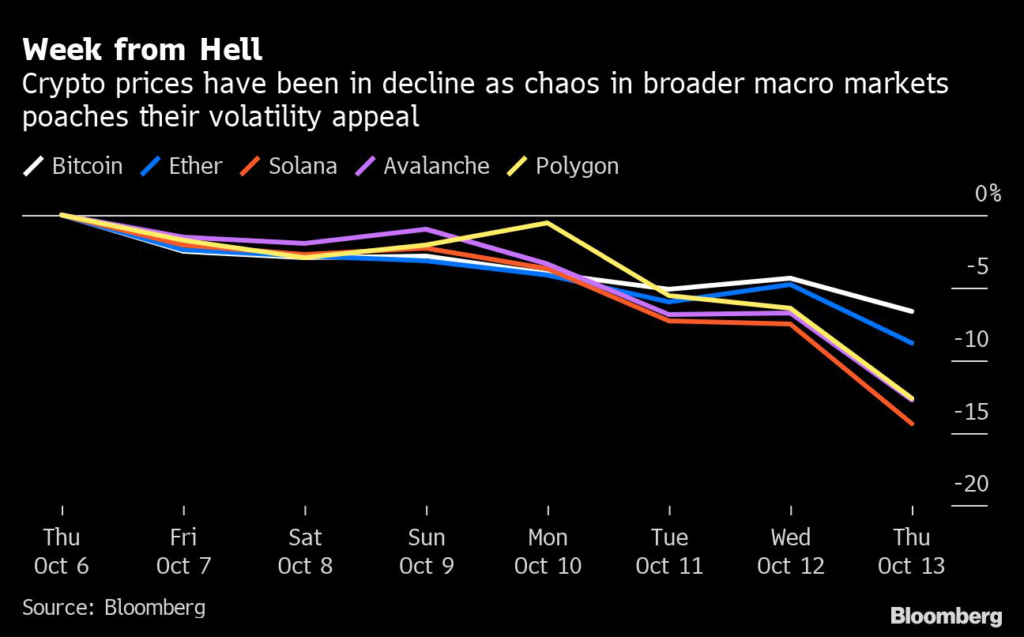
(Bloomberg) — Prices in the cryptoasset market slumped across the board on Thursday, after data showing US inflation at a 40-year high further eroded fading demand for riskier assets. 

Bitcoin, the largest cryptocurrency by market value, fell as much as 5.1% on Thursday in New York to $18,201, its lowest in about three weeks. The September low was the least since prices tumbled in June after crypto lender Celsius collapsed. Ether fell as much as  8.2%, with both coins trending toward the lower end of their respective ranges. Each are down more than 60% this year. 

“The crypto markets are dumping right now,’ said Garry Krugljakow, founder of 0VIX and GOGO Protocol, an open-source DeFi protocol for asset management and savings. He added that the market selloff in Bitcoin “will be continuous leading up” to the next Federal Reserve meeting in November.

Minutes from the Fed’s September meeting on Wednesday showed officials were committed to raising interest rates to curb inflation, a touchstone for crypto activity where Bitcoin has moved largely in tandem with risk assets. The core consumer price index, which excludes food and energy, increased 6.6% from a year ago, the highest level since 1982, Labor Department data showed Thursday. 

Meanwhile altcoins including Solana, Avalanche, Polygon and Cardano all tumbled more than 9%. As interest rates have risen this year, traditional markets like US Treasuries and corporate bonds have outpaced yields among decentralized finance protocols where returns are diminishing.

Volatility has also been absent from crypto in recent months, with fiat currencies taking its place as the new hotspot for traders seeking to profit off price differences across exchanges. The T3 Bitcoin Volatility Index is down 6.7% since the start of September, while the JPMorgan Global FX Volatility Index is up 13.4%.

“Altcoins have been trading above their trendlines,” said Fadi Aboualfa, head of research at crypto custodian Copper. “It could be markets are giving things their last test to see if things can hold, but they can certainly fall much lower with ETH testing just under $1k, and Solana around $27.”

Some market-watchers had noticed in recent days that Bitcoin had been behaving in a less-volatile way than stocks. Since the start of September, the coin is been down less than the S&P 500, for instance.

But the coin’s — and Ether’s — relative strength over the past few months has been an “illusion,” said John Roque at 22V Research.

“Many had pointed out that Bitcoin, especially, had been showing remarkable chutzpah over the last few months as it held firm in the face of equity deterioration,” he wrote in a note, adding that he sees Bitcoin falling to $10,000 and Ether dropping to the $420 level. 

More stories like this are available on bloomberg.com

©2022 Bloomberg L.P.

Pinterest Leaves Peers in the Dust With 34% Rally

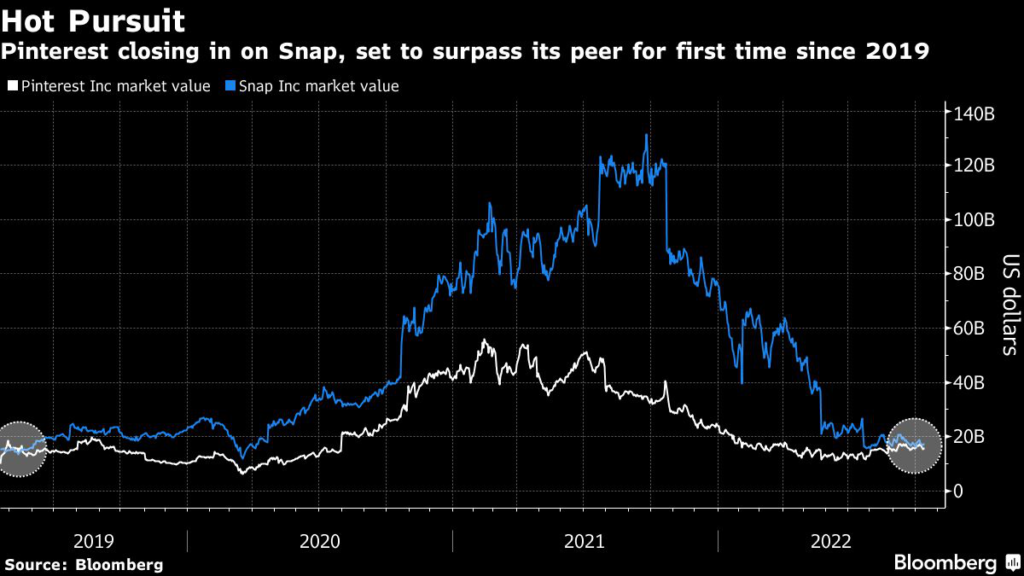
(Bloomberg) — Pinterest Inc. is slowly digging itself out of the hole that social media stocks find themselves in, leaving the owners of Facebook and Snapchat behind thanks to its greater reliance on search-driven advertising.

Shares in the digital pin-board platform have risen 34% from a two-year low in mid-June, as analysts note improving growth in the number of users on the site, as well as how much they’re interacting with content there. In the same period, Facebook parent Meta Platforms Inc. has tumbled 22% and Snap Inc. slipped 12%, through Wednesday’s close.  

Facebook and Snapchat rely more on targeting ads to users based on their activity on the site, a model that has become less effective following changes put in place by Apple Inc. last year on its iPhones for privacy reasons. Alphabet Inc.’s Google and Pinterest, meanwhile, are able to serve more ads linked to searches that users have done on the platforms. 

“Pinterest has been sitting out there with a lovely cash-flow-positive business and it is grinding out double-digit growth year after year,” said Robert Cantwell, who owns the stock in the actively managed Compound Kings ETF that he runs. “It is a disruptive asset with incredibly high margins, and when it hit a $12 billion valuation earlier this year, it started to look incredibly cheap.” 

One advantage the site has over rivals is that users often visit it with shopping in mind. Someone who’s say, renovating a kitchen and is searching for design ideas can be served ads for wall tiles or cabinetry. Pinterest has worked in recent years to help advertisers and retailers sell products directly on the site.

That interest in shopping is a unique element of the platform, said Eric Sheridan, an analyst at Goldman Sachs Group Inc., who raised his rating on the stock last week, citing improving user growth and better engagement trends.

Even after the rally from the lows, Pinterest shares are down 37% this year, and it’s still the smallest of the major social media companies, with a market value of $15.5 billion. The stock has been buoyed by occasional bouts of speculation that it will attract a buyout offer. 

The shares surged in August after the company reported resilient user numbers and activist investor Elliott Investment Management confirmed a major stake. Elliott said then that Pinterest has “significant potential for growth” and it supports new Chief Executive Officer Bill Ready. 

“The market is convinced that Pinterest cannot exist a stand-alone business and will be taken out at a premium,” said Tejas Dessai, analyst at Global X, a manager of the Global X Social Media ETF. “The likelihood of a deal could become much higher” if the company reports weak third-quarter results and gives disappointing guidance for the holiday quarter, he said. 

While the stock may have looked attractive at a $12 billion market value this year, the San Francisco-based company is no longer cheap relative to other social media companies. It trades trades at 4.9 times projected sales, compared to 3.3 times at Snap and 2.7 times for Meta, according to Bloomberg data. 

It’s not been easy year for a sector dependent heavily on online advertising, with a combination of headwinds weighing on the stocks over the past year: Apple’s software update has made targeting ads tougher, competition from new entrants like TikTok is on the rise and now fears of a looming recession are pressuring ad budgets.

The worsening environment have led analysts to slash their estimates multiple times this year. Over the past six months the average estimate for this year’s adjusted earnings per share has fallen by 42% and the revenue forecast has dropped by 10%, according to Bloomberg data. Still, the company is forecast to post 9% revenue growth this year and a 17% increase in 2023.

Tech Chart of the Day

The selloff this year that has pushed the Nasdaq 100 Index down by 34% has resulted in the evaporation of $6.5 trillion of market value for the companies in the tech-heavy gauge. There are now only 22 components of the benchmark with equity capitalizations of more than $100 billion, down from 34 at the end of last year. The Nasdaq 100 slipped 3% after the latest reading on inflation.

Top Tech Stories

  • Taiwan Semiconductor Manufacturing Co. slashed its 2022 capital spending target by roughly 10%, a dramatic sign of trouble for the technology industry from the world’s most valuable chip company.
    • The Biden administration’s new restrictions on doing business with China are sending shock waves through the global semiconductor industry, with chip-equipment makers girding for perhaps the most painful fallout.
    • Taiwan’s economic affairs minister downplayed the impact of new chip curbs on the island’s economy while urging investors to stay calm and believe in Taiwan Semiconductor Manufacturing’s resilience.
  • Amazon.com Inc. shoppers are largely skipping pricey purchases during the company’s Prime sale sequel — favoring pantry items and affordable gifts over big-ticket items like televisions and laptops.
  • Sony Group Corp. and Honda Motor Co. will target the premium electric vehicle market through their joint mobility venture in 2025, as the two try to gain ground in a field already crowded by earlier entrants such as Tesla Inc.
  • Apple is withholding its latest employee benefits from staff who work at its sole unionized retail store, a move that could potentially inflame labor tensions at the technology giant.
  • Toshiba Corp. soared after a report that a group led by Japan Industrial Partners Inc. expects to pay about 2.8 trillion yen ($19.1 billion) to buy out the iconic conglomerate.
  • US soldiers using Microsoft Corp.’s new goggles in their latest field test suffered “mission-affecting physical impairments” including headaches, eyestrain and nausea, according to a summary of the exercise compiled by the Pentagon’s testing office.

(Updates to market open.)

More stories like this are available on bloomberg.com

©2022 Bloomberg L.P.

Close Bitnami banner
Bitnami