Bloomberg

Korean Gaming Developer Lionheart Is Latest to Shelve IPO Plan

(Bloomberg) — Game developer Lionheart Studio Corp. said it withdrew its plan to sell shares in Seoul as it struggled to obtain desired valuation, becoming the latest South Korean company hit by a volatile market for initial public offerings. 

The company and its shareholders, including Kakao Games Corp., sought to raise as much as 604.2 billion won ($422 million) through the IPO slated to be priced early next month. If shares had been sold at the top of the marketed range, it would be South Korea’s second-largest listing this year. 

Apart from the giant $10.8 billion listing by LG Energy Solution in January, the number of IPOs and total proceeds raised in Seoul slumped in 2022 versus last year as fears of inflation and global monetary policy tightening roiled markets. In the first half, companies such as security-services provider SK Shieldus Co. and app-operator One Store Co. withdrew their offerings citing difficulty in obtaining desired valuations. 

Last month W-Scope Chungju Plant Co., a maker of battery parts used in electric vehicles, plunged 31% in its debut in Seoul even after cutting its IPO size by half. 

Kakaopay Corp., KakaoBank Corp. and Kakao Corp., the ultimate parent, are among the worst performers in the blue-chip Kospi 200 Index this year, down 80%, 72%, and 58% respectively. Kakao Games, which owns about 55% of Lionheart Studio, slumped about 60% this year to the lowest close since its debut in 2020. Kakao Games traded 1,300 won higher at 38,400 won in after-hour trading after the IPO withdrawal plan was announced.

The recent rout wiped out $65 billion in market value from the four Kakao stocks this year, according to Bloomberg calculations.

“It’s hard to justify Kakao’s market value as the company has split and listed its units including Kakaopay and KakaoBank,” said An Hyungjin, chief executive at the Seoul-based hedge fund Billionfold Asset Management. 

More stories like this are available on bloomberg.com

©2022 Bloomberg L.P.

Sony Honda to Make Premium EVs in North America From 2025

(Bloomberg) — Sony Group Corp. and Honda Motor Co. will target the premium electric vehicle market through their joint mobility venture in 2025, as the two try to gain ground in a field already crowded by earlier entrants such as Tesla Inc. 

Sony Honda Mobility Inc. will produce its EVs at Honda’s North American facilities, and sales and personal customization will take place primarily online, its Chief Executive Officer Yasuhide Mizuno said in a news conference on Thursday. The company will deliver cars to customers in North America first in 2026, with delivery in Japan to come in the second half of 2026, he said. Sales in Europe would be next.

The two Japanese firms joined forces this year, seeking to combine their strengths to catch up to rivals ranging from Tesla and Volkswagen AG to upstarts such as China’s Xiaomi Corp. and Taiwan’s Foxconn Technology Group. Sony expects the partnership will give it access to Honda’s decades-long expertise in car manufacturing, sales and servicing, while Honda seeks to tap its partner’s knowledge in entertainment, networking and sensors for autonomous vehicles.

Sony’s overall mobility effort includes Masayasu Ito, a former longtime hardware architect who oversaw the development of the PlayStation game console.

Sony Honda, which will procure materials for the cars mainly in North America, will host a showcase at CES in Las Vegas in January. Growing tech protectionism is prompting more manufacturers to seek locally sourced components. EVs are laden with a wide array of semiconductors, which have become the focus of a US-China technology race, with the US ratcheting up curbs on chip firms’ exports to China.

The company will consider less expensive EV models in the future and is not ruling out production in other regions in the future, Mizuno said.

“We want to create a team that can win overseas,” Sony Honda Mobility Chief Operating Officer Izumi Kawanishi said. “Software will be our strength, compared with our EV rivals.”

Shares in Sony, which has been hunting new sources of growth as it grapples with recession fears, closed down 0.5%. Honda rose 1% after the announcement.

(Updates with details and share price moves)

More stories like this are available on bloomberg.com

©2022 Bloomberg L.P.

Hong Kong’s BPEA in Talks to Join JIP’s Toshiba Bid, Sources Say

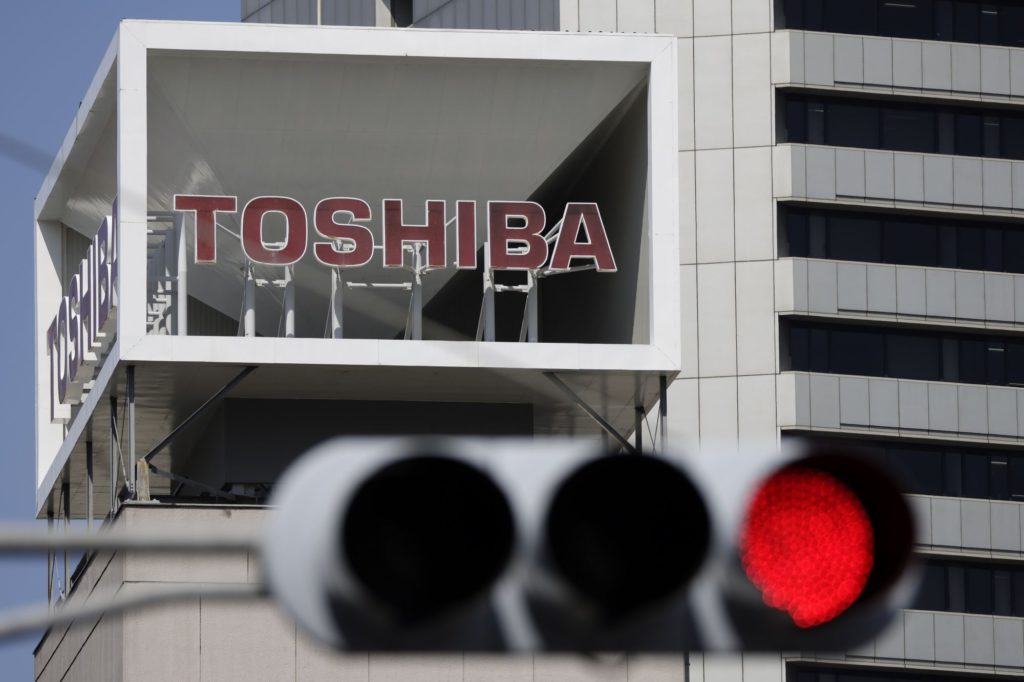
(Bloomberg) — Baring Private Equity Asia is considering joining a consortium led by Japan Industrial Partners Inc. for a buyout of Toshiba Corp., according to people familiar with the matter.

The Hong Kong-based investment firm is in talks with financial advisers as it evaluates the potential transaction, the people said, asking not to be identified as the matter is private. BPEA could join the JIP-led group as both an equity and debt investor, the people said.

Discussions are ongoing and the pan-Asian private equity fund — which itself is merging with Swedish investment firm EQT AB — could still decide against pursuing a deal, the people said.

Toshiba granted preferred bidder status to a consortium led by JIP for a buyout of the iconic Japanese firm, people familiar with the matter said this week. The Tokyo-based private equity firm is looking to acquire Toshiba in partnership with domestic companies including Orix Corp. and Chubu Electric Power Co. as well as global investment firms, they said. CVC Capital Partners is among those considering becoming part of the group, one of the people said.

Representatives for BPEA, CVC and JIP declined to comment. Midori Hara, a spokesperson for Toshiba, declined to comment on candidates or co-investors, saying to do so could undermine a fair process.

The Japanese conglomerate has solicited proposals to shape its future strategy, including potential buyout bids. Such a deal could be private equity’s largest ever in Japan. Aside from JIP, state-backed investment fund Japan Investment Corp. is leading a rival group, with other investors such as Bain Capital and MBK Partners in talks to be involved in its bid, Bloomberg News has reported.

BPEA in September raised $11.2 billion in total capital commitments in September for its eighth private equity fund, surpassing its $8.5 billion target and making it one of the largest ever funds raised by an Asian buyout firm. Founded in 1997 and led by Jean Eric Salata, the company has $22 billion of assets under management. Its merger with EQT is expected to close in the fourth quarter.

More stories like this are available on bloomberg.com

©2022 Bloomberg L.P.

TSMC Cuts Capital Spending 10% as China Curbs, Recession Weigh

(Bloomberg) — Taiwan Semiconductor Manufacturing Co. slashed its 2022 capital spending target by roughly 10%, a dramatic sign of trouble for the technology industry from the world’s most valuable chip company.

TSMC said it expects to spend about $36 billion in 2022 on capital equipment, down from at least $40 billion previously. The sharp reduction in expenditure, an indicator of its own expectations for growth, suggest the Taiwanese firm is bracing for a deeper-than-anticipated tech downturn.

The Biden administration’s new restrictions on doing business with China are sending shock waves through the global semiconductor industry. Applied Materials Inc. on Wednesday slashed its forecast for the fourth quarter, warning that the new export regulations will reduce sales by about $400 million in the period, while Intel Corp. is said to be preparing to fire thousands.

TSMC is also projecting revenue of $19.9 billion to $20.7 billion in the December quarter, though that assumes certain US dollar expectations at a time Asian currencies have weakened. 

Taiwan’s largest company is betting on its massive size and industry-leading manufacturing technology to navigate its biggest challenges in years. The US tightened chip trade controls over the weekend, leading to a broad selloff of semiconductor stocks and sending TSMC shares to their lowest in more than two years. Meanwhile electronics demand is slowing, hurt by rising interest rates, soaring inflation and concerns of a potential global recession.

Click here for a live blog of TSMC’s results.

The Biden administration measures limit the ability of companies that use US technology to sell products to China. The restrictions make it more difficult for chipmakers to move their inventories and hit TSMC more severely than previous such actions by the US, Fubon Research analysts led by Sherman Shang said in a note this week. The curbs mean about 5%-8% of TSMC’s total sales will likely be restricted, and it’s “very possible” that TSMC may push out its spending plans and lower its growth targets for the following years, they said. Bloomberg Intelligence estimates TSMC could lose more than 10% of its annual sales because of the restrictions.

TSMC’s net income rose to NT$280.9 billion ($8.8 billion) for the quarter through September, the company said Thursday in a statement. Analysts estimated NT$264.7 billion on average. Revenue jumped 48% to NT$613 billion, as previously reported. Its shares have tanked this week, taking its market capitalization to about $320 billion from more than $550 billion in January.

Hsinchu, Taiwan-based TSMC is the world’s largest contract chipmaker, producing for the likes of Qualcomm Inc., Apple Inc. and Nvidia Corp., all of which sell a significant portion of their products into the Chinese market. The Taiwanese firm, which gets about 10% of its revenue from China-based customers, may need to scale back its aggressive investment and growth plans if it has to pull back from certain customers.

The US measures include restrictions on the export of some types of chips used in artificial intelligence and supercomputing, and also tighter rules on the sale of semiconductor equipment to any Chinese company.

The outlook for the electronics industry had already begun to darken. Macroeconomic shocks have suppressed consumer demand and business spending, while unsold inventory among PC vendors built up. Third-quarter shipments of desktop and laptop computers slumped 15%, according to IDC data, and chip companies like Advanced Micro Devices Inc. have said they were surprised by the speed and sharpness of the downturn in demand. Memory makers Micron Technology Inc. and Kioxia Holdings Corp. have announced cutbacks in output of as much as 30% to try and stabilize prices.

TSMC can’t even rely on sustained demand for products of Apple, its main customer, whose growth has benefited the Taiwanese manufacturer for years. While the California company has launched new types of chips to boost the performance of its devices, it has recently backed off plans to increase production of its new iPhones, raising further questions about underlying electronics demand.

More stories like this are available on bloomberg.com

©2022 Bloomberg L.P.

African Exports Seen Doubling on Asian Shipments, StanChart Says

(Bloomberg) — Africa’s annual exports are expected to double to $540 billion by 2030 from a decade earlier, chiefly on shipments from Nigeria to the Asian nations of India, Indonesia and mainland China, and links between Kenya and Pakistan, according to Standard Chartered Bank Plc.

“There’s a number of macro-economic dynamics that are creating a lot of demand — new marketplaces, newer more progressive organizations,” said Ricky Kaura, the bank’s regional head of transaction banking in Asia Pacific, Africa and the Middle East. 

India will be the largest and fastest-growing importer for Nigerian shipments, which are seen reaching $112 billion by 2030 from $44 billion in 2020. Indonesia and mainland China will also remain key markets for Africa’s biggest economy, accounting for 12% and 10% of exports respectively by 2030, Kaura said. 

Kenyan exports to Pakistan — which have been predominantly tea — are expected to climb 11% annually to $1 billion by 2030. In the decade through 2030, shipments from East Africa’s largest economy are projected at $10.2 billion from $4.9 billion, lifted by shipments to Uganda and the US, which will account for about 11% and 9% respectively.  

Many companies are localizing and shortening supply chains after getting caught out by the pandemic, Kaura said. They are setting up new production facilities in Africa to be closer to markets and to enjoy the benefits of trade bloc agreements, he said. 

In response, Standard Chartered is providing more digital settlement solutions as clients seek more convenient payment options.

“One of the things that the pandemic created was an urgency with our clients to have a larger acceptance of digital,” Kaura said.

More stories like this are available on bloomberg.com

©2022 Bloomberg L.P.

Equities Under Pressure Ahead of Key US CPI Data: Markets Wrap

(Bloomberg) — Shares continued their declines and currencies fluctuated amid caution in markets as investors awaited highly anticipated US inflation data later Thursday. 

Stocks fell in Japan, Hong Kong and South Korea, along with European futures. US contracts fluctuated after a sixth consecutive decline for the S&P 500, which fell to the lowest level since November 2020. 

The dollar held on to recent gains and the yen steadied near a fresh 24-year low that has put traders on watch for intervention from Japan. 

Investors are on tenterhooks as they await consumer price figures that may determine if the Federal Reserve delivers a fourth-straight outsized hike in interest rates, piling more pressure on an already struggling world economy. Minutes released on Wednesday from the Fed’s last meeting suggested some officials considered reducing the pace of rate hikes, which triggered a brief surge on Wall Street that quickly unwound.

“The Fed is not going to blink,” James Ashley, head of international market strategy at Goldman Sachs Asset Management, said on Bloomberg Television. “If they’re going to make a mistake, they would far rather err on the side of being too hawkish.”

Yen traders prepared for a spike in volatility when the CPI report lands. The currency fell 2% minutes after last month’s release. The offshore yuan inched lower. Investors speculated that Chinese authorities are employing a tactic used in 2019 to steady the currency.

Japan’s benchmark 10-year bond traded for the first time in a week on Thursday about six hours after the market opened. The yield held at 0.245%, just below the upper end of the BOJ’s accepted range. 

The pound declined slightly in Asia after a busy day of bond buying from the Bank of England, which reiterated the view that its emergency support for the gilt market would cease on Friday, contradicting a media report that suggested it could endure. UK pensions were found offloading assets around the world to shore up liquidity ahead of the move.

The Biden administration is considering adding aluminum to economic sanctions against Russia. Shares in Rusal, the Russian aluminum giant that has a listing in Hong Kong, fell sharply. Vladimir Putin said any energy infrastructure in the world is at risk after the explosions on the Nord Stream pipelines. Oil fell.

“The Fed needs data to start finding an off-ramp,” Carol Schleif, deputy chief investment officer at BMO Family Office, said on Bloomberg Television. “That’s a tough market to be in. Until we get a bunch more data, markets will have to figure out how to find their footing.”

Key events this week:

  • Earnings this week include: JPMorgan Chase & Co., Citigroup Inc., Morgan Stanley, BlackRock Inc., Delta Air Lines Inc., UnitedHealth Group Inc., U.S. Bancorp, Wells Fargo & Co.
  • US CPI, initial jobless claims, Thursday
  • G-20 finance ministers and central bankers meet, Thursday
  • China CPI, PPI, trade, Friday
  • US retail sales, business inventories, University of Michigan consumer sentiment, Friday
  • BOE emergency bond buying is set to end, Friday

Some of the main moves in markets:

Stocks

  • Futures on the S&P 500 were steady as of 6:58 a.m. London time. The S&P 500 fell 0.3%
  • Futures on the Nasdaq 100 were little changed. The Nasdaq 100 fell 0.1%
  • The Topix Index fell 0.7%
  • The S&P/ASX 200 fell 0.1%
  • The Hang Seng Index fell 1%
  • The Shanghai Composite Index rose 0.1%
  • Euro Stoxx 50 futures fell 0.5%

Currencies

  • The Bloomberg Dollar Spot Index was little changed
  • The euro was little changed at $0.9705
  • The Japanese yen was little changed at 146.89 per dollar
  • The offshore yuan fell 0.1% to 7.1830 per dollar

Cryptocurrencies

  • Bitcoin fell 0.4% to $19,102.11
  • Ether fell 0.8% to $1,288.58

Bonds

  • The yield on 10-year Treasuries advanced two basis points to 3.91%
  • Japan’s 10-year yield was at 0.245%
  • Australia’s 10-year yield advanced six basis points to 4.00%

Commodities

  • West Texas Intermediate crude was little changed
  • Spot gold fell 0.2% to $1,670.45 an ounce

More stories like this are available on bloomberg.com

©2022 Bloomberg L.P.

TSMC Is Likely to Miss Its Own Capital Spending Projection

(Bloomberg) — Taiwan Semiconductor Manufacturing Co. looks increasingly likely to miss its own forecast of reaching at least $40 billion in capital spending. 

This year, it invested $25.5 billion over three quarters, or an average of about $8 billion a quarter. It would have to hit more than $14 billion to reach the low end of its projected range.

TSMC, the world’s most valuable chipmaker, said earlier that it planned to spend near the lower end of a $40 billion to $44 billion range on capital equipment, but the industry has since hit a market downturn with slowing demand for personal computers, smartphones and other gear.

TSMC reported net income rose to NT$280.9 billion ($8.8 billion) for the quarter through September, compared with analysts’ estimates of NT$264.7 billion on average. 

More stories like this are available on bloomberg.com

©2022 Bloomberg L.P.

US Chip Moves Offer Opportunities for Allies, Rahm Emanuel Says

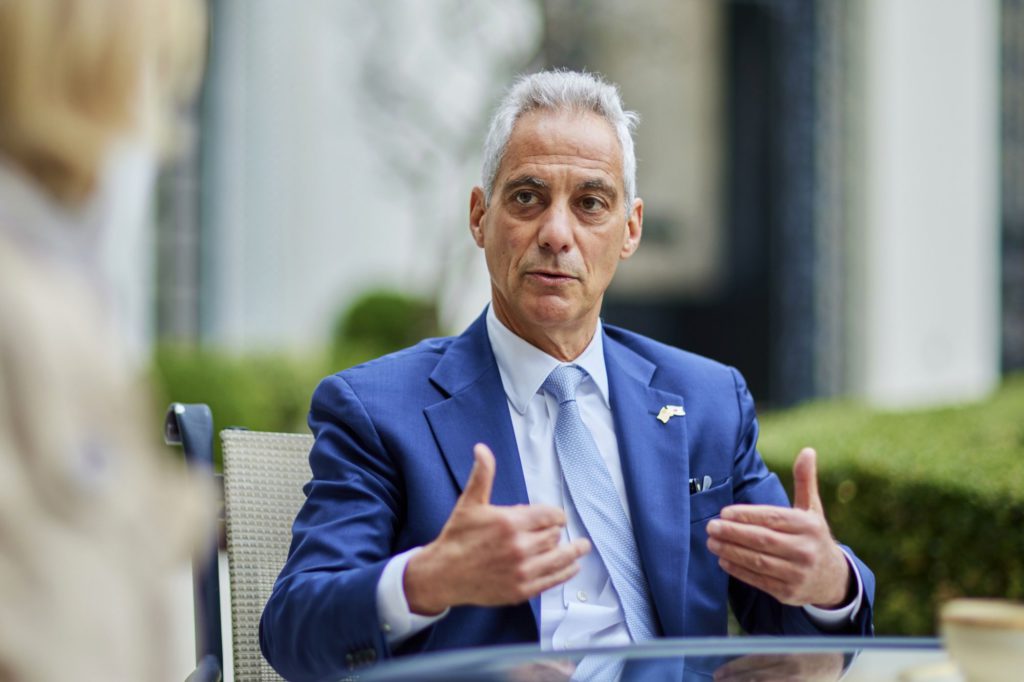
(Bloomberg) — President Joe Biden’s moves to reorient chip supply chains present business opportunities for allies in line with US national security interests, according to Rahm Emanuel, the American ambassador to Japan.

“There’s a group now meeting with our commerce secretary to understand the opportunities that exist from that Chips act,” Emanuel, a longtime Democratic Party insider and former Chicago mayor, told Bloomberg Television Thursday, referring to a $50 billion law designed to bolster domestic chip production. Companies from Japan and elsewhere could expand their footprint in the US or for research and development, he added.

The US last week unveiled expanded curbs on access to chips technology, part of a yearslong campaign to hamper China’s ability to develop the most advanced semiconductors and equip its military. Given the highly interdependent nature of the industry’s global supply chain, the announcement sent shockwaves across the sector, including in US-friendly countries with chip-equipment makers and technology providers.

That decision was “appropriate for the United States to do because it’s part of our national security self interest,” Emanuel said. “Our allies understand that and also want to be part of that future. And that’s America realizing and using not only its investment but doing it from a strategic perspective, where our allies can be our partner of that effort.”

Read more: Chip Industry Braces for ‘Heavy Blow’ From China Export Curbs

The US will also seek to resolve any issues with allies that might be caught up in the restrictions on doing business with China before taking any retaliatory action, the ambassador said.

“You work with allies before you ever get to the level of punishment,” Emanuel said. Japan has an “incredible leadership role” in the semiconductor supply chain, he added. 

China is pouring billions of dollars into developing a domestic semiconductor industry that’s less dependent on the rest of the world, but those chipmakers still need to purchase highly specialized equipment from suppliers in the US, Europe and other parts of Asia.

Read more: China Says Biden’s New Chip Technology Curbs Will Harm Recovery

In the arena of electric vehicles and battery manufacturing, Japanese companies are stepping up investments in the US to build out capacity, Emanuel said. They’ve been attracted by US resources, labor, energy security and climate policies, he added.

“For a long time, the United States was basically idling and neutral,” Emanuel said. “We’re now seizing the future and major companies from Japan are investing that future in the United States, where we will continue to be the dominant leader in the transition to a more energy efficient and a more energy capable transition that’s climate friendly, and job friendly.”

Honda Motor Co. and Korea’s LG Energy Solution Ltd. are planning to spend $4.4 billion to build electric-vehicle batteries at a new joint venture in Ohio, part of a project by the automaker to start EV production at its plants in the state.

Panasonic Corp. is investing in a battery production site that’s expected to cost $4 billion, part of its efforts to ramp up production capacity to meet growing demand from Tesla Inc. and other EV makers. 

“Our abundance of energy and a portfolio from nuclear to natural gas to renewables also give private companies the security, the reliability to make those type of investments that don’t exist around the world,” Emanuel said.

More stories like this are available on bloomberg.com

©2022 Bloomberg L.P.

Heirs to Richest Turks Put Fortunes Into Tech at Riskiest Moment

(Bloomberg) — As the eldest son of Turkey’s richest man, Yahya Ulker was destined to take over his family’s multi-billion dollar business. But the 29-year-old opted for a different path, supporting local startups and venture capitalists.  

After completing a business degree and a stint at Credit Suisse Group AG, he started to dabble in venture capital instead of taking up an executive role at Yildiz Holding AS, the world’s third-largest snack maker that’s been in his family for 78 years. His father, Murat Ulker, owns international brands such as Godiva chocolates and McVities biscuits, and has a net worth of $4.7 billion, according to Forbes. 

In 2019, Yahya Ulker set up Yildiz Ventures with $50 million to invest directly into startups and venture capital funds. The firm has since backed several e-commerce startups including Istegelsin and VC funds such as Germany’s Earlybird Venture Capital and Turkey’s Revo Capital. He is now targeting “at least a two-fold growth in all investments” — a favorable return in a country where rampant inflation is at the highest level for more than two decades and a plummeting currency is impacting deals. 

Yildiz Ventures needs to act in “an agile and courageous way” as the business environment is “changing rapidly,” Yahya Ulker said in a recent phone interview. The company is “focusing on startups in the e-commerce, retail and food sectors so that we can set a basis for creating synergies with the main businesses of Yildiz Holding.”

Private Wealth

Yahya Ulker is one of many third-generation heirs to some of Turkey’s biggest conglomerates opting for a less-traditional route to spend their fortunes. The emergence of the nation’s private wealth as a force in venture capital is timely as rising interest rates, market upheaval and a global slowdown in funding threaten the prospects of an industry after a boom in 2021.

Global venture funding slumped to $74.5 billion in the past three months, its lowest level in nine quarters, according to CB Insights. That represents a 34% quarterly drop, the biggest in a decade.

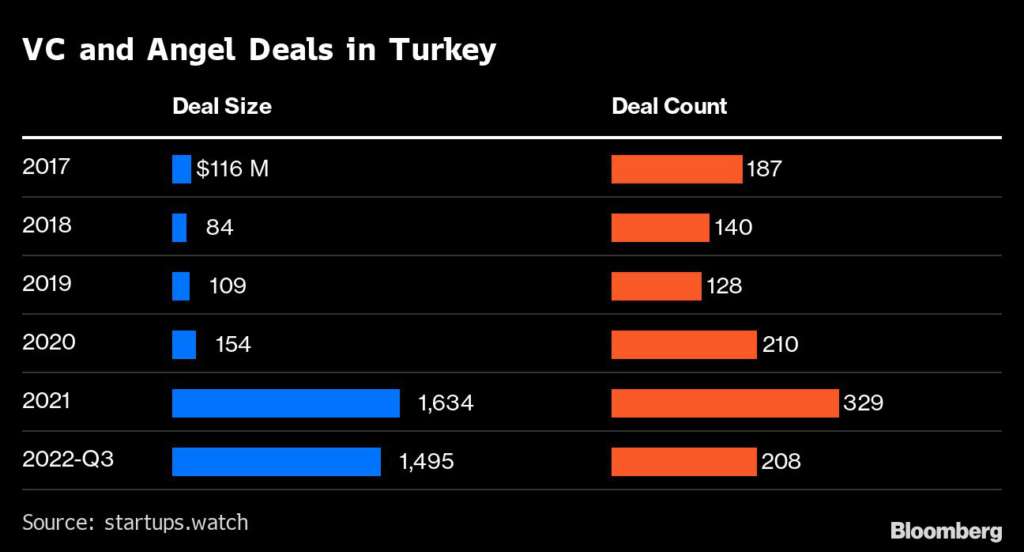
By contrast, Turkish startups attracted a record $1.5 billion in investments from venture capital funds, private equity funds and family offices in the first nine months of the year, up from $1.44 billion a year earlier, according to data from startups.watch. 

Turkish venture capital funds, meanwhile, raised more than three-quarters of last year’s total amount in the first half of 2022, according to startup data platform Magnitt. The number of corporate or family office-led venture capitalists in the country has more than quadrupled over the past six years.

“Turkey’s holding companies and family offices’ engagement in the venture capital asset class is experiencing a boom,” said Cem Kemal Mimaroglu, founder of New York-based ComposeVC. The country’s venture capital ecosystem is a “late-follower” because of “rather conservative and vision-constrained corporate culture and unpredictable economy.” 

Windfall

Deep-pocketed Turkish conglomerates could become a source of financial backing to rival some of the biggest global investors after a combination of cheap labor, economic growth and consumer spending have generated a windfall for the nation’s biggest companies that they are eager to spend. The nation’s largest conglomerate Koc Holding AS had $40 billion in sales in 2021, or 5% of Turkey’s gross domestic product, while Yildiz Holding had $5.4 billion.

The surge in VCs is largely due to companies seeking to benefit from tax breaks if they set up local VC funds that mainly invest in Turkey. “As a result, the local VC ecosystem has been seeing an increased dollar supply and a relative rise in valuations,” said Mimaroglu.

Koc Holding in 2010 set up the nation’s largest CVC fund Inventram with $110 million to invest. Hanzade Dogan Boyner, the founder of Nasdaq-listed online marketplace hepsiburada.com, set up a $100-million London-based fund D4 Ventures, while Inci Holding’s Vinci VC has raised $50 million since it was set up in 2018.

“While global valuations and investments are re-calibrated in 2022, Turkish startups are riding on the previous era’s waves,” said Mimaroglu. “Valuations and investments are coming down but at a much slower rate and pace than Europe and the US.”

Following the Getir, Insider and Dream Games mega deals early in the year, funding fell off sharply. As a result, Turkish VCs saw the biggest drop in the second quarter from the first three months compared with other emerging venture markets that Magnitt covers, according to Philip Bahoshy, chief executive officer of Dubai-based Magnitt.

Despite challenges such as layoffs and falling share prices, many of Turkey’s startups have been able to secure the backing of some of the world’s biggest investors.

In the nation’s biggest deal so far this year, grocery delivery app Getir raised $768 million from investors including Mubadala Investment Co., Sequoia and Tiger Global Management, giving it an $11.8 billion valuation. E-commerce platform Trendyol became Turkey’s largest startup with a $16.5 billion valuation after it received $1.5 billion from investors including Softbank Group Corp. and Abu Dhabi’s ADQ. 

All of this investment is translating into deals. Getir is said to be in advanced talks to buy rival Gorillas Technologies GmbH, which would give the Turkish firm scale in key European markets including the UK and Germany. Finberg, a corporate VC fund set up by billionaire Husnu Ozyegin’s Fibabanka in 2018, reaped a return of at least 10 times its initial investment in Getir and Turkish payment startup United Payment in two partial exits, according to Finberg board member Ihsan Elgin.

Whatever the venture capital structure is, you have the potential of making in a few years the same money that traditional companies make in decades, according to Serkan Unsal, founder of startups.watch. “This is whetting the appetite of large conglomerates and family offices.”

More stories like this are available on bloomberg.com

©2022 Bloomberg L.P.

Pensions Chaos Deepens Fears Over UK Shadow Banking Risks

(Bloomberg) — With uncanny timing, the Bank of England’s quarterly review of the risks facing the banking system landed during a fresh bout of market panic.

Wednesday morning’s financial policy summary expressed confidence in the resilience of traditional banks to weather a downturn. Of greater concern was the shadow banking system, the industry of lenders, brokers and other intermediaries that fall outside the realm of traditional regulated banks. 

“The vulnerabilities exposed by the gilt market dysfunction share characteristics with those in the non-bank financial system,” the central bank’s report said. It is crucial to boost “the resilience of non-bank financial institutions globally to sharp reductions in asset prices and liquidity.”

Such concerns echoed Governor Andrew Bailey’s call in a speech Tuesday for tougher standards for the non-bank financial sector, which made up about half of all global financial assets — some $227 trillion — in 2020, the Financial Stability Board said in a report in December.

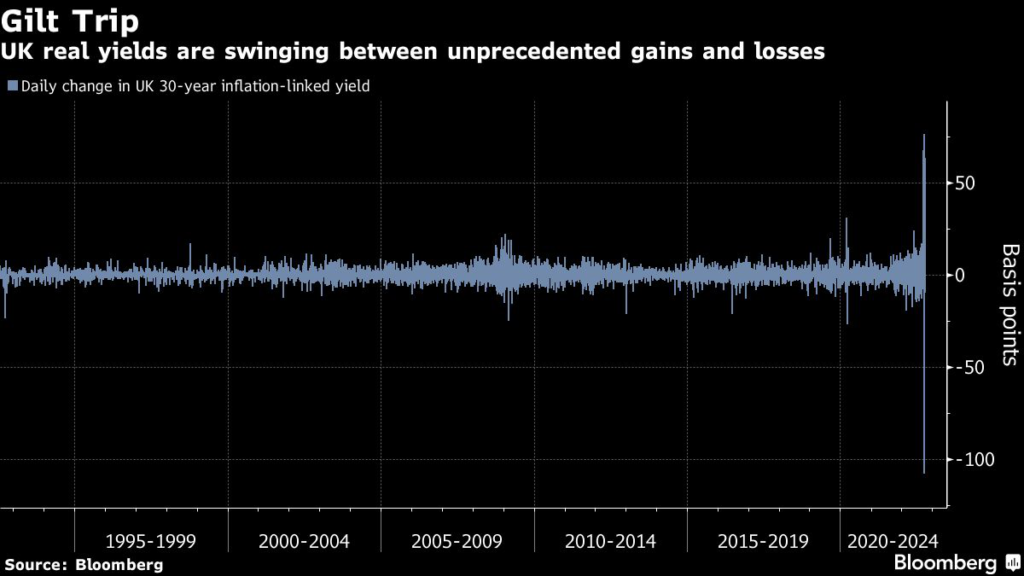
Regulators have worried about this opaque market for years but such fears have sharpened over the past couple of weeks after the UK government announced a package of unfunded tax cuts. That caused chaos in a little-known corner of the pensions market as funds dumped government and corporate bonds to cover their derivative positions.

Read More: How ‘Liability-Driven’ Funds Triggered UK Bond Panic: QuickTake

With the Bank of England seemingly determined to end its emergency bond-buying program on Friday, the turmoil is unlikely to ease. That could spill over into the wider shadow banking system already hurting from higher interest rates.

Former UK Prime Minister Gordon Brown told the BBC last week that more trouble lies ahead. 

“As inflation hits and interest rates rise, there will be a number of companies, a number of organizations that will be in grave difficulty, so I don’t think this crisis is over because the pension funds have been rescued,” he said. “There’s got to be eternal vigilance about what has happened to what is called the shadow banking sector, and I do fear that there could be further crises to come.”

Shadow Banking

Shadow banking is a catchall phrase that encompasses hedge funds, risky investment products, pawnshop and loan-shark operations and so-called peer-to-peer lending between individuals and businesses. The common denominator is that these products and practices flourish outside the regular banking system and often beyond the reach of regulators. 

Critically, they raise short-term funds and buy assets with longer-term maturities. The mismatch was a source of concern well before the mini-budget, drawing the attention of regulators worldwide. The Financial Stability Board said in a review last year that the market mayhem at the start of the pandemic in March 2020 had highlighted vulnerabilities in the sector, and exposed the interconnectedness of shadow banks and traditional lenders. 

Read More: Shadow Banking Is Booming Outside Regulators’ Grip: QuickTake

At the heart of the turmoil this time have been a little-watched cornerstone of UK pension funds, which manage more than $1 trillion in assets. These funds have offloaded all kinds of holdings in recent weeks to meet margin calls on derivatives they used to help ensure they have enough money to pay retirees decades in the future. 

The UK pension industry has operated through years of declining interest rates but rising rates are now the new normal, said Scott Peng, founder and CEO of Advocate Capital Management LLC. That has left the industry blindsided to the impact of tighter monetary policy. “This is the first time in over a decade that the UK LDI risk management framework has really been stress-tested and it did quite poorly,” he said. “This should result in a serious review of pension risk and liquidity management.” 

Multi-asset funds too are also a casualty of the pension industry’s dash for cash. Funds run by major asset managers, including Aviva Plc and Schroders Plc, have recorded hundreds of millions of pounds in net outflows since Sept. 23, when the UK government announced a package of unfunded tax cuts that sent the price of gilts tumbling.

Other entities or asset classes that rely on leverage may also find themselves in the spotlight, according to Howard Davies, chairman of NatWest Group Plc and former deputy governor of the central bank. Investment funds, hedge funds and private equity have all spent years in a world of low interest rates and the adjustment to higher rates could set off turbulence.

Property, Cars

The travails in the shadow banking world may spill out into the wider economy, given shadow banking firms now play significant roles in markets from real estate to car finance.

“Just as you’ve seen some marginal players in the mortgage markets pulling out because their wholesale funding isn’t available, I think you’re going to see that in other parts of shadow banking,” Davies said on Bloomberg Television Wednesday. He said he’d pay particular attention on those areas that are dependent on short-term funding.

That might include home loan providers outside of the traditional banks, a blow to an already squeezed housing market that’s seen mortgage costs spike, products pulled and caused some house sales to collapse. 

Still, history suggests it will be difficult to predict where the crunch will come from.

“It’s the pattern of all financial crises for hundreds of years,” Charlie Parker, managing director at boutique investment manager Albemarle Street Partners, said. “It’s always the bit of the market you’re least focused on.”

More stories like this are available on bloomberg.com

©2022 Bloomberg L.P.

Close Bitnami banner
Bitnami