Bloomberg

UK Delays Interim Huawei Ban After Carriers Warn About Outages

(Bloomberg) —

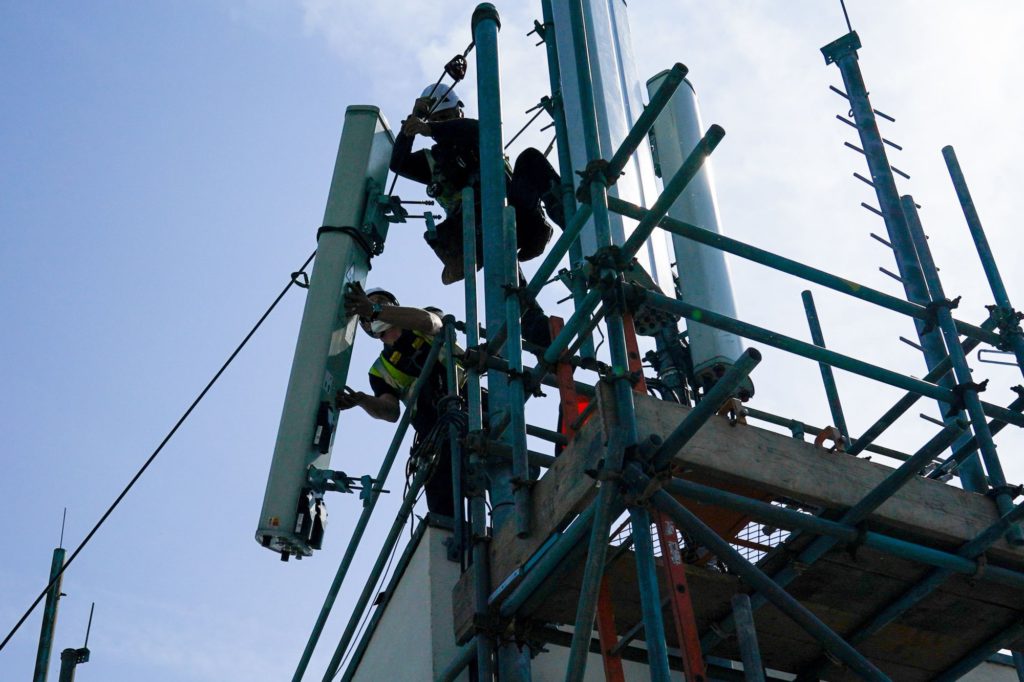
The UK delayed restrictions on Huawei Technologies Co.’s use in broadband networks after BT Group Plc said the original deadline could lead to outages. 

The restriction on Huawei’s use in network cores — which manage sensitive data and tasks, including security and control functions — will now go into effect in December 2023 rather than January, the UK Department for Digital, Culture, Media and Sport said in a statement on Thursday. 

A cap on Huawei’s use in the fiber access networks was also moved to October 2023 from July, the department said. The ultimate deadline, to remove Huawei from the country’s 5G networks by the end of 2027, is unchanged. 

The original interim deadlines “could have led to network outages and disruption for customers, due to delays caused by the pandemic and global supply chain issues” for a small number of operators, the DCMS said in the statement, adding that companies should strive to meet the original targets wherever possible.

Read More: BT’s $700 Million Job to Rip-And-Replace Huawei 5G Begins Here

The government made rules restricting the use of Huawei’s components in telecom networks legally binding in a letter to 35 operators on Thursday. The department said that following US sanctions, it’s become too difficult to verify the security of Huawei’s components. 

BT, the country’s biggest telecom network operator, said in June that it had asked for more time to replace Huawei’s equipment because of supply chain concerns. Huawei said it’s disappointed in the UK’s decision and has consistently denied that its components aren’t secure. The Chinese company said it works closely with operators and has submitted itself to a high level of government scrutiny. 

More stories like this are available on bloomberg.com

©2022 Bloomberg L.P.

Millennials and Gen Z Are Fueling a Boom in the Second-Hand Watch Market

(Bloomberg) — The pre-owned luxury watch segment will surge by 75% by the end of this decade, accounting for nearly half of the overall market, with younger buyers fueling the trend, according to a report.

Annual sales of second-hand watches will jump to 35 billion Swiss francs ($35 billion) by 2030 from 20 billion francs now, consulting firm Deloitte said in an industry report that surveyed consumers and watch brand executives. 

The boom in high-end used timepieces has led watchmakers such as Richemont to expand in the segment with its acquisition of Watchfinder. Deloitte expects more brands to launch their own secondary-market sales channels to capture more share and buy back stock to manage supply. The Deloitte report also predicts that established second-hand sales platforms, including Chrono24, Subdial, Watchbox and Hodinkee, will continue to expand. 

“The growth potential for the pre-owned market is enormous,” said Karine Szegedi, the head of consumer, fashion and luxury at Deloitte Switzerland. 

The study also heralds an acceleration of trends currently shaping the Swiss industry and global luxury watch market. It predicts a jump in the number of watches sold online compared to traditional retail outlets, a further shift by brands to more expensive products and a market driven by younger consumers who view luxury timepieces as investments. 

Interest in luxury watches surged during the pandemic as housebound consumers, flush with cash from lack of travel and dining out, began lusting over fancy timepieces online. Prices for pre-owned Rolex, Patek Philippe and Audemars Piguet timepieces soared to record levels before falling back sharply beginning in April as cryptocurrency values and stock markets declined. 

The Subdial50 Index, which tracks global market prices for the 50 most traded luxury watches by value, has fallen by 18% in the past six months. Still, Deloitte says the price pullback does not mean the secondary market is shrinking.

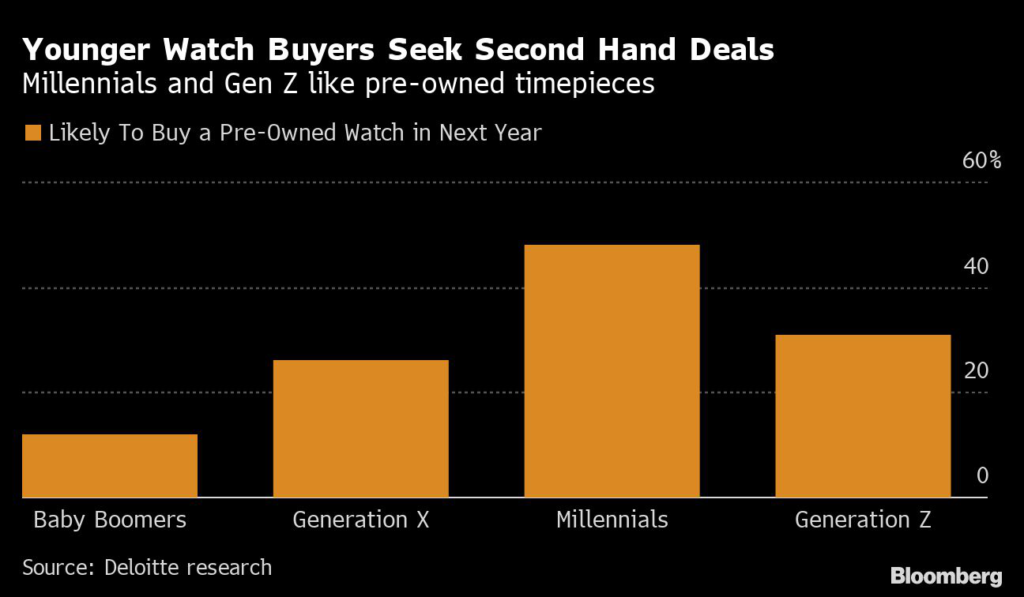
Younger buyers born in the Millennial and Gen Z eras are more likely to purchase second-hand watches, as they are more comfortable with buying pre-owned items online and are looking for cheaper prices, according to the report. Almost half of Millennials said they would likely buy a second-hand watch in the next year, compared to just 12% of Baby Boomers.

“Our audience is so different than who you assume a traditional watch buyer to be,” Ben Clymer, the founder of online watch news and retail website Hodinkee said in the report. “They’re much younger, they’re buying and selling watches much more often, and they care about pre-owned.” 

More stories like this are available on bloomberg.com

©2022 Bloomberg L.P.

India Car Sales Jump 92% on Pent-Up Demand Ahead of Holidays

(Bloomberg) — Sales of cars and SUVs in India soared 92% in September from a year earlier, driven by demand in major cities ahead of the festival season as pandemic restrictions eased. 

Data from the Society of Indian Automobile Manufacturers showed sales of passenger vehicles totaled 307,389 last month, compared with 160,212 in September 2021. Car sales climbed 122% to 142,727 units, while SUVs rose 73% to 151,759. Van sales totaled 12,903. 

“A combination of good urban demand and pent-up demand is reflected in the sales,” SIAM Director General Rajesh Menon said in New Delhi on Thursday. 

The Federation of Automobile Dealers Associations of India said earlier in October that passenger vehicle sales could be the highest in a decade this festive period. Diwali will fall on Oct. 24. 

The big jump in sales came from a low base, given the Covid situation in India a year ago, SIAM President Vinod Aggarwal said. “That is why we see better growth rates.”

While demand was strong in cities, vehicles remain unaffordable to many in India, particularly now that automakers are passing on higher input costs to consumers. About 65% of India’s population lives in rural areas. 

“Interest rates are going up, compressed natural gas prices are increasing, inflation is also high,” Aggarwal said. “There is pain in entry-level segment. Costs have significantly gone up.”

Sales of scooters, a preferred mode of transport in much of India, increased 13% to 1.74 million from a year earlier. 

More stories like this are available on bloomberg.com

©2022 Bloomberg L.P.

Microsoft’s Army Goggles Left US Soldiers With Nausea, Headaches in Test

(Bloomberg) — US soldiers using Microsoft Corp.’s new goggles in their latest field test suffered “mission-affecting physical impairments” including headaches, eyestrain and nausea, according to a summary of the exercise compiled by the Pentagon’s testing office.

More than 80% of those who experienced discomfort had symptoms after less than three hours using the customized version of Microsoft’s HoloLens goggles, Nickolas Guertin, director of Operation Test and Evaluation, said in a summary for Army and Defense Department officials. He said the system also is still experiencing too many failures of essential functions.

The problems found in the testing in May and June were outlined in a 79-page report this month. The Army marked it “Controlled Unclassified Information” to prevent public distribution, but Bloomberg News obtained a summary.

Despite the device’s flaws, Guertin doesn’t deem it a lost cause. He recommended that the Army “prioritize improvements” before widespread deployment to reduce the “physical discomfort of users.” He said improvements are also needed to the goggle’s low-light sensors, display clarity, field of vision and poor reliability of some essential functions.

On the positive side: The latest model’s reliability has improved for a key metric — the mean time between failures that render the whole system inoperable, according to the report. Leaders and soldiers also reported that the latest version “enhanced navigation and coordination of unit movements,” Guertin wrote.

Microsoft’s Integrated Visual Augmentation System, or IVAS, is expected to provide a “heads-up display” for U.S. ground forces, similar to those for fighter pilots. It would let commanders project information onto a visor in front of a soldier’s face and would include features such as night vision. The Army projects spending as much as $21.9 billion over a decade on the goggles, spare parts and support services if all options are exercised.   

The test results will be closely assessed by lawmakers as they decide whether to approve $424.2 million the Army proposed to spend on the program this fiscal year. The House and Senate appropriations panels separately proposed deep cuts to the Army’s request pending the outcome of the testing.

One finding that may give members of Congress pause: Acceptance of the goggles by soldiers “remains low” and they and their leaders indicated they don’t “contribute to their ability to complete their mission.” The exercise represented the fifth “Soldier Touch point” test of the system, a widely praised Army initiative to get soldiers’ feedback early in the acquisition process.

Microsoft, which wasn’t given a copy of the test results, said in a statement that “our close collaboration with the Army has enabled us to quickly build” and modify the device “to develop a transformational platform that will deliver enhanced soldier safety and effectiveness. We are moving forward with the production and delivery of the initial set” of devices.

Doug Bush, the Army’s assistant secretary for acquisition, said in a statement that the service “conducted a thorough operational evaluation” and “is fully aware” of the testing office’s concerns. The Army is adjusting the program’s fielding and schedule “to allow time to develop solutions to the issues identified,” he said.

He said the Army believes the finding that the goggles cause “physical impairment” overstates that issue but is pursuing “significant improvements to address soldier concerns regarding comfort and fit.”

In August, Bush cleared the Army to begin accepting some of the initial 5,000 sets of goggles produced but on hold, saying that the service “is adjusting its fielding plan to allow for time to correct deficiencies and also field to units that are focused on training activities.”

Asked why the Army directed the test office to label the report “Controlled Unclassified Information,” Bush said the service “followed appropriate DoD guidance on classification.”

More stories like this are available on bloomberg.com

©2022 Bloomberg L.P.

Ukraine Latest: Russia Strikes Kyiv Region With Iranian Drones

(Bloomberg) — The Kyiv region — although not Ukraine’s capital itself — was struck by Iranian-made drones on Thursday morning as air raid sirens rang out across much of the country for a fourth morning. Air strikes continued in the south, including Mykolaiv, where a multi-story apartment building was destroyed. 

Ukraine’s allies in Brussels for a NATO defense ministers’ meeting are expected to offer more air defense capabilities for Ukraine in the face of Russia’s stepped-up missile strikes. The UK on Thursday pledged Amraam rockets capable of shooting down cruise missiles. Turkish President Recep Tayyip Erdogan will meet Thursday with Russia’s Vladimir Putin in Kazakhstan. 

The United Nations General Assembly condemned Russia’s annexation of four Ukrainian regions in a symbolic vote that nonetheless exceeded western expectations for how much support the measure would receive. The vote was 143-5, with 35 nations, including India and China, abstaining. 

(See RSAN on the Bloomberg Terminal for the Russian Sanctions Dashboard.) 

Key Developments

  • White House Weighs Retaliatory Ban on Russian Aluminum
  • Putin Says All Infrastructure at Risk After Nord Stream Hit 
  • Russia Sends More Fuel to Army In Ukraine Amid Mobilization
  • NATO Countries Back German Plan for European Anti-Missile Shield
  • Europe Steps Up Defense of Energy Assets With Show of Force

On the Ground

Russia delivered missile and drone strikes on more than 40 settlements overnight, notably the Makariv municipal territorial community in Bucha district to the northwest of the capital. Other cities including Mykolaiv, Vinnytsya and Cherkasy also sustained damage, Ukraine’s military said. Nikopol in the Dnipropetrovsk region was shelled, mostly from Grad systems, for a second consecutive night, the president’s office said: a residential district was targeted including private buildings, stores and a hospital. Russia’s troops are struggling to stem Kyiv’s counteroffensive in the areas they seized from Ukraine and to break through near Bakhmut and Avdiyivka in Donetsk region, according to Ukraine’s military staff, which also said some Russian troops are getting orders to halt their offensive due to problems with low morale and mass desertion. The claims can’t be verified. 

(All times CET)

European Gas Prices Whipsaw After Putin Infrastructure Comment (11 a.m.) 

European natural gas swung as anxiety mounted over the safety of infrastructure that’s key to ensuring supply to the continent.

Traders are on edge with Russian President Vladimir Putin saying any energy infrastructure in the world is at risk after the recent Nord Stream explosions.  

Another Six Grain Ships Depart (10:46 a.m.) 

Six vessels carrying a total of 154,000 tonnes of Ukrainian grain sailed early Thursday, taking total foodstuffs shipped under the safe-transit deal brokered by Turkey and the UN for three Black Sea ports to almost 7.4 million tns since early August, Ukraine’s infrastructure minister said on Twitter. 

NATO Countries Back German Plan for Anti-Missile Shield (9:54 a.m.)

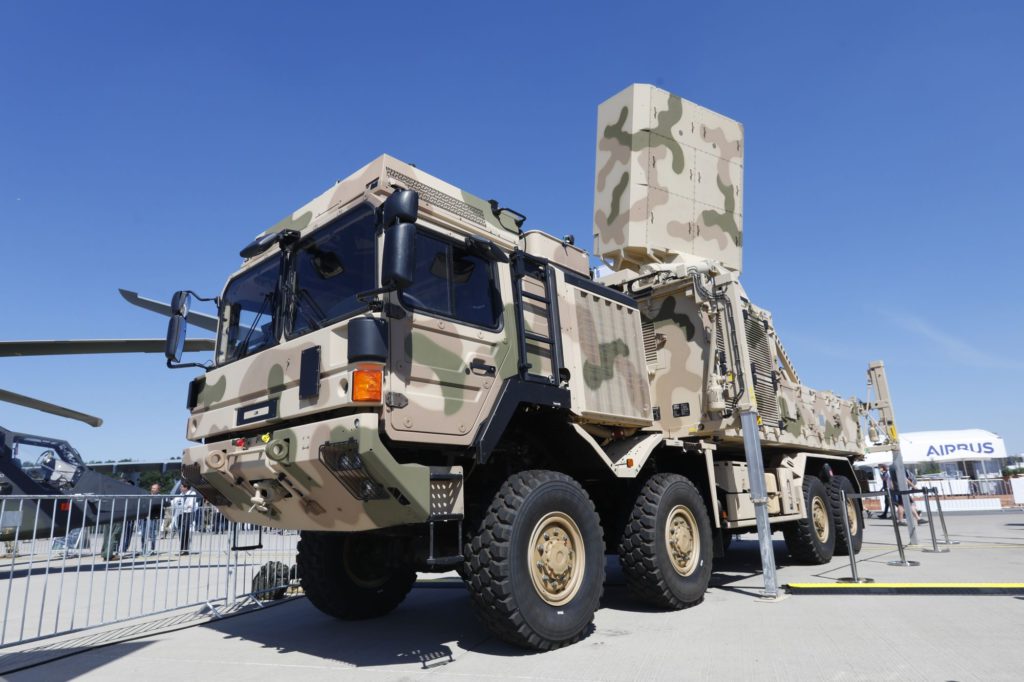
At least 15 countries of the NATO military alliance have signed a letter of intent to join a long-term German project to create a European anti-missile shield that would boost protection for much of the continent.

The system will have several layers to intercept various kinds of missiles from different heights, possibly linking up Israeli Arrow 3 air-defense systems as well as US-made Patriots and German Iris-Ts, and would be fully deployable through the North Atlantic Treaty Organization. 

Read more: NATO Countries Back German Plan for European Anti-Missile Shield

Ukraine Says It’s Restored Mobile Network After Russian Attacks (9:30 a.m.)

Ukraine has restored its mobile network after recent missile and drone strikes from Russia, with the number of customers suffering from connection issues due to the attacks reduced from 18% at the beginning of the week to 2% now, according to Ukraine’s Information Protection Service. 

The service urged people to limit usage of mobile internet to ease pressure on cell network and help fix the outstanding issues as soon as possible.

Russian Forces Anticipating Combat Reaching Kherson, UK Says (9 a.m.)

Moves by Russia’s occupation authorities to evacuate some civilians from Kherson suggest “they anticipate combat extending to the city,” the UK defense ministry said. 

After retreating by about 20 km (12 miles) in the north of the Kherson region early this month, Russian troops are likely attempting to consolidate a new front line west from the village of Mylove, the UK said. Ukrainian advances mean Russia’s flank is no longer protected by the Inhulets River.   

UK Providing Air Defence Missiles to Ukraine (7 a.m.) 

The UK said it will donate Amraam air defence missiles to help Ukraine defend against Russian missile strikes. The rockets will be provided in the coming weeks and will help defend Ukrainian infrastructure, Britain’s defence ministry said in a statement. The UK said it would also donate more drones for information gathering and 18 extra howitzer artillery guns, in addition to 64 already delivered.

General Assembly Votes Overwhelmingly to Condemn Annexation (12:46 a.m.)

US Ambassador to the UN Linda Thomas-Greenfield said that the 143-5 vote denouncing the annexation of Ukrainian territory had a practical effect of showing that “Ukraine’s borders remain the same” in the eyes of the world.

She said the vote showed how the international community “soundly rejected the affront to territorial integrity, to national sovereignty, to peace and security.” 

France Won’t Use Nuclear Weapons If Russia Does (9:53 p.m.)

France wouldn’t respond with nuclear weapons should Russia resort to deploying them tactically against Ukraine, President Emmanuel Macron said.

“Our doctrine rests on the fundamental interests of the nation,” Macron said during a live interview on public broadcaster France 2. “They are defined clearly and wouldn’t be directly affected at all if, for example, there was a ballistic nuclear attack in Ukraine, in the region.” 

Musk’s Starlink Gets a Thank-You From Ukraine (9:27 p.m.)

Mykhailo Fedorov, Ukraine’s vice prime minister and chief of digital transformation, praised Elon Musk’s Starlink satellite communications system, saying it “quickly restored” connections severed when “over 100 cruise missiles attacked” Ukraine’s energy and communications infrastructure.

“You’re most welcome,” Musk responded. “Glad to support Ukraine.”

Ukraine Needs at Least $3 Billion a Month Next Year, IMF Says (8:28 p.m)

Ukraine will need at least $3 billion a month next year to finance its wartime economy, which means allies will have to step up with more support, the head of the International Monetary Fund said. 

“Our current thinking is that the financing requirements” will be around $3 billion to $4 billion a month, Kristalina Georgieva said at a meeting in Washington to discuss global economic support for Ukraine, according to a draft text of her comments.  

Developments in the war “could push financing needs beyond this range,” as the government seeks to maintain basic social services, repair infrastructure and import energy, Georgieva said. “This requires actions on the part of the authorities but importantly also the international community.”

Read the full story here.

Zelenskiy Calls for IMF Loan of Up to $20 Billion (8:20 p.m.)

Speaking remotely to the same roundtable as the IMF’s Georgieva, President Zelenskiy said his nation is looking for a loan of as much as $20 billion from the Washington-based crisis lender as a main source of funds for closing the nation’s budget deficit.

Ukraine needs $38 billion to make up for the gap in its budget next year, he said. Ukraine also needs targeted credits of $2 billion to rebuild its electric energy infrastructure, Zelenskiy said by video to the officials assembled in Washington. 

Georgieva said later that Ukraine’s non-financial program, announced in recent days and monitored by the IMF board, will be a bridge to the larger borrowing that Zelenskiy is seeking. The fund approved $1.3 billion for the nation under its new “food shock window” last week.

White House Weighs Retaliatory Ban on Russian Aluminum (5:47 p.m.)

The Biden administration is eyeing three options for action against Russian aluminum: an outright ban, increasing tariffs to levels so punitive they would impose an effective ban, or sanctioning the company that produces the nation’s metal, United Co. Rusal International PJSC, according to people familiar with the decision-making.

Such a move would have wide-reaching repercussions for the globally traded aluminum market, potentially forcing consumers in the US and other countries into a rush to find replacement metal. The globally traded aluminum price surged on the news of a possible ban.

Russia Running Low on Precision Guided-Munitions, Official Says (4:39 p.m.) 

Russia has apparently depleted a significant portion of its precision-guided munitions because Moscow is increasingly using old Soviet munitions with indiscriminate precision on the battlefield, a senior NATO official said.

Such munitions have wider targeting margins, making it more likely they’ll hit civilian casualties, the official said, adding that Russia used a combination of both modern and older munitions in its latest round of strikes. The official also said Russia’s new military commander, General Surovikin, will have to contend with an increasingly factional ministry of defense that’s poorly resourced to reach the Kremlin’s strategic objectives.

Erdogan Likely to Propose Ukraine Mediation Plan, Kremlin Says (4:32 p.m.)

“The Turks are offering their mediation,” state news service Tass reported Putin’s foreign policy aide, Yuri Ushakov, as saying ahead of an Erdogan-Putin meeting on Thursday. “If any negotiations or contacts take place, then they’ll likely be on their territory, in Istanbul or Ankara.” 

Turkey, along with Saudi Arabia and the UAE, has been involved in mediation efforts between Russia and Ukraine that led to a major prisoner exchange last month. The three countries have refused to adopt Western sanctions on Russia and have maintained ties with both sides during the war.  

More stories like this are available on bloomberg.com

©2022 Bloomberg L.P.

Equities Edge Up, With Eyes on US Inflation Data: Markets Wrap

(Bloomberg) — US equity index futures rose on Thursday, ahead of key US inflation data that could determine how much further the Federal Reserve’s policy-tightening cycle will run. 

Futures contracts on the S&P 500 were up 0.5% as of 5:20 a.m. in New York, while those on the Nasdaq 100 gained 0.3%. The benchmark index had tumbled to its lowest since November 2020 yesterday, as concerns mounted about the impact of hawkish Fed policy, especially on rate-sensitive sectors such as semiconductors. Europe’s Stoxx 600 gauge reversed an earlier loss to rise 0.2, while on currency markets, the dollar slipped.   

Upcoming monthly consumer-price figures may determine if the Federal Reserve delivers a fourth-straight outsized hike in interest rates. Thursday’s data is expected to show a slight deceleration to 8.1% annually but all eyes are on the ‘core’ reading that excludes food and energy. This is seen rising 6.5% from a year earlier, matching the rate seen in March that was the highest since 1982. 

Any sign that price pressures remain elevated may send markets into sell mode, as on Wednesday, when an above-forecast producer prices reading erased a tentative stock rally. It would also boost Treasury yields and the dollar, potentially adding to its 15% year-to-date gain.

However investors note the Fed is already more or less priced to raise rates by about 75 basis points next month and most markets have fallen sharply in recent weeks.

“Given the negative bond and equity moves over the last month, the potential for reversals of all of these moves on a soft CPI is significant,” Adam Cole, chief currency strategist at RBC Europe in London, wrote in a research note.


The aggressive policy-tightening and expectations of more to come have sent the link between the S&P 500 and Citigroup Inc.’s widely followed surprise index for the US economy to the most negative since 2015. 

Read more: Inflation Data Calling the Shots as Market Correlations Snowball

Chip stocks were under pressure after chip-gear maker Applied Materials Inc. slashed fourth-quarter earnings forecast, citing the Biden administration’s new chip export control rules, while Taiwan Semiconductor Manufacturing Co. slashed its 2022 capital spending target.

The dollar eased against most other currencies and US 10-year Treasury yields held off multi-year highs hit recently. 

“It’s all about the core CPI. If that comes in below expectations, you can anticipate a pretty aggressive dollar selloff as we can then start to price in a peak in the Fed Funds Rate,” said Peter Kinsella, head of currency strategy at asset manager UBP.

In UK markets, the pound inched up and long-dated bonds rallied sharply as a recent selloff lured in buyers. Investors remain focused on whether the Bank of England will extend its Oct. 14 deadline to end an emergency bond-buying program it launched to soothe markets. It has so far declined to do so. 

Key events this week:

  • Earnings this week include: JPMorgan Chase & Co., Citigroup Inc., Morgan Stanley, BlackRock Inc., Delta Air Lines Inc., UnitedHealth Group Inc., U.S. Bancorp, Wells Fargo & Co.
  • US CPI, initial jobless claims, Thursday
  • G-20 finance ministers and central bankers meet, Thursday
  • China CPI, PPI, trade, Friday
  • US retail sales, business inventories, University of Michigan consumer sentiment, Friday
  • BOE emergency bond buying is set to end, Friday

Some of the main moves in markets:

Stocks

  • The Stoxx Europe 600 fell 0.4% as of 8:38 a.m. London time
  • Futures on the S&P 500 rose 0.1%
  • Futures on the Nasdaq 100 were little changed
  • Futures on the Dow Jones Industrial Average rose 0.1%
  • The MSCI Asia Pacific Index fell 0.9%
  • The MSCI Emerging Markets Index fell 1%

Currencies

  • The Bloomberg Dollar Spot Index rose 0.1%
  • The euro fell 0.1% to $0.9690
  • The Japanese yen was little changed at 146.82 per dollar
  • The offshore yuan fell 0.3% to 7.1979 per dollar
  • The British pound fell 0.2% to $1.1076

Cryptocurrencies

  • Bitcoin fell 0.9% to $18,988.26
  • Ether fell 1.8% to $1,275.32

Bonds

  • The yield on 10-year Treasuries advanced three basis points to 3.93%
  • Germany’s 10-year yield was little changed at 2.32%
  • Britain’s 10-year yield was little changed at 4.43%

Commodities

  • Brent crude rose 0.6% to $93.03 a barrel
  • Spot gold fell 0.3% to $1,668.27 an ounce

More stories like this are available on bloomberg.com

©2022 Bloomberg L.P.

Dubai Family Villa Rentals at $73,000 a Year Come With a Warning

(Bloomberg) — It’s not just Dubai’s luxury home sales that are on a tear, rental prices are too.

The average annual rent for a villa, or family home, in the emirate reached 268,758 dirhams ($73,171) last month after prices jumped 26% in the year through September, according to real estate adviser CBRE Group Inc. Average apartment rents, meanwhile, soared 27% to 89,986 dirhams.

The surge in rental prices is being driven by a growing number of expatriate workers moving to the city, according to CBRE’s head of research Taimur Khan. It also mirrors soaring luxury real-estate prices, which jumped 89% over the past year, property consultant Knight Frank said earlier this week.

The average sale price for villas rose 14%, while apartment prices rose 9% through September, according to CBRE. 

But CBRE warned that such rapid growth may impact Dubai’s attractiveness. 

“The rate of growth in certain typologies and neighborhoods may start to impact affordability in the city very significantly,” Khan said. “This in turn may impact its competitiveness and lead a negative spill over into other sectors, particularly amidst a high cost of living and softer global economic backdrop.” 

Demand to rent and buy homes in Dubai is booming as the government’s handling of the pandemic and its liberal visa policies attract more foreign buyers and residents. The emirate’s real-estate market is benefitting from an influx of newcomers including bankers fleeing strict Covid restrictions in Asia, crypto investors and wealthy Russians escaping their sanctions-hit country after its invasion of Ukraine. 

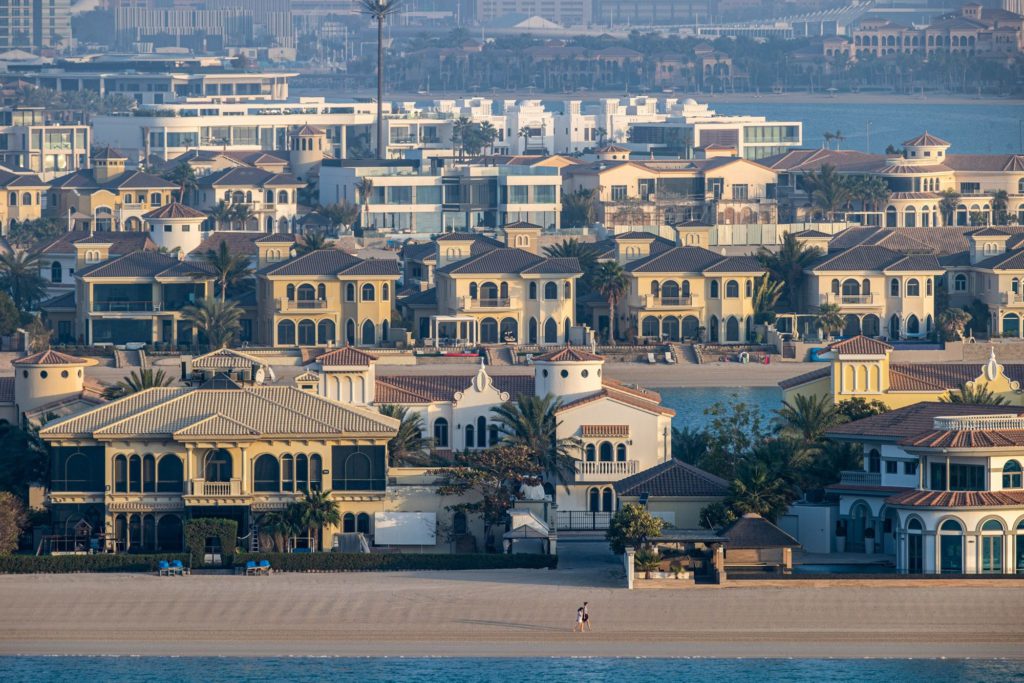
Rentals for apartments on the city’s man-made island, Palm Jumeirah, reached the highest level at 231,397 dirhams on average. While annual villa rentals in the swanky neighborhood of Al Barari hit 946,270 dirhams, CBRE said. 

“Rates are rising at the fastest pace ever and that’s making the gulf between core areas and secondary areas much more pronounced,” Khan said. “Some secondary areas are seeing occupancy levels of around 95%.”

Rental prices may start to moderate by early next year, Khan said. Monthly increases are slowing, an indication that many renters are voting with their feet and moving to cheaper areas, Khan said. 

Demand from buyers has also surged. The number of home sales in the year through to September reached their highest level since 2009, CBRE said. 

More stories like this are available on bloomberg.com

©2022 Bloomberg L.P.

SEC Finds a Way to Keep Up With the Kardashians

  • Listen to Bloomberg Crypto on the iHeartRadio App
  • Listen to Bloomberg Crypto on Apple Podcasts
  • Listen to Bloomberg Crypto on Spotify  

(Bloomberg) — It seems that the Securities and Exchange Commission has finally found a way to keep up with the Kardashians. 

The US markets regulator announced last week that Kim Kardashian had agreed to pay $1.26 million to settle allegations that she broke US rules by touting a crypto token. The SEC said Kardashian did not disclose that she was paid $250,000 to post on her Instagram account about EMAX tokens, a crypto asset offered by EthereumMax. 

That allegation meant she had, in SEC speak, illegally touted a crypto security.

The law requires anyone who touts a security, such as a stock or even some types of cryptocurrencies, to not only say they are getting paid to do so, but also to disclose the amount, the source, and the nature of those payments.

Kardashian settled without admitting or denying the SEC allegations. And she agreed to refrain from touting any additional digital assets for three years.

What are the broader implications of the SEC’s action? What does it mean for other influencers and celebrities hawking digital assets like NFTs? And is it a warning shot that stricter adherence to the rules is on the way?

Bloomberg crypto and regulation reporter Allyson Versprille and Bloomberg financial lifestyles and money culture reporter Misyrlena Egkolfopoulou join this episode.  


Follow us on Twitter @crypto, and subscribe to the Bloomberg Crypto Newsletter at https://bloom.bg/cryptonewsletter 

More stories like this are available on bloomberg.com

©2022 Bloomberg L.P.

Bitcoin Cowboys Are the Ultimate Stress Test for Texas’ Power Grid

(Bloomberg) — One scorching hot afternoon, Justin Ballard drives a Nissan Frontier pickup across a stretch of West Texas oil country. For years, Ballard worked these mesquite-covered expanses like any good oil landman, trying to persuade people to let the drill rigs come in and do their work. But he left that search early last year. Now he’s scouring the same barren landscapes for a different sort of fuel: natural gas that’s being burned off and wasted. This lost gas can be harnessed to power huge arrays of computers that create, or mine, Bitcoin and validate transactions on its ledger, the blockchain.

“It’s all about stranded energy—searching for it, finding it, mining it,” says Ballard, 41. “It’s a lot like the oil business.” In other words, instead of using drill rigs to get to oil deep underground, wildcat crypto miners sniff out surplus electricity to run the servers that work around the clock. The prize is a digital currency worth about $19,000. As with a barrel of oil, the consequences for the planet aren’t factored into the cryptocurrency’s price.

Wearing a brown T-shirt, skinny jeans, and lace-up work boots, Ballard pulls up to an orange flame shooting out of a blackened pipe, a few feet from an oil well. These flares are everywhere in West Texas, a byproduct of teasing oil from the Permian Basin, the huge petroleum reserve that lies more than a mile underground. With oil comes natural gas, and there’s not always a pipeline that can take it to market. The gas is instead burned off to make way for crude, sending plumes of sooty smoke into the Texas sky.

Ballard wants to persuade the well’s owner to sell him the wasted gas at a deep discount, so he can use it to power a container full of Bitcoin servers. That’s how he got his start as a miner 16 months ago, running servers off gas wells in Wyoming. “It’s like I can see the Bitcoins coming out of that flare,” he says.

Ballard’s real priority is two hours northwest, where he’s planning the digital equivalent of a big oil gusher: a massive Bitcoin mining complex plugged into a string of substations, fed by some of the cheapest power in the world.

Bitcoin cowboys such as Ballard are leading a push that’s transforming Texas, with its low-cost power and light regulations, into one of the world’s biggest centers for crypto mining. At meetups in Austin, Houston, and Miami, the men—they’re almost all men—gather by the thousands to swap stories about hash rates, PPAs (power purchase agreements), and ASICs, the acronym for computer servers that solve the math puzzles behind Bitcoin. They share dreams of transforming electricity into digital gold and freeing their wealth from government and central bank meddling. Texas is their Xanadu.

“Bitcoin mining is freedom,” says Griffin Haby, holding court at dinner after a long day talking up crypto at a mining conference in Houston, decked out in a brimmed hat and cowboy boots. Haby, a former oil landman like his friend Ballard, scouts out Bitcoin mining sites for his clients. “That’s why we like it so much in Texas.”

Bitcoin miners have been run out of entire countries (most notably China), blamed for shorting out power grids, pushing up electricity prices, and exacerbating global warming. But political leaders in the Lone Star State have embraced them. “I believe in Bitcoin,” Republican Senator Ted Cruz said in late May at a Heritage Foundation symposium on cryptocurrencies in Washington. “I want Texas to be the oasis on planet Earth for Bitcoin and crypto.”

Cruz’s utopia smacked into reality soon after, when the crypto market collapsed. Bitcoin’s price plummeted more than 60% from its peak earlier this year. Some miners went out of business. Others had to delay or scale back expansion plans and liquidate crypto holdings to raise cash. For the miners who’ve held on in Texas, turning a profit comes down to the low cost of electricity. “We’re energy maximalists,” says Ballard, a lawyer by trade. “There’s no better place to be for that.”

The Bitcoin buildup in Texas has been so massive and so fast that it’s like adding entire cities’ worth of electricity consumption in just a couple of years. Texas utilities have gotten proposals for multiple Bitcoin mines that would require an additional 33,000 megawatts of electricity, or enough to power all of New York state.

But the rapid expansion is piling on risk to one of the largest and most unstable power grids in the US. Electricity is a finite commodity, and the humming servers are competing with 30 million Texas residents who need it, too. The state’s Bitcoin miners are already using as much power as 300,000 homes, taxing a grid that has a track record of sometimes failing when temperatures rise or fall significantly.

In February 2021, a fierce storm caused extensive blackouts that killed hundreds of people. This past May, a heat wave knocked out six power plants in Texas, pushing utilities into crisis again and prompting pleas to conserve energy as a record number of hot days slammed the state. These incidents highlight the potential difficulty of diverting so much electricity to crypto mining.

There are planetary costs as well. Worldwide, Bitcoin mining consumes more electricity than the Philippines, a nation of 110 million people, and much of that is currently generated with fossil fuels that produce greenhouse gases. Estimates of Bitcoin’s use of carbon-free power vary significantly. The Bitcoin Mining Council, an industry group, says it’s 58%. An academic study found that as of August 2021, renewable energy accounted for only about 25% of worldwide Bitcoin mining electricity use.

The industry “has a massive carbon footprint, no matter how you look at it,” says Alex de Vries, a specialist in the energy use of Bitcoin at Vrije Universiteit Amsterdam, who led the study. In September the White House released its own report warning that Bitcoin mining was jeopardizing US climate goals, singling out the energy-sucking process behind it known as proof of work.

But increasingly, the miners are trotting out a counterintuitive argument in their defense: that their power use is actually good for the climate and good for Texas’ power grid. By consuming voracious amounts of power, Bitcoin mining can help balance the grid and provide a market for underused solar and wind resources. And when blackouts loom, they simply switch off, helping avert disaster.

Bitcoin miners can play a role in stabilizing the electricity grid, says Adam Back, founder and chief executive officer of Bitcoin miner Blockstream Corp. in British Columbia, from his home in Malta. Miners, he says, can help green energy take root in the nation’s heartland, which will help protect power grids in Texas and beyond from blackouts.

Earlier this year, Back decided to test this theory in the field. Blockstream and Block Inc., co-founded and run by former Twitter Inc. CEO Jack Dorsey, began building a $12 million Bitcoin mining pilot project in West Texas, powered directly by solar panels. The plant has big Tesla batteries to store electricity, which would enable the mine to run at night, when there’s no sun. For now, the batteries’ cost makes a Bitcoin mine unprofitable, but Back says his pilot project will prove that can change.

Miners want their computers to run continuously, not to stop when the sky clouds over or the wind dies down. For now, those who want to turn a profit—that is, all of them—plug into the grid, even in locations where renewable energy is abundant.

For Bitcoin cowboys such as Ballard, the real money isn’t in hooking up servers to gas flares. The big payoff comes from the cheap electricity in West Texas, one of the world’s biggest centers of renewable energy, where there’s more wind and solar power than the sparsely populated region can ever consume. It’s stranded energy on a massive scale, Ballard says, steering his Frontier pickup toward a spot on the Texas-New Mexico line where he’s made his biggest Bitcoin mining strike ever.

He’s reached an agreement with miner Mawson Infrastructure Group Inc. in Sydney to plug 30,000 computers into underused electricity substations sprinkled across remote tracts owned by Texas Pacific Land Corp. to mint Bitcoins by the hundreds. The potential payoff in Bitcoins is immense: The mines stand to create 3,700 Bitcoins a year worth $72 million at today’s prices. 

West Texas has a surfeit of renewable energy, because federal price guarantees and tax breaks led to the construction of scores of solar and wind farms. Problem is, the subsidies didn’t fund a similar construction of transmission lines. As a result, there’s no way to get all that power hundreds of miles to cities that need it. The Texas grid operator estimates that by 2023, there will be at least 6,700 gigawatt-hours more wind and solar power generated in West Texas than the power lines can handle. That’s enough to power 500,000 Texas homes for about a year. 

What Ballard is doing is “just another way for the renewable power producers to continue to create a return on investment, which leads to further expansion and stabilization of the grid through renewable projects,” he says. “So, it’s like, this is actually helping to green up the grid, more than, ‘Oh, we’re creating a burden on the grid.’ ”

Republican state leaders from Cruz and Governor Greg Abbott on down have adopted this argument. Abbott likes to repeat industry assertions that Bitcoin miners stabilize the power grid by faithfully using vast amounts of power that others don’t need.

The Texas grid already has been pushed to the limit by a decade of economic and population growth. Then came this summer’s scorching heat. Texas has broken electricity consumption records 37 times since May as temperatures stayed above 100F day after day, according to the Electric Reliability Council of Texas, or Ercot, which operates the grid. Ercot said its 1,000 power plants have enough capacity to exceed summer demand by 23%. But that calculation doesn’t fully take into account the extreme heat that Texas endures every summer, according to a recent assessment by the North American Electric Reliability Corp., which monitors power systems nationwide. Demand for electricity has been growing fast in Texas for the past decade. One culprit in jacking up demand: Bitcoin mining, the independent agency warned in the assessment.

Miners have a different take: They can head off blackouts by simply switching off their servers, conserving power for families, schools, and hospitals. That’s what happened this summer as the temperature in Houston reached a record-breaking 105F. Ercot warned of a possible shortage and appealed to residents and businesses to conserve energy the following afternoon. That day, July 11, every major Bitcoin miner in the state shut down, reducing electricity consumption by an astounding 1,000 megawatts and helping avert any blackouts.

The crypto world took a victory lap. “Texas #bitcoin miners are not only good corporate citizens, but they are also good ‘grid citizens,’ ” tweeted Lee Bratcher, president of the Texas Blockchain Council. The scenario played out at least 12 other times throughout the summer.

But the families who kept their lights on will end up paying miners for the privilege of doing so. Ercot has so-called curtailment programs, where Bitcoin miners and other industrial power users, such as factories, are paid not to use electricity they’re entitled to receive under power contracts. Riot Blockchain Inc., one of the biggest Bitcoin miners in the world, earned an estimated $9.5 million in power credits through July by shutting down its huge mining complex near Rockdale, north of Austin. In the end, such costs are passed along to just about anyone who has to pay an electricity bill.

“Bitcoin miners are helping to create an electricity shortage,” says De Vries, the specialist in Bitcoin’s environmental impact. “And then they get paid a ridiculous amount of money to help solve the shortage that they helped to create in the first place.”

Doug Lewin, an energy consultant in Austin, says he thinks crypto miners could help the grid by shutting down when demand peaks. But it can’t be voluntary, as it is now. “At a certain point you need some regulation,” Lewin says. “You can’t get to a point where people are mining Bitcoin when human life is in jeopardy.”

Sherbino I is the name of a wind farm in remote Pecos County, where the oil giant BP Plc put up 50 300-foot-high turbines in 2008. They turned for a decade, boosted by federal programs that guaranteed wind plants a price of $27 per megawatt hour for electricity as long as they sent their power somewhere. But those guarantees ended 10 years after a project was built, and it was cheaper for Sherbino I to shut down than to generate power no one would buy. Today the high mesa is empty, the turbines long gone. In a clearing at the base of the site sits an underused electricity substation, connected to the local power grid.

County Judge Joe Shuster, the top local elected official in Pecos County, knew little about Bitcoin until early 2021, when the demolition crew was still cutting up Sherbino I’s sleek turbine blades and carting them off. Then, multiple miners started coming at Shuster, lobbying for county tax breaks to invest hundreds of millions of dollars in huge facilities in the middle of the desert.

Shuster, who sports a graying handlebar mustache, knows miners are a gamble. They’re mobile; they can pick up and leave quickly if prices crash. But he’s confident Bitcoin isn’t going away as long as there’s power to spare. “For now, they’ve come through with jobs, which is what we need,” he says.

Jamie McAvity, 37, CEO and founder of Cormint Data Systems, was one of the people wooing Shuster. A former oil trader, he seems like a true believer, Shuster says—young, full of energy, and convincing in his argument that Bitcoin is here to stay. In exchange for the promise of at least 50 full-time jobs, the county agreed to waive Cormint’s property taxes for 22 years, documents filed with the county show. The company moved its headquarters to Fort Stockton and pledged to invest at least $100 million in a mine nearby that will consume 200 megawatts of power.

That’s enough to power 40,000 Texas homes on a hot day, but McAvity isn’t worried about making the state’s electricity problem worse. “Adding Bitcoin miners to your grid is like adding a market maker to a market,” he says. “It increases liquidity, and it reduces volatility.” His Bitcoin mine sits on a patch of desert hemmed in by the towering rock mesas that once hosted the windmills, roughly between Midland and El Paso. Once its 24 mining units are up and running, the plant will create 24 Bitcoins a day, valued at a total of almost $500,000 at today’s prices.

Texas is building out renewable energy faster than anywhere else in the US. But like its existing clean power, much of the new supply risks getting stuck. Although President Joe Biden’s Inflation Reduction Act has almost $3 billion to facilitate the siting and building of transmission lines, that infrastructure won’t appear overnight. Transmission projects take years to build.

If the new climate law works as it’s supposed to—spurring the addition of wind and solar capacity around the country—places outside of Texas could find themselves with a similar bounty of clean energy they can’t tap where and when they most need it. But Texas is in a particular bind, because its massive power grid isn’t connected to the national networks, so it can’t import power from other states to avert blackouts when demand exceeds supply. (Unlike most other states, Texas opted to wall off its grid a century ago to avoid federal oversight of its electricity system.)

“I don’t know how they got taught to think that this is a good deal for the Texas grid,” De Vries says of the miners. “I mean, if you want to fix the grid, what you need is flexible additional supply, but flexible additional demand? It’s a really weird way of thinking.”

A few weeks after the deadly blackouts of 2021, the dearth of emergency power in Texas—flexible supply—led billionaire Warren Buffett to lobby the state to invest $8.3 billion in multiple so-called peaker power plants. The natural gas-fired generators, which would be built by Buffett’s companies, would be switched on only to avert blackouts. The state has yet to take Buffett up on his offer.

In the absence of flexible power plants or more creative solutions, grid operators are left to rely on miners and other mega power users to keep the lights on.

For fragile power grids during the nation’s slow, clumsy transition to clean energy, crypto mining is like the contrast dye doctors inject before a diagnostic scan. It highlights the paradoxes, such as a simultaneous glut and shortage of clean power, and the perverse incentives that reward an industry for being an energy hog.

There’s little sign Texas leaders will stop wooing Bitcoin miners. In April, Ercot’s former interim CEO, Brad Jones, said he was working with miners to prepare the grid to handle a lot more crypto demand and aimed to make Texas the world’s largest mining center.

The network for Ethereum, the No. 2 cryptocurrency, just shifted from a “proof of work” approach to a far less energy-intensive model called proof of stake. So far there are no signs Bitcoin will do the same. The Bitcoin Mining Council in May called proof of work and proof of stake “qualitatively different” and said it was “imperative” that Bitcoin remain on proof of work. The council was responding to a letter from Democratic members of Congress to the US Environmental Protection Agency raising concerns about mining facilities’ climate emissions.

Meanwhile, the Bitcoin world is in a race against what’s known as “the halving.” In 2024 the algorithm is set to become twice as difficult. That means it will require twice the computing power to create a coin—and twice as much energy, taxing the Texas grid even further.

Zach Pless, a 35-year-old former street musician from California who manages the Cormint site for McAvity, is convinced Bitcoin mining can help with Texas’ electricity problem. Like a lot of crypto converts, Pless speaks with an almost religious fervor. “Bitcoin is freedom, a way to keep my wealth away from the banks, away from the government,” he says. “It’s libertarian. I guess it’s who I am.”

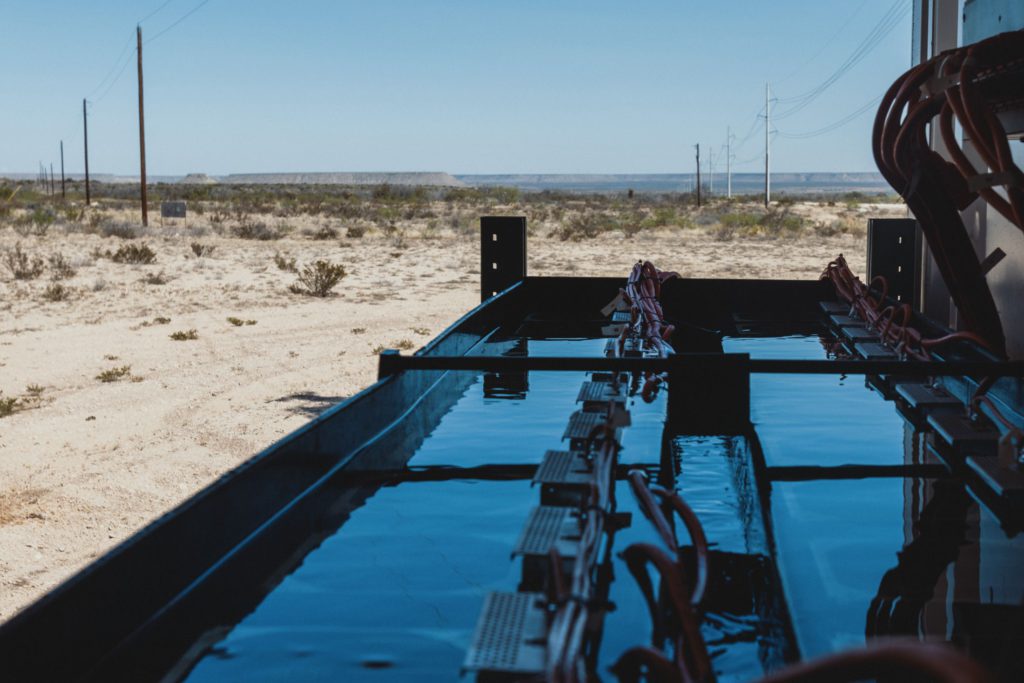
In early 2021, Pless began setting up the mine, and he’s been sleeping in a camper, a few feet away from the humming servers, ever since. One recent afternoon, he walks inside a container where servers lie in a row immersed in vats of coolant to allow them to run better as temperatures outside reach triple digits. It’s a tiny pilot mine of sorts that will be expanded one hundredfold. The servers are silent—a testament, Pless says, to how Bitcoin miners can do their part to help Texas avert blackouts that leave people in the dark, heat, or cold, or even kill.

“Just today, the boss called and told me to shut it down, heeding a call from the utility,” Pless says, pointing to the idled servers. It’s not much; the pilot mine uses only 166 kilowatts of power. “Imagine what would happen when we’re at full capacity and we get that call?” he says. “Maybe that would make a difference.” —With Naureen Malik

More stories like this are available on bloomberg.com

©2022 Bloomberg L.P.

MGM-Backed Playstudios Pays $70 Million for Solitaire Maker

(Bloomberg) — Playstudios Inc., a maker of free-to-play casino-oriented video games, acquired Brainium, a studio known for titles such as Spider Solitaire and Mahjong.

The price is $70 million in cash and an additional sum based on Brainium’s performance through the end of the year, according to a statement from Las Vegas-based Playstudios. The acquired company will keep its name and leadership team.

The deal will immediately contribute to profitability, Playstudios said, more double the number of active daily players and expand the company’s loyalty program. Founded in 2008, Brainium has 10 unique titles, attracting 2 million daily users that will gain access to rewards such as dining and entertainment discounts.

“We’ve found what we think is a strategically significant and complementary company and we’ve acquired it for all cash,” Playstudios Chief Executive Officer Andrew Pascal said in an interview.

Playstudios went public last year via a merger with a special-purpose acquisition company. The shares traded as high as $13.20 in February 2021, around when the deal was announced, and as low as $3.24. The stock closed Wednesday at $3.70.

The casino-game operator is backed by MGM Resorts International and offers titles including Tetris and myVEGAS Slots. The company had $287.4 million in revenue last year, while daily active players stood at around 1.5 million at midyear, up 20% from 2021.

Playstudios gets its revenue primarily from in-app purchases by players, who earn loyalty points that can be traded for real-world benefits. Its partners include Wolfgang Puck restaurants and companies like Norwegian Cruise Line Holdings Ltd. and Resorts World.

Brainium, which employs just 34 people, relies on higher-margin advertising sales and will soon add Playstudios’ features to its games.

“It dovetails perfectly with the partners we currently have,” Pascal said. “We have 100 partners, all within different verticals of leisure and entertainment.”

More stories like this are available on bloomberg.com

©2022 Bloomberg L.P.
Close Bitnami banner
Bitnami