Bloomberg

Medibank Becomes Latest Target of Cyber Attack in Australia

(Bloomberg) — Health insurer Medibank Private Ltd. detected a potential cyber attack on its network, adding to the growing list of Australian companies falling victim to cyber crime.  

The company has already enlisted the help of cybersecurity firms after detecting unusual activity on its network, it said in a statement Thursday. Medibank says there’s no evidence that any sensitive data was accessed in the incident, which occurred Wednesday.  

Cyber attacks are becoming increasingly common in Australia, with last month’s major hack of mobile phone provider Optus spurring national outcry. Optus revealed a hacker had accessed the records of almost 10 million current and former customers. 

The phone company, which is owned by Singapore Telecommunications Ltd., continues to face complaints that it failed to protect personal information and destroy data it no longer needed.

Vicki Brady, chief executive officer of rival telecom provider Telstra Corp., called for a review of the country’s data retention laws in the hack’s aftermath. Telstra is blocking “unprecedented levels of malicious activity” against customers, including rogue calls and text messages, Brady said earlier this week. 

On Monday, Singtel disclosed a second Australian business it owns, technology consultancy Dialog, had also suffered a recent cyberattack that potentially exposed client and customer data. Telstra was also recently exposed to a third-party data breach that accessed information about employees from 2017 earlier this month. 

More stories like this are available on bloomberg.com

©2022 Bloomberg L.P.

Asian Equities Slip Ahead of Key US CPI Data: Markets Wrap

(Bloomberg) — Asian shares declined and currencies fluctuated amid caution in markets as investors await highly anticipated inflation data later Thursday. 

Stocks fell Japan, China and South Korea while US futures inched up after a sixth consecutive decline for the S&P 500, which fell to the lowest level since November 2020. The dollar held on to recent gains and the yen crept back from a fresh 24-year low that has put traders on watch for intervention from Japan. 

Investors are on tenterhooks as they await US consumer price figures that may determine if the Federal Reserve delivers a fourth-straight outsized hike in interest rates, piling more pressure on an already struggling world economy. Minutes released on Wednesday from the Fed’s last meeting suggested some officials considered reducing the pace of rate hikes, which triggered a brief surge on Wall Street that quickly unwound. 

“The Fed needs data to start finding an off-ramp,” Carol Schleif, deputy chief investment officer at BMO Family Office, said on Bloomberg Television. “That’s a tough market to be in. Until we get a bunch more data, markets will have to figure out how to find their footing.”

Read more: Top-Ranked Chartist Says Gaming Out Fed Pivot Is ‘Fool’s Errand’

The pound declined slightly in Asia after a busy day of bond buying from the Bank of England, which reiterated the view that its emergency support for the gilt market would cease on Friday, contradicting a media report that suggested it could endure.

The Biden administration is considering adding aluminum to economic sanctions against Russia. Vladimir Putin said any energy infrastructure in the world is at risk after the explosions on the Nord Stream pipelines. Oil benchmarks made small gains after falling more than 2% on Wednesday.

Key events this week:

  • Earnings this week include: JPMorgan Chase & Co., Citigroup Inc., Morgan Stanley, BlackRock Inc., Delta Air Lines Inc., UnitedHealth Group Inc., U.S. Bancorp, Wells Fargo & Co.
  • US CPI, initial jobless claims, Thursday
  • G-20 finance ministers and central bankers meet, Thursday
  • China CPI, PPI, trade, Friday
  • US retail sales, business inventories, University of Michigan consumer sentiment, Friday
  • BOE emergency bond buying is set to end, Friday

Some of the main moves in markets:

Stocks

  • Futures on the S&P 500 rose 0.3% as of 10:50 a.m. Tokyo time. The S&P 500 fell 0.3%
  • Futures on the Nasdaq 100 rose 0.2%. The Nasdaq 100 fell 0.1%
  • The Topix Index fell 0.6%
  • The S&P ASX Index rose 0.4%
  • The Hang Seng Index was steady
  • The Shanghai Composite Index fell 0.2%
  • Euro Stoxx 50 futures fell 0.2%

Currencies

  • The Bloomberg Dollar Spot Index was little changed
  • The euro was unchanged at $0.9703
  • The Japanese yen rose 0.1% to 146.82 per dollar
  • The offshore yuan was little changed at 7.1751 per dollar

Cryptocurrencies

  • Bitcoin fell 0.2% to $19,109
  • Ether fell 0.2% to $1,294

Bonds

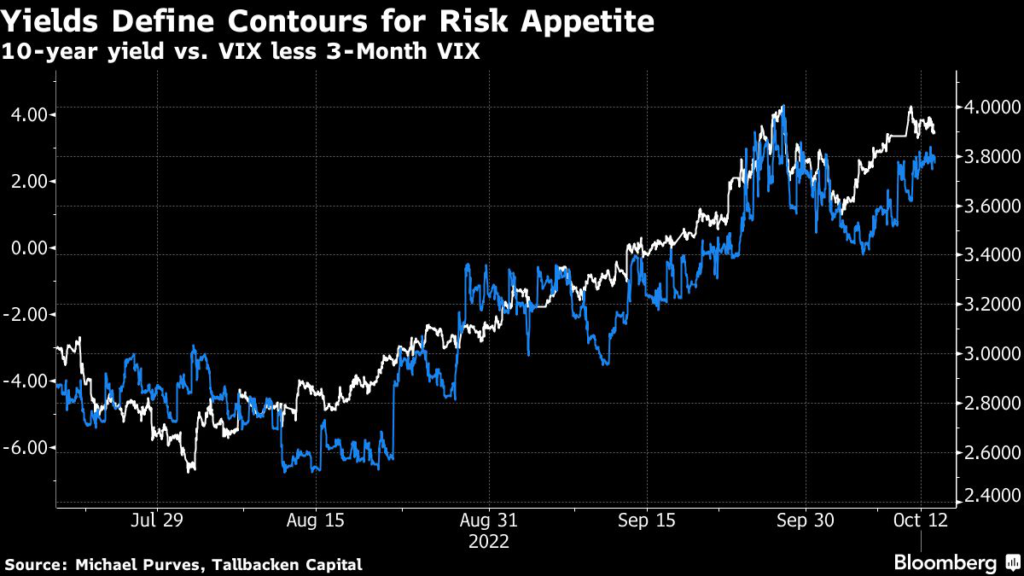
  • The yield on 10-year Treasuries advanced two basis points to 3.92%
  • Japan’s 10-year yield was little changed at 0.25%
  • Australia’s 10-year yield advanced six basis points to 4.01%

Commodities

  • West Texas Intermediate crude rose 0.2% to $87.41 a barrel
  • Spot gold was little changed

More stories like this are available on bloomberg.com

©2022 Bloomberg L.P.

Chip Industry Braces for ‘Heavy Blow’ From China Export Curbs

(Bloomberg) — The Biden administration’s new restrictions on doing business with China are sending shock waves through the global semiconductor industry, with chip-equipment makers girding for perhaps the most painful fallout. 

Applied Materials Inc., a leading maker of chipmaking equipment, on Wednesday slashed its forecast for the fourth quarter, warning that the new export regulations will reduce sales by about $400 million in the period. It now expects revenue of about $6.4 billion, plus or minus $250 million, compared with a previous forecast of roughly $6.65 billion.

In another sign of retreat, Applied Materials, along with KLA Corp. and Lam Research Corp., have started or are preparing to pull employees from Yangtze Memory Technologies Co., China’s most advanced maker of memory chips, people familiar with the matter have told Bloomberg. ASML Holding NV, another top producer of manufacturing gear, told its US employees in the US to refrain from servicing customers in China.

“The US government’s recent restrictions are serious and escalate the economic (and potentially geopolitical) conflict with China – the largest customer of semis,” Bank of America analyst Vivek Arya wrote, estimating the restrictions could shave off as much as $7 billion in 2023 sales for vendors like Applied Materials.

The Biden White House outlined the export curbs Friday, part of a years-long campaign to hamper China’s ability to develop the most advanced chips and equip its military. China is pouring billions of dollars into developing a domestic semiconductor industry that’s less dependent on the rest of the world, but those chipmakers still need to purchase highly specialized equipment from suppliers in the US, Europe and other parts of Asia.

“The new regulations could deliver a heavy blow to Applied Materials and Lam Research, which have a high sales exposure to China,” Bloomberg Intelligence analysts Masahiro Wakasugi and Brian Moran wrote in a research note Thursday.

The restrictions hit when the industry was already suffering a downturn, shifting from a worldwide shortage of chips during the pandemic — when demand for electronics skyrocketed — to a glut in a matter of months as demand cooled, reflecting the boom-and-bust nature of the sector. The Philadelphia Stock Exchange Semiconductor Index has dropped 12% since the restrictions were announced. The index is now down more than 44% this year.

Netherlands-based ASML has been selling its deep ultraviolet, or DUV, machines to Chinese customers but has held back its more advanced extreme ultraviolet, or EUV, technology. It’s not clear whether those existing sales will be affected by the new Biden administration regulations.

The semiconductor industry has had an inkling for weeks that tighter rules were coming, with Nvidia Corp. warning in September that US government restrictions on exporting AI chips to China could affect hundreds of millions of dollars in revenue.

Companies such as Applied Materials and Intel Corp. can’t easily walk away from China, which is the biggest single market for their products and part of a global supply chain for electronics.

Fallout has been swift and far-reaching, and Asia’s biggest chip stocks are also reeling. Taiwan Semiconductor Manufacturing Co., the world’s largest contract chipmaker, plunged a record 8.3% Tuesday, while Samsung Electronics Co. and Tokyo Electron Ltd. also retreated. 

Applied Materials shares are down about 14% since last Thursday, the day before the new restrictions were announced. After that steep decline, its latest warning didn’t do much to jar investors. The stock was little changed in late trading Wednesday.

The Santa Clara, California-based company also trimmed its profit forecast. Excluding some items, earnings will be $1.54 to $1.78 a share in the fourth quarter, which ends Oct. 30. That’s down from as much as $2.18 previously. 

The lower earnings outlook is a result of reduced sales and a writedown of 23 cents a share for inventory and manufacturing tied to the new export regulations, the company said. Applied Materials also expects the rules to hurt sales in its fiscal first quarter by roughly the same amount.

More stories like this are available on bloomberg.com

©2022 Bloomberg L.P.

Indian Car-Sharing Platform Zoomcar to Go Public Via SPAC Deal

(Bloomberg) — Zoomcar Inc., an India-based car-sharing platform, has reached an agreement to go public via a merger with blank-check firm Innovative International Acquisition Corp., according to people familiar with the matter.

Zoomcar operates a marketplace for private vehicles, with owners making their cars available on the platform and users able to rent them by the hour, day, week or month. The company, whose headquarters are in Bangalore, operates in more than 50 cities in India, Indonesia, Vietnam and Egypt.

The merger with the special purpose acquisition company implies a pro forma enterprise value of about $456 million for the business, said the people, who asked not to be identified because the matter isn’t public.

Representatives for Zoomcar and Innovative International declined to comment.

Zoomcar was founded in 2013 by Greg Moran, who is now chief executive officer, and David Back, who is no longer with the company. The platform has more than 3 million active users, with over 25,000 vehicles registered by their owners. The company, which doesn’t own any of the vehicles rented through its platform, takes 40% of each transaction.

The company is part of a small but burgeoning cadre of companies such as San Francisco-based Turo Inc. that have extended the ride-sharing model to the vehicle itself. 

Last November, Zoomcar got $92 million in a Series E round led by SternAegis Ventures, bringing the total it has raised to $332 million, according to data provider PitchBook. Sequoia Capital India is an investor and board member. Waze co-founder Uri Levine is chairman of the board.

Innovative International, which is led by Chairman and Chief Executive Officer Mohan Ananda, raised $230 million including so-called greenshoe shares in its initial public offering last year, according to a statement at the time.

Shares of the merged company, to be called Zoomcar Holdings Inc., are expected to trade on the Nasdaq. 

More stories like this are available on bloomberg.com

©2022 Bloomberg L.P.

Crypto Hackers Set for Record Year After Looting Over $3 Billion

(Bloomberg) — Cryptocurrencies may have crashed this year but they remain a digital cash-machine for one potent constituency: hackers.

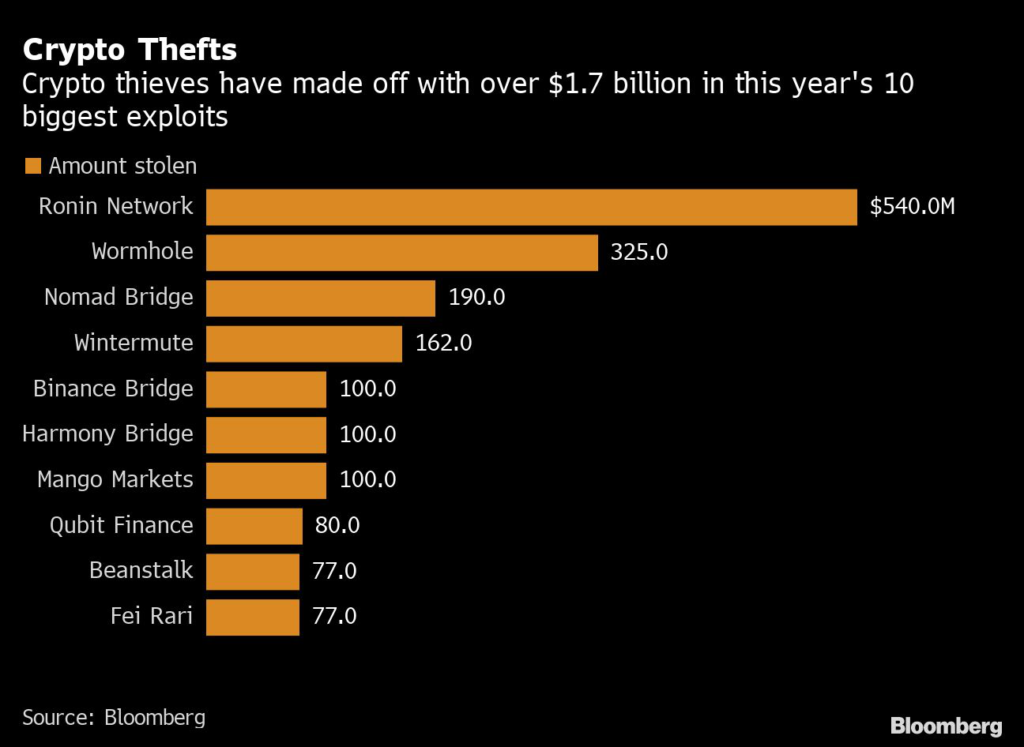
At least $718 million has been stolen so far in October alone, taking the gross tally for the year past $3 billion and putting 2022 on course to be a record for the total value hacked, according to blockchain specialist Chainalysis Inc.

Most of the targets are so-called decentralized finance — or DeFi — protocols, which deploy software-based algorithms to enable crypto investors to trade, borrow and lend on digital ledgers without using a central intermediary. 

Hackers have become adept at exploiting weaknesses in the security, coding and structure of DeFi marketplaces. That’s putting the onus on crypto players to find solutions given that DeFi is touted as important for crypto adoption.

“October is now the biggest month” for hacking activity in 2022, Chainalysis said Thursday on Twitter, adding that bridges between blockchains are a big vulnerability too.

Two major exploits have roiled the crypto sector in recent days. One was a heist whereby a hacker spirited away about $100 million from DeFi service Mango by manipulating the price of its token. The perpetrator wiped out depositors on the platform in the process.

Last week, 2 million Binance Coins — equivalent to nearly $570 million — were effectively minted and taken by a hacker. About $100 million wasn’t recovered, while the rest was frozen, according to a Binance statement.

DeFi platforms have become a frequent target of state-sponsored hacking. Earlier this year, Chainalysis estimated that North Korea-affiliated groups have stolen approximately $1 billion of crypto from DeFi protocols.

More stories like this are available on bloomberg.com

©2022 Bloomberg L.P.

Taiwan Urges Calm on TSMC, Downplays Impact of Biden Chip Rules

(Bloomberg) — Taiwan’s economic affairs minister downplayed the impact of new chip curbs on the island’s economy while urging investors to stay calm and believe in Taiwan Semiconductor Manufacturing Co.’s resilience.

“The reason Taiwanese investors are very panicking is because they do not have a good understanding of the very complicated rules,” Wang Mei-hua said Wednesday in an interview with Bloomberg News. Wang is in Washington for meetings with government officials and visited the Taiwan Expo summit. 

The government’s preliminary assessment indicates there will be “minimal” implications for Taiwan and its chip industry because the curbs focus on advanced tech and exclude consumer electronics, she said.

“That’s why we derive at this moment that the impact is not going to be too big,” she said, adding that officials need time to study the rules in greater detail. 

Her comments come days after the Biden administration’s announcement of new restrictions on chip technology and equipment sent stocks tumbling. TSMC shares earlier this week fell by the most in 28 years after the US announced tighter controls over chip exports to China, escalating tensions between the world’s biggest economies and disrupting the global semiconductor industry.

According to Wang, the company is withholding official comment on the rules until its investor meeting on Thursday. Wang said her ministry wasn’t aware if TSMC would request a license from the US government to continue selling the restricted products.

“Knowing TSMC with their capability in advanced technologies around chipmaking, I believe they are in the right position to still have more business to come in the future,” she added. “So I would urge Taiwanese investors to be confident about TSMC advanced technologies.”

Taiwan and the Biden administration have been discussing joint steps to verify the end users of the chip technology and ensure they’re not sold to the Chinese military, Wang said, but declined to share details at this point.

TSMC still continues to develop their most advanced technology in Taiwan, not in the US or European countries, despite offers of subsidies by the Biden administration and other nations. Wang said the company would invest in America, but not offshore its most-advanced technology.

“In my view, of course semiconductor is a very key industry for Taiwan’s not only economic development but also security guarantee,” Wang said. “So we will continue to support TSMC develop in Taiwan.”

That poses a dilemma for President Joe Biden, who is trying to reduce US reliance on Taiwan and TSMC.

The chip dispute also comes as Biden has started formal negotiations with Taiwan on a trade framework.

Wang said it’s Taipei’s “continued wish” to push for a US-Taiwan free trade agreement and that she’s pleased with bipartisan support in Congress for such a move. She said the agreement would be “very significant from a security point of view.”

The Taiwanese government pushed for a free trade agreement with the Trump administration but the request was rejected while negotiations on a US-China deal were ongoing, as Beijing views the self-governed island as part of its territory.

The Biden administration wants to be flexible on trade discussions with Taiwan and won’t prejudge the outcome, a US Trade Representative spokesman said in response to questions.

More stories like this are available on bloomberg.com

©2022 Bloomberg L.P.

Lightrock Raises €860 Million for First Climate Impact Fund

(Bloomberg) — Lightrock, the London-based private equity firm, has closed a €860 million ($835 million) climate impact fund, its first investment pool for companies working to reduce carbon emissions.

The initial €600 million hard cap was oversubscribed after getting demand from backers, including anchor investor LGT Group and its private banking clients, Swedish pension fund Forsta AP-Fonden and the Grantham Foundation, the firm said in a statement. Lightrock’s climate fund will back later-stage startups in Europe and North America.

“The climate strategy was quite a natural thing for us to do because, first of all, we had been doing these type of investments for a number of years,” Chief Executive Officer Pal Erik Sjatil said. “The world now finally takes this appropriately seriously, which means that more and more R&D money is coming in, more and more early-stage money is coming in.”

Venture capitalists are pouring increasing sums into startups that aim to cut emissions, amid rising demand from investors to back sustainable companies. While indexes tracking stocks that meet criteria on environmental, social and governance issues have dropped in line with the broader market this year, Sjatil said one cause for optimism is that investors are now treating sustainability as almost “a separate class.”

Lightrock has raised more than $2 billion in the past year, including this fund. The group closed a Latin American fund in May and raised $900 million for the Lightrock Growth Fund I last year, it said. 

Lightrock previously backed companies including insurance-technology firm Wefox and urban farming company InFarm, according to its website. 

More stories like this are available on bloomberg.com

©2022 Bloomberg L.P.

Ukraine Latest: UN General Assembly Condemns Russian Annexation

(Bloomberg) — The United Nations General Assembly condemned Russia’s annexation of parts of eastern Ukraine in a symbolic vote that nonetheless exceeded western expectations for how much support the measure would receive.

The General Assembly voted 143-5, with 35 nations including India and China abstaining, to approve the western-backed resolution, which opposed Russia’s “attempted illegal annexation” of the four regions. The vote was a strong indication of how isolated Russia has become over its invasion and decision to absorb parts of eastern Ukraine.

US Defense Secretary Lloyd Austin said he expects allies who met in Brussels will come forward with more air defense capabilities for Ukraine after Kyiv renewed its pleas for such systems following Russia’s recent strikes on cities.

The Biden administration is considering a complete ban on Russian aluminum — long shielded from sanctions due to its importance in everything from automobiles and skyscrapers to iPhones — in response to Russia’s military escalation in Ukraine.

(See RSAN on the Bloomberg Terminal for the Russian Sanctions Dashboard.) 

Key Developments

  • White House Weighs Retaliatory Ban on Russian Aluminum
  • Putin Says All Infrastructure at Risk After Nord Stream Hit 
  • Russia Sends More Fuel to Army In Ukraine Amid Mobilization
  • Oil Slumps as Key Inflation Metric Sparks Fresh Slowdown Fears
  • Europe Gas Swings as Russian War Risk Counters Higher Stockpiles
  • Poland Says Leak on Russian Oil Pipeline ‘Probably’ an Accident
  • Europe’s ‘Accident’-Prone Energy Infrastructure Causes Concern

On the Ground

Russian forces focused on stopping Ukrainian counter-offensive actions, according to Ukraine’s General Staff. It reported 13 Russian air strikes and more than 40 multiple rocket launcher assaults, as well as 14 attacks on critical infrastructure in the southern Odesa and Mykolaiv regions with Iranian drones. Twelve of these UAVs were destroyed. Attacks by Russian forces killed 14 civilians in Ukraine on Oct. 11, while 34 people were wounded, according to deputy head of the presidential office, Kyrylo Tymoshenko. Ukraine’s Air Force said it shot down at least four Russian helicopters in the south early Wednesday.  

(All times CET)

General Assembly Votes Overwhelmingly to Condemn Annexation (12:46 a.m.)

US Ambassador to the UN Linda Thomas-Greenfield said that the 143-5 vote denouncing the annexation of Ukrainian territory had a practical effect of showing that “Ukraine’s borders remain the same” in the eyes of the world.

She said the vote showed how the international community “soundly rejected the affront to territorial integrity, to national sovereignty, to peace and security.” 

France Won’t Use Nuclear Weapons If Russia Does (9:53 p.m.)

France wouldn’t respond with nuclear weapons should Russia resort to deploying them tactically against Ukraine, President Emmanuel Macron said.

“Our doctrine rests on the fundamental interests of the nation,” Macron said during a live interview on public broadcaster France 2. “They are defined clearly and wouldn’t be directly affected at all if, for example, there was a ballistic nuclear attack in Ukraine, in the region.” 

Musk’s Starlink Gets a Thank-You From Ukraine (9:27 p.m.)

Mykhailo Fedorov, Ukraine’s vice prime minister and chief of digital transformation, praised Elon Musk’s Starlink satellite communications system, saying it “quickly restored” connections severed when “over 100 cruise missiles attacked” Ukraine’s energy and communications infrastructure.

“You’re most welcome,” Musk responded. “Glad to support Ukraine.”

Ukraine Needs at Least $3 Billion a Month Next Year, IMF Says (8:28 p.m)

Ukraine will need at least $3 billion a month next year to finance its wartime economy, which means allies will have to step up with more support, the head of the International Monetary Fund said. 

“Our current thinking is that the financing requirements” will be around $3 billion to $4 billion a month, Kristalina Georgieva said at a meeting in Washington to discuss global economic support for Ukraine, according to a draft text of her comments.  

Developments in the war “could push financing needs beyond this range,” as the government seeks to maintain basic social services, repair infrastructure and import energy, Georgieva said. “This requires actions on the part of the authorities but importantly also the international community.”

Read the full story here.

Zelenskiy Calls for IMF Loan of Up to $20 Billion (8:20 p.m.)

Speaking remotely to the same roundtable as the IMF’s Georgieva, President Zelenskiy said his nation is looking for a loan of as much as $20 billion from the Washington-based crisis lender as a main source of funds for closing the nation’s budget deficit.

Ukraine needs $38 billion to make up for the gap in its budget next year, he said. Ukraine also needs targeted credits of $2 billion to rebuild its electric energy infrastructure, Zelenskiy said by video to the officials assembled in Washington. 

Georgieva said later that Ukraine’s non-financial program, announced in recent days and monitored by the IMF board, will be a bridge to the larger borrowing that Zelenskiy is seeking. The fund approved $1.3 billion for the nation under its new “food shock window” last week.

US’s Austin, Milley Say Allies to Respond to Ukraine’s Air-Defense Pleas (6:40 p.m.)

After a meeting in Brussels of the US-led Ukraine Contact Group, which coordinates arms deliveries and training, Austin commended Germany for sending its IRIS-T system in response to Ukraine’s pleas for air-defense systems.

“I have every confidence that countries will do whatever they can, if they can, to generate additional capabilities,” Austin said when asked about air defenses for Ukraine. He told reporters a number of the more than 50 allies at the table also pledged to provide munitions for those systems.

General Mark Milley, chairman of the US Joint Chiefs of Staff, said Ukraine was seeking an integrated missile defense system combining short, medium and long-range air defenses to deny airspace to Russian aircraft. He said the aim will be to bring the various systems together, train Ukrainians on them and make sure they can be linked to Ukrainian command and control. He added doing all of that will take time.

White House Weighs Retaliatory Ban on Russian Aluminum (5:47 p.m.)

The Biden administration is eyeing three options for action against Russian aluminum: an outright ban, increasing tariffs to levels so punitive they would impose an effective ban, or sanctioning the company that produces the nation’s metal, United Co. Rusal International PJSC, according to people familiar with the decision-making.

Such a move would have wide-reaching repercussions for the globally traded aluminum market, potentially forcing consumers in the US and other countries into a rush to find replacement metal. The globally traded aluminum price surged on the news of a possible ban.

Russia Running Low on Precision Guided-Munitions, Official Says (4:39 p.m.) 

Russia has apparently depleted a significant portion of its precision-guided munitions because Moscow is increasingly using old Soviet munitions with indiscriminate precision on the battlefield, a senior NATO official said.

Such munitions have wider targeting margins, making it more likely they’ll hit civilian casualties, the official said, adding that Russia used a combination of both modern and older munitions in its latest round of strikes. The official also said Russia’s new military commander, General Surovikin, will have to contend with an increasingly factional ministry of defense that’s poorly resourced to reach the Kremlin’s strategic objectives.

Erdogan Likely to Propose Ukraine Mediation Plan, Kremlin Says (4:32 p.m.)

“The Turks are offering their mediation,” state news service Tass reported Putin’s foreign policy aide, Yuri Ushakov, as saying. “If any negotiations or contacts take place, then they’ll likely be on their territory, in Istanbul or Ankara.” 

Turkey, along with Saudi Arabia and the UAE, has been involved in mediation efforts between Russia and Ukraine that led to a major prisoner exchange last month. The three countries have refused to adopt Western sanctions on Russia and have maintained ties with both sides during the war. 

Ukrainians Should Turn Down the Heat, Prime Minister Says (3:36 p.m.)

Households should prepare for indoor temperatures to fall to 16 degrees Celsius (61 Fahrenheit) after the government switches central heating on, Prime Minister Denys Shmyhal said during a government meeting in Kyiv. 

“This is a necessity – and our contribution to victory,” Shmyhal said, without specifying whether heating will go on in mid-October, as it did in previous years. 

Ukraine Taps Iconic French Tune in Plea for Heavy Weapons (3:22 p.m.)

The Ukrainian Defense Ministry tapped French pop culture in a plea for more heavy weapons from President Emmanuel Macron’s government. In a video posted to Twitter, the ministry interspersed images of roses, chocolates and a romantic backdrop of Paris with footage of long-range artillery fire. Serge Gainsbourg and Jane Birkin’s 1967 sultry hit, “Je t’aime… moi non plus,” played in the background.

“Romantic gestures take many forms, but if you really want to win our hearts, nothing beats 155 millimeter, highly mobile self-propelled artillery,” the clip said, a reference to Macron’s pledge to send six more Caesar howitzers among other heavy weaponry. “Merci beaucoup France, please send more.”

Russia’s Budget Surplus Shrinks as Ukraine War Drags On (3:13 p.m.) 

Russia’s budget surplus more than halved in September, as revenue failed to keep up with increases in spending during an increasingly costly and protracted war in Ukraine.

The fiscal surplus shrank to 55 billion rubles ($850 million) in the first nine months, from 137 billion reported in the year through August, according to preliminary data reported by the Finance Ministry on Wednesday. 

Putin Says All Infrastructure at Risk After Nord Stream Hit (2:29 p.m.) 

The Russian leader said any energy infrastructure in the world is at risk after the explosions on the Nord Stream gas pipelines.

The attacks were an act of terror that set “the most dangerous precedent,” the Putin told a Moscow energy forum on Wednesday. “It shows that any critically important object of transport, energy or utilities infrastructure is under threat” irrespective of where it is located or by whom it is managed, he said.

Putin blamed the sabotage on the US, Ukraine and Poland, calling them “beneficiaries” of the blasts that caused major gas leaks in the Baltic Sea. The US and its allies have rejected those allegations and suggest Russia may have been behind the underwater blasts.

NATO Members to Back German Anti-Missile System Proposal (1:40 p.m.)

At least 13 alliance members are poised to sign a letter of intent backing Chancellor Olaf Scholz’s proposal for a joint European anti-missile shield, Der Spiegel reported. The plan, announced by the German leader in a speech in Prague in August, may attract more members as NATO defense chiefs meet in Brussels.

The system, which would likely use Israel’s Arrow 3 air-defense system, would significantly broaden the region’s protection against potential missile attacks, Spiegel said. The German military currently relies on US Patriot missiles.

Dutch Minister Calls for Increased Defense Output (1:09 pm)

Securing the defense industry’s sustained production will remain a high priority over the coming years as stocks are depleted by the war in Ukraine, Dutch Defense Minister Kajsa Ollongren said. “We have to deliver now, but we also have to produce more,” she told reporters in Brussels. 

The Dutch government will send €15 million worth of additional anti-aircraft missiles to Ukraine. “We need to show Putin that if he attacks more, the only result will be that we’ll help even more,” Ollongren said.

Kremlin Wants UAE to Continue Mediation Efforts on Ukraine (11:45 a.m.)

Moscow said it would like the UAE to continue its efforts to help mediate the conflict with Ukraine, with Kremlin spokesman Dmitry Peskov hailing what he called the “important role” played by the Gulf state in negotiating prisoner exchanges between Russia and Ukraine.

The Russian and UAE leaders discussed the tensions at length in talks Tuesday in St. Petersburg, he said, with the Emirati leader conveying Kyiv’s positions on key issues. They also discussed the situation at the Zaporizhzhia nuclear plant, where fighting has raised fears of a possible accident.

NATO Chief Urges More Air Defense for Ukraine (11:20 a.m.)

Stoltenberg urged alliance members to scale up supplies of air defense systems to Ukraine in the wake of what he called “horrific, indiscriminate attacks against Ukrainian cities,” civilians and energy facilities. The Nato chief, speaking to reporters at the start of a two-day meeting of defense ministers in Brussels, said more air defense will be the top priority in discussions on how to boost support for Ukraine.

The strikes show “the urgent need for more air defense for Ukraine,” he said. “Allies have provided air defense but we need even more. We need different types of air defense, short range, long range, air defense systems to take ballistic missiles, cruise missiles, drones, different systems for different tasks.”

Poland Says Pipeline Leak Likely an Accident (11:03 a.m.)

Polish authorities are assuming a leak in a pipeline bringing Russian oil to Europe is probably an accident. Investigations continue, but Mateusz Berger, Poland’s top official in charge of strategic energy infrastructure, said he has no reason to think it was an act of sabotage.

“I prefer to assume it was probably an accident,” Berger said. “It’s not the first case of leakage and it surely can’t be compared to the explosion on Nord Stream.” 

More stories like this are available on bloomberg.com

©2022 Bloomberg L.P.

Josh Kushner Is Still Backing Kim Kardashian’s SKIMS, Brushing Off Ye’s Rant

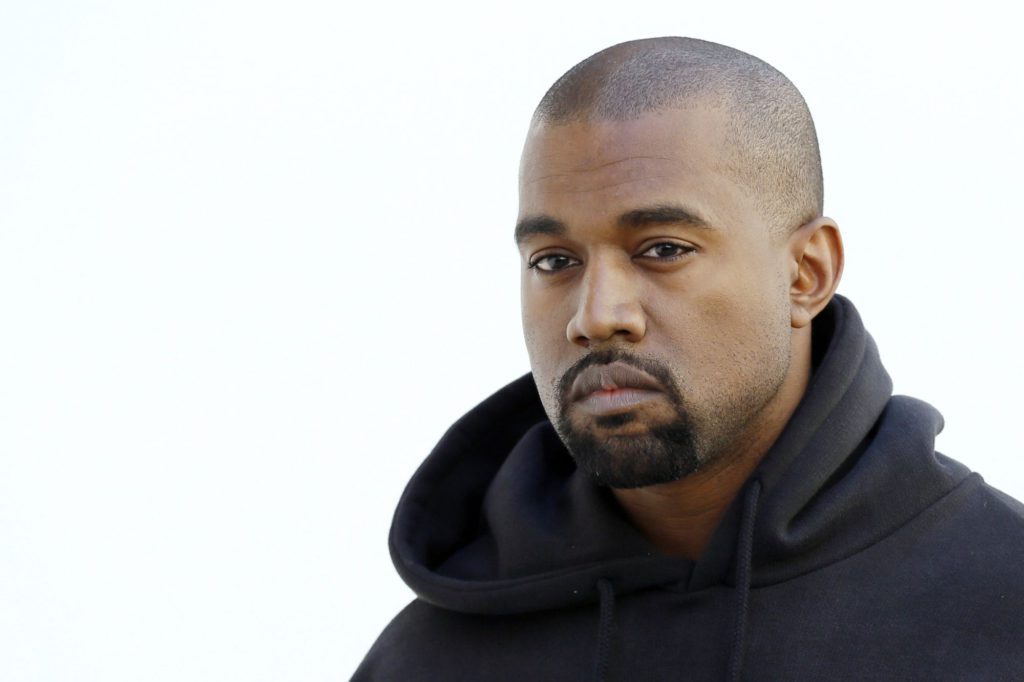
(Bloomberg) — Josh Kushner, a venture capitalist and brother of the former White House senior adviser, responded publicly Wednesday to comments from Ye for the first time since the hip-hop icon criticized one of Kushner’s investments.

Ye, formerly known as Kanye West, wrote “F— Josh Kushner” in a since-deleted Instagram post condemning an investment by Kushner’s VC firm in SKIMS, an underwear company created by the rapper’s ex-wife Kim Kardashian. Soon after, Ye’s accounts on Instagram and Twitter were restricted for posting anti-Semitic comments. (Those later posts weren’t specifically directed at Kushner, who is Jewish.)

“Getting called out by Kanye on Instagram was not on last week’s bingo card for me,” Kushner, the founder of Thrive Capital, said onstage in response to a question at the Bloomberg Invest conference in New York. “We feel really fortunate to work with [SKIMS] in particular and to support Kim and Jens and Emma and all of the people involved.”

The beef with Kushner centers on a disparity in their holdings of Kardashian’s company. Ye said he has 5% of shares and was surprised to learn Kushner’s Thrive has 10%. Ye thinks he should have more. His anti-Semitic comments are harder to explain. He had tweeted that he would go “death con 3 On JEWISH PEOPLE,” an apparent reference to the defense condition DEFCON.

“On a personal level and a human level, I think some of the comments that were made, specifically around anti-Semitism, were disappointing to me,” Kushner said at the Bloomberg conference.

Ye had elaborated on his views in an interview with Fox News’ Tucker Carlson last week. He again criticized Kushner as well as his brother, Jared Kushner, the son-in-law of former President Donald Trump. Ye said a peace agreement Jared helped negotiate between Israel, the United Arab Emirates and Bahrain was designed just “to make money.” He further criticized the Kushner family’s wealth.

The Kanye situation aside, Kushner and a general partner at Thrive Capital, Kareem Zaki, showed optimism for a rebound in the technology industry and for health tech in particular. “I think there will be a reawakening of digital health post-Covid,” he said, in part because of the new digital methods physicians can use to treat patients.

Thrive has built and incubated several companies. Zaki, while at Thrive, helped start the health-tech businesses Cedar and Cadence.

Another Thrive investment, a real estate financing company called Cadre, said in June that co-founder Ryan Williams was stepping aside from the CEO role. Kushner suggested the move was a sign of Williams’ self-awareness.

“He’s really scaled the business to an incredible point,” Kushner said. At the time of his decision, Williams’ mindset was, “I actually think this thing can be so much bigger” and, “How do I bring in someone who is exceptional?” Kushner said. Jared Kaplan, a longtime fintech executive, is the new CEO.

The creator economy is another area Kushner identified as a focus. “One of the things that’s really interesting is the growth of the creator,” he said. “That can be around recognizable individuals like Kim Kardashian and SKIMS, which we invested in, but also new people coming up on new mediums and platforms. We invested in Patreon and Twitch, which have enabled a whole new category of individuals.”

The relationship between Kushner and Zaki dates back to Harvard University, where they were classmates. Kushner reflected on his time in college, saying the friendships he made there were more important than any major. Kushner and Zaki also said they’re excited to work with someone they didn’t go to school with — former Walt Disney Co. Chief Executive Officer Bob Iger, who said he would join the investment firm as a partner in September.

(Updates with creator economy comment in the penultimate paragraph. A previous version corrected the name of a startup Zaki co-founded and rectified an omission from Kushner’s SKIMS quote.)

More stories like this are available on bloomberg.com

©2022 Bloomberg L.P.
Grayscale Brief Says SEC Unfairly Rejected Bitcoin ETF Bid

(Bloomberg) — Grayscale Investments LLC, the largest crypto asset manager, said the US Securities and Exchange Commission acted arbitrarily earlier this year in rebuffing a bid to convert its $12 billion spot Bitcoin trust into an exchange-traded fund. 

The rejection over the risk of fraud and manipulation in the spot Bitcoin market is “capricious” and “discriminatory” because the SEC has allowed futures-based Bitcoin ETFs and they are exposed to similar concerns, Grayscale said Tuesday in the opening brief of its lawsuit against the regulator.

In a statement, the firm said the brief argues that “the test the SEC has applied to Bitcoin-related ETFs, and only Bitcoin-related ETFs, is flawed and has been inconsistently applied with a ‘special harshness’ to spot Bitcoin ETFs.”

The SEC declined to comment on the Grayscale argument.

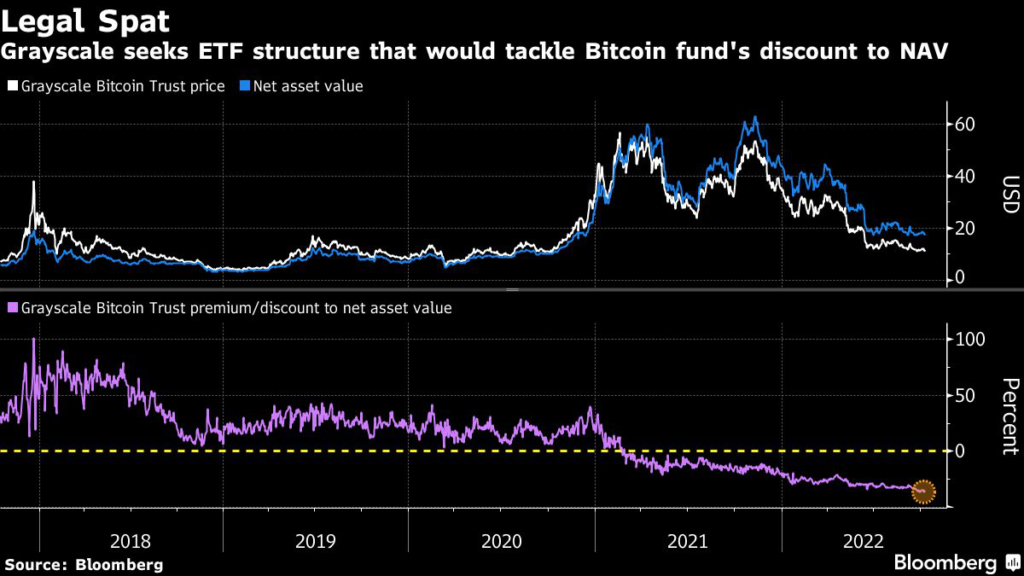
Grayscale sued the SEC mid-year after the regulator denied the company’s application to convert its Grayscale Bitcoin Trust, the world’s largest Bitcoin fund, into an ETF. The fund was started in 2013 and the company filed its plan to change the structure in October last year.

The shift would help to close the fund’s near-record discount to net asset value. The ETF structure has a creation and redemption process that helps to keep a fund’s price in line with its underlying holdings.

“We have regular dialog with really everyone in D.C.,” Grayscale’s Chief Executive Officer Michael Sonnenshein said on Bloomberg Television on Wednesday. “What we are seeing now in D.C. is probably the most engagement around crypto right now.”

Bitcoin, the biggest digital token by market value, has sunk about $50,000 from a peak of nearly $69,000 hit in November at the height of a pandemic-era mania for crypto.

A global wave of monetary-policy tightening to tackle high inflation has sucked liquidity from financial markets and hurt demand for speculative investments.

The share price of the trust — down 67% this year — rose 0.5% on Wednesday to $11.21.  

(Updates with Grayscale CEO’s comment in the seventh paragraph.)

More stories like this are available on bloomberg.com

©2022 Bloomberg L.P.
Close Bitnami banner
Bitnami