Bloomberg

Chip Gear-Maker ASML Tells US Employees to Stop Working With Customers in China

(Bloomberg) — ASML Holding NV, the most advanced maker of equipment for producing semiconductors, told its employees in the US to refrain from servicing customers in China following new regulations from the Biden administration, according to an internal email sent to staff.

“ASML US employees must refrain — either directly, or indirectly — from servicing, shipping or providing support to any customers in China until further notice, while ASML is actively assessing which particular fabs are affected by this regulation,” according to an email from the US management team addressed to employees in the country. The ban applies to all US employees, including American citizens, green card holders and foreign nationals who live in the country, according to the email. 

The US last week banned Chinese companies from buying advanced chip-making equipment or employing American citizens without a license to prevent the Communist Party from becoming more of an economic and military threat. 

The Veldhoven, Netherlands-based ASML has had to strike a challenging balance between the US and China. It has been selling its deep ultraviolet, or DUV, machines to Chinese customers but has held back from offering its more advanced extreme ultraviolet, or EUV, machines. 

ASML head of corporate communications Monique Mols confirmed that the email that circulated on social media on Wednesday “is indeed a genuine communication but it was not intended to be shared externally.” 

“We are of course taking precautionary measures in order to ensure full compliance with the new regulations while we are assessing the new Export Control restrictions,” Mols said in an email. “As the memo says, further instructions to our employees will follow once we have done the assessment.”

ASML’s move comes as American suppliers are beginning to withdraw staff from one of China’s leading chip companies in the wake of the same regulations. Applied Materials Inc., KLA Corp. and Lam Research Corp. have started or are preparing to pull employees from Yangtze Memory Technologies Co., the country’s most advanced maker of memory chips, Bloomberg reported on Wednesday.

More stories like this are available on bloomberg.com

©2022 Bloomberg L.P.

Stocks Gain on Fed Minutes ‘Calibrate’ Comment: Markets Wrap

(Bloomberg) — US stocks rose modestly after minutes of the last Federal Reserve meeting showed officials committed to tightening policy but that calibration was needed. Treasuries rose and the dollar fell. UK markets were roiled once again by confusion over the country’s policies.

The S&P 500 is attempting to stage a comeback after a five-day losing streak. PepsiCo Inc. led gains in consumer staples as drink and snack sales bucked inflation. The tech-heavy Nasdaq 100 posted modest gains. Treasuries yields fell across the curve, and the dollar retreated.

Fed minutes showed officials committed to restrictive rates and holding them there to get inflation back to their target, though several said it would be important to calibrate the pace of hikes to mitigate adverse risks to the economy.

“The market is waiting for the CPI print tomorrow more than it was waiting for minutes,” according to Sarah Hunt of Alpine Woods Capital Investors. “There may be a little hint of relief on the ‘calibrate’ statement, but I think that with the speed of hikes so far it would be irresponsible not to have some sort of possible slowdown coming in hikes, even if it isn’t a cessation in hikes.” 

Data earlier showed prices paid to US producers rose in September by more than expected ahead of a key measure of consumer inflation due Thursday that’s set to return to a four-decade high. 

“Prices remain elevated so it shouldn’t be a surprise to see producer goods and services rise,” Mike Loewengart, head of model portfolio construction at Morgan Stanley Global Investment Office, wrote. “No doubt the Fed still has its work cut out for them, and if tomorrow’s CPI read is hot, don’t be surprised to see some investors come to grips with how long the road to tamer inflation may be.”

Read more: Top-Ranked Chartist Says Gaming Out Fed Pivot Is ‘Fool’s Errand’

Earlier, comments by Minneapolis Fed chief Neel Kashkari reaffirmed policy makers’ commitment to the current rate-hike path, with the Minneapolis Fed chief saying the bar for a pivot away from monetary policy tightening is “very high.”

PepsiCo jumped the most in more than two years after lifting its forecast for the year on the back of better-than-estimated third-quarter profit as drink and snack sales buck inflation. Moderna Inc. posted double-digit gains after Merck & Co. said it would exercise an option to work in partnership with the biotech on a messenger RNA cancer vaccine. The reporting season will kick off in earnest Friday with results from banks including JPMorgan Chase & Co. and Citigroup Inc. 

Read more: JPMorgan, Citi May Show Growth Elusive Despite Interest Income

A selloff in long-maturity UK debt gathered pace after the Bank of England damped hopes it would extend its bond-buying support into next week. The yield on 30-year gilts surged above 5%, nearing levels that just last month drew the central bank’s intervention, before easing again after the BOE snapped up billions in its daily operations.

Kristina Hooper, chief global market strategist for Invesco, said in a note that while world economy is slowing after rate hikes, there’s yet to be a meaningful decline in inflation. 

“This is an extraordinary monetary policy tightening environment and we are waiting to see if something breaks globally,” she said. “The UK has come close.”

On the energy front, oil in New York dropped below $88 a barrel on slowdown fears. OPEC trimmed projections for the amount of crude it will need to pump this quarter, while Russia’s President Vladimir Putin said any energy infrastructure in the world is at risk after the explosions on the Nord Stream pipelines.

NATO Secretary General Jens Stoltenberg urged alliance members to step up supplies of air defense systems to Ukraine, condemning Russian strikes. In China, Shanghai is quietly shutting down schools and a raft of other venues as officials try to rein in a flareup that’s hit the financial hub.

Key events this week:

  • Earnings this week include: JPMorgan Chase & Co., Citigroup Inc., Morgan Stanley, BlackRock Inc., Delta Air Lines Inc., UnitedHealth Group Inc., U.S. Bancorp, Wells Fargo & Co.
  • FOMC minutes for September meeting, Wednesday
  • Fed’s Michelle Bowman and Neel Kashkari speak
  • ECB’s Christine Lagarde speaks
  • US CPI, initial jobless claims, Thursday
  • G-20 finance ministers and central bankers meet, Thursday
  • China CPI, PPI, trade, Friday
  • US retail sales, business inventories, University of Michigan consumer sentiment, Friday
  • BOE emergency bond buying is set to end, Friday

Some of the main moves in markets:

Stocks

  • The S&P 500 rose 0.3% as of 2:31 p.m. New York time
  • The Nasdaq 100 rose 0.5%
  • The Dow Jones Industrial Average rose 0.5%
  • The MSCI World index rose 0.2%

Currencies

  • The Bloomberg Dollar Spot Index fell 0.1%
  • The euro was unchanged at $0.9708
  • The British pound rose 1.3% to $1.1112
  • The Japanese yen fell 0.6% to 146.73 per dollar

Cryptocurrencies

  • Bitcoin rose 0.6% to $19,142.5
  • Ether rose 1.2% to $1,297.62

Bonds

  • The yield on 10-year Treasuries declined five basis points to 3.90%
  • Germany’s 10-year yield advanced two basis points to 2.31%
  • Britain’s 10-year yield was little changed at 4.44%

Commodities

  • West Texas Intermediate crude fell 2.5% to $87.12 a barrel
  • Gold futures fell 0.1% to $1,684.10 an ounce

More stories like this are available on bloomberg.com

©2022 Bloomberg L.P.

Crypto Is Unlikely to Replace Traditional Money, Fed’s Barr Says

(Bloomberg) — The top US bank regulator says that crypto tokens are unlikely to replace traditional currency and that banks should proceed cautiously when they experiment with the asset class. 

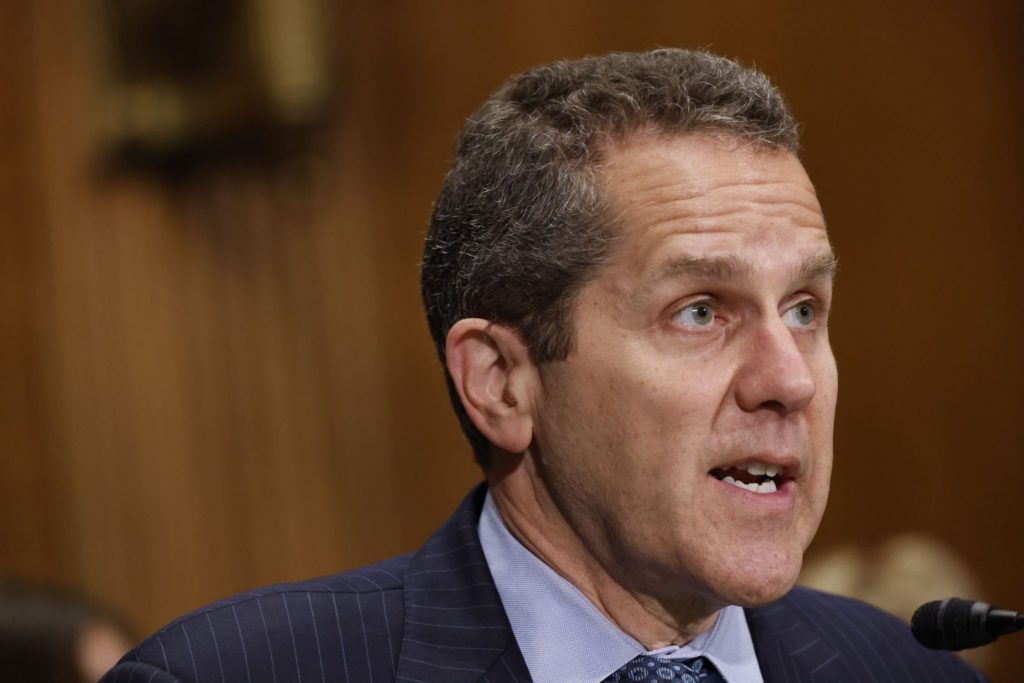
“Because crypto assets have proved to be so volatile, they are unlikely to grow into money substitutes and become a viable means to pay for transactions,” Federal Reserve Vice Chair for Supervision Michael Barr said on Wednesday in remarks prepared for a DC Fintech Week event. “Banks looking to experiment with these new technologies should do so only in a controlled and limited manner.”

Bank of New York Mellon announced on Tuesday the debut of a digital-asset platform in the US, with “select clients” using it to hold and transfer Bitcoin and Ether. He didn’t mention any specific projects in his remarks. 

Barr said he was concerned about the “novel risks” associated with banks’ involvement in crypto. He also said he also believes so-called crypto stablecoins could eventually pose a risk to financial stability and that regulators need to put in guardrails before their adoption is more widespread.

More stories like this are available on bloomberg.com

©2022 Bloomberg L.P.

NYC Tech Boom Helped Offset Pandemic Job Losses, DiNapoli Says

(Bloomberg) — New York City’s booming tech industry helped offset job losses in other sectors during the Covid-19 pandemic, according to report by state Comptroller Thomas DiNapoli.

The tech industry grew by 9.4%, or 14,340 jobs, in 2020, the largest growth since 2012, the report said. In the same period, total private-sector employment declined by 12.6%, or 494,810 jobs. In 2021, growth in tech slowed to 3.1%, though the gain was still larger than the total private sector’s growth of 2.4%

“In 2020, even as the Covid-19 pandemic caused employment to decline in every major industry in the city, it did not slow down the tech sector as people became more reliant on technology during the lockdowns and the shift to working from home,” according to the report released Wednesday.

The tech business has been growing in the city since before the pandemic. The report found that tech employment increased by 33.6% from 2016 to 2021, compared with a 3.3% decline in other sectors. Total employment in tech reached a record 172,570 in that span.

Tech jobs also grew in other nontech businesses, including retail trade, that employ workers like software developers or computer programmers. When combined with the jobs in nontech sectors, the city had a total of 281,100 tech jobs in 2021, 58% higher than in 2011.

The average salary in tech jobs in New York City reached $228,620 in 2021, which was double the average pay in the total private sector, the report found.

More stories like this are available on bloomberg.com

©2022 Bloomberg L.P.

Apple to Withhold Its Latest Employee Perks From Unionized Store

(Bloomberg) — Apple Inc. is withholding its latest employee benefits from staff who work at its sole unionized retail store, a move that could potentially inflame labor tensions at the technology giant.

The company told retail and corporate staff this week that it will increase benefits for outside educational classes and health care, according to people familiar with the matter. Workers will get more funds to pursue coursework, and employees in some states will be able to access new health plan benefits, said the people, who asked not to be identified because the program hasn’t been announced publicly.

It’s part of a broader effort to reward workers at the Cupertino, California-based company, which has had to navigate inflationary pressure, a tight labor market and changing demands of workers during the pandemic. But the company was quick to inform the employees at its unionized retail location — a store in the Baltimore suburb of Towson, Maryland — that they wouldn’t get the new perks.

The reason given was that the Towson store needs to negotiate benefits with Apple via the collective bargaining arrangement that comes with a union. The approach isn’t unique to Apple. Excluding unionized stores from new benefits has also been a flashpoint in the labor dispute at Starbucks Corp., where about 250 cafes have voted to unionize over the past year. Starbucks rolled out a series of new perks at nonunion stores, including raises and student-debt coaching, while saying that it can’t legally provide them unilaterally to sites with union activity.

Apple’s move could dissuade employees in other cities from unionizing their stores, but it also could further upset workers. The company declined to comment.

Employees at an Apple store in Oklahoma City are due to vote this week whether to join the Communications Workers of America, and labor groups are looking to mobilize workers at more of the company’s US stores in the coming months. The iPhone maker also has contended with some employee pushback in its office staff, which was ordered back to in-person work in recent months.

The new benefits include:

  • Apple prepaying some tuition for outside education. The company has long reimbursed employees for a portion of education costs, but the iPhone maker will now pay the amount in advance. This will start at a small amount of colleges, though the list is expected to expand over time.
  • A program with Coursera Inc. beginning on Jan. 1 that gives Apple employees a free membership. Coursera is an online-course provider that normally charges $399 per year for its premium subscription.
  • In certain states, including Connecticut, New York, Georgia, Washington and New Jersey, employees will get access to a new health care plan that waives co-pays for some Apple-approved doctors within the UnitedHealth Group Inc. network.

Apple has expanded other benefits for workers over the past year. The company previously upped vacation and sick days, and it has long-offered health care and product discounts. 

The store in Maryland, which is represented by the International Association of Machinists and Aerospace Workers union, is preparing to begin formal negotiations with Apple. Its labor group in recent days supplied employees with guides to negotiate with Apple and hold conversations with managers. 

According to an internal survey provided with the guide that was obtained by Bloomberg News, the No. 1 bargaining priority at that location is general wage increases, followed by cost-of-living adjustments, improved work-life balance, better communication and more staffing.

Apple’s union-related moves have been under heavy scrutiny in recent weeks, with the US National Labor Relations Board and Communications Workers of America accusing the iPhone maker of discriminating against pro-union employees. 

In the Starbucks case, the union said it waived the right to negotiate over receiving perks that were already being provided to other stores — meaning employees should just get them automatically. Workers United, the group attempting to organize Starbucks cafes, described the denial of benefits as a union-busting tactic.

More stories like this are available on bloomberg.com

©2022 Bloomberg L.P.

Balwani Denied Request to Join Bid by Holmes for a New Theranos Trial

(Bloomberg) — A federal judge rejected a request by former Theranos Inc. President Ramesh “Sunny” Balwani to join an attempt by the company’s founder and former chief executive officer Elizabeth Holmes to win a new trial.

  • Balwani wanted to join an Oct. 17 hearing where a former Theranos lab director will be questioned about the veracity of his testimony at trial
  • US District Judge Edward Davila ruled Wednesday that none of the statements by the director, Adam Rosendorff, pertain to Balwani’s trial
  • Rosendorff “unequivocally stands by his testimony at Mr. Balwani’s trial,” Davila said in his ruling
  • Balwani was convicted in July of defrauding investors and patients, after Holmes was found guilty in January of defrauding investors
  • Read More: Elizabeth Holmes’s Ex Sees Her Bid for New Trial and Antes Up
  • The case is US v. Holmes, 18-cr-00258, US District Court, Northern District of California (San Jose).


More stories like this are available on bloomberg.com

©2022 Bloomberg L.P.

Crypto’s Copper Secures $196 Million in Series C Funding

(Bloomberg) — Crypto custodian Copper Technologies Ltd has obtained $196 million in fresh funding this year, as part of an ongoing series C investment in the business.

The London-based firm raised $181 million from new and existing shareholders as of June, in addition to a convertible loan note of $15 million, according to company filings published this week. The document did not name the investors. A Copper spokesperson declined to comment on the firm’s valuation, as the company has yet to formally close the round. 

Copper, which provides infrastructure for digital assets to institutions such as FTX and State Street, also declared a loss for the business of £14.4 million ($15.95 million) in 2021, a significant widening from the previous year’s shortfall of £3.7 million. 

The investment has been a long and drawn-out process for Copper, which was reported by Bloomberg to be seeking a total of $500 million at a valuation of $3 billion in November last year when Bitcoin was at an all-time high. Since then cryptocurrency prices have crashed, wiping as much as $2 trillion from the market’s total value and reducing appetite for companies in the space. 

“It just generally took longer than we expected to basically make sure that there is a full clarity as to what’s going on, and how things are,” Copper Chief Executive Dmitry Tokarev said of the fundraising effort in a July interview.

Accel, SoftBank Group, Tiger Global and Barclays Plc are some of the companies that had reportedly considered investing in the round. Accel and SoftBank did not participate in Copper’s funding, according to people familiar with the matter. Accel and Tiger Global did not respond to a request for comment, while a spokesperson for Barclays declined to comment.

Copper had previously sought permission to operate its crypto services in the UK under the Financial Conduct Authority’s anti-money laundering standards. It gained an extension to its application from the regulator in March, but ultimately withdrew after securing similar approvals in Switzerland a month later. 

The company is raising cash in an increasingly tough market, as venture capitalists soured on investing in crypto startups in recent months. VC firms plugged $4.44 billion into crypto startups in the third quarter, according to data from PitchBook, a 37% decline from the same period a year earlier.

(Adds that Accel didn’t particiate in the sixth paragraph.)

More stories like this are available on bloomberg.com

©2022 Bloomberg L.P.

Google’s Pixel Phone and Watch Are Best Apple Alternatives Yet

(Bloomberg) — Alphabet Inc.’s Google has been selling smartphones under its own brand for a dozen years, but its failure to break through into mainstream consciousness has been so total that its latest ads start by asking, “did you know Google makes a phone?”

The company best known for its online services is trying once again with the seventh generation of its Pixel smartphones — but this time it’s making a serious ecosystem play by adding a smartwatch and “introducing a true portfolio of Pixel products for the first time,” in the words of senior vice president and hardware chief Rick Osterloh.

The Android-powered Pixel 7 and 7 Pro are joined by the Pixel Watch, running WearOS, and the Google Pixel Buds Pro to create a cohesive set of devices that work best in concert — much in the same fashion as Apple Inc. reinforces its iPhone’s appeal by adding AirPods and Apple Watch accessories that work best with it. It’s the closest any company in the Android sphere has come to emulating Apple to date, including Samsung Electronics Co., which has been trying for years.

“The Watch and the Pixel offers the best Apple-like multi-device ecosystem with a pure Google services experience,” said mobile industry analyst Carolina Milanesi. “Samsung’s Galaxy Watch and devices like the Fitbit Versa are okay, but not quite the same value add of using a Pixel phone and watch.”

Mountain View, California-based Google completed its acquisition of fitness-tracking firm Fitbit in January 2021 and that deal has fed much of the most valuable functionality of its new Pixel Watch. It replicates almost the full Fitbit health-tracking experience — the Watch lacks temperature sensing and blood oxygen measurements — and benefits from over 20 billion nights of sleep analysis data in the Fitbit library.

Through experience, Apple has made its Watch into a health gadget which doubles as a convenient tool for contactless paying and has a glanceable display of useful info. Google has done the same: the Pixel Watch is a Fitbit in all but name and design — it’s more handsome and feels premium in a way no Fitbit wearable has done to date — and it layers on Google Pay and an on-board app store for extra functionality like Google Maps, weather, voice messaging and music controls.

“This is very much an ecosystem play, possibly a more cohesive one with Google Assistant at the heart of it, which is consistently better than Siri at most things,” said Anshel Sag, mobile industry analyst at Moor Insights & Strategy. “It’s also a broader and more tightly integrated ecosystem since Apple doesn’t have much of a first-party smart home play like Google does with Nest.”

The Pixel 7 and 7 Pro lean heavily into Google’s traditional strength of features enriched with artificial intelligence. Google’s Recorder app is now smarter and can label different speakers during a transcription. Its cameras, which use machine learning and other AI techniques to combine several frames into one higher-quality image, have been meaningfully upgraded. Google’s lead over the contemporary iPhone generation’s image quality is as large as it’s ever been.

Chinese Android partners like Xiaomi Corp., Oppo and Vivo have no chance of penetrating the key US market, whereas Samsung has largely focused on promoting its foldable devices into a mainstream category, leaving Google to pick up the slack in competing directly against the iPhone in the domestic market. Google, the author of Android, has made its operating system as smooth and responsive as Apple’s and reduced gaps in design and quality.

Like Apple, Google is now powering its devices with its custom-designed chip, the Tensor G2. It yields extremely quick camera performance and fluid animations and responsiveness while extending the device’s battery life.

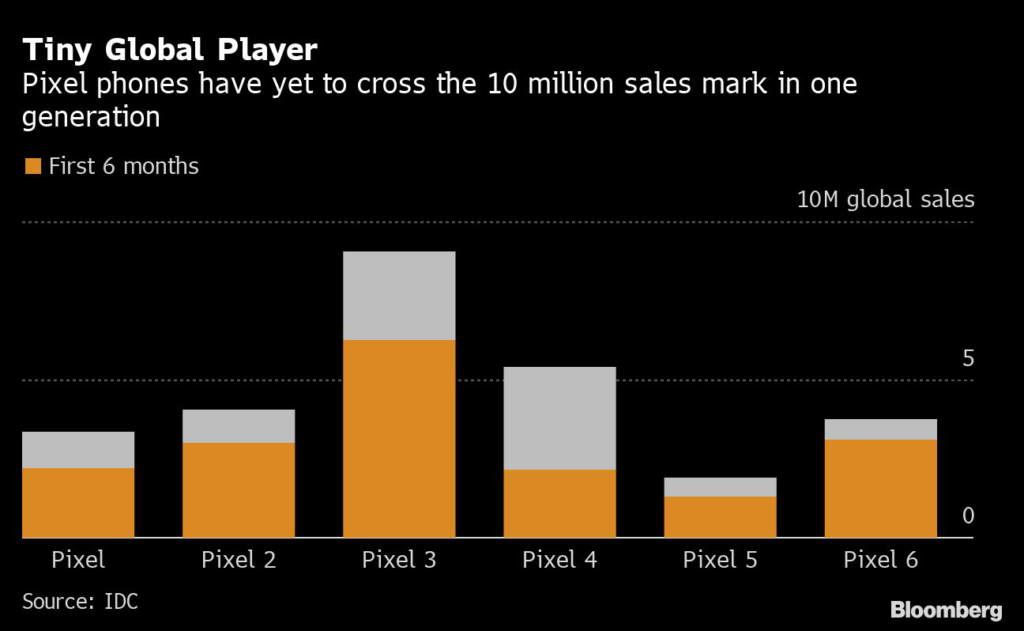
It’s the most complete and cohesive smartphone Google has put on the market, coming 12 years after the Nexus One released in partnership with HTC Corp. The one thing Google still needs to fix, however, is the relatively narrow distribution, which has contributed to paltry sales numbers.

Google’s new smartphones are available in 17 markets, including France, Germany, some of the Nordics and the UK in Europe alongside Japan, India, Singapore and Taiwan in Asia. It’s a markedly smaller audience than Apple and Samsung’s globe-spanning device portfolios enjoy. 

“Now more than ever, Android needs Pixel to do bigger volumes so they are not solely dependent on Samsung, especially in the high end,” Milanesi said. “With Chinese vendors still limited internationally and likely to be even more so because of US government decisions, they need alternatives.”

Google has spared little expense in marketing its Pixel products: they’re title sponsors during NBA Finals games and have featured superstars Kevin Durant, Giannis Antetokounmpo and Stephen Curry in advertising spots at home. The company also rolled out aggressive trade-in campaigns in various countries during the pre-order period for its phones, which start at $599, including bundling the $349 Pixel Watch for free with the $899 Pixel 7 Pro in France.

Another area where Google lags behind Apple is in its mastery of the supply chain: several of the Pixel 7 and Pro variants are already unavailable, with customers pointed to waiting lists across Google’s French, UK and Japanese online stores. Considering the critical importance of launch-window sales for any smartphone, this failure to secure enough units to fulfill initial demand may significantly impact Google’s final tally.

The Pixel 7 generation of devices, augmented with the Pixel Buds Pro and Pixel Watch, is Google’s best attempt at emulating Apple to date. But there’s still a long way for the proprietor of YouTube, Gmail, Chrome and a handful of other billion-user services to go before it can hold its hardware division up alongside its core software business.

More stories like this are available on bloomberg.com

©2022 Bloomberg L.P.

What Dimon’s ‘Easy 20%’ Drop in the S&P 500 From Here Looks Like

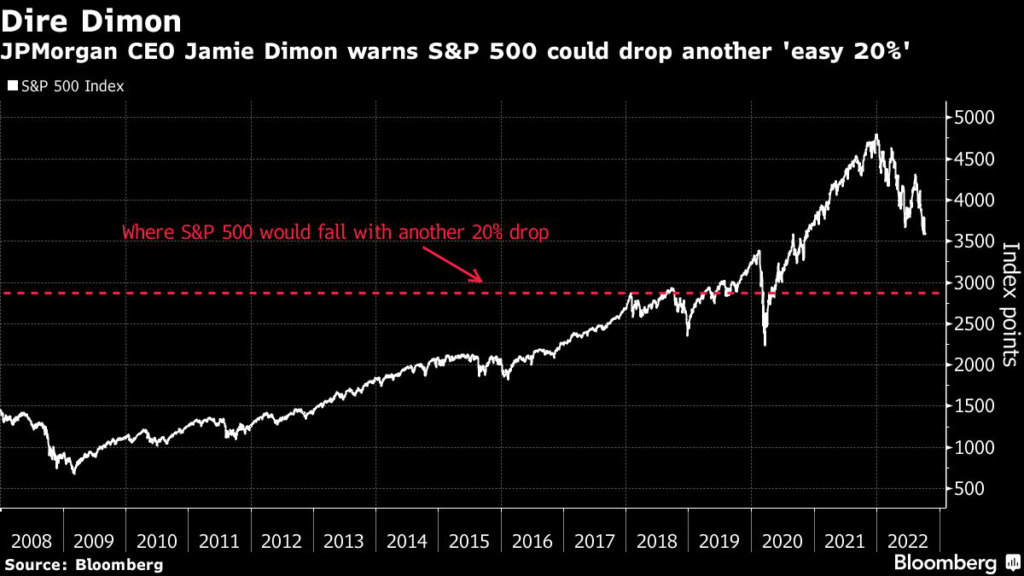
(Bloomberg) — JPMorgan Chase & Co.’s boss Jamie Dimon says the US stock market could suffer another “easy 20%” drop, which would push the benchmark index below 3,000 — a level it hasn’t seen since the depths of the coronavirus pandemic. 

So what would another slide of that magnitude actually look like and which stocks would get hit hardest? 

For one thing, it would be painful for investors, with technology and so-called growth shares likely taking the brunt of the suffering, with their elevated valuations becoming targets as borrowing costs rise. Such a decline would push the S&P 500 to 2,871 based on Tuesday’s close, shaving $6 trillion off the S&P 500’s current market value of $30 trillion. 

Read: Jamie Dimon’s S&P 500 Bear Market: Brutal, Far From Unimaginable

The top five companies in the S&P 500 — Apple Inc., Microsoft Corp., Alphabet Inc., Amazon.com Inc. and Tesla Inc. — account for 21% of the index, creating risk for equity investors because any big declines from those shares can quickly steer broader markets lower. 

“Do I think another 20% drop from here is likely? No. But there’s better than a 50% chance it could happen,” said Nick Giacoumakis, president of NEIRG Wealth Management, citing the steep equity downturn in the early 2000s. When the dot-com bubble burst, the S&P 500 lost nearly half of its value, shedding 49% from its peak in March 2000 to its ultimate low in October 2002, according to Bespoke Investment Group.

When the S&P 500 peaked in October 2007, it lost 57% of its value when it finally hit its low in March 2009 in the wake of the global financial crisis.

“That’s the magnitude of what Dimon is talking about,” Giacoumakis added. “Back then, we had an extreme run-up in exuberance similar to now, but instead of internet stocks now it’s SPACs and trillions of dollars in excess liquidity that has put the economy on steroids.” 

During this year’s market rout, Amazon has shed more than 30%, while Tesla, Microsoft and Alphabet have all lost at least a third of their value. Apple — a stock that delivers stable earnings, and pays out a consistent dividend — hasn’t been shielded either this year, tumbling 21%. But Giacoumakis, who likes big tech, is more concerned about slumping chipmakers due to mounting growth concerns.

The S&P 500 is already down 25% from it’s Jan. 3 closing high. Another 20% decline from its high would push it about 40% below its peak — far beyond the average drawdown for bear markets. 

Since World War II, there have been nine bear markets that have been accompanied with a US recession, with the S&P 500 declining 35% on average versus a 28% decline in bear markets that didn’t come with an economic downturn, according to CFRA.

A quick, back-of-the-envelope look at what Dimon says could happen to the market in the near future. Is he serious or just talking down expectations ahead of the bank’s earnings Friday?

“Dimon’s human. All he can do is make estimates on how the economic data is coming in,” Giacoumakis said. “We’re not in a recession yet, but I think it’s coming in the next three to nine months. So we have enough left in the equity bubble to drop another 10% to 15% from here, no sweat.” 

More stories like this are available on bloomberg.com

©2022 Bloomberg L.P.
Microsoft Unveils App To Help Hybrid Workforce Decide When to Go Into the Office

(Bloomberg) — Microsoft Corp. will introduce an app to help employees and managers in a hybrid workplace decide what’s the right time to go into the office. 

The new Microsoft Places app will let users know when a large number of their co-workers plan to be in the office or attend a meeting in person. The app also shows when a workspace is likely to be pretty empty to help managers make decisions about electricity, heating and cooling that can save money. For example, as Europe looks to a winter of fuel and electricity shortages, companies are seeking tools like this, Microsoft vice president Jared Spataro said in an interview.

The software maker also is introducing a new premium version of the Teams chat and conferencing app that will generate summaries of meetings with chapters and personalized highlights, which will let more workers skip meetings they don’t really need to attend and catch up later, he said. Too many people go to meetings because of a “fear of missing out” rather than the need to be there, he said. 

“We see a lot of FOMO in meetings — people go because they want to either be seen or there really is a fear of missing out,” he said. “We’re going to promote what we call JOMO — the joy of missing out, like please don’t attend that meeting and let intelligent recap do the work for you.”

Teams Premium will be widely available beginning in February at $10 per user per month, Microsoft said. 

The company will also offer OpenAI’s Dall-E, which generates images from text prompts, to select customers of Microsoft’s Azure OpenAI cloud service. Azure OpenAI lets Microsoft cloud customers make use of some of the artificial intelligence products OpenAI has developed. Customers such as Mattel are now using Dall-E through Azure cloud to generate images of toy cars they might want to design, Microsoft said. The company will also add the image creation tool to one of its consumer Design products and its Bing search image creation tool. 

The new workplace app and update to Teams were among the products and services Microsoft introduced Wednesday at its annual Ignite conference. The company also announced:

  • A partnership with Cisco Systems Inc. in which customers can join Teams meetings from Cisco hardware. The partnership is noteworthy because Cisco also owns the rival Webex conferencing software.
  • Syntex — an artificial intelligence tool that scans and indexes corporate content to make it searchable and available to various corporate applications
  • A new Microsoft 365 app that combines Teams, Word, Excel, PowerPoint, Outlook and other newer Microsoft products.

More stories like this are available on bloomberg.com

©2022 Bloomberg L.P.
Close Bitnami banner
Bitnami