Bloomberg

Amazon Workers at California Warehouse Seek to Join Upstart Union

(Bloomberg) — Workers at an Amazon.com Inc. warehouse in Southern California have filed paperwork to hold an election on whether to join the Amazon Labor Union, the latest organizing drive at one of the retail giant’s facilities. 

Workers at the ONT8 fulfillment center in Moreno Valley, California, are seeking to hold an election and affiliate with the upstart ALU, National Labor Relations Board spokesperson Kayla Blado said in an email. The proposed bargaining unit has 800 employees, and the labor board is waiting for additional paperwork to verify they’ve received signed cards from at least 30% of them, Blado said. 

The facility is one of several operated by Amazon in California’s Inland Empire, home base for activists who have long criticized the company and asked it to do more for workers there. The region east of Los Angeles serves as a critical logistics hub for the company, which relies heavily on goods imported at the nearby ports of Los Angeles and Long Beach.  

ONT8 opened in 2014 and is an inbound cross dock, according to MWPVL International Inc., a consulting firm that closely tracks Amazon’s network. Such facilities receive goods from manufacturers and break them down, before sending the products to other Amazon warehouses that store and package them for shipment. 

“While we haven’t received an official copy of the petition yet, we remain skeptical that there are a sufficient number of legitimate signatures for an election,” Amazon spokesperson Paul Flaningan said in an emailed statement. Amazon says there are more than 2,300 employees at the facility. 

The ALU in April won an election at a warehouse employing about 8,000 workers in New York City’s Staten Island  — an outcome Amazon is seeking to overturn. The group lost a second vote at a much smaller Staten Island facility the next month, but has since sought to back Amazon workers beyond New York City. 

An ALU-affiliated group of workers at a warehouse in Schodack, New York, near Albany, begins voting on whether to join the union on Wednesday. Vote counting at the facility, called ALB1, is set to begin Oct. 18. 

The Retail, Wholesale and Department Store Union, meanwhile, is seeking to represent workers at an Amazon warehouse in Bessemer, Alabama. Federal officials determined that Amazon’s conduct during a vote there last year made a fair election impossible, and a rerun election remains too close to call.

(Updated with Amazon statement in the fifth paragraph.)

More stories like this are available on bloomberg.com

©2022 Bloomberg L.P.

Futures Pare Gains; Gilts Fall on Policy Confusion: Markets Wrap

(Bloomberg) — US futures pared gains and European stocks extended declines on Wednesday after producer price data fueled Federal Reserve tightening bets. UK markets were roiled once again by policy concerns.

The yield on 30-year gilts rose above 5% after the Bank of England confirmed its plan to end emergency bond purchases, but the pound rallied above $1.10. The BOE also signaled interest rates are likely to rise sharply in November and warned that some UK households may face a strain over debt repayments that’s as great as before the 2008 financial crisis.

“The Bank of England is a test case for how hawkish central banks can be without doing damage to financial stability,” said Michael Metcalfe, global head of macro strategy at State Street Global Markets.

Treasury yields and the dollar were little changed as data showed prices paid to US producers rose in September by more than expected ahead of a key inflation measure due Thursday that’s set to return to a four-decade high. US investors are also looking to corporate earnings for clues about Federal Reserve policy. 

Kristina Hooper, chief global market strategist for Invesco, said in a note that while world economy is slowing after rate hikes, there is yet to be a meaningful decline in inflation. “This is an extraordinary monetary policy tightening environment and we are waiting to see if something breaks globally,” she said. “The UK has come close.”

Among notable premarket moves, Moderna Inc. rose after Merck & Co. exercised its option to jointly develop and commercialize a cancer vaccine. Major US technology, internet and semiconductor stocks rebounded.

“While futures positioning is now slightly less extreme, it is still a very bearish set up into what is seen as a binary market event tomorrow,” said Carl Dooley, head of EMEA trading at Cowen in London. That makes it “natural to see some bear covering, with the remaining bulls having another roll of the dice.”

In Europe, Credit Suisse Group AG slumped after a report that US authorities are investigating whether the bank helped clients hide assets. 

Elsewhere, crude fluctuated. OPEC slashed projections for the amount of crude it will need to pump this quarter, while Russia’s President Vladimir Putin said any energy infrastructure in the world is at risk after the explosions on the Nord Stream pipelines.

NATO Secretary General Jens Stoltenberg urged alliance members to step up supplies of air defense systems to Ukraine, condemning Russian strikes. In China, Shanghai is quietly shutting down schools and a raft of other venues as officials try to rein in a flareup that’s hit the financial hub.

Key events this week:

  • Earnings this week include: JPMorgan Chase & Co., Citigroup Inc., Morgan Stanley, BlackRock Inc., Delta Air Lines Inc., UnitedHealth Group Inc., U.S. Bancorp, Wells Fargo & Co.
  • FOMC minutes for September meeting, Wednesday
  • US PPI, mortgage applications, Wednesday
  • OPEC Monthly Oil Market Report, Wednesday
  • Fed’s Michelle Bowman and Neel Kashkari speak
  • ECB’s Christine Lagarde speaks
  • US CPI, initial jobless claims, Thursday
  • G-20 finance ministers and central bankers meet, Thursday
  • China CPI, PPI, trade, Friday
  • US retail sales, business inventories, University of Michigan consumer sentiment, Friday
  • BOE emergency bond buying is set to end, Friday

Some of the main moves in markets:

Stocks

  • Futures on the S&P 500 rose 0.4% as of 8:45 a.m. New York time
  • Futures on the Nasdaq 100 rose 0.5%
  • Futures on the Dow Jones Industrial Average rose 0.3%
  • The Stoxx Europe 600 fell 0.4%
  • The MSCI World index fell 1%

Currencies

  • The Bloomberg Dollar Spot Index was little changed
  • The euro was little changed at $0.9704
  • The British pound rose 0.8% to $1.1052
  • The Japanese yen fell 0.6% to 146.73 per dollar

Cryptocurrencies

  • Bitcoin rose 0.5% to $19,119.64
  • Ether rose 1.4% to $1,299.83

Bonds

  • The yield on 10-year Treasuries advanced one basis point to 3.96%
  • Germany’s 10-year yield advanced nine basis points to 2.39%
  • Britain’s 10-year yield advanced 12 basis points to 4.56%

Commodities

  • West Texas Intermediate crude fell 0.6% to $88.84 a barrel
  • Gold futures fell 0.7% to $1,673.80 an ounce

More stories like this are available on bloomberg.com

©2022 Bloomberg L.P.

Riyadh Cables Seeks About $400 Million From Saudi IPO

(Bloomberg) — Riyadh Cables Group, a Saudi Arabian manufacturer and exporter of power and telecommunications cables, is planning an initial public offering in the kingdom that could raise about $400 million, according to people familiar with the matter.

The company is working with Riyad Capital and Himmah Capital on the proposed listing that could come as soon as this year, the people said, asking not to be identified as the information isn’t public. More banks could be added later, they said.

Representatives for Riyadh Cables, Riyad Capital and Himmah Capital didn’t respond to calls seeking comment.

Riyadh Cables joins a long list of companies looking to go public in Saudi Arabia, the Gulf’s biggest market for share sales. A surge in oil prices at the start of the year as well as investor inflows have driven a flurry of listings across the Gulf, bucking a global slowdown in IPOs as recession and inflation fears bite.

Middle Eastern listings have fetched $16.4 billion this year 2022 and the region is on track for its best year for IPOs since 2019, when Saudi Aramco raised $29.4 billion, data compiled by Bloomberg show. Of the 33 Gulf IPOs this year, 22 took place on Saudi Arabia’s Tadawul, the data show.

Riyadh Cables, founded in 1984, had initially planned a domestic IPO in 2015, when the country opened its stock market to international investors, Bloomberg News reported. It is majority-owned by Saudi Arabia’s AlZaim family.

More stories like this are available on bloomberg.com

©2022 Bloomberg L.P.

Online Food Inflation Hits a Record in US Even as Prices for Electronics Dip

(Bloomberg) — Prices of goods sold online in the US contracted for the second time in three months, as steep declines for computers and electronics masked a record surge for groceries, according to Adobe Inc.

September online prices dropped 0.2% from a year earlier, after rising 0.4% in August, Adobe said Wednesday. In July, prices had declined for the first time in more than 2 1/2 years. 

There was little sign of relief for consumers buying food, however, with annual inflation for groceries bought online at 14.3% last month. Out of 18 e-commerce categories tracked by Adobe, grocery is the only one to move in step with overall consumer prices tracked by the government.


In total, 11 categories in the Adobe digital price index saw gains, including products for pets and for home improvement. 

Although overall inflation has abated in the US in recent months, it remains historically high. Economists expect that the consumer price index, scheduled to be released on Thursday, rose 8.1% last month from a year earlier. 

More stories like this are available on bloomberg.com

©2022 Bloomberg L.P.

Einhorn Says Twitter Is The Biggest Long Bet He’s Made This Year

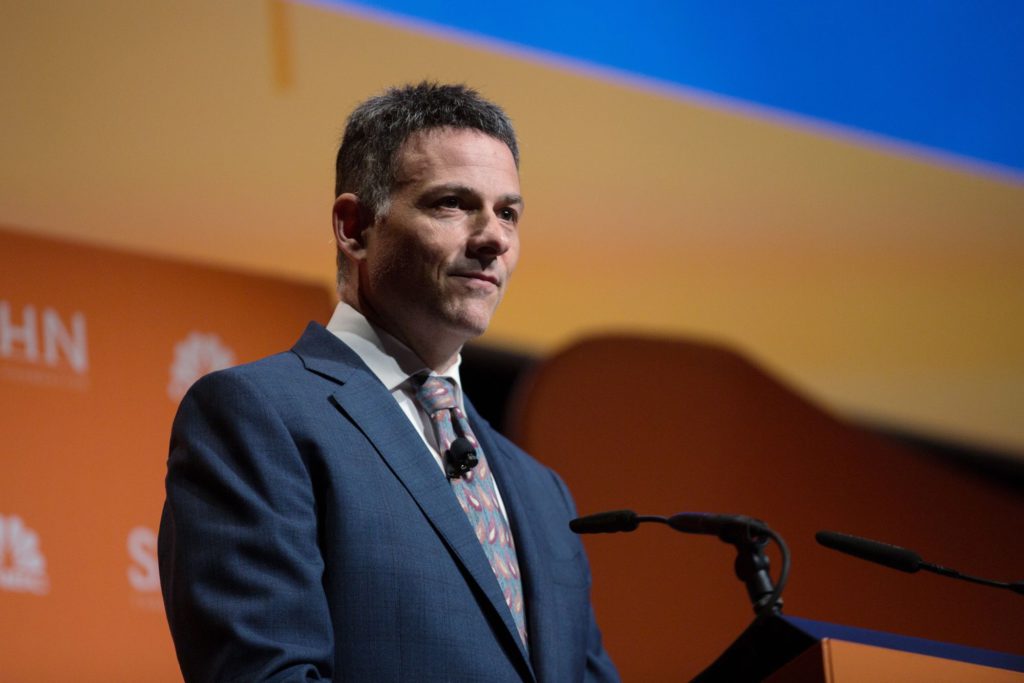
(Bloomberg) — David Einhorn, the founder of Greenlight Capital who was among hedge fund managers wagering on Twitter Inc., said he believes that Elon Musk will go through with his deal to buy the social media company this year.

“It’s pretty much the only sizable long investment we’ve made the entire year because we’ve been very cautious with the bear market,” he said Tuesday in a Bloomberg Television interview on Tuesday. “Investing in something like Twitter, which I think will resolve this year, is good because I should get the cash out to redeploy into the next thing.” 

Einhorn said earlier this year that the laws tied to mergers and acquisitions are clear, and that the Delaware Chancery Court would uphold a deal. Though Musk has tried to pull out of the purchase, he revived his bid in recent weeks at the original price of $54.20 a share. 

Read more: Hedge funds pile into Twitter

“We have a sizable investment,” Einhorn said, without disclosing his full stake. “As for Elon’s reputation, I don’t believe it will be changed one way or another.”

More stories like this are available on bloomberg.com

©2022 Bloomberg L.P.

Health Startup Folx Raises $30 Million as GOP Tries to Limit LGBTQ Rights

(Bloomberg) — Folx Health, which seeks to expand access to healthcare for LGBTQ people, completed a $30 million funding round Wednesday, attracting support from investors amid a push by Republican lawmakers across the country to limit the community’s rights.

The money will go toward launching support groups for LGBTQ people interested in family planning, Chief Executive Officer Liana Douillet Guzmán said in an interview. The company, which has raised a total of $59.4 million, already offers its members virtual primary care consultations as well as prescriptions for drugs including hormone replacement therapy and birth control, and rolled out an employer-subsidized healthcare option in June.

All of these expansions serve “the full spectrum of our community’s needs,” said Douillet Guzmán. “The enterprise play for us is really about being able to increase the number of people who have access to this very important care.”

A survey of transgender and gender non-conforming people by the National Gay and Lesbian Task Force and the National Center for Transgender Equality showed 19% have been refused healthcare because of their gender status. Such stigma can cause people to avoid going to the doctor altogether; a survey conducted by Folx found that 71% of members previously avoided care because they worried about being discriminated against. 

Republican lawmakers’ escalating attempts to limit LGBTQ health care and rights may compound that fear. About 60% of proposed bills that center on LGBTQ health care in the 2022 state legislative year have attempted to ban or limit transgender-related healthcare, and other GOP leaders are doubling down on barring transgender children from receiving affirming care or playing in sports leagues that align with their gender identity. Folx and its backers hope that their funding round can serve as reminder that they and others are committed to providing care even as it’s being attacked.

7wireVentures and Foresite Capital led the latest fundraise, and 7wireVentures’ managing partner, Lee Shapiro, will join Folx’s board of directors. Bessemer Venture Partners, Define Ventures and Polaris Partners, investors in the company’s $25 million haul in February last year, also participated. 

“The need and frankly, the demand, for culturally competent care for the LGBTQIA+ community is a paramount need right now,” said Shapiro. The Folx telehealth model, which includes lower price points for pre-exposure prophylactic drugs that prevent the spread of HIV, can help “serve communities who have been underserved by some of the systemic racism and and cultural bias that exists in our existing healthcare system,” he said. Such prescriptions can cost as much as $2,000 a month without insurance. 

The company is raising money at a time when investors have been slower to write checks for startups. Funding for digital health companies was down 32% in the second quarter from the first three months of the year, according to research firm CB Insights. Plume, another telehealth startup focused on transgender care, raised $24 million in August from investors including Transformation Capital and General Catalyst. Plume has raised nearly $46 million, according to research firm Pitchbook.

More stories like this are available on bloomberg.com

©2022 Bloomberg L.P.

Microsoft Says Biased Sony Attack on $69 Billion Deal Swayed UK

(Bloomberg) — Microsoft Corp. accused Britain’s competition watchdog of relying on “self-serving” input from fierce rival Sony Group Corp. in its decision to probe the tech giant’s $69 Billion takeover of Activision Blizzard Inc..

The Competition and Markets Authority opened a longer review of the deal last month citing concerns it could hamper markets, for example by restricting players of Activision’s Call of Duty to Microsoft’s Xbox console.

In the agency’s full decision published Wednesday it said “the main rival that could be affected by this conduct would be Sony,” whereas other competitor Nintendo competes less closely. The CMA also pointed to past “strategies” used by Microsoft to justify taking a closer look at the tie-up.

Microsoft hit back, saying the CMA “incorrectly relies on self-serving statements by Sony which significantly exaggerate the importance of Call of Duty.” In a response to the CMA statement, seen by Bloomberg, it said the authority has adopted the complaints of market leader Sony without the “appropriate level of critical review.”

The combination with Activision — which owns some of the most popular franchises including World of Warcraft and Guitar Hero — will make Microsoft the world’s third-largest gaming company and boost the Xbox maker’s roster of titles for its Game Pass subscribers.

The CMA and Sony didn’t immediately respond to requests for further comment.

Microsoft is facing scrutiny from global regulators including in the US. The European Union has also formally opened a probe and will next update in November. The UK regulator has until March 1 to come to a final decision on whether it will allow the deal to go ahead.

More stories like this are available on bloomberg.com

©2022 Bloomberg L.P.

TSMC Analysts Not Shaken By Asia’s Worst Stock Rout

(Bloomberg) — US-China trade tensions and plunging demand for electronics are prompting analysts to slash their earnings estimates for the semiconductor industry at the fastest pace since 2008. Not, though, for Taiwan Semiconductor Manufacturing Co.

That paradox means there’s ever more pressure on the company, the world’s largest contract chipmaker, to report reassuring earnings Thursday. Even as TSMC has lost $319 billion in market value since a peak in January, analysts have been raising their sales and profit estimates for the year. Should that optimism turn out to be misplaced, forecasts and the stock price are likely to tumble.

Tighter US controls over chip exports to China, announced last week, could result in TSMC losing clients or suspending some production in the country, analysts and investors say, adding to existing risks over high inventory levels and a potential global recession. Those factors may not be fully reflected in earnings estimates.  

“We can’t rule out the possibility that TSMC could be forced to suspend some of their businesses with Chinese customers,” Morningstar Inc. analyst Phelix Lee said. “It’s an undervalued stock from a long-term perspective, but I’m cautious because the near-term headwinds are just too many.”

China accounts for about 12% of TSMC’s revenue, Lee said. By comparison, SK Hynix Inc. gets about 30% of its revenue from China while Samsung Electronics Co. has about 13% of its sales from the nation, according to data compiled by Bloomberg.

TSMC has plunged 35% this year, including a record 8% drop Tuesday, and now has surpassed Tencent Holdings Ltd. as Asia’s biggest loser of market value this year. 

The shares trades at about 10.6 times estimated earnings for the next year, the lowest level in more than a decade, according to data compiled by Bloomberg. The company is now cheaper than most of the members of the Philadelphia Stock Exchange Semiconductor Index, which tracks the biggest US-listed semiconductor companies.

Hsinchu-based TSMC’s third-quarter report on Thursday will include guidance for fourth-quarter margins, inventories and revenue. The potential effect of the China ban will be among the key questions from investors, according to Citigroup Inc. 

“Most of TSMC’s advanced nodes are for US clients such as Apple, Qualcomm, AMD and Nvidia,” Citi analysts including Laura Chen wrote in a note. “However, with more business restrictions, its clients’ business in China could also be negatively impacted in the longer term.” 


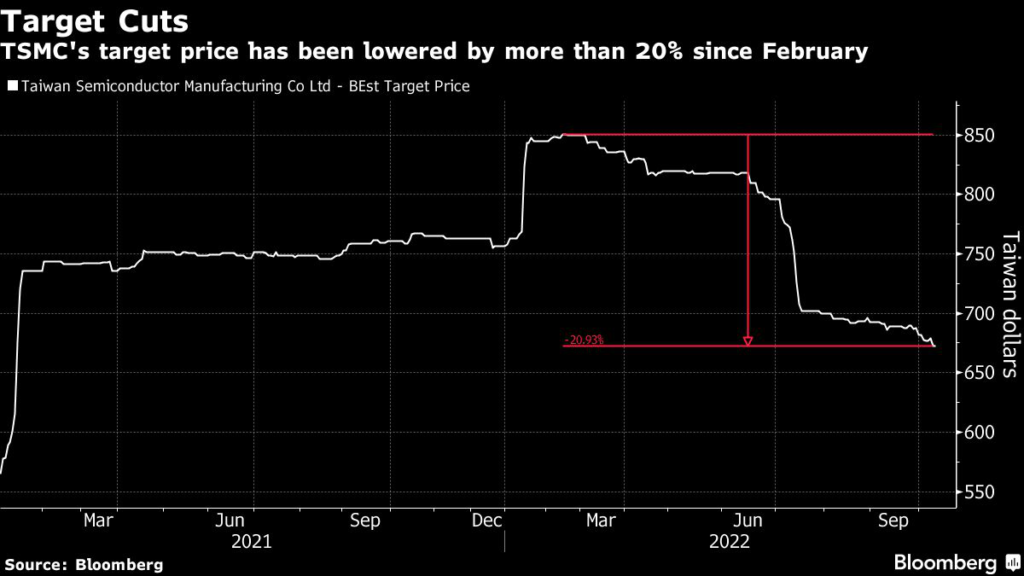
Analysts have cut the average target price for TSMC’s stock by more than 20% since February as investors reassess global demand for smartphones, personal computers and cars amid rising recession risks. 

They’ve resisted lowering their earnings estimates, though, in part because the company has been gaining market share in advanced chips and it’s been charging higher prices. A growing global glut of chips may soon force analysts’ hands.  

“With the latest US ban, the inventory adjustment may take longer than previously expected,” said Quincy Liu, chairman of Shin Kong Investment Trust Co. “The inventory correction may be prolonged and delay demand recovery.”


Tech Chart of the Day

The selloff in shares of Meta Platforms Inc. has pushed the Facebook parent further down the list of the largest companies. It sank 3.9% on Tuesday, closing at its lowest since 2018 and ending below Walmart Inc. in size for the first time since 2015. The social-media company ended with a market value of $345.5 billion, compared with $360 billion for the retailer. This comes just days after energy giant Exxon Mobil Corp. overtook Meta for the first time since early 2017. Meta has dropped 62% this year, and is now the 12th-largest company in the S&P 500 Index; at the start of the year, when its market value exceeded $900 billion and Walmart was more than $400 billion, it was the sixth largest.

Top Tech Stories

  • Intel Corp. is planning a major reduction in employees, likely numbering in the thousands, to cut costs and cope with a sputtering personal-computer market, according to people with knowledge of the situation.
  • As global investors attempt to gauge the depth of the selloff in semiconductor stocks, one Korean fund manager says it’s still too early to buy the world’s largest memory-chip maker, Samsung Electronics Co.
  • Chip-design firm Socionext Inc. jumped 15% in its Tokyo debut after completing Japan’s largest initial public offering this year, defying recent investor pessimism about global semiconductor shares.
  • ByteDance Ltd. is offering to buy back shares from its employees, ramping up efforts to boost staff morale after plans for an initial public offering stalled.
  • Meta Platforms has made it clear that it wants to infiltrate the business world with virtual reality technology. Our reporter tested the premise Tuesday morning, joining the company’s Connect developer conference via an Oculus Quest 2 virtual reality headset.
  • Short sellers are setting their sights on some of the biggest US stocks on concern recession risks across the globe will curb their earnings. Apple Inc. and Tesla Inc. are the most shorted stocks among S&P 500 Index members, while Visa Inc. and Twitter Inc. saw the biggest increase in short interest over the past month.
  • Workers at an Amazon.com Inc. warehouse in Southern California have filed paperwork to hold an election on whether to join the Amazon Labor Union, the latest organizing drive at one of the retail giant’s facilities.
  • For Twitter, there are no good outcomes to the Elon Musk affair, Kurt Wagner writes in Bloomberg Businessweek.

More stories like this are available on bloomberg.com

©2022 Bloomberg L.P.

Tesla Semi Looks Like a Bidenmobile Spurred by the Climate Bill

(Bloomberg) —

This much is clear: Tesla is going to start delivering Semi trucks on Dec. 1, a full five years after Elon Musk started taking orders for them. The first ones are going to PepsiCo, which will put them to work at a Frito-Lay facility in Modesto, California, and a beverages plant in Sacramento.

From there, details are fuzzy for a product the world has known about since 2017.

Specifications? “500 mile range & super fun to drive,” Musk tweeted last week.

There isn’t a whole lot more information on Tesla’s website, aside from a zero-to-60 acceleration time, which doesn’t rank particularly high on truckers’ priority list. Braking distance, for example, is far more important than beating another big rig off the line, as one ex-trucker pointed out after Musk’s prototype presentation years ago. (It takes 20 seconds to get up to 60 miles per hour, by the way).

How many Semis is PepsiCo getting? Musk and the food and beverage giant haven’t said.

And why is the Semi finally going into production? Musk hasn’t addressed this, but the climate legislation President Joe Biden signed into law in August sure looks like the reason.

Before the Inflation Reduction Act, Musk had said the Semi was more or less on hold because Tesla didn’t have enough batteries. The Semi uses roughly five times the number of cells a car would, but won’t sell for five times what a car does, so it didn’t make sense to produce trucks until the company had worked through battery production constraints, the CEO said in January of last year.

Those cell constraints don’t seem to have lifted — Musk referred to battery output as “the fundamental rate limiter” for transitioning to sustainable energy during Tesla’s most recent earnings call. It also didn’t sound during that July call like the company was close to meaningfully ramping up output of the larger battery cells that Musk has suggested the Semi will use. He referred to those cells as important for Tesla’s plans for 2023, but not this year.

A week after that earnings call, Senator Joe Manchin and Majority Leader Chuck Schumer announced they’d agreed on legislation that would enact major parts of Biden’s climate agenda. While the up to $7,500 clean car tax credit that consumers will be eligible for grabbed a lot of headlines, costlier commercial vehicles qualify for a much bigger incentive: as much as $40,000 per truck.

And low and behold, days after the Senate passed the bill, Musk announced the Semi would start shipping this year.

Musk wasn’t begging for the big incentives. On the contrary, he spoke out against Biden’s earlier Build Back Better proposal, saying he believed “the role of government should be that of like a referee, but not a player on the field” and calling for Washington to “get out of the way and not impede progress.”

But rather than get in the way, the Inflation Reduction Act appears to have spurred Tesla to progress its stalled product. The tax credit “will turbocharge adoption of electric medium-duty and heavy-duty trucks,” according to RMI, a clean energy-focused nonprofit. “The IRA tax credit makes owning an electric truck cheaper than owning a diesel one in most use cases, with urban and regional electric trucks becoming cost-superior to diesel ones as soon as 2023.”

Musk’s frustrations with the Biden administration have been well-documented. If the IRA tax credit is as effective as hoped in stoking demand for electric heavy trucks, this may well be another policy that elicits a thumbs-up reply.

More stories like this are available on bloomberg.com

©2022 Bloomberg L.P.
Gilts Fall Amid UK Policy Confusion; Stocks Rise: Markets Wrap

(Bloomberg) — Gilts fell and the pound whipsawed as traders struggled to make sense of UK policy. US futures and European stocks rose ahead of Thursday’s inflation report.

The Bank of England confirmed its plan to end emergency bond purchases on Friday after confusion sparked by a Financial Times report that the central bank was prepared to extend support to stave off a crisis in UK pensions. Meanwhile, some investors are betting that the government may make further fiscal u-turns. 

A report that the UK economy shrank unexpectedly in August also weighed on the nation’s bonds. The yield on 30-year gilts — favored by investors such as pension funds at the heart of recent market stress — rose to 4.95%. 

“The Bank of England is a test case for how hawkish central banks can be without doing damage to financial stability,” said Michael Metcalfe, global head of macro strategy at State Street Global Markets.

In the US, Treasury yields held near multi-year highs, the dollar was little changed and stocks were set to snap a five-day losing streak as investors are looking to earnings and inflation figures for clues on Federal Reserve policy. 

“I don’t see any imbalances yet that would cause a pivot from the Fed,” Citigroup Inc. economist Veronica Clark said on Bloomberg Television. “The Fed will pay attention to global financial stability concerns, a strong dollar is part of that, but it’s ultimately going to be domestic conditions and what the Fed is seeing on inflation.” 

Kristina Hooper, chief global market strategist for Invesco, said in a note that while world economy is slowing after rate hikes, there is yet to be a meaningful decline in inflation. “This is an extraordinary monetary policy tightening environment and we are waiting to see if something breaks globally,” she said. “The UK has come close.”

Elsewhere, gold and oil prices rose. 

NATO defense chiefs are set to gather in Brussels on Wednesday to discuss how to better protect critical infrastructure, ramp up weapons production and maintain support for Ukraine. 

Key events this week:

  • Earnings this week include: JPMorgan Chase & Co., Citigroup Inc., Morgan Stanley, BlackRock Inc., Delta Air Lines Inc., UnitedHealth Group Inc., U.S. Bancorp, Wells Fargo & Co.
  • FOMC minutes for September meeting, Wednesday
  • US PPI, mortgage applications, Wednesday
  • OPEC Monthly Oil Market Report, Wednesday
  • Fed’s Michelle Bowman and Neel Kashkari speak
  • ECB’s Christine Lagarde speaks
  • US CPI, initial jobless claims, Thursday
  • G-20 finance ministers and central bankers meet, Thursday
  • China CPI, PPI, trade, Friday
  • US retail sales, business inventories, University of Michigan consumer sentiment, Friday
  • BOE emergency bond buying is set to end, Friday

Some of the main moves in markets:

Stocks

  • Futures on the S&P 500 rose 0.8% as of 5:47 a.m. New York time
  • Futures on the Nasdaq 100 rose 1%
  • Futures on the Dow Jones Industrial Average rose 0.6%
  • The Stoxx Europe 600 rose 0.3%
  • The MSCI World index fell 1%

Currencies

  • The Bloomberg Dollar Spot Index was little changed
  • The euro was little changed at $0.9704
  • The British pound rose 0.8% to $1.1056
  • The Japanese yen fell 0.4% to 146.39 per dollar

Cryptocurrencies

  • Bitcoin rose 0.8% to $19,177.03
  • Ether rose 1.7% to $1,303.26

Bonds

  • The yield on 10-year Treasuries was little changed at 3.94%
  • Germany’s 10-year yield advanced seven basis points to 2.37%
  • Britain’s 10-year yield advanced eight basis points to 4.52%

Commodities

  • West Texas Intermediate crude rose 0.5% to $89.78 a barrel
  • Gold futures fell 0.5% to $1,677.50 an ounce

More stories like this are available on bloomberg.com

©2022 Bloomberg L.P.
Close Bitnami banner
Bitnami