
Bloomberg

Crypto Attack Swipes $100 Million From DeFi Service Mango

(Bloomberg) — An attacker spirited away about $100 million from decentralized finance provider Mango by manipulating the price of its token in an exploit that wiped out depositors on the crypto platform.

The heist began with two accounts funded with the stablecoin USD Coin, the platform said Wednesday on Twitter. The accounts took large positions in Mango perpetual futures, causing the price of the Mango token to spike.

The price jump stoked an unrealized profit from the futures. The attacker used that to borrow and withdraw roughly a net $100 million from the protocol in a range of tokens — leaving depositors with nothing, according to Mango.

“This incident has effectively resulted in a total draining of all equity available,” the platform said on Twitter, adding the attackers are communicating with Mango and “indicating a willingness to negotiate.”

The exploit, which follows a spate of multimillion-dollar hacks of DeFi protocols in past months, sheds light on some of the security weaknesses of decentralized exchanges. At so-called DEXs, software essentially enables crypto traders to transact directly with each other without an intermediary. 

This differs from centralized exchanges — CEXs in industry argot — which are run by a central entity that has custody of user funds.

“Despite their potential, DEXs are still immature in terms of their evolution and come with their own set of security risks,” said Hirander Misra, chief executive of GMEX Group. “There are over a hundred public blockchains, each with their own ways of doing things, meaning no effective agreed standards and given their decentralized nature, no regulation and investor protection.”

The Mango incident is “a price manipulation attack” that took advantage of the ability to leverage up positions on the platform, according to BlockSec, a company specializing in crypto security.

The perpetrator has posted a proposal on Mango’s governance page that appears to raise the possibility of returning some of the money in return for a bounty. Other conditions include using the service’s treasury to pay off bad debt and not pursuing criminal probes or freezing funds.

Pump and Dump

Mango, which operates on the Solana blockchain, is a decentralized crypto exchange that offers users the ability to make spot trades and loans.

It disabled deposits and said it believes the most constructive thing to do is to communicate with those responsible in an “attempt to resolve the issues amicably.”

Data from tracker CoinGecko shows that in the past 24 hours the price of the Mango token at one point shot up to about 9 US cents from 4 US cents before sinking to about 2 US cents.

Some $2 billion has been lost in crypto security incidents this year, many perpetrated by North Korea-linked groups, according to blockchain analysis firm Chainalysis.

Just last week, 2 million Binance Coins — equivalent to nearly $570 million — were effectively minted and taken by a hacker. About $100 million wasn’t recovered, while the rest was frozen, according to a Binance statement.

(Updates comment from GMEX executive in seventh paragraph.)

More stories like this are available on bloomberg.com

©2022 Bloomberg L.P.

ByteDance Offering to Buy Back Employees’ Shares for $155 Apiece

(Bloomberg) — ByteDance Ltd. is offering to buy back shares from its employees, ramping up efforts to boost staff morale after plans for an initial public offering stalled.

The Beijing-based company, parent of the hit TikTok video app, informed employees on Wednesday that it will repurchase shares at a price of $155 per restricted stock unit to help those who need to monetize their stocks sooner, according to an internal memo viewed by Bloomberg News. The program, beginning immediately, marks the company’s second round of employee share buybacks in 2022, exceeding previously offered prices, according to a person familiar with the plan who asked not to be named discussing private matters.

ByteDance didn’t respond to an inquiry for comment.

Last month, the Chinese social media titan offered to buy back as much as $3 billion of its own shares from investors at a valuation of about $300 billion, giving backers a way to cash out their investment from the decade-old startup. Once the darling of global investors, ByteDance is now joining a growing list of Chinese internet companies searching for solutions to restore market confidence and retain talent.

ByteDance has grown into the world’s most valuable startup on the success of apps like TikTok and its Chinese twin Douyin, but in recent years it has been squeezed by Beijing’s crackdown on internet firms at home and Washington’s suspicion of its services in the US. 

The company has considered taking TikTok public for years, a move that could both reward investors and ease some political pressure as the unit formally splits from its Chinese parent. ByteDance also contemplated a separate IPO for Douyin and its China businesses in Hong Kong. But both debuts have been delayed repeatedly by heightened regulatory scrutiny of Big Tech firms and a global tech selloff that’s suppressed valuations.

With no clear exit plan on the horizon, ByteDance’s valuation dropped to below $300 billion in private trading from a peak of more than $400 billion, Bloomberg News reported in July. The company told its 110,000 global employees in August that it will lower the price of its stock options by 20% as a gesture to retain workers and entice new ones.

More stories like this are available on bloomberg.com

©2022 Bloomberg L.P.

VW Closes In on $1 Billion JV With Chinese Chipmaking Startup

(Bloomberg) — Volkswagen AG is close to reaching a joint venture deal with Chinese autonomous driving startup Horizon Robotics Inc. that could see the auto giant make an investment of about $1 billion, according to a person familiar with the situation.

Talks between the two parties are at an advanced stage, the person said, asking not to be named because the discussions are private. The venture will focus on developing autonomous driving technologies and wireless connectivity software for VW vehicles, the person said.

Germany’s Manager Magazin earlier reported some of the details of the deal, saying it could be announced within days. VW said it’s planning to significantly expand development skills in China, particularly in digital innovations, according to a statement, while declining to comment on a deal with Horizon. 

The chipmaker, backed by investors including Intel Corp., Hillhouse Capital and electric-vehicle maker BYD Co., has been looking at raising as much as $200 million ahead of a possible share sale in Hong Kong this year, Bloomberg News reported in August.

A spokeswoman for Horizon declined to comment.

Horizon’s technology can be installed in everything from cars to smart speakers, and already counts Volkswagen’s Audi among its partners, according to its website.

Volkswagen is seeking to accelerate improvements in its software capabilities, including connectivity and ensuring access to high-tech chips. Struggles at the company’s Cariad software unit resulting in model delays and buggy functions earlier this year prompted VW to appoint new Chief Executive Officer Oliver Blume to replace Herbert Diess. The German carmaker is also partnering with Robert Bosch GmbH to develop a common software platform to bring automated driving technologies to its vehicles. 

The automaker has a budget of €89 billion ($86 billion) for EV and software development over the next half decade and is also investing $2.6 billion in Ford Motor Co.-backed driverless tech startup Argo AI.

More stories like this are available on bloomberg.com

©2022 Bloomberg L.P.

Crypto Winter Claims High Profile C-Suite Execs

  • Listen to Bloomberg Crypto on the iHeartRadio App
  • Listen to Bloomberg Crypto on Apple Podcasts
  • Listen to Bloomberg Crypto on Spotify  

(Bloomberg) — What do Michael Saylor, Jesse Powell, Michael Moro, Sam Trabucco, Brett Harrison and Alex Mashinsky have in common? If you said they’re dudes in crypto, you’d be correct. If you said they’re dudes who used to be crypto CEOs and suddenly weren’t anymore, you’d also be correct. 

This crypto winter has seen a string of high-profile exits from the C-suite, a mix of resignations and other forms of, to coin a phrase, conscious uncoupling. 

What’s driving all this activity? Is it Bitcoin prices falling more than 50%? Is it the bankruptcy filings? Is it the SEC breathing down your neck? Is it the wanting to spend more time with your yacht in the Bahamas? Perhaps even all of these at once.  

For more on this succession-level crypto drama, this episode features Bloomberg reporter Yueqi Yang and Deepali Vyas, Executive Search Recruiter at global consulting firm Korn Ferry.

Follow us on Twitter @crypto, and subscribe to the Bloomberg Crypto Newsletter at https://bloom.bg/cryptonewsletter

More stories like this are available on bloomberg.com

©2022 Bloomberg L.P.

Xpeng’s Flying Car Hits the Skies for the First Time in Dubai

(Bloomberg) — XPeng Aeroht, an affiliate of Chinese electric-vehicle maker XPeng Inc., staged the first public flight of its X2 flying car in Dubai this week, displaying a vehicle designed for low-altitude city trips such as sightseeing and medical transportation. 

XPeng President Brian Gu described the event as a “major step” in the company’s exploration of future mobility. 

The two-seater electric vertical take off and landing vehicle, or eVTOL, has an enclosed cockpit and a carbon fiber structure. It has both manual and autonomous flying modes. 

“Xpeng X2’s public display in Dubai represents a significant milestone for Xpeng Aeroht and the international achievement of flying cars,” Gu said in a statement dated Oct. 10. 

The X2 is XPeng Aeroht’s fifth-generation flying car. The company said it plans to announce progress on its sixth-generation model that can drive on roads as well as fly at the 1024 XPeng Tech Day, due to take place on Oct. 24.  

Several other startups including China’s TCab Tech and AutoFlight are exploring low-altitude city flights, or global urban air mobility, a market that could reach $1 trillion by 2040, according to Morgan Stanley. Still, there have been plenty of setbacks, including the air-taxi company backed by billionaire Google co-founder Larry Page, which said last month it will close down. 

More stories like this are available on bloomberg.com

©2022 Bloomberg L.P.
Crypto Price Exploit Swipes $100 Million From DeFi Service Mango

(Bloomberg) — An attacker spirited away about $100 million from decentralized finance provider Mango by manipulating the price of its token in an exploit that wiped out depositors on the crypto platform.

The heist began with two accounts funded with the stablecoin USD Coin, the platform said Wednesday on Twitter. The accounts took large positions in Mango perpetual futures, causing the price of the Mango token to spike.

The price jump stoked an unrealized profit from the futures. The attacker used that to borrow and withdraw roughly a net $100 million from the protocol in a range of tokens — leaving depositors with nothing, according to Mango.

DeFi Platform Mango Says Net Value of $100m Extracted in Exploit

“This incident has effectively resulted in a total draining of all equity available,” the platform said on Twitter, adding the attackers are communicating with Mango and “indicating a willingness to negotiate.”

A string of attacks have befallen digital assets this year, most notably hacks on blockchain bridges, further undermining confidence in a sector that’s also nursing a $2 trillion wipeout from a November peak.

The Mango incident is “a price manipulation attack” that took advantage of the ability to leverage up positions on the platform, according to BlockSec, a company specializing in crypto security.

The perpetrator has posted a proposal on Mango’s governance page that appears to raise the possibility of returning some of the money in return for a bounty. Other conditions include using the service’s treasury to pay off bad debt and not pursuing criminal probes or freezing funds.

Pump and Dump

Mango, which operates on the Solana blockchain, is a decentralized crypto exchange that offers users the ability to make spot trades and loans.

It disabled deposits and said it believes the most constructive thing to do is to communicate with those responsible in an “attempt to resolve the issues amicably.”

Data from tracker CoinGecko shows that in the past 24 hours the price of the Mango token at one point shot up to about 9 US cents from 4 US cents before sinking to about 2 US cents.

Some $2 billion has been lost in crypto security incidents this year, many perpetrated by North Korea-linked groups, according to blockchain analysis firm Chainalysis.

Just last week, 2 million Binance Coins — equivalent to nearly $570 million — were effectively minted and taken by a hacker. About $100 million wasn’t recovered, while the rest was frozen, according to a Binance statement.

(Updates with the method of the attack from the first paragraph.)

More stories like this are available on bloomberg.com

©2022 Bloomberg L.P.
Pound Gains, Stock Futures Rise on BOE Speculation: Markets Wrap

(Bloomberg) — The dollar erased an advance and the pound swung to a gain after a report that raised the prospect of the Bank of England extending its emergency bond buying. US stock futures jumped and Asian equity markets pared losses amid a shift in risk sentiment.

The Financial Times reported that the BOE told lenders it was prepared to extend its emergency bond-buying program past its Oct. 14 deadline to stave off a crisis in UK pensions. This ran counter to a vow on Tuesday from Governor Andrew Bailey to end purchases as scheduled.

Gilts and the pound held gains even after a report showed the UK economy shrank unexpectedly in August for the first time in two months, raising the possibility that the country is now in a recession. Ten-year Treasury yields fell after closing at a decade high on Tuesday, while most European bonds fell. 

The unwinding in market moves on Wednesday arrested the greenback’s rally while the yen remained around levels that previously triggered intervention as investors prepare for higher US rates while the Bank of Japan sticks with ultra-easy policy.

“I don’t see any imbalances yet that would cause a pivot from the Fed,” Citigroup Inc. economist Veronica Clark said on Bloomberg Television. “The Fed will pay attention to global financial stability concerns, a strong dollar is part of that, but it’s ultimately going to be domestic conditions and what the Fed is seeing on inflation.” 

Kristina Hooper, chief global market strategist for Invesco, said in a note that while world economy is slowing after rate hikes, there is yet to be a meaningful decline in inflation. “This is an extraordinary monetary policy tightening environment and we are waiting to see if something breaks globally,” she said. “The UK has come close.”

Elsewhere, gold and oil prices rose. 

US President Joe Biden said a recession was possible, while Russian President Vladimir Putin threatened further missile attacks on Ukraine after hitting Kyiv and other cities in the most intense barrage of strikes since the first days of its invasion.

Key events this week:

  • Earnings this week include: JPMorgan Chase & Co., Citigroup Inc., Morgan Stanley, BlackRock Inc., Delta Air Lines Inc., UnitedHealth Group Inc., U.S. Bancorp, Wells Fargo & Co.
  • FOMC minutes for September meeting, Wednesday
  • US PPI, mortgage applications, Wednesday
  • OPEC Monthly Oil Market Report, Wednesday
  • Fed’s Michelle Bowman and Neel Kashkari speak
  • ECB’s Christine Lagarde speaks
  • US CPI, initial jobless claims, Thursday
  • G-20 finance ministers and central bankers meet, Thursday
  • China CPI, PPI, trade, Friday
  • US retail sales, business inventories, University of Michigan consumer sentiment, Friday
  • BOE emergency bond buying is set to end, Friday

Some of the main moves in markets:

Stocks

  • Futures on the S&P 500 rose 0.9% as of 7:40 a.m. London time
  • Futures on the Nasdaq 100 rose 1.1%
  • Futures on the Dow Jones Industrial Average rose 0.7%
  • The MSCI Asia Pacific Index fell 2.2%
  • The MSCI Emerging Markets Index fell 2.3%

Currencies

  • The Bloomberg Dollar Spot Index fell 0.1%
  • The euro rose 0.2% to $0.9727
  • The Japanese yen fell 0.2% to 146.15 per dollar
  • The offshore yuan rose 0.2% to 7.1575 per dollar
  • The British pound rose 0.3% to $1.0996

Cryptocurrencies

  • Bitcoin rose 0.8% to $19,170.43
  • Ether rose 1.3% to $1,298.05

Bonds

  • The yield on 10-year Treasuries declined four basis points to 3.90%
  • Germany’s 10-year yield advanced three basis points to 2.33%
  • Britain’s 10-year yield declined three basis points to 4.44%

Commodities

  • Brent crude rose 0.4% to $94.70 a barrel
  • Spot gold rose 0.5% to $1,674.60 an ounce

More stories like this are available on bloomberg.com

©2022 Bloomberg L.P.
No Need to Blow Up TSMC in China War, Taiwan Security Chief Says

(Bloomberg) — Taiwan’s flagship semiconductor industry will not need to be destroyed in a Chinese invasion, the island’s security chief said, amid growing US concerns that Beijing could move to forcibly acquire the crucial Taiwanese chip technology.

Chen Ming-tong, director-general of Taiwan’s National Security Bureau, told lawmakers on Wednesday that it would be useless to take over facilities from Taiwan Semiconductor Manufacturing Co. if Beijing took control of the island. TSMC is highly integrated with the global supply chain, including suppliers such as ASML Holding NV of the Netherlands, so the US and other countries would be able to choke off its production without getting rid of its plants, he said.

“If you understand the ecosystem of TSMC, the comments out there are unrealistic,” Chen said. “TSMC needs to integrate global elements before producing high-end chips. Without components or equipment like ASML’s lithography equipment, without any key components, there is no way TSMC can continue its production.”

“Even if China got a hold of the golden hen, it won’t be able to lay golden eggs,” he added.

Chen’s remarks came in response to lawmakers who asked about a Bloomberg report that said President Joe Biden’s administration has stepped up contingency planning for a potential assault on Taiwan after Russia’s invasion of Ukraine. The war-gaming remains purely hypothetical, but has included considerations to evacuate TSMC’s chip engineers in the event of a Chinese invasion, according to people familiar with the administration’s deliberations.

Some former US officials have even advocated that the US take the extreme option of making clear to China that it would destroy TSMC facilities if the island was occupied, although there are no current plans to consider this. Such a tactic would serve both as deterrence and to avoid Taiwan’s critical chip production plants from falling in Beijing’s hands.

Chen on Wednesday dismissed concerns from local legislators that the US may try to take over TSMC or attract its semiconductor engineers abroad, noting the Taiwanese semiconductor giant had built a critical ecosystem that helped it stay ahead of rivals including Intel Corp. and Samsung Electronics Co.

“Those war-gaming plans are just scenarios,” he said. “If they understood TSMC’s ecosystem better, they would realize that it’s not as simple as they think. That’s why Intel can’t catch up with TSMC.”

Invasion Fears

Tensions in the Taiwan Strait in recent months have renewed fears of a Chinese takeover of the island, particularly after Beijing launched unprecedented military exercises around Taiwan in response to House Speaker Nancy Pelosi’s August trip to Taipei. Beijing has vowed to bring democratic Taiwan under its rule, resorting to the use of force if necessary.

Taiwan, for its part, has sought to address American concerns by pledging to work with the US and its allies to prevent China’s military from acquiring its advanced chip technologies. Various governments have wooed TSMC to expand its presence into their countries, and TSMC has agreed to set up a $12 billion chip fabrication plant, or fab, in Arizona.

The US National Security Council has estimated that the loss of TSMC in a Chinese invasion of Taiwan could cost the world economy more than $1 trillion.

On Tuesday, TSMC shares fell by the most in 28 years after the US imposed tighter controls over chip exports to China. The new restrictions expanded curbs on the export of some advanced chips used for artificial intelligence and supercomputing and also tightened rules on the sale of semiconductor equipment to any Chinese company.

More stories like this are available on bloomberg.com

©2022 Bloomberg L.P.

Chip Firm Socionext to Debut in Tokyo After Japan’s Biggest 2022 IPO

(Bloomberg) — Chip design firm Socionext Inc. jumped 15% in its Tokyo debut after completing Japan’s largest initial public offering this year, defying recent investor pessimism about global semiconductor shares.

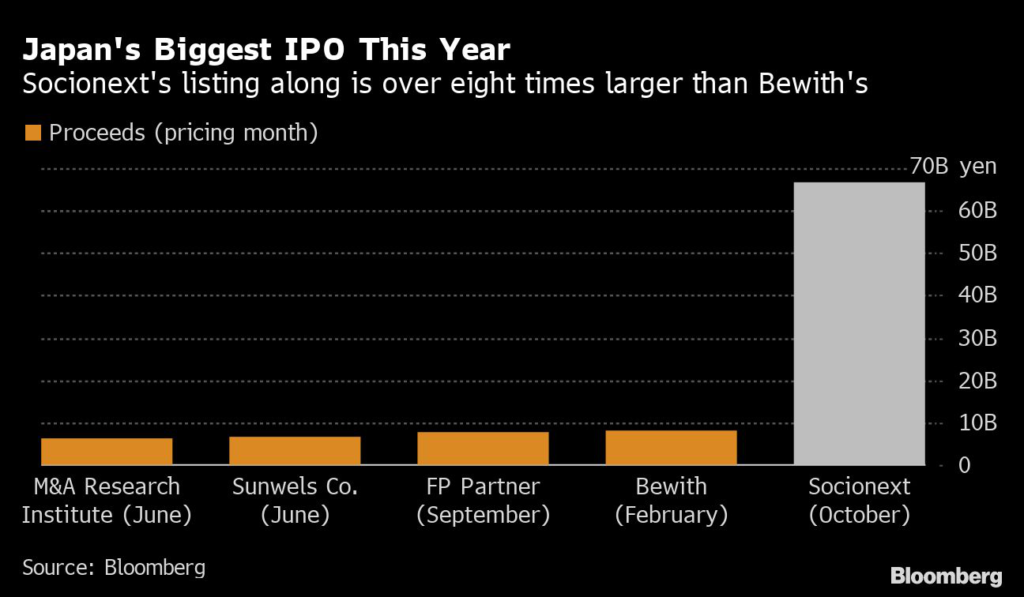
Shares of the Yokohama-based company, which had Panasonic Holdings Corp., Fujitsu Ltd. and the Development Bank of Japan Inc. as holders prior to the listing, ended the first session at 4,200 yen. They were sold at 3,650 yen each, the top of the marketed range in an IPO that was upsized to 66.8 billion yen ($456 million) due to high investor interest. 

Semiconductor listings in Tokyo tend to perform well in their first session, Bloomberg data show. Socionext managed to attract buyers even in a weak market for IPOs in Japan, where proceeds slumped 80% this year on an annual comparison. The jump contrasts to a chip-related stocks rout that’s wiped out more than $240 billion from the sector’s global market value this week after the US imposed curbs on China’s access to technology.

Socionext develops customized systems-on-chips for clients across the consumer, automotive and industrial fields. Apple Inc.’s Silicon processors and Qualcomm Inc.’s Snapdragon line are mass-market examples of such logic processors, often referred to as the brains of electronic devices. Enterprise customers increasingly seek bespoke, application-specific chips and Socionext competes with Taiwan’s Faraday Technology Corp., Alchip Technologies Ltd. and Global Unichip Corp. to fill that demand.

The company was founded in 2015 from the combination of the SoC divisions of Fujitsu Semiconductor Ltd. and Panasonic.

It’s the fourth semiconductor company to go public in Japan during the past two years, and the biggest among the country’s nine semiconductor listings in the past decade, the data show. Just one of them, RS Technologies Co., didn’t end the first session above the IPO price.  

Looking at the broader market, companies that debuted in Tokyo over the past two years after raising more than $100 million rose by a 28% average on the first day, Bloomberg data show.

Demand for Socionext’s IPO “seems to have been strong with long-only funds taking up the deal,” said Clarence Chu, an analyst at Aequitas Research who publishes on Smartkarma. The company is among global chip players attempting to expand in the fast-growing automotive tech industry, with sales to the segment “continually” rising, and had its shares priced “at a more attractive valuation” than peers listed in Japan, the US and Taiwan, he said.

SMBC Nikko Securities Inc., Nomura Securities Co. Ltd., Daiwa Securities Co. Ltd., Mizuho Securities Co. Ltd., Rakuten Securities and Monex were principal underwriting participants in the offering. 

(Updates with closing price)

More stories like this are available on bloomberg.com

©2022 Bloomberg L.P.

Chip Startup Defies Global Rout With 15% Surge in Tokyo IPO

(Bloomberg) — Chip design firm Socionext Inc. jumped 15% in its Tokyo debut after completing Japan’s largest initial public offering this year, defying recent investor pessimism about global semiconductor shares.

Shares of the Yokohama-based company, which had Panasonic Holdings Corp., Fujitsu Ltd. and the Development Bank of Japan Inc. as holders prior to the listing, ended the first session at 4,200 yen. They were sold at 3,650 yen each, the top of the marketed range in an IPO that was upsized to 66.8 billion yen ($456 million) due to high investor interest. 

Semiconductor listings in Tokyo tend to perform well in their first session, Bloomberg data show. Socionext managed to attract buyers even in a weak market for IPOs in Japan, where proceeds slumped 80% this year on an annual comparison. The jump contrasts to a chip-related stocks rout that’s wiped out more than $240 billion from the sector’s global market value this week after the US imposed curbs on China’s access to technology.

Socionext develops customized systems-on-chips for clients across the consumer, automotive and industrial fields. Apple Inc.’s Silicon processors and Qualcomm Inc.’s Snapdragon line are mass-market examples of such logic processors, often referred to as the brains of electronic devices. Enterprise customers increasingly seek bespoke, application-specific chips and Socionext competes with Taiwan’s Faraday Technology Corp., Alchip Technologies Ltd. and Global Unichip Corp. to fill that demand.

The company was founded in 2015 from the combination of the SoC divisions of Fujitsu Semiconductor Ltd. and Panasonic.

It’s the fourth semiconductor company to go public in Japan during the past two years, and the biggest among the country’s nine semiconductor listings in the past decade, the data show. Just one of them, RS Technologies Co., didn’t end the first session above the IPO price.  

Looking at the broader market, companies that debuted in Tokyo over the past two years after raising more than $100 million rose by a 28% average on the first day, Bloomberg data show.

Demand for Socionext’s IPO “seems to have been strong with long-only funds taking up the deal,” said Clarence Chu, an analyst at Aequitas Research who publishes on Smartkarma. The company is among global chip players attempting to expand in the fast-growing automotive tech industry, with sales to the segment “continually” rising, and had its shares priced “at a more attractive valuation” than peers listed in Japan, the US and Taiwan, he said.

SMBC Nikko Securities Inc., Nomura Securities Co. Ltd., Daiwa Securities Co. Ltd., Mizuho Securities Co. Ltd., Rakuten Securities and Monex were principal underwriting participants in the offering. 

(Updates with closing price)

More stories like this are available on bloomberg.com

©2022 Bloomberg L.P.

Close Bitnami banner
Bitnami