Bloomberg

Celius Bankruptcy Professional Bills Are Already Into Millions

(Bloomberg) — The first bills from the army of lawyers and advisers working on the bankruptcy of crypto lender Celsius Network LLC are in and already adding up to millions of dollars.

Alvarez & Marsal North America LLC, a financial adviser for debtors, has asked to be paid about 80% of a near-$3 million bill for work involving 20 staffers over July 14 to Aug. 31, according to a filing Tuesday.

In another filing, fees for a court-appointed examiner and her counsel were estimated at $3 million to $5 million, excluding additional expected costs from a financial adviser the examiner plans to retain.

Costs in the Celsius case are likely to rack up as the bankruptcy proceedings continue. Crypto restructurings have in effect become a new market for lawyers and advisers after a $2 trillion rout in digital assets toppled some high-profile firms.

Overall professional service fees for the companies working on the case could eventually amount to “tens of millions” of dollars, according to Daniel Besikof, a partner at law firm Loeb & Loeb LLP.

Some of the staff at Alvarez have already worked on the Celsius case for hundreds of hours. One worker clocked about 423 hours at an hourly rate of $775, the filing shows.

Celsius, once one of crypto’s most prominent lenders, suspended customer withdrawals in June and sought bankruptcy protection the following month.

The market value of Celsius’s holdings has declined about $12.3 billion since the end of March to $1.75 billion, and the large majority will likely be deemed property of the bankruptcy estate, making customers the exchange’s only unsecured creditors, according to Negisa Balluku, a litigation analyst at Bloomberg Intelligence.

Separately, Celsius said in a tweet that it’s filed a motion to set a deadline for customers to submit proofs of claim — the so-called bar date — and that the matter is due to be heard in court on Nov. 1.

(Updates with Celsius’s motion for a bar date in the last paragraph.)

More stories like this are available on bloomberg.com

©2022 Bloomberg L.P.

Toshiba Chooses JIP-Led Group as Preferred Bidder for Buyout

(Bloomberg) — Toshiba Corp. granted a consortium led by Japan Industrial Partners Inc. preferred bidder status for a buyout of the iconic Japanese firm, according to people with knowledge of the situation.

Private equity firm JIP was looking to acquire Toshiba in partnership with multiple domestic companies including Orix Corp. and Chubu Electric Power Co., the people said. Toshiba considered that a sale to JIP would keep the company as one entity, according to the people, who asked not to be identified as the information is private.

Deliberations are ongoing and no final decision has been made, the people said. Other bidders remain interested in the assets, they added. Midori Hara, a spokeswoman for Toshiba, declined to comment on the matter, saying to do so may undermine a fair process. JIP wasn’t immediately available to comment. 

Representatives from both Chubu Electric and Orix declined to comment. The Nikkei newspaper earlier reported JIP was Toshiba’s preferred bidder. Toshiba shares rose as much as 3.5% in Tokyo on Wednesday.

The Japanese conglomerate has been seeking strategic proposals for its future, including potential buyout bids. It had targeted second-round offers by the end of September, people familiar with the process told Bloomberg last month. State-backed investment fund Japan Investment Corp. is leading a rival group to JIP, with other investors such as Bain Capital and MBK Partners in talks to be involved in its bid, the people have said.

JIP is expected to have a month to negotiate with Toshiba, and it’s unclear if it will be able to agree on terms in that period, the Nikkei said. 


(Adds response from Chubu Electric and Orix in fourth paragraph)

More stories like this are available on bloomberg.com

©2022 Bloomberg L.P.

Taiwan Stocks Shrug Off Short-Selling Curb to Extend Losses

(Bloomberg) — Taiwan’s stocks were poised to fall for a third day as stricter short-selling rules failed to negate the downward pressure fueled by global risk aversion.

The benchmark Taiex Index dropped as much as 0.9% on Wednesday, a day after the regulator beefed up curbs on short-selling. Chip-related shares continued to slide, with Taiwan Semiconductor Manufacturing Co. down as much as 1.5% while Global Unichip Corp. and Alchip Technologies Ltd. each slid almost 10%.

The restriction follows a similar measure initiated at end-September and may help to limit further swings in equities if chip stocks continue to sell off. The authorities could take additional steps should the rout extend, with stock purchases by the National Financial Stabilization Fund offering a source of support for the market.

“It could have some effect, but still Taiex would be dragged by the bigger trend of the US market,” said David Chu, chairman of Hua Nan Securities Investment Management Co., referring to the short-selling rule. If the market can digest negative news from the earnings season, it may stabilize, he added.

The limit on the volume of intraday securities lending orders will be reduced to 10% of the average daily trading volume over the previous 30 trading days from 20% effective Wednesday, the Financial Supervisory Commission said.

The FSC said the move was aimed at maintaining the order and stability of the securities market and to protect investors’ interests. The financial regulator also raised the minimum short-sale margin requirement to 120% from 100%.

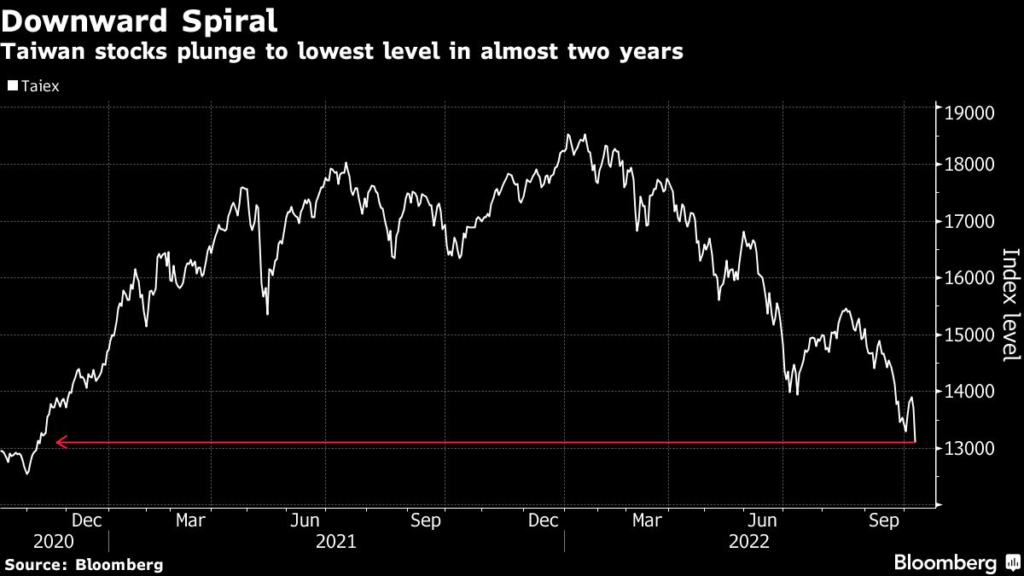
The island’s benchmark stock gauge has fallen 30% from a January peak as a hawkish Federal Reserve and tension in the Taiwan Strait hurt sentiment. Global funds have pulled $46 billion from local equities this year to put the market on track for its biggest annual outflows in more than two decades.

(Updates with Wednesday’s market moves, analyst’s comment)

More stories like this are available on bloomberg.com

©2022 Bloomberg L.P.

Grayscale Brief Says SEC Unfairly Rejected Bid for Bitcoin ETF

(Bloomberg) — Grayscale Investments LLC, the largest crypto asset manager, said the US Securities and Exchange Commission acted arbitrarily in rebuffing a bid to convert its $12 billion spot Bitcoin trust into an exchange-traded fund. 

The rejection over the risk of fraud and manipulation in the spot Bitcoin market is “capricious” and “discriminatory” because the SEC has allowed futures-based Bitcoin ETFs and they are exposed to similar concerns, Grayscale said in the opening brief of its lawsuit against the regulator.

In a statement, the firm said the brief argues that “the test the SEC has applied to Bitcoin-related ETFs, and only Bitcoin-related ETFs, is flawed and has been inconsistently applied with a ‘special harshness’ to spot Bitcoin ETFs.”

The SEC didn’t immediately reply to an email outside business hours for comment on the Grayscale argument.

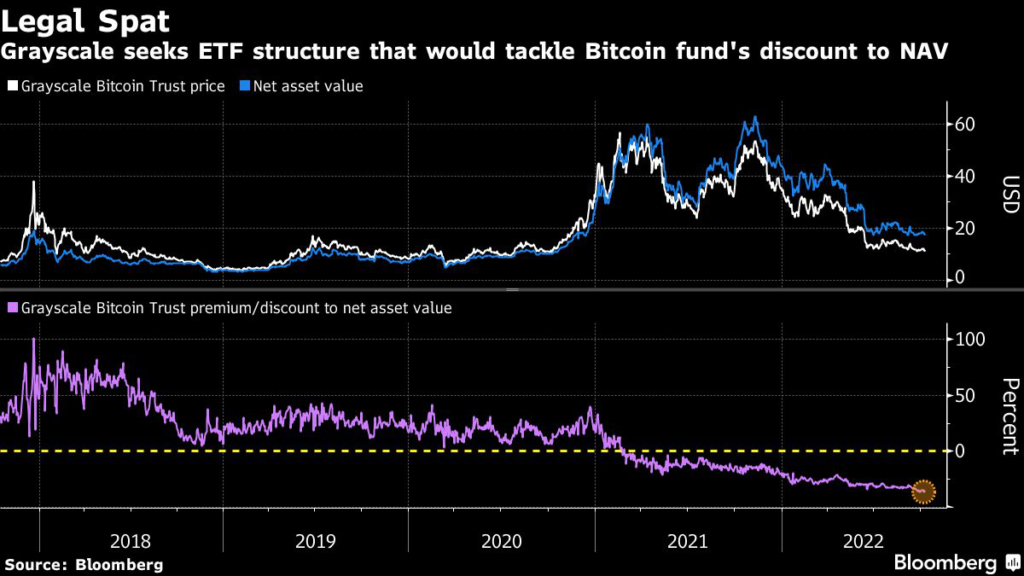
Grayscale sued the SEC mid-year after the regulator denied the company’s application to convert its Grayscale Bitcoin Trust, the world’s largest Bitcoin fund, into an ETF. The fund was started in 2013 and the company filed its plan to change the structure in October last year.

The shift would help to close the fund’s near-record discount to net asset value. The ETF structure has a creation and redemption process that helps to keep a fund’s price in line with its underlying holdings.

Bitcoin, the biggest digital token by market value, has sunk about $50,000 from a peak of nearly $69,000 hit in November at the height of a pandemic-era mania for crypto.

A global wave of monetary-policy tightening to tackle high inflation has sucked liquidity from financial markets and hurt demand for speculative investments.

More stories like this are available on bloomberg.com

©2022 Bloomberg L.P.

Crypto Platform Mango Hit by Latest Hack in Digital-Asset Sector

(Bloomberg) — A security event hit the cryptocurrency sector at decentralized finance platform Mango just days after a hacker made off with about $100 million in an exploit involving Binance Coin.

Mango said on Twitter it’s “investigating an incident where a hacker was able to drain funds” and is disabling deposits. The platform added that it’s taking steps to “have third parties freeze funds in flight.”

Mango also asked the hacker to get in touch to discuss a “bug bounty.”

This is the latest in a string of security incidents to afflict the digital-asset sector, which is also reeling from a plunge in token prices. Some $2 billion has been lost in crypto hacks this year, many perpetrated by North Korea-linked groups.

Last week, a total of 2 million Binance Coin — equivalent to nearly $570 million — were effectively minted and taken by a hacker. About $100 million wasn’t recovered, while the rest was frozen, according to a Binance statement.

More stories like this are available on bloomberg.com

©2022 Bloomberg L.P.

Intel Plans Thousands of Job Cuts in Face of PC Slowdown

(Bloomberg) — Intel Corp. is planning a major reduction in headcount, likely numbering in the thousands, to cut costs and cope with a sputtering personal-computer market, according to people with knowledge of the situation. 

The layoffs will be announced as early as this month, with the company planning to make the move around the same time as its third-quarter earnings report on Oct. 27, said the people, who asked not to be identified because the deliberations are private. The chipmaker had 113,700 employees as of July.

Some divisions, including Intel’s sales and marketing group, could see cuts affecting about 20% of staff, according to the people.

Intel is facing a steep decline in demand for PC processors, its main business, and has struggled to win back market share lost to rivals like Advanced Micro Devices Inc. In July, the company warned that 2022 sales would be about $11 billion lower than it previously expected. Analysts are predicting a third-quarter revenue drop of roughly 15%. And Intel’s once-enviable margins have shriveled: They’re about 15 percentage points narrower than historical numbers of around 60%. 

During its second-quarter earnings call, Intel acknowledged that it could make changes to improve profits. “We are also lowering core expenses in calendar year 2022 and will look to take additional actions in the second half of the year,” Chief Executive Officer Pat Gelsinger said at the time. 

Intel, based in Santa Clara, California, declined to comment on the layoffs.

Intel’s last big wave of layoffs occurred in 2016, when it trimmed about 12,000 jobs, or 11% of its total. The company has made smaller cuts since then and shuttered several divisions, including its cellular modem and drone units. Like many companies in the technology industry, Intel also froze hiring earlier this year, when market conditions soured and fears of a recession grew.

The latest cutbacks are likely meant to reduce Intel’s fixed costs, possibly by about 10% to 15%, Bloomberg Intelligence analyst Mandeep Singh said in a research note. He estimates that those costs range from at least $25 billion to $30 billion. 

Gelsinger took the helm at Intel last year and has been working to restore the company’s reputation as a Silicon Valley legend. But even before the PC slump, it was an uphill fight. Intel lost its long-held technological edge, and its own executives acknowledge that the company’s culture of innovation withered in recent years.

Now a broader slowdown is adding to those challenges. Intel’s PC, data center and artificial intelligence groups are contending with a tech spending downturn, weighing on revenue and profit.

PC sales tumbled 15% in the third quarter from a year earlier, according to IDC. HP Inc., Dell Technologies Inc, and Lenovo Group Ltd., which use Intel’s processors in their laptops and desktop PCs, all suffered steep declines.

With PC prices stagnating and demand weakening, Intel also may need to pursue a dividend cut to offset cash-flow headwinds, Singh said. But Intel’s plan to sell shares of its Mobileye self-driving technology business in an initial public offering may ease those concerns, he said.

It’s a particularly awkward moment for Intel to be making cutbacks. The company lobbied heavily for a $52 billion chip-stimulus bill this year, vowing to expand its manufacturing in the US. Gelsinger is planning a building boom that includes bringing the world’s biggest chipmaking hub to Ohio. 

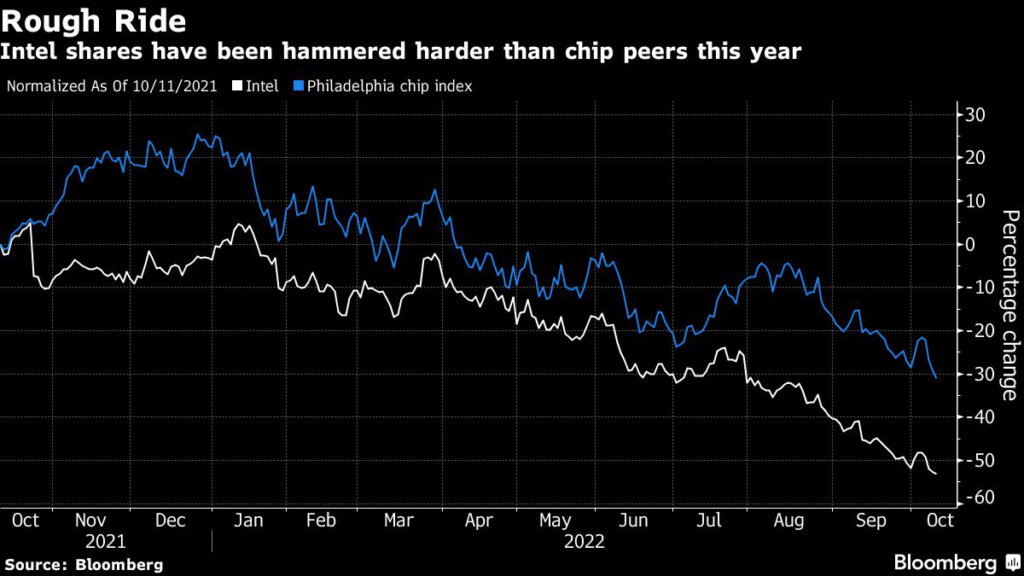
At the same time, the company is under intense pressure from investors to shore up its profits. The company’s shares have fallen more than 50% in 2022, with a 20% plunge occurring in the last month alone.

The shares slipped 0.6% to $25.04 in New York on Tuesday. 

US tensions with China also have clouded the chip industry’s future. The Biden administration announced new export curbs on Friday, restricting what US technologies companies can sell to the Asian nation. The news sent shares of chipmakers tumbling anew, with Intel falling 5.4% that day.

Intel has been trying to regain its footing in the industry by releasing new PC processors and graphics semiconductors. A key part of its strategy is selling more chips to the data-center market, where rivals AMD and Nvidia Corp. have made inroads. On Tuesday, Google unveiled new Intel-powered technology for its server farms that will help speed artificial intelligence tasks.

Intel is now looking to pursue those goals as a leaner company.

David Zinsner, Intel’s chief financial officer, said after the company’s latest quarterly report that “there are large opportunities for Intel to improve and deliver maximum output per dollar.” The chipmaker expected to see restructuring charges in the third quarter, he said, signaling that cuts were looming.

Some chipmakers, including Nvidia and Micron Technology Inc., have said they’re steering clear of layoffs for now. But other tech companies, such as Oracle Corp. and Arm Ltd., have already been cutting jobs.

(Updates with analyst report starting in eighth paragraph.)

More stories like this are available on bloomberg.com

©2022 Bloomberg L.P.

GM Takes on Tesla With Its Own Solar Power and Energy Storage System

(Bloomberg) — General Motors Co. plans to compete with Tesla Inc.’s solar and Powerwall business by offering its own sun-generated power and storage system starting late next year.

A new business unit, called GM Energy, is working with SunPower Corp. to provide solar panels and home energy storage for residential and commercial users, the company announced in a statement. It’s similar to Tesla’s energy business, in which panels sold by the automaker charge a battery that supplies homes with electricity at night or during blackouts.

The home-energy system will be available alongside GM’s electric version of the Chevrolet Silverado, production of which is expected to start next year. 

For GM, it’s a way to get into the energy-storage business while serving electric vehicle owners and giving them a cheaper way to charge their vehicles. As part of the initiative, GM is also cutting deals with utilities to enable buyers of its EVs to use their vehicle’s battery to power the home if there is a blackout.

PG&E Pilot

That service will begin next year in a pilot project between GM and PG&E Corp., which provides service in California. Ford Motor Co. offers similar capability with its F-150 Lightning pickup.

“The reliability of the US electrical power grid has never been more important,” said Travis Hester, vice president of GM EV growth operations. GM Energy seeks to offer “sustainable energy products and services that can help mitigate the effect of power outages and provide customers with resilient and cost-effective energy management.”

GM is working with other utilities to set up similar pilot programs, including Consolidated Edison Inc. and New Hampshire Electric Cooperative Inc., the company said.

The solar panel and storage business hasn’t been a big part of Tesla’s revenue, though it is growing. The company said solar deployments rose 25% in the second quarter.

“We really expect a large number of GM customers who buy an electric vehicle over time to want to put solar and solar battery on their house,” Peter Faricy, SunPower’s chief executive officer, said in an interview Tuesday.  

Read more: Solar power, battery storage to be real test for Tesla

With some US regions seeing an increase in blackouts, more companies will be competing to sell power solutions — especially solar for home and commercial fleet use — said Sam Abuelsamid, principal research analyst at Guidehouse Insights. Tesla is selling stationary energy storage, as is Generac Holdings Inc.

“We’re going to see major automakers all going down this path,” Abuelsamid said in an interview. “There may not be enough power in some parts of the country, so people may be more interested in solar. The bigger part of this will be the commercial side with fleet customers.” 

(Adds CEO quote in the ninth paragraph. A previous version corrected the name of the business unit in the sixth paragraph.)

More stories like this are available on bloomberg.com

©2022 Bloomberg L.P.
Meta Wants You to Work in Virtual Reality. Here’s What That’s Like

(Bloomberg) — Meta Platforms Inc. has made it clear that it wants to infiltrate the business world with virtual reality technology. So I tested the premise on Tuesday morning, joining the company’s Connect developer conference via an Oculus Quest 2 virtual reality headset. 

The conference was hosted in the company’s Horizon Worlds app, which the company said will soon be stuffed with basic corporate productivity offerings from Microsoft, Adobe, Accenture and Zoom. Digital avatars that look like cartoon versions of us, except legless (more on that later), will have access to PDFs, Word documents, breakout rooms and whiteboard meetings. 

It’s going to be an adjustment, and take more than a few familiar tools to win me over.

Joining the event wasn’t as simple as pulling up a video link. I had to enter the company’s Horizon Worlds app, the virtual universe where people can build and join their own mini experiences, and fire up the Connect conference from my events queue. A bright blue loading screen with a flashing “warning” sign dropped my avatar into a hallway leading to an expansive virtual courtyard, with some multi-story buildings, greenery and a water feature with a slowly rotating Meta logo.

For those with some video game familiarity, I’d put the world closer to a Roblox or the Sims. Basic, unfussy designs made it easy to navigate. I could tell when my avatar was climbing — er, floating — up stairs. Nature sounds, bubbling water and the dim conversations of a handful of other users around me gave me a sense of being there. But the dark sky gave no indication of time or weather; the smell of my real-world coffee was my only reminder the work day was starting.

A sign directed me across the courtyard for Chief Executive Officer Mark Zuckerberg’s keynote, so I thumbed two joysticks — thankful for my experience as a casual gamer — to maneuver around the fountain, up some stairs and into the Horizon version of a metaverse amphitheater. Not expecting to have to “walk” to the event, I was about a minute late, but I did spot a sign saying 1,200 people were already there. 

I didn’t expect to have to walk around to tune in to various parts of the presentation. I began to imagine how the average business attendee wearing a headset might feel, fumbling to find their hand controller after setting it down to type mid-meeting. 

Then I began to panic that I couldn’t have the headset on and type at the same time. Apparently, there’s a way to set up the headset to “see” the world around you via small cameras on the device. I didn’t know to enable this, and was left squinting through the nose hole to clack at my keyboard, retrieve my controller, and pull up my Slack or Twitter on my real-world laptop.

At first, watching the presentation in this medium felt unnecessary. The Meta execs appeared via pre-recorded video, announcing various products in their real skin; I moved my avatar downstairs to a landing to get a better look at them. Some quirky touches were exclusively available in VR, like video game characters floating outside the screen or millennial-aesthetic architecture.

Event etiquette in VR is still under development too, it seems. I had to move to avoid overhearing some of the dozen people in my room talking during the presentations, and one poor soul with a stuffy nose relentlessly sniffling and blowing it.

Then, the brand new Zuckerberg avatar appeared on stage, donning the gray sweater, skinny blue jeans and tech-bro sneakers that he has in real life. He told his virtual audience what they wanted to hear: soon, they would be getting legs. The announcement was a hit. All the avatars floated to the stage to celebrate, stopped by a virtual banister like in a Sims concert (even in the metaverse, Zuckerberg gets security). Some threw confetti or thumbs-up emoji into the air.

Then, it was over. For a reporter like me, the end of an “in-person” event isn’t the end of our job, and I had planned on interviewing some attendees. But I wasn’t fast enough for those power-off switches as people went back to their real lives or other virtual worlds. The courtyard was empty. And my face hurt. 

PC Mag puts the Quest 2 headset at 17.7 ounces (1.1 lbs). Even after adjusting and readjusting the straps, that weight was dragging on my face, messing up my makeup and breaking the anti-aging rule of never tugging on the skin. After writing this, I pulled out my cosmetics bag for a touch-up, and wondered how many people working on virtual reality at Meta wear makeup every day. On Tuesday, the company said more photorealistic avatars are coming, but I still want to present an un-smudged version of myself in the real world when the headset comes off.

Meta itself has struggled to get its own employees to use Horizons at least once a week, according to two internal Meta memos reported by the Verge. The swath of tools coming to its metaverse today, some of the most popular in the corporate world, are clearly an attempt to give people a reason to be there. But for me, I’ll be putting my headset away from 9 to 5.

More stories like this are available on bloomberg.com

©2022 Bloomberg L.P.

Serena Williams’ Firm Invests in Nigerian Data Provider Stears

(Bloomberg) — Serena Williams’s venture capital firm is backing Nigerian data and insights firm Stears Inc. in a $3.3 million seed round led by MaC Venture Capital.

The investment is one of just a handful in Africa for Serena Ventures, whose founder announced that she would turn more of her attention to investing following her retirement from tennis after the US Open in September.

“One of the main reasons I invested in Stears is not because of my love and appreciation for Africa, but because Stears has strategically thought of how to increase the investment community on the continent,” Williams said in an emailed statement. “They’re aware of the complexities and have leverage with data and technology and I truly respect what they’re doing.”

Stears, based in Lagos, offers data collection, production, advisory and analysis services. Its products include Stears Insights, the company’s flagship digital publication, which provides analysis-driven content to its subscribers.

MaC contributed $2 million as the lead investor in the round, according to Stears co-founder and Chief Executive Officer Preston Ideh. Other participants in the round included Melo7 Tech Partners LLC, Cascador, Hoaq Club and return investor Luminate Fund of the Omidyar Group. Stears declined to provide valuation information.

The company has grown thanks to paid subscriptions, making it a rare subscription success story in Nigeria, where consumers are generally unaccustomed to pay walls for information.

The Stears round comes in a year that has been a historic high for African startup funding. Even so, early-stage African companies tend to raise less than their US counterparts, according to data compiled by Bloomberg. The median investment for African seed rounds this year is $2.6 million, compared with a median of $4.5 million in the US.

Stears was launched in 2017 by four co-founders who met during secondary school at Loyola Jesuit College in Abuja, Nigeria, and at the London School of Economics and Imperial College in the UK.

The company plans to use the new funding to expand its coverage geographically by establishing a presence in East and Southern Africa, Ideh said. In addition, Stears will expand its product breadth beyond insights to data, deepen data partnerships, and collect its own proprietary data, to which it will license access, he said.

While it started as an online publication, Stears now considers its main competitors to be other data and intelligence providers, Ideh said in an interview. Some Stears readers rely on its Insights product as an alternative to Bloomberg News and other information services. The company plans to launch a service for proprietary data on Africa that will compete more directly with Bloomberg LP, according to a statement from the company.

Stears said in a statement that its user base has grown at around 6.5% month-on-month, doubling the company’s number of users over the last year. Enterprise customers make up more than 75% of revenue, up from 45% in 2021. The company said its revenue in the first half of 2022 surpassed that for all of 2021.

Institutional Clients

Its largest institutional clients — accounting for 90% of enterprise revenue — are international organizations such as the European Investment Bank, United Nations Development Programme and the UK’s Foreign, Commonwealth & Development Office, all of which use Stears to collect or analyze data. The remaining 10% of enterprise revenue comes from Nigerian companies’ corporate subscriptions.

Stears uses its data and analysis skills to produce interactive visualizations. Stears created Nigeria’s first real-time election tracker, which it says drew 2 million unique users during the 2019 general election cycle and attracted widespread readership and investor attention to the main site.

While Stears’ coverage currently concentrates on Nigeria, it plans to eventually have a continent-wide focus.

“Our mission has always been to be the world’s most trusted provider of African data and insight,” Ideh said.

The new financing brings Stears’ total cumulative funding to $4 million, following a 2019 pre-seed round led by Omidyar Group’s Luminate Fund.

The investment is the ninth in an African firm by MaC, whose co-founder and managing general partner Marlon Nichols is joining the Stears board.

“Data is a huge business, and I think Stears has figured out a unique process of acquiring and analyzing data, and also visualizing that data in a way that really resonates with both companies and governments,” Nichols said in an interview.

‘Tooth and Nail’

Serena Ventures fought “tooth and nail” to get into the round, which was challenging because it came together in September when Williams was playing in the US Open, said Alison Stillman, the firm’s founding general partner.

Most of the firm’s previous African investments have been in financial technology companies. Stillman said that Stears data products would prove valuable to her firm and others hoping to invest more in Africa.

”We have this whole thesis about how important Africa and the ecosystem is going to be,” she said. “But we also know that data is really hard to find right now.”

(Updates with MaC’s investment in fifth paragraph.)

More stories like this are available on bloomberg.com

©2022 Bloomberg L.P.
BOE’s Bailey Has a Message for Funds: ‘You’ve Got Three Days’ to Wind Up Positions

(Bloomberg) — Bank of England Governor Andrew Bailey warned fund managers they have until the end of this week to wind up positions that they can’t maintain before the central bank halts its market support, triggering a selloff in the pound and US stocks.

“My message to the funds involved and all the firms is you’ve got three days left now,” Bailey said at the Institute of International Finance annual meeting in Washington on Tuesday. “You’ve got to get this done.”

The comments rattled broad markets, with US stocks turning sharply lower in late trading as Treasury yields rose. The pound fell below 1.10 versus the dollar for the first time since Sept. 29 and weighed on stock indexes. It was last 1% lower at 1.09 at 4:10 p.m in New York.

The Bank earlier on Tuesday expanded the range of its bond-buying program to include inflation-linked debt for the first time to avert what it called a “fire sale” that threatens financial stability. While the central bank has always said its support will end Friday, a lobby group representing UK pension funds urged Bailey to extend the program at least until the end of the month, saying that investors hadn’t been given enough time to unwind their positions. 

“We think markets will force the Bank’s hand to either extend these measures or open new ones into mid-November, their hard stance on taking away the support mechanism is doing the pound no favors,” said Simon Harvey, head of FX analysis at Monex Europe. “The BoE’s actions to expand its backstop reeked of desperation.”

“Two weeks is not enough, and more needs to be done,” said Daniela Russell, head of U.K. rates strategy at HSBC. “Pension funds are taking steps to address their liquidity issues but they are currently chasing a moving target as yields have continued to rise.”

Bailey has been wrestling with the turmoil in markets since Chancellor of the Exchequer Kwasi Kwarteng announced plans for £45 billion ($50 billion) of unfunded tax cuts in an effort to boost the long-term growth rate for the UK economy.

The central bank governor told his audience that he’d worked round the clock for several nights in a row in order to devise the market intervention. The BOE did not want to buy gilts because doing so blurs the distinction with monetary policy, under which it bought £875 billion with quantitative easing.

“We have the two things working in opposite directions,” Bailey said. The BOE is raising rates and has said it hopes to start selling gilts from its Quantitative Easing program, but now finds itself buying gilts to contain instability in the market. 

Officials at the bank had tried to come up with a policy that would have directly targeted stresses emerging in so-called Liability Driven Investment strategies, but they had been prevented from implementing them due to a “structural issue,” Bailey said. That had led them to introduce the bank’s initial pledge to buy long-dated gilts.

“In the end, we couldn’t make the targeted intervention into that particular sector,” Bailey said. “So we had to announce that we went by conventional bills.” The package was extended to include corporate bonds at the start of the week and index-linked gilts on Tuesday.

The BOE has previously run stress tests on potential market volatility, but the moves in the past few weeks went beyond the BOE’s worst case scenarios.

Funds have access to the liquidity they need but would have struggled to “bring it over” without upsetting markets. He said there was now “a window of opportunity for the pension funds to do this rebalancing.”

Read More: How ‘Liability-Driven’ Funds Triggered UK Bond Panic: QuickTake

Bailey also used the platform to welcome the government’s plan for growth and its decision to expose its fiscal plans to the independent scrutiny of the Office for Budget Responsibility. If the government can raise the trend rate of growth, that will help the operation of monetary policy, he said. “Bringing the OBR back is important,” he added. “Just as monetary policy has to have a framework, so does fiscal policy.”

However, he cautioned the government against pushing too hard on financial deregulation as part of its plans for post-Brexit freedoms. A key plank of the government’s supply side reforms is an unencumbered financial sector.

“Competitiveness in financial services is important. It’s important as regulator that we regulate to support sustainable growth,” he said.  But equally, “having effective strong regulation is an important part of being a strong financial center.”  

He also used the latest market crisis to once again call for tougher standards for the non-bank financial sector, the lightly regulated asset managers and hedge funds that sit outside banking and were the source of the latest instability.

(Updates with comment in fourth paragraph)

More stories like this are available on bloomberg.com

©2022 Bloomberg L.P.
Close Bitnami banner
Bitnami