
Bloomberg

Survival Tips for Tech Startups as Funding Dries Up

(Bloomberg) — For years, becoming a unicorn was the main goal of startups. Now, with venture funding drying up and many young firms’ survival in doubt, another creature is the talk of the town: the cockroach.

Venture capitalists and technology chieftains converged in Singapore in recent weeks to hobnob over a number of high-profile annual conferences, marking the city-state’s grand coming-out-of-Covid party. Yet gone was glamor and talk of blitzscaling, and participants instead focused on the drastic need for conserving cash and a dimming future.

“It’s cockroach time — do whatever it takes to survive,” Tessa Wijaya, co-founder of Xendit, a digital payments firm valued at $1 billion, said during a panel discussion moderated by Square Peg Capital partner Piruze Sabuncu. “It’s a little bit gross but it kind of works. If you can survive the next two, three years, you’re probably going to thrive.”

In the past several years, Southeast Asia attracted abundant capital from investors eager to bet on one of the fastest-growing internet economies. Perpetually growing teams was the norm at richly funded companies and for many young leaders and staff, this was the only environment they’ve ever known.

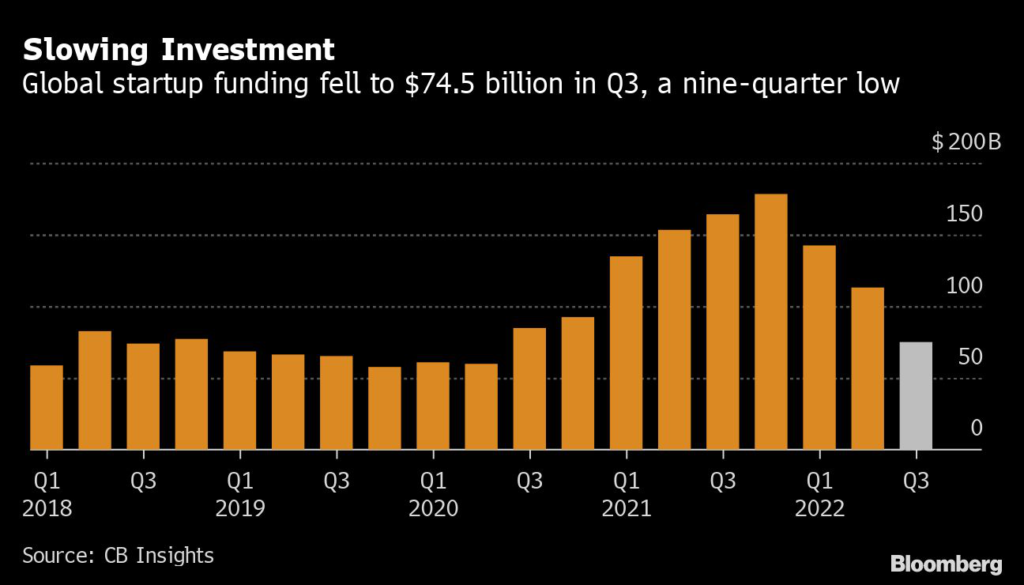
Now the startup ecosystem is facing headwinds. Global venture funding slumped to $74.5 billion in the past three months, its lowest level in nine quarters, according to CB Insights. That represents a 34% quarterly drop, the biggest in a decade.

“Cash is not only king, it’s king, queen and everything else,” Raj Ganguly, who started B Capital Group with Facebook co-founder Eduardo Saverin, said at SuperReturn Asia, a conference that drew a record 1,500 senior executives. “A lot of what we’ve been doing is pushing companies to have more realistic cash runway discussions.”

That sentiment was echoed by Jenny Lee, a managing partner of GGV Capital and one of the most sought-after figures who spoke at five conferences, including Forbes Global CEO Conference and the Milken Institute Asia Summit.

“In my 22 years as an investor, this is probably the most complex environment globally,” Lee said at the Tech in Asia Conference on Sept. 21, held six floors below SuperReturn Asia at the Marina Bay Sands. The most important thing to remember in a downturn, she said, is never the valuation but “your ability to have a cash runway.”

Her venture capital firm is advising its portfolio companies to have enough cash to stay afloat for 36 months without having to raise additional funds. About 80% of them are now in that bucket, said Lee, who launched GGV’s first office in China in 2005 and now leads the firm’s US fundraising activities.

After reaching sky-high valuations, tech companies the world over have seen the worst year of their lives amid surging inflation and interest rate hikes. Many are cutting jobs and shutting parts of their operations to shore up balance sheets ahead of a potential recession.

In Southeast Asia, Sea Ltd. and Grab Holdings Ltd., Singapore’s biggest tech companies, are emblematic of this new reality: Their US-traded stocks have lost more than half their value this year, and Sea warned it doesn’t anticipate being able to raise funds in the market.

Grab’s first investor day coincided with Singapore’s Formula One race week at the turn of the month, with former Google Chief Executive Officer Eric Schmidt and General Atlantic Vice Chairman Ajay Banga among some of the 90,000 delegates in town. Grab’s top executives sought to reassure shareholders that it’s adjusting to a downturn and speeding up efforts to reverse years of losses.

Shailendra Singh, managing director at Sequoia Capital India, said founders shouldn’t dread raising funds at a lower valuation.

“Down rounds are like your 10th grade math exam: It might increase your anxiety at that point in time, but in the long term it doesn’t matter,” Singh said. “If and when you list, you will face market fluctuations all the time.”

Founders who’ve been through previous cycles remained upbeat about the prospects for companies with proven business models. 

Julian Tan, the founder of a startup whose app FastGig matches employers with part-time job seekers, said he hasn’t had problems to raise funds this year and got calls from investors looking for sustainable businesses while trying to tackle social issues. He said Southeast Asia has so far had few services for manual and semi-skilled employees, which make up the vast majority of the working population.

“Not-so-good startups have been filtered out. Now is the time for real startups to shine, go out and raise from value investors,” said Aung Kyaw Moe, who sold a chunk of his 19-year-old payments company 2C2P to Ant Group Co. this year. “We cannot go and buy $1 revenue with $2 subsidy using investors’ money. This has to stop.”

As in previous downturns, efficiency is emerging as a key focus.

“This was a word that wasn’t used for years,” B Capital’s Ganguly said. “It was always about growth, growth, growth. Now we talk a lot about efficiency.”

Patrick Cao, president of Indonesia’s biggest internet company GoTo, said his firm will focus on reducing subsidies and streamlining operational expenses while offering services that merchant partners can monetize further. “We’ve accelerated our break-even targets,” he said, “but there’s still a lot of work to be done.”

GoTo’s archrival Grab downplayed its long-held slogan of being “Southeast Asia’s leading superapp,” the powerful tagline that helped the company raise billions of dollars from investors including SoftBank Group Corp.

Its newly defined goal, posted in its investor day presentation slides, underscores its intention to become more focused after burning through cash since its inception: “Southeast Asia’s largest and most efficient on-demand platform that enables local commerce and mobility.”

More stories like this are available on bloomberg.com

©2022 Bloomberg L.P.
Uber, Lyft Shares Fall on Possible Changes to How Gig Workers Are Classified

(Bloomberg) — Uber Technologies Inc. and Lyft Inc. tumbled after the Biden administration issued a proposal that could change the way it approaches workers’ employment status, a move that could upend the ride-hailing companies’ business models that rely on millions of gig workers. 

The proposal, released Tuesday by the US Labor Department, aims to clarify when restaurant workers, delivery couriers, ride-hailing drivers and other gig workers should be classified as employees, or independent contractors in business for themselves. Categorization as an employee would require that businesses provide benefits and protections such as a minimum wage, paid overtime and contributions to unemployment insurance, which companies say would lead to prohibitive operational costs and reduce the amount of flexibility workers have over their jobs. 

The Biden administration’s proposal lays out a new assessment for workers’ status that will consider multiple factors, including how “economically dependent” a person is on a company, the opportunity for profit or loss, and whether the work is integral to the employer’s business, among other criteria, to determine whether the person is truly in business for themselves. The highly anticipated proposal differs from the current rule, which was created under the Trump administration and gave greater weight to how much control workers have over their duties and their opportunities for earnings. 

The Department of Labor said in a statement the new proposal will “help protect workers from misclassification.” The acting head of the DOL’s Wage and Hour Division, Jessica Looman, said the rulemaking wasn’t likely to result in large worker classification changes.

The proposal could take several months to finalize and effectively reverts back to the guidelines adopted by the Obama administration, which relied on a broader definition to assess employee status. There will be a 45-day public comment period on the proposal once it’s published on Thursday. After it goes into effect, the rule wouldn’t mandate companies to reclassify workers outright, but would be the new interpretation for how the Fair Labor Standards Act should be applied. 

Read more about the Biden administration’s attempts to expand gig worker protections under a new rule

Uber, Lyft and construction, trucking, and other industries that use independent contractors to staff their fleets were watching closely for the rule. The shares of most such companies fell. Uber declined 10%, Lyft gave up 12% and DoorDash Inc. dropped 6% at the close in New York. But the companies largely shrugged off the news and investors and legal experts said it’s not likely to change much in how they operate. 

The proposal Tuesday “is hardly controversial,” said Richard Reibstein, co-head of Locke Lord’s independent contractor compliance and misclassification practice, who represents employers. He wrote in a blog post that the proposal “does little more” than formally rescind a business-friendly test outlined by the Trump administration and restore an approach that considers the totality of circumstances. 

Gig economy giants like Uber, Lyft, DoorDash and Instacart Inc., connect millions of independent workers with jobs. The companies’ argue that classifying drivers and couriers that way allows workers to control how long and when they work, a degree of flexibility they claim people want. However, labor advocates say the current system has left gig workers vulnerable and they should also be entitled to the wage and legal protections enjoyed by employees. Advocates like Gig Worker Rising applauded the long-awaited proposal, but others said it didn’t go as far as was expected from a pro-worker administration. 

Uber, in fact seemed to applaud the proposal. It said in a statement, “the Department of Labor listened to drivers, who consistently and overwhelmingly state that they prefer the unique flexibility that comes with being an independent contractor.” The new proposal “takes a measured approach essentially returning us to the Obama era, during which our industry grew exponentially,” the company said. 

“There is no immediate or direct impact on the Lyft business at this time,” the San Francisco-based company said in a blog post published after the Labor Department’s announcement, adding that “Lyft will continue to advocate for laws like the one in Washington state which gives workers what they want: independence plus benefits and protections.”  

Companies had anticipated the Biden administration would reinstate the Obama-era guidance on classification and the proposal didn’t come as a surprise, according to Tom White, an analyst at DA Davidson & Co. “It has no immediate changes to anything related to how companies operate their business,” White said. “It’s a proposal that in some ways can be viewed more like a conversation starter.” He added that it “creates sort of a framework that governs the overall discussion between the gig companies and the states.”

Still, the stock decline reflected lingering investor concerns of what a gig-worker friendly administration could do. “The fear is that there’s still a risk that a full reclassification could occur down the line,” said CFRA Research analyst Angelo Zino. 

DOL leaders noted the rulemaking wasn’t likely to result in large worker classification changes and that the proposal isn’t intended to target any particular industry or business model. The agency also emphasized that its misclassification enforcement has been targeted toward low-wage industries, citing examples in restaurants, construction, and health care.

At the state level, gig companies have poured millions of dollars into efforts to keep their couriers and drivers classified as independent contractors. In California, DoorDash, Instacart, Lyft and Uber bankrolled a $200 million campaign in 2020 to pass a hotly contested ballot measure designed to exempt them from a state law requiring the companies to classify most of their workers as employees. But after the win, Proposition 22 was later struck down by a state judge and the companies are appealing.

In Massachusetts, Uber and Lyft sought to secure a ballot measure concerning the job status of drivers. However, in June, they were dealt a setback when a court ruled the proposed measure violated state law and was not eligible to be put to voters this fall.

(Updates with DoorDash comment, additional background starting in fifth paragraph.)

More stories like this are available on bloomberg.com

©2022 Bloomberg L.P.
Washington, D.C., Is Starting to Crack Down on Crypto

  • Listen to Bloomberg Crypto on the iHeartRadio App
  • Listen to Bloomberg Crypto on Apple Podcasts
  • Listen to Bloomberg Crypto on Spotify  

(Bloomberg) — Back in March, President Joe Biden issued an executive order that directed every relevant federal agency to work on guidance related to digital assets and to submit a report with their recommendations.We’re now in that “time to report back” window, and the White House, along with other government agencies, have started providing updates on their findings. The White House’s policy recommendations included suggestions for better consumer and investor protections.But what about agencies like the Securities and Exchange Commission or the Commodity Futures Trading Commission, both of whom have a stake in crypto regulation?Bloomberg reporter Allyson Versprille joins this episode to break down the latest developments. 

Follow us on Twitter @crypto, and subscribe to the Bloomberg Crypto Newsletter at https://bloom.bg/cryptonewsletter

More stories like this are available on bloomberg.com

©2022 Bloomberg L.P.
Stocks Sink After BOE Warning Rattles Investors: Markets Wrap

(Bloomberg) — US stocks turned sharply lower in late trading after comments by the Bank of England chief on removing market support rattled investor sentiment. Benchmark Treasury yields rose and the dollar gained.

The S&P 500 slid amid renewed selling in tech shares that sent the Nasdaq 100 down more than 1%. Long-end Treasuries bore the brunt of losses and the pound tumbled after BOE Governor Andrew Bailey urged investors to finish winding up positions that they can’t maintain, saying the central bank will halt intervention in the market as planned at the end of this week.

“When Andrew Bailey makes a comment that he will stop QE on Friday, this is going to be an interesting test,” Jimmy Chang, chief investment officer at Rockefeller Global Family Office, said on Bloomberg TV. “It’s a very interesting line in the sand. Will the market push back? How much higher will the yields run? We’ll see.”

Risk sentiment remained fragile after a four-day losing streak wiped $1.6 trillion off the value of the S&P 500 Index ahead of US inflation readings. Data Thursday may seal the case for another 75-basis-point interest-rate increase at the next Federal Reserve meeting in the absence of a major shortfall. 

Nor have officials given any inclination to pause their rate-hiking cycle in the near future, with Cleveland Fed President Loretta Mester saying Tuesday officials need to keep raising interest rates and cannot get complacent. 

More market comments:

  • “The gilt market is one of the more fragile elements of global finance right now,” said Steve Sosnick, chief strategist at Interactive Brokers. “The BOE rescued global markets in the last week of September when they stabilized gilts, so it’s a big risk if they’re going to let them potentially drift lower.”
  • “Tuesday’s price action was heavily reliant on the influence of the gilt market; selling off in sympathy with British yields overnight and stabilizing once London left for the day until governor Bailey’s hawkish remarks drove a partial reversal,” Ian Lyngen and Ben Jeffery at BMO Capital Markets wrote in a note.

In addition to inflation data, big US banks kick off the third-quarter earnings season in earnest later this week, with strategists braced for weak profits against a drumbeat of warnings over the rising risk of a global recession. The International Monetary Fund joined the refrain, warning of a worsening outlook as efforts to curb inflation may add to damage from the war in Ukraine and China’s slowdown. 

“We have not seen the impact of tightening,” Michael Kelly, head of the multi-asset team at PineBridge Investments told Bloomberg TV. “That lies ahead and when we see that, it’s another leg down for risk assets.”

Meanwhile, Russian President Vladimir Putin threatened further missile attacks on Ukraine after hitting Kyiv and other cities in the most intense barrage of strikes since the first days of its invasion.

“It’s little wonder investors enter the week in a dreary mood, especially with headlines from Ukraine signaling a further escalation in geopolitical tensions,” Christopher Smart, chief global strategist at Barings, said in a note. 

With world growth under pressure, US oil futures tumbled more than 2%, giving up more of last week’s 17% rally. 

Key events this week:

  • Earnings this week include: JPMorgan Chase & Co., Citigroup Inc., Morgan Stanley, BlackRock Inc., Delta Air Lines Inc., UnitedHealth Group Inc., U.S. Bancorp, Wells Fargo & Co.
  • FOMC minutes for September meeting, Wednesday
  • US PPI, mortgage applications, Wednesday
  • OPEC Monthly Oil Market Report, Wednesday
  • Fed’s Michelle Bowman and Neel Kashkari speak
  • ECB’s Christine Lagarde speaks
  • US CPI, initial jobless claims, Thursday
  • G-20 finance ministers and central bankers meet, Thursday
  • China CPI, PPI, trade, Friday
  • US retail sales, business inventories, University of Michigan consumer sentiment, Friday
  • BOE emergency bond buying is set to end, Friday

Some of the main moves in markets:

Stocks

  • The S&P 500 fell 0.7% as of 4 p.m. New York time
  • The Nasdaq 100 fell 1.2%
  • The Dow Jones Industrial Average rose 0.1%
  • The MSCI World index fell 1%

Currencies

  • The Bloomberg Dollar Spot Index rose 0.2%
  • The euro was little changed at $0.9711
  • The British pound fell 0.6% to $1.0986
  • The Japanese yen was little changed at 145.82 per dollar

Cryptocurrencies

  • Bitcoin fell 1.3% to $18,996.28
  • Ether fell 1.9% to $1,282.09

Bonds

  • The yield on 10-year Treasuries advanced six basis points to 3.94%
  • Germany’s 10-year yield declined four basis points to 2.30%
  • Britain’s 10-year yield declined three basis points to 4.44%

Commodities

  • West Texas Intermediate crude fell 2.9% to $88.52 a barrel
  • Gold futures fell 0.1% to $1,673.40 an ounce

More stories like this are available on bloomberg.com

©2022 Bloomberg L.P.
Selloff in US-Listed China Stocks Worsens on Covid, Growth Fears

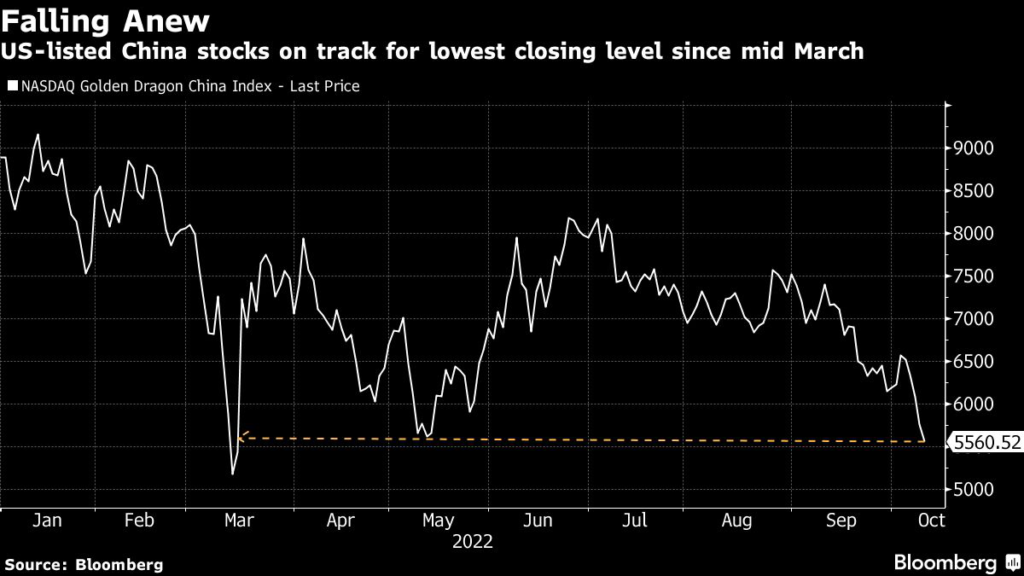
(Bloomberg) — Chinese stocks listed in the US tumbled for a fifth day, taking the Nasdaq Golden Dragon China Index lower for its longest losing streak since April, as investors assess the country’s bleak economic outlook and Beijing’s persistent Covid-zero policy.

The Golden Dragon fell 3.4% Tuesday, after plunging as much as 5.4%. It has declined 15% in the past five sessions and closed at its lowest level since March 15, when China announced a strong push to stabilize its markets and sparked a rally. Among large-cap tech companies in the index, Alibaba Group Holding Ltd. lost 4.9%, Baidu Inc. dropped 5.6%, Pinduoduo Inc. slid 4.4% and JD.com Inc. slipped 2.8%.

Read: China Markets Keep Showing Any Reopening Bets Are Risky (1)

Hopes for a near-term relaxation of Covid controls and an economic reopening are waning after Chinese state media including People’s Daily and Xinhua endorsed the country’s Covid-zero policy ahead of the Communist Party Congress. Meanwhile, the International Monetary Fund lowered its growth estimate for China’s economy to 4.4% from 4.6%. 

Investor sentiment is also being hurt by the Biden administration’s new measures restricting exports of cutting-edge semiconductor technology to China, escalating tensions between the two countries. 

(Updates with share moves at close)

More stories like this are available on bloomberg.com

©2022 Bloomberg L.P.
Cathie Wood’s ARKK Hits Pandemic Low With 62% Plunge This Year

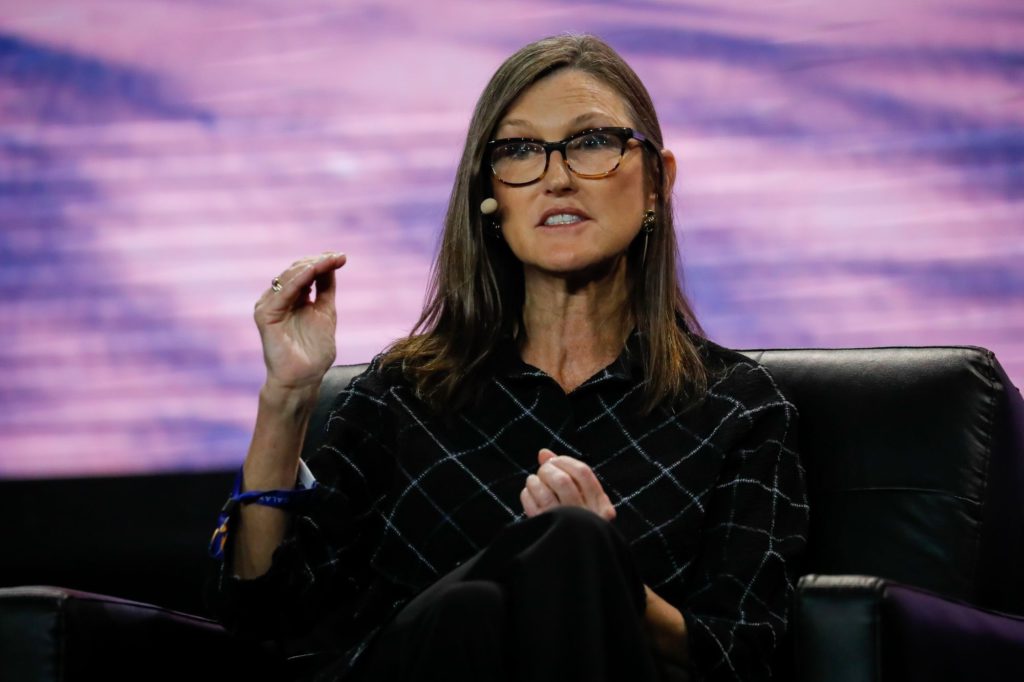
(Bloomberg) — The drubbing in Cathie Wood’s flagship exchange-traded fund has taken it back to lows reached during the depths of the pandemic.

The $7.1 billion ARK Innovation ETF (ticker ARKK) closed on Tuesday at its lowest level since March 2020. The fund has plummeted 62% so far in 2022, more than twice the pace of the plunge in S&P 500.

The year hasn’t been kind to the ETF and growth-centered products as the Federal Reserve raises rates to knock down scorching levels of inflation. Wood this week took the central bank to task for its aggressive tightening campaign, penning an open letter to officials to express concern that they could be making a policy error. 

Speaking at the Greenwich Economic Forum, Wood said she believes the current risk-off environment means investors and trading algorithms are looking for safety in passive benchmark-tracking products. She says they’re failing to recognize that the companies ARK targets are positioned to help tackle some of the macro challenges facing the market.

“We have so many more problems now,” she said, citing the supply chain and Russia’s invasion of Ukraine. “Innovation solves problems, and yet these algorithms and very short-term time horizons — ours is five years, the market in risk-off goes to one quarter — algorithms are dominating the market.”

“ARKK has really been the poster child for pain from this environment — global interest rates surging and a Fed set on continuing to tighten until inflation is put to bed,” said Todd Sohn, ETF strategist at Strategas Securities. 

Read: Cathie Wood Warns Fed of Policy Error as Rate Hikes Hit ARK ETFs

It’s not only ARKK that has been hit. Short sellers have been targeting Wood’s ARK Investment Management family recently, even paying up to wage against the funds. 

Things weren’t always like this for ARKK and other growth stocks and funds. Wood’s flagship ETF surged almost 150% in 2020, becoming a darling of retail traders and others who had bought into Wood’s vision of innovation.

Those investors largely appear to have stayed loyal this year, and the fund has posted net inflows of $1.3 billion in 2022, according to data compiled by Bloomberg. That puts it in the top 10 of actively managed ETFs for new cash — even as it has struggled in terms of performance.

October has been less kind, however, with outflows of $244 million for the month — through the latest session for which data is available.

“As sentiment continues to sour, those with higher-beta exposure may see further outflows,” said Mohit Bajaj, director of ETFs at WallachBeth Capital.

(Updates prices. Earlier version corrected performance year in third to last paragraph.)

More stories like this are available on bloomberg.com

©2022 Bloomberg L.P.
Ark Analyst Stands by Prediction Bitcoin Price Will Top $1 Million

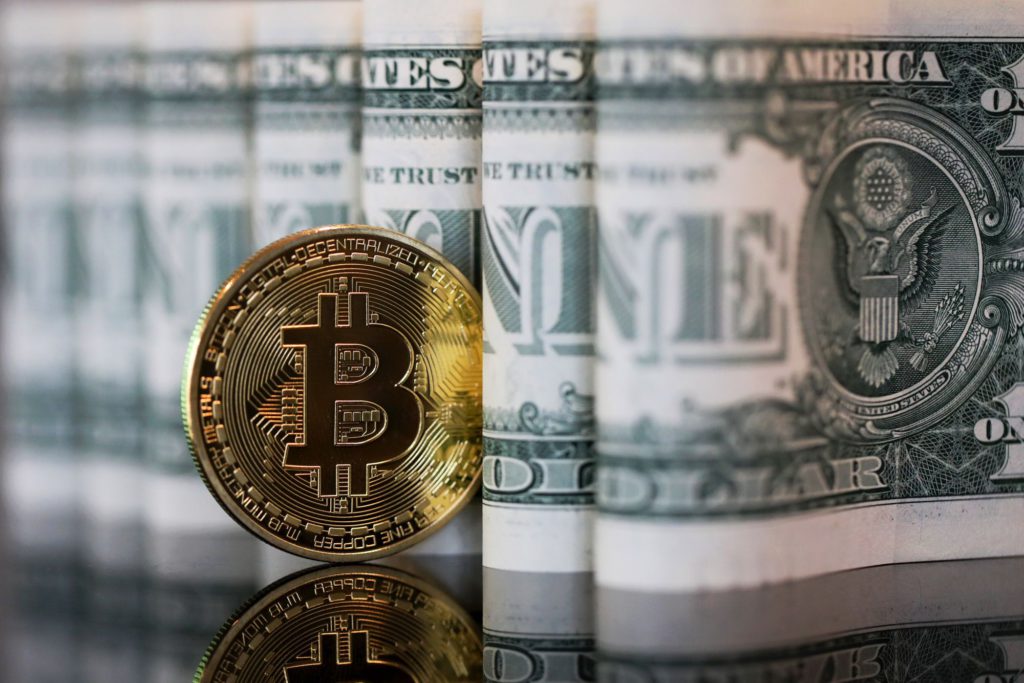
(Bloomberg) — Ark Investment Management analyst Yassine Elmandjra is standing by his firm’s prediction that Bitcoin’s price will shoot past the million-dollar mark, despite this year’s massive sell-off in the digital currency. 

Cathie Wood, the fund manager behind Ark’s flagship innovation-themed ETFs, forecast earlier this year that the world’s largest cryptocurrency would top $1 million per coin by 2030. Yet, coin holders and miners have been selling off the token en masse in 2022 as the Federal Reserve continues to aggressively tighten monetary policy, driving investors away from riskier asset classes, such as crypto.  

The bellwether virtual currency is down nearly 60% to around $19,000 this year, according to Bloomberg data. 

Yet, Ark crypto analyst Elmandjra said that there is still a sizable opportunity to be found in Bitcoin, in an interview with Bloomberg TV Tuesday, reiterating his firm’s view of each coin exceeding $1 million in the coming years. 

“When we look at Bitcoin’s potential, we segment it across several use cases — everything from it competing as a digital store of value, to a settlement network, to an insurance policy against arbitrary asset seizure,” he explained. “When you stack every use case one on top of another, you come to about a 28 trillion-dollar opportunity, which translates to more than a million dollars per Bitcoin.” 

Even so, the firm gave up its place as the third-largest shareholder of US-based crypto platform Coinbase Global Inc. over the summer, dumping some its holdings amid a US Securities and Exchange Commission probe. Three Ark Investment Management LLC funds sold over 1.41 million shares toward the end of July, worth $75 million at the time. 

Ark’s $7.1 billion Innovation ETF (ticker ARKK) has not had a favorable year, lingering near its lowest closing level since March 2020 on Tuesday. The fund has plunged 62% in 2022 as global risk sentiment sours, compared to a 24% fall in the S&P 500.

Elmandjra’s long-term view of Bitcoin remains bullish, nevertheless. 

“When you look at Bitcoin as a strategic asset, non-sovereign, censorship-resistant money, competing against central banks and fiat currencies, Bitcoin supply being capped at 21 million, I think there is an arms race — especially as we shift from the digital to the physical world — to be an asset independent of the traditional financial systems and traditional asset classes,” he said in the TV interview.

More stories like this are available on bloomberg.com

©2022 Bloomberg L.P.

Meta Debuts $1,500 VR Headset Targeting Working Professionals

(Bloomberg) — Meta Platforms Inc. unveiled its newest virtual-reality headset on Tuesday, a foray into the world of high-end VR devices designed to entice creators and working professionals to adopt Mark Zuckerberg’s vision for an immersive digital future.

The Meta Quest Pro is the company’s latest offering in a product line previously branded as Oculus. The Quest Pro includes a number of technological advancements from the company’s Quest 2 headset, which was launched in late 2020.

The new headset is also much pricier than its predecessor — it will cost $1,500, or three times the price of the Quest 2, in part because the company is targeting more serious working professionals. With the new device, Facebook parent Meta is seeking to transcend the notion that VR is primarily the realm of gamers, an effort to broaden its audience. Meta’s Quest 2 headset has sold an estimated 15 million units.

“It’s work-focused,” Meta Chief Executive Officer Zuckerberg told a small group of reporters in late September. “The ideal customers for this [are] gonna be either people who just want the highest-end VR device — so enthusiasts, prosumer type folks — or people who are trying to get work done.”

Some of the Quest Pro’s new features are built for this work-focused audience, and would be particularly useful for people taking meetings in VR while working remotely. The device includes face- and eye-tracking, which can be used to humanize avatars so that conversations in VR feel more personal. It also has what Meta calls a “full-color mixed reality experience,” which uses cameras on the outside of the headset to let people see the world around them and overlay graphics while wearing the device. (The Quest 2 also has this mixed reality feature, but only in black and white.)

Meta is also launching new “self-tracking” controllers alongside its new headset, which means each controller has built-in sensors that can “track their position in 3D space independent of the headset,” according to Meta’s blog post about the product.

Meta and Zuckerberg have been teasing the Quest Pro for months, and many of the gadget’s details leaked ahead of Tuesday’s announcement at the company’s annual Connect conference. Still, Meta’s research in developing virtual and augmented reality headsets is key to plans for the so-called metaverse, an immersive version of the internet where Zuckerberg hopes people will eventually work and play.

Someday users may access the metaverse as digital avatars through devices like the Quest Pro, and eventually through augmented reality glasses intended to look like ordinary reading spectacles. That vision is still far off — and costing Meta tens of billions of dollars in the interim. The company said investments in its Reality Labs division, which is responsible for building the metaverse, cut operating profits by $10 billion in 2021.  Meta’s shares have tumbled more than 60% this year.

For now Meta is promoting the Quest Pro as an important tool for working remotely, and is teaming up with Microsoft Corp. to offer Microsoft Teams and Microsoft 365 office-productivity software on the new devices. Microsoft CEO Satya Nadella appeared on video alongside Zuckerberg Tuesday announcing the partnership and promoting the new headset, saying, “we are going through a once-in-a-lifetime change in how we work.” 

Despite buy-in from some of the world’s biggest tech companies, many observers have raised doubts as to whether Zuckerberg’s vision is even possible. After the CEO recently posted a picture of his own avatar to his Facebook page, he was mocked ruthlessly by people who felt the image looked amateur. He quickly ordered up a more advanced version, and Meta is creating much more sophisticated looking avatars than the one Zuckerberg initially posted. For one thing, some of the new avatars have legs as Zuckerberg demoed them Tuesday — a notable change from previous ones that drew ridicule for looking like floating cartoon torsos.

Meta is building other technology besides headsets that will play into this vision. While some advances, like the full-color mixed reality and facial-tracking technology, are already available, a lot of the innovations are much further off. That category includes things like easy-to-use 3D scanning so people can photograph or take a video of personal items and quickly upload digital versions of those items to a virtual world. It also includes improved spatial audio so that conversations happening in the metaverse will have the same acoustic feel as those in real life.

The company is working on a wristband that can detect neurological signals in humans and turn those signals into outputs on a digital screen. The technology essentially turns the human hand into a remote control, a helpful tool when trying to operate a pair of smart glasses.

Zuckerberg demonstrated this technology to a group of reporters late last month from one of the company’s office buildings near Seattle. The wristband is bulky right now, he acknowledged, but eventually he thinks it will be stylish enough that people always wear it to control the devices around them.  

“I think in the future people will use this to control their phones and computers and all this other stuff,” he said. “You’ll just have a little band around your wrist.”

“It’s not that far off.” He added. “It’s not this year, but it’s not that far off.”

The Quest Pro goes on sale starting Tuesday and Meta will begin shipping it on Oct. 25. 

((Updates to add details about Microsoft partnership in ninth paragraph.))

More stories like this are available on bloomberg.com

©2022 Bloomberg L.P.

BNY Mellon Debuts Crypto Custody Platform for Bitcoin and Ether

(Bloomberg) — Bank of New York Mellon Corp. launched a digital asset platform in the US that will allow some clients to hold and transfer Bitcoin and Ether.

The firm, with $43 trillion of assets under custody or administration at midyear, “has the scale to reimagine financial markets through blockchain technology and digital assets,” Chief Executive Officer Robin Vince said Tuesday in a statement.

The move comes even after the US Securities and Exchange Commission published an accounting guideline in March that said public companies holding crypto assets on behalf of clients should should treat them as liabilities on their balance sheets. The guideline has made crypto custody more capital-intensive for banks, which are subject to capital rules. 

The SEC guideline is “definitely something we see as restricting our ability to scale our offering fully,” said Caroline Butler, BNY Mellon’s CEO of custody services, in an interview. Still, the bank will follow the SEC guideline while continuing its discussions with the regulator on this topic, she added.  

BNY Mellon, which formed its enterprise Digital Assets Unit in 2021, got approval from the New York Department of Financial Services before launching crypto custody. It plans to expand its offerings, such as providing clients with access to crypto exchanges, pending market demand and regulatory guidance.  

The bank sponsored a recent survey that found strong demand for infrastructure that can accommodate traditional and digital assets and that 41% of institutional investors hold cryptocurrencies in their portfolios. The bank partnered with fintech startups Fireblocks and Chainalysis – which it has invested in – to develop the platform. 

Shares of the bank fell 1.9% to $38.43 as of 3:21t p.m. in New York, extending their decline this year to 32%.

Read More: Nasdaq Makes First Big Crypto Push to Lure Institutional Clients

(Updates with context, quotes from Caroline Butler)

More stories like this are available on bloomberg.com

©2022 Bloomberg L.P.
NASA Spacecraft Rams Asteroid, Changes Orbit in Earth Defense Test

(Bloomberg) — NASA says a mission to nudge a distant asteroid off course succeeded, showcasing a potential new method for saving Earth from dangerous space rocks that astronomers might identify in the future.

A NASA spacecraft called DART, which rammed the asteroid last month, was able to alter the trajectory of its moving target, officials at the space agency said Tuesday.

“NASA has proven that we are serious as a defender of the planet,” agency administrator Bill Nelson told reporters at a press conference.

The spacecraft, which is about the size of a refrigerator, slammed into an asteroid called Dimorphos at 14,000 miles per hour on Sept. 26. Dimorphos, roughly the size of a football stadium, orbits around a larger asteroid called Didymos. The momentum from the impact, combined with the recoil of the ejected particles the collision created, helped to substantially alter Dimorphos’ path through space.

Read more: NASA Craft Rams Distant Asteroid in Test of Earth Defense 

Prior to the impact, Dimorphos orbited Didymos roughly once every 11 hours and 55 minutes. After the impact, NASA said the orbit is now 11 hours and 23 minutes — a 32 minute change, based on astronomy observations. Dimorphos now orbits slightly closer to Didymos than it did before.

“For the first time ever, humanity has changed the orbit of a planetary body,” Lori Glaze, director of NASA’s Science Mission Directorate, said during the press conference.

NASA’s minimum requirement for DART’s success would have been a trajectory change of 73 seconds, which the mission easily exceeded. The precision of the change has an error of plus or minus two minutes. A combination of four optical telescopes and planetary radar was used to determine the asteroid’s new orbit.

Dimorphos never posed a risk to Earth, but was merely a target asteroid to showcase this deflection technique. Asteroids similar in size to Dimorphos could cause regional devastation if they were to hit a populated area on the planet.

“I think that the DART mission has demonstrated that we are capable of deflecting an asteroid, even a potentially hazardous asteroid of this size,” Glaze said.

(Updates with additional details beginning in fifth paragraph)

More stories like this are available on bloomberg.com

©2022 Bloomberg L.P.

Close Bitnami banner
Bitnami
