
Bloomberg

Online Retailers Aren’t on 2022 Holiday Wish Lists

(Bloomberg) — E-commerce stocks have struggled this year, and plenty of investors are doubtful the holiday shopping season will provide a catalyst to turn things around.

Online retailers such as Wayfair Inc. and Etsy Inc. already are under pressure from the loss of pandemic-era tailwinds and economic weakness weighing on consumer sentiment. Now, some analysts are fretting that high inventories will spur sites to offer big discounts to move merchandise, weighing on earnings at a time when investors are focused on profitability. 

Adobe Analytics expects US online holiday sales to increase 2.5% this year, slower than 2021’s 8.6% pace. The shopping season gets an unofficial kickoff Tuesday with Amazon.com Inc.’s two-day “early access” sale, though Target Corp. has already started weekly Black Friday deals.

“This will be a weaker holiday season, and a deceleration in online retail growth will have a meaningful impact on valuations as investors recalibrate their expectations,” Chad Morganlander, senior portfolio manager at Washington Crossing Advisors. “We like retailers, but brick-and-mortar stocks are more reasonably priced, while there’s still a lot of air to come out of the unprofitable online space.”

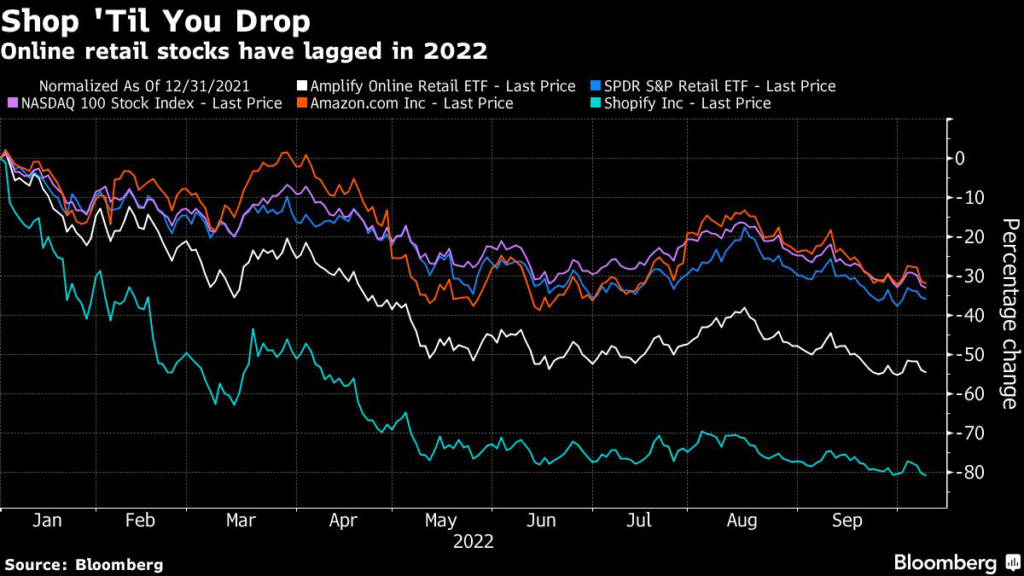
The Amplify Online Retail ETF has dropped 55% this year, including a 1.2% drop on Tuesday, compared with a decline of 35% in the broader SPDR S&P Retail ETF and a 33% retreat for the Nasdaq 100 Index. Both Wayfair and Shopify Inc., which provides infrastructure for e-commerce companies, have collapsed more than 80%, and both closed at multiyear lows on Monday. Etsy has dropped 51%, eBay Inc. is down 44% and Amazon has lost a third of its value.

Even after those declines, online retailers are still expensive relative to their past valuations or to the market at a time when the Federal Reserve is aggressively raising interest rates to combat inflation, a headwind to multiples. Wayfair trades at nearly 98 times estimated earnings, and both it and Shopify are unprofitable, putting them out of favor at a time when market participants are gravitating toward companies with earnings.

Both Etsy and Amazon are below their long-term average valuations, but at 32 and 40 times earnings, respectively, they’re more than double the S&P 500 Index’s multiple of 15.3. Analysts predict Amazon’s revenue will rise 11% this year while Etsy’s growth is seen slowing to 6.2% from from 35% in 2021. 

“There’s still a lot of risk and e-commerce stocks are still pretty expensive,” said Lamar Villere, partner and portfolio manager at Villere & Co. “We don’t see anything attractive, as it remains a high-multiple sector at a time when growth has slowed.”

Analysts are also pulling back their expectations: The average estimates for full-year revenue at Etsy, Wayfair and Shopify are down 9.2% or more over the past six months. 

The consensus for Amazon’s is down a milder 3.6%, and the Seattle-based megacap remains a favorite for its cloud-computing and advertising businesses. Nearly 95% of analysts recommend buying the stock, while the average analyst price target implies a gain of 49% from current levels.

“The environment for online retailers isn’t as good as it was, but Amazon has the balance sheet heft that can help it endure an economic slowdown,” said Jack Ablin, chief investment officer at Cresset Capital. “If you’re a long-term investor, Amazon’s weakness could look like an opportunity.”


Tech Chart of the Day

The S&P 500 tech sector index has dropped 32% in 2022, as of its last close, a steeper decline than the 24% drop of the overall benchmark index. This year is on track to be the first one since 2013 where tech has underperformed, and the degree of underperformance is the biggest since 2002. The sector has been pressured as rising rates weigh on valuations, and as investors rotate into value strategies over growth.

Top Tech Stories

  • Asia’s top chip stocks tumbled Tuesday, ensnared in an escalating US-China tech race that has erased more than $240 billion from the sector’s global market value.
    • Taiwan Semiconductor Manufacturing Co. shares fell by the most in 28 years after the US imposed tighter controls over chip exports to China, escalating tensions between the two countries and pitching the global semiconductor industry into new uncertainty.
  • The global PC market saw its steepest decline on record as economic uncertainty and a glut of unsold inventory dented shipments for the fourth quarter in a row.
  • Just before Elon Musk revived his proposal to buy Twitter Inc. last week, the billionaire accused the company of ordering a whistle-blower to destroy evidence of its missteps as part of a $7.8 million severance package.
  • Musk’s Starlink has debuted in Japan, making it the first Asian nation to receive SpaceX’s satellite internet service.
  • Cathie Wood bought another tranche of Adobe Inc. shares as the stock languishes near its mid-September low when it cratered after announcing its biggest-ever acquisition.

(Updates to market open.)

More stories like this are available on bloomberg.com

©2022 Bloomberg L.P.

LGT Bank Sees Asia Business Surpassing Rest Amid Expansion Plans

(Bloomberg) — LGT Group expects Asia to surpass its business in the rest of the world as the private bank that’s owned by Liechtenstein’s royal family steps up expansion in the region. 

Our “private banking books in Asia aren’t quite at $100 billion, but they have been growing faster than the rest,” Chairman Prince Max von und zu Liechtenstein said in an interview in Dubai. “I think in just a couple of years Asia would have overtaken the rest as those economies are growing faster.”

LGT has about $300 billion of assets under management, which include about $210 billion private banking assets, he said. The bank has already expanded its Asia business from two hubs in Singapore and Hong Kong to centers in Japan, Thailand, India and Australia.

The bank — like other global wealth managers — has been expanding in Asia, lured by the growing number of rich. Knight Frank expects Asia to surpass Europe to become the region with the second-most ultra-rich by 2026 despite China’s “common prosperity” campaign.

‘Good Fit’

LGT has mainly grown organically but is looking out for acquisition opportunities to help the firm achieve a critical mass faster. LGT acquired Australian high net worth advisory firm Crestone Wealth Management for around A$475 million ($299 million) in December. 

“In Thailand and Japan we have gone more the organic route,” said von und zu Liechtenstein. “We may potentially find something later but those markets are not very developed from the private banking side so its more difficult to find a good fit.” 

Separately, the bank, which started offering crypto custody and brokerage services to private clients in May, doesn’t expect the digital assets to become “a substantial investment area for the next couple of years” following the recent market rout, he said. 

When asked about the recent troubles at fellow wealth manager Credit Suisse Group AG, von und zu Liechtenstein said: “I think there is enough strength in that business to get through the crisis,” he said, adding that LGT isn’t looking to buy any of Credit Suisse’s assets.

More stories like this are available on bloomberg.com

©2022 Bloomberg L.P.
Colorado Startup Wins $13.3 Million US Contract for Satellite Refueling

(Bloomberg) — Orbit Fab Inc., a Denver-area startup backed by Lockheed Martin Corp. and Northrop Grumman Corp., won a $13.3 million government contract to provide fuel for US Space Force satellites — another step toward what the company hopes will become a network of gas stations in outer space. 

The four-year contract calls for Orbit Fab to deliver hydrazine, the most common satellite propellant, to a Space Force satellite in 2025, the company said Tuesday. A typical satellite uses 10 kilograms of hydrazine per year to stay in a geosynchronous orbit but requires more of the fuel to move in space. The ability to refuel will allow military satellites to maneuver around the growing field of debris in orbit.

Closely held Orbit Fab tested its first fuel depot in a low Earth orbit in June 2021 and has since landed a pair of other satellite-refueling contracts. Co-founder and Chief Development Officer Jeremy Schiel said in an interview that the company plans to open a network of fuel depots that will allow for mining and manufacturing operations in space. The global in-orbit refueling market is projected to reach almost $1.1 billion by 2032, a study from BIS Research shows.

“As NASA goes to the Moon and Elon Musk goes to Mars, we want to establish the orbital highway where we place our depots in key orbits to allow the commercial industry and government agencies to keep expanding the human footprint into our solar system,” Schiel said. 

More stories like this are available on bloomberg.com

©2022 Bloomberg L.P.
US Equity Futures Steady as Yields Pare Advance: Markets Wrap

(Bloomberg) — US equity index futures recouped earlier losses to trade flat as investors weighed up how inflation and hawkish central bank policy will erode corporate earnings. Treasury yields pared an advance to multi-year highs.

Contracts on the S&P 500 and Nasdaq 100 were little changed after having fallen as much as 1%. Meta Platforms Inc. dropped with other big tech names sensitive to rising rates. In Europe, the Stoxx 600 index fell for the fifth day, with energy and tech stocks underperforming. The dollar erased a gain that had taken it to the highest this month.

The mood remains fragile after a four-day losing streak wiped $1.6 trillion off the value of the S&P 500 Index. US inflation data, due Thursday, could seal the case for another 75 basis-point interest rate increase, should it come in higher than expected. Nor have Federal Reserve officials shown any inclination to pause their rate-hiking cycle in the near future.

Strategists are also bracing for weak profits against a drumbeat of warnings over the rising risk of a global recession. Big US banks kick off the third-quarter earnings season in earnest later this week. 

“We have not seen the impact of tightening,” Michael Kelly, head of the multi-asset team at PineBridge Investments told Bloomberg TV. “That lies ahead and when we see that, it’s another leg down for risk assets.” 

Yields on two-year Treasuries earlier hit the highest since 2007 while the 30-year yield surged to the highest since 2014.

Turmoil in UK bond markets eased Tuesday as the Bank of England was forced to expand its emergency measures to tackle what it called “fire-sale dynamics.” Ten-year UK government yields which had risen more than 50 basis points since Oct. 4, dropped five basis point to about 4.4%.

Meanwhile, Russian President Vladimir Putin threatened further missile attacks on Ukraine after hitting Kyiv and other cities in the most intense barrage of strikes since the first days of its invasion.

“It’s little wonder investors enter the week in a dreary mood, especially with headlines from Ukraine signaling a further escalation in geopolitical tensions,” Christopher Smart, chief global strategist at Barings, said in a note. 

With world growth under pressure, US oil futures tumbled about 2%, giving up more of last week’s 17% rally. 


Key events this week:

  • Earnings this week include: JPMorgan Chase & Co., Citigroup Inc., Morgan Stanley, BlackRock Inc., Delta Air Lines Inc., UnitedHealth Group Inc., U.S. Bancorp, Wells Fargo & Co.
  • IMF’s World Economic Outlook and Global Financial Stability Report, Tuesday
  • Fed’s Loretta Mester speaks, Tuesday
  • BOE’s Andrew Bailey speaks, Tuesday
  • FOMC minutes for September meeting, Wednesday
  • US PPI, mortgage applications, Wednesday
  • OPEC Monthly Oil Market Report, Wednesday
  • Fed’s Michelle Bowman and Neel Kashkari speak
  • ECB’s Christine Lagarde speaks
  • US CPI, initial jobless claims, Thursday
  • G-20 finance ministers and central bankers meet, Thursday
  • China CPI, PPI, trade, Friday
  • US retail sales, business inventories, University of Michigan consumer sentiment, Friday
  • BOE emergency bond buying is set to end, Friday

Some of the main moves in markets:

Stocks

  • Futures on the S&P 500 were little changed as of 8:41 a.m. New York time
  • Futures on the Nasdaq 100 fell 0.1%
  • Futures on the Dow Jones Industrial Average were little changed
  • The Stoxx Europe 600 fell 0.3%
  • The MSCI World index fell 0.3%

Currencies

  • The Bloomberg Dollar Spot Index fell 0.1%
  • The euro rose 0.3% to $0.9730
  • The British pound rose 0.4% to $1.1100
  • The Japanese yen was little changed at 145.60 per dollar

Cryptocurrencies

  • Bitcoin fell 0.2% to $19,209.98
  • Ether fell 1.2% to $1,290.98

Bonds

  • The yield on 10-year Treasuries advanced three basis points to 3.91%
  • Germany’s 10-year yield declined four basis points to 2.31%
  • Britain’s 10-year yield declined four basis points to 4.43%

Commodities

  • West Texas Intermediate crude fell 1% to $90.18 a barrel
  • Gold futures rose 0.1% to $1,677.70 an ounce

More stories like this are available on bloomberg.com

©2022 Bloomberg L.P.
ForgeRock to Be Bought by Thoma Bravo in $2.3 Billion Cash Deal

(Bloomberg) — ForgeRock Inc., a maker of identity-verification software, said it will be acquired by Thoma Bravo in an all-cash deal valued at about $2.3 billion.

The San Francisco-based company’s investors will receive $23.25 in cash and the deal is expected to close in the first half of 2023, the company said in a statement Tuesday. 

ForgeRock completed its initial public offering in September last year, selling 11 million shares for $25 each after marketing them for $21 to $24. The stock has slumped since, and closed Monday at $15.16. The offer represents a 53% premium over that closing price. 


To view the source of this information click here

More stories like this are available on bloomberg.com

©2022 Bloomberg L.P.
Uber Executive’s Conviction Puts Spotlight on Secrecy About Hacking

(Bloomberg) — The conviction of Uber Technologies Inc.’s former security chief on Oct. 5 has raised the specter that a high-profile criminal charge and newly expanded federal rules may force companies to be more transparent when it comes to reporting cybersecurity breaches. But that new path forward runs up against a stubborn history of secrecy, according to industry data and interviews with security experts.

A lack of corporate transparency around hacking manifests in several ways, from companies issuing minimal, often vague, public statements to hiring cybersecurity investigators through law firms, which can attach attorney-client privilege. Companies may also not want to disclose breaches because it could damage their reputation.

That opacity comes as the private sector continues to face an onslaught of intrusions — especially from ransomware hackers — that can paralyze hospitals, shutter colleges and shut down major gas pipelines.

“The verdict has not solved the larger problem of a patchwork of notification laws, which are not always totally clear around ransomware cases about what needs to be reported and by whom,” said Josephine Wolff, an associate professor of cybersecurity policy at Tufts University. “It will probably make companies a little more cautious and over report. But there’s enough ambiguity in these laws that companies feel like they have space to maneuver.”

Former Uber security head Joe Sullivan was found guilty in San Francisco federal court that stemmed from a 2016 hack — details of which he tried to keep hidden. But experts told Bloomberg the case may an exception, not the rule, when it comes to the government pushing for more disclosure. In fact, the Justice Department didn’t charge Sullivan with violating disclosure regulations, but obstruction of justice and concealing a felony amid a probe by the Federal Trade Commission. 

Still, the conviction comes at a time when lawmakers and regulators are pushing for more accountability on hacks. In March, President Joe Biden signed sweeping cybersecurity legislation that mandates certain sectors report breaches to the U.S. Department of Homeland Security within 72 hours of discovery of the incident, and 24 hours if they make a ransomware payment. Many states now require companies to report breaches, and the US Securities and Exchange Commission has proposed new cyber-reporting laws. 

For years, companies have turned to outside lawyers to handle such incidents, a practice that’s grown. In 2018, more than 4,000 companies retained legal counsel to help with their cyber responses; by 2021, that number doubled, according to data from firms that were surveyed by insurance firm Advisen Ltd. and analyzed by Bloomberg News. The cybersecurity firm Crowdstrike Holdings Inc. told Bloomberg that 42% of its engagements last year were under privilege with outside counsel. 

Even when companies do decide to disclose, it can be so generic that it isn’t useful to investors or the public. “I worry that these judgments have too often erred on the side of nondisclosure, leaving investors in the dark — and putting companies at risk,” said former SEC Commissioner Robert J. Jackson Jr. in 2018.

After a company is breached, outside law firms often bring in a cybersecurity company for what’s known as incident response, or IR. But now, with ransomware actors — who will likely never see the inside of a US courtroom — the attorney-client privilege may be overused and misplaced, according to experts who study cybersecurity policy.

“External counsel go beyond merely providing legal advice,” wrote Daniel Woods, a researcher who’s also published on this topic with Wolff. The lawyers control who gets hired to respond to the breach and “prioritize protecting client-attorney privilege above other concerns.”

Michael Risch, the vice dean at Villanova University’s law school, said having lawyers involved is meant to protect a firm and can actually guide companies to follow regulations more closely than had they not consulted an attorney. The antidote to secrecy, he said, “is to make laws that require companies to disclose more. And then the attorneys would say, ‘You have to disclose.’”

Beyond legal machinations, companies are often tight-lipped when breaches do happen. The phrases “cybersecurity incident” and “IT incident” — a common shorthand phrase often accompanied by few details — appeared in more than 1,000 newspaper and wire stories during the last five years, according to clippings archived by LexisNexis.

That secrecy can be particularly prevalent in critical parts of the private sector following major breaches, including hospitals. Some companies ultimately provide details, but others not until months later, leaving patients worried whether IT issues may affect their medical care.

Tenet Healthcare Corp., for example, published a brief, four-paragraph press release about a “cybersecurity incident” in April. A spokesperson declined to elaborate to a Bloomberg reporter at the time, saying, “We don’t have any comments beyond the release.” Three months later, the company offered more details in an SEC filing, admitting the breach cost Tenet $100 million before taxes.

A spokesperson for Tenet didn’t respond to a recent request for comment.

FBI officials last year estimated that the bureau has visibility into only a quarter of cyber incidents, resulting in a government-wide lack of information about the nature of many data breaches, the tactics of cybercriminals and the U.S. industries that are most vulnerable. 

Michael Hamilton, co-founder and chief information security officer of Critical Insight, said the idea of “executive negligence” — where companies can be held personally liable for damages — will come into sharper focus. CISOs, Hamilton said, “take an ethical oath, and it’s pretty clear that you don’t lie about stuff like this.”

More stories like this are available on bloomberg.com

©2022 Bloomberg L.P.

RBC Counts on Technology for UK Wealth Growth After Brewin Deal

(Bloomberg) — Royal Bank of Canada expects to gain more market share in the UK wealth-management business in the years ahead, with its technological capabilities key to attracting clients.

Canada’s largest bank recently completed its 1.6 billion-pound ($1.8 billion) acquisition of Brewin Dolphin Holdings Plc, vaulting its wealth-management operation to the No. 3 spot in the UK and Ireland. Still, the industry in the UK remains “very fragmented” with “lots of market share up for grabs,” said Doug Guzman, head of Royal Bank’s wealth-management, insurance and investor, and treasury-services businesses.

“The UK business is only partway along the modernization path that North America is,” Guzman said in an interview last week. “There’s lots more work to do on digital, there’s lots more work to do integrating banking products in the interests of clients. That will serve as a consolidating force over time, which we think serves to our benefit.”

The bank will keep its focus on its three main geographies of Canada, the US and the UK, with less emphasis on continental Europe, he said.

Royal Bank, which says its wealth business is ranked sixth in the US by assets under administration, also sees market share available there, Guzman said. The firm’s plan in the US includes increasing its adviser base and adding new capabilities such as a system that the bank added in recent years to let clients borrow against their investment portfolios with a few clicks.

“The biggest in the industry are really, really big,” Guzman said. “So we don’t see ourselves getting to one, two or three. But we’ve had good success in the US adding products.”

More stories like this are available on bloomberg.com

©2022 Bloomberg L.P.
Amazon’s Second Prime Day Sale Falls Flat on Social Media

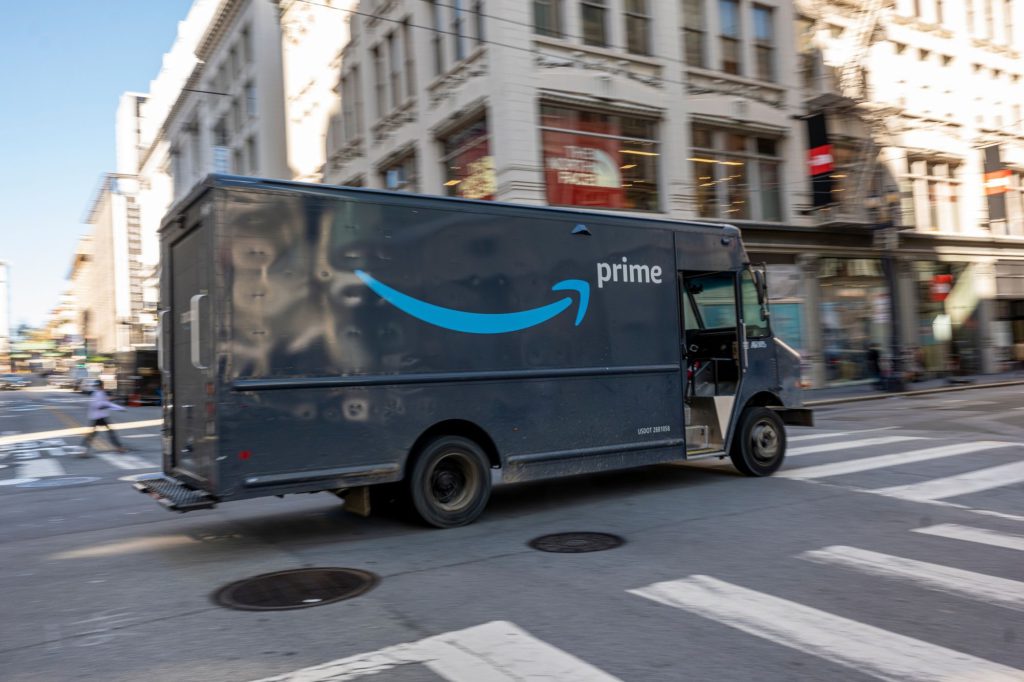
(Bloomberg) — Amazon.com Inc.’s second Prime sale this year has generated little enthusiasm on social media, a sign of consumer fatigue and a potential harbinger for the holiday shopping season.

Twitter mentions of “Prime Early Access Sale” on the day the event was announced last month fell 70% compared with mentions for the previous event in June, according to analytics firm Sprout Social Inc. And buzz about the two-day sale that begins Tuesday has been waning, the opposite of what happened during the run-up to the summer event.

“The data suggests possible fading consumer enthusiasm around seasonal promotions,” said Mike Blight, a market research manager at Sprout. “Announcing a second, similar campaign during the crowded holiday promotion season likely contributed to the lack of engagement.”

Retailers are bracing for a lackluster holiday that will require deep discounts to move a glut of inventory. Many consumers, meanwhile, are planning to cut back because higher food and fuel costs have left them with less disposable income. US online spending in November and December will grow just 2.5% this year to $209.7 billion, according to Adobe Inc. That would be a big slow-down from last year’s gain of 8.6%.

Still, Amazon has an opportunity to win market share even if shoppers pull back, helping the e-commerce giant stand out when investors pick holiday winners and losers, according to Scott Gravelle, who runs the robotic logistics firm Attabotics in Calgary. As an online marketplace with millions of merchants, Amazon offers a broader selection of goods than traditional retailers without having to buy inventory.

“There’s a battle about to happen for market confidence about who captures more consumer spending dollars when shoppers spend less,” Gravelle said. “I think Amazon has a bit of an advantage.”

The Seattle-based company launched Prime Day in 2015 to attract new subscribers who now pay $139 a year for shipping discounts, video streaming and other perks. The event helps Amazon lock in shoppers before the holidays and deepen its relationship with existing customers by offering them deals on Amazon gadgets and other goods. This is the first time the company is hosting two big Prime member sales in the same year. Amazon is touting hundreds of thousands of deals on electronics, appliances, toys and other products to lure shoppers.

But consumers should be wary of what’s shown as a steep discount, according to research from marketing professors at three universities that was published this month in Marketing Science. They discovered a phenomenon they call “Price Increase and List Price Synchronization,” when a merchant significantly increases the “list price” of a product to make a discount look like a bargain. 

In reality, shoppers often end up spending more for the item than what it usually costs, they said. The researchers, who first studied prices for almost 15,000 products on Amazon in 2016 and 2017, said the phenomenon has continued this year — also on other sites, including Walmart.com. 

“It is really deceptive because they frame a price increase as a discount,” said Jinhong Xie, a marketing professor at the University of Florida’s Warrington College of Business, who worked on the study. “This is a very effective way to mislead consumers.”

Amazon spokeswoman Megan Lagesse said the study “doesn’t accurately represent the shopping experience today.” She declined to say what has changed since the researchers first conducted their study five years ago.

More stories like this are available on bloomberg.com

©2022 Bloomberg L.P.

Mercedes Car Sales Jump Defying Growing Global Economic Gloom

(Bloomberg) — Mercedes-Benz AG sales rose by more than a fifth during the third quarter, piercing through ongoing supply-chain bottlenecks and an increasingly negative economic outlook as consumers battle surging inflation.

The luxury-auto maker delivered 517,800 vehicles globally in the third quarter, up 21% compared to the same period a year ago with demand in China leading strong growth in all key regions, Mercedes said Tuesday. In Europe, where multiplying energy bills are affecting buyers, deliveries still rose some 18% as automakers catch up on orders after months of severe shortages of semiconductors hampering output.

“Global demand for Mercedes-Benz vehicles remains robust, even as energy supply uncertainties in Europe and the ongoing covid challenges in Asia continue to impact consumer sentiment,” Mercedes said in a statement. 

While many automakers still report firm demand, consumer confidence measures in major markets are around record lows amid surging inflation. Central banks in Europe, the U.K. and the U.S. are raising interest rates in a bid to tame price rises, moves that should reduce demand for big-ticket items like cars. 

Key competitor BMW AG earlier this week reported quarterly sales that were almost flat compared to a year ago at just under 588,000. For fully-electric cars, Mercedes said deliveries more than doubled to 30,000 vehicles. 

More stories like this are available on bloomberg.com

©2022 Bloomberg L.P.

Yuan Traders Crank Up Bearish Bets on Chip, Covid Curbs

(Bloomberg) — Bearish bets on the yuan are gaining momentum after the Biden administration curbed China’s access to US semiconductor technology and reports endorsing Beijing’s Covid Zero policy dashed hopes the curbs would be lifted soon. 

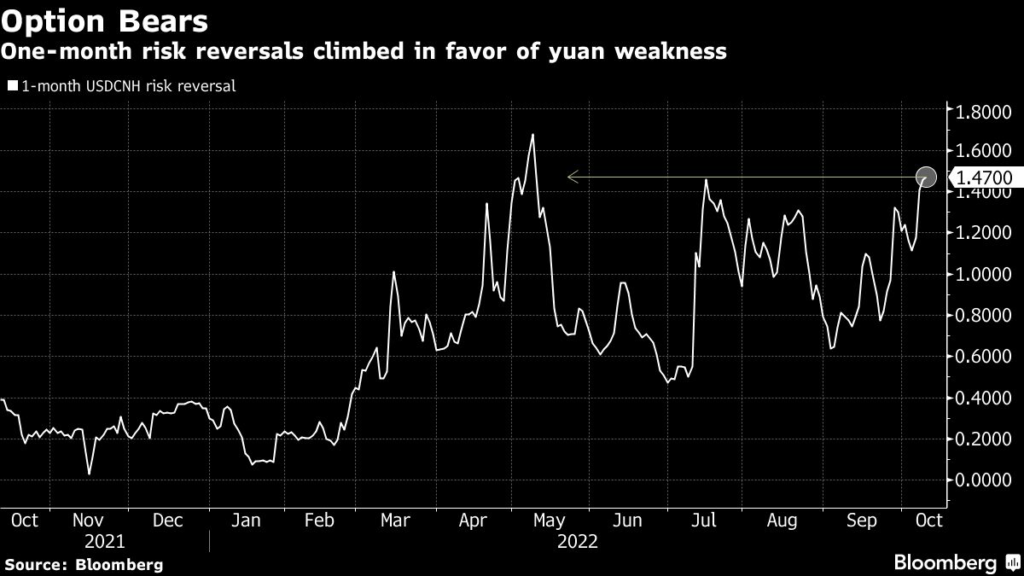
Option traders are boosting bearish wagers on the offshore yuan as indicated by the one-month risk reversal, which hit the highest level since May 10. Onshore yuan implied volatility for the same period rose to the highest on record as demand for protection against yuan weakness grew. The offshore unit fell as much as 0.7% to weaken past the key 7.2 per dollar level, wiping out gains from the Golden Week holidays.

Concerns over the chip sector and China’s Covid policy are adding to existing worries over outflows. That’s because the nation’s monetary policy diverges further from the US, with the Federal Reserve expected to aggressively hikes rates to tame inflation. Moreover, China’s domestic growth is also at risk from the turmoil in the property sector.

Covid Zero is “sustainable” and the country must stick to the policy because it’s key to stabilizing the economy and protecting lives, the People’s Daily said in a commentary Tuesday. The commentary comes amid signs Covid Zero will persist well after the Party Congress this month, with Shanghai ordering mass testing for Covid until early November.

The state media report on China’s Covid policy dented market hopes for relaxation after sentiment was already hurt by US tightening sanctions against China’s semiconductor industry, said Qi Gao, a strategist at Scotiabank in Singapore. Confidence in the yuan is lacking after most Fed officials recently reiterated intentions of another jumbo rate hike in November, he said.

Fresh US curbs on China’s access to American technology also hit chip-related stocks in Japan, South Korea and Taiwan, erasing more than $240 billion from the sector’s global market value. It’s not only adding to US-China tensions but non-US companies may also be under pressure to cut their supply to China, Tommy Wu, senior economist at Commerzbank AG wrote in a note.

China’s pushback against yuan weakness, with a 29th straight day of stronger-than-expected fixings, did little to stem the currency’s losses. The onshore yuan opened stronger, near the People’s Bank of China’s fixing, before giving up gains. An organization formed by China’s biggest foreign-exchange traders had asked banks to trade the currency at levels closer to the central bank’s fixing at the market open, people familiar with the matter had said in late September.

The renewed pressure on yuan will put the PBOC back in focus, especially in the run-up to the twice-a-decade party congress that that starts Oct. 16 where President Xi Jinping is set to secure a precedent-breaking third term in power.

In late September, the central bank delivered a strongly-worded statement to warn against one-way bets on the yuan. It also imposed a risk reserve requirement of 20% on currency forward sales by banks last month to make it more expensive to short the yuan. That’s after an earlier move to reduce the foreign-currency reserve requirement for banks. 

“Onshore dollar buying will likely deter the PBOC from aggressive intervention, but I will still be cautious if the pair rises above 7.20,” Stephen Innes, Managing Partner at SPI Asset Management, wrote in a note. “It is too early to say the PBOC will let the spot go up from here.”

(Updates with yuan volatility in the second paragraph and economist comment in the sixth paragraph.)

More stories like this are available on bloomberg.com

©2022 Bloomberg L.P.

Close Bitnami banner
Bitnami