
Bloomberg

Currencies Replace Crypto at Forefront of Market Trading Chaos

(Bloomberg) — The atmosphere at a conference of currency market professionals was markedly different from the previous few years: there was a buzz.

Senior executives from banks and brokers were feeling optimistic about the prospects of foreign-exchange trading at the recent gathering in Amsterdam. They’ve spent years eyeing the world of crypto with envy, as digital assets thrived in a highly volatile market, while traditional money remained dull. 

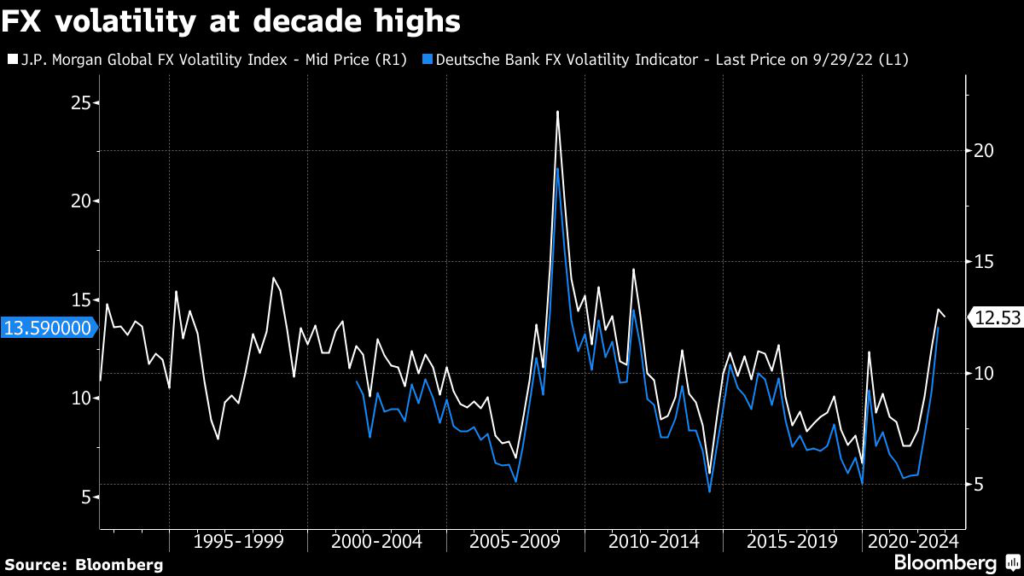
Currencies are now at the forefront of the action. Rapidly climbing interest-rate risks around the world and increased geopolitical tensions are fueling a 30% surge in trading and historic moves, reviving an industry that spent the past decade struggling with stagnant volumes.

“FX as an asset class is really back this year,” said Russell LaScala, the global head of FX at Deutsche Bank AG, the world’s largest currency player by market share. “I think last year a lot of macro hedge funds were trading different assets, including crypto.”

The notoriously wild swings in crypto markets have subsided this year, with the Bitcoin Volatility Index shedding more than 50% since a peak in May. By contrast, both Deutsche Bank’s and JPMorgan Chase & Co.’s gauges of currency volatility are at the highest in a decade apart from a spike when the pandemic struck.

And the moves have been shocking: in Japan, authorities sold dollars to prop up the yen for the first time since 1998, while the euro sank below parity with the dollar to a 20-year low. In London, the world’s top currency trading hub, the pound slid to an all-time low.

“Volatility is a bit like a London bus: there are either none to be found for love or money, or three arrive at the same time,” said Kit Juckes, global head of currency strategy at Societe Generale SA. 

FX Traders Relish Volatile Markets After Years in the Doldrums

The action has drawn in speculative players such as macro hedge funds and grabbed the attention of real-money investors, whose portfolio valuations are now subject to sudden swings. The war in Ukraine and aggressive Fed rate hikes heightened the moves, drawing money to the dollar as a haven and influencing other markets from Bitcoin to stocks. 

“FX has become a much bigger focus, even for investors who are not typically focused on FX for two main reasons: the dollar has been the one remaining effective hedge across markets and the dollar’s appreciation has been very tradable for speculative investors,” said Ebrahim Rahbari, the global head of foreign-exchange analysis and content at Citigroup Inc.

At TradeTechFX, the Amsterdam conference, executives packed sessions with titles such as “How can you ready your FX desk for heightened volatility,” before taking to the floor at afterparties fueled by expresso martinis. 

Crypto players, following debates on whether progress in building an institutional ecosystem has been “hindered by the ‘winter,’” looked grim, muttering in corners. Bitcoin has been stagnant at around $20,000 for months in a collapse from last year’s peak near $70,000. 

Crypto Lending Now Pays Less Than Safest US Government Debt

“Crypto seemed to be having all the fun until the central banks started breaking things,” said Tanvir Sandhu, chief global derivatives strategist at Bloomberg Intelligence. “It took inflation to blast the secular decline in currency volatility as central banks unleashed years of suppression. Volatility creates opportunity and it’s a trader’s best friend.”

In fact, cryptocurrencies command only a fraction of volumes of foreign exchange markets, for all the attention they generate. Trades of fiat currencies clock in at around $6.6 trillion each day, according to the Bank for International Settlements. That compares with just under $1 trillion for Bitcoin and other tokens, according to data website CoinMarketcap.

It’s likely that markets are now migrating to a higher range for interest rates and bond yields and that will be accompanied by higher currency volatility on average, Societe Generale’s Juckes said.

This is boon to the firms that dominate the space. Trading activity on major exchanges has soared compared with last year, while profits at the largest currency trading banks stand at multi-year highs.

EBS Market, a platform owned by CME Group Inc., posted a 30% increase in spot trading in September compared with a year ago, with futures trading at a record high. Spot volumes hit $76 billion, the highest since the pandemic struck in March 2020. Other large platforms have also enjoyed a boost, with Euronext FX seeing a 20% increase in August, according to website LiquidityFinder.

Good Business

It’s not all been plain sailing. At times liquidity has still been challenging, said Citigroup’s Rahbari.

“There have been occasions when large asset price movements were in fact observed with relatively little flow, similar to patterns in other markets this year,” he said.

Overall though, the jump in volatility has benefited Deutsche Bank, UBS Group AG and JPMorgan, the top three banks by market share. They control 30% of the market, according to an annual survey of currency trading banks by Euromoney.

JPMorgan clocked up a 15% increase in its fixed-income markets business in the second quarter. UBS highlighted foreign exchange as a driver of revenues that climbed 19% at its global markets division. Meanwhile, fixed income and currencies at Deutsche Bank grew 32%, the best second quarter in a decade.

“I’ve been doing this for a long time and when you get markets that are volatile, but not disorderly, client activity increases and that’s usually good for the business,” LaScala said.

More stories like this are available on bloomberg.com

©2022 Bloomberg L.P.

Delivery Startup Getir in Advanced Talks to Buy Gorillas

(Bloomberg) — Getir, the Istanbul-based delivery startup, is in advanced talks to buy rival Gorillas Technologies GmbH, people familiar with the matter said. 

The proposed deal would be a mix of cash and equity, the people said, asking not to be identified because the discussions are private. No final decisions have been made and the deliberations may not result in a transaction, they said. 

The combination would give Getir, which is backed by Mubadala Investment Co. and Sequoia Capital, scale in key European markets including the UK and Germany. Gorillas, which last raised funds at a $3 billion valuation a year ago, has been exploring options after investors became more cautious on the money-losing industry.

Representatives for Getir and Gorillas declined to comment. 

Read More: Gorillas Explores Options, Weighed Deals With Delivery Rivals

Gorillas had previously held talks with a number of competitors about the prospects for a merger or sale of its business, people familiar with the matter said previously. The industry is consolidating as companies emphasize a shift to profitability. Getir agreed to buy UK startup Weezy in late 2021, while Gorillas acquired France’s Frichti earlier this year. 

Berlin-based Gorillas quickly attracted capital after it was founded in 2020, at the height of the Covid-19 lockdowns when delivery services enjoyed a surge in popularity. More lately, the German company has had to slash staff and pull back from some of its markets after rapidly burning through capital by offering grocery delivery within minutes. 

Chief Executive Officer Kagan Sumer said earlier this year that he planned to look for new financing to recalibrate the company to work toward profitability. 

Read More: Gorillas Startup Dream of Food Delivery and Office Raves Falters

Getir, which launched in 2015, raised nearly $800 million in March at a valuation of $11.8 billion to expand its rapid-delivery business. 

While the industry received billions of venture capital dollars during a pandemic-fueled boom, rising interest rates and plunging valuations for public technology companies have spurred a shift in strategy.

Another rival, SoftBank Group Corp.-backed Gopuff, plans to end its Spanish operations to retrench in the UK and focus on moving toward profitability, Bloomberg News reported in August. 

(Updates from ninth paragraph with industry context)

More stories like this are available on bloomberg.com

©2022 Bloomberg L.P.
TCS Profit Tops Estimates After Outsourcer Wins New Deals

(Bloomberg) — Tata Consultancy Services Ltd.’s second-quarter profit topped analysts’ estimates after the Indian software services exporter won more deals, helping it weather a slowdown in tech spending by corporations.

Net income rose 8% to 104.3 billion rupees ($1.3 billion) in the three months through September, the company said Monday in a statement. Analysts estimated 102.9 billion rupees on average. Sales advanced 18% to 553.1 billion rupees.

TCS, which kicked-off the earnings season for Indian companies, and its IT rivals such as Infosys Ltd. have so far remained positive on winning business transformation deals from clients in North America and Europe. But uncertainty in Europe due to the war between Russia and Ukraine and concerns of a global recession are intensifying, leading some customers to cut back on discretionary tech spending.

“There is that increasing sense that we need to be wary of uncertainties,” TCS Chief Executive Officer Rajesh Gopinathan told reporters in Mumbai after the earnings. “Will we be totally insulated? Very difficult to say. But our intent will be to stay very close to the customers and minimize the impact of volatility.”

Indian IT service providers are also grappling with rising employee costs amid stiff competition for tech talent. Attrition at Asia’s biggest outsourcer rose to 21.5% from the previous quarter’s 19.7%.

What Bloomberg Intelligence Says

We anticipate pricing to remain relatively stable, lead by its largest financial services segment. We also expect management to tread cautiously on its outlook for 2023 IT budgets.

– Anurag Rana, analyst

Click here for research. 

TCS, the largest player in India’s $227 billion tech services industry that employs more than half a million workers around the world, doesn’t typically provide a sales outlook. Over the long-term, the company and its peers are betting on services such as cloud computing, artificial intelligence, machine learning and analytics to shore up revenue.

Earlier this year, TCS revamped its organization with specialized groups to target startups as well as large global enterprises as it eyes $50 billion in annual sales before 2030.

(Adds comment from CEO in fourth paragraph.)

More stories like this are available on bloomberg.com

©2022 Bloomberg L.P.
Crypto Services Firm Luxor Unveils Derivative for Bitcoin Mining

(Bloomberg) — Crypto-mining services firm Luxor Technologies is offering what it says is a first-of-its kind product that allows institutional investors like hedge funds to bet on Bitcoin miners’ revenue. 

Unlike Bitcoin mining stocks, which has become a popular way for people to invest in the sector, the derivative offering, dubbed Luxor Hashprice NDF, will provide investors direct exposure to the miners’ revenue without other variables that can influence the company’s stock price such as operational costs, Luxor said Monday. The company said its “the first of many” derivatives it plans on rolling out this year. 

Luxor is the latest company to offer investors a way to gain direct exposure to the Bitcoin mining industry. Crypto lender Maple and Icebreaker Finance set up a $300 million credit fund that charges miners as much as 20% interest rate last month. Chinese crypto billionaire Jihan Wu launched a $250 million distressed asset fund for miners. The largest crypto asset manager Grayscale Investments teamed up with crypto-mining services provider Foundry and established a new entity to invest in Bitcoin mining hardware last week. These offerings come, however, as Bitcoin, the world’s largest cryptocurrency based on market value, is down 58% so far this year and a number of digital-asset lenders and exchanges struggle to stay afloat. 

Luxor’s non-deliverable forward contract (NDF) trades over-the-counter and enables traders to arbitrage revenue miners make from a hashrate, a measure of how much power is being used to mine Bitcoin over a specific period of time. Meanwhile, it gives miners a way to hedge their mining operations. Bitcoin miners can get much-needed cash from selling bets on future production or lock in their future production at a fixed price.

There is usually a discount for these forward contracts compared to the current spot price of a certain amount of computing power for Bitcoin mining. That could be around 5%, based on the feedback from investors and miners, said Matthew Williams, head of derivatives at Luxor. One of the most common durations for such contracts is 30 days, he said. 

The derivative could become a major tool for miners as their Bitcoin holdings shrink, Williams said. Miners tend to use Bitcoin option contracts to manage risks associated with the token’s price when they have large Bitcoin reserves on their balance sheets. However, miners are now being forced to sell their coins to repay debt and cover operational costs as the price of Bitcoin falls.

More stories like this are available on bloomberg.com

©2022 Bloomberg L.P.
Bitcoin Chart Pattern Brings Warning of Volatility Spike, Losses

(Bloomberg) — An unusually placid Bitcoin may be girding for a pick-up in turbulence and a lurch lower, if history is any guide.

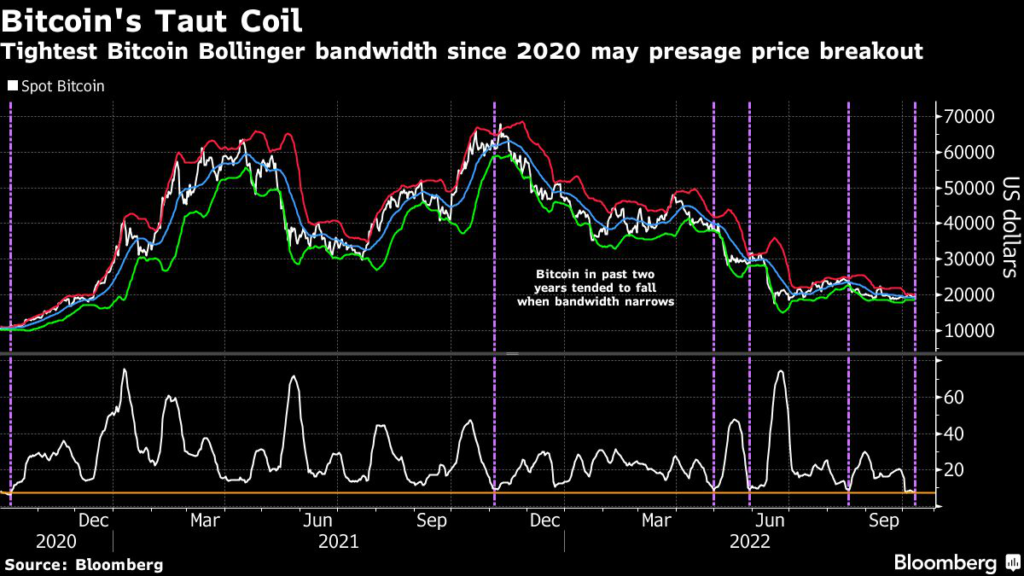
The world’s largest cryptocurrency is notorious for its volatility but has defied that stereotype by oscillating in a relatively constrained range around the $20,000 level in the four months since hitting a low in mid-June.

But now a potentially portentous indicator known as the Bollinger bandwidth has shrunk to the narrowest since 2020. The bandwidth is the gap between the upper and lower bands in a Bollinger study, a popular way of gauging volatility.

The bandwidth has been similarly narrow five other times in the past two years, according to data compiled by Bloomberg. On four of those occasions, Bitcoin subsequently shed almost 16% over 20 days. One time, back in October 2020, it embarked on a surge to a record high of almost $69,000.

Some technical analysts therefore view the tight Bollinger bandwidth as a harbinger of increased Bitcoin swings and potentially a drop in its price.

A global wave of monetary tightening to fight inflation has spurred a near 60% slide in Bitcoin this year. Some $2 trillion has been wiped off cryptocurrencies since a high in November 2021, prompting regulators to step up oversight.

“I still don’t think we will have a bullish run anytime soon,” said Cici Lu, chief executive officer of Venn Link Partners Pte. “All it takes is one piece of negative news to do with regulation and we could break through the bottom end of” Bitcoin’s recent $19,000 to $24,000 trading range, she said.

Global markets are also awaiting US inflation data due Thursday. A hot number could strengthen expectations of more Federal Reserve interest-rate hikes, roiling a range of assets, while a material slowdown may work the other way.

“We expect Bitcoin’s price to be very macro driven in the near term,” said Darius Sit, co-founder of crypto investment fund QCP Capital Pte. “A break out of the recent range on either side would likely be triggered by something like a surprise in the CPI print.”

Bitcoin was little changed at about $19,366 as of 9:50 a.m. on Monday in New York. Other coins like Ether, Solana and Cardano also struggled for direction.

More stories like this are available on bloomberg.com

©2022 Bloomberg L.P.

PayPal Says It Never Intended to Fine Users for ‘Misinformation’

(Bloomberg) — PayPal Holdings Inc. said it has no intention of fining customers for spreading misinformation, after attracting criticism for publishing a new user agreement outlining such a plan.

The issue gained traction over the weekend after the company published policy updates prohibiting users from using the PayPal service for activities identified by the company as “the sending, posting, or publication of any messages, content, or materials” promoting misinformation, in an Acceptable Use Policy due to kick in on Nov. 3. A penalty of $2,500 could be imposed for each violation, according to the update.

The notice included “incorrect information,” a spokesperson for PayPal said in a statement to Bloomberg News. “PayPal is not fining people for misinformation and this language was never intended to be inserted in our policy.”

Shares of the company tumbled as much as 5.3% to $85.43, the biggest intraday decline since July 26. They dropped 4.7% to $85.90 at 9:48 a.m. in New York.

The original notice attracted the ire of former leaders at the company, including David Marcus, the president of PayPal from 2012 to 2014, who called such a move “insanity” on Twitter. Tesla Chief Executive Officer Elon Musk, who co-founded the platform, said he agreed with Marcus in a tweet.

Right-wing politicians in the US have long accused major tech firms of censoring conservative voices, with social media giants such as Twitter Inc. and Meta Platforms Inc. attracting the most ire. Musk, who is offering to buy Twitter for $44 billion, has said he will prioritize free speech on the platform, after criticizing its treatment of personalities including former President Donald J. Trump and rapper Kanye West.

While Republican calls for more regulation of big tech has found support among some progressives, current proposals requiring platforms to safeguard user privacy and security have largely faltered as Congress pursues other priorities.

The PayPal controversy was also seized upon by conservative politicians and social media personalities, who called on users to delete their PayPal accounts. Tim Scott, a Republican senator from South Carolina, said before the firm’s statement that his office will look into the validity of the policy and take any necessary action to stop such “corporate activism.”

More stories like this are available on bloomberg.com

©2022 Bloomberg L.P.
Tech Earnings Matter More Than Ever as the Bubble Deflates

(Bloomberg) — Investors in technology companies are focused more than ever on profits, following an era when low interest rates drove a speculative frenzy in money-losing companies. 

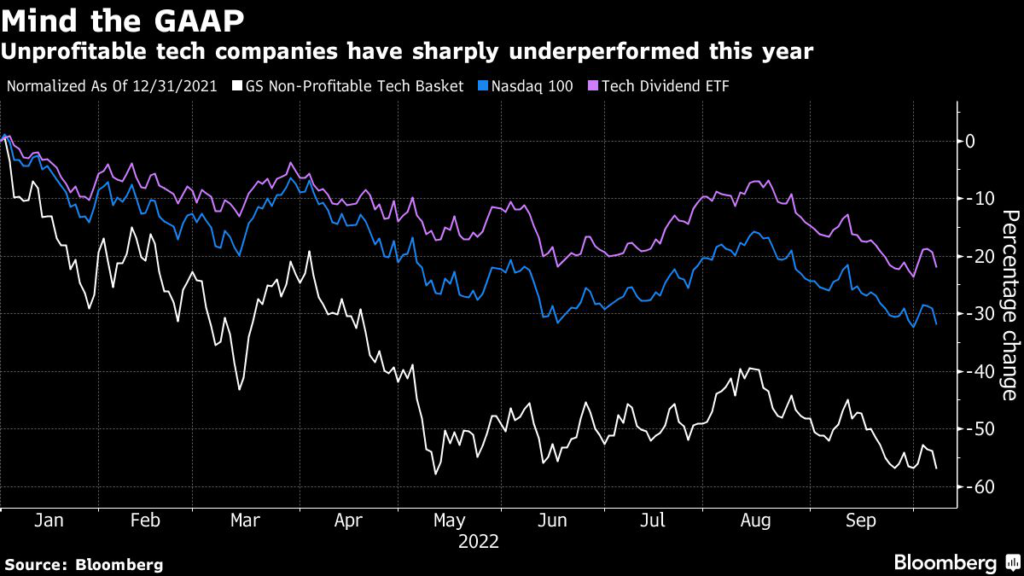
Unprofitable companies have underperformed this year and are likely to continue doing so, investors say. A slowing economy and the threat of recession make their stocks a riskier bet than usual, suggesting that the unwinding from the peak of pandemic-era speculation may not yet be done.

A basket of money-losing tech companies compiled by Goldman Sachs Group Inc. has plunged 57% in 2022, including a drop of 0.3% on Monday. To compare, an exchange-traded fund focused on dividend-paying companies in the industry has fallen 22% on a total-return basis, and the Nasdaq 100 Index has dropped 32%. 

The Nasdaq 100 rose 0.1% on Monday.

The drop has come as the Federal Reserve aggressively raises rates to fight inflation, a headwind to stocks that are priced on their prospects far out in the future. Goldman’s basket sank 6.7% on Friday, after a strong jobs report underlined that the Fed is likely to remain hawkish. The yield on the 10-year U.S. Treasury note has jumped to almost 3.9%, more than double where it started the year.

“Profitability has become much more important,” said Anthony Saglimbene, chief market strategist at Ameriprise Financial. “There may come a time where unprofitable companies outperform again, but I don’t think Fed policy or the market backdrop will favor them anytime soon. I think they’re in for more pain until we see inflation moderate and the Fed slows its pace of hikes.”

He favors companies with stable businesses and high visibility into profit streams, including Apple Inc., Microsoft Corp., Visa Inc., Mastercard Inc., and Nvidia Corp.

The focus on profitability represents a sharp about-face from pandemic-era trends, when ultra-low rates and economic stimulus fueled outperformance in hyper-growth stocks. Goldman’s basket soared more than 400% between a low in March 2020 and a peak hit less than a year later. It has since dropped 73% from the high.

Among the unprofitable companies with the biggest stock declines this year are Unity Software Inc., Okta Inc. and Asana Inc., all down 68% or more.  

While the selloff has compressed price-earnings multiples, many unprofitable tech companies — notably high-growth software stocks — continue to trade at sky-high valuations. According to KeyBanc Capital Markets, software valuations remain above average in terms of enterprise value to free cash flow.

In another risk, many unprofitable companies offer stock-based compensation packages to employees. This has become a headwind amid the market’s decline, as companies either have to issue more shares to keep talent, which dilutes the stakes of other investors, or they have to pay more in cash, a further drag on the bottom line.

“There’s been a complete 180 in the market backdrop compared to 2020, with rates going up and the economy slowing,” said Patrick Burton, a portfolio manager at Winslow Capital Management, which oversees about $26 billion. “Not only has the cost of capital skyrocketed and the math stopped working for stock compensation, but these companies should see slower growth. That makes us think they have more room to drop.”

Burton favors tech giants like Microsoft, Amazon.com Inc., and Alphabet Inc., and said some chipmakers had become attractive given their year-to-date weakness. 

“We wouldn’t branch out into unprofitable tech,” he said. “Eventually, high-growth unprofitable stocks will come back, but we don’t expect that for a long time.”


Tech Chart of the Day

The collapse in Meta Platforms Inc.’s stock shows no sign of stopping. The Facebook parent closed Friday at its lowest since January 2019, extending a slump that has erased 60% — and about $577 billion — off its market value this year. Last week’s drop of 1.6% represented its fourth straight negative week, and it stood in contrast to the gains posted by Apple, Microsoft, Amazon.com, and Alphabet, as well as social-media peers Pinterest Inc., Snap Inc., and Twitter Inc. 

Top Tech Stories

  • The Biden administration’s new restrictions on technology exports to China could undercut the country’s ability to develop wide swaths of its economy, from semiconductors and supercomputers to surveillance systems and advanced weapons.
    • Chinese semiconductor stocks slumped after fresh US curbs on China’s access to American technology added to a disappointing start to the earnings season, stoking concerns that the industry’s downturn is far from over.
    • US restrictions on China’s access to advanced American technologies could slash growth of the country’s largest chipmaker, Semiconductor Manufacturing International Corp.,  by half next year, according to Bloomberg Intelligence estimates.
  • Twitter Inc. has restricted and locked the account of billionaire musician and fashion designer Kanye West, just one day after he returned to the social media platform for the first time in almost two years. Twitter said the account was locked due to a violation of its policies.
  • Chinese food delivery titan Meituan is studying an expansion into Hong Kong and international markets as domestic growth slows, according to people familiar with the matter.
  • Japanese printer maker Seiko Epson Corp. may raise prices in response to the chronic supply chain upheaval that’s disrupted electronics firms around the world.
  • Noom Inc., the maker of a controversial weight loss app, is looking for a new chief executive officer to replace co-founder and CEO Saeju Jeong.
  • Electric vehicle maker Rivian Automotive Inc. will recall about 13,000 vehicles — nearly all of vehicles delivered to customers —  after discovering a minor structural defect.

(Updates to market open.)

More stories like this are available on bloomberg.com

©2022 Bloomberg L.P.

Nissan Seeks Reshaped Alliance Through Renault EV Backing

(Bloomberg) — Nissan Motor Co. is ready to invest $500 million to $750 million in Renault SA’s electric vehicle business, viewing the French carmaker’s reorganization as a chance to reshape their decades-old alliance, a person familiar with the matter said.

In exchange for backing the entity being set up by Renault Chief Executive Officer Luca de Meo, the French carmaker is willing to sign onto a plan to reduce its ownership of Nissan to 15%, from the current 43%, over time, said the person, who asked not to be identified because negotiations are ongoing.

The moves would alleviate an imbalance that’s been a source of friction for years. Renault rescued Nissan in 1999 and sent in Carlos Ghosn, who eventually became CEO of both carmakers and the chairman of their alliance. He later added Mitsubishi Motors Corp. to the partnership, but was arrested in 2018 on charges of under-reporting his compensation. He escaped Japan in December 2019 and is currently in Lebanon.

Nissan, which owns 15% of Renault and lacks voting rights, sees supporting de Meo’s transformation as a way to repay Renault for coming to its aid more than 20 years ago, the person said. Nissan CEO Makoto Uchida and Chief Operating Officer Ashwani Gupta held marathon discussions over the weekend with Renault’s de Meo and Francois Provost, senior vice president of international development and partnerships.

A representative for Nissan declined to comment beyond a joint statement issued with Renault on Monday. Nissan said it’s considering investing in Renault’s EV entity, and the carmakers said they’re working on “structural improvements to ensure sustainable alliance operations and governance.”

A spokeswoman for Renault declined to comment beyond the statement, which the companies issued after reports about the executives meeting in Japan to discuss the EV carve-out, shareholdings and other issues. 

Renault shares gained after Bloomberg’s report, trading up 5.2% to €32.28 as of 3 p.m. in Paris trading.

EV Stake

Nissan is ready to take as much as a 15% stake in the EV and software business that Renault said in May would be based in France and employ about 10,000 people by next year.

Renault also outlined plans to create an entity dedicated to developing and producing combustion and hybrid powertrains, which will be headquartered outside France and also have around 10,000 employees.

Nissan’s Uchida and Gupta and Renault’s de Meo and Provost spent all day Saturday and Sunday speaking on the sidelines of the Formula 1 Japanese Grand Prix in Suzuka and nearby Nagoya. The four flew to Tokyo together and continued discussions on Monday in Yokohama, where Nissan is headquartered.

Share Sell-Off

Renault’s sale of its stake in Nissan won’t happen right away. One option being discussed is placing shares in a trust and giving Nissan the right of first refusal for any stock that is offered for sale, according to the person familiar with the talks.

While Nissan may buy back some of its shares, Renault has no plans to sell right away because it would have to take an impairment by selling at current prices, and will seek an orderly disposal of stock.

Any agreement will include provisions preventing Renault from selling shares to a competitor or to an activist investor, the person added.

Renault’s voting rights will also be capped immediately when the deal goes into effect. The changes will require a new operating agreement between the companies, the person said.

Nissan’s Position

The block of shares to be set aside is currently worth about €4 billion ($3.9 billion). Nissan had ¥1.47 trillion ($10.1 billion) of cash and equivalents at the end of June, giving the company plenty of leeway to invest in Renault’s EV business and repurchase some of its shares. Nissan’s profitability and sales are better than forecasts, and the company will likely raise its outlook when it reports quarterly results in early November, the person said.

Renault is trying to secure an agreement with Nissan before its capital markets day around the same time, on Nov. 8. One sticking point in negotiations is Nissan’s reluctance to allow Renault to transfer combustion-powertrain technology to Aurobay, a joint venture between Volvo Car AB and China’s Zhejiang Geely Holding Group, and other investors.

The French state, which has a 15% shareholding in Renault, also would need to approve the companies’ plans.

Some of the hurdles for the combustion-powertrain deal include securing blessing from the Japanese government, and from Dongfeng Motor Group Co., Nissan’s long-time partner in China. Uchida has been briefing officials at Japan’s Ministry of Economy, Trade and Industry on the implications of Renault’s carve-outs and potential tie-up with Aurobay.

Talks are focused on Renault retaining a minority stake in the legacy business and possibly aiming for an initial public offering, people with knowledge of the matter have said.

(Updates with Renault share move in the seventh paragraph.)

More stories like this are available on bloomberg.com

©2022 Bloomberg L.P.
Binance Shakes Up Landscape for Most-Traded Crypto Tokens

(Bloomberg) — The competitive landscape for some of crypto’s most traded tokens is shifting, following a move by digital-asset exchange Binance to prioritize its own product and the attractiveness of rising interest rates in traditional finance.

Stablecoins — digital tokens which aim to keep a one-to-one value with a less volatile asset like the dollar — are typically used by traders as a haven from the wild price swings in crypto markets. They’re also a popular tool for trading across multiple venues or exchanges, and particularly on decentralized venues, can sometimes earn investors a tidy yield.

A long-established status quo between the market’s top three stablecoins by market value was shaken up by Binance last month, when the world’s largest exchange announced that it will automatically convert all deposits of Circle’s USDC — the second largest of the group — into its own, the third-largest BUSD stablecoin. 

The transition, which appeared to be in the making for several months before officially changing for users on Sept. 29, has upended months of growth for USDC. Its value declined by more than 12% since the start of September to below $50 billion, according to CoinGecko data, while Binance’s BUSD has steadily ticked upward over the same period. Meanwhile growth in Tether’s USDT, the largest of all stablecoins at $68 billion, has plateaued after losing around a fifth of its overall circulation in May, when it briefly de-pegged during the collapse of the Terra ecosystem.

“Tether is still in a very strong position in the market,” said Clara Medalie, head of research at blockchain data firm Kaiko. “Not every exchange lists BUSD and most traders will probably have accounts on multiple exchanges, so they’re going to favor a stablecoin that’s the easiest to work with.”

Getting BUSD

The announcement of Binance’s auto-conversion policy caused concerns of anti-competitiveness, as users may be less likely to convert their BUSD back into USDC when withdrawing from Binance if the stablecoins are considered of equal monetary value. Binance Chief Executive Changpeng Zhao said the change was about increasing liquidity on the platform, which in turn may make BUSD more useful to traders.

  • Read more: Binance’s Stablecoin Move May Be a Land Grab: Bloomberg Crypto

But beyond forced conversions, Binance is readily seeking other ways to make BUSD more appealing to users. It temporarily removed trading fees between BUSD and Ether in August prior to a major upgrade for the Ethereum network, anticipating that investors would be buying up the latter to benefit from staking rewards. Data from Kaiko showed the share of the ETH-BUSD trading pair relative to Ether and USDT jumped 73% immediately after zero-fee trading launched, though it lost most of those gains once fees resumed post-upgrade. 

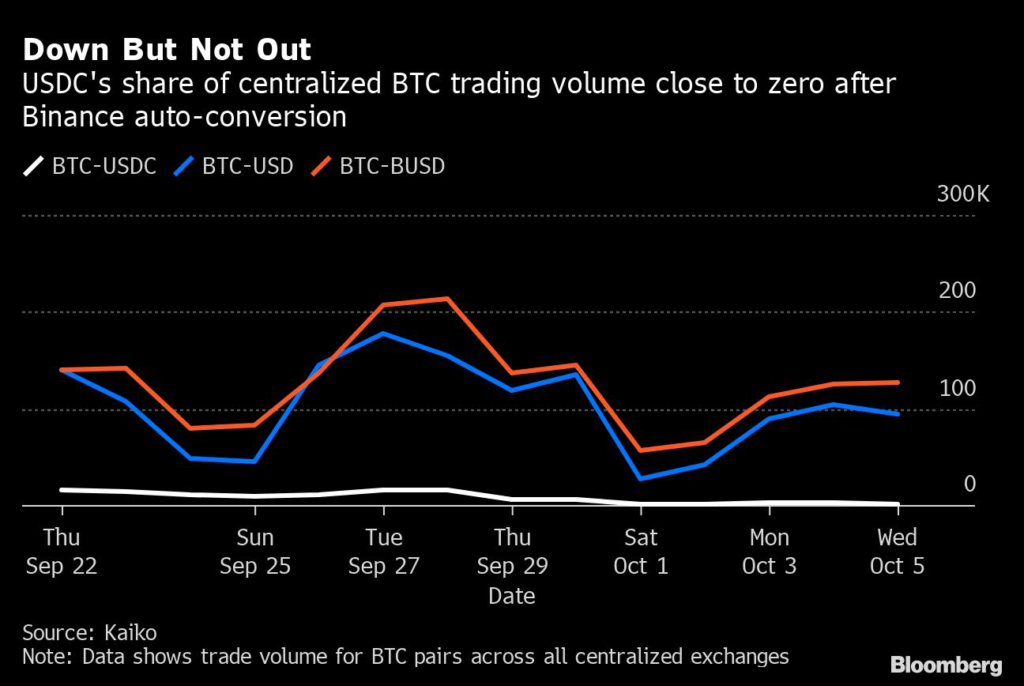
For USDC, trading volumes for its Bitcoin pair on centralized exchanges show another viewpoint of the token’s gradual decline. Medalie said the de-listing of USDC by Binance caused a global drop in volumes, demonstrating how even though it’s just one exchange out of hundreds, “Binance overall was very important to centralized market activity for USDC”.

But if the strategy were to shift USDC’s volumes directly over to BUSD, the plan may not be running as smoothly as hoped. Most of the lost trading volume for USDC has since shifted to Tether-denominated trading pairs, Medalie said, potentially due to far fewer exchanges offering BUSD. 

Historically the most popular token on decentralized exchanges, USDC may also be receiving a rude awakening from turmoil in the broader global markets. Yields on decentralized finance protocols are lower thanks to a general drop in activity, making USDC less appealing when compared to rising interest rates on traditional products like three-month US Treasury bills. 

“To earn interest on deposits in DeFi protocols, it’s not as profitable anymore,” Medalie added. “At the macro level, DeFi is no longer as attractive as it once was when you can earn a lot higher just by holding dollars.”

Beyond Crypto

Not content with being limited to the realm of crypto trading, stablecoin issuers are also keen to show their tokens and blockchain technology can be useful in traditional finance as a means to faster and cheaper payments.

Trading app Robinhood listed USDC on its platform at the end of September, a move which primarily allowed users to store wealth earned from crypto bets without paying a premium on converting it back into fiat currency. The partnership was also a win for Circle’s payments ambitions, with USDC now the base trading pair for Robinhood’s crypto wallet project and to be used as a settlement asset across Robinhood products. 

But as that vision inches closer to reality, central bankers and regulators have warned of the multiple risks that stablecoin payments might present to global financial stability. 

Researchers at the Federal Reserve Bank of New York said the shift of flows from Tether into USDC after Terra’s collapse was especially concerning. In a paper on crypto stability last month, they said the fact that some stablecoins like USDC are viewed as more resilient in times of crisis “can amplify run risks” from those that more fragile, where issuers would still be forced to quickly sell off the real-world reserves that back them to meet customer redemptions.

Rich Teo, co-founder of Paxos which issues BUSD alongside Binance, said that after Terra, a lack of regulation for stablecoins was an additional factor in the recent shifting tides around the top trio. Paxos’s own USDP token is also among those being automatically converted by Binance.

Teo pointed to guidelines from some US regulatory agencies issued this summer, which he said “suggested that a private corporation should not be providing banking services such as yield, and also should not be issuing a stablecoin on an unregulated basis. That could have somewhat affected sentiment.”

More stories like this are available on bloomberg.com

©2022 Bloomberg L.P.

US Stock Futures Flat as Earnings Gloom Beckons : Markets Wrap

(Bloomberg) — US equity futures swung between losses and gains as investors weighed up how central bank policy-tightening would ripple through the global economy and company earnings. The dollar was buoyed by haven demand.

Contracts on both the S&P 500 and Nasdaq 100 swung higher, erasing earlier losses sparked by an escalation in the Russia-Ukraine war and anxiety about the resilience of corporate balance sheets to policy tightening. Ford Motor Co. and General Motors Co. shed more than 3% after UBS downgraded its view on the stocks, citing the risk to sales from a potential economic recession. 

The mood remains fragile ahead of Thursday’s US inflation data and a raft of bank earnings that will kick off the third-quarter season in earnest. A hotter-than-expected inflation reading, coming on top of last week’s strong labor print, will heap pressure on policy makers to extend 75 basis-point rate hikes beyond this year.

“Given continued Fed tightening, both macroeconomic conditions and risk markets are likely to weaken considerably over the next few quarters,” Erik Weisman, a portfolio manager at MFS Investment Management, wrote in a note to clients. “Fed tightening acts on the economy only with a significant lag.”

Signs of a dangerous new escalation in the Russia-Ukraine war also sapped risk appetite, lifting the dollar against other currencies, while British authorities’ latest efforts to support jittery markets largely failed to reassure pound traders.

The relentless central bank policy-tightening is making investors increasingly gloomy about the upcoming earnings season. JPMorgan Chase & Co. and Citigroup Inc. are among the big banks that will unveil earnings later this week.

Even after this year’s brutal selloff, markets have not priced all the risks stemming from higher interest rates and stubbornly high inflation. More than 60% of the 724 respondents to Bloomberg’s latest MLIV Pulse survey predicted the earnings season would push the S&P 500 Index lower. Strategists at Goldman Sachs Group Inc. and Morgan Stanley warned it would be a difficult reporting season, given risks such as slowing demand and soaring costs

“The bear market will not be over until the deteriorating fundamental picture is more fully discounted,” Morgan Stanley strategists told clients.

Europe’s broad Stoxx 600 gauge rose 0.2%, erasing earlier losses. 

Meanwhile, Britain stepped up efforts to support market functioning. The Bank of England extended emergency measures backing the bond market through early next month while Chancellor of the Exchequer Kwasi Kwarteng brought forward the date at which he will deliver his much-awaited fiscal strategy.

Despite the measures, 30-year borrowing costs rising above 4.5%. The pound slipped to trade at a 12-day low.

“The BOE is going to calm the market, but it’s not going to save the market,” said Geoffrey Yu, a senior strategist at Bank of New York Mellon in London. The central bank “is not going to cap yields,” he said.

Key events this week:

  • Earnings this week include: JPMorgan Chase & Co., Citigroup Inc., Morgan Stanley, BlackRock, Delta Air Lines, Fast Retailing, Infosys, PepsiCo, TSMC, Tata Consultancy, UnitedHealth, U.S. Bancorp, Walgreens Boots, Wells Fargo, Wipro
  • Fed’s Lael Brainard and Charles Evans speak, Monday
  • IMF’s World Economic Outlook and Global Financial Stability Report, Tuesday
  • Fed’s Loretta Mester speaks, Tuesday
  • BOE’s Andrew Bailey speaks, Tuesday
  • FOMC minutes for September meeting, Wednesday
  • US PPI, mortgage applications, Wednesday
  • OPEC Monthly Oil Market Report, Wednesday
  • Fed’s Michelle Bowman and Neel Kashkari speak
  • ECB’s Christine Lagarde speaks
  • US CPI, initial jobless claims, Thursday
  • G-20 finance ministers and central bankers meet, Thursday
  • China CPI, PPI, trade, Friday
  • US retail sales, business inventories, University of Michigan consumer sentiment, Friday
  • BOE emergency bond buying is set to end, Friday


More stories like this are available on bloomberg.com

©2022 Bloomberg L.P.

Close Bitnami banner
Bitnami
