

Bloomberg

Nissan Seeks to Reshape Alliance by Backing Renault EV Business

(Bloomberg) — Nissan Motor Co. is ready to invest $500 million to $750 million in Renault SA’s electric vehicle business, viewing the French carmaker’s reorganization as a chance to reshape their two decade-old alliance, a person familiar with the matter said.

In exchange for the cash infusion in the entity being set up by Renault Chief Executive Officer Luca de Meo, the French carmaker is willing to sign on to a plan to reduce its ownership of Nissan to 15%, from the current 43%, over time, said the person, who asked not to be identified because negotiations are ongoing.

The moves would alleviate an imbalance that’s been a source of friction for years. Renault rescued Nissan in 1999 and sent in Carlos Ghosn, who eventually became CEO of both carmakers and the chairman of their alliance. He later added Mitsubishi Motors Corp. to the partnership, but was arrested in 2018 on charges of under-reporting his compensation. He escaped Japan in December 2019 and is currently in Lebanon.

Nissan, which owns 15% of Renault without any voting rights, sees supporting de Meo’s transformation as a way to repay Renault for coming to its aid more than 20 years ago, the person said. Marathon discussions were held over the past weekend between CEO Makoto Uchida and Chief Operating Officer Ashwani Gupta of Nissan, and Renault’s de Meo and Francois Provost, senior vice president of international development and partnerships.

A representative for Nissan declined to comment beyond a joint statement issued with Renault on Monday, in which the two confirmed discussions to strengthen their cooperation and the future of the alliance. Nissan is considering investing in the EV entity, and the carmakers said they’re working on “structural improvements to ensure sustainable alliance operations and governance.”

A spokeswoman for Renault declined to comment beyond the statement, which the companies issued after reports on the executives meeting in Japan to discuss the EV carve-out, shareholdings and other issues.

EV Stake

Nissan is ready to take as much as a 15% stake in the EV and software business that Renault said in May would be based in France and employ about 10,000 people by next year.

Renault also outlined plans to create an entity dedicated to developing and producing combustion and hybrid powertrains, which will be headquartered abroad and also have around 10,000 employees.

Nissan’s Uchida and Gupta and Renault’s de Meo and Provost spent all day Saturday and Sunday speaking on the sidelines of the Formula 1 Japanese Grand Prix in Suzuka and nearby Nagoya. The four flew back to to Tokyo together and continued discussions on Monday in Yokohama, where Nissan is headquartered.

Share Sell-Off

Renault’s sale of its stake in Nissan won’t happen right away. One option being discussed is placing shares in a trust and giving Nissan the right of first refusal for any stock that is offered for sale, according to the person familiar with the talks.

While Nissan may buy back some of its shares, Renault has no plans to sell right away because it would have to take an impairment by selling at current prices, and will seek an orderly disposal of the stock.

Any agreement will include provisions preventing Renault from selling shares to a competitor or to an activist investor, the person added.

Renault’s voting rights will also be capped immediately when the deal goes into effect. The changes will require a new operating agreement between the companies, the person said.

Nissan’s Position

The block of shares to be set aside is currently worth about €4 billion ($3.9 billion). Nissan had ¥1.47 trillion ($10.1 billion) of cash and equivalents at the end of June, more than enough to cover the cost of investing in Renault’s EV business and repurchasing some of its shares. The Japanese carmaker’s profitability and sales are better than forecasts, and the company will likely raise its outlook when it reports quarterly results in early November, the person said.

Renault is seeking to secure an agreement with Nissan before it holds a capital markets day around the same time, on Nov. 8. One sticking point in negotiations is Nissan’s reluctance to allow Renault to transfer combustion powertrain technology to Aurobay, a joint venture between Volvo Car AB and China’s Zhejiang Geely Holding Group, as well as other investors.

The French state, which has a 15% shareholding in Renault, also would need to approve the companies’ plans.

Some of the hurdles for the combustion-powertrain deal include securing the blessing of the Japanese government, as well as from Dongfeng Motor Group Co., Nissan’s long-time partner in China. Uchida has been briefing officials at Japan’s Ministry of Economy, Trade and Industry on the implications of Renault’s carve-outs and potential tie-up with Aurobay.

Talks are focused on Renault retaining a minority stake in the legacy business and possibly aiming for an initial public offering, people with knowledge of the matter have said.

More stories like this are available on bloomberg.com

©2022 Bloomberg L.P.
Stocks Face Brutal Earnings Season With All Eyes on Apple, Investors Say

(Bloomberg) — Investors expect this earnings season to pummel stocks further and will watch Apple Inc. in particular as a bellwether of global economic conditions.

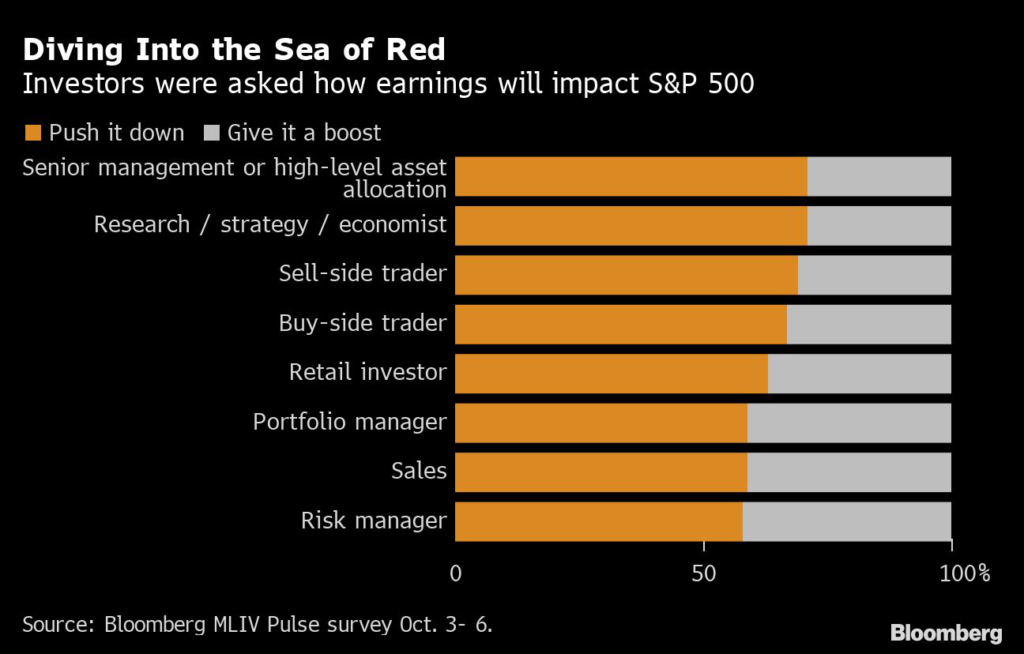
More than 60% of the 724 respondents to the latest MLIV Pulse survey say this earnings season will push the S&P 500 Index lower. That means no end in sight to the dismal run for stocks, after a tumble Friday decisively dashed hopes that the eye-popping two-day rally early last week would be the start of something bigger. About half of poll participants also expect equity valuations to pull back even further from their average of the past decade.

The results underscore Wall Street’s fear that even after this year’s brutal selloff, stocks have yet to price in all the risks stemming from central banks’ aggressive tightening as inflation remains stubbornly high. The outlook isn’t likely to improve any time soon with the Federal Reserve steadfast on hiking rates, likely weighing on growth and profits in the process. Data on Friday showed that the US labor market remains strong, increasing the chances of another jumbo Fed rate hike next month.

“Third-quarter earnings will disappoint with clear downside risks to fourth-quarter analyst estimates,” said Peter Garnry, head of equity strategy at Saxo Bank A/S. “The key risks to third-quarter earnings are the cost-of-living crisis impacting demand for consumer products” and higher wages eating into companies’ profits.

 The US earnings season starts in earnest this week with results from major banks, including JPMorgan Chase & Co. and Citigroup Inc., set to give investors a chance to hear from some of Corporate America’s most influential leaders. US equity index futures ticked down on Monday.

Watch Apple

As for stocks to watch in the next few weeks, 60% of survey takers see Apple as crucial. The iPhone maker, which has the heaviest weighting on the S&P 500, will provide insight into an array of key themes, such as consumer demand, supply chains, the effect of the soaring greenback and higher rates. The company reports on Oct. 27. JPMorgan garnered the second-biggest mention, at 25%, but Microsoft Corp. and Walmart Inc. also drew a noteworthy number of votes.

The reporting stretch kicks off with the S&P 500 down 24% this year, on pace for its worst performance since the Great Financial Crisis. Against that grim backdrop, almost 40% of survey participants are inclined to invest more in value stocks, compared with 23% for growth, the earnings outlook for which is vulnerable when interest rates rise. Still, 37% chose neither of those categories, perhaps reflecting Citigroup quantitative strategists’ view that equity markets have “turned decidedly defensive” and are only just starting to reflect the risks of a recession.

US stocks have had an awful year, but so have other financial assets, from Treasuries to corporate bonds to crypto. The balanced 60/40 portfolio mixing stocks and bonds in an attempt to protect against strong moves in the markets either way has lost more than 20% so far this year.

Inflation Fears

Survey respondents expect that references to inflation and recession will dominate earnings calls this season. Only 11% of participants said they expect chief executive officers to utter the word “confidence,” underscoring the gloomy backdrop.

“I’m expecting more cautious and negative guidance on the basis of broad economic weakness and uncertainty and tighter monetary policy,” said James Athey, investment director at abrdn.

About half of poll respondents see equities valuations deteriorating further in the next few months. Of those, some 70% expect the S&P 500’s price-to-earnings ratio to fall to the 2020 low of 14, while a quarter see it tumbling to the 2008 low of 10. The index currently trades at about 16 times forward earnings, below the average for the last decade. 

Rough Outlook

Wall Street has a similarly dim view.  Morgan Stanley strategists warned about cash flow ‘havoc’, while Citigroup strategists expect a 5% contraction in global earnings for 2023, consistent with below-trend global economic growth and elevated inflation. The bank’s earnings-revisions index shows downgrades outweighing upgrades for the US, Europe and the world, with the US seeing the deepest downgrades. Strategists at Bank of America Corp. expect 20% downside for European earnings per share by mid-2023, while Goldman Sachs Group Inc. counterparts say Asia ex-Japan equities can see more earnings downgrades amid weak macro and industrial data.

With all the pessimism, there’s scope for positive surprises ahead. A beat to lowered earnings expectations is likely in third-quarter reporting, according to Bloomberg Intelligence strategists. Meanwhile, at Barclays Plc, strategists led by Emmanuel Cau said that the results aren’t likely to be a “disaster” due in part to still-high nominal growth, but they doubt the outlook will be constructive.

“Earnings estimates for 2023 have started to move lower but have further to fall. Estimate revisions are a necessary part of creating a durable bottom in equity markets,” said Madison Faller, global strategist at JPMorgan Private Bank. “As estimates drop, investors will be anxious to get more engaged in anticipation of a potential pause in the Fed’s hiking cycle.”

Join us on Oct. 11 at 10 a.m. New York time for a discussion on the survey results with Amy Kong, chief investment officer at Barrett Asset Management, and Kim Forrest, founder and chief investment officer of Bokeh Capital Partners.

To subscribe to MLIV Pulse stories, click here. For more markets analysis, see the MLIV blog.

(Updates with market move in fifth paragraph.)

More stories like this are available on bloomberg.com

©2022 Bloomberg L.P.

Amazon, Walmart Kick Off Holiday Sales With ‘Massive’ Deals Expected

(Bloomberg) — Holiday deals are coming back, bringing a measure of relief for US shoppers squeezed by inflation.

Tech gadgets to sporting goods will see “massive” online discounts, with the best bargains likely in late November, Adobe Analytics said in a report Monday. Walmart Inc. is already touting deals on computers, toys and air fryers this week, while Amazon.com Inc. will begin a two-day “early access” sale Tuesday. Target Corp.’s weekly Black Friday deals have started.

Retailers are racing to tap seasonal demand as they struggle to reduce bloated inventories, and they have little choice but to dangle price cuts in stores and online to entice consumers who have been hammered by this year’s surge in inflation. That’s a big shift from 2021, when relatively flush shoppers snapped up goods amid fears that transportation snarls would lead to shortages.

“Last year, there wasn’t a lot of product and retailers didn’t need to discount,” said Brian Yarbrough, an analyst at Edward Jones. “Fast forward to this year and we’re in the exact opposite situation.”

Online holiday sales from Nov. 1 through Dec. 31 are projected to be $209.7 billion, Adobe said, up only 2.5% from a year ago. That pales in comparison to last year’s 8.6% gain. And when accounting for the expectation that annual US inflation rate will be around 8%, many retailers may actually make fewer sales this year, though at higher prices.

Part of the reason for the sluggish outlook for November and December is that retailers are trying to coax customers into starting their shopping early.

Amazon’s “Prime Early Access Sale” is expected to pull some spending forward, much as the company’s Prime Day in July fueled a rising tide for all retailers, said Taylor Schreiner, senior director of Adobe Digital Insights.

Another drag on holiday spending is that shoppers have less money for discretionary purchases as inflation forces them to spend more on essentials such as fuel and groceries. Americans are also taking more trips this year as the coronavirus pandemic eases.

“If they’re traveling, that reduces their spending on holiday gifts,” said Marshal Cohen, chief industry adviser at NPD Group. “And even just the cost of the Thanksgiving and Christmas meals is going to go up 25% or more for a lot of people.”

Adobe’s soft outlook for holiday sales is consistent with what other industry watchers have predicted. Deloitte is also predicting a slower season as inflation takes its toll.

Retailers hope price cuts will rekindle shoppers’ interest in items that have lingered on shelves, including electronics and housewares. Best Buy Co. is starting a two-day sale Tuesday with discounts on televisions, headphones and Apple Inc. laptops.  

Read more: Retailers Still Have a Lot of Extra Stuff That Shoppers Don’t Want

More promotional activity will further pressure results at big retailers, many of which have already cut their profit forecasts. Some companies might get a little relief on costs as transportation bottlenecks ease, reducing the strain on margins. But it will be hard for them to avoid joining the rush to lure shoppers with discounts.

“It’s just a given, everyone’s going to promote,” said Gabriella Santaniello, founder of retail consultant A Line Partners. “It’s going to come from everywhere.”

More stories like this are available on bloomberg.com

©2022 Bloomberg L.P.
US Semiconductor Stocks Join Global Rout as Biden Expands Curbs

(Bloomberg) — Shares of semiconductor companies fell Monday, with the industry selling off globally after fresh US curbs on China’s access to American technology added to a disappointing start to the earnings season, stoking concern that the industry’s downturn is far from over.

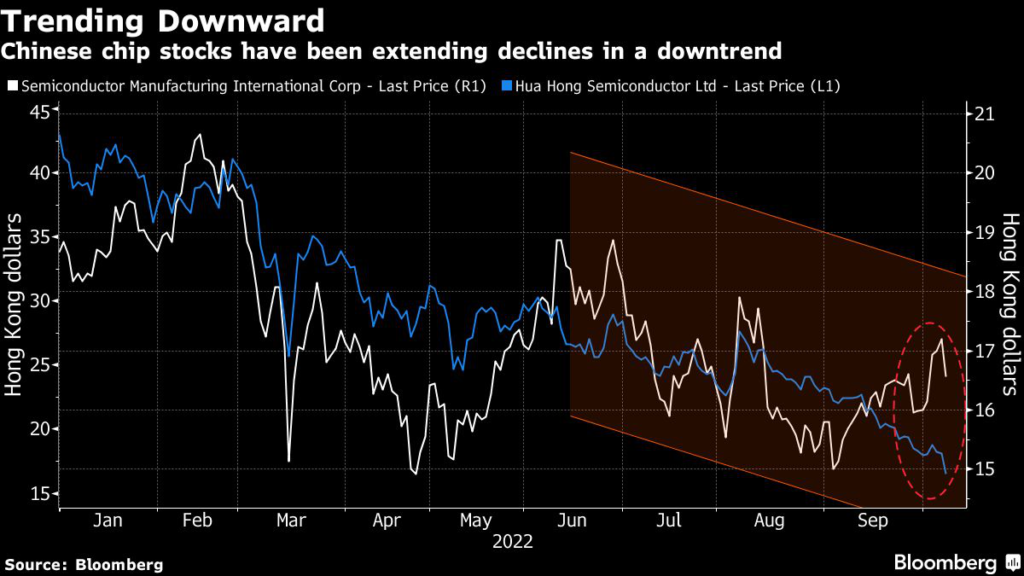
In the US, Nvidia Corp. declined 0.9% in premarket trading while Advance Micro Devices Inc. dropped 1%. Chip-equipment maker ASML Holding NV tumbled as much as 3.2% in Amsterdam and Chinese bellwether Semiconductor Manufacturing International Corp. fell 4% in Hong Kong, the most in five weeks. Declines were steeper in smaller stocks. 

The US measures include restrictions on the export of some types of chips used in artificial intelligence and supercomputing, and also tighter rules on the sale of semiconductor equipment to any Chinese company. Separately, the US also added more Chinese firms to a list of companies that it regards as “unverified,” which means US suppliers will face new hurdles in selling technologies to those entities. 

“The changes represent a further escalation, and we do not know what China might do in response,” wrote Stacy Rasgon, an analyst at Bernstein. “Potential retaliation remains a risk.”

The new strategy suggests that Washington aims to “freeze in” China at its current level, enabling the US to increase its lead, said Gabriel Wildau, an analyst at advisory firm Teneo Holdings LLC.

Chinese Foreign Ministry spokesperson Mao Ning said Saturday that the measures, which are set to enter into force this month, are unfair and will “also hurt the interests of US companies.” They “deal a blow to global industrial and supply chains and world economic recovery,” she said.

What Bloomberg Intelligence Says

“SMIC’s revenue could grow at a 50% slower pace vs. our expectations in 2023 on the US’s stricter equipment export license requirements, as 48% of its new capacity to be installed by next year is in 28- or smaller nanometer node advanced chip manufacturing.”

— Charles Shum, analyst

Click here for the full research

The new US rules come at a time when the chip industry is already grappling with an ominous start to the earnings season and has gone from a worldwide shortage of chips to a glut in a matter of months due to the boom-and-bust nature of semiconductor demand. 

Samsung Electronics Co., the world’s largest memory-chip maker, and PC-processor maker AMD reported results last week that suggested a deeper-than-feared slowdown ahead. 

Among smaller chip-related companies, equipment maker ACM Research Inc. plunged 26% in US premarket trading, while its Shanghai-listed subsidiary, ACM Research Shanghai Inc., sank 20%. In Hong Kong, Hua Hong Semiconductor Ltd. fell 9.4% and Shanghai Fudan Microelectronics Group Co. plummeted 20%, the most since July 2020. China’s Will Semiconductor Co. and Maxscend Microelectronics Co. dropped more than 6% each.

The curbs are a “big setback to China” and “bad news” for global semiconductors, Nomura Holdings Inc. analyst David Wong wrote in a note. China’s localization efforts may also be “at risk as it may not be able to use advanced foundries in Taiwan and Korea,” he wrote.

The US Commerce Department has added Beijing Naura Magnetoelectric Technology Co., a subsidiary of Naura Technology Group Co., to its Unverified List, Naura Technology said in a filing. Naura Technology plunged by the daily limit of 10% in China.

To be sure, the intensifying Sino-American tensions could spur Beijing to step up support for homegrown firms in a bid to achieve its goal of becoming an independent chip powerhouse.

The fall in Chinese chip stocks may cast a pall over the sector globally. Markets in Japan, South Korea, Taiwan and Malaysia will get a chance to react on Tuesday as they are closed on Monday. 

“This will not only be negative to the Chinese semiconductor industry but also indirectly impact global semiconductor makers’ business opportunities longer term,” Citigroup analysts including Laura Chen wrote in a note.

The VanEck Semiconductor ETF fell 0.6% in the US, suggesting the industry would open in negative territory. Chipmakers have been struggling throughout 2022, with the Philadelphia Semiconductor Index down 40% thus far this year, including a 6.1% decline on Friday.

Broader Chinese equity market also saw declines on Monday after returning from the Golden Week holiday, hurt by a global equities selloff and bleak holiday-spending data that deepened concerns about an economic recovery.

Read: China Stocks Slide as Traders Return From Golden Week Holiday

(Updates trading, adds Bernstein comments.)

More stories like this are available on bloomberg.com

©2022 Bloomberg L.P.
TCS Profit Tops Estimates After Outsourcing Giant Wins New Deals

(Bloomberg) — Tata Consultancy Services Ltd.’s second-quarter profit topped analysts’ estimates after the Indian software services exporter won more deals, helping it weather a slowdown in tech spending by corporations.

Net income rose 8% to 104.3 billion rupees ($1.3 billion) in the three months through September, the company said Monday in a statement. Analysts estimated 102.9 billion rupees on average. Sales advanced 18% to 553.1 billion rupees.

TCS, which kicked-off the earnings season for Indian companies, and its IT rivals such as Infosys Ltd. have so far remained positive on winning business transformation deals from clients in North America and Europe. But concerns of a global recession are intensifying, leading some customers to cut back on discretionary tech spending.

Indian IT service providers are also grappling with rising employee costs amid stiff competition for tech talent. Attrition at Asia’s biggest outsourcer rose from the previous quarter’s high of 19.7%.

What Bloomberg Intelligence Says

We anticipate pricing to remain relatively stable, lead by its largest financial services segment. Retail could slow on high sensitivity to elevated inflation. We also expect management to tread cautiously on its outlook for 2023 IT budgets.

– Anurag Rana, analyst

Click here for research. 

TCS, the largest player in India’s $227 billion tech services industry which employs more than half a million workers around the world, doesn’t typically provide a sales outlook. Over the long-term, the company and its peers are betting on services such as cloud computing, artificial intelligence, machine learning and analytics to shore up revenue.

Earlier this year, TCS revamped its organization with specialized groups targeted to gain business from startups as well as large global enterprises as it eyes to hit $50 billion in annual sales before 2030.

More stories like this are available on bloomberg.com

©2022 Bloomberg L.P.
Morgan Stanley Names Badalia as M&A Head for Southeast Asia

(Bloomberg) — Morgan Stanley has named Rikhit Badalia as head of mergers and acquisitions for Southeast Asia, according to a memo seen by Bloomberg News.

Badalia, who has been with the US bank for more than a decade, is taking over the post left vacant by Jonathan Pflug, who was also head of Singapore coverage at Morgan Stanley. A representative for Morgan Stanley confirmed Badalia’s appointment.

Badalia joined Morgan Stanley in 2010 as an analyst in India before relocating to Singapore almost a year later, according to his Linkedin profile. He worked his way up the ranks and file with a focus on the technology, media and telecom sector before assuming his current position as executive director and Asia Pacific M&A operations officer based in Hong Kong.

Pflug has joined Raine Group as the boutique adviser launches its Singapore office, Bloomberg News reported last month. He became the bank’s head of Southeast Asia mergers and acquisition in 2018.

More stories like this are available on bloomberg.com

©2022 Bloomberg L.P.

Germany Won’t Rule Out Foreign Country Role in Rail Sabotage

(Bloomberg) — German Transport Minister Volker Wissing said he can’t rule out involvement of foreign countries in what he called an act of sabotage that halted train services across northern Germany on Oct. 8, highlighting the government’s sense of alert to protect crucial infrastructure. 

“We have increased vigilance since the beginning of the war in Ukraine, because we know that infrastructures have become an increased target,” Wissing told German public broadcaster ARD on Monday. He didn’t name any countries or particular groups that might be to blame for the act. 

Rail traffic in northern Germany was halted for several hours this past weekend after two separate radio cables were severed, disrupting communications for the national network. The complexity of the sabotage — the two cables are located several hundred miles from one another, with one operating as a backup for the other — raises the question of detailed inside knowledge about how rail company Deutsche Bahn AG operates. 

The country’s police force called the attack on the network professional and targeted. Germany’s federal police has taken over the investigation. 

“It is clear that there is a connection between the crime in Berlin and in Herne, and there is little to suggest that it was a coincidence,” Wissing said, referring to the two locations of the cables. 

The disruption came less than two weeks after several massive leaks damaged the Nord Stream gas pipeline linking Russia and Germany via the Baltic Sea, which authorities have also called an act of deliberate sabotage. Germany has implied that Russia is to blame for what appears to have been detonations at the submerged link, a view the Kremlin denies. President Vladimir Putin in turn has blamed “Anglo-Saxons” for the damage. 

No group has claimed responsibility for the attack on the German rail network and no suspects have been identified. Train travel has been disrupted in the past by acts of metal and cable theft, and there have been cases of militant activist groups cutting cables to disrupt train services, though these perpetrators have typically claimed responsibility.

The Transport Minister said it was able to swiftly restore operations because it followed existing security protocol. The government is aware that infrastructures has become a target and has displayed “increased vigilance since the beginning of the war in Ukraine,” according to Wissing.

European Commission President Ursula von der Leyen said on Monday that European infrastructure has increasingly become a target, calling critical installations “the new frontier of modern warfare and Europe will be prepared.” 

The bloc is working to strengthen the resilience of key EU entities, coordinating stress tests of European infrastructure to detect weak points and boosting the ability to respond to outages and attacks with civil protection teams, she said. The EU also plans to make better use of its satellite surveillance capacity to detect possible threats and to strengthen cooperation with NATO and the US, von der Leyen said.

“If we have reason to raise our high safety standards, we will do so without fail,” Wissing said.

(Updated with von der Leyen comment in ninth paragraph.)

More stories like this are available on bloomberg.com

©2022 Bloomberg L.P.
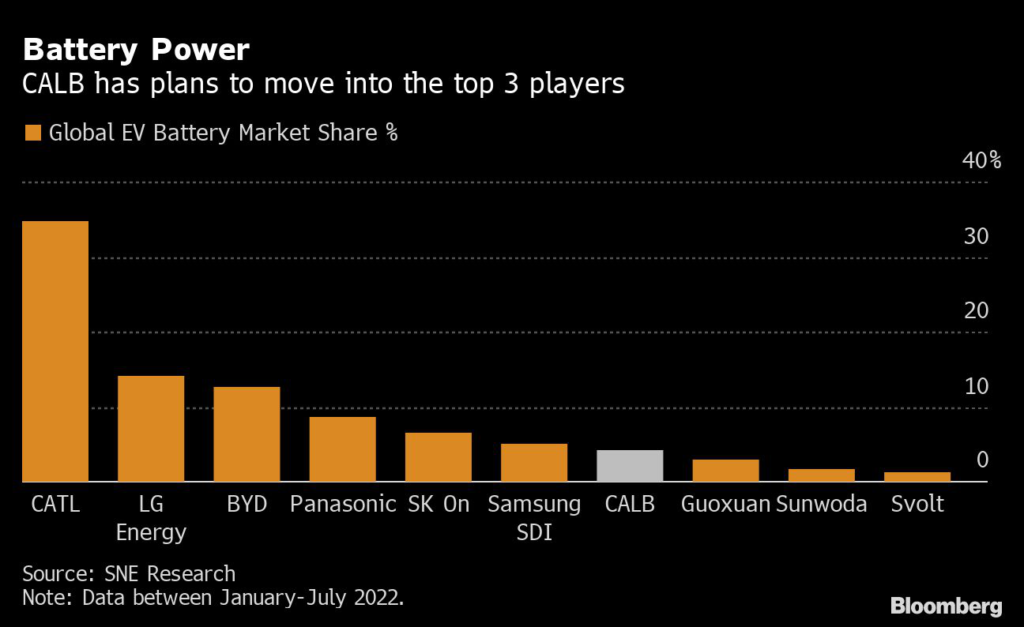
CALB’s Debut Was Lukewarm, But China Has Buckets of EV Funding

(Bloomberg) —

Life as a newly minted public company didn’t get off to the roaring start that CALB, China’s third-largest electric vehicle battery maker, might have hoped for, particularly after rivals LG Energy Solution and CATL soared 68% and 44%, respectively, on their day one debuts.

CALB listed in Hong Kong late last week to a muted response from investors. After selling shares at HK$38 apiece, the stock closed Monday at HK$34.60. It still wasn’t as poor a performance as Zhejiang Leapmotor Technologies, whose electric cars CALB helps powers.

Changzhou, Jiangsu-headquartered CALB and Leapmotor are the latest in a pipeline of EV-related companies to tap equity markets and be met with lukewarm reception — a contrast to last year, when demand for renewable energy, cleaner cars and all kinds of greener technologies was creating immense wealth.

CALB’s Chief Executive Officer Jingyu Liu was matter-of-fact when talking to Bloomberg Television prior to the company’s debut, saying the some $1.3 billion raised from the IPO will be used for expansion and R&D and adding that going public was a “natural next step” in the high-growth sector.

CALB aims to become a top-three player worldwide within three to five years, she said, encroaching on territory currently held by CATL, LG and China’s BYD, among others. The battery maker has 200 gigawatt hours of annual capacity under construction, Liu said, enough to secure a “big” increase in domestic market share.

And grabbing more share locally is important, considering China’s stunning EV growth. There are currently around 11.5 million electric cars in China, representing about 3.7% of the total. Newly registered EVs in the first three quarters of 2022 came to 3.7 million, almost double the year-earlier period and making up almost one-quarter of all new vehicle registrations, China Passenger Car Association data show.

Whether CALB can execute on its plans without needing further capital remains to be seen, but one thing does look certain — even if investors outside of China won’t stump up, those within the country probably will.

More than 1.3 trillion yuan ($182.7 billion) of funds have poured into China’s EV supply chain in the first nine months of this year, with some 900 billion yuan of that into batteries, according to high-tech industry portal OFWeek. And over 28 Chinese EV brands have raised new funds this year, including Hozon and WM Motor.

From Shanghai offering fiscal subsidies to help develop electric-vehicle charging facilities in the city to the country’s biggest oil and gas producer setting up an EV-battery leasing firm, China is clear on its green passenger transport ambitions. If foreign dollars don’t flow, there’s a high likelihood money sloshing around within the country will.

More stories like this are available on bloomberg.com

©2022 Bloomberg L.P.

Grim Reality Greets China Traders as Stocks Slide After Holiday

(Bloomberg) — Chinese stocks slumped to the lowest since April 2020 on their return from the Golden Week holiday, hurt by Sino-American tensions and bleak holiday-spending data that deepened concerns about an economic recovery amid rising Covid cases. 

The benchmark CSI 300 Index fell 2.2%, led by losses in tech and consumer staples. That’s the biggest post-Golden Week tumble for the benchmark since 2018, when the China-US trade war was at its height.

Grim reality faced mainland traders on their return, with trends last week showing a sharp slide in holiday spending, a rebound in virus cases and no respite from the property crisis. Fresh tech export curbs by the US, which are the Biden administration’s most aggressive yet, added to the gloom by striking at the foundation of China’s efforts to build its own chip industry. 

The global market mood offered no support, with fading hopes of a central bank pivot, dire warnings about the world economy and a further escalation in Ukraine.

With little conviction of a market bottom, investors are reluctant to build positions ahead of the Communist Party congress on Oct. 16, where leadership will be confirmed and key policies unveiled. 

“A slew of weak macro-economic data that China has released shows that there is very limited room for an economic rebound in the short term, which is hard to provide support for earnings and market confidence,” said Shen Meng, a director at investment bank Chanson & Co in Beijing. Rising bets for a 75-basis point Fed hike in November are also hurting sentiment in today’s onshore market, he said.

READ: Wall Street Desire for Xi to Pivot to Growth Faces Reality Check

Shares of chip and electronics makers tumbled following Washington’s announcement of new restrictions on China’s access to US semiconductor technology. The moves are the Biden administration’s most aggressive yet as it tries to stop China from developing technological capabilities it sees as a threat. 

The Hang Seng China Enterprises Index of Chinese stocks in Hong Kong slid more than 3%, while a gauge of tech shares listed in the city plunged 4%. The onshore yuan reversed earlier gains to weaken against the dollar. 

It didn’t help that China job market prospects dropped to a record low, which underlines dwindling confidence as growth is dragged down by repeated Covid flare-ups.

“China is still very much under Covid’s shadow and headwinds from the US,” said Steven Leung, executive director at Uob Kay Hian (Hong Kong) Ltd. “All eyes are on the 20th party congress. Politically, investors are focusing on who will be the new premier and what that means for economic policies.”

READ: China Chip Stocks Drop as Biden Tightens Rules on US Tech Access

Party Congress

The CSI 300 has now fallen more than 24% in 2022, heading for its first back-to-back annual declines in a decade. Stocks have continued to be sold off as traders see any shift away from Covid Zero or massive stimulus as unlikely at the upcoming leadership gathering.

“We’re very unlikely to see any kind of big bang easing, but a gradual easing of approach over a matter of months, which leads to a pickup in growth from really very low levels now,” Jonathan Garner, chief Asia and emerging markets strategist at Morgan Stanley, said in a Bloomberg TV interview.

Meanwhile, bleak tourism and entertainment spending data for the week-long holiday was another proof that consumer demand in China continues to weaken in the face of Beijing’s Covid curbs. 

Tourism revenue declined 26% to 287 billion yuan ($40.3 billion) over the week-long holiday from a year ago. Compared with pre-pandemic levels in 2019, revenue was down nearly 56%. Roughly 422 million trips were taken, down 18% from last year and 39% from 2019 levels.

Hopes of a strong post-holiday gain for Chinese stocks were also dented after Friday’s solid US jobs figures sent shares tumbling again on bets for aggressive Federal Reserve rate hikes. The NASDAQ Golden Dragon China Index slumped more than 4% on Friday, wiping out all its gains for the week that onshore traders were away.

READ: Amundi Slashes China Stocks Citing Covid and Housing Problems

Valuations are in China are extremely cheap,” Garner said, adding that in terms of the actual performance of the market going forward, a lot will hinge on “how we come out of the party congress.”

On the currency market, the onshore yuan traded 0.3% weaker at 7.1416 per dollar as of 4:10 p.m. local time, erasing earlier gains. The offshore yuan also gave up its strength to weaken 0.2%. 

(Updates with global market sentiment in fourth paragraph)

More stories like this are available on bloomberg.com

©2022 Bloomberg L.P.

Stocks Drop, Bracing for Earnings Disappointment: Markets Wrap

(Bloomberg) — European stocks fell for the fourth straight day Monday and US equity index futures ticked down as concerns mounted that central bank policy-tightening was set to take a heavy toll on the global economy and company earnings.

Europe’s Stoxx 600 index and S&P 500 futures both sliped 0.4%. The semiconductor sector saw an across-the-board hit from Washington’s decision to further restrict China’s access to US technology and signs that chip demand is slowing. Europe-listed Infineon, STMicro and OSRAM dropped, while in premarket New York trade, chipmakers Nvidia and Advanced Micro Devices shed more than 1% each.

An eventful week lies ahead, with inflation data due Thursday and the third-quarter earnings season kicking off in earnest. 

Hotter-than-expected consumer price growth would heap pressure on policy makers to extend 75 basis-point rate hikes beyond this year. Minutes of the latest Fed policy meeting on Wednesday may provide insight into where the pain threshold lies for Fed officials, who are so far resolutely hawkish in their message that neither financial-market volatility nor the threat of an economic downturn will deter them from raising rates. 

Investors are also bracing for disappointment from the earnings season, with more than 60% of the 724 respondents to Bloomberg’s latest MLIV Pulse survey predicting the season would push the S&P 500 Index lower. 

The poll underscores Wall Street’s fear that even after this year’s brutal selloff, stocks have not priced all the risks stemming from central banks’ aggressive tightening and stubbornly high inflation. While JPMorgan Chase & Co., Citigroup Inc. and other big banks report this week, iPhone maker Apple is in particular focus as its report is expected to offer insight into themes ranging from global consumer demand to the impact of dollar strength. 

Stocks Face Brutal Earnings With Apple in Focus: MLIV Pulse

“The narrative will start changing from central banks and inflation, to one of weaker growth and downward earnings revisions that is going to weigh on risk sentiment over coming weeks,” Jefferies strategist Mohit Kumar wrote in a note. 

Similarly, Morgan Stanley strategists warned that the bear market in US stocks won’t be over until earnings forecasts are cut further or share valuations better reflect the risks.

Earlier, a gauge of Asian equities dropped by more than 1%.

In Britain, the Bank of England stepped up its measures to support market functioning as its emergency gilt buying measures entered their final week.

The UK central bank said it will increase the size of its buying operations for the next five days to a maximum of £10 billion ($10.8 billion), from £5 billion previously. However, UK long-dated bonds shrugged off the news, with 10-year yields rising 6 basis points. 

Focus is also training on Italy where the yield premium demanded by investors to hold Italian debt compared to Germany has surged to the highest since 2020, after ratings agency Moody’s warned of the need to keep national debt on a sustainable path. 

The dollar firmed against its Group-of-10 counterparts. Goldman Sachs Group Inc. strategists warned the strength of the US currency — up 15% already this year — posed a risk to the earnings of American companies which generate 30% of revenues overseas.

Fears for the slowing world economy stalled an oil price rally triggered by OPEC+’s decision to cut supply. US crude futures slipped 0.7% after last week’s 17% gain.


Key events this week:

  • Earnings this week include: JPMorgan Chase & Co., Citigroup Inc., Morgan Stanley, BlackRock, Delta Air Lines, Fast Retailing, Infosys, PepsiCo, TSMC, Tata Consultancy, UnitedHealth, U.S. Bancorp, Walgreens Boots, Wells Fargo, Wipro
  • Fed’s Lael Brainard and Charles Evans speak, Monday
  • IMF’s World Economic Outlook and Global Financial Stability Report, Tuesday
  • Fed’s Loretta Mester speaks, Tuesday
  • BOE’s Andrew Bailey speaks, Tuesday
  • FOMC minutes for September meeting, Wednesday
  • US PPI, mortgage applications, Wednesday
  • OPEC Monthly Oil Market Report, Wednesday
  • Fed’s Michelle Bowman and Neel Kashkari speak
  • ECB’s Christine Lagarde speaks
  • US CPI, initial jobless claims, Thursday
  • G-20 finance ministers and central bankers meet, Thursday
  • China CPI, PPI, trade, Friday
  • US retail sales, business inventories, University of Michigan consumer sentiment, Friday
  • BOE emergency bond buying is set to end, Friday

Some of the main moves in markets:

Stocks

  • Futures on the S&P 500 fell 0.4% as of 5:21 a.m. New York time
  • Futures on the Nasdaq 100 fell 0.5%
  • Futures on the Dow Jones Industrial Average fell 0.2%
  • The Stoxx Europe 600 fell 0.4%
  • The MSCI World index fell 0.4%

Currencies

  • The Bloomberg Dollar Spot Index rose 0.2%
  • The euro fell 0.4% to $0.9703
  • The British pound fell 0.1% to $1.1074
  • The Japanese yen fell 0.1% to 145.46 per dollar

Cryptocurrencies

  • Bitcoin fell 1.1% to $19,280.3
  • Ether fell 1% to $1,307.47

Bonds

  • Germany’s 10-year yield declined three basis points to 2.16%
  • Britain’s 10-year yield advanced seven basis points to 4.31%

Commodities

  • West Texas Intermediate crude fell 0.7% to $92.03 a barrel
  • Gold futures fell 1.1% to $1,690.70 an ounce

More stories like this are available on bloomberg.com

©2022 Bloomberg L.P.

Close Bitnami banner
Bitnami
