Bloomberg

Sequoia-Backed LingoAce Seeking $200 Million in New Funds, Sources Say

(Bloomberg) — LingoAce is seeking to raise about $200 million in a funding round that could value the Singapore-based language learning startup at around $1 billion, according to people familiar with the matter.

The educational technology firm is working with an adviser on the fundraising and is in talks with prospective investors, the people said, asking not to be identified as the information is private. 

Deliberations are ongoing and details of the funding round such as size and valuation could change, the people said. A representative for LingoAce didn’t immediately respond to requests for comment.

Founded in 2017, the company formally known as PPlingo Pte is a Mandarin and English language-learning platform aimed at children from three to 15 years old, according to its website. It has more than 4,500 teachers and offices in Singapore as well as in Thailand, Indonesia, China and the US.

LingoAce raised $160 million in series B and C rounds led by Sequoia Capital India, Tiger Global, Owl Ventures and SWC Global. In May, the company named Asian-American basketball player and NBA championship winner Jeremy Lin as its global brand ambassador, according to a statement.

More stories like this are available on bloomberg.com

©2022 Bloomberg L.P.

How Biden’s Chip Actions May Be Broadest China Salvo Yet

(Bloomberg) — Washington unveiled sweeping curbs on the way chip companies do business with China’s tech industry, a series of restrictions that together represent some of the strongest actions taken so far to contain the rise of a geopolitical rival.

The actions, which incensed Beijing and provoked accusations of unfair targeting, threaten to disrupt a global economy already dealing with a potential recession, soaring inflation and lingering supply snarls. Some analysts warn it could strike a further blow to companies from Nvidia Corp. and Taiwan Semiconductor Manufacturing Co. to Applied Materials Inc., as well as a raft of Chinese up-and-comers, that underpin the $550 billion chip industry.

Read more: ‘No Possibility of Reconciliation’ as US Chip Rules Slam China

Depending on how broadly Washington enforces the restrictions, the impact could extend well beyond semiconductors and into industries that rely on high-end computing, from electric vehicles and aerospace to gadgets like smartphones. The Biden administration’s latest curbs encompass three broad categories, though questions remain about their scope and final impact, as well as Washington’s ability to enforce them. These include:

1. Ban on the shipment of chips for AI and high-performance computing, plus gear that can used to manufacture such semiconductors.

  • The new restrictions, first announced by Nvidia in exchange filings in September, are intended to sever the flow of US know-how to China’s military and surveillance systems
  • They will hurt Nvidia and Advanced Micro Devices Inc.’s business in China, in particular
  • It’s unclear whether the bans may curtail the flow of older chips, which can be upgraded or modified for use in modern AI computing
  • China’s AI chipmakers, including Biren, may face some restrictions on outsourcing production to TSMC
  • It’s unclear if restrictions extend to older-generation equipment from non-American firms such as ASML Holding NV and Tokyo Electron Ltd. More mature-generation gear can in theory be used to produce current-generation components.

2. Chipmaking gear restrictions that cover production of both logic and memory chips. The ban now encompasses tools for:

  • Logic chips using so-called nonplanar transistors made with 16-nanometer technology or anything more advanced than that. Generally speaking, the smaller the nanometers, the more capable the chip
  • 18-nanometer dynamic random access memory chips
  • Nand-style flash memory chips with 128 layers or more
  • Foreign companies such as Samsung Electronics Co. and SK Hynix Inc. can apply for licenses to continue acquiring machinery they need for their plants in China
  • The new rules also cover broad, de facto prohibitions on US persons “supporting” the development or manufacture of chips covered by the restrictions.

3. An expanded and beefed-up Unverified List that acts as a precursor to the Entity List, which in turn bans exports of American designs and technology to members such as Huawei Technologies Co. 

  • New members include Yangtze Memory Technologies Co., China’s largest and most advanced maker of memory chips
  • A subsidiary of China’s leading chip production equipment maker, Naura Technology Group Co., was also included
  • Notably, the US can now migrate companies swiftly from the list to the Entity List, if firms don’t clarify their status within two months. That more severe step effectively blocks companies from buying US technology
  • It strikes directly at Beijing’s multibillion-dollar effort to build a world-class semiconductor industry and replace American technology. The country’s chipmaking champions, which include top chipmaker Semiconductor Manufacturing International Corp., haven’t responded publicly to the actions.

More stories like this are available on bloomberg.com

©2022 Bloomberg L.P.

Former Crypto Employees Find a Home in Traditional Finance

  • Listen to Bloomberg Crypto on the iHeartRadio App
  • Listen to Bloomberg Crypto on Apple Podcasts
  • Listen to Bloomberg Crypto on Spotify  

(Bloomberg) — The cooling crypto market has had a domino effect for people who work in the sector. In the wake of plummeting digital currency prices, a flurry of crypto firms have reduced their headcount. Coinbase Global Inc. announced an 18% reduction of its workforce, BlockFi Inc. cut their staff by 20% and Crypto.com by 5%. So, what happens to employees in decentralized finance, or DeFi, who are laid off? 

An increasing number of them are getting snatched up by traditional financial firms, or TradFi. The skills that these engineers and software developers have accumulated are now very much in demand with TradFi firms that want to explore the crypto space and experiment with blockchain technologies. 

Bloomberg reporters Will Shaw and Aisha Gani join this episode to explore why TradFi institutions are scooping up DeFi experts.

Follow us on Twitter @crypto, and subscribe to the Bloomberg Crypto Newsletter at https://bloom.bg/cryptonewsletter

More stories like this are available on bloomberg.com

©2022 Bloomberg L.P.

Global Chip Stocks Tumble as Biden Expands Technology Curbs

(Bloomberg) — Semiconductor stocks across the globe retreated Monday after fresh US curbs on China’s access to American technology added to a disappointing start to the earnings season, stoking concerns that the industry’s downturn is far from over.

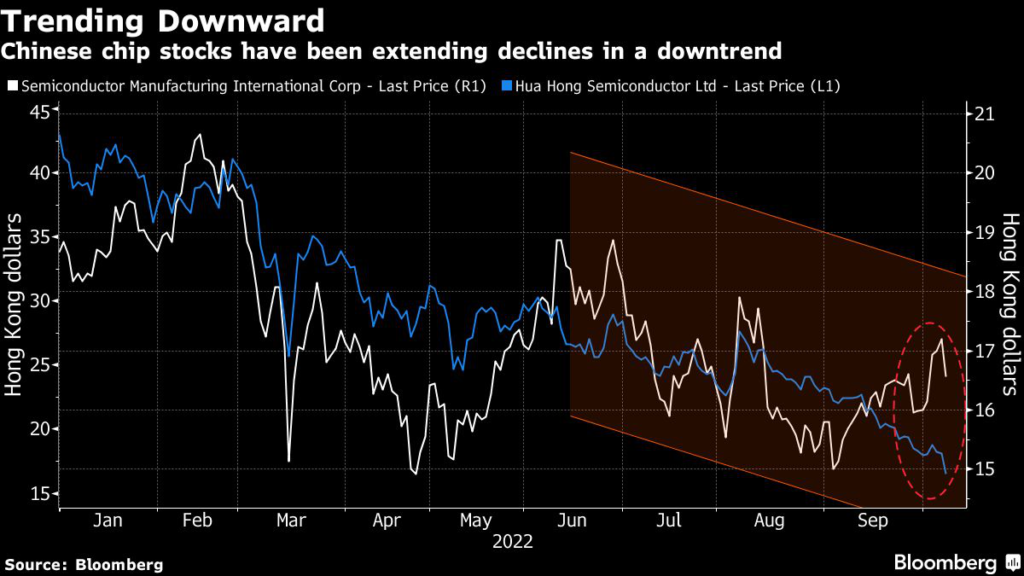
In China, bellwether Semiconductor Manufacturing International Corp. fell 4% in Hong Kong, the most in five weeks. Declines were steeper in smaller stocks. Hua Hong Semiconductor Ltd. sank 9.4%, while Shanghai Fudan Microelectronics Group Co. plummeted 20%, the most since July 2020. Will Semiconductor Co. and Maxscend Microelectronics Co. dropped more than 6% each.

In the US, artificial intelligence chipmakers Nvidia Corp. and Advance Micro Devices Inc. both fell more than 1.2% in premarket trading. Chip-tool maker Applied Materials Inc. dropped 1.2%, while peer ASML Holding NV tumbled as much as 3.2% in Amsterdam. These decline followed a 6.1% drop in the Philadelphia Semiconductor Index on Friday.

The US measures include restrictions on the export of some types of chips used in artificial intelligence and supercomputing, and also tighter rules on the sale of semiconductor equipment to any Chinese company. Separately, the US also added more Chinese firms to a list of companies that it regards as “unverified,” which means US suppliers will face new hurdles in selling technologies to those entities. 

The new strategy suggests that Washington aims to “freeze in” China at its current level, enabling the US to increase its lead, said Gabriel Wildau, an analyst at advisory firm Teneo Holdings LLC.

Chinese Foreign Ministry spokesperson Mao Ning said Saturday that the measures, which are set to enter into force this month, are unfair and will “also hurt the interests of US companies.” They “deal a blow to global industrial and supply chains and world economic recovery,” she said.

What Bloomberg Intelligence Says

“SMIC’s revenue could grow at a 50% slower pace vs. our expectations in 2023 on the US’s stricter equipment export license requirements, as 48% of its new capacity to be installed by next year is in 28- or smaller nanometer node advanced chip manufacturing.”

— Charles Shum, analyst

Click here for the full research

The new US rules come at a time when the chip industry is already grappling with an ominous start to the earnings season and has gone from a worldwide shortage of chips to a glut in a matter of months due to the boom-and-bust nature of semiconductor demand. 

Samsung Electronics Co., the world’s largest memory-chip maker, and PC-processor maker AMD reported results last week that suggested a deeper-than-feared slowdown ahead. 

The curbs are a “big setback to China” and “bad news” for global semiconductors, Nomura Holdings Inc. analyst David Wong wrote in a note. China’s localization efforts may also be “at risk as it may not be able to use advanced foundries in Taiwan and Korea,” he wrote.

Among other stocks, Naura Technology Group Co., plunged by the daily limit of 10% on the mainland, while Advanced Micro-Fabrication Equipment Inc. and ACM Research Shanghai Inc. fell more than 16% each.

The US Commerce Department has added Beijing Naura Magnetoelectric Technology Co., a subsidiary of Naura in its Unverified List, the company said in a filing.

To be sure, the intensifying Sino-American tensions could spur Beijing to step up support for homegrown firms in a bid to achieve its goal of becoming an independent chip powerhouse.

The fall in Chinese chip stocks may cast a pall over the sector globally. Markets in Japan, South Korea, Taiwan and Malaysia will get a chance to react on Tuesday as they are closed on Monday. 

“This will not only be negative to the Chinese semiconductor industry but also indirectly impact global semiconductor makers’ business opportunities longer term,” Citigroup analysts including Laura Chen wrote in a note.

Broader Chinese equity market also saw declines on Monday after returning from the Golden Week holiday, hurt by a global equities selloff and bleak holiday-spending data that deepened concerns about an economic recovery.

Read: China Stocks Slide as Traders Return From Golden Week Holiday

(Updates with European trading, US premarket in third paragraph.)

More stories like this are available on bloomberg.com

©2022 Bloomberg L.P.

‘No Possibility of Reconciliation’ as US Slams China Chips

(Bloomberg) — The Biden administration’s new restrictions on technology exports to China could undercut the country’s ability to develop wide swaths of its economy, from semiconductors and supercomputers to surveillance systems and advanced weapons. 

The US Commerce Department on Friday unveiled sweeping regulations that limit the sale of semiconductors and chip-making equipment to Chinese customers, striking at the foundation of the country’s efforts to build its own chip industry. The agency also added 31 organizations to its unverified list, including Yangtze Memory Technologies Co. and a subsidiary of leading chip equipment maker Naura Technology Group Co., severely limiting their ability to buy technology from abroad. 

The moves are the Biden administration’s most aggressive yet as it tries to stop China from developing technological capabilities it sees as a threat. Depending on how broadly Washington enforces the restrictions, the impact could extend well beyond semiconductors and into industries that rely on high-end computing, from electric vehicles and aerospace to simple gadgets like smartphones. 

Chinese state media and officials over the weekend raged against the action, warning of economic consequences and stirring speculation about potential retaliation. He Xiaopeng, the chairman and CEO of Chinese EV maker Xpeng Inc., warned last month that escalating US restrictions on chip exports will set back the nation’s autonomous driving sector. 

The two countries are now officially in an “economic war,” Dylan Patel, chief analyst at SemiAnalysis, said. A Chinese analyst said there is “no possibility of reconciliation” any longer. 

“This is the US salvo against China’s efforts to build its domestic tech capabilities,” said Patel, who estimates the restrictions could reduce global technology and industry trade by hundreds of billions of dollars. “It’s the US firing back, making clear they will fight back.”

European and Chinese semiconductor stocks tumbled on the news. ASML Holding NV, the most advanced maker of equipment for producing semiconductors, fell more than 3%. Bellwether Semiconductor Manufacturing International Corp. fell as much as 5.2% in Hong Kong on Monday, the most since Aug. 15, as Bloomberg Intelligence analyst Charles Shum slashed his estimate on 2023 growth by 50%. Hua Hong Semiconductor Ltd. plunged 10%, while Shanghai Fudan Microelectronics Group Co. plummeted 25%. Naura fell by its daily limit of 10% in mainland China, the biggest fall since April.

“The rules are a directional signal about US policy on China: a very hawkish consensus is now cemented in place,” wrote Dan Wang, technology analyst at Gavekal Dragonomics.

US officials said the new restrictions are necessary to stop China from becoming more of an economic and military menace. They are seeking to ensure the country’s chipmakers don’t secure the capability to make advanced semiconductors.

China “has poured resources into developing supercomputing capabilities and seeks to become a world leader in artificial intelligence by 2030,” said Assistant Secretary of Commerce for Export Administration Thea D. Rozman Kendler. “It is using these capabilities to monitor, track and surveil their own citizens, and fuel its military modernization.”

Reaction in China was furious. The nationalistic Global Times newspaper warned the “savage attack on free trade” would have dire consequences for the US.

“Only arrogant and ignorant people can truly believe that the US can block the development of China’s semiconductor or other technology industries by these illegitimate means,” it said in an editorial. “The US hegemony in science and technology that harms others without benefiting itself may bring some short-term difficulties to China’s semiconductor industry, but will in turn strengthen China’s will and ability to stand on its own in science and technology.”

Chinese Foreign Ministry spokesperson Mao Ning said the measures are unfair and will “deal a blow to global industrial and supply chains and world economic recovery.”

“The reality is the US is determined to use chips as a tool to contain China,” Gu Wenjun, head of Chinese chip researcher ICwise, wrote in an online commentary. “There is no possibility of reconciliation.”

The new US regulations broadly limit chipmakers from selling to China artificial intelligence semiconductors and those that can be used for supercomputers. Nvidia Corp. warned in September that government restrictions on exporting AI chips to China could affect hundreds of millions of dollars in revenue, sending its stock tumbling. 

Chipmakers can request a Commerce Department exception to those rules. But they should presume such requests will be denied, senior officials said.

Commerce also put in place a raft of restrictions on supplying US machinery that’s capable of making advanced semiconductors. It’s targeting the types of memory and logic chips that are at the heart of state-of-the-art designs.

Specifically, the restrictions cover production of logic chips using so-called nonplanar transistors made with 16-nanometer technology or anything more advanced than that, 18-nanometer dynamic random access memory chips and Nand-style flash memory chips with 128 layers or more. Generally speaking, the smaller the number of nanometers, the more capable the chip.

Analysts pored over the Commerce Department’s announcement that ran to more than 135 pages for implications. Chinese AI chip designers like Biren could face some restrictions on their orders with TSMC, according to Patel.

Stacy Rasgon and a team from Sanford C. Bernstein explained the restrictions on AI, supercomputers and advanced chip-making equipment, while pointing out that the standard CPUs used in personal computers and servers would not be blocked from export to China, as some had feared.

“The changes represent a further escalation, and we do not know what China might do in response,” the Bernstein analysts wrote. “Potential retaliation remains a risk.”

One question is how the US rules will affect the ability of companies like ASML to sell into China. The Dutch company is effectively the most important supply chain company for chipmakers around the world. 

ASML has had to strike a challenging balance between the US and China. It has been selling its deep ultraviolet, or DUV, machines to Chinese customers, but has held back from selling its more advanced extreme ultraviolet, or EUV, machines. Under the new Commerce Department restrictions, the company may be limited from selling DUV technology to Chinese customers too, Citigroup analysts wrote.

“We are assessing the potential implications of the new regulations, if any, and cannot comment at this moment,” said Monique Mols, a spokesperson for ASML.

Patel of SemiAnalysis believes the unverified list is a serious threat to China’s tech ambitions. In the past, the Commerce Department cut off access to critical technologies for companies like Huawei Technologies Co. when they were added to the so-called entity list, meaning the agency had gathered evidence against them. The unverified list simply means the Commerce Department can’t verify that a company’s activities are safe.

“That is huge,” he said. “They can pretty much blacklist any company they want in China within two months.” 

Read more: US Pushes for ASML to Stop Selling Chipmaking Gear to China

(Updates with European share action from the 7th paragraph)

More stories like this are available on bloomberg.com

©2022 Bloomberg L.P.

Crypto Gets Reminder of DeFi Risks From Latest Loan Default

(Bloomberg) — A lending service in the cryptocurrency sector said a debtor had defaulted on a $3.4 million loan, a development that highlights the potential for ongoing stress in the digital-asset marketplace.

Decentralized lending protocol TrueFi said in a blog post Monday that South Korea’s Blockwater Technologies had missed a payment due in stablecoin Binance USD. Blockwater couldn’t immediately be reached for comment.

TrueFi said the default is the only one it’s suffered so far and that the loan is in “an active restructuring to maximize recovery.” TrueFi said the debt represents about 2% of its total outstanding value and that it remains vigilant overall with borrowers given the “challenging market conditions.”

This year’s crypto rout has roiled a number of digital-asset lenders and exchanges. It’s also opened fissures in decentralized finance or DeFi, where crypto investors trade, borrow and lend without using a central intermediary.

TrueFi, an uncollateralized lending protocol, said in the blog post that it has originated more than $1.7 billion in unsecured loans and successfully collected approximately $1.5 billion in repayments.

More stories like this are available on bloomberg.com

©2022 Bloomberg L.P.

Era of Peak Yields Signals Entry Point for Emerging-Market Bets

(Bloomberg) — The moment emerging-market investors have been waiting for as they endured the worst rout since the 2008 global financial crisis has finally come into view. 

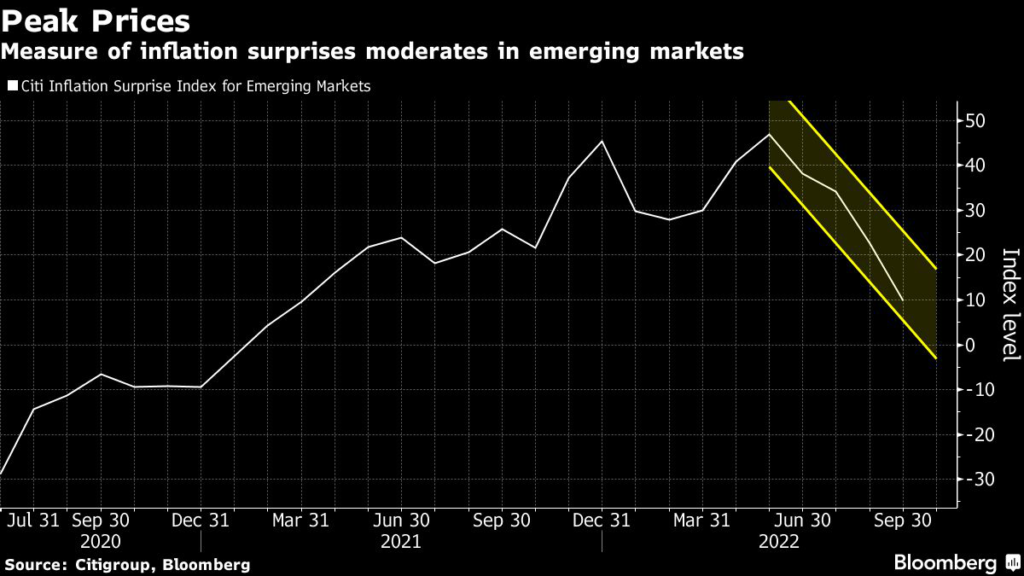
It’s a combination of two peaks. One, in inflation: Developing nations from India to Brazil are reporting declines in consumer-price growth, early victories in a war that’s gone on for two years. Two, monetary tightening: From the US to UK and Europe, wagers on rate hikes that kept surging until last month are now moderating.

It’s still early days and a lot of turbulence could hit before these two trends consolidate, but expectations for a peak in borrowing costs next year are encouraging investors to dip their toes back into emerging-market assets. When monetary tightening does wind down, investors may find the developing world more attractive because equity and bond valuations are cheaper than in rich nations, real yields higher and beaten-down currencies brim with carry. 

“We are more inclined to selectively add risk at this point,” said Lewis Jones, a debt manager at William Blair Investment Management in New York. “Emerging-market currency valuations are very attractive and central banks, particularly among the higher-yielding basket of countries, have tightened very aggressively, and successfully in terms of expected levels of inflation next year.”

Benchmark gauges of emerging-market bonds, in both dollars and local currencies, have been rallying in October after posting declines in eight of the nine months this year. The equity benchmark rebounded last week from the worst monthly slump since March 2020, while the currency index bounced off the longest streak of losses since 2019.

Part of the gains came from euphoria at the start of the month that bad economic data will push central banks including the Federal Reserve to make a dovish pivot. While those hopes have since been dashed — with policymakers reaffirming their fight against inflation and the US labor market staying strong — the case for at least a halt to tightening next year continues to find support.

“Aggressive central-bank intervention, some eye-catching relief in rates markets and very heavy long dollar positioning have altered the near-term market narrative a little and introduced some more two-way price discovery,” said Paul Greer, a London-based money manager at Fidelity International. “This creates some tactical opportunities in the emerging-market universe.”

Poorer nations’ main concern for the past two years — runaway inflation — is abating. India has reported four successive months of declines in its consumer price index, while Brazil and South Africa have also joined the peak-inflation club. This has taken the pressure off some of the biggest economies to raise rates.

Meanwhile, money markets are pruning their bets for terminal rates in developed markets. They now call for a top rate of 5.8% in the UK, 3.15% for the European Central Bank and as low as 4.5% for the Fed, all dropping from peaks seen in September.

Greer expects the average sovereign risk premium to narrow by as many as 100 basis points if the Fed wagers come true. The spread stood close to 540 on Thursday, down from a peak of 593 in July, according to a JPMorgan Chase & Co. index.

“A peak or stability in US yields would be quite constructive for emerging-market bonds,” said Eric Lo of Manulife Investment Management. The money manager bought South Korea’s battered bonds given their close correlation with the US and that they could benefit from a turnaround in Treasuries.

Fidelity International took profit on some bearish currency positions and initiated bullish bets on the Mexican peso and Singapore dollar. Greer said he is also taking greater exposure to local-currency government bond duration in Brazil and Mexico.

Waiting on Wings

Money managers take pains to explain these are selective bets and it’s not yet time to be bullish on emerging markets overall. Most investors are stepping back from the clamor for a “Fed pivot,” which called for a dovish tilt from policymakers. The best hope now is for rate hikes to stop, even if rate cuts are further away on the horizon.

Analysts at Deutsche Bank AG said it’s too early to turn bullish on local currencies and bonds, citing the risk of inflation surprises that could lead to higher US rates and the fallout from Russia’s war in Ukraine. While several central banks have signaled the end of tightening cycles — including Hungary, the Czech Republic and Brazil and Chile — there’s a risk that inflation will linger for longer, hurting potential returns, analysts including Christian Wietoska and Oliver Harvey wrote in an email.

“The market has been romancing for a Fed pivot for a while now and it always gets disappointed,” said Francesc Balcells, the chief investment officer of emerging-market debt at FIM Partners in London. “In any case, whether we are in peak yields now or in the future, the risk-reward for long duration fixed-income asset classes such as emerging-market debt, is beginning to look more attractive here.” 

What to watch this week:

  • The yuan rose as China’s markets reopened Monday after a week-long holiday, ahead of the Communist Party congress that’s scheduled to start on Oct. 16. President Xi Jinping is expected to secure an unprecedented third term in power at the twice-a-decade gathering
    • Meantime, Chinese stocks fell, hurt by a bleak holiday-spending data and a rebound in virus cases that deepened concerns about the economy. The nation’s semiconductor stocks slumped after fresh US curbs on China’s access to American technology
  • China’s price data will be closely watched. Consumer inflation probably picked up in September, mainly on higher food prices, while factory-gate inflation likely continued to ease amid a pullback in commodities
    • Meantime, the nation’s trade report will probably show slowing export growth, underscoring weakening external support for the economy
  • Brazil, India and Israel will also publish CPI data that may offer clues on the outlook for monetary policy
  • South Korea and Chile will likely raise interest rates. Mexico’s central bank will release minutes on Thursday from its Sept. 29 meeting
  • India, Malaysia, Mexico and Turkey will report on industrial production

(Updates prices in fifth paragraph, performance of China’s markets as they reopened Monday in the first bullet)

More stories like this are available on bloomberg.com

©2022 Bloomberg L.P.
Philippines’ Marcos Signs Law Requiring SIM Card Registration

(Bloomberg) — Philippine President Ferdinand Marcos Jr. has signed a law requiring all SIM cards to be registered, a move that is meant to curb mobile-phone scams and other crimes but has also raised privacy concerns.

The new law mandates telecommunication companies to maintain a register of SIM card subscribers, and submit a list of authorized sellers to the government. A valid identification document must now be presented to buy a SIM card, and existing ones need to be registered.

PLDT Inc., Globe Telecom Inc. and DITO Telecom have all supported the measure, which was vetoed during President Rodrigo Duterte’s term due to a provision requiring registration of social media accounts. Human rights advocates have raised concerns that the law will legitimize state surveillance, but Marcos has said the legislation has privacy safeguards.

More stories like this are available on bloomberg.com

©2022 Bloomberg L.P.

China Stocks Slide as Grim Reality Grips Traders After Holidays

(Bloomberg) — Chinese stocks fell on their return from the Golden Week holiday, hurt by a bleak holiday-spending data that deepened concerns about an economic recovery amid rising Covid cases.  

The benchmark CSI 300 Index dropped as much as 2% to head for its lowest close since April 2020. Tech and consumer staple drove the decline. The Hang Seng China Enterprises Index of Chinese stocks in Hong Kong slid more than 3%. The onshore yuan edged higher against the dollar.  

Grim reality faced mainland traders on their return, with trends last week showing a sharp slide in holiday spending, a rebound in virus cases and no respite from the property crisis. Data Saturday showed China’s services activity contracted in September for the first time in four months amid Covid lockdowns in major cities.

With little conviction of a market bottom, investors are reluctant to build positions ahead of the Communist Party congress on Oct. 16, where leadership will be confirmed and key policies unveiled.

“A slew of weak macro-economic data that China has released shows that there is very limited room for an economic rebound in the short term, which is hard to provide support for earnings and market confidence,” said Shen Meng, a director at investment bank Chanson & Co in Beijing. Rising bets for a 75-basis point Fed hike in November are also hurting sentiment in today’s onshore market, he said.

READ: Wall Street Desire for Xi to Pivot to Growth Faces Reality Check

Meanwhile, Sino-American tensions were again back in focus as the Biden administration’s Friday announcement of new restrictions on China’s access to US semiconductor technology caused the Asian nation’s chip shares to slide on Monday.

“China is still very much under Covid’s shadow and headwinds from the US,” said Steven Leung, executive director at Uob Kay Hian (Hong Kong) Ltd. “All eyes are on the 20th party congress. Politically, investors are focusing on who will be the new premier and what that means for economic policies.”

A gauge of Chinese tech stocks listed in Hong Kong plunged more than 4% on Monday. The city’s benchmark Hang Seng Index lost over 3%.

READ: China Chip Stocks Drop as Biden Tightens Rules on US Tech Access

Party Congress

Bleak tourism and entertainment spending data for the week-long holiday was another proof that consumer demand in China continues to weaken in the face of Beijing’s Covid curbs. 

Tourism revenue declined 26% to 287 billion yuan ($40.3 billion) over the week-long holiday from a year ago. Compared with pre-pandemic levels in 2019, revenue was down nearly 56%. Roughly 422 million trips were taken, down 18% from last year and 39% from 2019 levels.

Hopes of a strong post-holiday gain for Chinese stocks were also dented after Friday’s solid US jobs figures sent shares tumbling again on bets for aggressive Federal Reserve rate hikes. The NASDAQ Golden Dragon China Index slumped more than 4% on Friday, wiping out all its gains for the week that onshore traders were away.

READ: Amundi Slashes China Stocks Citing Covid and Housing Problems

The CSI 300 has now fallen more than 24% in 2022, heading for its first back-to-back annual declines in a decade. Stocks have continued to be sold off as traders see any shift away from Covid Zero or massive stimulus as unlikely at the upcoming leadership gathering.

“We’re very unlikely to see any kind of big bang easing, but a gradual easing of approach over a matter of months, which leads to a pickup in growth from really very low levels now,” Jonathan Garner, chief Asia and emerging markets strategist at Morgan Stanley, said in a Bloomberg TV interview.

Valuations are in China are extremely cheap,” he said, adding that in terms of the actual performance of the market going forward, a lot will hinge on “how we come out of the party congress.”

On the currency market, the onshore yuan traded 0.1% stronger at 7.1126 per dollar as of 2:28 p.m. local time, with the central bank setting a stronger-than-expected fixing for the 28th day. The offshore yuan also gained. 

More stories like this are available on bloomberg.com

©2022 Bloomberg L.P.
‘No Possibility of Reconciliation’ as US Chip Rules Slam China

(Bloomberg) — The Biden administration’s new restrictions on technology exports to China could undercut the country’s ability to develop wide swaths of its economy, from semiconductors and supercomputers to surveillance systems and advanced weapons. 

The US Commerce Department on Friday unveiled sweeping regulations that limit the sale of semiconductors and chip-making equipment to Chinese customers, striking at the foundation of the country’s efforts to build its own chip industry. The agency also added 31 organizations to its unverified list, including Yangtze Memory Technologies Co. and a subsidiary of leading chip equipment maker Naura Technology Group Co., severely limiting their ability to buy technology from abroad. 

The moves are the Biden administration’s most aggressive yet as it tries to stop China from developing technological capabilities it sees as a threat. Depending on how broadly Washington enforces the restrictions, the impact could extend well beyond semiconductors and into industries that rely on high-end computing, from electric vehicles and aerospace to simple gadgets like smartphones. 

Chinese state media and officials over the weekend raged against the action, warning of economic consequences and stirring speculation about potential retaliation. He Xiaopeng, the chairman and CEO of Chinese EV maker Xpeng Inc., warned last month that escalating US restrictions on chip exports will set back the nation’s autonomous driving sector. 

The two countries are now officially in an “economic war,” Dylan Patel, chief analyst at SemiAnalysis, said. A Chinese analyst said there is “no possibility of reconciliation” any longer. 

“This is the US salvo against China’s efforts to build its domestic tech capabilities,” said Patel, who estimates the restrictions could reduce global technology and industry trade by hundreds of billions of dollars. “It’s the US firing back, making clear they will fight back.”

Chinese semiconductor stocks tumbled on the news. Bellwether Semiconductor Manufacturing International Corp. fell as much as 5.2% in Hong Kong on Monday, the most since Aug. 15, as Bloomberg Intelligence analyst Charles Shum slashed his estimate on 2023 growth by 50%. Hua Hong Semiconductor Ltd. plunged 10%, while Shanghai Fudan Microelectronics Group Co. plummeted 25%. 

US officials said the new restrictions are necessary to stop China from becoming more of an economic and military menace. They are seeking to ensure the country’s chipmakers don’t secure the capability to make advanced semiconductors.

China “has poured resources into developing supercomputing capabilities and seeks to become a world leader in artificial intelligence by 2030,” said Assistant Secretary of Commerce for Export Administration Thea D. Rozman Kendler. “It is using these capabilities to monitor, track and surveil their own citizens, and fuel its military modernization.”

Reaction in China was furious. The nationalistic Global Times newspaper warned the “savage attack on free trade” would have dire consequences for the US.

“Only arrogant and ignorant people can truly believe that the US can block the development of China’s semiconductor or other technology industries by these illegitimate means,” it said in an editorial. “The US hegemony in science and technology that harms others without benefiting itself may bring some short-term difficulties to China’s semiconductor industry, but will in turn strengthen China’s will and ability to stand on its own in science and technology.”

Chinese Foreign Ministry spokesperson Mao Ning said the measures are unfair and will “deal a blow to global industrial and supply chains and world economic recovery.”

“The reality is the US is determined to use chips as a tool to contain China,” Gu Wenjun, head of Chinese chip researcher ICwise, wrote in an online commentary. “There is no possibility of reconciliation.”

The new US regulations broadly limit chipmakers from selling to China artificial intelligence semiconductors and those that can be used for supercomputers. Nvidia Corp. warned in September that government restrictions on exporting AI chips to China could affect hundreds of millions of dollars in revenue, sending its stock tumbling. 

Chipmakers can request a Commerce Department exception to those rules. But they should presume such requests will be denied, senior officials said.

Commerce also put in place a raft of restrictions on supplying US machinery that’s capable of making advanced semiconductors. It’s targeting the types of memory and logic chips that are at the heart of state-of-the-art designs.

Specifically, the restrictions cover production of logic chips using so-called nonplanar transistors made with 16-nanometer technology or anything more advanced than that, 18-nanometer dynamic random access memory chips and Nand-style flash memory chips with 128 layers or more. Generally speaking, the smaller the number of nanometers, the more capable the chip.

Analysts pored over the Commerce Department’s announcement that ran to more than 135 pages for implications. Chinese AI chip designers like Biren could face some restrictions on their orders with TSMC, according to Patel.

Stacy Rasgon and a team from Sanford C. Bernstein explained the restrictions on AI, supercomputers and advanced chip-making equipment, while pointing out that the standard CPUs used in personal computers and servers would not be blocked from export to China, as some had feared.

“The changes represent a further escalation, and we do not know what China might do in response,” the Bernstein analysts wrote. “Potential retaliation remains a risk.”

One question is how the US rules will affect the ability of companies like ASML Holding NV to sell into China. The Dutch company is the most advanced maker of equipment for producing semiconductors, effectively the most important arms dealer for chipmakers around the world. 

ASML has had to strike a challenging balance between the US and China. It has been selling its deep ultraviolet, or DUV, machines to Chinese customers, but has held back from selling its more advanced extreme ultraviolet, or EUV, machines. Under the new Commerce Department restrictions, the company may be limited from selling DUV technology to Chinese customers too, Citigroup analysts wrote.

Representatives for ASML didn’t immediately respond to requests for comment.

Patel of SemiAnalysis believes the unverified list is a serious threat to China’s tech ambitions. In the past, the Commerce Department cut off access to critical technologies for companies like Huawei Technologies Co. when they were added to the so-called entity list, meaning the agency had gathered evidence against them. The unverified list simply means the Commerce Department can’t verify that a company’s activities are safe.

“That is huge,” he said. “They can pretty much blacklist any company they want in China within two months.” 

Read more: US Pushes for ASML to Stop Selling Chipmaking Gear to China

More stories like this are available on bloomberg.com

©2022 Bloomberg L.P.
Close Bitnami banner
Bitnami