
Bloomberg

Stocks Slump on Rates Outlook, US-China Friction: Markets Wrap

(Bloomberg) — Shares tumbled Monday amid intensifying concern over rising global interest rates and as Chinese investors returned from a week-long holiday to tighter restrictions on American technology.

A gauge of Asian equities dropped by more than 1%, led by tech stocks in Hong Kong, while US futures also slid. A rebound in Covid cases in China amplified the downbeat tone. Commodities declined as traders weighed mounting risks to the world economy.   

The US measures include restrictions on the export of some types of chips used in artificial intelligence and supercomputing, and also tighter rules on the sale of semiconductor equipment to any Chinese company. This latest tension between Washington and Beijing adds to a host of geopolitical risks for markets, from Taiwan to North Korea to Ukraine. 

Bond yields climbed in Australia and New Zealand, following gains in Treasury yields on Friday, after strong US labor data solidified wagers that the Federal Reserve will raise rates by 75 basis points for a fourth straight time next month. 

“The debate about are we going into recession or not is over,” Jonathan Garner, chief Asia and emerging markets strategist at Morgan Stanley, said on Bloomberg Television. “Everything that we see indicates that we’re in some kind of recessionary environment as of the third quarter and we’ll get a lot more of that as companies announce over the next couple of weeks.”

The dollar fluctuated versus its Group-of-10 counterparts while China set its reference rate for the yuan stronger than expected for a 28th day. 

Oil eased as risks to energy demand stemming from tighter monetary policy halted a rally triggered by OPEC+’s decision to cut supply. Gold extended a decline in Asia after plunging below the $1,700 an ounce mark last week.

Investors continued to digest comments from Fed Bank of New York President John Williams, who said last week that rates need to rise to around 4.5% over time, but the pace and ultimate peak of the tightening campaign will hinge on how the economy performs. Officials have been resolutely hawkish in their message that they won’t be deterred from raising rates by volatility in financial markets. 

All eyes will now be on this week’s US inflation data after a hotter-than-expected reading in August tempered hopes of a nascent slowdown. Separately, minutes from the Fed’s September meeting will give clues into the central bank’s tolerance for economic pain.

“US CPI is the marquee event risk and when we see expectations that core CPI will rise 20 basis points to 6.5% from 6.3%, it will give the Fed even more fodder to keep tightening financial conditions,” Chris Weston, head of research at Pepperstone Group Ltd., wrote in a note. “The short sellers are having it all their way – we have no central bank support.”

Markets are closed for a holiday in Japan. The US bond market is closed but the stock market will be open. 

Key events this week:

  • Earnings this week include: JPMorgan Chase & Co., Citigroup Inc., Morgan Stanley, BlackRock, Delta Air Lines, Fast Retailing, Infosys, PepsiCo, TSMC, Tata Consultancy, UnitedHealth, U.S. Bancorp, Walgreens Boots, Wells Fargo, Wipro
  • Fed’s Lael Brainard and Charles Evans speak, Monday
  • IMF’s World Economic Outlook and Global Financial Stability Report, Tuesday
  • Fed’s Loretta Mester speaks, Tuesday
  • BOE’s Andrew Bailey speaks, Tuesday
  • FOMC minutes for September meeting, Wednesday
  • US PPI, mortgage applications, Wednesday
  • OPEC Monthly Oil Market Report, Wednesday
  • Fed’s Michelle Bowman and Neel Kashkari speak
  • ECB’s Christine Lagarde speaks
  • US CPI, initial jobless claims, Thursday
  • G-20 finance ministers and central bankers meet, Thursday
  • China CPI, PPI, trade, Friday
  • US retail sales, business inventories, University of Michigan consumer sentiment, Friday
  • BOE emergency bond buying is set to end, Friday

Some of the main moves in markets:

Stocks

  • Futures on the S&P 500 fell 0.6% as of 6:50 a.m. in London. The S&P 500 fell 2.8% on Friday
  • Futures on the Nasdaq 100 fell 0.6%. The Nasdaq 100 fell 3.9%
  • The Hang Seng Index fell 2.9%
  • The Shanghai Composite Index fell 0.8%
  • Euro Stoxx 50 futures fell 1.1%
  • The S&P ASX Index fell 1.4%

Currencies

  • The Bloomberg Dollar Spot Index rose 0.1%
  • The euro fell 0.2% to $0.9723
  • The Japanese yen fell 0.1% to 145.40 per dollar
  • The offshore yuan rose 0.2% to 7.1217 per dollar
  • The British pound fell 0.2% to $1.1069

Cryptocurrencies

  • Bitcoin fell 0.4% to $19,401.75
  • Ether fell 0.2% to $1,318.23

Bonds

  • The US 10-year Treasury yield increased 6 basis points to 3.88% on Friday
  • Australia’s 10-year yield advanced 2 basis points to 3.87%

Commodities

  • West Texas Intermediate crude fell 0.7% to $92.01 a barrel
  • Spot gold fell 0.4% to $1,687.23 an ounce

More stories like this are available on bloomberg.com

©2022 Bloomberg L.P.
US Tech Curbs Could Halve Growth of China’s Top Chipmaker

(Bloomberg) — US restrictions on China’s access to advanced American technologies could slash growth of the country’s largest chipmaker by half next year, Bloomberg Intelligence estimates.

Semiconductor Manufacturing International Corp. could see 2023 sales growth 50% lower than he previously expected, as the latest export curbs hamper its capacity buildup, analyst Charles Shum wrote on Monday. Roughly 48% of SMIC’s capacity to be installed by next year will require gear from US tool makers such as Lam Research Corp. and Applied Materials Inc., he said. 

The estimate is based on Shum’s calculations of SMIC’s affected capacity and don’t include the impact of price fluctuations or utilization levels. China’s largest contract chip manufacturer by sales had been projected to grow overall revenue more than 38% in 2022 and about 5% in 2023, according to data compiled by Bloomberg. Its shares fell as much as 5.2% in Hong Kong on Monday.

What Bloomberg Intelligence Says

SMIC’s revenue could grow at a 50% slower pace vs. our expectations in 2023 on the US’s stricter equipment export license requirements, as 48% of its new capacity to be installed by next year is in 28- or smaller nanometer node advanced chip manufacturing, we calculate. This would require supplies from US tool makers such as Lam Research and Applied Materials.

– Charles Shum, analyst

Click here for research.

The Biden administration announced a set of restrictions last week aimed at stopping China from developing home-grown semiconductor capability. The measures include restrictions on the export of some types of chips used in artificial intelligence and supercomputing, and also tighten rules on the sale of semiconductor manufacturing equipment to any Chinese company.

Shanghai-based SMIC had already been blacklisted by the US. The company declared breakthroughs in 7-nanometer chipsets this year, the most advanced node for China, Bloomberg News reported in July.

More stories like this are available on bloomberg.com

©2022 Bloomberg L.P.

Taiwan Says It Won’t Compromise on Democracy After Musk Proposal

(Bloomberg) — Taiwan will not compromise on its sovereignty or democracy, President Tsai Ing-wen said, hours after China hailed a proposal that the self-ruled island adopt a Hong Kong-style governance model.

“The Beijing authorities should not make any misjudgment on account of Taiwan’s vigorous democratic system,” Tsai said Monday during her annual National Day speech. “They must not mistake there is room for compromise in the Taiwanese people’s commitment to democracy and freedom.”

Chinese diplomats over the weekend heaped praise on Elon Musk’s recommendation that Taiwan become a Hong Kong-style special administrative zone of China. Qin Gang, China’s ambassador to the US, thanked the Tesla Inc. chief executive officer on Twitter for re-upping the idea, saying the “one country, two systems” framework was a basic principle for “resolving the Taiwan question.” Shortly after, Foreign Ministry spokeswoman Mao Ning affirmed those remarks.

READ: Taiwan to Make Military Service Extension Announcement This Year

Such a proposal faces resistance in Taiwan, where there is growing hostility to any form of integration with Beijing, especially in the wake of the Chinese Communist Party’s sweeping crackdown on dissent in Hong Kong.

Tsai made clear to the island’s 24 million people that such a plan wasn’t acceptable. “We must defend our national sovereignty and our free and democratic way of life,” she said. “On this point, we have no room for compromise.” 

Taiwan is expected to be a major issue at China’s twice-a-decade congress later this month, where President Xi Jinping is set to secure a precedent-breaking third term. The Chinese leader has previously pledged to use “all necessary means” to resolve the Taiwan issue.

While Tsai warned China an armed confrontation was “absolutely not an option,” she said Taiwan was bolstering its defenses in response to Beijing’s escalating military pressure. That meant ramping up production and procurement of weapons, such as precision missiles and high-performance naval vessels, she said, adding that Taiwan wouldn’t “leave anything to fate.”

She also spoke of the need to resume people-to-people exchanges, after the loosening of Covid-related border restrictions on both sides, to “ease tensions.” Tsai added that Taipei was willing to find a common solution with Beijing on cross-strait stability.

Tsai also vowed to strengthen Taiwan’s semiconductor supply chains, and downplayed concern among foreign governments of over-reliance on the island for cutting-edge chips.

“The concentration of the semiconductor sector in Taiwan is not a risk, but is the key to the reorganization of the global semiconductor industry,” Tsai said. She added that Taiwan would “help optimize” supply chains in a way that would give the island’s firms “an even more prominent global role.” 

Taiwan has signaled it’s taking the war threat from Beijing more seriously since US House Speaker Nancy Pelosi’s August visit prompted unprecedented military drills around the island. China has sent warplanes and military vessels near Taiwan on an almost daily basis since that trip, which Beijing said violated its territorial claims over the self-governed democracy.

Last week, Taiwan pledged to treat any People’s Liberation Army incursion into the island’s airspace as a “first strike,” and said it would make an announcement on extending its four-month military conscription requirement by the end of the year.

Monday’s events, which mark the founding of the Republic of China, the formal name for Taiwan, include military and high-school marching band parades. Warplanes flew over the presidential office and advanced jet trainers performed an aerial display.

Tsai’s defiant speech comes as her Democratic Progressive Party prepares for local elections next month that are seen as a mid-term test ahead of a presidential vote in 2024. The DPP is seeking to defend key mayoral seats against the main opposition party, the Kuomintang.

(Updates with Tsai’s remarks.)

More stories like this are available on bloomberg.com

©2022 Bloomberg L.P.
China Chip Stocks Tumble as Biden Expands Technology Curbs

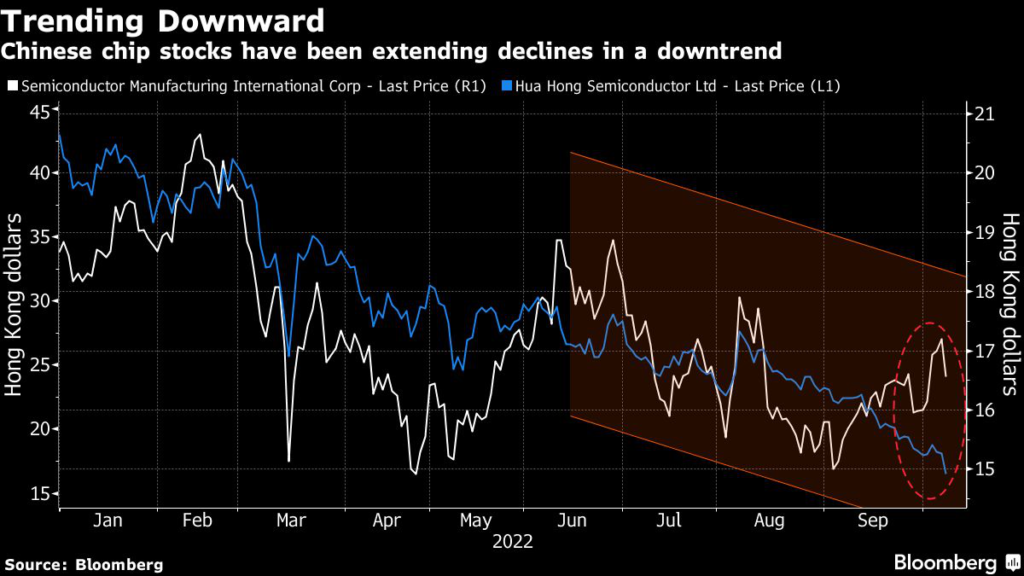
(Bloomberg) — Chinese semiconductor stocks slumped after fresh US curbs on China’s access to American technology added to a disappointing start to the earnings season, stoking concerns that the industry’s downturn is far from over.

Bellwether Semiconductor Manufacturing International Corp. fell as much as 5.2% in Hong Kong on Monday, the most since Aug. 15. Declines were steeper in smaller stocks. Hua Hong Semiconductor Ltd. plunged 10%, while Shanghai Fudan Microelectronics Group Co. plummeted 25%, the most in seven years. Will Semiconductor Co. and Maxscend Microelectronics Co. dropped more than 6% each.

The US measures include restrictions on the export of some types of chips used in artificial intelligence and supercomputing, and also tighter rules on the sale of semiconductor equipment to any Chinese company. Separately, the US also added more Chinese firms to a list of companies that it regards as “unverified,” which means US suppliers will face new hurdles in selling technologies to those entities. 

The new strategy suggests that Washington aims to “freeze in” China at its current level, enabling the US to increase its lead, said Gabriel Wildau, an analyst at advisory firm Teneo Holdings LLC.

Chinese Foreign Ministry spokesperson Mao Ning said Saturday that the measures, which are set to enter into force this month, are unfair and will “also hurt the interests of US companies.” They “deal a blow to global industrial and supply chains and world economic recovery,” she said.

What Bloomberg Intelligence Says

“SMIC’s revenue could grow at a 50% slower pace vs. our expectations in 2023 on the US’s stricter equipment export license requirements, as 48% of its new capacity to be installed by next year is in 28- or smaller nanometer node advanced chip manufacturing.”

— Charles Shum, analyst

Click here for the full research

The slide in the chip stocks also followed a 6.1% drop in the Philadelphia Semiconductor Index on Oct. 7, after strong labor market data reinforced expectations for more aggressive interest rate hikes by the Federal Reserve. 

The new US rules come at a time when the chip industry is already grappling with an ominous start to the earnings season and has gone from a worldwide shortage of chips to a glut in a matter of months due to the boom-and-bust nature of semiconductor demand. 

Samsung Electronics Co., the world’s largest memory-chip maker, and PC-processor maker Advanced Micro Devices Inc. reported results last week that suggested a deeper-than-feared slowdown ahead. 

The curbs are a “big setback to China” and “bad news” for global semiconductors, Nomura Holdings Inc. analyst David Wong wrote in a note. China’s localization efforts may also be “at risk as it may not be able to use advanced foundries in Taiwan and Korea,” he wrote.

Among other stocks, Naura Technology Group Co., plunged by the daily limit of 10% on the mainland, while Advanced Micro-Fabrication Equipment Inc. and ACM Research Shanghai Inc. fell more than 16% each.

The US Commerce Department has added Beijing Naura Magnetoelectric Technology Co., a subsidiary of Naura in its Unverified List, the company said in a filing.

To be sure, the intensifying Sino-American tensions could spur Beijing to step up support for homegrown firms in a bid to achieve its goal of becoming an independent chip powerhouse.

The fall in Chinese chip stocks may cast a pall over the sector globally. Markets in Japan, South Korea, Taiwan and Malaysia will get a chance to react on Tuesday as they are closed on Monday. 

“This will not only be negative to the Chinese semiconductor industry but also indirectly impact global semiconductor makers’ business opportunities longer term,” Citigroup analysts including Laura Chen wrote in a note.

Broader Chinese equity market also saw declines on Monday after returning from the Golden Week holiday, hurt by a global equities selloff and bleak holiday-spending data that deepened concerns about an economic recovery.

Read: China Stocks Slide as Traders Return From Golden Week Holiday

(Updates with analyst comments throughout.)

More stories like this are available on bloomberg.com

©2022 Bloomberg L.P.
Stocks Slump as Rate-Hike Outlook Damps Sentiment: Markets Wrap

(Bloomberg) — Shares opened the week lower amid intensifying concern over the impact of tightening monetary policy after strong labor market data reinforced expectations for more aggressive interest rate hikes from the Federal Reserve.

Asian equities slumped, led by tech stocks in Hong Kong, while US futures also slid. Chinese investors returned from a week-long break, just after the US expanded restrictions on access to semiconductor technology, and as Covid cases rebounded ahead of a Congress that’s set to give Xi Jinping a third term. 

Bond yields climbed in Australia and New Zealand, following gains in US Treasury yields on Friday after the labor figures solidified wagers that the Fed will raise rates by 75 basis points for a fourth straight time next month. Almost 95% of the companies in the S&P 500 fell and the Nasdaq 100 sank nearly 4%. 

The dollar fluctuated versus its Group-of-10 counterparts as investors weighed the campaign by central banks to quell inflation with higher borrowing costs. China set its reference rate for the yuan stronger than expected for a 28th day. 

Fed Bank of New York President John Williams said rates need to rise to around 4.5% over time, but the pace and ultimate peak of the tightening campaign will hinge on how the economy performs. Several officials recently delivered a resolutely hawkish message that price pressures remain elevated and they won’t be deterred from raising rates by volatility in financial markets. 

All eyes will now be on this week’s US inflation data after a hotter-than-expected reading in August tempered hopes of a nascent slowdown. Separately, minutes from the Fed’s September meeting will give clues into the central bank’s tolerance for economic pain.

“US CPI is the marquee event risk and when we see expectations that core CPI will rise 20 basis points to 6.5% from 6.3%, it will give the Fed even more fodder to keep tightening financial conditions,” Chris Weston, head of research at Pepperstone Group Ltd., wrote in a note. “The short sellers are having it all their way – we have no central bank support.”

Markets are closed for a holiday in Japan. The US bond market is closed but the stock market will be open. 

Key events this week:

  • Earnings this week include: JPMorgan Chase & Co., Citigroup Inc., Morgan Stanley, BlackRock, Delta Air Lines, Fast Retailing, Infosys, PepsiCo, TSMC, Tata Consultancy, UnitedHealth, U.S. Bancorp, Walgreens Boots, Wells Fargo, Wipro
  • Fed’s Lael Brainard and Charles Evans speak, Monday
  • IMF’s World Economic Outlook and Global Financial Stability Report, Tuesday
  • Fed’s Loretta Mester speaks, Tuesday
  • BOE’s Andrew Bailey speaks, Tuesday
  • FOMC minutes for September meeting, Wednesday
  • US PPI, mortgage applications, Wednesday
  • OPEC Monthly Oil Market Report, Wednesday
  • Fed’s Michelle Bowman and Neel Kashkari speak
  • ECB’s Christine Lagarde speaks
  • US CPI, initial jobless claims, Thursday
  • G-20 finance ministers and central bankers meet, Thursday
  • China CPI, PPI, trade, Friday
  • US retail sales, business inventories, University of Michigan consumer sentiment, Friday
  • BOE emergency bond buying is set to end, Friday

Some of the main moves in markets:

Stocks

  • Futures on the S&P 500 fell 0.3% as of 10:57 a.m. Tokyo time. The S&P 500 fell 2.8% on Friday
  • Futures on the Nasdaq 100 fell 0.3%. The Nasdaq 100 fell 3.9% on Friday.
  • The S&P ASX Index fell 1.5%
  • The Hang Seng Index fell 2%
  • The Shanghai Composite Index was little changed

Currencies

  • The Bloomberg Dollar Spot Index was little changed
  • The euro was little changed at $0.9749
  • The Japanese yen was little changed at 145.37 per dollar
  • The offshore yuan rose 0.2% to 7.1186 per dollar
  • The British pound rose 0.2% to $1.1105

Cryptocurrencies

  • Bitcoin rose 0.1% to $19,510.05
  • Ether rose 0.8% to $1,331.97

Bonds

  • The US 10-year Treasury yield increased 6 basis points to 3.88% on Friday
  • Australia’s 10-year yield advanced four basis points to 3.88%

Commodities

  • West Texas Intermediate crude fell 0.6% to $92.05 a barrel
  • Spot gold was little changed

(An earlier version of this story was corrected to show the US bond market is closed but the stock market will be open.)

More stories like this are available on bloomberg.com

©2022 Bloomberg L.P.
NFT Platform OpenSea’s CFO Exits Role in Another Crypto Shake-Up

(Bloomberg) — The crypto management carousel just keeps on spinning.

The latest in a spate of C-suite departures in the sector comes from nonfungible token marketplace OpenSea, where Brian Roberts has exited from the role of chief financial officer after less than a year in the job.

Roberts, who joined the NFT platform in December after seven years at ride-sharing firm Lyft Inc., said in a LinkedIn post he’ll be an adviser to OpenSea.

“I remain incredibly bullish on web3 and especially OpenSea,” Roberts said in the post. Web3 is a vision of a decentralized internet built around blockchains.

The digital-asset sector has shed $2 trillion in value since a November 2021 peak, crushed by tightening monetary policy and blowups at crypto firms. Trading volumes for NFTs — digital art and other collectibles recorded on blockchains — have also sunk. OpenSea announced major job cuts in July.

The shakeout in the crypto sector is also buffeting senior management: for instance, the co-founders of bankrupt crypto lender Celsius Network LLC recently left their positions and the chief executive officer of digital-asset exchange Kraken stepped down.

The changing of the guard in the roughly decade-old industry is stoking questions about what kind of crypto sector will emerge from this year’s rout.

More stories like this are available on bloomberg.com

©2022 Bloomberg L.P.
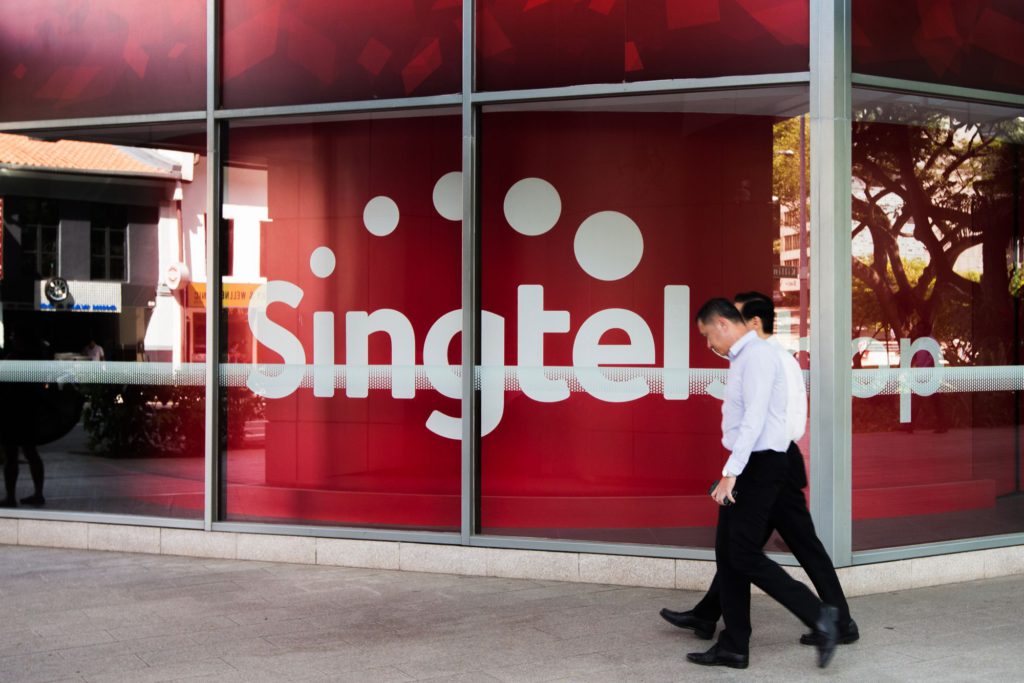
Hackers Target SingTel’s Dialog Unit After Huge Optus Breach

(Bloomberg) — A second Australian business owned by Singapore Telecommunications Ltd. suffered a cyberattack, compounding the data-security crisis at the company following the huge data breach at mobile-phone operator Optus.

A hack on technology consulting company Dialog, which SingTel bought earlier this year, may have accessed data on fewer than 20 clients and 1,000 current and former staff, according to a Dialog statement issued by SingTel on Monday. Dialog found out on Oct. 7 that a “very small sample” of its data, including personal employee information, had been published on the so-called Dark Web. The attack itself took place almost a month earlier, on Sept. 10.

A second hack at a SingTel-owned business raises questions about cybersecurity at the broader group, the timeliness of breach disclosures, and whether the Singapore parent is being deliberately targeted.

Another Australian subsidiary of SingTel, Optus, last month revealed a vast security breach had exposed details of 9.8 million former and current customers in one of the country’s biggest-ever hacks. More than 2 million people had identity document numbers compromised, triggering concerns about widescale financial fraud.

Read more: Giant Optus Hack May Swallow a Quarter of Singtel Profits

A subsidiary of SingTel, NCS, announced the acquisition of Dialog in March for A$325 million ($207 million). Dialog’s systems are completely independent from those of SingTel, NCS and Optus, and there’s no evidence that the two recent incidents are linked, SingTel said.

According to Dialog’s website, the firm’s clients include some of Australia’s biggest and best-known companies. They include National Australia Bank Ltd. and airline Virgin Australia, as well as several state and federal government departments.

“We are doing our utmost to address the situation and, as a precaution, we are actively engaging with potentially impacted stakeholders to share information, support and advice,” Dialog said in its statement.

The hacks threaten to become an expensive lapse for the Singapore company. Optus is already paying for replacement drivers licenses and passports, and total costs including bills and fines could stretch into hundreds of millions of dollars, according to some estimates.

More stories like this are available on bloomberg.com

©2022 Bloomberg L.P.
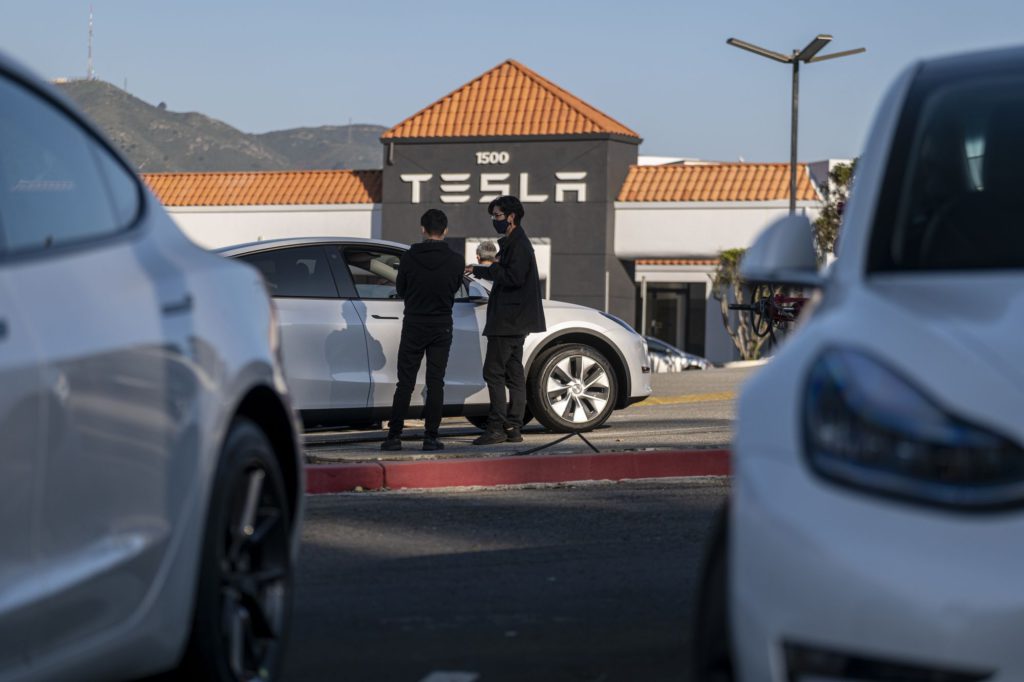
Tesla’s Week to Forget Was Anchor Weighing On S&P 500

(Bloomberg) — For all the stock market gyrations last week, one company’s performance stands out beyond all others: Tesla Inc.

Tesla’s stock has plunged 16% over the five sessions, marking its worst week since March 2020’s Covid-stricken market selloff. Meanwhile, the S&P 500 Index recorded its best week in a month, closing up 1.5% on the strength of powerful rallies last Monday and Tuesday. Tesla was by far the biggest weight on the S&P this week, knocking about 13 points off the index. 

The EV-maker’s issues are no secret. It has been battered by the one-two punch of disappointing quarterly deliveries and Chief Executive Officer Elon Musk’s surprise decision to revive his offer to buy social-media platform Twitter Inc. The Twitter deal comes with the possibility that Musk will be forced to sell Tesla shares to finance the deal. 

For ardent Tesla fans like ARK Investment Management’s Cathie Wood, the selloff offers a chance to buy more of the stock at its cheapest price in months. The growth-stock guru, whose funds have been hit hard this year amid soaring inflation and rising interest rates, snapped up shares worth about $32 million on Monday. Mom-and-pop traders were also big buyers, with nearly $540 million in net purchases over the past five trading days, Vanda Research said.

On the flipside, there are more cautious investors, who say the stock has several hurdles to navigate before finding a clear runway. A looming recession, growing threat of competition, a wary consumer squeezed by high inflation and the stock’s expensive valuation are the biggest worries. 

Musk’s Focus

“Will Tesla’s stock retain a halo effect and prosper while other high growth, high valuation stocks suffer? It hasn’t so far this year,” said Catherine Faddis, chief investment officer of Grace Capital. 

Musk’s purchase of Twitter adds a few more wrinkles. In addition to the uncertainty around the deal’s financing, investors are also worried that the billionaire could be pushing himself beyond his limits with so many demanding ventures.

“Musk will need to ‘justify’ the valuation he paid for Twitter by generating value as soon as possible, this will take his time and focus away from running Tesla,” said Brian Mulberry, client portfolio manager at Zacks Investment Management. “Musk may be a genius businessman, but he is still a human being and a day is still only 24 hours long.” Zacks owns Tesla stock through its All-Cap Core fund.

Meanwhile, even with this selloff, Tesla continues to tower over Big Tech and most of the S&P 500 with its eye-watering valuation. Tesla shares are trading at 40 times the company’s estimated forward earnings. By comparison, the S&P 500 trades at an average of 15 times, and Apple trades at 23 times.

All that being said, there is a reason why Tesla has such a lofty valuation. It’s about the future. Tesla’s dominating position in the still nascent and fast-growing EV market makes it dangerous to bet against, particularly in a global economy that will soon be powered by green energy. And Musk, for all the distractions pulling at him, is committed to making the company a success.

“Tesla is unique among US big tech right now because it has a much clearer fundamental growth trajectory than any other name. It also has the largest ‘key man’ risk of any stock in the S&P 500,” said Nicholas Colas, co-founder of DataTrek Research. “Musk’s attention to Tesla is worth a lot to many investors.”

(Corrects to say $32 million in the fourth paragraph.)

More stories like this are available on bloomberg.com

©2022 Bloomberg L.P.
Covid’s Shadow Looms Large Over Any Post-Holiday China Gains

(Bloomberg) — Chinese traders returning from the Golden Week holiday are set to face a raft of conflicting signals, mitigating the market’s chances of playing catch-up to the small advance seen in global stocks.

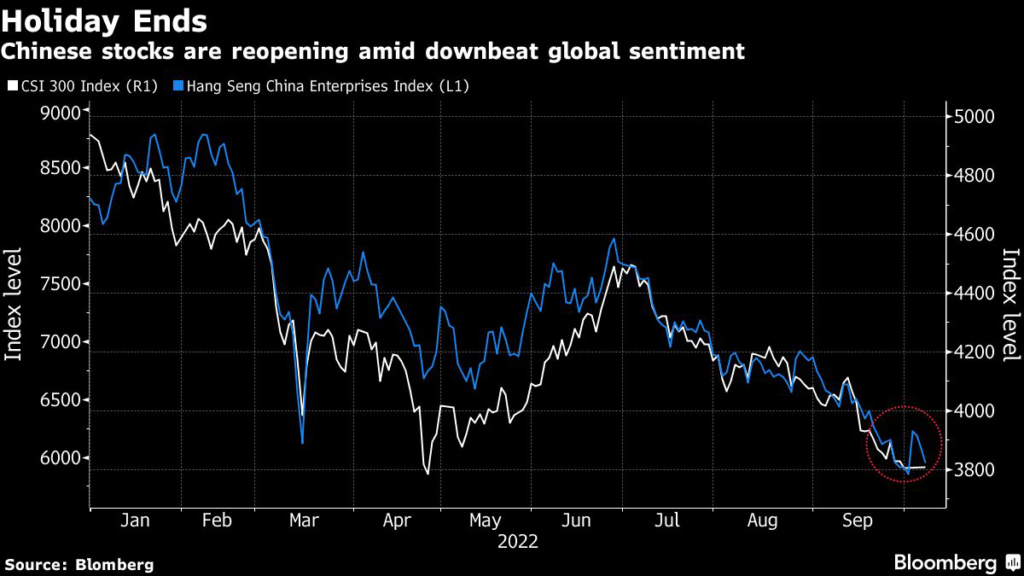
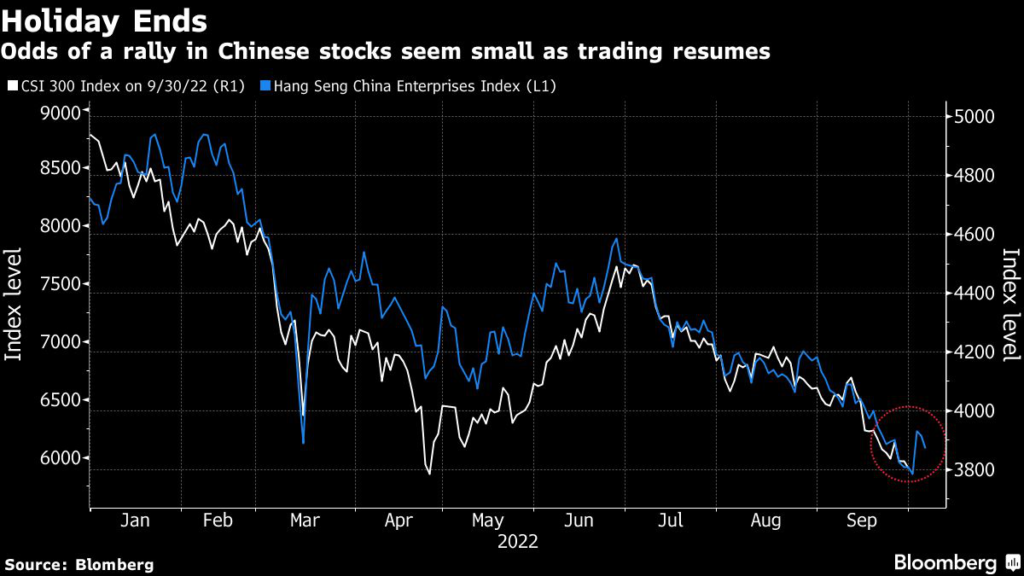
Having started last week with its best two-day rally since April 2020, a gauge of world equities finished the period with a gain of just 1.7% as Friday’s solid US jobs figures sent shares tumbling again on renewed bets for aggressive Federal Reserve rate hikes. While the Hang Seng China Enterprises Index of Chinese stocks in Hong Kong is up nearly 3% since onshore shares last traded at the end of September, it closed before Friday’s US data. The offshore yuan has had a tiny weekly gain versus the dollar.

Traders in China will also find it hard to ignore the grim reality facing the world’s second-biggest economy, with data Saturday showing services activity contracted for the first time in four months. Other trends last week showed a sharp slide in holiday spending, a rebound in virus cases and no respite from the property crisis. The CSI 300 Index, mainland China’s equity benchmark, went into the weeklong break near its lowest since April 2020.

READ: Amundi Slashes China Stocks Citing Covid and Housing Problems

Tensions with the US remain to the fore with China criticizing expanded restrictions on its access to semiconductor technology, which were announced by President Joe Biden’s administration on Friday.

Meanwhile, the upcoming Communist Party Congress will likely keep some hopes alive for further policy stimulus, especially as consumer demand continues to weaken in the face of Covid curbs. Bloomberg Intelligence expects consumer, tech, auto, transportation and infrastructure sectors to be among the potential beneficiaries.

“The focus will be back to China specific challenges – Covid Zero and the ailing property market,” said Hao Hong, Hong Kong-based partner and chief economist at Grow Investment Group.

READ: China Traders See Property Boost, Covid Zero Resolve at Congress

Here is what to watch out for markets when trading resumes Monday: 

Equities 

Traders will be assessing the economy’s recovery momentum from spending data during the holiday, which doesn’t offer a lot of encouragement. Travel plans have been disrupted as several cities were locked down and visitors stranded following Covid flareups at tourism spots.

Tourism revenue declined 26% to 287 billion yuan ($40.3 billion) over the week-long holiday from a year ago. Compared with pre-pandemic levels in 2019, revenue was down nearly 56%, and even worse than last year’s 40% decrease from 2019 levels, according to figures from the official social media account of the Ministry of Culture and Tourism.

Roughly 422 million trips were taken, down 18% from last year and 39% from 2019 levels.

READ: China Shows Soft Travel Trend During Golden Week Holiday: Citi

Without firm conviction of a market bottom, traders will be hesitant to build positions ahead of the twice-a-decade political gathering that starts Oct. 16, where leadership will be confirmed and key policies unveiled. The CSI 300 has fallen 23% in 2022, heading for its first back-to-back annual declines in a decade.

There’s been some “bottom fishing and short covering, especially for reopening names, but very limited new position building given so many false starts this year,” said Xiadong Bao, fund manager at Edmond de Rothschild Asset Management in Paris. “Skepticism and wait-and-see attitude is the mainstream mentality for foreign investors.”

READ: Wall Street Desire for Xi to Pivot to Growth Faces Reality Check

Yuan Fixing 

The offshore yuan capped a small gain last week after seven weeks of declines. That could lend some support to the onshore currency, which touched the lowest since 2008 before the holiday.

Traders will be closely watching the People’s Bank of China’s daily yuan fixing at 9:15 a.m. in Beijing. The central bank had set a record run of stronger-than-expected fixes prior to the holiday in order to curb the currency’s selloff.

A weakening yuan, coupled with a reversal in yield gap between the US and China following a series of Fed hikes, has spurred concerns over capital outflows. China’s forex reserves as of end-September fell to the lowest since 2017.  

“The drop in mobility during the National Day holidays could translate into weaker retail sales, but yuan bears could be reined in not just by the PBOC’s guidance but also on anticipation of any other significant growth-boosting policy shifts from the Party Congress,” said Fiona Lim, foreign exchange strategist at Malayan Banking Bhd in Singapore.   

Credit Slump 

China’s offshore credit saw renewed panic selling while onshore traders were away, as a slump in dollar notes of CIFI Holdings Group Co., the nation’s 15th-largest developer by contract sales, tested market confidence.

Investors are focusing on further indication from CIFI on how it can address debt issues. The firm had its ratings cut by Moody’s Investors Service on refinancing risks. 

Bondholders are also seeking more details from previous support measures, including an urge from China’s top financial regulators to six major banks to offer financing support to the real-estate sector.

That delivered a short-term boost in sentiment but isn’t “sufficient to support the market,” said Andy Suen, a portfolio manager and head of Asia ex-Japan credit research at Pinebridge Investments Asia Ltd. “We remain very defensive in our positioning in the sector.”.

(Updates with services data, US semiconductor tensions.)

More stories like this are available on bloomberg.com

©2022 Bloomberg L.P.

KKR-Backed Livspace Sets Aside $100 Million for Acquisitions

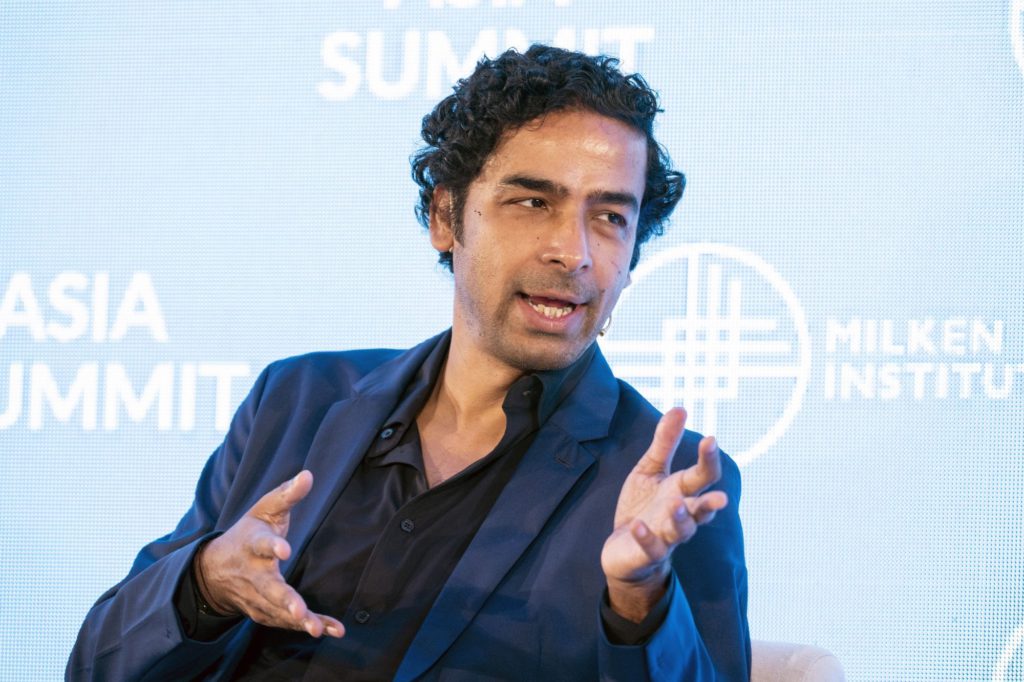
(Bloomberg) — Livspace, a home interiors and renovation platform backed by KKR & Co. and Goldman Sachs Group Inc., is setting aside $100 million for acquisitions to fuel expansion across India, Singapore, Malaysia and the Middle East.

The Singapore-based startup is in active discussions with eight to nine companies as it hunts for assets that would help the company generate growth and accelerate its path to profitability, Livspace Chief Executive Officer Anuj Srivastava said.

“This is our strategy to expand the market size and the profitability profile of the company,” Srivastava said in a joint interview with Ankit Shah, a former Goldman Sachs executive director who joined Livspace as chief strategy officer earlier this year. Its consolidation strategy will help put Livspace “on clear path to profitability for our core business over the next 12 to 18 months,” the CEO said. 

The move comes after Livspace raised $180 million in a funding round that valued the company at more than $1 billion. The Series F round was led by KKR and drew in existing investors including Ikea-parent Ingka Group Investments, Jungle Ventures, Venturi Partners and Peugeot Investments.

Of the potential targets, Livspace is likely to end up acquiring about three to four companies, rather than taking a small stake in a bunch of companies, the two executives said.

“Our plan is to do less but do it well,” said Shah, who will spearhead the company’s acquisition efforts. “It gives us more opportunity to truly act as a consolidation platform and acquire some of these capabilities in a strategic way.”

More stories like this are available on bloomberg.com

©2022 Bloomberg L.P.

Close Bitnami banner
Bitnami