Bloomberg

South Africa’s SARB Says No Impact From Reported Cyber Breach

(Bloomberg) — The South African Reserve Bank said there had been no impact from a reported breach of its systems four months ago.

The central bank received information from state agencies and private security service providers in August about a “possible breach” and acted in accordance with its protocols, it said in an emailed response to questions on Wednesday. The bank hasn’t previously issued a statement on the incident.

“There was no impact on our systems and our operations,” it said.

Finance Minister Enoch Godongwana told delegates at a gathering of Eastern Cape provincial leaders late last month that the central bank was hacked on Aug. 12.

“The minister of finance, in accordance with the constitutional practice of receiving operational updates from the bank, was informed of the attempted breach of the South African Reserve Bank’s computer systems and that there was no impact on the SARB’s systems or operations,” Finance Ministry spokesman Mfuneko Toyana said Wednesday in an emailed response to questions.

The Bank of Zambia suffered a cyber attack in May. The breach caused minimal damage to its systems and the bank refused to pay a ransom to the group behind the hack, it said at the time.   

–With assistance from S’thembile Cele and Monique Vanek.

More stories like this are available on bloomberg.com

©2022 Bloomberg L.P.

Dutch Minister Warns Economy Is Hitting Wall on Emissions, Space

(Bloomberg) — Dutch growth has “hit a wall” because of nitrogen emissions and a lack of space as the Netherlands seeks to reduce the environmental impact of its economy, Finance Minister Sigrid Kaag said.

The world’s second-largest agricultural exporter will need to accelerate a shift toward high-tech jobs, boost affordable housing and attract more business investment over the next decade, she said in an interview with Bloomberg News.

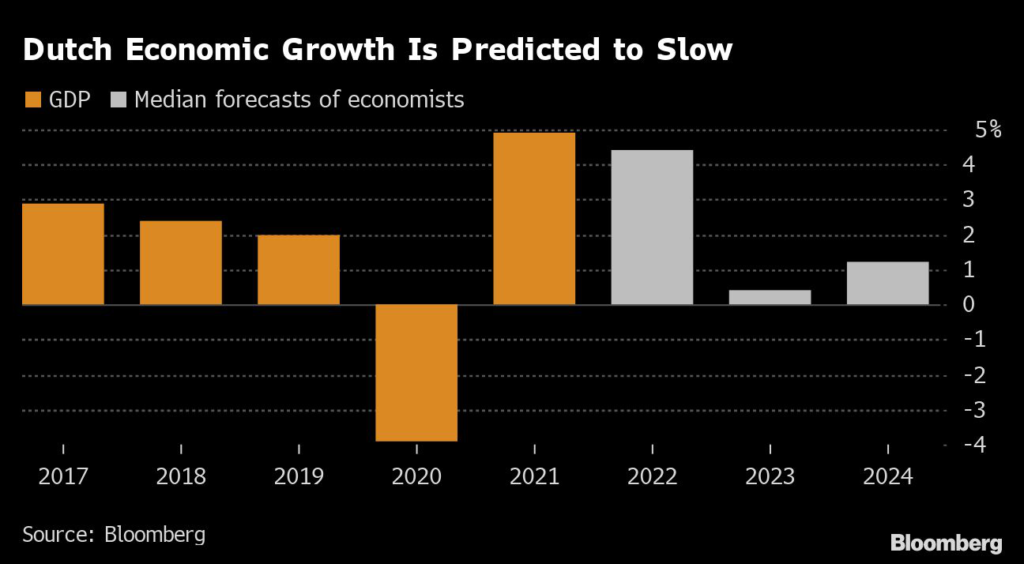
“We’ve hit a wall in terms of current possibilities due to nitrogen, CO2 emissions and space,” Kaag said at her office in The Hague. Economists predict growth in output will slow to 4.4% this year and 0.4% in 2023, following a post-pandemic rebound to 4.9% in 2021.

The Netherlands, where farming takes up close to three-fifths of the country, had agricultural exports of €105 billion ($110 billion) last year, according to an estimate from Wageningen University. Cattle and fertilizers are key sources of nitrogen emissions, and the country is already breaching limits set by the European Union.

The Dutch government wants to transform its agricultural, transportation and construction sectors to meet a goal of halving emissions by 2030, and plans to buy out thousands of farmers to free up land. This could lead to a one-third drop in livestock over eight years.

Read more: Dutch No Longer Want to Be One of World’s Top Agro Exporters

Kaag said the Netherlands’s growth strategy must focus more on technology and a highly skilled labor force. The country is already home to ASML Holding NV, the world’s biggest manufacturer of chipmaking machines and Europe’s most valuable tech stock.

“We’re clearly trying to sustain an investment climate that’s attractive for a wide range of companies to either invest here or stay here,” she said. “But we need to make very difficult choices and we need to do it in a way that the majority of people not only understand but also support because they know we cannot incur a climate debt.”

The country became engulfed in months of protests by farmers after the government presented plans to reduce emissions in June.

Fossil Fuels

Asked about EU efforts to wean itself off Russian fossil fuels, Kaag said the Netherlands is against joint borrowing to accelerate the transition to cleaner energies.

Member states are negotiating a proposal, known as REPowerEU, to use as much as €220 billion of unused loans from the bloc’s pandemic recovery fund and €20 billion of subsidies to bolster the EU’s energy infrastructure.

“We’re not convinced that the common reflex is common borrowing or a sovereignty fund,” Kaag said.

–With assistance from William Horobin.

More stories like this are available on bloomberg.com

©2022 Bloomberg L.P.

Corporate America Buys Back Fewer Shares as Recession Fears Rise

(Bloomberg) — US companies are cutting share buybacks to conserve cash in the face of economic uncertainty, which threatens to add another weight to the equity market’s attempted rebound. 

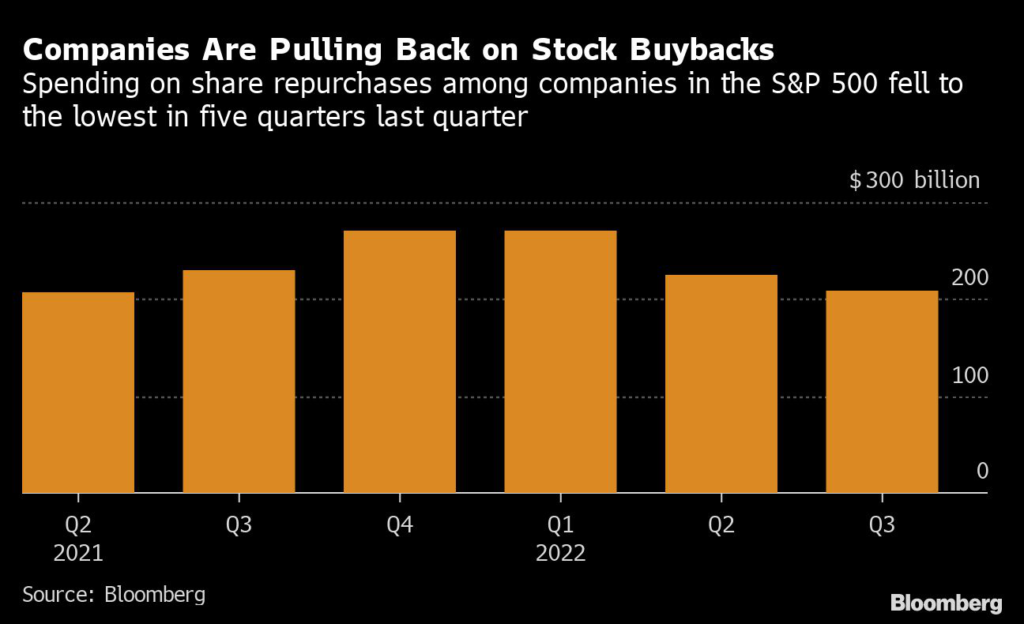
S&P 500 Index firms bought back just over $200 billion of their own shares during the third quarter, marking the slowest quarter for repurchases since the middle of last year and coming in roughly 25% below the levels seen in late 2021 and early 2022, according to data compiled by Bloomberg.

The pullback chips away at what had been a major force in lifting the stock market over the past two years as corporations used surging profits to buy back their own shares. If the trend continues, it would create another headwind for the S&P 500, which is still down 16% this year even after rallying back sharply from its mid-October low.

“Buybacks can be a significant driver of market returns, especially in the large cap sector,” said Phil Blancato, the chief executive officer at Ladenberg Thalmann Asset Management. “This would be another component of softer returns for 2023.”

The communication-services industry was among the biggest decliners in share repurchases during the third quarter, with companies such as Facebook owner Meta Platforms Inc. seeing revenue drop as businesses scale back on digital advertising. Consumer discretionary and technology companies including Amazon.com Inc. and Microsoft Corp. also reduced their buybacks, outweighing an increase from the energy sector.

The moves reflects mounting anxiety that growth will stall because of the Federal Reserve’s most aggressive interest-rate hikes since the 1980s. It also signals an effort to prioritize spending, with companies seeking to protect dividend payments, which rose 9% to nearly $600 billion over the past year.

Already, some companies are trying to figure out how best to slice up a shrinking cash pie. Goldman Sachs Group Inc. Chief Executive Officer David Solomon said this month that management teams have to prepare for “bumpy times ahead,” and several big banks recently joined technology giants like Meta and Amazon.com in reducing their payrolls. 

Morgan Stanley is cutting about 1,600 jobs, or about 2% of its global workforce. And Goldman plans to eliminate hundreds of jobs, moving beyond its annual weeding out of underperforming workers.

Buybacks are a far less disruptive cost to cut than headcount. With the housing market hit by rising rates, RH, the luxury furniture maker, repurchased 87% fewer shares in the third quarter than in the second quarter, according to regulatory filings. When asked about the decision on the company’s Dec. 8 earnings call, CEO Gary Friedman said it was a prudent way to brace for a slowdown. 

“When you’re going into a kind of a storm that you haven’t seen before, you don’t want to spend all your fuel before you can see the shore,” he said. “When we have a better view of the shore then we’ll make the right decisions.”

–With assistance from Tom Contiliano.

More stories like this are available on bloomberg.com

©2022 Bloomberg L.P.

Meta Accused in Lawsuit of Amplifying Hate Speech in Africa

(Bloomberg) — Meta Platforms Inc. has been accused of amplifying hate speech and inciting violence on Facebook in Africa, in a lawsuit filed in Kenya’s high court that’s calling for about $2 billion in restitution.

The case was brought by Ethiopian researchers Abrham Meareg and Fisseha Tekle, along with Kenyan human rights group Katiba Institute, and supported by legal nonprofit Foxglove. Meareg’s father, chemistry professor Meareg Amare, was shot and killed outside his home last November after a series of hateful posts targeted him for attack, the court filings state.

The petitioners argue that the public needs protection from Facebook’s “woeful failure to address violence on its platform” and its design that “promotes and prioritizes hateful, incitement and dangerous content,” according to court filings seen by Bloomberg News.

Meta, which generated revenue of $117.9 billion in 2021, uses a recommendation algorithm on Facebook that promotes content that users are more likely to interact with in order to hold people’s attention. This allows people to be served more ads so the company can maximize revenue, according to the court documents.

“Content that promotes violence can and does translate to violence off-line,” the documents state.

Meta says it invests in enforcing its rules against hate speech and incitement of violence. 

“Feedback from local civil society organizations and international institutions guides our safety and integrity work in Ethiopia,” the company said in a statement. “We employ staff with local knowledge and expertise and continue to develop our capabilities to catch violating content in the most widely spoken languages in the country, including Amharic, Oromo, Somali and Tigrinya.”

Moderate Content

The petitioners want Meta to invest more heavily in content moderation focused on Africa, Latin America and the Middle East, particularly in countries that are “vulnerable to war, conflict, ethnic cleansing and genocide,” the court filings state. They also call on Meta to provide better pay and working conditions to content moderators focused on those regions and set up a restitution fund of 250 billion Kenyan shillings (about $2 billion) for victims of hate and violence incited on Facebook.

There is precedent in international and human rights law to hold anyone responsible for spreading hate and inciting violence, Foxglove director, Cori Crider, said in an interview, citing a judgment against a state broadcaster in a case about the 1994 Rwanda genocide. 

She said that Facebook played a similar role to what radio did in Rwanda during the genocide, and is potentially even more dangerous as it has wider reach than a broadcaster for instance. “With radio you have to be within the broadcast distance, where with Facebook people from the diaspora and keyboard warriors are able to incite violence and attacks in Ethiopia from afar, that still has real world effects – so if anything it is more dangerous,” said Cider. 

In a sworn affidavit, Maereg argues that reports to Facebook about hate speech related to the civil war in Ethiopia, particularly against Tigrayans such as his family, were not acted on. He mentioned a specific post where a photo of his father was posted in October 2021 along with a message making unfounded accusations, that attracted comments calling for violence against him.

Ethiopia Attack

“My father was killed because posts published on Facebook identified him, accused him falsely, leaked the address of where he lives and called for his death,” Maereg wrote in the affidavit.

He added that he received no response from Meta until Nov. 11, 2021, over a week after his father’s murder. Facebook responded that the post would be removed for violating community standards, he said.

The Tigray war is an armed conflict that started in November 2020, and is being fought between the Ethiopian government and the Tigray People’s Liberation Front. In 2020, Tigray held its own regional elections that the Ethiopian government considered to be illegal, and responded by slashing federal funding to the region, which ultimately led to the war.

The lawsuit follows similar allegations made against Meta by human rights groups about Facebook’s role in inciting violence in Myanmar that contributed to the Rohingya genocide. Meta commissioned an independent report in 2018 that found that the company wasn’t doing enough to prevent its platform from being used to “foment division and incite offline violence.”

In December 2021, Rohingya refugees filed a class-action lawsuit in San Francisco and a related action in the UK seeking $150 billion in compensation for Meta’s role in amplifying hate speech.

–With assistance from Marissa Newman.

(Update with comments from Foxglove director in ninth paragraph)

More stories like this are available on bloomberg.com

©2022 Bloomberg L.P.

Billionaire Agarwal Struggles to Get Backers for $19 Billion Chip Unit

(Bloomberg) — Billionaire Anil Agarwal is struggling to find financial backers for a planned semiconductor factory in India with an investment of as much as 1.54 trillion rupees ($18.6 billion), according to people familiar with the matter.

Agarwal’s representatives met with large funds from the Middle East, Singapore, and the US over the past three months to garner financing commitments for the manufacturing business, the people said, asking not to be named as the information is not public. All the funds gave the opportunity a pass leaving them with almost no backers for the project, they said, without providing further details.

The tycoon had announced in September that his Volcan group had joined forces with Hon Hai Precision Industry Co., the assembler of most of the world’s iPhones, to build a chipmaking facility in the state of Gujarat. The partners, with little experience running large chip operations, were betting on rising semiconductor demand while announcing the plan.

Volcan Investments Ltd., the family trust of Agarwal, is not looking for any external investors to finance the semiconductor and display project, its spokesman said in an emailed statement. It didn’t respond to questions about whether the company had sought overseas funding.

The investors to whom Agarwal pitched the plan raised concerns about the group’s limited experience in the sector, and its stretched financial situation, the people said. 

While Agarwal had initially tweeted that Vedanta Ltd., his India unit, was making the chip plant investments, he backtracked a few days later to say that the manufacturing business would fall within the purview of Volcan.

To be sure, the venture plans an initial investment of $2 billion for the plant that is expected to be set up in two years. The Indian government is also offering to bear half the costs for such projects under a production incentive plan.

While Vedanta Ltd. boasts an investment-grade rating, Moody’s Investors Service classifies its majority owner, Vedanta Resources Ltd., as high-yield. Volcan is the ultimate parent of both entities.  

–With assistance from Swansy Afonso and Sankalp Phartiyal.

(Updates fourth graph with comment from the company.)

More stories like this are available on bloomberg.com

©2022 Bloomberg L.P.

Olaplex’s ‘Broke My Hair’ Problem Is a TikTok Cautionary Tale

(Bloomberg) — It was the opposite of the celebrity endorsements typical of social media. Earlier this month, Kristin Cavallari went on Instagram to tell her 4.5 million followers why they shouldn’t use one of the trendiest products out there.

“This is not an ad — at all,” the 35-year-old reality-TV actress turned beauty influencer and entrepreneur said in a video. Her target was Olaplex, the hair-care brand that has had a rapid rise in popularity thanks in part to rave reviews from celebs like her.

“I was using it too much, and it literally broke my hair,” said Cavallari, who declined to comment for this story. “That has happened to other people, so if you’re using it, just be careful,” she said before recommending another product.

While the company says its offerings don’t damage hair, Cavallari’s post encapsulates the reputational challenge facing Olaplex, a once high-flying brand that has seen its stock collapse 80% this year — erasing $15 billion in market value — amid rising competition and a selloff in equity markets.

That drop came after the firm, based in Santa Barbara, California, raised $1.55 billion in an initial public offering in September 2021, which was the biggest in the US consumer-goods sector in two decades, according to data compiled by Bloomberg.

Social media played an outsize role in Olaplex’s success. An unpaid endorsement by Kim Kardashian about a year after the company’s founding in 2014 ignited online attention that it has maintained in its pitch to investors — its filing to go public last year touted metrics such as TikTok hashtag views (317 million).

That accelerant, however, has turned Olaplex into a cautionary tale about the volatile power of social media to lift a brand up — and then drag it back down.

A post on TikTok in February falsely claimed an Olaplex product was being banned in Europe for containing an ingredient that could cause infertility. The company tried to ease fears by saying that it was an inactive ingredient that didn’t pose a risk, and had been removed as a precaution.

But that did little to slow social media chatter.

“You live by the sword, you die by the sword,” said Jim Stengel, a consultant and former Procter & Gamble chief marketing officer. The downside of social media is that “you don’t have control.”

The online disillusionment with Olaplex has continued and shifted to performance, with complaints about hair that feels like straw and worse.

A Facebook group where users discuss hair damage they attribute to Olaplex has amassed 3,000 members since cropping up in July. Published content includes photos of clumps of hair they say they’ve lost and screenshots purportedly showing the company’s response to refund requests. Some have said they’ve spoken with lawyers and are considering legal action.

Olaplex didn’t make any executives available for this story. In a statement, it said tests in-house and by independent labs showed no evidence that the products cause hair loss or breakage. The company declined to share copies of that research.

“We recognize that experiencing hair loss and hair breakage can be distressing, and we empathize with those who have endured it,” Olaplex said. “We remain confident in the evidence showing that Olaplex products are safe and effective.”

Joe Schwarcz, a chemist and director of McGill University’s Office for Science and Society, said he doesn’t see anything in Olaplex that would cause the damage described in the complaints. The company’s bond-building claims make sense in theory, according to Schwarcz.

Leslie Simon, a 43-year-old living in Denver, is a member of the Facebook group and said that when she started using Olaplex’s shampoo and oil at the beginning of this year it initially made her hair stronger. But then her locks started falling out. Doctor visits didn’t yield answers. Bloodwork came back clean. Next, a chunk of hair broke off and her scalp felt like it was burning. Desperate for answers, Simon stopped using Olaplex products in August, and her hair bounced back in a couple of months, she said.

“At one point in the shower, it was like handfuls were just slipping right out of my hair,” Simon said. “They need to be accountable.”

Olaplex is often credited with creating a new category of products that repair damaged hair. Sales hit $150 million in 2019 when private equity firm Advent International led an acquisition of the company, touting it as one of the “highest-engagement hair-care brands on social media.”

Stylists were the initial fans, but when salons closed during the pandemic, Olaplex’s growth accelerated as sales to consumers through retailers and its website jumped. With annual revenue on pace to more than double to nearly $600 million in 2021, the company went public. (Advent, which declined to comment, still owns about 77% of the shares, according to filings.)

Analysts liked Olaplex’s patented formulas and devoted customers. JuE Wong, a veteran of the cosmetics industry who joined in 2020 as chief executive officer, didn’t waste time reminding investors of the brand’s online buzz, saying during her first earnings call that it was the “No. 1 prestige hair-care brand on social media.” The company’s market value surpassed $19 billion at the start of this year.

But the honeymoon didn’t last long. Piper Sandler analyst Korinne Wolfmeyer conducts a quarterly survey of Olaplex-certified hairstylists. In September, she flagged that about 40% of stylists had heard negative reviews from clients, mainly regarding dryness and breakage. She downgraded Olaplex’s shares to the equivalent of a hold rating later that month, citing misinformation and competition as increasing risks.

The next month, Olaplex slashed an annual sales forecast it had reiterated 10 weeks earlier and cast a wide net of blame, including competition and a weakening economy. The stock sank by 57% in a day to $4.24 — about one-fifth of its IPO price. Analysts now expect sales to decline 20% this quarter.

Piper’s latest survey showed that the percentage of respondents ranking Olaplex as their top hair treatment also dropped, while competitors such as K18 gained. “We are starting to struggle to view it as the clear category leader it once was,” Wolfmeyer wrote in a research note this month.

To better inform consumers, Olaplex plans to send representatives to the 75 top-performing stores at retail partners Sephora and Ulta. (The brand is in a total of about 1,800 locations at those chains.) It’s to “really debunk any myths, help educate the beauty consultants and also engage with consumers,” Wong said at an investor conference last week.

Social media has become an essential part of marketing, with brands paying so-called influencers to promote products online. If done well, that paid content leads to others sharing and creating their own posts. That multiplier effect helped Olaplex keep a lid on ad spending. But the risk is that online buzz is volatile. Olaplex pointed out as much in its IPO filing, saying that failure to respond to the “accelerated impact of social media could adversely impact our business.”

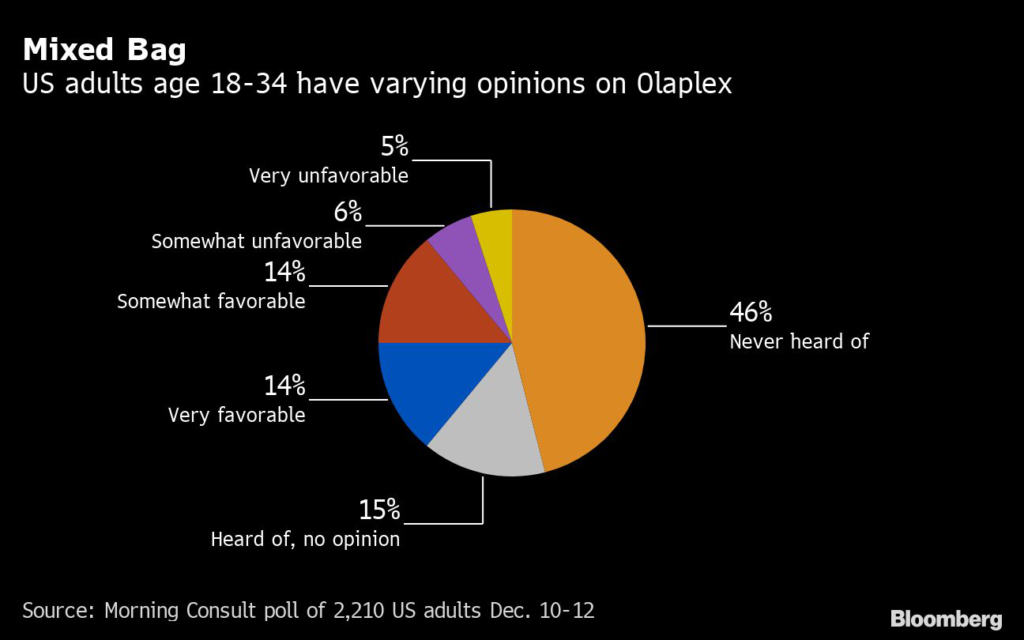
The company, however, does have room to win over consumers in the US, according to a recent survey by Morning Consult commissioned by Bloomberg. Among adults ages 18-34, about 60% didn’t know the brand or had no opinion of it. Meanwhile, only 11% had an unfavorable view.

An underlying problem is that there’s a mishmash of advice about how to use Olaplex’s offerings. The company says that its products repair all types of hair damage, and that its lineup is suitable and beneficial for all hair types.

Meanwhile, interviews with a handful of clerks and stylists at stores that sell the brand provided diverging advice. Some advised anyone could use the treatments, while others cautioned that only people with chemically treated hair should consider them. One said that shoppers were overusing the products.

Holly Reardon, 25, had been bleaching her hair since high school when she saw women online touting Olaplex’s ability to transform their locks. She followed advice from social media and began leaving Olaplex’s No. 3 treatment, its best-selling item, in her hair for a few hours at a time. The company recommends using the product for at least 10 minutes, and that it’s more effective when left on up to 90 minutes.

Reardon, who also used other Olaplex products, noticed an improvement but after a year said her hair felt like “hay.” In March, she posted a video on TikTok, where she has 147,000 followers, saying, “I have a very controversial statement, but I’m just gonna go for it. I think Olaplex ruined my hair.”

The Boston resident stopped using Olaplex and focused on hydrating products, which along with a haircut and returning to her natural brunette hue have helped. After her Olaplex experience, she’s also now a bit more skeptical.

“I definitely think social media can lead people astray.”


More stories like this are available on bloomberg.com

©2022 Bloomberg L.P.

US Futures Swing Amid Caution Over Fed Response: Markets Wrap

(Bloomberg) — US equity-index futures fluctuated between gains and losses as investors debated whether inflation had eased enough to encourage the Federal Reserve to slow monetary tightening.

Contracts on the S&P 500 and Nasdaq 100 index rose about 0.1% each after Tuesday’s rally in US stocks on the back of a fifth month of decline in consumer-price growth. Treasuries rallied for a second day, while the dollar slipped. The Stoxx Europe 600 Index dropped for the second time in three days. Charter Communications Inc. declined 5.8% in premarket New York trading amid concern its capital-spending plan may crimp cash flow.

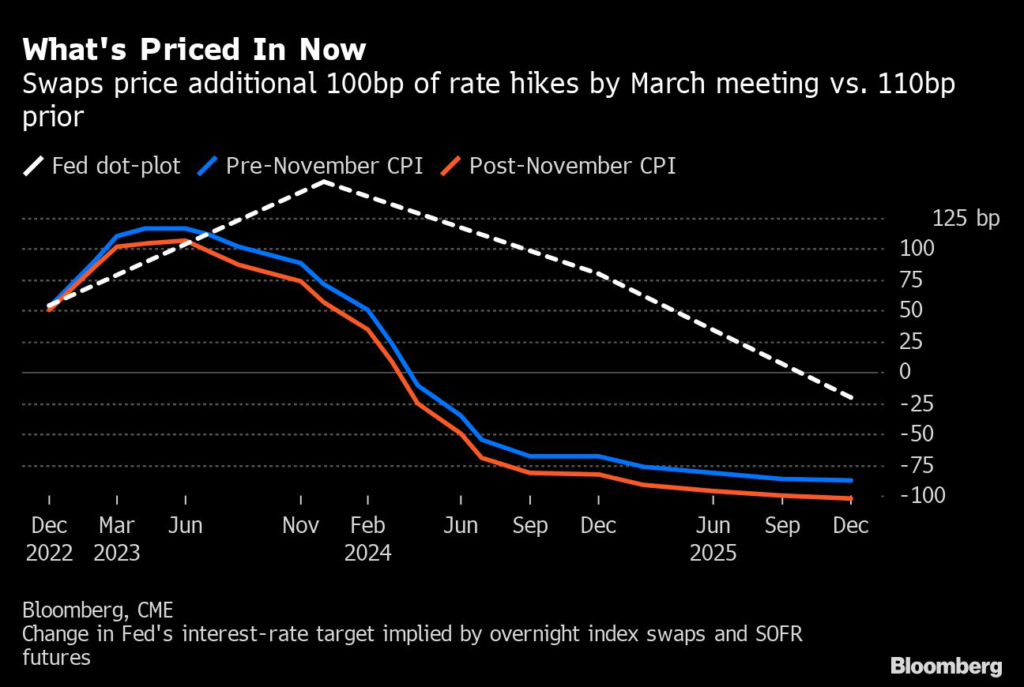
While a softer-than-expected figure for US consumer price index stoked a rally across stocks and bonds, the gains were tempered by caution that the Fed may still remain resolute on continuing rate hikes. After a 50 basis-point increase in Fed’s policy rate later Wednesday was firmly priced in, traders remained on the edge over what signals policymakers may offer on when the hikes will stop and whether a rate cut is possible next year.

“The question is, with inflation still at generational highs, will the Fed walk through that door?” Stephen Innes, managing partner at SPI Asset Management, wrote in a note. “After an initially high-spirited response, the relatively muted reaction for stocks is likely attributable to pre-risk event positioning, prevailing bearish growth sentiment, technical factors and the devil in the details.”


Europe’s equity benchmark fell after posting the biggest single-day advance since Nov. 10 as caution prevailed over Fed’s messaging later in the day as well as expectations for rate hikes by the European Central Bank and Bank of England on Thursday.

Treasuries with shorter-term maturities posted the biggest gains Wednesday. The two-year and five-year rated shed 4 basis points each. Traders are betting that the Fed, after today’s move, will opt for 50 basis points more of hikes, and then an equivalent-sized cut by the end of next year.

Charter Communications Inc., the second-largest US cable TV provider, fell in early trading after saying it will spend $5.5 billion to bring higher-speed broadband connections to customers. Higher capital expenditure and lower cash flow create near-term uncertainty, yet expanding the footprint could fuel subscriber growth, Bloomberg Intelligence analysts said.

In the UK, the pound traded near the strongest level since June. Inflation in the country fell from a 41-year high in November, raising the possibility that the worst of the cost-of-living squeeze is over. A gauge of the dollar’s strength traded 0.3% lower. 

Shares in Hong Kong, Japan and Australia held advances, nudging the MSCI Asia Pacific index toward a three-month high and a close of 19% above its October low.

Jitters over Fed policy echoed in the oil market, where West Texas Intermediate futures halted a two-day advance. Traders also weighed the demand outlook amid a rapid relaxation of Covid restrictions in China against the effect of new cases on economic activity in the country.

Key events this week:

  • FOMC rate decision and Fed Chair news conference, Wednesday
  • China medium-term lending, property investment, retail sales, industrial production, surveyed jobless, Thursday
  • ECB rate decision and ECB President Lagarde briefing, Thursday
  • Rate decisions for UK BOE, Mexico, Norway, Philippines, Switzerland, Taiwan, Thursday
  • US cross-border investment, business inventories, empire manufacturing, retail sales, initial jobless claims, industrial production, Thursday
  • Eurozone S&P Global PMI, CPI, Friday

Some of the main moves in markets:

Stocks

  • Futures on the S&P 500 were little changed as of 5:39 a.m. New York time
  • Futures on the Nasdaq 100 were little changed
  • Futures on the Dow Jones Industrial Average were little changed
  • The Stoxx Europe 600 fell 0.6%
  • The MSCI World index rose 0.1%

Currencies

  • The Bloomberg Dollar Spot Index fell 0.3%
  • The euro rose 0.3% to $1.0661
  • The British pound rose 0.2% to $1.2395
  • The Japanese yen rose 0.6% to 134.73 per dollar

Cryptocurrencies

  • Bitcoin rose 0.4% to $17,824.45
  • Ether rose 0.2% to $1,322.72

Bonds

  • The yield on 10-year Treasuries declined one basis point to 3.49%
  • Germany’s 10-year yield advanced four basis points to 1.97%
  • Britain’s 10-year yield advanced one basis point to 3.31%

Commodities

  • West Texas Intermediate crude rose 1% to $76.14 a barrel
  • Gold futures fell 0.3% to $1,820 an ounce

This story was produced with the assistance of Bloomberg Automation.

–With assistance from Richard Henderson, James Hirai and Georgina Mckay.

More stories like this are available on bloomberg.com

©2022 Bloomberg L.P.

How 2022 Became A Very Bad Year for Crypto — And Its Biggest Players (Podcast)

(Bloomberg) — Listen to Bloomberg Crypto on the iHeartRadio App, Apple Podcasts or Spotify.

It’s safe to say that 2022 wasn’t the best year for crypto. By late January, Bitcoin had already shed half of its value from its all-time high of nearly $69,000 set in November 2021. Bitcoin’s descent accelerated after the first major crisis of this year — the collapse of an algorithmic stablecoin called TerraUSD. The implosion of what was once considered an ambitious experiment for decentralized finance, or DeFi, sent shockwaves through the industry, ultimately triggering the collapse of crypto hedge fund Three Arrows Capital as well as crypto lenders Voyager Digital and Celsius. 

It started to feel a bit like the Hunger Games — crypto CEOs and other senior executives racing for the exit, true believers getting into Twitter fights about whether centralization was the real enemy, all against a backdrop of conferences and parties where people tried to rekindle enthusiasm for their Bored Ape non-fungible (NFT) collections. Then there was the stunning collapse of one of the most significant crypto exchanges in the sector, FTX, and the resignation of its 30-year-old CEO Sam Bankman-Fried. It’s been quite the year. And 2022 isn’t even over yet.

In this episode — a breakdown of this year’s biggest stories with Bloomberg reporters Vildana Hajric and Emily Nicolle, with key takeaways and a look ahead to next year.

Subscribe to the Bloomberg Crypto Newsletter at https://bloom.bg/cryptonewsletter 

This podcast is produced by the Bloomberg Crypto Podcast team: Supervising producer: Vicki Vergolina, Senior Producer: Janet Babin, Producers: Sharon Beriro and Muhammad Farouk, Associate Producers: Mo Andam and Ty Butler. Sound Design/Engineer:  Desta Wondirad.

More stories like this are available on bloomberg.com

©2022 Bloomberg L.P.
Equity Rally Fizzles as Caution Over Fed Dominates: Markets Wrap

(Bloomberg) — US equity-index futures traded weaker as investors debated whether inflation had eased enough to encourage the Federal Reserve to slow monetary tightening.

Contracts on the S&P 500 and Nasdaq 100 index fell about 0.1% each after Tuesday’s rally in US stocks on the back of a fifth month of decline in consumer-price growth. Treasuries rallied for a second day, while the dollar slipped. The Stoxx Europe 600 Index dropped for the second time in three days. Charter Communications Inc. declined 4.5% in premarket New York trading amid concern its capital-spending plan may crimp cash flow.

While a softer-than-expected figure for US consumer price index stoked a rally across stocks and bonds, the gains were tempered by caution that the Fed may still remain resolute on continuing rate hikes. After a 50 basis-point increase in Fed’s policy rate later Wednesday was firmly priced in, traders remained on the edge over what signals policymakers may offer on when the hikes will stop and whether a rate cut is possible next year.

“The question is, with inflation still at generational highs, will the Fed walk through that door?” Stephen Innes, managing partner at SPI Asset Management, wrote in a note. “After an initially high-spirited response, the relatively muted reaction for stocks is likely attributable to pre-risk event positioning, prevailing bearish growth sentiment, technical factors and the devil in the details.”


Europe’s equity benchmark fell after posting the biggest single-day advance since Nov. 10 as caution prevailed over Fed’s messaging later in the day as well as expectations for rate hikes by the European Central Bank and Bank of England on Thursday.

Treasuries with medium-term maturities, called the belly of the yield curve, posted the biggest gains Wednesday. The five-year rate shed 4 basis points, while its seven-year counterpart was 3 basis points lower. Traders are betting that the Fed, after today’s move, will opt for 50 basis points more of hikes, and then an equivalent-sized cut by the end of next year.

Charter Communications Inc., the second-largest US cable TV provider, fell in early trading after saying it will spend $5.5 billion to bring higher-speed broadband connections to customers. Higher capital expenditure and lower cash flow create near-term uncertainty, yet expanding the footprint could fuel subscriber growth, Bloomberg Intelligence analysts said.

In the UK, government bonds rallied across the curve, with the two-year yield falling 4 basis points. Inflation in the country fell from a 41-year high in November, raising the possibility that the worst of the cost-of-living squeeze is over. 

The dollar traded 0.3% lower. The New Zealand dollar fell in a decline that accelerated after the government warned a recession was likely next year. 

Shares in Hong Kong, Japan and Australia held advances, nudging the MSCI Asia Pacific index toward a three-month high and a close of 19% above its October low.

Jitters over Fed policy echoed in the oil market, where West Texas Intermediate futures halted a two-day advance. Traders also weighed the demand outlook amid a rapid relaxation of Covid restrictions in China against the effect of new cases on economic activity in the country.

Key events this week:

  • FOMC rate decision and Fed Chair news conference, Wednesday
  • China medium-term lending, property investment, retail sales, industrial production, surveyed jobless, Thursday
  • ECB rate decision and ECB President Lagarde briefing, Thursday
  • Rate decisions for UK BOE, Mexico, Norway, Philippines, Switzerland, Taiwan, Thursday
  • US cross-border investment, business inventories, empire manufacturing, retail sales, initial jobless claims, industrial production, Thursday
  • Eurozone S&P Global PMI, CPI, Friday

Some of the main moves in markets:

Stocks

  • The Stoxx Europe 600 fell 0.6% as of 9:48 a.m. London time
  • Futures on the S&P 500 dropped less than 0.1%
  • Futures on the Nasdaq 100 fell 0.1%
  • Futures on the Dow Jones Industrial Average were little changed
  • The MSCI Asia Pacific Index rose 0.9%
  • The MSCI Emerging Markets Index rose 1.1%

Currencies

  • The Bloomberg Dollar Spot Index fell 0.3%
  • The euro rose 0.3% to $1.0663
  • The Japanese yen rose 0.3% to 135.15 per dollar
  • The offshore yuan rose 0.2% to 6.9490 per dollar
  • The British pound rose 0.3% to $1.2401

Cryptocurrencies

  • Bitcoin rose 0.2% to $17,793.15
  • Ether was little changed at $1,319.45

Bonds

  • The yield on 10-year Treasuries declined one basis point to 3.49%
  • Germany’s 10-year yield advanced three basis points to 1.96%
  • Britain’s 10-year yield declined two basis points to 3.28%

Commodities

  • Brent crude fell 0.2% to $80.52 a barrel
  • Spot gold fell 0.1% to $1,808.58 an ounce

This story was produced with the assistance of Bloomberg Automation.

–With assistance from Richard Henderson, James Hirai and Georgina Mckay.

More stories like this are available on bloomberg.com

©2022 Bloomberg L.P.
ASML’s CEO Pushes Back on Further Export Restrictions to China

(Bloomberg) — Dutch chip-gear giant ASML Holding NV has “given up enough” with the pre-existing restrictions on its sales to China, Chief Executive Officer Peter Wennink said.

With an effective ban already in place on its cutting-edge extreme ultraviolet lithography, or EUV, machines, ASML “has already surrendered,” Wennink told Dutch newspaper NRC in an interview late Tuesday. Wennink said US chip-gear makers benefited from that restriction as more than 25% of their revenue comes from China, whereas the country accounts for 15% of ASML’s sales.

An ASML spokesperson confirmed the comments to Bloomberg News on Wednesday.

Wennink’s comments come as the US is pushing the Netherlands to impose new controls on exports of chipmaking equipment to China. The Netherlands and Japan are the world’s top suppliers, outside the US, of machinery and know-how needed to make advanced semiconductors. 

Japan and the Netherlands have agreed in principle to join the US in tightening controls over the export of advanced chipmaking machinery to China, people familiar with the matter told Bloomberg, a potentially debilitating blow to Beijing’s technology ambitions.

With the move, the two country’s officials will essentially codify and expand their existing export control measures to further restrict China’s access to cutting-edge chip technologies.

“What we hear from our Chinese customers is that China is adjusting their roadmap by making more chips that use older production technology, for which the equipment can still be supplied because those chips are still very much needed,” NRC cited Wennink as saying. “If China wants anything with advanced chips, they have to buy very advanced deposition and etching machines, and they mainly come from the US.”

On Monday, China filed a dispute over the US export controls with the World Trade Organization, the country’s Ministry of Commerce said in a statement. Beijing said the restrictions threaten the stability of the global supply chain and that the US’s national-security justification is dubious.

“The intention of the Americans is to hit the Chinese manufacturing industry, but it also affects an important supplier of ours, which has some parts made in China,” Wennink said. “Ultimately, the part that is made in China should end up in a chip machine; ASML is now also indirectly affected by those rules.”


More stories like this are available on bloomberg.com

©2022 Bloomberg L.P.

Close Bitnami banner
Bitnami