
Bloomberg

Tesla Isn’t Having the Epic End to the Year Elon Musk Predicted

(Bloomberg) —

Elon Musk’s prediction that Tesla would have an “epic” end of year looks more off base by the day.

The ebullient outlook the CEO offered during the carmaker’s last earnings call has given way to price and production cuts in China. In the US, Tesla is offering consumers something previously unthinkable: a $3,750 incentive to take delivery of certain vehicles now, rather than wait for the new year.

“Tesla increasingly appears to have a demand issue,” Toni Sacconaghi, a Bernstein analyst with the equivalent of a sell rating on the stock, wrote in a report last week. He believes Tesla will need to slash prices further to stimulate demand in China, plus make permanent cuts to the cost of models in the US to qualify for perks tucked in the Inflation Reduction Act.

Musk may have lost his perch atop the Bloomberg Billionaires Index on Tuesday, but Tesla remains in an enviable spot. It’s still the dominant seller of electric cars globally and carried just eight days’ worth of vehicles in inventory at the end of September. No other auto manufacturer is as well-positioned to take advantage of the IRA’s tax credits for battery cell manufacturing and locally assembled EVs.

But in order to meet its goal to grow deliveries by 50% annually over several years — an objective Tesla already has said it will fall just short of in 2022 — it looks increasingly likely that Musk will have to make some compromises. Cutting the sticker prices of models in the lineup even as battery costs creep up may shrink profit margins.

Musk also keeps alluding to headwinds that are out of Tesla’s control. During the company’s third-quarter earnings call, he granted that demand was “a little harder than it would otherwise be” because of China’s slumping property market, Europe’s energy crisis and the Federal Reserve’s interest rate increases. He offered an almost identical assessment in a tweet last week.

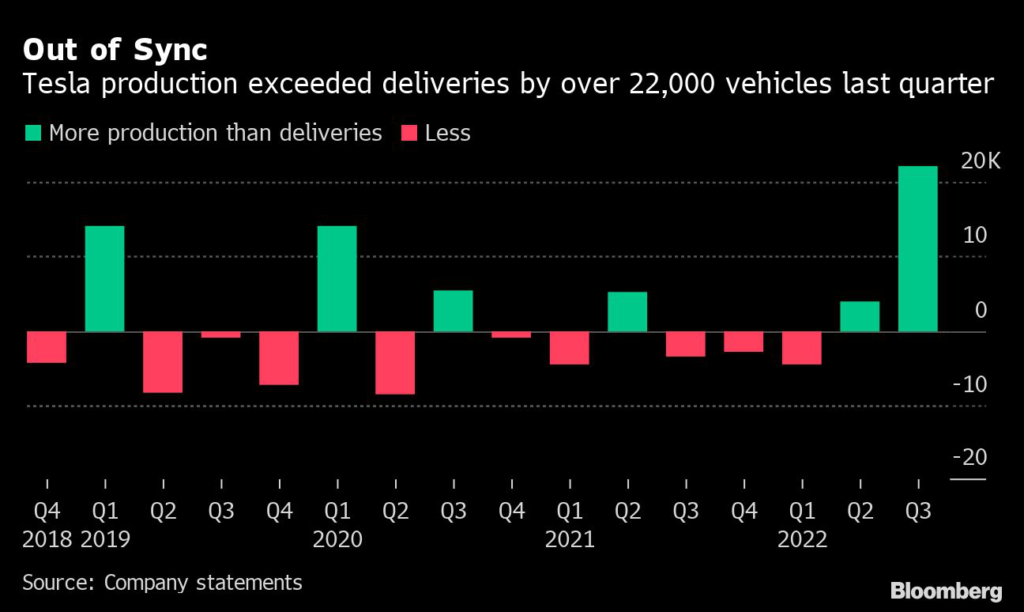
The first sign of trouble for Tesla this quarter came when the company reported that its production exceeded deliveries by more than 22,000 vehicles during the prior three months. CFO Zachary Kirkhorn warned during the Oct. 19 earnings call that investors should expect another “gap” at the end of the year, with more cars manufactured and still in transit as the quarter comes to an end.

Soon thereafter, Tesla cut prices cross its lineup in China, with reductions ranging from around 5% to more than 9%. In November, it offered insurance subsidies, reinstated a referral program and even advertised on a local television shopping channel, departing from Musk’s longtime strategy to avoid traditional marketing.

Then Bloomberg reported last week that Tesla planned to lower production at its Shanghai factory by about 20% from last month. The company started offering further incentives, with sales in China dropping industrywide due in part to sporadic lockdowns that have kept consumers at home. The company scheduled downtime at its plant for the end of the month and into early January and is shortening the amount of time workers spend per shift on production, according to people familiar with the matter.

In the US, customers who take delivery of a new Model 3 or Y this month will get what Tesla is calling a $3,750 “price adjustment” to make up for the new EV tax credit taking effect next year. The company has been struggling to make bigger battery cells at its newest factory in Austin, Texas, and has called in help from Tom Zhu, the head of its Asia Pacific operations.

Back in April, Musk said Tesla would produce more than 1.5 million vehicles this year. The company made 929,910 cars through the first three quarters, so it needs to crank out more than 570,000 vehicles to meet that goal.

“Getting to 1.5 million for the year will be tough,” said Sam Fiorani, vice president for global vehicle forecasting at AutoForecast Solutions. “We’re looking at fear of recession, rising interest payments, buyers not anxious to spend a lot of money.”

In other words, the sort of conditions Musk hasn’t had to contend with since Tesla was just getting started making Roadsters in 2008.

–With assistance from Chunying Zhang.

More stories like this are available on bloomberg.com

©2022 Bloomberg L.P.
UK Inflation Eases More Than Expected From 41-Year High

(Bloomberg) — UK inflation dipped from a 41-year high in November, raising the possibility that the worst of the cost-of-living squeeze is over. 

Consumer prices rose 10.7% from a year earlier, the Office for National Statistics said Wednesday, down from 11.1% in October. Economists expected a rate of 10.9%. 

The slowdown indicated a respite from an almost unbroken string of soaring prices over the past 1 1/2 years. It will do little to shift the interest-rate debate at the Bank of England, where officials expect inflation to remain above the 2% target until well into 2024 despite the economy falling into a recession.

“While these figures suggest inflation has peaked, it nevertheless remains at a precariously high rate which is having a real impact on people and businesses,” said Suren Thiru, economics director at the Institute of Chartered Accountants in England & Wales. “With inflationary pressures looking more broad-based, the pace of easing is likely to be slow.”

What Bloomberg Economics Says …

“The fall in inflation in November will come as a welcome relief to the Bank of England and will probably tip the balance towards a 50-bp hike at its final meeting of the year. Still, with inflation in double digits, there isn’t room for complacency. Rates will keep edging higher in 2023 as the BOE adopts a smaller-for-longer strategy.”

— Dan Hanson, Bloomberg Economics. Click for the REACT.

Money markets pared wagers on Bank of England rate hikes by as much as 10 basis points, pricing the bank rate to peak at 4.68% by August.

Policymakers are expected to deliver their ninth rate increase in a year on Thursday in an effort to stop inflation from becoming entrenched, with further hikes signaled in the first half of 2023. The government and the BOE have put preventing a wage-price spiral at the top of the agenda.

“I know families and businesses are struggling here in the UK,” Chancellor of the Exchequer Jeremy Hunt said in a statement. “Getting inflation down so people’s wages go further is my top priority.”

The inflation decline was largely due to the cost of petrol and used cars, along with tobacco, clothing, computer games and hotel stays. 

Fuel prices rose more slowly than a year ago, and the effect provided a sharp reduction in the pace of annual inflation. 

Food and non-alcoholic beverages prices rose 16.4%, the most since September 1977, with bread and cereals gaining the most in that category.

“While we expect inflation to continue on its downwards trajectory and return to the Bank of England’s target of 2% in the first half of 2024, there is a risk it may prove more persistent as higher costs are passed on more widely,” said Yael Selfin, chief economist at KPMG. “However, the weaker economic environment could also see inflation undershoot its target.”

Core inflation, which excludes energy, food, alcohol and tobacco prices, eased to 6.3% growth from 6.5% in October.

Alcohol prices in restaurants, cafes and pubs rose sharply, particularly for whiskey, wine and gin.

Services inflation held steady at a 30 year high of 6.3%. The elevated levels raise concerns that above-target inflation will persist unless the BOE continues to act forcefully to tame price growth. 

“Tobacco and clothing prices also rose, but again by less than we saw this time last year,” said Grant Fitzner, chief economist at the ONS. “This was partially offset by prices in restaurants, cafes and pubs which went up this year compared to falling a year ago.”

Evidence is mounting that inflation has peaked in the US too, stoking hopes that the Federal Reserve will be able to pause its rate-hiking cycle soon. US consumer prices rose 7.1% in November and have declined in each of the past five months.

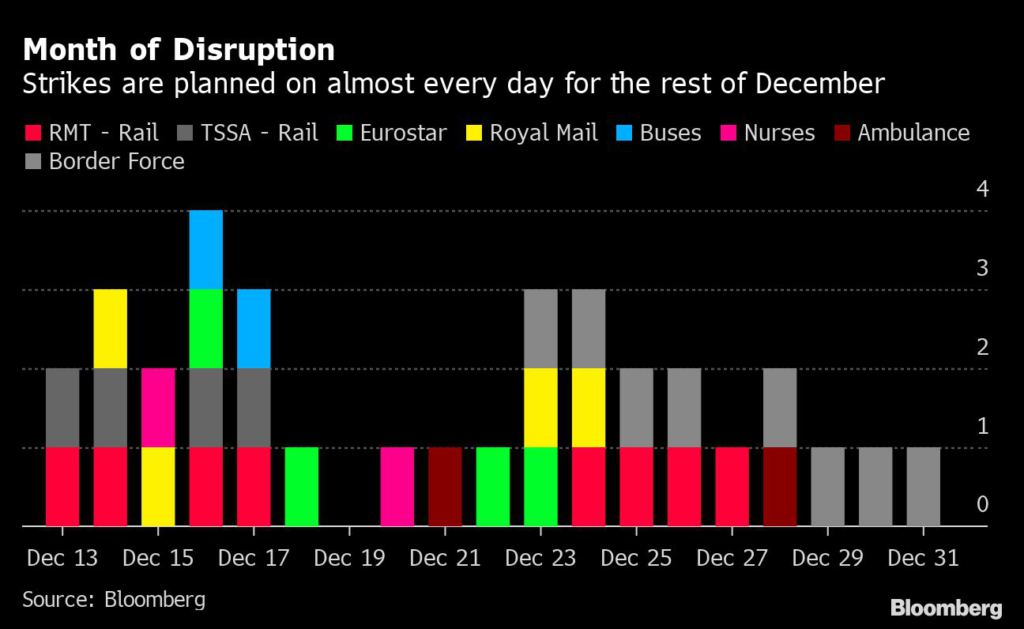
UK inflation by contrast has risen faster than expected in most of the past 1 1/2 years, fueling demands from workers for higher pay. Unions representing train drivers, nurses and border agents plan strikes between now and the end of the year, putting pressure on Prime Minister Rishi Sunak’s government to ease wage restraints.

Unlike the US, where gasoline prices have tumbled and power markets are mostly insulated from overseas trends, UK energy prices have spiraled ever higher this year after Russia choked off supplies of natural gas to Europe.

Producer input and output prices are normally released alongside the CPI data. However, the ONS decided not to publish them this month following the discovery of problems that are now under investigation.

–With assistance from James Hirai.

(Updates headline and third paragraph.)

More stories like this are available on bloomberg.com

©2022 Bloomberg L.P.
IMF Declines to Testify to UK MPs Over Mini-Budget Intervention

(Bloomberg) — The International Monetary Fund has declined a request from UK lawmakers to explain to Parliament why it made an unsolicited attack on the former government’s budget shortly before the plan imploded.

Harriett Baldwin, chair of the Treasury Committee in the House of Commons, has asked IMF officials to give evidence about the statement they made on Sept. 27. The fund at the time urged former Chancellor of the Exchequer Kwasi Kwarteng to re-evaluate his tax-cutting “Growth Plan.”

Asked by the committee on Monday about the intervention, Beth Russell, the second permanent secretary at the Treasury, said “it was a bit unusual to have that commentary outside a formal engagement.”

She added that the government “didn’t have sight of the statement in advance” and that private discussions were held with IMF officials afterwards. 

In an emailed statement, the IMF said it “engages with governments, central bank officials and often with parliamentarians” during the regular annual UK check-up. “Discussions with authorities typically happen in that context.” It declined to comment specifically on the request to appear before the committee.

The Washington-based institution normally reserves its uninvited public critiques to less developed nations that are not major shareholders. The UK is a founding member of the IMF. 

Speaking four days after Kwarteng’s fiscal statement, at a time when the pound was plunging and UK government bond prices were in free-fall, the IMF said it was “important that fiscal policy does not work at cross purposes to monetary policy.”

“Given elevated inflation pressures in many countries, including the UK, we do not recommend large and un-targeted fiscal packages at this juncture.” It also said the UK plan would increase inequality.

The comment came just hours after former US Treasury Secretary Larry Summers called Kwarteng’s plan “utterly irresponsible” and said he was “surprised that we have heard nothing from the IMF” given the risk of “a currency crisis in a reserve currency.”

The day after the IMF statement, the Bank of England launched an emergency intervention in long-dated government bond markets to prevent a fire-sale of assets that threatened to cause an economic crash. The market reaction to the ill-judged fiscal statement prompted Prime Minister Liz Truss to step down after just 44 days in office.

Truss was succeeded by her arch rival in the summer’s Tory leadership contest, Rishi Sunak, who has ripped up her “Growth Plan” in a bid to restore economic stability.

Baldwin, a member of the ruling Conservative Party, told Treasury officials at a hearing on Monday, “We have invited the IMF to come and give evidence to the committee. So far they have not agreed to give us any evidence on the record.” 

“We would like to ask them questions about this particular incident as they were so explicit about making commentary, and we feel it’s very much in the scope of what we should be looking at.”

James Bowler, the Treasury’s top civil servant, acknowledged that the IMF had given evidence to the Treasury committee about the economic recovery from Covid. 

The IMF has a satellite UK office at the BOE in London, where two or three of the fund’s staff are based. 

More stories like this are available on bloomberg.com

©2022 Bloomberg L.P.
US to Add More Than 30 Chinese Companies to Trade Blacklist

(Bloomberg) — The Biden administration plans to put Yangtze Memory Technologies and more than 30 other Chinese companies on a trade blacklist that would prevent them from buying certain American components, deepening tensions between the world’s two economic superpowers.

The US Department of Commerce will add China’s leading maker of memory chips and the others to the so-called Entity List as early as this week, according to a person familiar with deliberations who asked not to be named discussing a sensitive matter.

Companies on the Entity List are blocked from buying technology from US suppliers unless they get a special export license from Commerce. That designation’s earlier use decimated Huawei Technologies Co.’s consumer smartphone business and hampered the efforts of Semiconductor Manufacturing International Corp. to grow into China’s chipmaking champion.

The US has “politicized and weaponized economic cooperation,” Chinese Foreign Ministry spokesman Wang Wenbin said Wednesday at a regular press briefing in Beijing, adding that Washington’s actions disrupted supply chains. China would take steps to protect the rights of its companies, he said.

A representative for Yangtze Memory declined to comment.

Chip Limits Heat Up Biden’s Tech War With China: Hal Brands

The latest move would represent an escalation in the US-China conflict over technology. The Biden administration unveiled a sweeping set of restrictions on China’s ability to buy semiconductors and chipmaking equipment in October, putting Yangtze Memory and other companies on a list for further scrutiny at the time.  

At the time, the US Commerce Department added 31 organizations including Yangtze Memory to what’s known as the Unverified List, which means American authorities are not able to prove that those companies are not supporting the Chinese military. That set in motion a 60-day countdown during which the companies would have to prove their businesses were not involved in activities that jeopardized US national security.

‘No Possibility of Reconciliation’ as US Slams China Chips

The Chinese government had appeared to be cooperating with US authorities to prevent Yangtze Memory and other firms from being added to the Entity List. That involved China’s Ministry of Commerce helping domestic companies through end-use checks required by the US, including disclosures about products and operations.

Yangtze Memory, based in Wuhan, is the country’s largest 3D NAND semiconductor maker, producing memory chips that go into smartphones and other computing devices in competition with the likes of Samsung Electronics Co. The firm had been in talks to supply Apple Inc., which would have marked a significant step for China’s tech industry, but that has since been put on hold. 

The Financial Times was first to report Commerce’s intention to blacklist Yangtze Memory.

US officials imposed the latest chip restrictions by explaining they are necessary to stop China from becoming more of an economic and military menace. The Biden administration wants to ensure the country’s chipmakers don’t secure the capability to make advanced semiconductors that would bolster China’s military.

China has sharply criticized the US moves, arguing that the American government is trying to stop its rise. This week, China filed a dispute with the World Trade Organization trying to overturn US-imposed trade controls, arguing they will disrupt global trade.

–With assistance from Gao Yuan, Debby Wu and Philip Glamann.

(Updates with quote from Chinese Foreign Ministry and details of Entity List designation)

More stories like this are available on bloomberg.com

©2022 Bloomberg L.P.
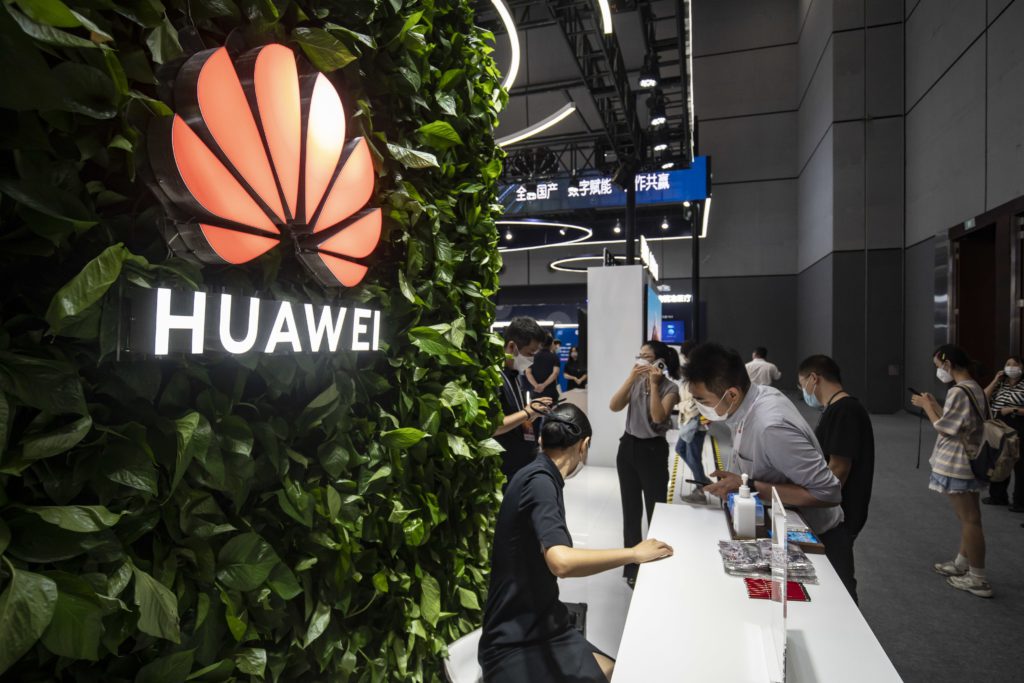
Senate Bill Would Bar China’s Huawei From US Finance System

(Bloomberg) — US lawmakers have introduced legislation that could cut Huawei Technologies Co. and other foreign firms from the world’s largest financial system, in the latest attempt to curb China’s technological ambitions. 

The Senate bill, whose sponsors include Senate Majority Leader Chuck Schumer, a New York Democrat, would ban US companies from participating in significant transactions with foreign firms that produce 5G technology and engage in industrial espionage. If Huawei were so designated, it would effectively halt its access to US banks. 

“We cannot allow Huawei and the Chinese Communist Party to have access to Americans’ personal data and our country’s most sensitive defense systems,” said Senator Tom Cotton, an Arkansas Republican who also backed the bill. “We must address the dire threat these Chinese companies pose to our national security.” 

The legislation comes amid broad support in Washington for finding ways to curb China’s influence, and Huawei in particular. Last month, the Federal Communications Commission barred Huawei and other telecommunications firms including ZTE Corp. from selling electronics in the US on grounds they posed risks to data security.

Beijing opposed Washington’s distortion of the concept of national security, Chinese Foreign Ministry spokesman Wang Wenbin said Wednesday at a regular press briefing in response to a question about the bill. “The US is ruining international rules,” he said. “China will take measures to uphold the legitimate and legal rights and interests of Chinese companies.”

US lawmakers are also seeking to ban Chinese-owned video app TikTok, which the Federal Bureau of Investigation has warned could control millions of users’ software, steal information, launch hacking attacks or conduct influence operations.  

China has denounced measures by the US to restrict the capacity of its technology sector, including sweeping sanctions that limit its access to advanced chipmaking equipment.

(Updates with comment from China’s foreign ministry in fifth paragraph.)

More stories like this are available on bloomberg.com

©2022 Bloomberg L.P.
GoTo Sells Stake in Store Operator to Focus on Main Businesses

(Bloomberg) — GoTo Group sold a stake in Indonesian convenience store operator Alfamart to focus on its main internet businesses and assuage investor concerns.

The Jakarta-based ride-hailing and e-commerce company sold the stock for a total of 1.5 trillion rupiah ($96 million), according to a statement Wednesday. GoTo made a “significant gain” on the minority investment, Chief Financial Officer Jacky Lo said.

Shares of GoTo, hurt by the expiry of a lockup on major shareholders’ stakes that freed them to reduce their holdings, continued their plunge after a brief jump on Tuesday snapped 16 straight sessions of losses.

GoTo shares dropped by as much as 7% on Wednesday — the daily limit — hitting 93 rupiah in Jakarta trading. The stock has declined more than 70% since its April debut, which has prompted the Indonesia stock exchange to put GoTo on its watchlist for any unusual trading activity.

Management held a meeting with investors on Thursday in which they said GoTo has enough funds to last until it reaches profitability and that it’s considering asset sales — comments that did little to halt the stock’s slide.

Shares of Alfamart, also known as Sumber Alfaria Trijaya Tbk PT, have more than doubled this year.

More stories like this are available on bloomberg.com

©2022 Bloomberg L.P.

Animoca Founder Says Crypto ‘Cheering’ Bankman-Fried’s Arrest

(Bloomberg) — A co-founder of crypto investor and game developer Animoca Brands Corp. said many in the digital-asset industry welcome the arrest of Sam Bankman-Fried because it helps to separate the fallen tycoon from the sector.

“The reputational impact for crypto has definitely been affected because Sam was such a prolific figure,” Yat Siu, also chairman of Animoca Brands, said on Bloomberg Television on Wednesday. “But I think today, especially the news of his arrest, many people in our industry are actually cheering it on.”

The US has charged Bankman-Fried with wire fraud, conspiracy to commit securities fraud and several other counts for allegedly misappropriating billions of dollars in customer funds from his now defunct FTX exchange. He’s under arrest in the Bahamas, where the platform was based.

“For a long time people were confused because they didn’t understand what was going on,” Siu said. “Some people just thought, hmm, is it just crypto as an industry? Clearly it’s not, but that’s basically what people were afraid of.”

Asked about the impact of FTX’s bankruptcy on gaming startups in Animoca’s portfolio, Siu said “it’s very minor.” He added that Animoca is doing what it can but “it’s not been quite as bad as we feared.” 

Bankman-Fried has denied knowingly committing fraud in numerous media interviews. His lawyer Mark Cohen said in a statement on Tuesday that Bankman-Fried is “reviewing the charges with his legal team and considering all of his legal options.”

–With assistance from David Ingles, Yvonne Man and Annabelle Droulers.

More stories like this are available on bloomberg.com

©2022 Bloomberg L.P.
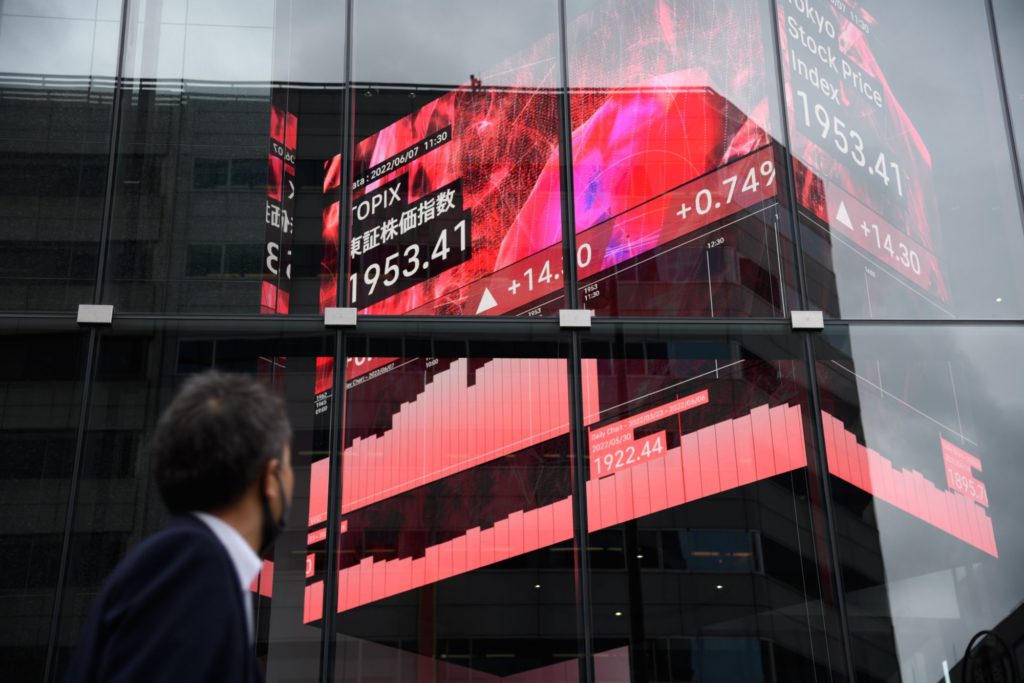
European, US Stock Futures Edge Higher Before Fed: Markets Wrap

(Bloomberg) — European and US equity futures rose while a gauge of Asian stocks inched closer to a bull market as investors weighed a slowdown in inflation ahead of the Federal Reserve’s policy decision.

Shares in Hong Kong, Japan and Australia held advances, nudging the MSCI Asia Pacific index toward a three-month high and a close of 19% above its October low. 

Futures for the S&P 500 rose about 0.3% in Asia after the US benchmark closed off its intraday peak on Tuesday. Investors are awaiting more clues on the Fed’s interest-rate path from the decision later Wednesday and Chair Jerome Powell’s briefing.

The dollar traded little changed after losing ground to its Group-of-10 counterparts the previous session. The New Zealand dollar fell in a decline that accelerated after the government warned a recession was likely next year. 

Treasuries added to their rally on Tuesday, when data showed Powell’s key measure of services prices excluding energy and rents moderated again in November. While price pressures appear to have peaked, headline CPI remains above 7%, suggesting the Fed has more work to do to rein in inflation. 

“The market is now anticipating a slower pace of hikes and a moderation of the peak terminal rate in the US,” said Kellie Wood, deputy head of fixed-income at Schroders in Sydney. “We believe the market is fully priced for this interest rate cycle given the level of inflation in the US economy.”

A dovish repricing swept across rates markets on Tuesday. With a half-percentage point move by the Fed notched in, wagers leaned toward a quarter-point increase as early as February. Further out, swaps priced the peak Fed policy rate around 4.85% by May, down from almost 5% ahead of Tuesday’s inflation print. The current Fed policy range is 3.75% to 4%. 

Elsewhere in markets, Bitcoin held near the one-month high reached on Tuesday in a sign of investor appetite for risk taking.

Oil fell slightly ahead of the Fed decision and after rallying 6% over the previous two sessions. Gold steadied near its highest level since July.

The price of iron ore fell for a third day as traders attempted to plot the effects of China’s shift away from pandemic restrictions and a rise in Covid infections.

Following the Fed, the European Central Bank will announce its rate decision Thursday. Markets will also contend with decisions from the Bank of England and monetary authorities in Mexico, Norway, the Philippines, Switzerland and Taiwan.

Key events this week:

  • FOMC rate decision and Fed Chair news conference, Wednesday
  • China medium-term lending, property investment, retail sales, industrial production, surveyed jobless, Thursday
  • ECB rate decision and ECB President Lagarde briefing, Thursday
  • Rate decisions for UK BOE, Mexico, Norway, Philippines, Switzerland, Taiwan, Thursday
  • US cross-border investment, business inventories, empire manufacturing, retail sales, initial jobless claims, industrial production, Thursday
  • Eurozone S&P Global PMI, CPI, Friday

Some of the main moves in markets:

Stocks

  • Futures on the S&P 500 rose 0.3% as of 6:42 a.m. London time. The S&P 500 gained 0.7%
  • Nasdaq 100 futures climbed 0.3%. The Nasdaq 100 climbed 1.1%
  • The Hang Seng Index rose 0.7%
  • The Topix index climbed 0.6%
  • The Shanghai Composite Index fell 0.1%
  • Euro Stoxx 50 futures rose 0.1%

Currencies

  • The Bloomberg Dollar Spot Index fell 0.1%
  • The euro was little changed at $1.0638
  • The Japanese yen rose 0.1% to 135.43 per dollar
  • The offshore yuan was little changed at 6.9616 per dollar
  • The British pound was little changed at $1.2371

Cryptocurrencies

  • Bitcoin was little changed at $17,768.28
  • Ether was little changed at $1,319.38

Bonds

  • The yield on 10-year Treasuries declined two basis points to 3.48%
  • Japan’s 10-year yield was little changed at 0.25%
  • Australia’s 10-year yield declined three basis points to 3.36%

Commodities

  • West Texas Intermediate crude fell 0.4% to $75.11 a barrel
  • Spot gold was little changed

This story was produced with the assistance of Bloomberg Automation.

–With assistance from Georgina Mckay and Stephen Kirkland.

More stories like this are available on bloomberg.com

©2022 Bloomberg L.P.
Paytm Shares Fall After Buyback Fails to Reassure Investors

(Bloomberg) — Paytm shares fell after the Indian fintech announced a buyback of as much as 8.5 billion rupees ($103 million), offering little respite to a stock down 75% since listing on bourses last year. 

The company, whose official name is One 97 Communications Ltd., on Tuesday approved a plan to repurchase as many as 10.5 million shares at a price not exceeding 810 rupees apiece on the open market. That upper limit is a 59% premium to Thursday’s closing price, before the company said it was considering a buyback.

Shares of Paytm fell as much as 2.7%, erasing its earlier gains on Wednesday. The broader Mumbai market was flat.

While a buyback may help bolster the stock, which floated at 2,150 rupees at the initial public offering, some investors worry about management using cash to prop up the share price rather than to turn around loss-making operations. The buyback could be seen as Paytm giving an exit to investors who bought shares before the IPO, said Deven Choksey, managing director at KRChoksey Holdings.

“The company is supposed to arrest the losses before returning the capital to shareholders,” he said.

Paytm said in a filing that its board determined that there was “surplus liquidity that can be productively applied” for a buyback. Backed by China’s Ant Group Co. and Japan’s SoftBank Group Corp., Paytm had a cash balance of 91.8 billion rupees at the end of September, according to its earnings statement last month.

The company is estimated to burn $33 million over the next three quarters, and would likely break even in the second quarter 2024 on an adjusted earnings before interest, taxes and depreciation basis, JPMorgan analysts said in a note to investors. The brokerage kept its overweight rating, saying the repurchases would support the shares in the near term.

“Paytm board believes that this buyback is a sign of confidence that the company is on a clear path to deliver cash flow profitability, and this buyback will not have any impact on its growth plans in the near future or on its profitability plans,” Paytm said in its filing. 

Once India’s most valuable startup, the company said it is ahead of its plans to achieve an operating profit before employee stock option costs by the end of September 2023.

Headquartered on the outskirts of New Delhi, the company posted a wider second-quarter loss last month. It competes with Walmart Inc.’s PhonePe and Alphabet Inc.’s GPay in the crowded Indian fintech market.

–With assistance from Jennifer Ryan and Ashutosh Joshi.

(Updates with comment from analyst in fifth paragraph)

More stories like this are available on bloomberg.com

©2022 Bloomberg L.P.
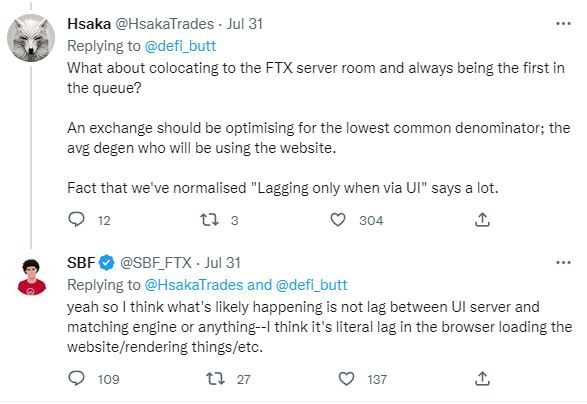
FTX’s Systems Gave Alameda Trades a Secret Speed Edge, CFTC Says

(Bloomberg) — Sam Bankman-Fried’s trading house Alameda Research had a secret speed advantage when executing orders on his now-collapsed FTX crypto exchange, according to the US Commodity Futures Trading Commission.

Alameda, which also tumbled into bankruptcy last month along with FTX, was able to skirt certain portions of the exchange’s trading architecture and sidestep some automated verification processes, the CFTC said in a complaint filed Tuesday in Manhattan federal court.

“These advantages were not publicly disclosed” and yielded a “significant speed advantage,” the CFTC said.

While most or all other customers accessing the FTX platform through an application programming interface — API — “had their transaction orders routed through the FTX system, Alameda was able to bypass certain portions of the system and gain faster access to the API,” according to the suit.

‘Time Advantage’

“Alameda’s transaction orders were received several milliseconds faster than those of other API users,” the CFTC said. “In the high-frequency trading sector, this is a significant time advantage.”

The features of Alameda’s account at FTX also allowed the trading shop to avoid automated steps like verifying available funds ahead of executing a transaction, according to the lawsuit.

If other customers “placed several orders at once, these checks occurred in sequential order, so that each transaction could be confirmed as viable,” the CFTC alleged. “This did not apply to the Alameda account.”

Bankman-Fried’s spokesman Mark Botnick declined to comment on the specific CFTC claims about a speed advantage.

There were longstanding concerns in the crypto industry that Alameda was getting preferential treatment on FTX. As recently as September, Bankman-Fried said Alameda sent orders and accessed customer information the same way other users did.

The CFTC is suing Bankman-Fried, FTX and Alameda Research for violations of federal commodities laws. The Securities and Exchange Commission on Tuesday accused him of carrying out a multi-year scheme to defraud investors. He’s also facing US criminal charges and was arrested Monday in the Bahamas.

For crypto market prices: CRYP; for top crypto news: TOP CRYPTO.

More stories like this are available on bloomberg.com

©2022 Bloomberg L.P.

Close Bitnami banner
Bitnami
