Bloomberg

Kanye’s Return to Twitter Lasts One Day as Account Is Locked

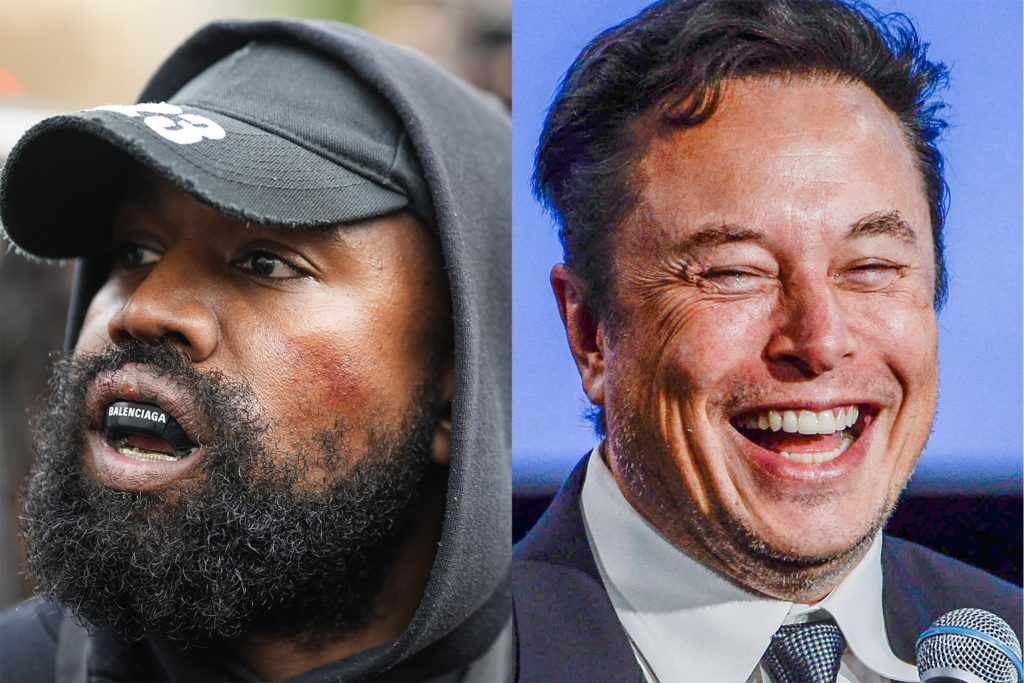
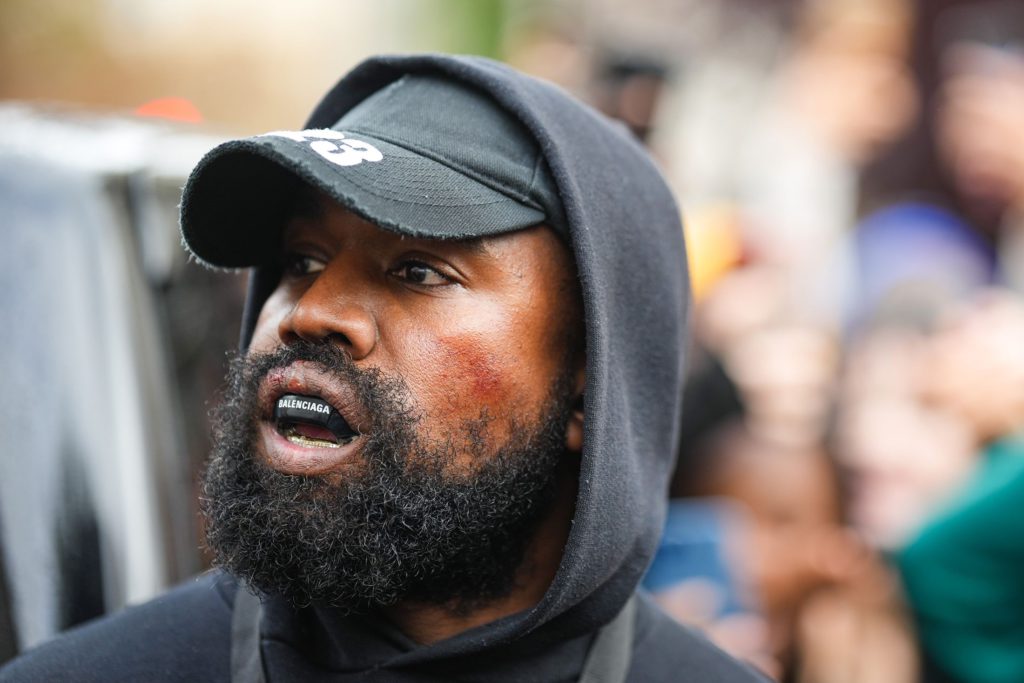
(Bloomberg) — Twitter Inc. has restricted and locked the account of billionaire musician and fashion designer Kanye West, just one day after he returned to the social media platform for the first time in nearly two years.

A spokesperson for Twitter said Sunday the account was locked due to a violation of its policies. West, now known as Ye, started posting on the site late Friday, after he was suspended from Meta Platforms Inc.’s Instagram for a now-deleted post. 

West is just the latest celebrity to test how major social media companies police speech on their platforms. Both Instagram and Twitter deleted posts from West widely criticized as anti-Semitic and locked his accounts. 

The move by Twitter to lock West’s account comes just hours after Tesla Inc. Chief Executive Officer Elon Musk welcomed the rapper back to the platform. 

Musk, who last week said he will proceed with his offer to purchase Twitter after months of back-and-forth negotiations, has said he will prioritize free speech on Twitter and criticized its decision to ban individuals such as former President Donald Trump for violating its rules.

Musk hasn’t yet commented on the locking of West’s account.

More stories like this are available on bloomberg.com

©2022 Bloomberg L.P.

Food Inflation on Path to Slowing, Says Bank of Canada’s Macklem

(Bloomberg) — Food price inflation is set to slow, helped in part by “reasonably good harvests” in Canada and several other countries, Bank of Canada Governor Tiff Macklem said.

“I am actually hopeful that at least food inflation, which is not quite the same thing as food prices, is going to come down because in Canada in a number of other countries there have been reasonably good harvests,” Macklem said in an interview with federal government-owned CBC Radio broadcast Sunday. 

He also pointed to a resumption of some wheat shipments out of Ukraine, a major exporter of the grain before the war with Russia.     

Inflation has started easing as the central bank lifted interest rates to 3.25%. Consumer prices climbed 7% in August, slowing from the 7.6% increase in July.  

Interest rate increases “have started to cool parts of the economy and actually that’s what we need,” said Macklem. That’s because “demand in the economy, spending in the economy is running ahead of what the economy can produce.” 

The central bank governor has vowed to continue on a hawkish rate path because of worries about elevated domestic price pressures and inflation expectations becoming entrenched. 

“Businesses can’t keep up, they can’t find enough workers to serve other clients,” he said. He pointed to the exceptionally high number of vacant jobs as a signal that “there is scope to slow the economy, there is scope to reduce the number of vacancies without a lot of people being put out of work.” 

Still, “I am not going to pretend that it is going to be painless, some Canadian are going to be squeezed,” he added. 

More stories like this are available on bloomberg.com

©2022 Bloomberg L.P.

Investors on Guard as Stocks Rally Sputters Ahead of Data Deluge

(Bloomberg) — It’s hard to blame any stock-market investor for being confused right now. 

The S&P 500 and Nasdaq 100 indexes are both coming off their best weeks in a month. But the way Friday ended, it’s hard to feel optimistic. Where the market goes from here likely lies in a batch of economic data that will arrive over the next couple of days. 

Traders are most closely watching the consumer price figures that are due Thursday because it will be key to determining if the Federal Reserve moves ahead with another 75 basis-point rate increase at its next meeting in early November. In fact, a further acceleration in prices could amp up the urgency to extend jumbo-sized rate hikes beyond this year.

“It’s a very bewildering time right now for investors, even more so than this whole year,” said Thomas Martin, senior portfolio manager at Globalt Investments. “Sentiment is the worst it’s ever been, so we were ripe for a pop. But we still have a very tight labor market and strong wage growth that’s complicating investors’ hopes for a Fed pivot. It’s a huge week with earnings season kicking off and the inflation data will be crucial once again.”

Read: US Jobs Rise While Unemployment Drops, Keeping Pressure on Fed

CPI is forecast to have risen 8.1% in September from a year earlier versus 8.3% in August, according to economists surveyed by Bloomberg. Core CPI, which strips out volatile food and energy components, is projected to rise 6.5% on a year-over-year basis and fall to 0.4% month over month.

What’s more, the minutes of the latest Fed policy meeting arrive on Wednesday and may provide more insight into the central bank’s aggressive efforts to fight inflation. And there’s a key measure of US producer prices is due Wednesday, followed by the University of Michigan’s monthly consumer inflation expectations on Friday.

Flip Flop

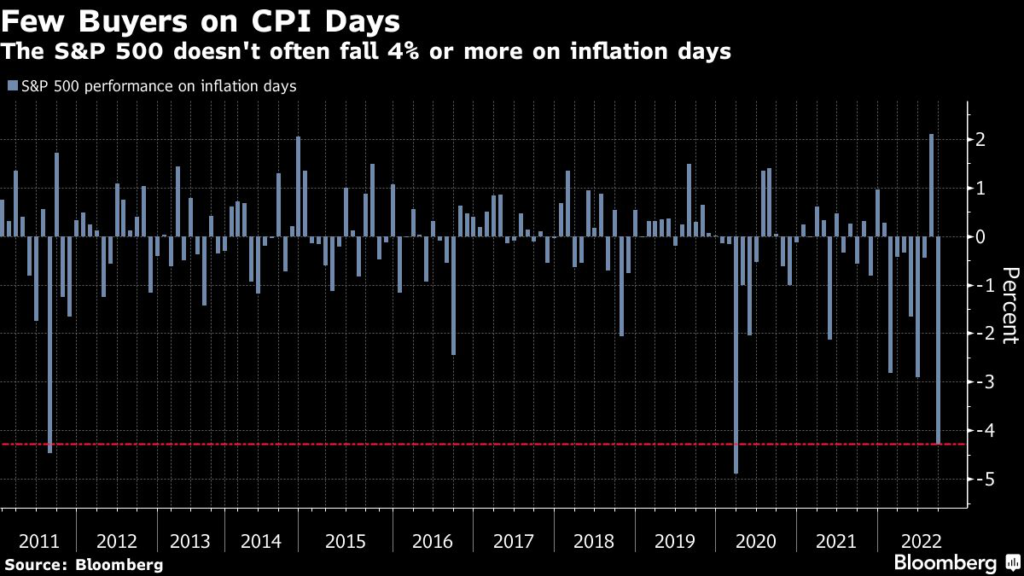
It’s no secret that the market is highly sensitive to high inflation right now. Trading sessions this year when consumer inflation reports are released this have been rough, with the the S&P 500 falling seven of nine times. Many investors, have fresh memories of the last inflation print on Sept. 13, which came in hotter than expected, sending the S&P 500 down 4.3%. It was the worst CPI session since March 2020, and other than that the worst since 2011. 

“This year, we’ve seen this absolute obsession around the inflation number,” said Matt Maley, Miller Tabak & Co.’s chief market strategist. “The bigger worry is — no matter the inflation report next week, investors are still going to be concerned about inflation being elevated. Most people on Wall Street are certain that we’re going to have a recession, and if the level of inflation stays steady, that won’t be good enough anymore.”

Tech Wreck

Semiconductor stocks, in particular, could face further pressure after taking a beating Friday after disappointing earnings results from Samsung Electronics Co. The world’s largest memory chipmaker reported its first profit drop since 2019, sparking further worries about Corporate America’s earnings power and margin-shredding inflation pressures.

The Philadelphia Stock Exchange Semiconductor Index tumbled 6.1% after Samsung’s results and Advanced Micro Devices Inc.’s preliminary third-quarter sales missed projections by more than $1 billion. The index, which is home to chip giants like Nvidia Corp., Micron Technology Inc. and AMD, has plummeted 40% in 2022.

Flow Show

Investors are rushing out of US equities, and most other risk assets, in search of safety with a recession possibly looming. Stock funds have recorded sparse inflows this year as the bear market emerged. Since the start of 2022, US equities have posted inflows in 21 of 39 weeks, or 54%. That’s down from 58% of weeks in 2021, and 48% of weeks in 2020, according to Bloomberg Intelligence data. 

More stories like this are available on bloomberg.com

©2022 Bloomberg L.P.

Your Sunday Briefing: The World’s Finance Chiefs Are Coming to Town

(Bloomberg) — Hello again.

Whether or not you’re getting a day off for Columbus Day tomorrow,  here’s something to get you set up for the coming week. 

The big gathering: Global finance chiefs gather in Washington for the first fully in-person IMF and World Bank meetings since the pandemic. With IMF chief Kristalina Georgieva already warning of a potential $4 trillion loss of output through 2026, central bankers, finance chiefs and others will need to confront the impact of rampant inflation, rising borrowing costs and the Ukraine war on the global economy.

The other big gathering: Xi Jinping is getting one step closer to a landmark third term in power. On Sunday, the Chinese President presided over a final meeting of top leaders that is taking place days before the twice-a-decade Communist Party congress that is expected to keep him in power for another five years. Here’s a look at Xi’s first decade and how he’s changed China, and the world.  

The big stat: The CPI report this Thursday will likely show continued pricing pressures — and give the Fed no reason to stray from its tightening path. Other data include figures on prices paid to US producers, as well as retail sales. 

The big market thought: Michael Safai of Dexterity Capital discusses how the growing influence of institution investors is changing the crypto market. “We might have been playing checkers two years ago. We’re playing chess now,” he says.  

The big earnings: Third-quarter earnings season kicks off  this week, with a slew of consumer and financial firms reporting their figures. PepsiCo is due Wednesday, Walgreens Boots Alliance and Domino’s Pizza Thursday, while Friday will see a slew of investment banks — JPMorgan, Wells Fargo, Citigroup and Morgan Stanley  — drop their numbers.  

The big award: The Nobel Prize for economics (officially “Economic Sciences”) will be announced on Monday. Sweden’s Riksbank set it up in 1968, adding a sixth category to existing prizes for physics, chemistry, medicine, peace and literature. The winner(s) will get to hang with this year’s other laureates at a sumptuous dinner in Stockholm in December.

The big trip: With Japan resuming visa-free travel to vaccinated tourists this week and the yen near multi-decade lows against the dollar, Americans may be rushing to book their flights to Tokyo. But after more two years, a few things have changed, for better or worse and tourists should take note.

The big opinion: OPEC+’s larger-than-anticipated 2-million-barrel a day output cut last week will likely keep prices stubbornly high and darken the midterm election prospects for the Democratic party. Still, the actual drop in production could be as little as one-tenth of the headline figure, given most cartel members are already pumping far below their quota levels, Julian Lee writes in Bloomberg Opinion.  

ICYM our Big Take: A strange thing happened to Jennifer King: A white Jaguar SUV bearing the logo of Google’s driverless car division, Waymo, was backing out of her San Francisco driveway. It was the first of dozens that began doing the exact thing, many times, every single day. King’s experience demonstrates how the self-driving car revolution is starting to look like a $100 billion bust, Max Chafkin writes for Bloomberg Businessweek.

And finally,  if you’re wondering how to rake in a billion dollars a year in music royalties, listen to this.

Have a good week. See you on the other side.

More stories like this are available on bloomberg.com

©2022 Bloomberg L.P.

Shutting Off Fed ‘Money Printer’ Leaves Bitcoiners Out of Sorts

(Bloomberg) — One of the most popular crypto memes during the Covid pandemic was about how the Federal Reserve was “printing” an endless amount of dollars — “money printer go brrr,” in Twitter parlance — and how that enhanced the value of Bitcoin, which has a capped amount of tokens. 

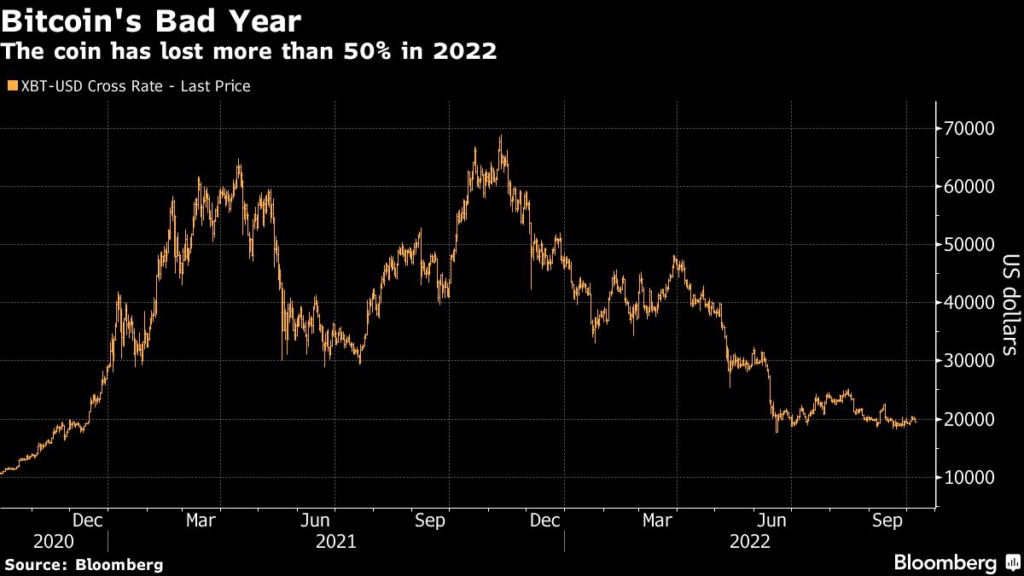
Now the proverbial printer has been turned off, with the central bank raising rates and the price of the largest digital token crashing more than 50% this year, leaving the average investor caring little whether there is a finite amount of Bitcoin. 

What’s behind the demise of the meme is a steep reduction in money supply, or M2, which is a measure of the amount of money in the US financial system. 

“The logic would be that with the money supply, or M2, coming down, there’s less money floating around that could find its way into risk assets, and clearly cryptocurrencies have proven to be risk assets over the course of the last 12-18 months,” Art Hogan, chief market strategist at B. Riley, said in an interview. “You’d suspect that would be a negative for some of the riskier edges of the investment universe.”

That’s not how things were supposed to be. Bitcoin was created amid the 2008 financial crisis in response to what was labeled as rampant money printing. The thought had been that due to its limited supply — capped at 21 million coins — it would hold up its value much better when central banks or governments were instituting loose monetary and fiscal policies. The coin, in such an environment, wouldn’t be devalued, its backers argued.    

Because of that limited supply, a number of narratives formed around the coin, including that it’s an inflation hedge and a safe store of value. But 2022 has proven otherwise, Hogan said. “That’s the real problem,” he said. “If you’re going to remove some of the punchbowl, which is the money supply that could ostensibly find its way into riskier assets, then clearly they’re all going to lose some sponsorship.”

Lauren Goodwin, economist and portfolio strategist at New York Life Investments, points to the gold market as a parallel. Investors had perceived gold in a similar way — as a central-bank hedge. When central banks resorted to quantitative easing, that raised concern even more so that an environment in which inflation is much more likely to fester was being created. And when that happens, the banks tighten the reins and gold prices evolve around this dynamic. 

“That logic was essentially applied to cryptocurrency in the last five or 10 years, but the reality is not so much that crypto is an inflation hedge but rather, much like gold has become, it evolves with central-bank liquidity,” she said by phone. “So the reversal of excess liquidity in the economy from the Fed and other central banks has contributed meaningfully, in my perspective, to the lower appetite for digital currencies.”

Ilan Solot, a partner at crypto-investment firm Tagus Capital, says the correlation between M2 and Bitcoin can be explained by at least two factors. The first relates to where Bitcoin and cryptocurrencies lie on the risk spectrum. Solot agrees that more liquidity in the financial system generally benefits riskier assets. “Higher money supply mechanically means the boats rise, and Bitcoin is one of the boats,” said Solot.

But the second relates to inflation expectations and monetary policy. When the money supply rose last year, buyers expected that prices would soon follow, and that pushed some crypto proponents to buy the token with the idea of it being an inflation hedge.

Some of these investors, says Solot, bet that the Fed would not raise rates enough to combat inflation, and that it would instead prioritize other factors like economic growth. That narrative did not play out. Fed Chairman Jerome Powell issued three consecutive 75-basis-point hikes this year. He’s signaled there’s more to come.

A dropoff in the money supply then made an asset like Bitcoin less attractive to investors –even those who viewed it as a hedge against inflation. “You don’t want to buy your insurance when the house has already burned down,” says Solot.

More stories like this are available on bloomberg.com

©2022 Bloomberg L.P.

How Pakistan’s Flood Crisis Bends Climate Talks Towards Reparations

(Bloomberg) —

This summer’s destructive floods have left 21 million Pakistanis in desperate need of help weeks after flooding peaked, and the United Nations is still scrambling for resources to deliver life-critical aid to even half that number. As acting head of the UN humanitarian agency’s work in Pakistan, Ruth Mukwana has spent recent days traveling through washed-out provinces of Sindh and Balochistan. The highways are filled with children and mostly women living in makeshift tents without access to clean water, appropriate nutrition or sanitation.

“These communities really have not created the climate crisis, and yet they’re the ones bearing the brunt of it,” says Mukwana in an interview.

Aid organizations will work for months and years to help Pakistanis recover. But that support will be temporary in nature, even as the country faces down an enduring new era of climate vulnerability and grave risk to its population. “Ultimately, the world has to be able to help the people of Pakistan stand again on their feet,” she says.

In remarks on Friday, UN Secretary General António Guterres implored member countries to contribute to Pakistan’s aid. The death toll from flooding now stands at 1,700, but he warned that malaria, cholera and other diseases spreading in the aftermath “threaten to claim far more lives than the floods.”

“We are still in the life-saving phase after 17 hard weeks,” Sherry Rehman, the minister of climate change for Pakistan, said Friday in an interview to Bloomberg TV. 

Few countries are as vulnerable as Pakistan. Its cities regularly record some of the hottest temperatures in the world, including a springtime heat wave this year made 30 times more likely by greenhouse gases. That set the stage for summer monsoons that saw rainfall reach an intensity more than 50% greater than would have been the case without planet-warming pollution. Both findings come from World Weather Attribution, a leading research group that delivers rapid analysis of the link between extreme weather and climate change.

This is one example of powerful new evidence in the moral and political argument for climate reparations. As diplomats and world leaders prepare for next month’s annual UN climate summit, known as COP27, there’s likely to be renewed focus on the long-running dispute over who should pay for the devastation wrought by rising temperatures. Speeches and closed-door negotiations will involve calls for payments from high-emitting countries, most of which are wealthier and less vulnerable, to their low-emitting counterparts that suffer climate impacts. The debate will be informed by the blatant suffering visible on the ground in Pakistan as well as new data on exactly who is responsible for atmospheric pollution.

Working with colleagues from Bloomberg’s data-visualization team, I took a deep look at cutting-edge research into economic attribution for climate damage. Two Dartmouth researchers, Christopher Callahan and Justin Mankin, recently published a study and data estimating for the first time how much economic growth, in terms of GDP, has been lost to developing countries as a result of burning fossil fuel. It’s striking to see estimated dollar figures linking the pollution by the two biggest emitters, the US and China, to more than $60 billion in economic loses for Pakistan. 

Together, the US and China have created enough atmospheric impact to cost the world about $1.8 trillion. The US alone was responsible for 16.5% of global GDP losses from climate change from 1990 to 2014, according to research by the Dartmouth team. (Check out the full story in Bloomberg Green to see the eye-opening graphics explaining this economic research as well as satellite data tracking the destruction in Pakistan.)

Mukwana’s experience driving through flooded provinces and walking along highways that have become makeshift homes for displaced people unifies the personal and the global in ways few will ever experience. That’s because the people pushed aside by flood waters are, in part, victims of a problem even bigger than the monsoon. 

UN climate negotiations for many years focused almost exclusively on preventing new emissions and the resulting rise of global average temperatures, a concept called “mitigation” in climate jargon. Diplomats and politicians have also taken up the question of “adaptation” — how nations might find the resources to afford greater resiliency. But Pakistan’s crisis has renewed emphasis on a more often ignored section of the 2015 Paris Agreement that deals with a concept called “loss and damage.” 

Since the steepest costs of today’s climate continue to be borne by populations that emitted the least, recognizing loss and damage could mean that nations who gained the most from burning fossil fuel should pay compensation. It’s a vision of climate reparations — and it’s long been opposed by wealthy nations.

When nearly 200 national delegations meet next month for COP27 in the Egyptian resort of Sharm El-Sheikh, loss and damage is expected to eclipse most other topics on the agenda. In part this stems from the coincidence that a Pakistani diplomat is currently the leader of the largest bloc of developing nations, known as the G77+China. The Egyptian hosts of this summit are also members of the bloc.

Loss and damage has struggled to rise up the agenda for years. Developing nations last year went to COP26 talks in Glasgow, Scotland, pushing for a formal process for dispatching finance and technical help paid for by developed nations. That summit ended with only a loosely defined “dialogue” on the topic. There are fresh indications that loss and damage may be treated with greater attention than ever before at COP27, even if it’s with “diverse views on the scope and timeframes” of how to tackle the issue, according to a briefing shared on Friday by Ed King, a climate media and policy strategist.

If or when countries agree on a structured way to help people deal with climate disasters, it won’t come fast enough for the millions suffering from this year’s monsoon rains in Pakistan. Estimates of damage have tripled to $30 billion since the end of August. UN Office for the Coordination of Humanitarian Affairs, which Mukwana represents in Pakistan, this week raised by a factor of five its initial aid goal, to $816 million, to pay for triage support through May 2023. Those funds might help blunt a rapidly emerging public-health crisis. But it can’t compensate Pakistan for the brutal consequences of other people’s emissions.

“How much can people go through these cyclical kinds of events?” Mukwana asks. “How much of it can people take?

  • READ MORE: A New Era of Climate Disasters Revives Calls for Climate Reparations

More stories like this are available on bloomberg.com

©2022 Bloomberg L.P.

Kanye West Returns to Twitter, Welcomed by Elon Musk

(Bloomberg) — Kanye West posted on Twitter Inc. for the first time in nearly two years. Among those who welcomed his return was Elon Musk, who’s poised to buy the social media network. 

West, who now goes by Ye, late Friday posted a photograph of a hat that said 2024. He followed that with another picture of himself with Meta Platforms Inc. Chief Executive Officer Mark Zuckerberg, accusing the latter of kicking him off Instagram.

Instagram deleted content and placed a restriction on West’s account after he violated the site’s policies, a Meta spokesperson said in an emailed response to queries. While the spokesperson didn’t specify what rules were violated, NBC reported that West had made a now-deleted post that was seen by some groups as anti-Semitic.  

It’s not the first time Instagram has suspended West. In March, he was previously locked out from his account for a day for violating the social media platform’s policies on hate speech, bullying and harassment.

Prior to this week, the rapper and businessman last posted on Twitter in November 2020, just after the last US presidential election. He had previously received a temporary ban from the social network for posting private information of another individual, and also faced criticism from other Twitter users for his political views. 

Musk responded to West, saying “Welcome back to Twitter, my friend.” The Tesla CEO this week reinstated his $44 billion offer to buy Twitter, saying he wants to create an “everything app” that could rival TikTok and WeChat. 

He has said he will prioritize free speech on Twitter and criticized its decision to ban individuals such as former President Donald Trump for violating its rules. 

(Updates with comment from Meta spokesperson.)

More stories like this are available on bloomberg.com

©2022 Bloomberg L.P.

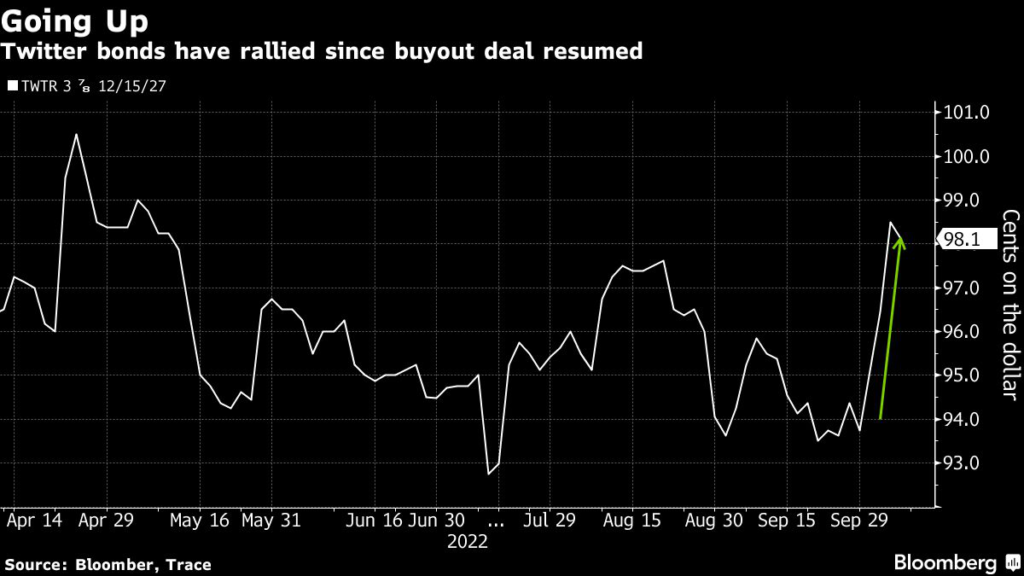
Twitter LBO Offers Latest Headache for Depleted Credit Markets

(Bloomberg) — It’s already bleak for Wall Street banks that struggled to sell risky debt to fund leveraged buyouts. Elon Musk’s revived deal for Twitter Inc. is only adding to the strain.

Banks have already been saddled with losses of about $600 million for the buyout of Citrix Systems Inc. and are still stuck with $6.5 billion of debt they couldn’t sell. They also had to shelve a $3.9 billion deal for Brightspeed after investors balked at the offer — and are expected to soon fund the buyout of Nielsen Holdings, and possibly even Tenneco Inc.

With that in mind, and with little else in the way of imminent deals, Twitter is likely to remain center stage for credit markets in the coming week.

Bond Deals Get Pulled During Critical Month for Global Sales

The $13 billion debt financing for Twitter — the biggest part of roughly $51 billion of risky committed debt that banks have to offload, according to Deutsche Bank AG estimates — would be a test for a leveraged-finance market that has been shaken in recent months.

A Delaware judge halted a court case against Musk over his $44 billion purchase of Twitter, giving the parties more time to complete the deal. If the transaction isn’t done by 5 p.m. on Oct. 28, a new trial date will be set for November.

With the timing unclear, markets will focus on the overdue $2.25 billion in financing to help fund Latam Airlines Group SA’s exit from bankruptcy. Terms have been sweetened, and timing remains unclear.

“The outlook for new issue supply is pretty bleak,” said Michael Chang, senior portfolio manager for high-yield credit at Vanguard. The amount of debt that still resides on bank balance sheets is likely to depress near-term new underwriting activity through the beginning of next year, he said.


Primary Drought

It’s also expected to be a light week in the US investment-grade bond market. High-grade borrowers are expected to sell $15 billion of debt following Monday’s US bond-market holiday. 

Issuers paid an “eyebrow-raising” 46 basis points in new issue concessions on Thursday — nearly 4 times the year-to-date average, according to Bloomberg credit strategist Brian Smith.

Most companies are approaching earnings blackout periods, with Yankee issuance expected to account for the majority of volume next week. JP Morgan Chase & Co. and Citigroup Inc. will kick off bank earnings on Friday, and debt offerings could follow.

High-grade markets are feeling the pressure as a strong US labor market leaves the Federal Reserve on course to stay aggressive in its fight against inflation. Across credit, money managers will closely watch a reading of US consumer prices on Thursday.

“Expectations are that it should start to move in the right direction,” said Arvind Narayanan, senior portfolio manager and co-head of investment-grade credit at Vanguard. “We will be looking for confirmation of that.” 

Investors withdrew $3.54 billion from US investment-grade bond funds in the week ended Oct. 5, following $10.3 billion of withdrawals in the prior period, according to Refinitiv Lipper data. High-yield funds, meanwhile, lured in about $1.87 billion, which could help support junk-bond prices next week with fresh capital for fund managers to put to work.

More stories like this are available on bloomberg.com

©2022 Bloomberg L.P.

Minecraft Star Dream Meets His Screaming Fans for First Time

(Bloomberg) — Minecraft celebrity Dream, 23, who showed his face for the first time ever to more than 50 million fans across the internet on Tuesday, got to meet some of them in person at Twitch’s annual convention in San Diego on Friday. Hundreds of his screaming followers queued to get a glimpse and photograph the cyber superstar.

Dream, whose real name is Clay and last name is unknown, seemed overwhelmed by the the reception.

“Good,” he said, when a moderator asked how he was. Shrieks followed. “I just said ‘good.’” More shrieks. “I’m shaking,” he said. “I love you guys.” The shrieking continued.

The Minecraft celebrity rose to fame meteorically during the pandemic. In his videos, which regularly receive more than 20 million views, he has mastered the art and sport of playing Microsoft Inc.’s computer game, the best selling of all time, in which Lego-like characters can create any object or environment with simple blocks.

In his most popular videos, Dream is outrunning a band of superstar YouTubers and Twitch streamers by magicking solutions to obstacles out of innocuous bricks. Other times he alters the game’s code to generate strange, funny videos like “Minecraft, But Gravity Flips Every Minute” or acts out theatrical plots with his friends on his own server.

“I feel like I’ve done everything you can possibly do in that game,” Dream told Bloomberg in his first face-to-face interview. 

Online, Dream is known to his fans by his voice, a Minecraft avatar and an image of a lopsided smiley face. In a digital-attention economy, where appearance is currency, Dream’s anonymity and massive fame were unusual. He says it may have helped more than it hurt; he compares himself to Spider-Man, who could have been anyone under the mask.

Minecraft Module Teaches Food Tech With State Department Funds

As his channel grew, Dream, who says he quit a job at Apple Inc. and had $20,000 saved, spent more of his days inside his house at his computer, creating and managing content, editing videos and playing games. 

“I’d wake up, go on my computer, get off my computer and eat, get on my computer again, then hop in bed and maybe watch some TV or something,” he said. That was his life for three years while he pursued success in the volatile content-creation industry. In 2020, he became YouTube’s top “breakout” star, earning 12.5 million subscribers. 

Still, Dream’s growing notoriety could not be kept entirely separate from his real life. Fans knew the sound of his voice and that he lived in Orlando, Florida. For him, that was enough to generate concerns that people might recognize him.

“Even if it’s 0.0001% chance, it’s not really worth it,” he says. “I’d rather it be my moment.” 

“I’m going to go to a different state to go to the dentist,” he said. “I went with my mom to go to the movies and eat dinner for the first time in a long time — I went to Georgia.”

Dream’s moment was attendant viewing. To prepare, he says, he wanted to look the best he could, even hiring a makeup artist. In a video titled “Hi, I’m Dream,” he removes a white smiley-face mask and greets his fans. “I feel so awkward talking to a camera for the first time!” he says smiling — a handsome kid with fluffy brown hair.

The video trended across social media, with fans and haters alike posting live reactions and memes. His devotees were ecstatic. Others wanting to get in on the moment scrutinized everything about his appearance, from his jawline to his camera angle. #HESUGLY trended on Twitter.

Gamers Plunked Into Their Own Version of Streaming Wars: Game On

“I got texted by so many friends of mine being like, ‘Are you OK?’” he says. “I was like, well, yeah, when you have 30 million eyeballs on you, a million, two million people are going to be making jokes or mean or are not great people. When you take that big of a pool, there’s going to be a portion.”

At his TwitchCon panel, called “Dream & Friends: The Ultimate SMP Reunion,” he and fellow Minecraft celebrities were asked about everything from their favorite vegetable to “Breaking Bad” characters. Countless fans were disappointedly turned away from the 400-capacity room. Those who had waited to ensure a spot inside brought handmade stuffed animals and letters as tributes. 

“I went to my room and started bawling.” He was overcome with emotion. It wasn’t that there were too many people, he says. “I’d never felt this feeling before–happiness but with overwhelming ‘Wow, this is real, this is my life.’” His Mom helped calm him down.

What motivated Dream to reveal his face was his excitement to enjoy real life with friends, some of whom he only knew online and they had no idea what he looked like.

The online celebrity has a lot of ideas about what shape his life will take next. Generally, his content will still focus on gaming, but he is interested in “incorporating gaming into real life.” He joked about maybe beating Minecraft on an airplane. 

More stories like this are available on bloomberg.com

©2022 Bloomberg L.P.

Ethiopia May Allow Overseas Lenders to Own 30% of Local Banks

(Bloomberg) —

Ethiopia plans to allow overseas lenders to acquire up to 30% in its commercial banks, the latest step by the government to encourage investment in one of Africa’s biggest economies.

A draft by Ethiopia’s Council of Ministers circulated to domestic lenders on Oct. 5 and seen by Bloomberg stipulates the amount of equity that foreigners can purchase. It comes after the government last month announced plans to ease restrictions on bank ownership, and fulfills a pledge by Prime Minister Abiy Ahmed when he came to power in 2018 to open up the economy to foreign investors.

National Bank of Ethiopia Governor Yinager Dessie didn’t answer calls or respond to text messages seeking comment. The central bank Vice Governor Fikadu Digafe said last month he expects the draft legislation to be enacted this year.

Read: Ethiopia Eases Banking Rules to Attract Foreign Investment

Ethiopia needs overseas investment to accelerate growth that’s been crimped by a civil war in the country’s northern region. The International Monetary Fund forecasts economic expansion will slow to 3.8% this year. The nation is also facing a severe shortage of foreign currency and consumer prices are soaring. 

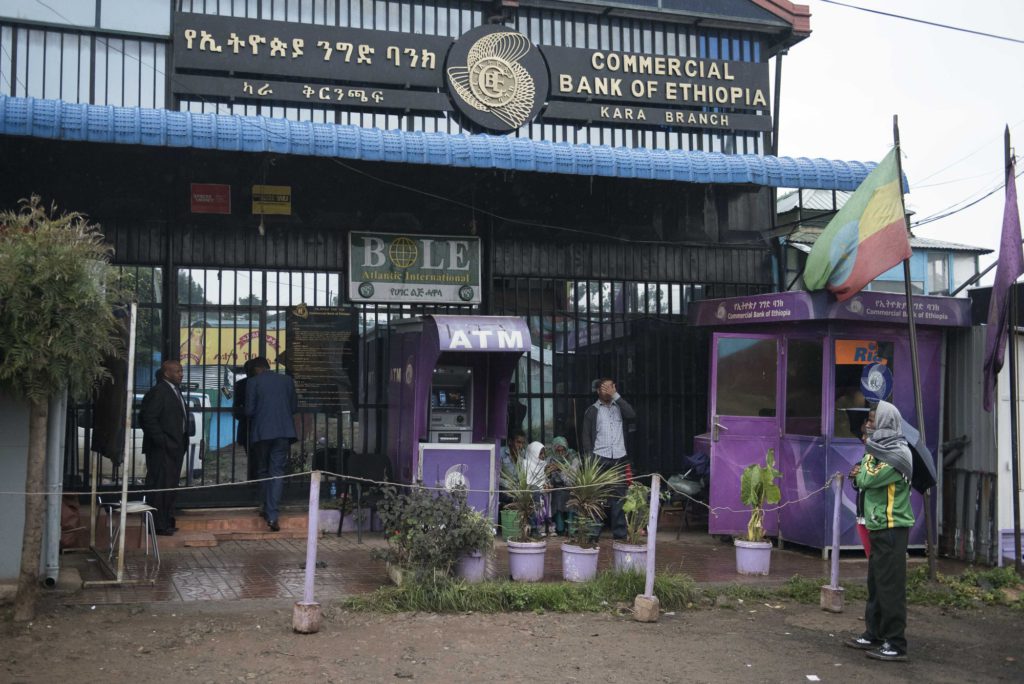
Ethiopia has 25 commercial banks serving 117 million people, according to World Bank data. Commercial Bank of Ethiopia, one of two state-owned lenders, held assets worth 485.7 billion birr ($17.6 billion) and caters to 15.9 million customers, according to its website.

Several foreign banks have representative offices in the Horn of Africa country, including Equity Group Holdings and KCB Group — the two biggest lenders in neighboring Kenya — along with Standard Bank Group. Lease companies, such as a unit of New York-based Africa Asset Finance Co., which pledged to bring in equipment worth $600 million after being licensed in August, can also operate there. 

The draft legislation also proposes that foreigner individuals can buy 5% in domestic banks. Foreign banks will also be allowed to set up subsidiaries or open branches in the nation. 

Africa’s second-biggest nation by population has already opened up its telecommunication industry by awarding a license to a Safaricom Plc-led Global Partnership for Ethiopia, a consortium that includes Japan’s Sumitomo Corp. and Britain’s Vodafone Group. The Ethiopian unit has secured a mobile money-services license after beginning commercial operations there and expects about $1 billion of investments within the next three years.

A year of its launch, the state telecom’s mobile money platform added 21.8 million users as of July 7.

More stories like this are available on bloomberg.com

©2022 Bloomberg L.P.
Close Bitnami banner
Bitnami