Bloomberg

FTC Drops Some Claims in Bid to Block Meta’s Merger With Virtual Reality App

(Bloomberg) — The US Federal Trade Commission pulled back in its first preemptive challenge to a takeover by Meta Platforms Inc., dropping some claims from a lawsuit that seeks to block the tech giant’s acquisition of virtual reality app Within Unlimited.

The agency, which sued to block the deal on antitrust grounds July 27, said it asked US District Judge Edward Davila Friday to let it remove some allegations about anticompetitive effects in the market for virtual-reality fitness apps.

Meta said the FTC’s case is “based on ideology, not evidence” and pointed out that the newly amended complaint drops allegations that its most popular virtual-reality game, Beat Saber, directly competes with Within’s Supernatural fitness app.

“The FTC now claims that Meta and Supernatural are not competitors, after previously claiming that they were,” Meta spokesperson Stephen Peters said in a statement. “What remains of the FTC’s case are speculative claims that continue to lack support in either the facts or the law.”

The company has denied the FTC’s allegations about the proposed deal and has accused the agency of selectively enforcing antitrust laws.  

The FTC said in its original complaint that Meta’s acquisition of Within, which develops apps for VR devices, including Supernatural, would “tend to create a monopoly.”

In Meta’s Beat Saber game, users hit targets in time to music. The social network acquired the game when it bought Beat Games in 2019 for an undisclosed amount.  The game has since become Meta’s top grossing app in its Oculus Quest store, where VR headset users download apps, surpassing more than $100 million in revenue as of October 2021.

Within’s Supernatural is a subscription fitness service where users can work out or meditate to music in immersive environments. The FTC’s original complaint alleged the two apps competed directly for users, but the new version refers to Beat Saber as an “incidental fitness app” and argues Meta was likely to create its own dedicated fitness app to compete with Supernatural before the acquisition.

The challenge to Meta’s proposed acquisition is indicative of the FTC’s stepped-up enforcement agenda under Chair Lina Khan, who was named by the Biden administration. The antitrust agency has faced significant criticism from Congress and antitrust advocates for allowing the biggest tech companies to acquire startups that might grow into rivals.

Meta has made a number of acquisitions, most of them small, to bolster its offering in virtual and augmented reality. Chief Executive Officer Mark Zuckerberg believes that in the future, the company will popularize a metaverse — a more immersive version of the internet, where people can populate an alternative virtual world to go shopping, go to work and see friends. 

The change to the complaint comes weeks after a key Republican senator raised questions about whether the agency was making “contradictory legal theories” about Meta in the Within challenge and its separate monopolization suit against the social network. 

At a Sept. 20 hearing, Utah Republican Senator Mike Lee told Khan he was concerned the inconsistency between the FTC’s arguments in the two cases could weaken the agency’s ability to challenge tech platforms. Khan declined to respond to Lee’s question about the Within suit, citing the ongoing proceedings. 

The FTC is seeking an injunction to halt the Within deal in federal court, and has filed a separate complaint against the merger in its in-house court. 

Davila has scheduled a two-week hearing in San Jose, California, on the injunction request and said he expects to issue a ruling before the end of the year, when Meta is trying to close the deal. The FTC’s in-house judge has scheduled a trial on the deal to start in January.

Stephen Calkins, an antitrust professor at Wayne State University Law School, described the FTC’s move to amend its complaint as “unusual,” particularly in a merger challenge, since those are often expedited.

“On a merger case, it’s not that common because it all happens fairly quickly,” said Calkins, who served as the FTC’s general counsel during the Clinton administration, adding that it is “certainly unusual to do it” within two months.

In a 2009 case, the FTC amended its complaint challenging the merger between organic grocer Whole Foods Market Inc. and Wild Oats Market Inc. But in that case, the FTC narrowed the allegations against the deal in its in-house court after initially losing in federal court, Calkins said, a different situation than in the Meta merger. 

The FTC said the vote to file the amended complaint was 4-0 with Republican Commissioner Noah Phillips, who intends to step down from the agency this fall, recused. Republican Commissioner Christine Wilson — who voted against the FTC’s original suit against Facebook in July — said she voted in favor of amending the complaint, but still doesn’t support the case overall.

(Updates with FTC vote in final paragraph)

More stories like this are available on bloomberg.com

©2022 Bloomberg L.P.

Celsius Says Execs Withdrew Millions Before Bankruptcy, Court Filings Show

(Bloomberg) — Top executives at Celsius Network LLC withdrew millions of dollars worth of cryptocurrencies in the month before suspending customer withdrawals from the platform, according to bankruptcy court documents filed by lawyers for the crypto lender in New York late Wednesday.

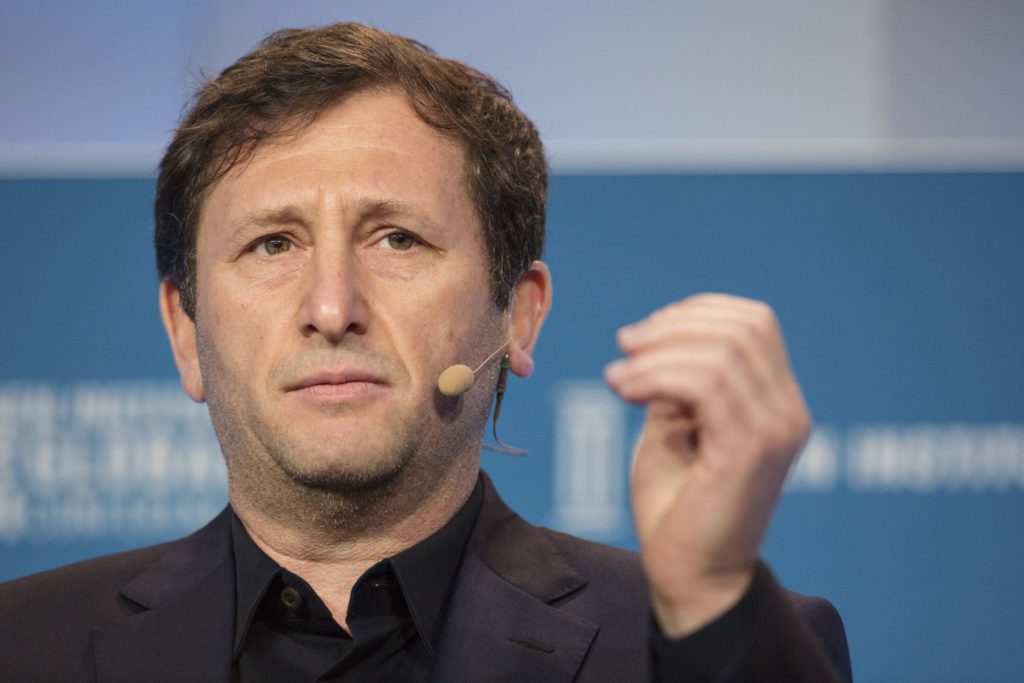
Now-former Chief Executive Officer Alex Mashinsky, co-founder Daniel Leon and Chief Technology Officer Nuke Goldstein and entities identified in the documents as their related parties made a series of withdrawals in May totaling in the tens of millions, these filings allege. Transactions were denominated in Bitcoin, Ether, USDC, Celsius’s own CEL token and “wrapped” Bitcoin.

Mashinsky withdrew about $10 million in cryptocurrency over the course of May, the filing shows. Leon withdrew about $7 million; net of deposits, his withdrawals amounted to about $3.1 million, the documents show. The calculations include withdrawals by entities and people related to the executives, as designated by Celsius advisers. 

For Goldstein, the filing listed $13 million of transactions identified as withdrawals. The filing further showed that Goldstein made deposits and posted collateral that brought his net withdrawals to about $559,000. Lawyers for Goldstein confirmed this number. According to a statement provided by his lawyers, “in many cases, the movement of funds between accounts are not ‘withdrawals’ from the platform; they simply reflect the shifting of funds between Mr. Goldstein’s accounts on the platform.”

The report, prepared by Celsius advisers, notes that some transactions marked as “withdrawals” may represent transfers from one Celsius account type to another. The company’s advisers are are continuing to analyze whether any transfers or withdrawals from the platform could be grounds for a lawsuit, according to the report. 

A Celsius representative didn’t immediately respond to an email seeking comment. Neither Mashinsky nor Leon returned multiple requests for comment. 

Read more: Bankrupt Crypto Firm Celsius Sets Dates for Auction of Assets

Celsius, once one of the industry’s most prominent lenders, suspended customer withdrawals in June and filed for bankruptcy protection the following month after making risky bets before the broader crypto market soured. The bankruptcy judge presiding over the case recently appointed an examiner to explore allegations of misconduct against the company and its executives.

Mashinsky stepped down from his position as CEO last month, followed by Leon whose resignation from the firm was confirmed by Celsius on Tuesday.

CoinDesk earlier reported on the withdrawals.

(Adds additional comment from lawyers for Nuke Goldstein. A previous version corrected the headline, subhed and text throughout to include attribution to court filings and add additional detail on transfers as well as deposits for Goldstein.)

More stories like this are available on bloomberg.com

©2022 Bloomberg L.P.

Juul Expands Board With Restructuring Experts to Weigh Its Options

(Bloomberg) — Juul Labs Inc. added two restructuring experts to its board of directors as the company weighs its options.

Paul Aronzon, who formerly led law firm Milbank’s global financial restructuring group, has joined the board. Another new independent director is David Barse, who runs index company XOUT Capital and family office DMB Holdings. Barse, the former chief executive officer of Third Avenue Management, joined the board of bankrupt cryptocurrency lender Celsius Network earlier this year.

Juul has been mulling options including a bankruptcy filing or new financing after the FDA banned Juul products from US shelves, citing a lack of evidence demonstrating their overall safety. The company won a court order temporarily blocking the FDA decision, and the agency separately stayed its ban. 

“As part of that preparation process, our board recently added two new independent members whose broad experience with companies exploring strategic options will help determine what path is best for our company, our products and the millions of adult smokers who have or are looking to transition from combustible cigarettes,” a Juul spokesperson told Bloomberg.

Juul has been working with restructuring advisers at Kirkland & Ellis and Alvarez & Marsal to assess  its options. The Wall Street Journal earlier reported about the new board members.

The company recently began talks regarding funding for a potential Chapter 11 bankruptcy, as Bloombeg reported. The preparations aren’t final, and plans could change. 

In a virtual town hall this week, Juul Chairman and CEO K.C. Crosthwaite said the company recently refinanced its secured debt, though it’s not a permanent solution to the company’s woes, according to a person with knowledge of the matter who asked not to be named because details are private. The company is also putting its international expansion on hold and focusing on the US and UK markets, where it generates almost all of its gross profit. 

More stories like this are available on bloomberg.com

©2022 Bloomberg L.P.

Tesla’s Week to Forget Is the Anchor Weighing On the S&P 500

(Bloomberg) — For all the stock market gyrations this week, one company’s performance stands out beyond all others: Tesla Inc.

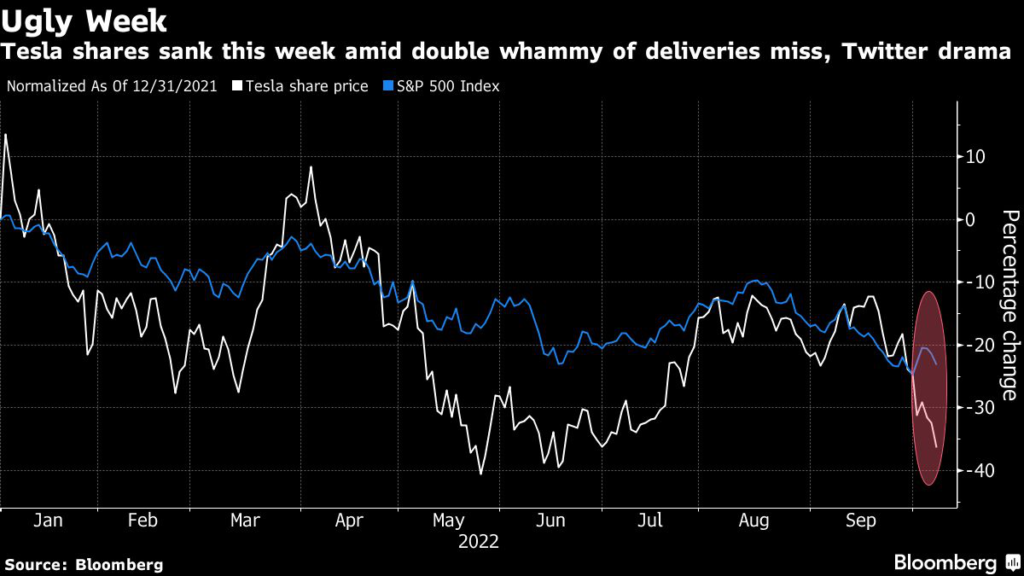
Tesla’s stock has plunged 16% over the five sessions, marking its worst week since March 2020’s Covid-stricken market selloff. Meanwhile, the S&P 500 Index recorded its best week in a month, closing up 1.5% on the strength of powerful rallies on Monday and Tuesday. Tesla was by far the biggest weight on the S&P this week, knocking about 13 points off the index. 

The EV-maker’s issues are no secret. It has been battered by the one-two punch of disappointing quarterly deliveries and Chief Executive Officer Elon Musk’s surprise decision to revive his offer to buy social-media platform Twitter Inc. The Twitter deal comes with the possibility that Musk will be forced to sell Tesla shares to finance the deal. 

For ardent Tesla fans like ARK Investment Management’s Cathie Wood, the selloff offers a chance to buy more of the stock at its cheapest price in months. The growth-stock guru, whose funds have been hit hard this year amid soaring inflation and rising interest rates, snapped up shares worth about $32 on Monday. Mom-and-pop traders were also big buyers, with nearly $540 million in net purchases over the past five trading days, Vanda Research said.

On the flipside, there are more cautious investors, who say the stock has several hurdles to navigate before finding a clear runway. A looming recession, growing threat of competition, a wary consumer squeezed by high inflation and the stock’s expensive valuation are the biggest worries. 

Musk’s Focus

“Will Tesla’s stock retain a halo effect and prosper while other high growth, high valuation stocks suffer? It hasn’t so far this year,” said Catherine Faddis, chief investment officer of Grace Capital. 

Musk’s purchase of Twitter adds a few more wrinkles. In addition to the uncertainty around the deal’s financing, investors are also worried that the billionaire could be pushing himself beyond his limits with so many demanding ventures.

“Musk will need to ‘justify’ the valuation he paid for Twitter by generating value as soon as possible, this will take his time and focus away from running Tesla,” said Brian Mulberry, client portfolio manager at Zacks Investment Management. “Musk may be a genius businessman, but he is still a human being and a day is still only 24 hours long.” Zacks owns Tesla stock through its All-Cap Core fund.

Meanwhile, even with this selloff, Tesla continues to tower over Big Tech and most of the S&P 500 with its eye-watering valuation. Tesla shares are trading at 51 times the company’s estimated forward earnings. By comparison, the S&P 500 trades at an average of 16 times, and Apple trades at 23 times.

All that being said, there is a reason why Tesla has such a lofty valuation. It’s about the future. Tesla’s dominating position in the still nascent and fast-growing EV market makes it dangerous to bet against, particularly in a global economy that will soon be powered by green energy. And Musk, for all the distractions pulling at him, is committed to making the company a success.

“Tesla is unique among US big tech right now because it has a much clearer fundamental growth trajectory than any other name. It also has the largest ‘key man’ risk of any stock in the S&P 500,” said Nicholas Colas, co-founder of DataTrek Research. “Musk’s attention to Tesla is worth a lot to many investors.”

(Updates stock and index moves in second paragraph.)

More stories like this are available on bloomberg.com

©2022 Bloomberg L.P.

Twitter Drifts Away From Musk’s Offer as Funding Doubts Loom

(Bloomberg) — Twitter Inc. shares extended losses for a third session on Friday, widening the gap between Elon Musk’s $54.20 per share offer as deal talks are said to be stuck over a debt financing contingency.

Shares in the social media firm closed 0.4% lower at $49.18, after slipping as much as 2.5%, as concerns surrounding the transaction’s funding persist. Those uncertainties have kept Twitter’s stock about 9% below the offer price.

The stock is now down for a third day after soaring on Tuesday when Musk made a surprising U-turn from his effort to back out of the deal, potentially avoiding a contentious courtroom fight.

On Oct. 3, the Tesla chief executive officer said his offer is contingent on receiving $13 billion in debt financing. Then on Thursday, Bloomberg reported talks to reach a deal resolution are stalled, in part, on the new contingency, according to people familiar with the matter.

On the same day, a Delaware judge halted a court case against Musk over his takeover of Twitter, giving the parties more time to complete the deal.

(Updates stock moves and the chart at close)

More stories like this are available on bloomberg.com

©2022 Bloomberg L.P.

Bitcoin Drops as Strong Jobs Data Seen Keeping Fed on Rate-Hike Path

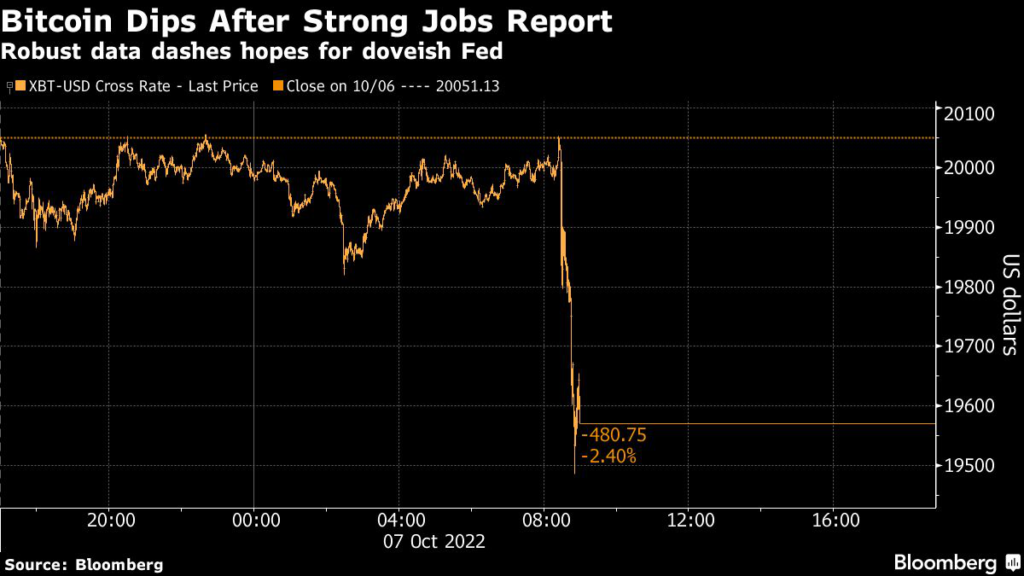
(Bloomberg) — Bitcoin fell after the monthly US jobs report showed that payrolls expanded at a faster-than-expected pace and the unemployment rate fell, bolstering expectations that the Federal Reserve will continue the aggressive rate hikes that have pulled down risk assets.

Bitcoin, the largest digital coin by market value, dipped as much as 3.6% on Friday, its largest intraday drop over a week. The token traded as low as $19,333. Ether dropped as much as 3.4%, with other so-called altcoins like Solana and Avalanche also declining. 

“I think we need to respect the down trend and assume that the bear-market cycle is still dominant,” says Katie Stockton, founder of Fairlead Strategies LLC.

The jobs report showed that the labor market has been resilient in the face of the steepest rate hikes in decades, with wages continuing to rise by an elevated pace in the face of inflation. That strength dulled investors’ hopes that Fed Chair Jay Powell may slow the pace of the monetary policy tightening.

“The jobs report was bearish for crypto and stocks, as the data came in hotter than expected,” said Marcus Sotiriou, an analyst at GlobalBlock. He added that consumer price index data coming next week should give added clarity on where the Federal Reserve may go next.

More stories like this are available on bloomberg.com

©2022 Bloomberg L.P.

Biden Tightens China Chip Rules on Chaotic Day for Industry

(Bloomberg) — The Biden administration announced new restrictions on China’s access to US semiconductor technology, escalating tensions between the two countries and adding fresh complications to an industry reeling from a slump in demand. 

The measures are aimed at stopping Beijing’s push to develop its own chip industry and advance the country’s military capabilities. They include restrictions on the export of some types of chips used in artificial intelligence and supercomputing and also tighten rules on the sale of semiconductor manufacturing equipment to any Chinese company.

Washington is looking to ensure that Chinese companies don’t act as a conduit for the transfer of technology to their country’s military — and that chipmakers there don’t develop the capability to make advanced semiconductors themselves.

China “has poured resources into developing supercomputing capabilities and seeks to become a world leader in artificial intelligence by 2030,” said Assistant Secretary of Commerce for Export Administration Thea D. Rozman Kendler. “It is using these capabilities to monitor, track and surveil their own citizens, and fuel its military modernization.”

The new rules are coming at a difficult time for the chip industry, which is suffering a steep drop in demand for personal-computer and smartphone components. Shares of many of the world’s biggest semiconductor makers tumbled on Friday following reports that the slump may be even worse than thought.

The government’s actions add another layer of uncertainty for investors already trying to work out how much demand for semiconductors might shrink. Companies such as Applied Materials Inc. and Intel Corp. can’t easily walk away from China, the biggest single market for their products and a key part of a global supply chain for electronics used everywhere in the world.

Chipmaker stocks have struggled throughout 2022, following three straight years where the group climbed between 40% and 60%. The Philadelphia Stock Exchange Semiconductor Index is down nearly 40% so far this year, on track for its biggest annual drop since 2008, and it recently fell to its lowest level since November 2020.

The losses have been widespread, with nearly every component of the industry benchmark index in negative territory this year. Nvidia Corp. and Advanced Micro Devices Inc., former highfliers, have declined almost 60%. AMD reported preliminary third-quarter revenue on Thursday that was weaker than expected, marking the latest in a series of chipmaker warnings. AMD and Nvidia have already disclosed that the China-related restrictions on AI chips will hurt their sales. 

Nvidia said Friday that the broader regulations just announced won’t have have much additional effect on its business, which was already restricted by previous export controls. 

“These regulations impose on the broader industry controls on processors meeting certain thresholds that we were already subject to,” Nvidia said in an emailed statement. “We don’t expect the new controls, including restrictions on sales for highly dense systems, to have a material impact on our business.”

When the new rules come into force, it will be harder for providers of chips used in Chinese supercomputers and related gear to get permission to fill orders. They should presume requests will be denied, according to senior Commerce Department officials.

Commerce also put a raft of restrictions on supplying US machinery that’s capable of making advanced semiconductors. It’s going after the types of memory chips and logic components that are at the heart of state-of-the art designs.

While there will be more latitude for overseas companies needing technology for their own operations in China — or for parties that can prove they’re making things there for immediate export elsewhere — Commerce said it will enforce the rules and also cut off support for existing deployments of machinery covered by the restrictions.

The US is home to the biggest block of companies that design vital electronic components — and provide the complex machinery needed to manufacture them — but other regions have capabilities that could undermine some of the government’s efforts.

Commerce Department officials acknowledged that overseas cooperation is necessary to avoid hampering the initiatives and said there are talks with other parties underway around the world on the topic. The officials declined to characterize how advanced the negotiations are or how likely they are to result in similar actions in key countries, such as the Netherlands and Japan.

Chipmaking gear restrictions cover production of the following:

  • Logic chips using so-called nonplanar transistors made with 16-nanometer technology or anything more advanced than that. Generally speaking, the smaller the number of nanometers, the more capable the chip.
  • 18-nanometer dynamic random access memory chips.
  • Nand-style flash memory chips with 128 layers or more.

For companies with plants in China — including non-US ones — the rules will create additional hurdles and require government signoff.

South Korea’s SK Hynix Inc. is one of the world’s largest makers of memory chips and has facilities in China — part of a supply network that sends components around the world. 

“The new measures restrict sale of equipment for memory products of certain level of technology or above, but allow Korean chipmakers to export if they have a license from the Commerce Department,” the company said in a statement. “SK Hynix is ready to make its utmost efforts to get the US government’s license and will closely work with the Korean government for this.”

Separately, Commerce added more names to a list of companies that it regards as “unverified,” meaning it doesn’t know where their products end up being used. The 31 additions are all Chinese. That indicates that US suppliers will face new hurdles in selling technologies to those entities.

The biggest name to be added to the list is Yangtze Memory Technologies Co. The memory-chip maker is widely regarded as being the best bet China has of breaking through into the front ranks of the industry and has made progress with advanced products for chip-based storage.

The new restrictions, which begin to take effect this month, are intended to break the link between Chinese companies and their country’s military and security apparatus. But the US chip industry has expressed concerns that moving too aggressively could put domestic companies at a disadvantage. They worry that losing China sales will hurt their ability to spend on innovation and potentially help their overseas competitors.

The Semiconductor Industry Association, a lobbying group representing all of the largest US chipmakers, said it’s evaluating the impact of the new export controls and will ensure compliance with the restrictions. 

“We understand the goal of ensuring national security and urge the US government to implement the rules in a targeted way — and in collaboration with international partners — to help level the playing field and mitigate unintended harm to US innovation,” the association said in a statement.

Anyone receiving the unverified designation has to submit to checks on where their products go. While that process is underway, their US technology suppliers will be required to go through extra certification steps.

Successfully proving they’re not breaking rules allows the companies to be removed from the list. Not doing so — or failing to cooperate — risks putting them on the so-called entity list, meaning that US technology exports to them are subject to prior approval by the Commerce Department.

Bloomberg reported this week that the administration was readying new restrictions, part of a broader strategy that also includes bolstering domestic chip production. Earlier this year, Biden signed a bill that promises to infuse about $52 billion into the US semiconductor industry.

“Our actions will protect US national security and foreign policy interests while also sending a clear message that US technological leadership is about values as well as innovation,” Kendler, the Commerce official, said Friday.

(Updates response from Nvidia and SK Hynix starting in ninth paragraph.)

More stories like this are available on bloomberg.com

©2022 Bloomberg L.P.

Stocks Crushed as Jobs Keep Fed on Hiking Path: Markets Wrap

(Bloomberg) — Wall Street got a reality check, with data showing a hot labor market that will likely keep the Federal Reserve on its aggressive hiking trail. Those bets sent stocks tumbling, pushing benchmark Treasury yields toward their longest weekly up streak since 1984.

To David Donabedian at CIBC Private Wealth US, the report puts an “an exclamation point” on the idea that the market bottoming process is going to be a long one. In this “bizarro world” of big hikes, traders may see the solid data as a reason to brace for turmoil, says Callie Cox of eToro. The bottom line for Brown Brothers Harriman’s Win Thin is that a 75-basis-point Fed boost in November is a “done deal,” with another increase of that size in December becoming a “real possibility.”

Almost 95% of the companies in the S&P 500 fell, with a rout in big tech weighing heavily on the market. The slide comes a few days after the gauge notched its biggest two-day rally since the onset of the pandemic amid a debate on whether the Fed would be closer to “peak hawkishness.” Those gains put the measure on track for its best week in a month — despite Friday’s plunge. Energy shares climbed with oil.

Ten-year yields topped 3.8%, heading toward their 10th consecutive weekly rise. The dollar advanced. The swap contract for the November Fed meeting priced in nearly 75 basis points of tightening. Market-implied expectations for where the rate will peak also increased, with the derivative contract for the March gathering trading around 4.65%. The current range for the benchmark rate stands between 3% and 3.25%.

Fed Bank of New York President John Williams said rates need to rise to around 4.5% over time, but the pace and ultimate peak of the tightening campaign will hinge on how the economy performs. Several officials, in separate remarks this week, delivered a resolutely hawkish message that price pressures remain elevated and they won’t be deterred from raising rates by volatility in financial markets.

All eyes will now be on next week’s US inflation data after a hotter-than-expected reading in August tempered hopes of a nascent slowdown. Separately, minutes from the Fed’s September meeting will give clues into the central bank’s tolerance for economic pain.

Amid fears of a looming recession, investors poured the most money into cash since April 2020, but stocks could see further declines as they don’t fully reflect that risk, according to Bank of America Corp. strategists. Their report cited EPFR Global data showing cash funds received nearly $89 billion in the week through Oct. 5 — while investors withdrew $3.3 billion from global stock funds.

Wall Street is “rebelling against” policy tightening, the strategists led by Michael Hartnett wrote in the note published before the labor-market report.

US REACT: September Jobs Seal Deal for Next 75-bp Fed Hike

From a technical perspective, the fact that the S&P 500 remains oversold enough alongside bearish sentiment may warrant a rebound that could materialize as early as next week, according to Dan Wantrobski at Janney Montgomery Scott.

“The data being reported alongside our proprietary cycle work to date gives us confidence that we are on the right track in anticipating more of a ‘U’-shaped market bottom and recovery in the months ahead (into 2023),” he added. “We believe the floor will be established at some point in the weeks/months ahead — but for now, investors should continue to expect a very choppy glide path due to significant macro overhang.”

More comments on jobs:

Jeffrey Roach, chief economist at LPL Financial:

“In a word: ‘frustrating.’ As long as job gains are strong, the markets should expect aggressive rate hikes by the Federal Reserve.”

Michael Shaoul, chief executive officer at Marketfield Asset Management:

“This report should keep expectations of any ‘dovish pivot’ at bay, and underlines our concerns that any shift in policy is much more likely to be provoked by much worse financial market conditions than a soft landing in the underlying US economy.”

Shawn Cruz, head trading strategist at TD Ameritrade:

“The market has been in a ‘bad-news-is-good-news’ mentality and there’s really no bad news in this report. It’s a solid jobs report, but it’s not what the market wants to see because it doesn’t give the Fed a reason to pause or shift away from its hawkish intentions.”

Ronald Temple, managing director at Lazard Asset Management:

“While job growth is slowing, the US economy remains far too hot for the Fed to achieve its inflation target. The path to a soft landing keeps getting more challenging. If there are any doves left on the FOMC, today’s report might have further thinned their ranks.”

Seema Shah, strategist at Principal Global Investors:

“Today’s job number is a hawkish reading, with almost all the elements of the report moving in the wrong direction for the Fed.”

Ian Lyngen, head of US rate strategy at BMO Capital Markets:

“On net, it was a strong enough read to keep a 75 bp Nov hike as the path of least resistance, but the deceleration in wage growth YoY adds to the case for a slowed hiking pace to 50 bp in December, and we still expect the final 25 bp hike in February to reach terminal.”

Some of the main moves in markets:

Stocks

  • The S&P 500 fell 2.6% as of 2:08 p.m. New York time
  • The Nasdaq 100 fell 3.6%
  • The Dow Jones Industrial Average fell 1.9%
  • The MSCI World index fell 2.3%

Currencies

  • The Bloomberg Dollar Spot Index rose 0.2%
  • The euro fell 0.3% to $0.9760
  • The British pound fell 0.6% to $1.1094
  • The Japanese yen fell 0.1% to 145.31 per dollar

Cryptocurrencies

  • Bitcoin fell 3% to $19,446.72
  • Ether fell 2.9% to $1,325.08

Bonds

  • The yield on 10-year Treasuries advanced five basis points to 3.87%
  • Germany’s 10-year yield advanced 11 basis points to 2.19%
  • Britain’s 10-year yield advanced seven basis points to 4.24%

Commodities

  • West Texas Intermediate crude rose 4.4% to $92.31 a barrel
  • Gold futures fell 0.8% to $1,707.10 an ounce

More stories like this are available on bloomberg.com

©2022 Bloomberg L.P.

Ukraine Latest: EU Leaders Closer to Price Cap on Russian Gas

(Bloomberg) — European Union leaders edged closer to a Russian gas-price cap as a further measure to punish President Vladimir Putin for his invasion of Ukraine, as Kremlin forces intensified strikes on the southern city of Zaporizhzhia. 

President Joe Biden said the Russian leader’s warnings that he may resort to deploying tactical nuclear weapons must be taken seriously and could lead to “Armageddon.” The US is trying to find an “off-ramp” for Putin, the US leader said. 

The Nobel Peace Prize was awarded to backers of human rights in Russia, Ukraine and Belarus, collectively cited by the Nobel committee for their “outstanding effort to document war crimes, human right abuses and the abuse of power.” But some in Ukraine made clear their chagrin at sharing the prize.

(See RSAN on the Bloomberg Terminal for the Russian Sanctions Dashboard.) 

Key Developments

  • Human Rights Champions Win Nobel Peace Prize as War Rages
  • For Europe, Biden’s ‘Armageddon’ Warning Can’t Be Dismissed
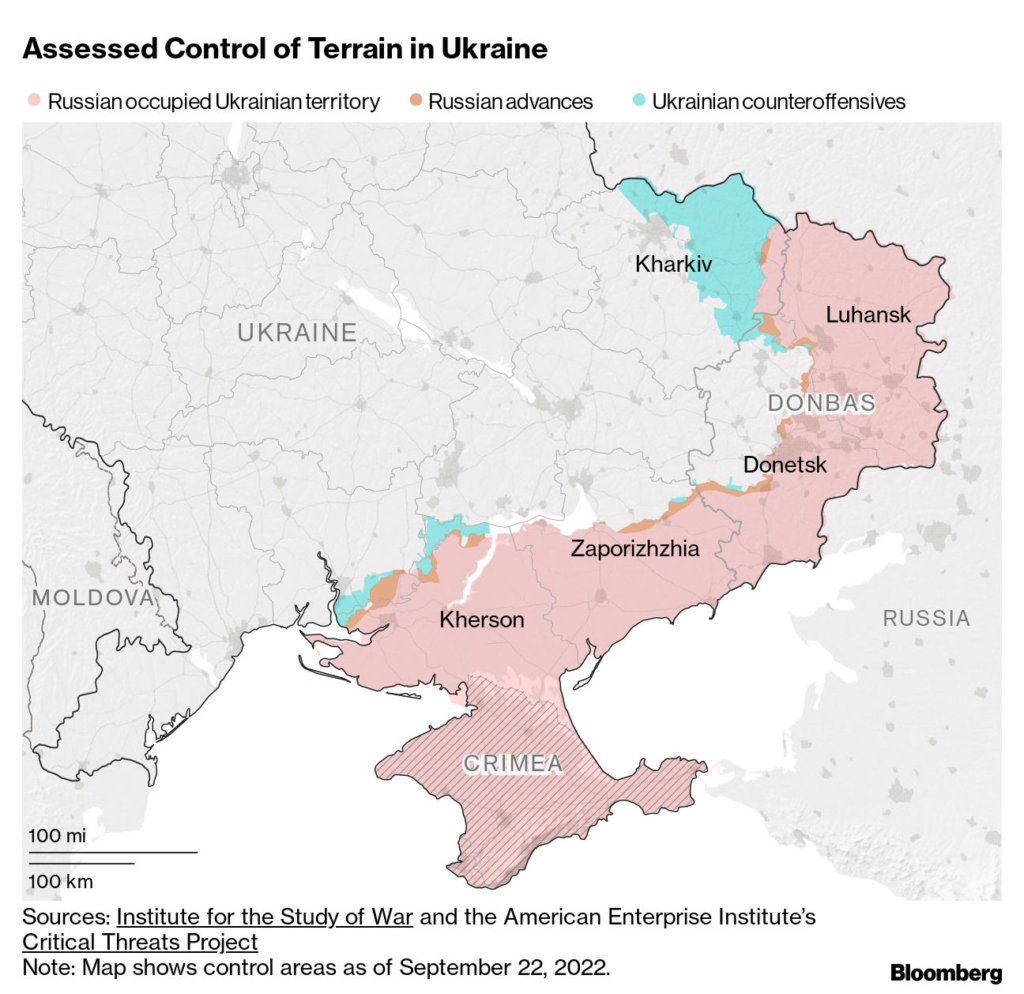
  • Russia Escalates Strike on Southeast City as Ukrainians Advance
  • Oil Poised for Biggest Weekly Rally Since March on OPEC+ Move
  • NATO Once Feared a Putin Victory, Now It Worries Over His Defeat
  • European Gas Prices Ease as Bloc Seeks to Blunt Energy Crisis

On the Ground

Moscow’s troops are likely establishing defensive positions in the upper Kherson region following the collapse of the Russian line in northeast Kherson, the US-based Institute for the Study of War said. Russian forces continued to conduct routine artillery, air and missile strikes west of Hulyaipole, and in the Dnipropetrovsk and Mykolaiv regions on Thursday. In the past 24 hours, Russia has carried out eight missile and 15 air strikes. The city of Zaporizhzhia was attacked on Thursday night by Iranian-made drones, with infrastructure damaged in two districts, according to regional governor. 

(All times CET)

Zelenskiy Says IMF Approved $1.3 Billion in Immediate Aid (7:45 p.m.)

Ukraine’s President Volodymyr Zelenskiy said on Twitter that the International Monetary Fund’s executive board approved providing about $1.3 billion in immediate aid to Ukraine under its Rapid Financing Instrument. The IMF’s press office didn’t immediately respond to a request for comment.


Shared Nobel Peace Prize Rankles Some in Ukraine (6:28 p.m.)

Ukrainian presidential adviser Mykhailo Podolyak criticized the Nobel committee for awarding its peace prize to activists from Russia and Belarus together with a rights group in his country, summing up the anger many in Ukraine expressed on social media.

Sardonically calling the peace prize “awesome,” Podolyak wrote on Twitter that “the Nobel Committee has an interesting understanding of word ‘peace’ if representatives of two countries that attacked a third one receive @NobelPrize together. Neither Russian nor Belarusian organizations were able to organize resistance to the war.”

But Olexandra Matviychuk, the head of the winning Ukrainian rights organization, praised the Russian and Belarusian winners on Facebook. “Delighted that the Center for Civil Liberties, which I lead, received the Nobel Prize today along with our friends and partners at Memorial and Viasna,” she wrote. 

Ukranian Troops Say Musk’s Starlink Devices Are Out on Front Lines (6:34 p.m.)

Ukrainian troops are reporting outages of their Starlink devices on the front lines, limiting communication efforts in recent weeks, the Financial Times reported, citing Ukrainian officials and soldiers.

But that may be because Elon Musk’s SpaceX was trying to prevent misuse of the satellite communications system by Russian forces, Roman Sinicyn a co-coordinator at the Serhiy Prytula Charity, a foundation that donates Starlink systems to the Ukrainian armed forces, told the FT.

Ukrainian Railways to Restore Connections with Izyum, Minister Says (6:15 p.m.)

Ukrainian’s state-run railway company, Ukrzaliznytsia, plans to restore connections with the liberated town of Izyum in the Kharkiv region, on Monday, Infrastructure Minister Oleksandr Kubrakov said on Facebook.

“As soon as we get the ‘green light’ from military and pyrotechnicians, will work on connection with Kupiansk, the key railway hub of Kharkiv Region,” Kubrakov said. He said establishing contact with Izyum and other settlements will allow providing aid faster and displaced people will be able to check the homes they left behind.

EU Aims to Finish Gas Price-Cap Plan in Two Weeks (5:33 p.m.) 

The EU’s executive arm is urgently planning to prepare several different options for how to cap the price of natural gas as it tries to alleviate an energy crisis

The aim is for a proposal to be completed by the time leaders meet in Brussels for an Oct. 20-21 summit. A consensus for measures to tackle rising energy prices emerged at an EU leaders summit in Prague, as several member states warned the EU needs to act quickly or jeopardize the bloc’s solidarity as nations start go their own way.

St. Petersburg Cancels New Year Celebrations for War Effort (4:05 p.m.) 

Putin’s hometown of St. Petersburg announced Friday that it’s cancelling New Year celebrations to redirect funds to the war effort in Ukraine. The money saved will be spent on equipment for Russian conscripts and volunteers fighting in the conflict, City Hall said on its website.

Some regional officials, including the governor of the Siberian region of Omsk, have complained they lack the financial means to make promised state payouts to those mobilized.

Oil Poised for Biggest Weekly Rally Since March (2:45 p.m.) 

Oil headed for the biggest weekly gain since early March as OPEC+ put the market on course for further tightening ahead of winter.

West Texas Intermediate was near $90 a barrel on Friday, with futures up almost 12% for the week. Benchmark Brent topped $95 for the first time since mid-September. Russia reiterated this week that it won’t sell oil to countries that adopt a US-led price cap, adding to supply uncertainty. 

Russia Demands Involvement in Nord Stream Leak Investigation (11:36 a.m.)

Russia sent a letter to Sweden demanding its authorities and state-owned gas company Gazprom PJSC be included in the investigation of the damage to the Nord Stream gas pipelines, newspaper Expressen reported. 

The letter comes a day after Swedish public prosecutors and the security service concluded that the two Nord Stream leaks in the country’s exclusive economic zone were caused by detonations. 

Read more: Russia Demands Involvement in Nord Stream Leak Investigation

Nobel Peace Prize Goes to Activists in Ukraine, Belarus, Russia (11 a.m.)

The Nobel Peace Prize for 2022 was awarded to a human rights activist from Belarus, Ales Bialiatski, who’s currently in detention, along with the Russian rights organization Memorial and Ukraine’s Center for Civil Liberties.

“They have made an outstanding effort to document war crimes, human right abuses and the abuse of power,” said Berit Reiss-Andersen, head of Norway’s Nobel committee said. “Together they demonstrate the significance of civil society for peace and democracy.” 

Memorial, a group founded by Soviet-era dissidents including Nobel Peace Prize laureate Andrei Sakharov, was shut down earlier this year on the grounds that it failed to identify itself as a “foreign agent” under Russian law.

Insider Confronted Putin About War, Washington Post Reports (9 a.m.)

One of Putin’s inner circle recently confronted him over his handling of the war in Ukraine, the Washington Post reported, citing information obtained by US intelligence. 

The development was considered significant enough to be included in President Joe Biden’s daily intelligence briefing, the newspaper reported, citing people familiar with the matter.  

The person’s discontent was said to be related to “mistakes being made by those executing the military campaign,” the Post reported. A spokesperson for the National Security Council declined to comment to the newspaper. 

Zelenskiy Vows Zaporizhzhia Atomic Plant to Remain in Ukraine’s Hands (8:20 a.m.)

Ukraine’s president said attempts by Russia to claim ownership of the Zaporizhzhia nuclear power plant are “frankly speaking, stupid,” a day after Russia’s Vladimir Putin ordered his government to take ownership of the facility. 

“Only Ukrainian specialists can guarantee that there will be no radiation incidents at the Zaporizhzhia station,” Zelenskiy said in a nightly address to the nation.

Ukraine’s leader discussed the Zaporizhzhia situation with Rafael Mariano Grossi, head of the International Atomic Energy Agency, at a meeting Thursday in Kyiv. He said Ukraine is “waiting for a tough statement” from the UN agency on Putin’s “raiding” of the plant. 

Ukraine May Have Captured 440 Russian Battle Tanks, UK Says (7:30 a.m.)

Ukraine has likely captured at least 440 Russian main battle tanks and some 650 other armored vehicles since February’s invasion, the UK defense ministry said. 

“Over half of Ukraine’s currently fielded tank fleet potentially consists of captured vehicles,” the UK said, adding that poor training and discipline had resulted in Russian troops leaving “intact equipment” behind. 

North Korea’s Kim Lauds Putin’s 70th Birthday (6:49 a.m.)

North Korean leader Kim Jong Un sent birthday greetings to Russian President Vladimir Putin, praising Moscow and bashing the US.

“Russia is reliably defending the dignity of the state and its fundamental interests from the challenges and threats by the U.S. and its vassal forces,” the state’s official Korean Central News Agency cited Kim’s message to Putin as saying. 

North Korea has backed Russia’s territorial claims in Ukraine. Meanwhile, US officials said last month it suspects Russia is looking to buy rockets and artillery shells from North Korea to help with its war in Ukraine. Pyongyang has denied selling weapons and blasted the US for spreading “rumors. “

Biden Says US Trying to Find ‘Off-Ramp’ for Putin (3:55 a.m.)

Biden said the US is trying to find an “off-ramp” for Putin and worries that his threats to use tactical nuclear weapons are real and could lead to “Armageddon.”

“We’re trying to figure out what is Putin’s off-ramp? Where does he get off? Where does he find a way out?” Biden said Thursday at a fundraiser in New York City. “Where does he find himself in a position that he does not, not only lose face but lose significant power in Russia?”

“He is not joking when he talks about potential use of tactical nuclear weapons or biological and chemical weapons, because his military is, you might say, significantly under-performing,” Biden added. 

More stories like this are available on bloomberg.com

©2022 Bloomberg L.P.

Air Force Says Boeing Tanker’s Camera Repair to Take Another 19 Months

(Bloomberg) — The US Air Force has concluded it will take an additional 19 months for Boeing Co. to start installing an improved version of the flawed camera-based refueling system on its KC-46 refueling planes, according to the service. 

“After thoroughly evaluating all the data and assumptions that went in to the current schedule” the Air Force and Boeing determined that achieving an “Operational Military Flight Release” for the upgrade will slip from March 2024 to October 2025, Major Josh Benedetti, an Air Force spokesman, said in a statement.

Boeing has agreed to  improve its Remote Vision System, 3D cameras that feed a console where an airman guides a refueling boom during a midair minuet to connect with another plane. The Air Force discovered in 2017 that shadows or the sun’s glare sometimes can hamper the system’s view, resulting in occasional scraping of planes being refueled or difficulty in performing the operation.

Boeing will continue to be responsible for the costs of fixing the camera system unless the Air Force orders changes to the design, Benedetti said. When Bloomberg News reported the prospect of further delays last month, the Air Force predicted the camera fix would take less than a year.

Andrew Hunter, the Air Force’s assistant secretary for acquisition, said in the statement that “our defense industrial base continues to face supply chain issues and we’re seeing effects in the acquisition schedules of technically complex systems,” such as the KC-46 camera system.

Boeing echoed that theme in a statement, saying that “the current revised delivery timeline addresses hardware availability due to global supply chain shortages and longer lead times for the complex computing equipment and technological components required for the cutting-edge enhancements” that the camera system will deliver.

More stories like this are available on bloomberg.com

©2022 Bloomberg L.P.

Close Bitnami banner
Bitnami