
Bloomberg

AMD, Samsung Demand Woes Spoil Rally in Semiconductor Stocks

(Bloomberg) — A sizzling rally in global semiconductor stocks this week is starting to look illusory as a slew of disappointing earnings from major chipmakers pointed to a likely protracted downturn for the sector. 

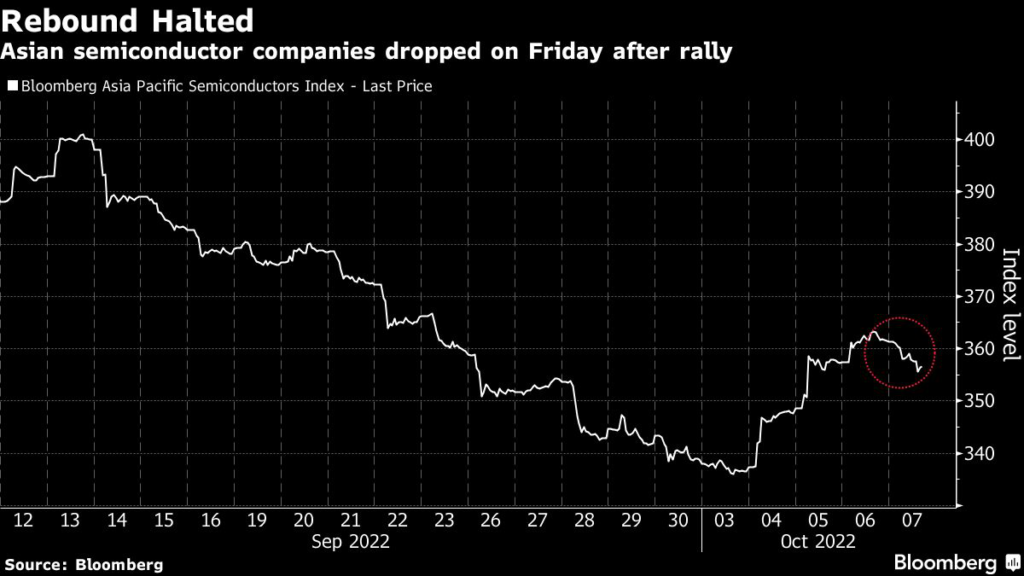
The Bloomberg Asia Pacific Semiconductors Index sank 1.6% Friday after gaining 6.7% earlier in the week. Taiwan Semiconductor Manufacturing Co. led the decline, dropping 2.9%. A gauge of European chip stocks fell for the first time in six sessions, and the selloff looks likely to spill over to the US, where the Philadelphia Semiconductor Index has jumped 8.8% this week.

Optimistic investors had been hoping that chip stocks finally were bottoming out after the Philadelphia index plunged 36% this year, the most since 2008. They got a rude awakening after Samsung Electronics Co., the world’s largest memory-chip maker, and PC-processor maker Advanced Micro Devices Inc. reported results that suggested a deeper-than-feared slowdown ahead. 

“Weakened demand and supply-chain woes in the semiconductor sector may have already been priced in, but there is still a darkened outlook,” said Tina Teng, an analyst with CMC Markets. “Excess inventories and cooling demand may further slow down the sector’s growth.”

In a reversal of the pandemic-induced boom, chipmakers have had a tough time this year as rising prices and weaker economies hurt consumption and expand inventories. The industry is grappling with factors including aggressive monetary tightening by major central banks and Washington’s export restrictions on China, a top consumer of chips. 

In the latest move, the Biden administration announced on Friday new restrictions on China’s access to US chip technology, adding measures aimed at stopping Beijing’s push to develop its own chip industry and advance the country’s military capabilities. 

Semiconductor stocks are the most cyclical part of the technology world because of the boom-and-bust nature of chip demand. This year the industry has gone from a worldwide shortage of chips to a glut in a matter of months because of those headwinds. And recent tensions between the US and China and new investments in US manufacturing could worsen the imbalance in supply and demand, Teng said.

The latest selling is putting an abrupt end to a nascent rally in the sector, after Morgan Stanley said the cyclical downturn appears to be finally nearing a bottom. “We are not calling for the beginning of a new cycle but acknowledge that an inflection (bottom) is closer,” the investment bank’s analysts wrote in a note. 

The case for optimism has been that stock prices now fully reflect the slowdown. The Philadelphia index is priced at 14.5 times earnings, an 11% discount to its average multiple of 16.3 for the past decade, while the European index is at a 17% discount. 

Those averages, though, reflect one of the greatest bull markets in history, so it’s hard to argue chip shares are shockingly cheap. And the Asian index is right in line with its average price-earnings ratio.

This year’s declines have been widespread, with 28 of the 30 stocks in the Philadelphia index falling. The slump was preceded by annual gains averaging 50% for the benchmark between 2019-2021.

Among notable losers around the globe, Nvidia Corp., a staple of high-end gaming computers, has lost more than $400 billion in market value. Germany’s Infineon Technologies AG, which gets almost half its sales from the auto industry, is down 38% this year, while Chinese manufacturers Sanan Optoelectronics Co. and Will Semiconductor Co. have fallen by more than half.

Some investors are willing to start nibbling on the stocks now in anticipation of a turnaround.  

“I have started to buy some shares of tier-one foundries and suppliers of advanced manufacturing in steps, as the valuations of the leading companies is low,” said Alex Huang, manager of the Capital Hi-Tech Fund in Taipei. “But I will wait for a while to add holdings significantly, pending further checks on the utilization rate of companies and supply-demand for products like cellphones and servers.”

There’s a chance it’s still too soon. 

The inflection point probably won’t come until 2024, when inflation cools and appetite for chips recovers, said Richard Windsor, founder of independent researcher Radio Free Mobile. Even for memory-chip makers that have seen a sharp drop in demand, it’s “impossible to tell” when the bottom will arrive and how sharp that will be, he said.


Tech Chart of the Day

Top Tech Stories

  • Samsung reported its first profit drop since 2019, underscoring the depth of a global PC and memory chip downturn.
  • Advanced Micro Devices’ preliminary third-quarter sales missed projections by more than $1 billion, adding to concerns about the sputtering market for personal-computer chips.
  • Talks between Elon Musk and Twitter Inc. to reach a resolution of the $44 billion takeover are stuck in part over Musk’s statement that his offer is now contingent on receiving $13 billion in debt financing, according to people familiar with the matter.
    • A Delaware judge halted the court case against Elon Musk over his $44 billion purchase of Twitter, giving the parties more time to complete the deal.
  • Walt Disney Co.’s ESPN is nearing a large new partnership with sports-betting firm DraftKings Inc., according to people familiar with the matter.
  • Alphabet Inc.’s Google will open its first data center in Japan next year as part of increasing investment in the world’s third-biggest economy.
  • Tesla Inc. will deliver its first Semi trucks to PepsiCo Inc. five years after Elon Musk showed off prototypes and began taking deposits for the electric big rigs.
  • President Joe Biden has been explicit in vowing to commit US forces in the event of a Chinese attack on Taiwan. The question occupying US and Taiwanese officials is the fate of the island’s flagship semiconductor industry.
  • Amazon.com Inc. is shutting down tests of its home delivery robot, the latest sign that the e-commerce giant is starting to wind down experimental projects amid slowing sales growth.

(Adds White House restrictions in paragraph 6.)

More stories like this are available on bloomberg.com

©2022 Bloomberg L.P.

Twitter Drifts Away From Musk’s Offer as Financing Concerns Loom

(Bloomberg) — Twitter Inc. shares extend losses for a third session on Friday, widening the gap between Elon Musk’s $54.20 per share offer as deal talks are said to be stuck over a debt financing contingency.

Shares in the social media firm slipped as much as 1.6% as concerns surrounding the transaction’s funding persist. Those uncertainties have kept Twitter’s stock about 10% below the offer price.

The stock is now down for a third day after soaring on Tuesday when Musk made a surprising U-turn from his effort to back out of the deal, potentially avoiding a contentious courtroom fight.

On Oct. 3, the Tesla chief executive officer said his offer is contingent on receiving $13 billion in debt financing. Then on Thursday, Bloomberg reported talks to reach a deal resolution are stalled, in part, on the new contingency, according to people familiar with the matter.

On the same day, a Delaware judge halted a court case against Musk over his takeover of Twitter, giving the parties more time to complete the deal.

(Updates stock moves throughout.)

More stories like this are available on bloomberg.com

©2022 Bloomberg L.P.
Futures Sink as Jobs Data Bolster Hawkish Fed Bets: Markets Wrap

(Bloomberg) — Stock futures fell and bond yields climbed after data showing a still solid US labor market threw cold water on expectations the Federal Reserve would soon moderate its pace of rate hikes to prevent a more significant economic slowdown.

S&P 500 contracts pushed lower, signaling the benchmark gauge will drop for a third consecutive session. Treasury 10-year yields climbed, pushing toward a 10th straight week of increases — the longest winning run since 1984. The dollar rose.

Nonfarm payrolls increased 263,000 in September — the smallest monthly advance since April 2021 — after a 315,000 gain in August, a Labor Department report showed Friday. The unemployment rate unexpectedly dropped to 3.5%, matching a five-decade low. Average hourly earnings rose firmly.

“Bottom line: 75 bp in November is a done deal, and I think 75 bp in December is becoming a real possibility,” says Win Thin, head of currency strategy at BBH. 

The September jobs numbers will be followed by the minutes of the Fed’s latest meeting and inflation figures next week. Five Fed officials, in separate remarks during the course of Thursday, delivered a resolutely hawkish message that inflation remains too high and they won’t be deterred from raising interest rates by volatility in financial markets.

Investors poured the most money into cash since April 2020 on fears of a looming recession, but stocks could see further declines as they don’t fully reflect that risk, say Bank of America Corp. strategists.

Even as major benchmarks bounced off last month’s lows, the bank’s report citing EPFR Global data showed cash funds received nearly $89 billion in the week through Oct. 5, while investors withdrew $3.3 billion from global stock funds.

Some of the main moves in markets:

Stocks

  • Futures on the S&P 500 fell 1.2% as of 8:49 a.m. New York time
  • Futures on the Nasdaq 100 fell 1.7%
  • Futures on the Dow Jones Industrial Average fell 0.9%
  • The Stoxx Europe 600 fell 0.7%
  • The MSCI World index fell 0.5%

Currencies

  • The Bloomberg Dollar Spot Index rose 0.3%
  • The euro fell 0.6% to $0.9737
  • The British pound fell 0.5% to $1.1111
  • The Japanese yen was little changed at 145.27 per dollar

Cryptocurrencies

  • Bitcoin fell 2% to $19,643.4
  • Ether fell 2.4% to $1,331.29

Bonds

  • The yield on 10-year Treasuries advanced seven basis points to 3.90%
  • Germany’s 10-year yield advanced 13 basis points to 2.21%
  • Britain’s 10-year yield advanced eight basis points to 4.24%

Commodities

  • West Texas Intermediate crude rose 0.8% to $89.13 a barrel
  • Gold futures fell 1% to $1,702.90 an ounce

More stories like this are available on bloomberg.com

©2022 Bloomberg L.P.

Harley Boss Sees LiveWire Listing Giving Him a Hiring Edge

(Bloomberg) —

Ever since Tesla opened up a big lead in electric vehicles that sent its valuation into the stratosphere, auto executives have been doing serious soul-searching about how best to navigate the transition from combustion.

One popular idea: split up their legacy and electric businesses, with the thesis being that a separate EV entity could command a higher valuation and more easily access capital on favorable terms.

This was more in vogue, of course, before the current market winter set in. Ford entertained the idea of a spinoff and ended up executing an internal split. China’s Geely and Sweden’s Volvo formed EV maker Polestar and merged it with a blank-check company. Renault is now planning to carve up the struggling French manufacturer in a bid to revive its fortunes.

Harley-Davidson also switched gears. Chief Executive Officer Jochen Zeitz spun off LiveWire, the motorcycle maker’s electric division, and closed its merger with a SPAC last week. The swooning stock market left LiveWire Group with less proceeds than planned, but Zeitz was undeterred.

Zeitz, a marketing whiz who took over as the head of Harley in 2020, is also CEO of newly public LiveWire. He stopped by Bloomberg’s New York headquarters last week to discuss his strategy for both companies. Here are highlights from the conversation, which have been edited for length and clarity.

What do you get out of spinning off LiveWire as a separate company?

Separating the brands brings strategic clarity that operationalizes itself from day one, in terms of how you go about electric versus combustion.

We’re hiring. The first question is, “Are you serious about electric?” I don’t have to answer that question anymore.

The high-flying engineer would ask, “Why should I join you? I can go to Rivian.”

What’s so unique about our model is that we are a Rivian, but we’re not. Why? Because we can use the infrastructure, manufacturing, supply chain, all the know-how that Harley has built over such a long period of time, without the baggage that comes along with that, that you don’t want if you want to have a very fast, nimble, transformational startup.

That’s the uniqueness of that model that auto doesn’t quite have, and certainly nobody in the motorcycle industry. I wanted to be the first. Thinking 10, 20, 30 years ahead, that’s the right thing to do.

Everyone raves about you — except your dealers. What role do dealers play for electric motorcycles?

[Laughs] I know, they love me so much. Traditional trade is always very retro, let’s put it this way. They don’t like change. I take it as a compliment. 

I don’t have the same restrictions that traditional manufacturers would have. We talk to our dealers that we’d like to come along on the LiveWire journey, rather than everyone can become a LiveWire dealer. We don’t want that. It’s a different consumer. It’s a new segment in terms of the product we’re launching. It’s digital direct, digital from the dealer, and all of these things that you need to do in order to be competitive, while providing service — not like Tesla, which struggles to have service.

The question of growth and people aging out of biking has bedeviled many a CEO at Harley. Is LiveWire the answer?

LiveWire started as an idea 12 years ago when I joined the board. I said, Harley has to start electric. I’m not thinking short-term. I’m thinking, where do we want to be, have to be, long-term? I have now had the opportunity to take it further, faster, by taking it as a separate brand and innovating in the electric space without mixing things up too much.

Everyone will always say, “The Harley electric motorcycle,” no matter what. It’s part of the DNA. It will always be there, so Harley will benefit and it will rub off positively on Harley.

If I can accomplish that without creating confusion, which I feel we created based on how we launched the first model, I think that clarity will eventually help Harley-Davidson in its focus and in its transformation to electric, long-term.

The question about the consumer — you don’t change that overnight. But the narrative of customers aging and da-da, da-da — every brand has to constantly engage and create desirability with consumers, whether you’re Nike, Harley or Gucci. It’s always the next generation, you can never stop. Our job is to make sure that the next generation that ages into Harley is ready and we talk to them when they’re ready.

What about other products, like apparel? Is that part of your growth plan?

I believe the brand has so much more opportunity above and beyond just being a brand for a motorcycle customer. That’s always the core. Retaining that authenticity is critical. But the aesthetic and the appeal of the other products that you’re selling needs to be the same as the motorcycle. I don’t think that we have ever tapped into that credibly, licensing being one example.

More stories like this are available on bloomberg.com

©2022 Bloomberg L.P.

White House Announces New Restrictions on Chip Exports to China

(Bloomberg) — The Biden administration announced new restrictions on China’s access to US semiconductor technology, adding measures aimed at stopping Beijing’s push to develop its own chip industry and advance the country’s military capabilities. 

The Commerce Department added more names to a list of companies that it regards as “unverified,” meaning it doesn’t know where their products end up being used. The 31 additions are all Chinese. That means US suppliers will face new hurdles in selling technologies to those entities.

The move is the next step in trying to break the link between Chinese companies and their country’s military and security apparatus. That conduit is seen as a possible backdoor allowing China to update its military and surveillance capabilities using US technology.

Anyone receiving the unverified designation has to submit to checks on where their products go and, while that process is ongoing, anyone who supplies them with US technology will be required to go through extra certification steps related to the use of the products.

Successfully proving they’re not breaking rules allows the companies to be removed from the list. Not doing so — or failing to cooperate — risks putting them on the so-called entity list, meaning that all exports to them of US technology are subject to prior approval by the Commerce Department.

Bloomberg reported this week that the administration was readying new restrictions, part of a broader strategy that also includes bolstering domestic chip production. Earlier this year, Biden signed a bill that promises to infuse about $52 billion into the US semiconductor industry.

More stories like this are available on bloomberg.com

©2022 Bloomberg L.P.
Binance May Spend Over $1 Billion This Year on Deals, CZ Says

(Bloomberg) — Binance Holdings Ltd. founder and CEO Zhao “CZ” Changpeng said the world’s biggest digital-asset exchange may spend more than $1 billion on acquisitions and investments this year despite what is shaping up to be a prolonged crypto winter. 

Binance has committed $325 million to 67 projects so far this year, compared with $140 million for 73 projects in 2021. That doesn’t take into account a possible more than $200 million investment in the Forbes media company and $500 million in financing for Elon Musk’s on-again acquisition of Twitter Inc., which could carry into next year if it gets done at all. 

While fellow crypto billionaire Sam Bankman-Fried has been dubbed the new John Pierpont Morgan for buying up assets from high-profile distressed lenders and brokers like Voyager Digital Ltd., Zhao has taken a more subdued approach by focusing on areas such as decentralized finance and nonfungible tokens. Binance, which had also bid for Voyager, hasn’t purchased any distressed crypto assets this year.

“We did look at a lot of lenders in recent months, because that’s where all the issues are,” Zhao said in an interview this week. “Many of them, they just take a user’s money and give it to somebody else. There’s not a lot of intrinsic value. In that case, what’s to acquire? We want to see real products that people use.”

In the meantime, Binance continues to deal with long-running industry issues such as software hacks and tightening regulation. Online pirates stole the equivalent of $568 million on Thursday by exploiting the exchange’s Binance Coin. Zhao took to social media to say the incident is now contained and told users that their funds are safe. 

Binance is also been pouring money into the ecosystem for NFTs and fan tokens and into traditional payment-service providers, Zhao said. Binance has remained profitable this year even with prices of most cryptocurrencies down more than 50% this year, Zhao said, without being more specific. 

“DeFi works,” Zhao said. “NFTs are a lot more than selling pictures of monkeys. NFT use cases have not largely been well built — NFTs for tickets, for university degrees. I think the technology will stay.”

In the coming months, Binance might also be interested in acquiring minority stakes in traditional ecommerce and gaming companies, he said. 

Binance has a $7 billion fund that’s been investing in deals, and it has a 30-plus member team focused on mergers-and-acquisitions, he said.

“Overall at a high level, during the bear market we’ll see more market consolidation,” Zhao said. “There’s a lot of risks and a lot of pain, but also a lot of opportunity.” 

More stories like this are available on bloomberg.com

©2022 Bloomberg L.P.

Union at Carlos Slim’s Phone Company Open to Trimming Retirement Pay

(Bloomberg) — The union representing workers at America Movil SAB’s fixed-line unit Telmex, which lifted a one-day strike this summer but threatens another, is willing to accept some cuts to the company’s retirement plan.

The company, controlled by billionaire Carlos Slim, could lower retirement payments to 70% of a worker’s final pay, plus benefits, for new employees, according to Francisco Hernandez, the leader of Mexico’s telephone operators union. That would be down from the current level of about 104%, he said in an interview. 

But the main point of contention with Telmex is that the union wants none of the package to come from Mexico’s pensions, known as Afores, which deduct contributions from workers’ paychecks during their labor cycle to fund retirement. Retired Telmex workers currently get payments from Telmex’s own pension plan, in addition to any savings they made with Afores. 

Another showdown could be imminent if an agreement isn’t reached. On July 27, almost 30,000 Telmex workers across Mexico went on a strike. While it only lasted several hours, it marked the first time Telmex’s unionized workers have walked off the job since 1985, and the first strike Slim faced since he took control of the company after a 1990 privatization. 

Telmex has insisted the national Afore system must be part of the retirement plan, while Hernandez argues the amount that workers will receive from Afore investments isn’t reliable. The system, which is similar to a pension system used in Chile, has been criticized as insufficient to support workers’ retirement. 

“We agree with a less expensive retirement plan, but not on the basis of Afores. That cannot be part of the agreement,” Hernandez said.

See also: World’s key workers threaten to hit economy where it will hurt

Companies have been facing an increasingly powerful labor movement in recent years. In Mexico, union activity has been bolstered by a 2020 regional trade agreement that improved worker protections. The provisions have mostly focused on the country’s vast auto industry, which led companies including General Motors Co. to agree to improve workers’ conditions at factories, but other sectors have also seen an increase in labor disputes. 

Representatives for Telmex declined to comment. The company has said its proposal to the union includes bonuses for retiring workers and that new hires would get pensions worth 100% of their final net pay after Afore payments are factored into the total.

The union has disputed this. If Telmex doesn’t change its proposal during next week’s planned meeting with the Mexican Labor Ministry, the union will consider calling another strike, which Hernandez said could be protracted. 

Another solution, Hernandez said, would be for the company to distribute Telmex shares to workers in exchange for part of its labor liabilities. 

Hernandez accused Telmex of having an unfair advantage in negotiations, citing President Andres Manuel Lopez Obrador’s close relationship with Slim, Mexico’s richest person.

“He has a good relationship with him,” Hernandez said. “It’s always a disadvantage that he has the opportunity to give his version to the president and we don’t.” 

AMLO, as the president is known, praised Slim at a press conference in July while Telmex workers were on strike. He also called on the company and its union to come to agreement.

Read more: Unionized Workers at Slim’s Telmex Go on Strike After No Deal

Hernandez said the Labor Ministry asked the union to make an effort to “lower their conditions.”

More stories like this are available on bloomberg.com

©2022 Bloomberg L.P.

India’s RBI Plans Phased Launch of Central Bank Digital Currency

(Bloomberg) — India’s central bank is working towards a phased introduction of a digital currency and will put forth a final design after it has conducted large scale pilot projects. 

The Reserve Bank of India is exploring the option of implementation of an account-based central bank digital currency or CBDC for the wholesale segment and token-based currency for the retail sector, it said in a paper released on Friday. The digital currency will be referred to as the e-rupee and will provide an additional option to all the available forms of money, it said. 

Cash-dependent India is joining countries including China in pushing forward with digital versions of their currencies as they look to harness new technologies to make transactions and payments more efficient. In her budget speech in February, Finance Minister Nirmala Sitharaman said the RBI would launch the digital currency this year.

“As there are multiple compelling motivations for the introduction of CBDCs, the RBI is currently engaged in working towards a phased implementation strategy, going step by step through various stages of pilots followed by the final launch. The RBI will soon kick off a limited pilot launch for the e-rupee.

Number of digital transactions have almost doubled in past three years, rising to 88.4b transaction in FY22 from 45.72b in FY20, according to the Ministry of Electronics and IT.

The “CBDC holds a lot of promises by way of ensuring transparency, and low cost of operation among other benefits and the potential to expand the existing payment systems to address the needs of a wider category of users,” the RBI said.

More stories like this are available on bloomberg.com

©2022 Bloomberg L.P.

China’s Holiday Spending Slumps as Consumer Demand in Asia Slows

(Bloomberg) — Chinese holidaymakers cut back sharply on travel and spending during the National Day break this week as strict Covid rules discouraged movement, while signs of a consumer slowdown across Asia mount.

Tourism revenue declined 26% to 287 billion yuan ($40.3 billion) over the week-long holiday from a year ago. Compared with pre-pandemic levels in 2019, revenue was down nearly 56%, and even worse than last year’s 40% decrease from 2019 levels, according to figures from the official social media account of the Ministry of Culture and Tourism. Roughly 422 million trips were taken, down 18% from last year and 39% from 2019 levels.

The number of trips taken via railways, roads, water and planes during the break is also estimated down 36% from last year, state broadcaster China Central Television reported Friday, with the daily average representing a decrease of 58.1% from 2019.

Despite recent calls to stimulate domestic spending, Covid curbs are still commanding the narrative for consumption. Air tickets this season were the cheapest in five years, and on average 12% lower than prices during Golden Week last year, according to local media, citing figures from booking site Qunar.com.

Cinema tickets also plunged, with sales reaching just 1.4 billion yuan ($197 million) as of 1 p.m. local time Friday, according to online ticketing service provider Maoyan Entertainment. That’s less than a third of the box office for the full seven-day break last year, and also much worse than the nearly 4 billion yuan earned in 2020.

The weak spending figures spell bad news for China’s consumer recovery at a time when economic growth risks are mounting. The slump in the property market shows no signs of easing, global demand for Chinese goods is slowing and the currency is plunging. Several economists say Beijing is unlikely to ease its Covid Zero policy until after March next year. 

Read more: China’s Covid Zero Could Last for Years Because It Works For Xi

The deterioration in the world’s second-biggest economy coincides with a broader downturn across Asia in sectors from electric cars to memory chips and online shopping, and may indicate more weakness to come. 

Samsung Electronics Co. reported its first profit drop since 2019 as memory chipmakers face sharp declines in orders, with macroeconomic shocks to soaring inflation and rate hikes hammering consumer sentiment. Expectations that household budgets are getting tighter also prompted a rating downgrade and stock slump for online payment company Kakaopay Corp. 

Read more: Chipmakers See ‘Breathtaking’ Drop in Demand as Recession Looms

What Bloomberg Economics Says…

High-frequency data covering China’s National Day holiday in the first week of October douse any hope that consumption is steadying — passenger rail traffic and cinema box office revenue plunged. A skid in home sales in the first three weeks of September added to the weak picture.

David Qu, China economist

For the full report, click here.

Back in China, the formerly bright spot of EVs has taken a hit with shares of Chinese makers plunging in Hong Kong on Friday on predictions of worse-than-expected orders during the holiday period.

China’s markets are due to re-open on Monday with Covid-19 cases at the highest in about a month and authorities facing increasing pressure to curb its spread before the Party Congress. 

Despite pleas for residents to stay home during Golden Week, typically a peak period for travel, infections are flaring in holiday spots and there’s been a fresh round of lockdowns from Hainan in the south to Inner Mongolia in the north and Xinjiang in the west. Cities including Hangzhou have also stepped up scrutiny over Covid tests after finding some cases among returnees, while a city in Shanxi province has made it harder for residents to leave its borders after some inbound travelers tested positive. 

The rise in cases is stoking concerns about whether similarly tough measures may be deployed more widely in the lead up to the congress, at which President Xi Jinping is expected to secure a precedent-breaking third term in power. Xi has made Covid Zero a cornerstone of his leadership, and Beijing views the measures as key in averting the death tolls seen in other parts of the world despite its growing social and economic costs.

READ: China’s Covid Rules Wreak Havoc With Holidays in Blow to Economy

(Updates travel figures, Covid restrictions)

More stories like this are available on bloomberg.com

©2022 Bloomberg L.P.

Morgan Stanley Calls an End to European Tech Underperformance

(Bloomberg) — Morgan Stanley strategists are calling a turn to this year’s underperformance of European technology stocks.

A team led by Graham Secker double upgraded the sector to overweight from underweight on Friday, saying investors are likely to move back into growth stocks once the Federal Reserve starts to temper rate hikes.

“We may be a bit early, but software should be relatively defensive in any further selloff, and valuations look reasonable now after EU tech has posted its biggest underperformance since 2005,” the strategists wrote in a note.

Morgan Stanley’s view echoes that of Citigroup Inc., which lifted global tech stocks to overweight on Thursday. Technology is the third-worst performing sector in Europe this year with a decline of 32%, reflecting a shift by investors toward cheaper value peers. The group trades at 18.9 times forward earnings, near pandemic lows and below the average over the past decade of 21.1 times.

Citi Strategists Favor Tech and US Stocks as Recession Looms


“While technology is never going to screen as particularly cheap from a top-down perspective, we note that valuations are back to much more interesting levels,” Secker wrote.

More specifically, the strategists moved European software stocks to overweight from neutral, and semiconductor and technology hardware to neutral from underweight.

More stories like this are available on bloomberg.com

©2022 Bloomberg L.P.

Close Bitnami banner
Bitnami