
Bloomberg

Taiwan Tensions Spark New Round of US War-Gaming on Risk to TSMC

(Bloomberg) — President Joe Biden has been explicit in vowing to commit US forces in the event of a Chinese attack on Taiwan. The question occupying US and Taiwanese officials is the fate of the island’s flagship semiconductor industry. 

Contingency planning for a potential assault on Taiwan has been stepped up after Russia’s invasion of Ukraine, according to people familiar with the Biden administration’s deliberations. The scenarios attach heightened strategic significance to the island’s cutting-edge chip industry, led by Taiwan Semiconductor Manufacturing Co. In the worst case, they say, the US would consider evacuating Taiwan’s highly skilled chip engineers.  

Estimates by the US National Security Council project that a Chinese invasion and the loss of TSMC could disrupt the world economy to the tune of more than $1 trillion, around twice the value of the entire semiconductor industry’s annual global sales. 

That doomsday scenario injects a new dynamic to Washington’s war-gaming that highlights an uncomfortable dilemma: For all the talk of strong support for the government in Taipei, the US has concluded that it’s too dependent on Taiwan for the kind of advanced chips that are essential for the latest smartphones and next-generation military hardware, and is working to build more domestic capacity as a result. 

“The focus among policymakers — and this is true of the US and elsewhere — is of understanding where risks are or concentration is,” said Chris Miller, an associate professor at Tufts University and the author of Chip War: The Fight for the World’s Most Critical Technology. The chip industry’s concentration in Taiwan, he said, “has raised red flags.”

The following account of the contingency planning being undertaken was provided by multiple officials and former officials who requested anonymity to speak candidly. They stressed that plans are purely hypothetical and many details remain unresolved.  

The US sees Taiwan as a key part of a new chip alliance it’s trying to set up, and last month the Senate Committee on Foreign Relations approved an act conveying  staunch support. Despite those reassurances, Taipei is feeling pressured by Washington on the chip front as attempts are also made to reduce Taiwan’s role in the global supply chain, effectively diminishing what President Tsai Ing-wen has called the island’s “Silicon Shield.” China views the democratically governed island of Taiwan as its territory. 

The paradox was on show during Kamala Harris’s September visit to Asia. Hours before hailing Taiwan’s technological contributions to the “global good,” the vice president touted a new US bill authorizing $50 billion for semiconductor research and manufacturing in America.

“Our dependence on Taiwan for chips is, you know, cut substantially,” Commerce Secretary Gina Raimondo said Sept. 29, when asked at an Atlantic Council event where she saw the US in 10 years. “It’s just like a new dawn.” 

TSMC’s might lies in its leading-edge technologies and its indispensable role in keeping the global economy humming. Companies including Apple Inc., Tesla Inc. and Volkswagen AG all need chips from TSMC, and so does the US military. California-based Intel Corp. is a couple of generations behind the Taiwanese company’s technology and is struggling to catch up.

Taiwan is trying to assuage Washington’s concerns: This week the government pledged to work closely with the US and other allies to prevent China’s military from acquiring its state-of-the-art technology. Taiwan’s Minister of Economic Affairs Wang Mei-hua is visiting the US later this month to discuss supply chain resiliency and geopolitics with relevant stakeholders.

TSMC has meanwhile agreed to build a $12 billion chip fabrication plant, or fab, in Arizona, a facility in Japan, and is mulling a European hub. Yet it has also said it doesn’t plan to move its most advanced technology abroad. 

Miller of Tufts, in a recent report for the Center for a New American Security, suggests the US threaten export controls on chip design software and manufacturing equipment in a bid to pressure TSMC to roll out its newest process technologies simultaneously in the US and in Taiwan. He says TSMC could also be pressed to commit that every dollar of capital expenditure in Taiwan be matched at one of its new overseas facilities. 

Washington is showing no signs of willingness to exert that kind of pressure.

Taiwan’s economy ministry said in a statement that the chip supply chain is long and complex, involving divisions of labor, with the US, Europe and Japan all playing critical roles. “Rather than saying chip production is centralized in Taiwan, it’s more apt to say that like-minded countries are creating innovation and leadership by focusing on their own strengths,” it said.

Read more on what could happen if China invaded Taiwan

There have always been contingency plans around TSMC. It lies in a seismically active area and it is hugely power intensive on an island that imports most of its energy. But the reality of war in Europe is giving added impetus to the planning for any Chinese attack.

One potential option is for Washington to try to entice TSMC workers to relocate to the US on the last planes out. The US would consider evacuating Taiwan’s chip engineers in a scenario that involves a full invasion.

Yet even if evacuation were feasible, replicating somewhere else the infrastructure that TSMC has established in Taiwan would take years if not decades, cost tens of billions of dollars, and wouldn’t mitigate the impact on the world economy of losing its factories.

At the extreme end of the spectrum, some advocate the US make clear to China that it would destroy TSMC facilities if the island was occupied, in an attempt to deter military action or, ultimately, deprive Beijing of the production plants. Such a “scorched-earth strategy” scenario was raised in a paper by two academics that appeared in the November 2021 issue of the US Army War College Quarterly.

That’s not something under consideration. Still, some former officials with ties to the Pentagon want the Biden administration to devise such a plan, arguing that there would be no other option in an invasion scenario.

“We can’t allow such a valuable equity to fall into Chinese hands, I think it would be nuts,” said Elbridge Colby, a former Pentagon official who helped write the Trump administration’s national defense strategy. Hawks in Washington doubt the Biden administration would pursue so extreme a path, however. 

That doesn’t take into account Taiwan’s own plans for its most strategic company. TSMC declined to comment for this article. However, Chief Executive Officer Mark Liu said in a July interview with CNN that the company could not be controlled by force and an invasion would “render TSMC factories inoperable.”

“TSMC and Taiwanese chip firms are all a part of global supply chain,” the economy ministry said. “The notion of snatching TSMC by force doesn’t align with the reality of how the chip industry operates.”

US officials declined to comment publicly on the details of their planning. One said that thinking through worst case scenarios was the defense department’s bread and butter.

Still, in a September interview with Bloomberg Television, National Security Advisor Jake Sullivan described the prospect of a Chinese invasion as a “distinct threat,” without specifying a timeframe for any potential move by China. Global financial firms are reassessing the risks of doing business in China on the back of escalating tensions.

The concern in Taipei is that President Xi Jinping may be tempted to launch an attack to divert attention from a faltering Chinese economy and high unemployment.  

China denies any such intention. Beijing blames the US for changing the status quo in the region, including by House Speaker Nancy Pelosi’s August trip to Taiwan. In any case, Xi has myriad other problems at home, and there’s no sign an invasion is imminent. 

Chinese Ambassador to the US Qin Gang downplayed the threat of an imminent attack on Taiwan. “People are over nervous about it,” he told reporters in August. Speculation China had moved up the timeline for an invasion is “baseless,” he said. 

Internal US meetings on Taiwan have intensified in frequency and scope in recent months regardless. At least two studies are under way, one at the Treasury Department on the overall market impact of an invasion, and one at the National Security Council about supply chains, semiconductors and US dependencies on TSMC. 

To reduce its reliance on foreign supplies, the US has incentivized TSMC to build its Arizona fab and secured a $17 billion commitment from Samsung Electronics Co. of South Korea for a new advanced fab in Texas. Samsung, the only company to challenge TSMC at the leading edge, said this week it could add more fabs in the US. Meanwhile, Intel is adding capacities in Arizona and creating a new chip hub in Ohio.

But it will take another two years at least for these plants to come online.

US officials meantime believe China’s approach will harden following this month’s Communist Party Congress, when Xi is expected to secure a precedent-defying third term. They see him emerging emboldened, more aggressive in his territorial assertions and US engagement.  

Not all US officials are convinced that Xi would push for a military invasion. But even a blockade or economic coercion would have grave consequences for Taiwan and the global economy.

Lately there’s been “a more acute concern about the prospect that the supply chain could be cut by some action by the Chinese,” whether a D-Day style attack or blockade, said Rupert Hammond-Chambers, president of the US-Taiwan Business Council. Businesses, like governments, are looking much harder at contingencies, he said, “so that if, God forbid, something does happen, they’ve actually got a game plan.” 

(Updates with Economy Minister trip to US in seventh paragraph.)

More stories like this are available on bloomberg.com

©2022 Bloomberg L.P.
Polestar Warns Slow Recovery From Lockdown Dragged on Results

(Bloomberg) — Polestar Automotive Holding said supply issues that lingered after China’s Covid lockdowns earlier this year will weigh on results the electric-car maker is releasing next month, though it’s sticking with its full-year deliveries target.

The Volvo Car AB plant in Luqiao, China, that produces the Polestar 2 was hamstrung or stopped entirely for almost eight weeks in the spring, and the company is still scrambling to get enough computer chips and other essential parts. Polestar handed over just 9,215 of those sedans to buyers during the quarter ended Sept. 30. The company will need to more than double that figure this quarter to reach its 50,000 vehicle target for the year, as it’s delivered 30,400 thus far.

“We basically have doubled output,” Chief Executive Officer Thomas Ingenlath said in an interview. “The cars are produced, the customers are waiting, the only thing left is that we deliver.”

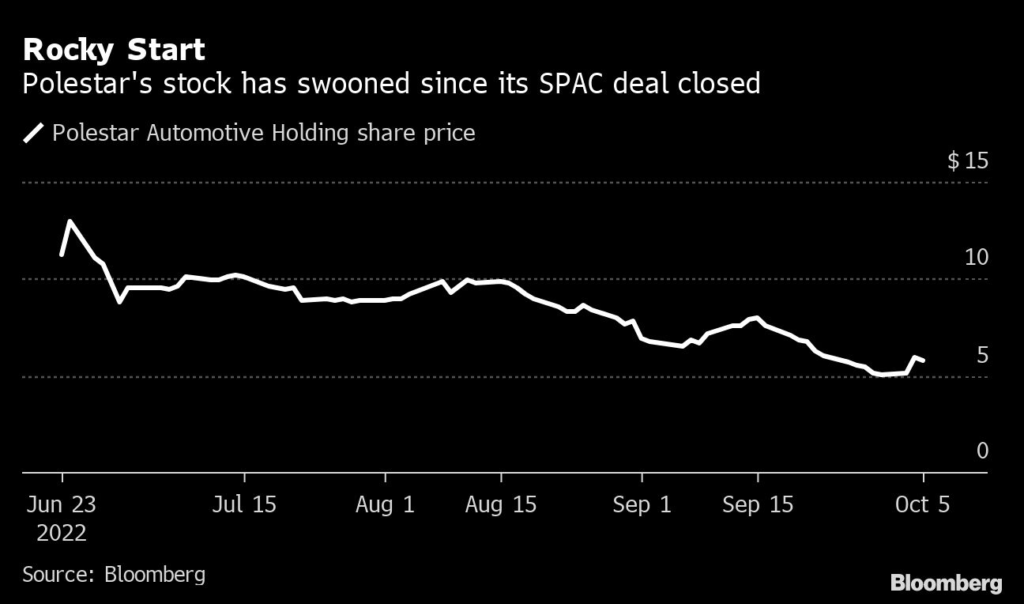
Polestar’s shares have roughly halved since the company went public in New York in June in the biggest climate-technology SPAC deal during the first half. Appetite to invest in startups has waned since then because of record inflation, rising interest rates and a worsening economic outlook. While drivers seem keen on the Polestar 2, the company may need to tap its main investors Volvo Car and Zhejiang Geely Holding Group Co. for more cash, Bernstein analysts said in June. Polestar is evaluating funding options including both debt and equity, the CEO said.

On the bright side, demand is strong. Every car Polestar will make this year has already been sold, though that’s somewhat common across the industry as customers switch to EVs faster than many auto executives expected. Polestar’s queue also lengthened substantially in April, when Hertz Global Holdings Inc. ordered 65,000 cars for its rental fleet at an undisclosed price. Ingenlath said Polestar, which is targeting around 290,000 EV sales by 2025, is experiencing “robust demand.”

Next week, the manufacturer will unveil the Polestar 3, which will give the manufacturer a presence in the lucrative sport utility segment. It’s the first model Polestar developed from scratch, without drawing significantly on parts and engineering from Volvo Car. Ingenlath said the Polestar 3 will be sportier and swankier than Tesla Inc.’s  Model Y, likening it to the Porsche Cayenne. “I mean that type of aspirational car,” he said.

The Polestar 3 will be made both in China and South Carolina; the 2 is only made in China. While producing the model in the US will help its standing with respect to tax credits included in the recently passed Inflation Reduction Act, the company said it can’t confirm whether the vehicle will meet battery material and component sourcing requirements to be eligible for the full $7,500 tax credit.

Polestar, which counted actor Leonardo DiCaprio as an early investor, last month said its operating loss more than doubled in the first half after the cost of expansion and spooling up a retail network washed out gains from its first wave of sedan sales. The company is scheduled to report third-quarter results on Nov. 1.

More stories like this are available on bloomberg.com

©2022 Bloomberg L.P.

Davidson Kempner Seeks Higher Price on £9.5 Billion Aveva Deal

(Bloomberg) — Davidson Kempner Capital Management is building its stake in Aveva Group Plc and will join other investors in pushing Schneider Electric SE to up a £31 ($34.7) per share bid for the UK industrial software company, people familiar with the matter said.

The hedge fund, which now has a holding of 3.5% in Aveva, and others may seek an improved offer of up to £35 a share, the people said, asking not to be identified discussing confidential information. Davidson Kempner is continuing to add to its position, the people said. 

French industrial giant Schneider last month agreed to buy out minority shareholders in Aveva in a deal valuing the target at £9.5 billion. The offer has already been criticized as too low by the likes of M&G and Mawer Investment Management. Funds holding nearly 7% of Aveva now oppose the current terms, the people said. 

A vote on the takeover is expected in November and the deal will need the support of 75% of Aveva’s minority investors to succeed. Representatives for Aveva, Davidson Kempner and Schneider didn’t immediately provide comment. 

Aveva’s stock rose as much as 4.6% in London on Friday. The shares were trading around £31.86 late morning, indicating the market sees a higher bid from Schneider as likely. 

The current offer is a 41% premium to Aveva’s share price on Aug. 23, the day before Bloomberg News first reported on a possible bid. The target’s independent committee declared the terms “fair and reasonable” and plans to recommend the offer.

Schneider already owns about 59.1% of Aveva. Last year, it seconded executive committee member Peter Herweck to the UK group to replace Craig Hayman as chief executive officer.

Merger arbitrage hedge funds have found fewer opportunities to bet on deals this year as rising inflation and interest rates put the brakes on global M&A volumes. Among the pending transactions that have attracted their attention is Philip Morris International Inc.’s $16 billion offer for smokeless tobacco company Swedish Match AB, in which firms including Davidson Kempner have built stakes.

Read more: Arb Traders Share Their Fears for M&A

(Updates shares in fifth paragraph, CEO detail in seventh paragraph.)

More stories like this are available on bloomberg.com

©2022 Bloomberg L.P.

New Venture Fund Will Only Back Tech Combating Wildfires

(Bloomberg) —

Some venture capital firms specialize in fields like transportation or crypto. Convective Capital, a new investment vehicle based in California, will focus squarely on wildfires. 

The fund, which debuted this month, has raised $35 million to back technology startups trying to detect, prevent or manage the spread of wildfires, a growing catastrophe for the American West and other parts of the world. 

Wildfires cost an estimated $50 billion in damage a year, and for these investors, the tech in modern firefighting—from drones to weather sensors and fancy fire retardants—have hardly dented the natural and economic devastation. “There’s still a really big gap between what needs to be done and what’s being done,” says Bill Clerico, the founder and managing partner of Convective Capital.

Clerico used to worked in mobile payments. After selling his startup WePay to JPMorgan Chase & Co. in 2017, Clerico decamped to a ranch in Mendocino, north of San Francisco, where he soon met the grim reality of rural California life. A 90-acre blaze licked the access road near his house. Insurance was hard to buy.

“I was just running into wildfire all the time,” he recalls. 

Clerico became a volunteer firefighter and began scouting techies working on the issue. He met the fund’s three other partners, all technologists, through philanthropic work on wildfires. Their financiers include foundations and multiple wealthy individuals with homes hit or threatened with fires, although Clerico declined to name them.

George Whitesides, another Convective Capital partner, dealt with fires constantly in the desert when he was chief executive officer at Virgin Galactic, Richard Branson’s space company. “It was an early indication of what’s coming,” he says.

Whitesides, a former NASA official, believes companies working with aircraft and space technologies can provide a major boost to fire management with communication gear during disasters or by taking stock of a fire’s toll. Convective Capital has already invested in Overstory, a software company that analyzes satellite imagery of vegetation to identify areas most likely to spark.

The fund has also backed Burnbot, a robotics startup working on controlled burns to limit fires, and Pano AI, a company building cameras for spotting new fires. The investors plan to cut about 15 more checks over the next three years for what they call “firetech.”

Clerico sees public agencies, utilities, insurance companies and landowners as target customers for the companies in his portfolio. While governments and utilities aren’t overflowing with profits, they have pledged billions to address wildfires, an urgency that could give startups more of a sales foothold. “The silver lining of the crisis that we’re in—wildfires are really a top priority, especially for utilities,” says Clerico. 

Wealthy homeowners, however, have proved very willing to pay for any fix for a fire, which raises the concern that firetech might only help the rich. Clerico thinks the current system is already tilted that way. “Right now, that’s happening, tech aside,” he says. “Insurance companies are only insuring high-value properties.” He adds that his fund will encourage companies to prioritize economic inclusivity following published guidelines.

Startups might also be inclined to throw tech at a problem that may be better solved with manpower, logistics and public administration. Captain Brian Fennessy, the fire chief for Orange County, in California, says he receives pitches from startups “all the time.” Many don’t address his needs. There are a slew of companies hawking unmanned drones or aircraft to fire departments, but Fennessy believes that having a human in the air to react is preferable.

Still, Fennessy welcomes aide from Convective Capital and other venture capitalists. In particular, he’s hunting for companies that can provide accurate, up-to-date information on ground conditions during the night and when wildfires spark. “If it’s more than a minute or two late,” Fennessy says, “the fire’s already grown.”

Even though his department has two airplanes and a supercomputer at its disposal, he feels at a disadvantage. “We’ve just been outpaced and outflanked by these wildfires,” he says.

More stories like this are available on bloomberg.com

©2022 Bloomberg L.P.

AMD Sinks After Early Peek at Revenue Shows Steep Shortfall

(Bloomberg) — Advanced Micro Devices Inc.’s preliminary third-quarter sales missed projections by more than $1 billion, adding to concerns about the sputtering market for personal-computer chips and sending its shares sliding in late trading.

Revenue in the period was about $5.6 billion, the company said Thursday in a statement, giving an early peek at numbers that were expected in the coming weeks. The average analyst estimate — and the company’s own forecast — had been about $6.7 billion.

Read More: Chipmakers See ‘Breathtaking’ Demand Drop as Recession Looms

Like its peers, AMD blamed the PC market for hurting sales, citing weaker demand and a build-up of inventory in the supply chain. The third quarter also will include $160 million in writedowns related to inventory, pricing and other issues, the company said.

AMD is the latest company related to the PC industry that has warned investors that the market for its products is imploding. Nvidia Corp. and Intel Corp. have already shaved billions off their projections and said they need to burn off stockpiles of unused parts.

While AMD has been making market-share gains at Intel’s expense, the company isn’t immune from the collapse in demand for PCs. Consumers who splurged on technology during pandemic lockdowns are now cutting back spending on big-ticket electronics as they confront recession fears and inflation.

“While our product portfolio remains very strong, macroeconomic conditions drove lower than expected PC demand and a significant inventory correction,” Chief Executive Officer Lisa Su said in the statement.

The stock fell about 5.1% in premarket trading after closing at $67.85 in New York on Thursday. Even before the drop, the shares were down 53% this year, part of a broader pullback for the chip industry. Other semiconductor makers, including Nvidia and Intel, also slipped after AMD’s report.

Read More: Chip Stocks Fall as AMD, Samsung Miss Estimates on PC Weakness

AMD plans to report full third-quarter earnings on Nov. 1, followed by a conference call to discuss the results. The company said it doesn’t plan to give any additional financial updates before then. 

Reflecting its relatively strong performance compared with Intel, AMD said its gross margin — the percentage of sales remaining after deducting costs — will be about 50% in the quarter. That’s down from an earlier projection but wider than Intel’s once industry-leading profitability levels.

(Updates with premarket trading in seventh paragraph.)

More stories like this are available on bloomberg.com

©2022 Bloomberg L.P.

Chipmakers See ‘Breathtaking’ Drop in Demand as Recession Looms

(Bloomberg) — Signs are piling up that the tech downturn may be deeper and longer-lasting than feared. 

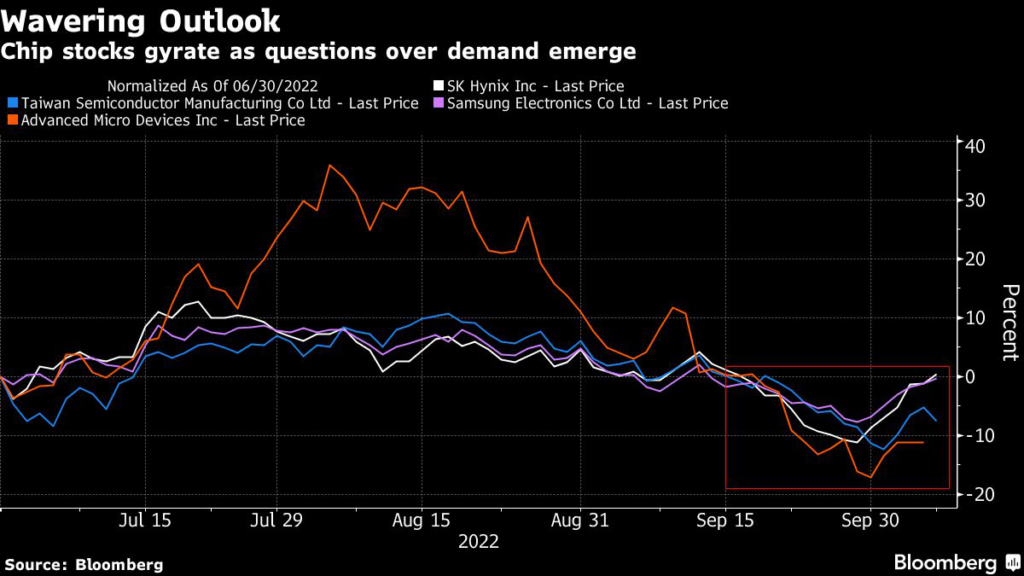
After years of record capital spending, chipmakers are warning on a weekly basis that demand is sputtering. In the latest sign of trouble, Samsung Electronics Co. and Advanced Micro Devices Inc. reported disappointing results within hours of each other that widely missed projections.

Samsung — the world’s largest memory chipmaker — reported a 32% dive in operating income, while PC-processor maker AMD said it will miss its earlier forecast by about $1 billion. Analysts’ reactions ranged from “breathtaking” to “Uff-da!”

Those numbers followed grim comments from memory makers Micron Technologies Inc. and Kioxia Holdings Corp., which are slashing spending and output in a bid to stabilize plummeting prices. AMD shares fell in premarket trading, along with chipmakers including Nvidia Corp. and Intel Corp. Chip gear suppliers such as ASML Holding NV and PC makers including Lenovo Group Ltd. also dropped. Japan’s Disco Corp., whose equipment grinds, polishes and dices chips, lost the most in more than two years Friday.

“It seems end demand has likely deteriorated markedly in recent weeks, and end customers appear to be aggressively draining inventory,” Bernstein’s Stacy Rasgon said. The cut in AMD’s client-revenue “is admittedly a bit breathtaking.”

Read: ‘Hard Times’ as Big Memory Makers Cut Output on Supply Glut

The outlier has been Taiwan Semiconductor Manufacturing Co., which posted a roughly 48% surge in quarterly revenue to about NT$613 billion ($19.4 billion) — at the top range of its guidance in US dollar terms — helped by its growing clout as the world’s most advanced maker of chips. The downtrend in demand may not have been fully reflected in the numbers, especially given the sharp depreciation of the Taiwan dollar, Haitong International Securities analyst Jeff Pu said.

Consumer electronics companies that had struggled with shortages during the pandemic are now facing a sudden falloff in demand, even while shipping and materials costs remain high. Recession fears are making cost-cuttingthe new norm across the tech industry, and businesses that hoarded chips for two years are now opting to cancel or postpone orders and tap inventory, just as new capacity goes online.

The semiconductor industry is also grappling with export restrictions from the US government, which is ratcheting up pressure on its allies to prevent shipment of cutting-edge chips to a growing list of Chinese companies, as it seeks to contain the Asian country. That’s hampering business for chipmakers from AMD to Nvidia in the world’s biggest semiconductor market.

Supply and demand are not all that is behind the current downcycle, said Heo Pil-Seok, chief executive officer at Midas International Asset Management in Seoul. “The US government’s exports controls would further limit IT companies’ sales in China and a large chunk of demand for chips will be weakened. If AMD, Nvidia can’t sell their chips in China, memory makers’ earnings will deteriorate further.”

The PC segment, which has for years been losing ground to smartphones, looks particularly vulnerable. But a serious recession would hammer demand even in areas that have remained solid, such as in cloud computing, automotives and factory automation. 

“We would continue to stay away from PC-centric names, which within our coverage list include AMD, Intel, and Nvidia, due to a likely prolonged PC downturn into next year and continued weakness in consumer gaming,” Baird analysts Tristan Gerra and Tyler Bomba wrote in a note to clients.

Share prices dropped throughout the semiconductor supply chain, from materials makers like JSR Corp. to chip gear makers such as Advantest Corp. and Screen Holdings Co. Even silicon wafer makers such as Shin-Etsu Chemical Co. and Sumco Corp. fell.

Read more: Asia Chip Shares Fall as AMD Sales Miss Estimates by $1 Billion

The companies themselves are bracing for a prolonged downturn. Samsung’s chip business head, Kyung Kyehyun, said last month he doesn’t see the memory market rebounding throughout next year. Kyung told employees at an internal event that Samsung cut its guidance for chip sales in the second half of this year by 32% compared to a forecast in April, according to the Korea Economic Daily.

What Bloomberg Intelligence Says

PC demand will continue to be soft in 4Q, given heavy PC processor inventory as announced by chipmaker AMD. Won depreciation might not be enough to offset weak sales of memory chips and consumer electronics, such as TVs.

— Masahiro Wakasugi, BI analyst

Click here for the full research

Delivery times for key components and machinery sometimes exceeded one year during the pandemic, causing companies to stockpile a year’s worth of inventory, while chipmakers rushed to ramp up capacity. Now that lead times have dropped, companies are scrambling to reduce stockpiles.

“You build supply for demand that turns out not to be as real as you thought it was,” Rasgon said. “No party lasts forever.” 

(Updates with share price reactions in fourth paragraph)

More stories like this are available on bloomberg.com

©2022 Bloomberg L.P.

US Futures Waver as Jobs Data Awaited for Fed Cues: Markets Wrap

(Bloomberg) — US equity-index futures wobbled between gains and losses as investors awaited the latest payrolls report for clues on the monetary-policy path after a raft of Federal Reserve officials doused expectations for a quick halt to rate hikes. 

December contracts on the Nasdaq 100 Index fell 0.2%, trimming deeper losses, amid premarket declines for semiconductor stocks. Advanced Micro Devices Inc. slumped after it reported weaker-than-expected preliminary 3Q revenue. Meanwhile, futures on the S&P 500 Index traded little changed, with the benchmark poised for the best weekly advance since June. Treasuries drifted lower.

US benchmark bond yields are heading for a 10th week of increases, the longest streak since 1984, as the Fed stays resolute in its fight against inflation despite recent data suggesting a cooling of the economy. Investors are being swayed between hopes for an end to monetary tightening by March next year and concern over the possibility of a deep recession that such a pivot would underscore. 

“The issue of the Fed pivot remains the main factor restricting risk appetite,” Sebastien Barbe, the head of emerging-market research and strategy at Credit Agricole CIB, wrote in a note. “Cautiousness should remain in place ahead of the US jobs report. Given the repeated hawkish comments by Fed speakers, this may not be enough to sustainably support risk appetite.”


Chipmakers led the slide in early New York trading. Besides AMD’s plunge, Nvidia Corp. and Intel Corp. which fell more than 2% each amid concern that a slowing world economy will sharply dent semiconductor demand.

In Europe, the main Stoxx 600 index traded near flat after two days of declines. Credit Suisse Group AG more than 4% after announcing a buyback of debt securities for cash, a show of financial strength after market volatility earlier this week on concerns about the bank’s solidity. 

Investor focus is increasingly trained on signs of a weaker earnings-reporting season. Besides Thursday’s dour trading update from European oil major Shell, underwhelming figures from AMD and South Korean Samsung Electronics Co. are reinforcing concerns for the global economy.

The US economy remains the focal point of invetors. Friday’s US jobs report is forecast to show employers added a further 255,000 workers in September. While the figure is robust, it would be the fewest jobs added in a month since a decline in late 2020. Unemployment is seen holding at 3.7%, which is just above a five-decade low.

The data will follow hawkish comments from officials. Chicago Fed President Charles Evans said the benchmark rate will probably be at 4.5% to 4.75% by next spring, and Minneapolis Fed’s Neel Kashkari said the central bank is “quite a ways away” from pausing its campaign of rate increases.

“Barring an unexpectedly shocking number, I do not think today’s release will prompt the Fed to change tack,” said Stuart Cole, the head macro economist at Equiti Capital. “This has certainly been the message that various Fed officials have been promulgating.”

US crude futures rose to approach $89 a barrel, on course for the biggest weekly surge since March.

Key events this week:

  • US unemployment, wholesale inventories, nonfarm payrolls, Friday
  • BOE Deputy Governor Dave Ramsden speaks at event, Friday
  • Fed’s John Williams speaks at event, Friday

Some of the main moves in markets:

Stocks

  • Futures on the S&P 500 were little changed as of 5:31 a.m. New York time
  • Futures on the Nasdaq 100 fell 0.2%
  • Futures on the Dow Jones Industrial Average rose 0.2%
  • The Stoxx Europe 600 rose 0.1%
  • The MSCI World index fell 0.2%

Currencies

  • The Bloomberg Dollar Spot Index fell 0.1%
  • The euro rose 0.2% to $0.9809
  • The British pound rose 0.5% to $1.1213
  • The Japanese yen rose 0.2% to 144.84 per dollar

Cryptocurrencies

  • Bitcoin fell 0.2% to $20,006.29
  • Ether fell 0.4% to $1,358.8

Bonds

  • The yield on 10-year Treasuries advanced one basis point to 3.84%
  • Germany’s 10-year yield advanced five basis points to 2.13%
  • Britain’s 10-year yield advanced four basis points to 4.20%

Commodities

  • West Texas Intermediate crude rose 0.6% to $88.94 a barrel
  • Gold futures were little changed

More stories like this are available on bloomberg.com

©2022 Bloomberg L.P.
This Week In Crypto: Regulations, Resignations and Kardashians

  • Listen to Bloomberg Crypto on the iHeartRadio App
  • Listen to Bloomberg Crypto on Apple Podcasts
  • Listen to Bloomberg Crypto on Spotify  

(Bloomberg) — It’s been another busy week in digital assets. What’s the latest in the markets? Are there any crypto CEOs left? Regulation: will it ever happen? 

Bloomberg crypto editor Beth Williams and Bloomberg reporter Allyson Versprille join this episode to help break down this weeks’ news.

Follow us on Twitter @crypto, and subscribe to the Bloomberg Crypto Newsletter at https://bloom.bg/cryptonewsletter

More stories like this are available on bloomberg.com

©2022 Bloomberg L.P.
Taiwan Exports ‘Will Only Get Worse’ After First Drop Since 2020

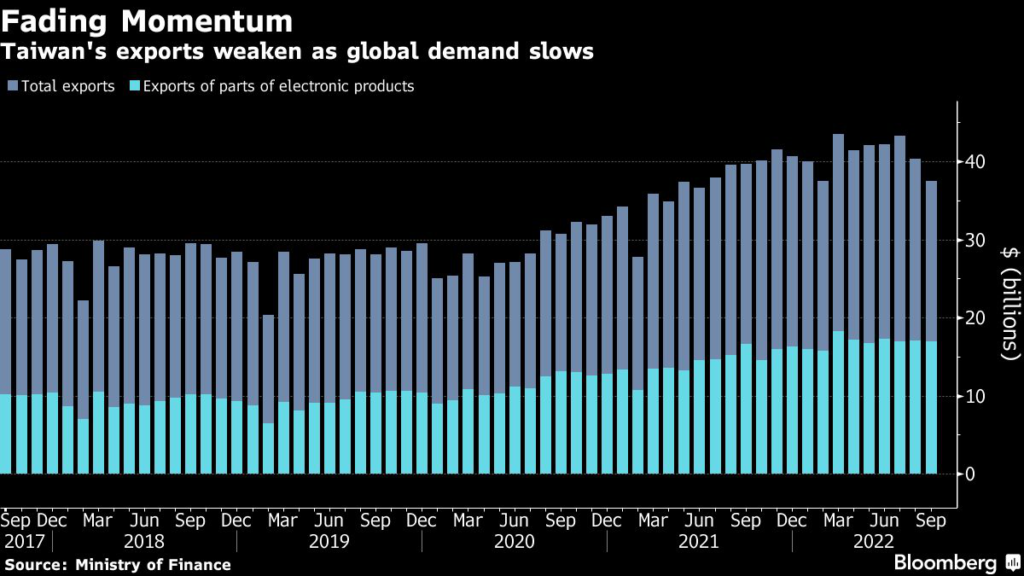
(Bloomberg) — Taiwan’s exports contracted in September for the first time since 2020 as weakening demand from China and around the world brought to an end an era of unprecedented trade performance.

Overseas shipments dropped 5.3% in September compared to a year earlier, according to a statement from the Finance Ministry in Taipei on Friday. 

That was the first drop in exports since June 2020, when the pandemic was in full swing and wreaking havoc on the world economy. It was the worst decline since January 2020.

Economists expected a 2.4% increase in September according to the median estimate in a Bloomberg survey.

“The cooling price of commodities and China real estate problems are dragging down the price and need for goods,” leading to Friday’s results, said Anita Hsu, an economist at Masterlink Securities Investment Advisory Corp. “It will only get worse from now on.”

Imports fell 2.4% in September, compared to a 3.5% increase in August. Economists had projected a 9.8% increase. That was also the first drop since 2020.

The main reason for the decline was “high global inflation, tightening monetary policy, and cooling consumer demand in China,” said Beatrice Tsai, the ministry’s chief statistician, at a press briefing with reporters in Taipei on Friday. The drop in exports was more severe than the warning officials gave last month of a decline by as much as 3%. 

Read More: Chipmakers See ‘Breathtaking’ Demand Drop as Recession Looms

Taiwan authorities have been cautioning that exports are expected to slow through the end of the year. Global demand for many products has waned as inflation elsewhere skyrockets and several major economies face the prospect of a slowdown or recession. The need for electronic equipment used in remote work has also faded as people gradually return to the office. 

Exports to partners including the US, UK, Singapore and Japan were all negative in September, but the pain was particularly acute in China and Hong Kong, where overseas shipments plunged more than 13% from a year ago.

Officials said Friday that they expect October exports to fall by as much as 6% year-on-year as trade continues to be challenged. In a statement, the finance ministry said export performance in the end of the year would be “highly pressured by slowing manufacturing activities around the world” due to rising interest rates and uncertainties caused by Russia’s invasion of Ukraine and the “US-China tech war.”

Read More: Taiwan Warns Exports to Struggle in Rest of 2022 as Demand Slows

“The tech sector’s impressive strong growth trend since the pandemic seems to have peaked, with Taiwan’s tech export orders falling about 13% from the recent peak” in the first quarter of this year, wrote Grace Ng, an economist at JPMorgan Chase & Co., in a research note earlier this week.

Taiwan’s not the only economy suffering from a slowdown in demand for chips and related products. South Korea, the hub of the world’s top memory chipmaker Samsung Electronics, saw its semiconductor output drop in August from a year earlier for the first time in more than four years. The country’s chip inventories also soared 67% as buyers hold off on more purchases, clouding the outlook of an industry that was still booming in the first half of 2022.

(Updates throughout with comments from the press conference, analyst commentary.)

More stories like this are available on bloomberg.com

©2022 Bloomberg L.P.

Tesla Plans to Deliver Semis to Pepsi Five Years After Unveiling

(Bloomberg) — Tesla Inc. will deliver its first Semi trucks to PepsiCo Inc. five years after Elon Musk showed off prototypes and began taking deposits for the electric big rigs.

The carmaker will hand over Semis to PepsiCo on Dec. 1, Musk tweeted Thursday. The food and beverage giant has said it’s reserved 100 of the trucks and expects to deploy an initial 15 by the end of the year.

Musk said when Tesla first unveiled the Semi in November 2017 that it would go into production two years later. While would-be customers including Walmart Inc. and Anheuser-Busch InBev SA put down deposits, the automaker ended up prioritizing output of Model 3 sedans and Model Y sport utility vehicles for consumers while contending with battery cell and semiconductor supply issues.

In January, Musk told analysts Tesla wouldn’t roll out any new models this year because of parts constraints. He changed his tune three days after the US Senate passed the Inflation Reduction Act, which made heavy-duty electric trucks eligible for as much as $40,000 federal tax credits. The chief executive officer tweeted on Aug. 10 that the company would start shipping Semis with 500 miles of range this year.

Tesla will compete with other makers of battery-powered big rigs including relative newcomer Nikola Corp. and more established firms like Sweden’s Volvo AB. The latter announced this week that it will deliver 20 fully electric trucks to Amazon.com Inc. by year-end.

Tesla shares slipped as much as 0.5% to $237 before the start of regular trading. The stock has dropped 32% this year.

(Updates with early share trading in the last paragraph.)

More stories like this are available on bloomberg.com

©2022 Bloomberg L.P.
Close Bitnami banner
Bitnami