Bloomberg

Telenor Sells 30% of Norway Fiber Assets for $1 Billion

(Bloomberg) — Telenor ASA agreed to divest a minority stake in its Norwegian fiber network to a consortium led by KKR & Co. and Oslo Pensjonsforsikring for about 10.8 billion kroner ($1 billion).

Telenor will use an estimated 30% of the proceeds to buy back shares and mitigate the impact of the new investors, the Fornebu, Norway-based company said in a statement on Friday. Including debt, the price values the fiber business at 36.1 billion kroner, it said. 

The deal is part of a strategy by Norway’s biggest telecommunications company to free up capital to fund more fiber buildouts. Telenor announced plans to potentially sell a stake in September as part of a reorganization that involved establishing its infrastructure business as a separate unit.  

“We are bringing in strong investors with a long-term horizon,” Chief Financial Officer Tone Hegland Bachke said in the statement. “This transaction benefits our stakeholders while safeguarding future investments in Norway’s fiber.”

Shares jumped as much as 5.1% after the announcement, the most since July 2020. The stock gained 3.6% at 9:58 a.m. in Oslo trading. 

The newly established company will own the passive fiber assets in Norway and includes 130,000 kilometers (81,000 miles) of cable. It will be a subsidiary of Telenor, which will maintain control of its operations and have the right to buy back the minority stake if the buyout firms decide to sell in the future. The deal is expected to close early next year. 

(Updates with additional details throughout)

More stories like this are available on bloomberg.com

©2022 Bloomberg L.P.

High-Frequency Crypto Trader Says Institutions Are Taking Over

(Bloomberg) —

Institutional investors are playing a more-influential role in crypto markets as retail traders retreat, and that explains much of the recent range-bound price action, according to Michael Safai of proprietary trading firm Dexterity Capital. 

“We might have been playing checkers two years ago,” said Safai, whose firm traded more than $1.2 trillion in crypto last year. “We’re playing chess now.” 

Safai joined the What Goes Up podcast this week to discuss the state of the digital-asset market and how high-frequency crypto trading strategies differ from the famous “Flash Boys” of the stock market. 


More stories like this are available on bloomberg.com

©2022 Bloomberg L.P.

Google to Open First Japan Data Center to Accelerate Asia Push

(Bloomberg) — Alphabet Inc.’s Google will open its first data center in Japan next year as part of increasing investment in the world’s third-biggest economy.

The new facility, based in Inzai City, Chiba, will accelerate the operation of Google tools and services and support economic activity and jobs, Chief Executive Officer Sundar Pichai wrote in a blog post Friday. It’s part of a broader $730 million investment in local infrastructure by the US company, which began last year and will extend through 2024. Google is also leading the construction of a new subsea cable linking Japan and Canada, called Topaz.

“Google’s partnership in Japan is now deeper than ever,” Pichai said in a surprise appearance at Google’s Pixel 7 and Pixel Watch launch event in Tokyo. “Japan has a history of being at the forefront of the world’s most advanced technologies.”

The CEO is visiting Japan to meet with Prime Minister Fumio Kishida and share details of Google’s investments plans. His previous visit in 2019 was to inaugurate a Google Campus for Startups incubator and this week he met with some student developers from local universities.

The Chiba data center will be the company’s third location in Asia, after Taiwan and Singapore, and will support its efforts to connect Japan to the rest of the global economy, Pichai said.

More stories like this are available on bloomberg.com

©2022 Bloomberg L.P.

A $568 Million Hack of Binance Coin Roils Crypto Sector Anew

(Bloomberg) — An already bad year for cryptocurrencies took another turn for the worse after a $568 million hack affecting Binance Coin became the latest in a string of security incidents to buffet digital assets.

An exploit occurred on a bridge between blockchains and the issue is “contained now,” Changpeng “CZ” Zhao, the billionaire co-founder of Binance, the world’s biggest crypto exchange, said on Twitter on Friday.

Security specialists at crypto firms BlockSec and Paradigm said blockchain data indicated somebody had hacked two million tokens of Binance Coin — also known as BNB — in two transactions. That’s equivalent to about $568 million at current prices for the virtual currency.

About $87 million was moved out of the Binance ecosystem but the hacker was unable to spirit away the rest of the funds because the Binance Smart Chain was suspended, according to BlockSec Chief Executive Officer Yajin Zhou. The blockchain was later restarted. The remaining tokens are on the wallet the hacker used, but have been frozen on the Binance network, Zhou said.

Binance’s Zhao in an earlier post on Twitter said the “impact estimate” of the incident was around $100 million. At least $7 million of stolen funds has already been frozen, a spokesperson for the Binance-backed BNB Chain said.

About $2 billion has been lost in crypto hacks this year, many perpetrated by North Korea-linked groups. Cross-chain bridges used to transfer tokens across blockchains are a popular target, turning them into a major vulnerability.

The Binance ecosystem is among the highest profile to be buffeted. Zhao said on Twitter that “in all likelihood, Binance will cover any fund that the hackers get away with.” 

BNB Chain said it’s working with security services to freeze transfers of stolen funds. Binance Coin fell as much as 3.3% on Friday and was trading  at around $284 as of 7:40 a.m. in London.

Binance Coin is the native token of BNB Chain and was launched through an initial coin offering in 2017. It was originally based on the Ethereum network.

The crypto sector has been pummeled by a $2 trillion rout as well as the litany of hacks. The latter have become a global concern — for instance, envoys from South Korea, the US and Japan on Friday agreed to redouble efforts to block North Korea’s nuclear and missile financing through crypto theft.

The wider crypto markets took the latest developments in their stride. Bitcoin was little changed at just below $20,000 on Friday.

(Updates with latest hack estimates from the first paragraph.)

More stories like this are available on bloomberg.com

©2022 Bloomberg L.P.

Activist Takes Temenos Stake Saying Stock in ‘Free-Fall’

(Bloomberg) — Activist fund Petrus Advisers told senior executives of Temenos AG that it has taken a small stake in the Swiss banking software specialist and questioned their ability to regain investor confidence and boost the share price.

An ambitious mid-term plan Temenos presented in February has failed to convince investors and despite “your stock entering a dangerous free-fall, research analysts are still not convinced that bottom has been reached,” Petrus said in an Oct. 6 letter to Executive Chairman Andreas Andreades and Chief Executive Officer Max Chuard. Petrus owns a stake of less than 3% in the company, according to the letter, which was reviewed by Bloomberg News.

Shares in Temenos jumped as much as 4.5% on Friday, according to data compiled by Bloomberg. The company’s shares have fallen about 46% this year, giving it a market value of around $5.2 billion.

Petrus questioned whether Andreades and Chuard have the ability to master the challenges ahead and said it expected the two to present a convincing plan while reviewing “all options you have to execute on your strategy.”

Temenos attracted interest from private equity firms EQT AB and Thoma Bravo, which explored potential bids for the Swiss company about a year ago, Bloomberg News reported at the time. Several analysts have named the firm as a top takeover target.

The company ignored interest from private equity investors at “prices substantially above the current share price,” Petrus said.

A representative for Temenos didn’t immediately respond to a request for comment.

Petrus has successfully pushed for higher takeover bids, most recently for an improved offer from Advent International and Centerbridge Partners for German real estate lender Aareal Bank AG.

‘New Targets’

The fund’s founder, Klaus Umek, said in April that the firm was looking for new targets.

For Temenos, the fund questioned the firm’s ambitious mid-term plan targeting a compounded annual revenue growth of 10% to 15% and an increase of its earnings margin.

“You must focus on explaining how the company will achieve your ambitious goals combining growth, higher margins, and higher cash flow; or you risk losing the capital market community further,” Petrus said in the letter. The company has lost a high amount of credibility placing its 2022 guidance on two contracts that are still to be won, it said.

Reputable analysts have “your vision on hold or sell,” Petrus said in the letter, adding, “Your communication with capital markets seems out of touch.”

(Updates with share price move in third paragraph.)

More stories like this are available on bloomberg.com

©2022 Bloomberg L.P.

Chipmakers See ‘Breathtaking’ Demand Drop as Recession Looms

(Bloomberg) — Signs are piling up that the tech downturn may be deeper and longer-lasting than feared. 

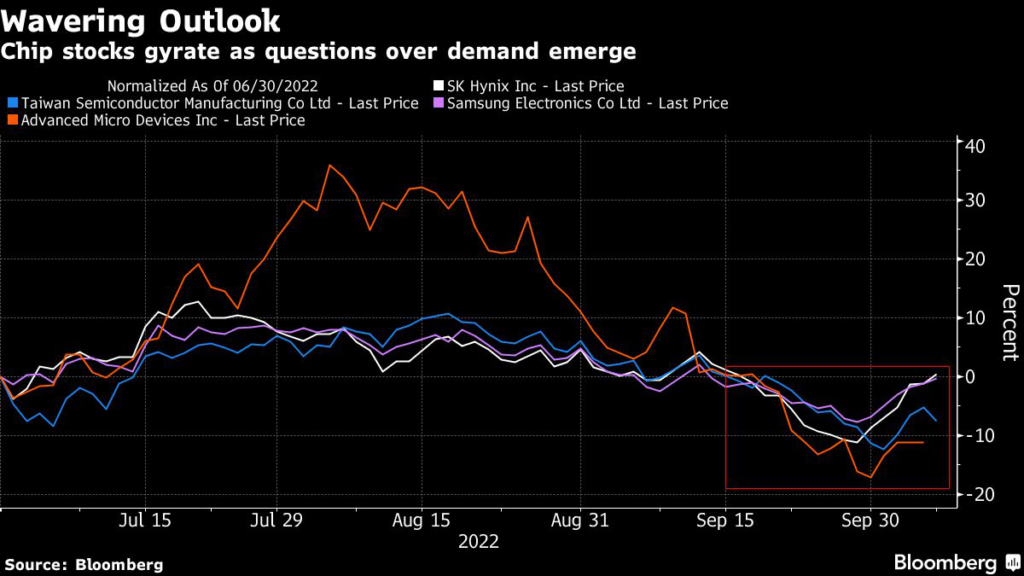
After years of record capital spending, chipmakers are warning on a weekly basis that demand is sputtering. In the latest sign of trouble, Samsung Electronics Co. and Advanced Micro Devices Inc. reported disappointing results within hours of each other that widely missed projections.

Samsung — the world’s largest memory chipmaker — reported a 32% dive in operating income, while PC-processor maker AMD said it will miss its earlier forecast by about $1 billion. Analysts’ reactions ranged from “breathtaking” to “Uff-da!”

Those numbers followed grim comments from memory makers Micron Technologies Inc. and Kioxia Holdings Corp., which are slashing spending and output in a bid to stabilize plummeting prices. AMD shares fell, spurring losses in chip gear suppliers from Tokyo Electron Ltd. to client PC makers including Lenovo Group Ltd. on Friday. Disco Corp., whose equipment grinds, polishes and dices chips, tumbled 7.1% — losing the most ground in almost 16 months.

“It seems end demand has likely deteriorated markedly in recent weeks, and end customers appear to be aggressively draining inventory,” Bernstein’s Stacy Rasgon said. The cut in AMD’s client-revenue “is admittedly a bit breathtaking.”

Read: ‘Hard Times’ as Big Memory Makers Cut Output on Supply Glut

Taiwan Semiconductor Manufacturing Co. posted a roughly 48% surge in quarterly revenue to about NT$613 billion ($19.4 billion) — at the top range of its guidance in US dollar terms — helped by its growing clout as the world’s most advanced maker of chips. The downtrend in demand may not have been fully reflected in the numbers, especially given the sharp depreciation of the Taiwan dollar, Haitong International Securities analyst Jeff Pu said.

Weaker-than-expected demand for consumer electronics is hitting companies along with surging shipping and materials costs. Cost-cutting has become the new norm across the tech industry, and businesses that hoarded chips during the pandemic are now opting to cancel or postpone orders and tap inventory.

The semiconductor industry is also grappling with export restrictions from the US government, which is ratcheting up pressure on its allies to prevent shipment of cutting-edge chips to a growing list of Chinese companies, as it seeks to contain the Asian country. That’s hampering business for chipmakers from AMD to Nvidia Corp. in the world’s biggest semiconductor market.

Supply and demand are not all that is behind the current downcycle, said Heo Pil-Seok, chief executive officer at Midas International Asset Management in Seoul. “The US government’s exports controls would further limit IT companies’ sales in China and a large chunk of demand for chips will be weakened. If AMD, Nvidia can’t sell their chips in China, memory makers’ earnings will deteriorate further.”

The PC segment, which has for years been losing ground to smartphones, looks particularly vulnerable. But a serious recession would hammer demand even in areas that have remained solid, such as in cloud computing, automotives and factory automation. 

“We would continue to stay away from PC-centric names, which within our coverage list include AMD, Intel, and Nvidia, due to a likely prolonged PC downturn into next year and continued weakness in consumer gaming,” Baird analysts Tristan Gerra and Tyler Bomba wrote in a note to clients.

Share prices dropped throughout the semiconductor supply chain, from materials makers like JSR Corp. to chip gear makers such as Advantest Corp. and Screen Holdings Co. Even silicon wafer makers such as Shin-Etsu Chemical Co. and Sumco Corp. fell.

Read more: Asia Chip Shares Fall as AMD Sales Miss Estimates by $1 Billion

The companies themselves are bracing for a prolonged downturn. Samsung’s chip business head, Kyung Kyehyun, said last month he doesn’t see the memory market rebounding throughout next year. Kyung told employees at an internal event that Samsung cut its guidance for chip sales in the second half of this year by 32% compared to a forecast in April, according to the Korea Economic Daily.

What Bloomberg Intelligence Says

PC demand will continue to be soft in 4Q, given heavy PC processor inventory as announced by chipmaker AMD. Won depreciation might not be enough to offset weak sales of memory chips and consumer electronics, such as TVs.

— Masahiro Wakasugi, BI analyst

Click here for the full research

“No party lasts forever,” Rasgon said. “It’s a cyclical industry. There were a few years of very, very strong growth” that prompted companies to ramp up capacity. “You build supply for demand that turns out not to be as real as you thought it was.”

(Updates with TSMC preliminary results and share reactions from the fourth paragraph)

More stories like this are available on bloomberg.com

©2022 Bloomberg L.P.

Crypto Fugitive Kwon Gets Boost as Terra Aide Avoids Detention

(Bloomberg) — Crypto fugitive Do Kwon received a boost after a court allowed an executive linked to his collapsed Terraform Labs ecosystem to avoid jail and indicated room for dispute over some of the allegations the person faces.

The court in Seoul said it didn’t see a need to detain the suspect and added there’s scope for legal debate over whether the individual breached the nation’s capital-markets law, charges that Kwon and four others also face.

Kwon created a pair of tokens, an algorithmic stablecoin TerraUSD that was meant to have a constant $1 value in a complex arrangement with a sister coin, Luna. The project suffered a spectacular $60 billion wipeout in May, roiling the global crypto market and shocking regulators.

Kwon’s location became unclear after South Korea last month sought his arrest. He is the subject of an Interpol red notice but has denied wrongdoing. One of the issues in the case is whether Luna was subject to securities law — echoing a wider question officials globally are asking about the status of digital tokens.

The Seoul court said in the judgment Thursday that the charges in the case are very serious while adding there’s room for legal argument over whether Luna counted as an investment contract security under the Capital Markets Act.

Prosecutors in Seoul said the judgment probably was a boost for Kwon’s case.

‘Optical Setback’

The development “could be an optical setback for the prosecutors, but they may still be able to charge Kwon with various other types of offence outside the realm of market misconduct, so this won’t necessarily close off that many available avenues for them,” said Claire Wilson, a partner at compliance and legal consulting firm Holland & Marie in Singapore.

The person who avoided jail is publicly known only by the surname Yu. Prosecutors on Thursday confirmed the individual had been arrested on charges including violations of the capital-markets law, fraud and breach of duty related to market manipulation. 

Kwon didn’t reply to a request for comment. He earlier retweeted a story about Yu avoiding detention.

Hagen Rooke, a partner at law firm Reed Smith LLP in Singapore, said market abuse frameworks currently only apply in respect of traditional capital markets products and not cryptocurrency in most jurisdictions.

This week, South Korea said Kwon must hand back his passport or it’ll be revoked, and a local report said prosecutors have frozen an additional 56.2 billion won ($40 million) of assets they claim are Kwon’s, bringing the total to about 95 billion won. 

Kwon subsequently said on Twitter that he didn’t know whom the funds belonged to. A spokesperson for Terraform Labs has labeled the case against him as “highly politicized.” Prosecutors have said Kwon should appear promptly before them to make his position clear.

More stories like this are available on bloomberg.com

©2022 Bloomberg L.P.

South Korea’s Growing Investment Overseas Adding to Won’s Pain

(Bloomberg) — South Korea’s growing direct overseas investment is among the factors piling pressure on the won amid its slide to its lowest levels since the aftermath of the global financial crisis.

While the Federal Reserve’s rapid policy tightening is the most obvious reason strengthening the dollar against a whole host of currencies across the globe, Korea’s foreign direct investment is a lesser-known long-term factor weighing on the won.

Foreign outflows are likely to keep increasing as Korean firms look to expand overseas given the slowing domestic market and pressure from the US to invest more in operations there.  

The nation plowed a net $89 billion into economies overseas via direct foreign investment and purchases of stocks and bonds in the 12 months to August, a nine-fold increase from a decade ago, according to the country’s balance of payments data. 

That has contributed to a depreciation in the South Korean currency. The won recently hit its weakest since March 2009, despite the Bank of Korea stepping in to help curb losses through repeated interventions. The won has been Asia’s worst performer after the yen this year.

The possibility of more outflows poses a challenge for a central bank that is increasingly concerned about a weaker won raising import prices and fueling inflation. The BOK meets next week and may need to return to larger rate increases to help support the currency by closing the gap with US rates.

“We used to be worried only about foreigners leaving, but now there’s a lot we have invested abroad and we plan to make the case that bringing it back is good for both investors and the national economy,” BOK Governor Rhee Chang-yong told lawmakers. “If our overseas investment is repatriated, it gives us more room to not raise rates.”

Rhee didn’t propose steps to encourage repatriation of investment during his comments. The Finance Ministry on Monday denied a Yonhap news agency report that the government was looking into tax breaks for investors who bring back money after selling shares abroad.

“If overseas investment increases continuously over the long term, excess demand for dollars piles up and eventually serves as a factor raising the currency rate,” said Min Kyunghee, a researcher at the Korea Chamber of Commerce and Industry in Seoul. “It seems unlikely the rate will drop sharply even if the Fed eases tightening later depending on economic situations.”

Outward Bound

While the more volatile swings of the larger portfolio investment flows typically gain more attention among market watchers, the steadier building up of FDI presents more of a structural weakening factor. 

Korea is investing more money overseas compared with many other nations. The country’s annual outward FDI as a proportion of gross domestic product is the highest among Asia-Pacific countries tracked by the Organization for Economic Co-operation and Development. Among the Group of 20 nations, it trails only the UK, Germany, Russia and Canada.

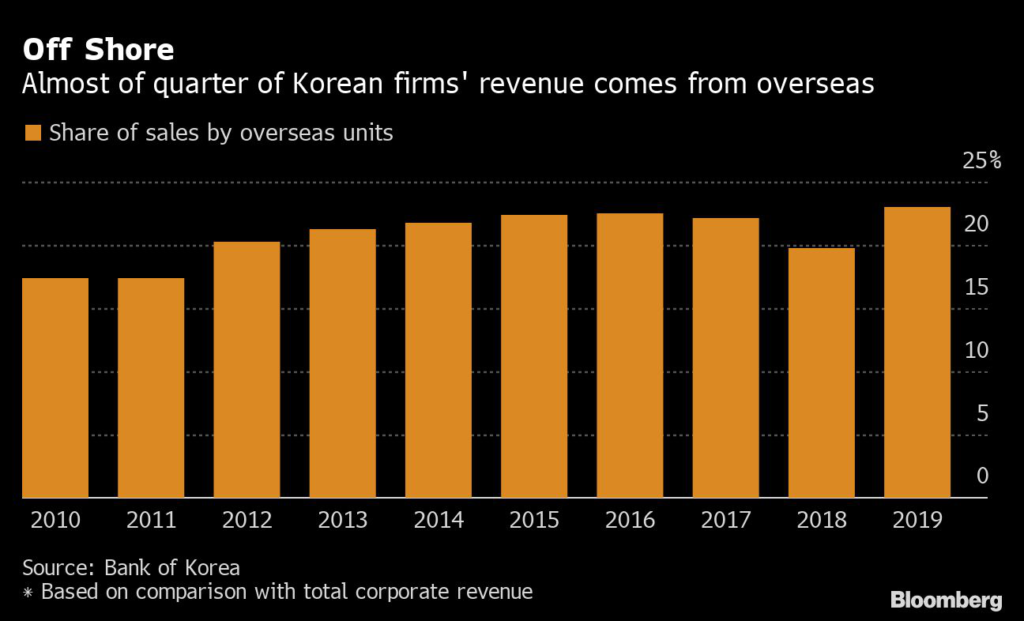
In an indication of the increase in operations abroad, sales by Korea’s overseas corporate units rose 71% to $368 billion in 2019 from $215 billion in 2010, with key products such as semiconductors, smartphones and cars accounting for almost two thirds of the gain, BOK researchers said.

The growing competition between the US and China is another factor pushing Korean firms to invest overseas, with companies such as Samsung Electronics Co. particularly vulnerable to US pressure because they rely heavily on American technology and equipment to produce semiconductors, batteries and other goods. 

Korea’s direct investment in the US amounted to a net $28.4 billion in the past year, a near five-fold increase from a decade ago, according to data from the Export-Import Bank of Korea. In the same period, investment in China rose two-fold to $7 billion, the data showed.

Even more Korean money may flow to the US as the administration of President Joe Biden expands efforts to reshore manufacturing. Korea’s high-tech firms are pivotal to the American effort to realign Asian supply chains to reduce reliance on China. 

In May, Biden visited a Samsung chipmaking plant in Korea and touted Hyundai Motor Co.’s pledge to invest more than $10 billion in the US. Last month when Korean President Yoon Suk Yeol visited the US, the chairman of SK Inc. Chey Tae-won said in Washington that his conglomerate plans to raise investment in the US to more than $50 billion by 2025.

“Direct investment has long-term, structural influence over capital flows,” said Choi Don-Seung, an economics professor at Andong National University in Korea. “How the US-China competition plays out will matter to the status of the dollar and how Korea positions itself will be important.”

More stories like this are available on bloomberg.com

©2022 Bloomberg L.P.
Stocks, US Futures Fall Ahead of US Payrolls Data: Markets Wrap

(Bloomberg) — Stocks in Asia slipped and US equity futures declined in subdued trading ahead of a pivotal US monthly payrolls report. Disappointing earnings from chipmakers weighed on broader investor sentiment.

The MSCI Asia Pacific Index fell as much as 1% and is on track to snap a three-day winning streak. Technology shares in Hong Kong led the retreat after Advanced Micro Devices Inc. and Samsung Electronics Co. reported earnings that missed analyst estimates. US equity contracts fell and European stock futures pointed to a lower open.

The dollar traded slightly higher against most major currencies, while the offshore yuan slipped after China said its foreign-exchange reserves fell to the lowest since 2017. The yen earlier weakened against the dollar toward levels that triggered direct market intervention last month, as traders test authorities’ tolerance for currency depreciation. Treasuries were little changed.

Friday’s US jobs report is forecast to show employers added a further 255,000 workers in September. That would be the fewest jobs added in a month since a decline in late 2020. 

It comes amid a drumbeat of hawkish comments from Federal Reserve officials — Chicago Fed President Charles Evans said the benchmark rate will probably be at 4.5% to 4.75% by next spring, and Minneapolis Fed’s Neel Kashkari said the central bank is “quite a ways away” from pausing its campaign of rate increases.

Read more: VIX Surge to 150 Is Day’s Biggest Options Bet for ‘Fear Gauge’

“There’s so much money out in the system chasing little supply,” Mariann Montagne, portfolio manager at Gradient Investments, said on Bloomberg Radio. “And what really needs to happen is we need more manufacturing in the US, more dependable sources of parts. We need more manufacturing goods available so that we can have a better economy.”

Ahead of the European open, Credit Suisse Group AG said it was offering to buy back debt securities for cash worth approximately 3 billion Swiss francs ($3 billion).  

Elsewhere, oil topped $88 a barrel and gold fell. Bitcoin traded around $20,000.

Key events this week:

  • US unemployment, wholesale inventories, nonfarm payrolls, Friday
  • BOE Deputy Governor Dave Ramsden speaks at event, Friday
  • Fed’s John Williams speaks at event, Friday

Some of the main moves in markets:

Stocks

  • S&P 500 futures lost 0.3% as of 2:01 p.m. Tokyo time. The S&P 500 fell 1%
  • Nasdaq 100 futures fell 0.3%. The Nasdaq 100 fell 0.8%
  • Japan’s Topix index dropped 0.8%
  • South Korea’s Kospi index was down 0.3%
  • Hong Kong’s Hang Seng Index slumped 1.3%
  • Australia’s S&P/ASX 200 Index decreased 0.6%
  • Euro Stoxx 50 futures slipped 0.4%

Currencies

  • The Bloomberg Dollar Spot Index rose 0.1%
  • The euro strengthened 0.1% to 0.9795 per dollar
  • The British pound was at 1.1161 per dollar
  • The Japanese yen surged 0.1% to 145.05 per dollar
  • The offshore yuan was at to 7.1016 per dollar

Bonds

  • The yield on 10-year Treasuries was little changed at 3.82%
  • Australia’s 10-year yield advanced almost eight basis points to 3.85%

Cryptocurrencies

  • Bitcoin fell 0.6% to $19,924
  • Ether fell 0.8% to $1,353

Commodities

  • West Texas Intermediate crude was at $88.29 a barrel
  • Gold fell 1.7% to $1,710.74 an ounce

More stories like this are available on bloomberg.com

©2022 Bloomberg L.P.

TSMC Sales Top Estimates as Clout Helps Chip Giant During Slowdown

(Bloomberg) — Taiwan Semiconductor Manufacturing Co. reported higher-than-expected quarterly revenue, signaling the chip giant is benefiting from market share gains to weather an industry slowdown.

Revenue at the world’s largest contract chipmaker rose 48% to about NT$613 billion ($19.4 billion) in the third quarter, according to Bloomberg’s calculations. Analysts estimated NT$603 billion on average.

Rising revenue at Apple Inc.’s most important chipmaker signals that the largest players in the $550 billion semiconductor industry may avoid the severe downturn investors have feared, helped by resilient demand for some electronics products in the face of rising interest rates and soaring inflation. Morgan Stanley this week projected a return to growth for the chip industry by the second half of 2023.

Other chipmakers warned in recent weeks that they are facing a tougher market as inventories build up and orders are being cut by data center as well as consumer tech clients. Micron Technology Inc. and Kioxia Holdings Corp. are cutting output to try and rebalance supply and avert a price crash.

Earlier on Friday, Samsung Electronics Co. reported its first profit drop since 2019. Shortly before Samsung’s results, US processor and graphics chip maker Advanced Micro Devices Inc. also missed estimates with its third-quarter sales figures, which came in $1 billion shy of its own forecast.

Shares of TSMC fell 2.9% in Taipei on Friday and have lost 29% this year.

TSMC, the world’s most advanced maker of silicon chips, has benefited from Apple launching new types of chips to boost the performance of its devices. Still, Bloomberg reported in September the Californian company is backing off plans to increase production of its new iPhones, raising questions about underlying electronics demand.

What Bloomberg Intelligence Says:

“For now, overseas capacity expansion will be front and center, especially in the US and Japan, as TSMC pushes to meet customers’ diversification requests and rises to the challenge of growing competition from Samsung and Intel. Rapidly rising depreciation and material costs, coupled with increasing uncertainty in smartphone demand, are putting a cap on its gross margin.”

–Charles Shum, Bloomberg Intelligence

Click here for the research

To diversify beyond chips for electronics, TSMC is also seeking growth in areas such as next-generation vehicles. The Taiwanese company is betting on growing demand for semiconductors as cars become electrified and more digitized.

More stories like this are available on bloomberg.com

©2022 Bloomberg L.P.
Close Bitnami banner
Bitnami