
Bloomberg

The Next Hurdle for Tech Stocks Could Be Weak Earnings Outlooks

(Bloomberg) — Investors hoping that third quarter earnings will be strong enough to reverse this year’s steady selloff in technology stocks should brace for the prospect of weak company outlooks causing further pain.

That’s the view from pessimists who say the mini-rally in the Nasdaq 100 Index that kicked off this week will peter out. Headwinds including higher interest rates, a strong dollar, and slower economic growth are likely to result in cautious commentary from companies as they roll out results over the next month. 

The Nasdaq 100 Index was little changed on Thursday.

That dynamic applies to stocks as a whole, but its especially a problem for tech shares, because earnings for the industry are now forecast to decline in the third quarter, unlike the rest of the market. 

While third quarter earnings may beat already-lowered estimates, as they usually do, that will be no consolation if analysts have to take an ax to 2022 and 2023 estimates again. And it will undermine the argument that the year-to-date rout has generated some bargains. 

“Consensus estimates need to come down more, and while this earnings season may be better than expected, as is typical, outlooks will hurt,” said Rick Bensignor, chief executive officer at Bensignor Investment Strategies. “If we get a major negative outlook, recent gains will disappear in a flash.”

Micron Technology Inc. recently gave a weak sales forecast, as did fellow chipmaker Nvidia Corp.. Outside of the tech sector, warnings from bellwether stocks like FedEx Corp. and Nike Inc. have painted a grim picture of business conditions going into next year.

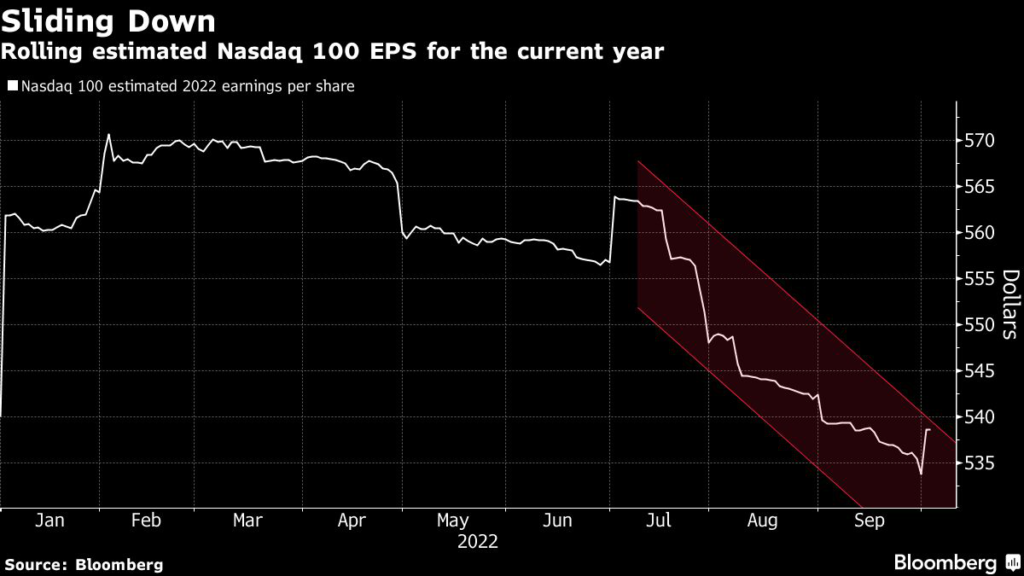
Earnings for the tech sector are expected to fall 6.5% in the third quarter, according to data compiled by Bloomberg Intelligence. In late June, the consensus had been for growth of about 3%. There is a similar trend for the communications services sector, which includes companies like Alphabet Inc. and Meta Platforms Inc.; the consensus is for earnings there to fall 10.4%, compared with the 0.2% growth expected in late June. Full-year estimates for both groups also have dropped for 2022 and 2023.

For the overall S&P 500, the consensus for third quarter earnings has dropped from 10.3% growth in late June to a 2.9% increase now. 

Tech and growth stocks “may not be as defensive as some investors expect,” according to BofA Global Research, which notes that earnings for Nasdaq companies continue to weaken compared with those for S&P 500 members.

The tech-heavy Nasdaq 100 is down 29% this year, finishing last week at the lowest since September 2020, with much of the weakness related to aggressive moves by central banks to combat inflation.  

The Nasdaq 100 trades at 20 times estimated earnings, in line with its 10-year average. However, falling estimates would lower the denominator in the price-to-earnings ratio, making equities look more expensive.

Michael Wilson, chief US equity strategist at Morgan Stanley, said the likelihood of more estimate cuts ahead suggests that valuations aren’t reflecting the reality of the economic environment, and that recent optimism about the Fed relaxing its hawkish stance was premature. 

“The light at the end of the tunnel you might see if that happens is actually the freight train of the oncoming earnings recession that the Fed cannot stop at this point,” he wrote. Even if the Fed were to pivot toward a more accommodative policy stance, “the timing is uncertain and won’t change the trajectory of earnings estimates, our primary concern for stocks at this point.”


Tech Chart of the Day

Meta Platforms shares have collapsed 59% this year, with the drop reducing its influence in the S&P 500 to a multi-year low. The Facebook parent now accounts for less than 1% of the benchmark, its lowest since 2015 and down from a 2021 peak of 2.4%. The weighting is roughly equal with that of chipmaker Nvidia and financial bellwether JPMorgan Chase & Co. Meanwhile, Apple Inc. remains the biggest company in the benchmark index by far at 6.9%.

Top Tech Stories

  • Elon Musk and Twitter Inc. agreed to postpone the billionaire’s long-awaited deposition in the company’s lawsuit aimed at forcing him to go through with a $44 billion buyout, according to people familiar with the matter.
    • Musk’s proposal to follow through on his agreement to buy Twitter came after unsuccessful earlier discussions about cutting the price, according to people familiar with the matter.
    • Investment firms that had expressed an interest in helping Musk finance his acquisition of Twitter abandoned the talks several months ago, around the time that the mercurial billionaire backtracked from the deal, according to people with knowledge of the matter.
  • Taiwan Semiconductor Manufacturing Co. surged the most in almost three months after Morgan Stanley projected a return to growth for the semiconductor industry by the second half of 2023, spurring a sector rally in Asia.
  • IBM Corp. will announce plans to invest $20 billion over the next decade during a visit by President Joe Biden to the company’s campus in Poughkeepsie, New York. The investments will go toward research and development and the manufacturing of semiconductors, mainframe technology, artificial intelligence and quantum computing in the Hudson Valley, according to a White House official.
  • A foreign buying spree of British technology companies has hit a wall after market turbulence scuppered a couple of high-profile deals, casting a shadow over future deal making in the sector.
  • With the global economy likely to slow down next year, tech stocks and US equities are looking more attractive, according to Citigroup Inc. strategists.
  • Cathie Wood’s latest dip-buying binge appears to be largely focused on smaller stocks, cementing her firm’s already hefty shareholdings in such companies.
  • AT&T Inc. Chief Executive Officer John Stankey said his company is way ahead of T-Mobile US Inc. and Elon Musk in efforts to provide mobile phone service to remote areas via satellites.
  • Uber Technologies Inc.’s former security chief was convicted of concealing a massive data breach in a case that prosecutors tied to the company’s troubled past under its original leadership.

(Updates to market open.)

More stories like this are available on bloomberg.com

©2022 Bloomberg L.P.

Faraday’s Executive Chair Exits EV Startup, Citing Death Threats

(Bloomberg) — Faraday Future Intelligent Electric Inc.’s executive chair resigned following what the company said were death threats and baseless allegations against certain directors, accelerating a planned transition of the troubled electric-vehicle startup’s leadership. 

Two additional board members stepped down this week along with Executive Chair Susan Swenson, the company said Thursday in a securities filing. Adam He was appointed to serve as interim non-executive chair.

The startup has been rocked by a fight over control, which veered into the morbid last month when Faraday reported that criticism of current management has escalated to include “threats of physical violence and even death threats.” That contributed to a shakeup under which Swenson was to have left once the company received certain funding as part of a wider overhaul giving more control to a group of dissident shareholders who own about 36% of the company. 

But Faraday said the threats prompted Swenson and the two other board members — lead independent director Jordan Vogel and Scott Vogel — to expedite their exits.

The directors “cited such threats and their fear that their continued association with the company might heighten the risk to themselves and their respective families as the reasons for their resignations,” it said.

Shares of the company rose 5.4% to 68 cents at 9:37 a.m. in New York.

Faraday last month delayed the launch of its debut electric vehicle until at least next year after having pledged when it went public last year to start production by mid-2022. It cited a need for additional cash as the reason for the postponement.

‘Employee Whistleblowers’

The company blamed what it called “self-described ‘employee whistleblowers’” and “various individuals and entities who represented themselves as current investors” for making allegations against the board of conspiring to run the company into the ground for their own personal benefit. Those claims were determined to be without merit, according to what it said was an independent external investigation.

Faraday has said it believes the dissident shareholder group is under the influence of co-founder Jia Yueting. He was sidelined in April after an internal probe led by Swenson concluded that managers misled investors on Jia’s day-to-day control and influence.

The Los Angeles-based startup has faced a number of other obstacles, including the resignation of its auditor. The SEC has opened a probe into Faraday’s financial statements.

More stories like this are available on bloomberg.com

©2022 Bloomberg L.P.

Musk Deposition Delayed in Twitter Suit as Buyout Advances

(Bloomberg) — Elon Musk and Twitter Inc. agreed to postpone the billionaire’s long-awaited deposition in the company’s lawsuit aimed at forcing him to go through with a $44 billion buyout, according to people familiar with the matter. 

Musk reversed course earlier this week and committed himself to consummating the $54.20-per-share offer for the social-media platform on its original terms. Even though the deal still may take months to close, a trial set for Oct. 17 is almost certain to be put on hold. 

Both sides agreed Wednesday to delay the deposition that was set for Thursday morning in Austin, Texas, while lawyers try to finalize procedures to dispose of the suit, according to the people, who declined to be identified discussing a confidential matter.

Twitter shares fell 1.4% to $50.58 in New York Thursday morning, suggesting the stock market at least isn’t entirely sold on the doneness of the deal. 

Meanwhile, banks and other investors are reviewing the deal’s original $12.5 billion debt-financing package. The lenders are led by Morgan Stanley. Other investors include Oracle Corp. Chief Executive Officer Larry Ellison. 

Before restoring his original offer, Musk’s representatives held talks with Twitter on lowering the deal price, people familiar with the negotiations told Bloomberg News. Musk was seeking a price cut of 30%, and more recently explored a 10% discount, but the discussions failed to yield an agreement, the New York Times reported, citing unidentified sources. 

Delaware Chancery Judge Kathaleen St. J. McCormick said Wednesday that since neither side has yet asked to pause the case, she’s pressing ahead with the upcoming trial. In a securities filing earlier this week, Musk offered to go forward with the deal if Twitter’s suit was put on hold. 

Twitter didn’t immediately respond to a request for comment after regular business hours on the deposition being delayed.

Musk skipped out on other deposition dates in the case. He cancelled a Sept. 28 meeting to answer questions because of Covid-19 concerns, according to court filings. He also demanded that the deposition be conducted in Texas instead of Delaware.

Musk backed away from his planned Twitter purchase earlier this year, claiming the company hadn’t leveled with him and investors about the number of bot accounts that artificially pump up advertising revenue. Twitter countered that the concerns were a pretext for Musk when he started feeling buyer’s remorse.

In the past, Musk –- chief executive officer of electric-car maker Tesla Inc. — has turned belligerent in pre-trial questioning in other court cases focused on his deal-making efforts.

In a deposition tied to a suit by Tesla investors over Musk’s buyout of renewal-power company SolarCity, the billionaire belittled a lawyer for shareholders who argued the deal was rife with conflicts.

“To bail out SolarCity was good for the world you’re telling us?” investors’ attorney Randy Baron asked in a pre-trial query.

“Advancing solar is absolutely good for the world,” Musk shot back. “Do you just think about money? What is your purpose in life?” Musk’s deposition testimony was played in the 2021 trial of the SolarCity dispute.

During his cross-examination at trial, Musk told a Delaware judge he didn’t respect Baron, who he considered to be “a bad human being” who specialized in asking deceptive questions. The judge ultimately ruled for Musk in the case.

The case over the Twitter buyout is Twitter v. Musk, 22-0613, Delaware Chancery Court (Wilmington). 

(Updates with share trading in fourth paragraph)

More stories like this are available on bloomberg.com

©2022 Bloomberg L.P.
Elon Musk’s Twitter Takeover Slightly Less of a Done Deal, Shares Suggest

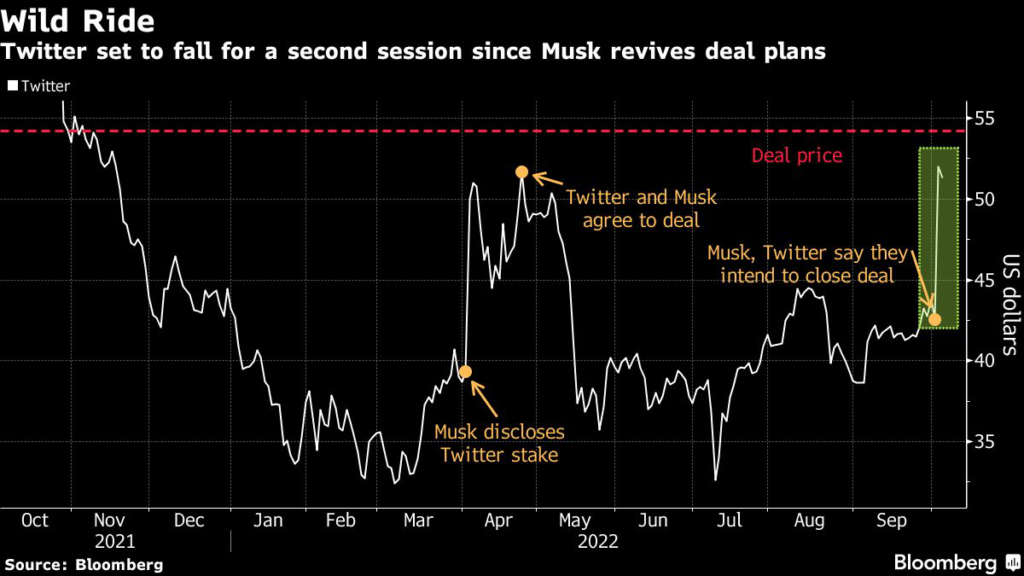
(Bloomberg) — Stock markets are still not entirely sold on Elon Musk’s $44 billion takeover of Twitter Inc. after the billionaire revived the deal at its original price earlier this week.

Shares in the social media firm slipped 0.7% to $50.95, taking them further below Musk’s offer of $54.20 a share. The stock is set to slip for a second day after soaring on Tuesday when the Tesla Inc. chief made a surprising U-turn from his effort to back out of the deal, potentially avoiding a contentious courtroom fight.

While most analysts see the deal closing fairly quickly, concerns persist surrounding the funding of the transaction, keeping Twitter’s stock about 6% below the offer price.

Banks led by Morgan Stanley and investors including Oracle Corp. Chief Executive Officer Larry Ellison are reviewing the deal’s original $12.5 billion debt-financing package. Lenders may struggle to sell the risky Twitter buyout debt amid a deterioration in credit markets since they committed to the financing back in April.

“The key question is financing and Twitter will probably not accept conditional financing,” said Jean-Francois Comte, managing partner at merger arbitrage firm Lutetia Capital. “Because of credit market evolution over the past months, we can reasonably assume there are serious discussions between Musk and the banks,” said Comte, who still considers the deal attractive.

Wedbush analyst Dan Ives says he doesn’t see the debt situation around the deal falling apart, though some are more skeptical.

The most plausible reason for the deal not to proceed “revolves around funding issues,” said Neil Campling, an analyst at Mirabaud Securities. “He (Musk) will try and wriggle out.” 

(Updates with market open.)

More stories like this are available on bloomberg.com

©2022 Bloomberg L.P.

Poshmark Deal Points to More Acquisitions in Resale Market

(Bloomberg) — The world’s biggest brands have had enough.

After watching online marketplaces rack up billions in revenue from secondhand sales of their goods, brands ranging from Lululemon Athletica to Jimmy Choo are aiming for their own piece of a resale market that Coresight Research projects to hit $30 billion in the US next year.

“We have seen just really an explosion in resale,” said Erin Schmidt, senior analyst at Coresight. “Every few weeks, we’re seeing another announcement of a brand or another retailer getting involved in this space.”

In the last month alone, Jimmy Choo, Balenciaga, On Running, Athleta and Vera Bradley have launched resale platforms where consumers can buy — and in some cases, sell — pre-owned apparel, shoes and handbags. Even non-profits are piling in.

That’s not good news for so-called peer-to-peer marketplaces that take a cut of transactions made on their platforms. Increasing competition has already led to sluggish growth and large losses while crushing the stocks of resale sites that have gone public.

Take Poshmark Inc., which had an initial public offering in January 2021 and saw its valuation surge above $8 billion. On Monday, the company announced a deal to be acquired by South Korean internet giant Naver Corp. for $1.2 billion.

The proposed transaction may spark more deals. Valuations for online retailers have declined meaningfully, according to Ashley Helgans, an analyst for Jefferies. Resale is also still a fast-growing category and attractive in the long-term, she wrote in a research note. Shares of secondhand sites ThredUp Inc. and The RealReal Inc. each jumped about 20% in the two trading days after news of the Poshmark deal.

To get in on the action, big brands are partnering with companies, including ThredUp and The RealReal, to run their resale units. One of the draws is that reselling goods is often a high-margin business. It also helps lure new customers who might not be willing to pay full-price and gives companies a way to pitch sustainability. In many cases, shoppers trade in used branded items and receive credit toward a future purchase from that company.

“Given there’s a race to the bottom in fashion right now — loads of stuff gets sold on discount — margins are squeezed,” said Marilyn Martinez, project manager at the Ellen MacArthur Foundation’s fashion initiative. “Resale is an amazing solution to up your margins if it’s integrated in your business model.”

Low prices and the eco-friendly appeal of resale put it in a position to grow 16 times faster than the broader retail sector by 2026, according to calculations from Bloomberg Intelligence.

Trove Recommerce, founded by Andy Ruben, a former Walmart e-commerce executive, runs the back-end operations for customers such as Levi’s and Allbirds. The company, along with competitors such Reflaunt, Recurate and Archive, is part of an increasingly crowded market that’s also likely to consolidate.

Ruben wants to eventually expand into categories such as home improvement, working with partners such as Home Depot and Lowe’s. There are already companies pushing into electronics, bicycles and music gear.

“If you believe that we will all shop this way, you have to invest in this now,” said Ruben, who compared waiting to enter the resale market to missing out on the e-commerce boom of the early 2000s.Saks Off 5th, the discount arm of Saks Fifth Avenue, is making a big push. It has three resale partnerships that allow the company to offer pre-owned handbags and apparel from brands it typically doesn’t carry, said Paige Thomas, the chain’s chief executive officer.

Despite the bullishness, resale faces a big hurdle in the fourth quarter. Retailers across the board are stuck with excess inventory after misreading demand during the pandemic. That is likely to lead to lots of discounting, according to Anna Andreeva, managing director at Needham & Company. More than two-thirds of consumers say a major reason they buy secondhand is to save money, according to survey data from Morning Consult.

Online resale also has a long way to go to match new items on convenience, according to Martinez of the Ellen MacArthur Foundation. At stores, you get an item immediately, while major full-price e-commerce sites have easier navigation and faster shipping times, she said.

“Resale is still not the norm,” Martinez said. “Not in the US, not in Europe, not anywhere just yet. To make it the norm, we need more of the bigger brands to jump into it as well.”


(In 7th paragraph, updates gains of other resale sites.)

More stories like this are available on bloomberg.com

©2022 Bloomberg L.P.

Amazon Plans to Hire 150,000 Workers for Holiday Season

(Bloomberg) — Amazon.com Inc. plans to hire 150,000 seasonal workers, about the same as last year despite slowing sales growth and predictions of a lackluster holiday shopping season. 

The world’s largest online retailer typically hires legions of temporary workers this time of year to help store, pack and ship items from its warehouses. Employees can earn more than $19 an hour, on average, based on their position and location in the US, Amazon said in a statement. 

The announcement suggests that Amazon expects steady demand for its logistics services even with shoppers back in stores and trimming their budgets amid the highest inflation in decades. In an effort to jumpstart sales going into the holiday season, the company will hold a two-day Prime Day sale next week, the first time Amazon has hosted such an event twice in the same year. 

Amazon ratcheted up hiring during the pandemic to handle a surge in orders from home-bound shoppers. When consumers returned to their previous shopping habits this year, the Seattle-based company found itself saddled with too many workers and facilities. 

Amazon has since shuttered, delayed or abandoned plans for dozens of warehouses in the US and Europe, Bloomberg reported in September. The company also winnowed its workforce — primarily through attrition, Amazon says — by almost 100,000 people between March and June, the biggest quarterly decline in its history. The company recently froze hiring in the corporate jobs behind its retail business for the rest of the year. 

Read more: Amazon Air Flights Grow at Slowest Pace Since Early Pandemic

Despite Amazon’s decision to keep seasonal hiring steady, the third-party merchants who account for more than half of the company’s online sales are bracing for what many fear will be a dreary holiday shopping season. Some expect to cut prices to move unsold inventory. It’s an abrupt change from 2020 and 2021 when sellers were scrambling to get enough products into Amazon warehouses to meet pandemic-fueled demand, even as chronic shortages let them increase prices. 

This year, US online sales will rise just 9.4% to $1 trillion, the first time growth has slipped into the single digits, according to Insider Intelligence, which in June lowered its earlier annual forecast. Spending on Amazon will hit $400 billion, up 9% and slower than the overall industry, the research firm says.

Amazon, the second-largest private US employer after Walmart Inc., employed 1.5 million people at the end of June. Last year at this time, the company said it would hire about 150,000 seasonal workers. Walmart also hired 150,000 temporary workers in 2021 but last month said it would cut holiday recruiting to some 40,000 people.

(Updated with details on corporate hiring freeze, Prime Day plans, beginning in the third paragraph.)

More stories like this are available on bloomberg.com

©2022 Bloomberg L.P.
Chinese EV Battery Maker CALB Targets Top Three After IPO

(Bloomberg) — Newly Hong Kong-listed CALB Co. aims to become a top-three player in the electric vehicle battery industry within five years, Chief Executive Officer Jingyu Liu said.

Shares in the Changzhou, Jiangsu-based firm ended at HK$38, matching the IPO price after dipping as low as HK$37.15. The offer raised about HK$10.1 billion ($1.3 billion), with the shares sold at the bottom of a marketed range that went as high as $51.

“We want to reach top five in the global EV battery market in a year’s time, and be third within three-to-five years,” Liu said in an interview with Bloomberg Television. 

The company is currently building out production lines that will have a combined annual capacity of more than 200 gigawatt hours. “This increased battery capacity will place us among the top few globally,” said Liu, the only female CEO of a top 10 global battery maker. 

A New Chinese EV Battery Giant Has Emerged: Anjani Trivedi

China Aviation Lithium Battery Technology Co., as its formally known, was formed in 2015 under Luoyang Co., a wholly owned unit of the China Airborne Missile Academy, which is part of state-owned aerospace and defense firm Aviation Industry Corp. of China Ltd.

The lofty goals for the Xpeng Inc. supplier come with a need to pay for the expansion. Liu said going public was a “natural next step” in the high-growth sector.

“Our IPO funds will be used for business expansion and R&D,” Liu said. “But our finances have been stable and we have sufficient capital for current needs.” 

CALB is projecting a “big” increase in domestic battery market share as it increases output, followed by “significant growth” from 2024 in overseas markets, she said.

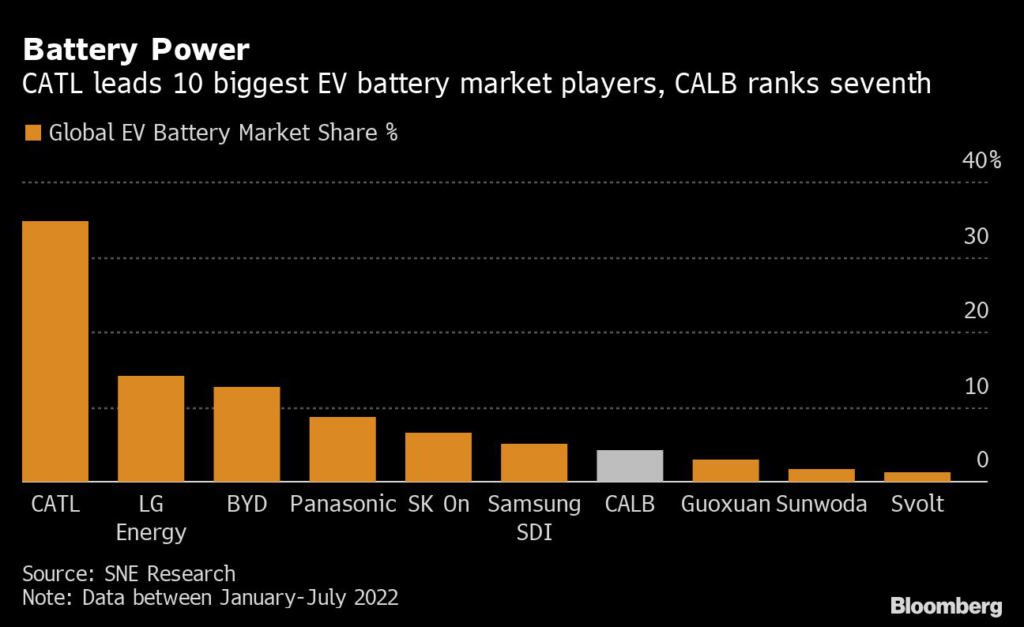
The company ranks seventh among global EV battery suppliers, according to SNE Research, but is dwarfed by larger Chinese rival Contemporary Amperex Technology Co. Ltd., followed by South Korea’s LG Energy Solution Ltd. and BYD Co., all whom have deep pockets and equally high ambitions to expand their market share.  

Market leader CATL has already unveiled around $20 billion worth of spending commitments this year on a slate of factories to be built at home, and as far away as Hungary and resource-rich Indonesia.

As the EV supply chain grapples with soaring costs of key battery materials like lithium and copper, CALB has seen through the worst of the industry-wide price shocks, Liu said. Margins have continued to grow, with first-quarter profit higher than a year earlier, and second quarter earnings higher than the first, she said.

“We expect our profits to continue increasing in every subsequent quarter,” she said. “We’ll reduce supply chain costs through working with our upstream suppliers and battery recycling.”

Even at a smaller size than initially expected, CALB is the third-largest IPO in Hong Kong this year, as mid-to-large sized deals return after a slow first half. Still, funds raised in the city are down about 75% since the start of January as rising interest rates roil markets and keep issuers on the sidelines.

Half of the 18 companies that have listed in Hong Kong after offerings larger than $100 million this year ended their first session underwater. Five finished little changed and only four rose on day one.

CALB’s debut comes one week after a disastrous first-day of trading for Chinese EV maker Zhejiang Leapmotor Technology Co., which plunged 34%, after raising $800 million in an IPO that was priced at the bottom of the marketed range. The slide was the biggest first-day decline for a listing of that size or bigger on record in the Hong Kong.

Huatai International Ltd. is the sole sponsor of CALB’s Hong Kong IPO.

(Updates with detail of share trading. An earlier version corrected province in China in 2nd graph.)

More stories like this are available on bloomberg.com

©2022 Bloomberg L.P.
US Index Futures Edge Lower After Jobless Claims: Markets Wrap

(Bloomberg) — US equity-index futures edged lower as more Americans than expected filed for unemployment support. Markets remained in the grip of volatility as the OPEC+ alliance’s plan to cut oil supply stoked inflation fears.

Futures on the S&P 500 posted small losses, signaling a muted opening for New York markets. US crude futures held on to weekly gains of about 10% after the oil cartel said it would cut daily output by 2 million barrels. Treasuries swung between gains and losses. In New York premarket trade, Twitter Inc. lost more 2%, falling further below Elon Musk’s offer price.

While higher energy prices risk stoking inflation, some investors speculated they’ll reduce demand and hit company earnings — potentially encouraging the Federal Reserve to slow monetary tightening. Such expectations fueled equity gains this week, but several money managers are already cautioning that the economic path to a less aggressive Fed could be painful.

“If you want to preempt the Fed, you are playing a very high-stakes game,” said Kenneth Broux, a strategist at Societe Generale SA. “The Fed do not want financial conditions to loosen; they don’t want equity markets to take off and get too comfortable.”


Applications for US unemployment insurance rose more than expected last week, in the latest sign that labor demand may be beginning to moderate. Initial unemployment claims increased by 29,000 to 219,000 in the week ended Oct. 1, Labor Department data showed Thursday. That helped to reduce the bearish overhand from European hours, leading to US index futures trading little changed.

West Texas Intermediate futures traded just under $88 a barrel, while Brent crude held just above $93. The output-cut plan drew a warning from the White House about negative effects on the global economy. Goldman Sachs Group Inc. increased its fourth-quarter price target for Brent to $110 a barrel. 

In Europe, the Stoxx 600 drifted 0.2% lower, as losses for energy and commodity stocks offset advances in auto-parts and technology shares. Shell Plc tumbled 4.3% after the energy giant pointed to a weaker third-quarter performance. 

Fed officials have been at pains to stress that market anticipation of rate cuts next year is misplaced, a point San Francisco Fed President Mary Daly reiterated in an interview on Bloomberg Television. The bank aims to keep policy tight to secure 2% inflation, she added.

The dollar advanced. Britain’s pound shed 0.5% after Fitch Ratings lowered its outlook on the nation to negative. Ten-year gilt yields jumped as much as 18 basis points.


Key events this week:

  • US initial jobless claims, Thursday
  • Fed’s Charles Evans, Lisa Cook, Loretta Mester speak at events, Thursday
  • US unemployment, wholesale inventories, nonfarm payrolls, Friday
  • BOE Deputy Governor Dave Ramsden speaks at event, Friday
  • Fed’s John Williams speaks at event, Friday

Will earnings disappoint and push equities to new lows? This week’s MLIV Pulse survey asks about corporate earnings. It’s brief and we don’t collect your name or any contact information. Please click here to share your views.

Some of the main moves in markets:

Stocks

  • Futures on the S&P 500 fell 0.3% as of 8:22 a.m. New York time
  • Futures on the Nasdaq 100 fell 0.3%
  • Futures on the Dow Jones Industrial Average fell 0.3%
  • The Stoxx Europe 600 fell 0.3%
  • The MSCI World index was little changed

Currencies

  • The Bloomberg Dollar Spot Index rose 0.2%
  • The euro fell 0.3% to $0.9858
  • The British pound fell 0.6% to $1.1256
  • The Japanese yen was little changed at 144.71 per dollar

Cryptocurrencies

  • Bitcoin rose 1.1% to $20,211.03
  • Ether rose 1.7% to $1,368.84

Bonds

  • The yield on 10-year Treasuries advanced one basis point to 3.77%
  • Germany’s 10-year yield was little changed at 2.03%
  • Britain’s 10-year yield advanced 13 basis points to 4.16%

Commodities

  • West Texas Intermediate crude was little changed
  • Gold futures rose 0.3% to $1,725.60 an ounce

More stories like this are available on bloomberg.com

©2022 Bloomberg L.P.
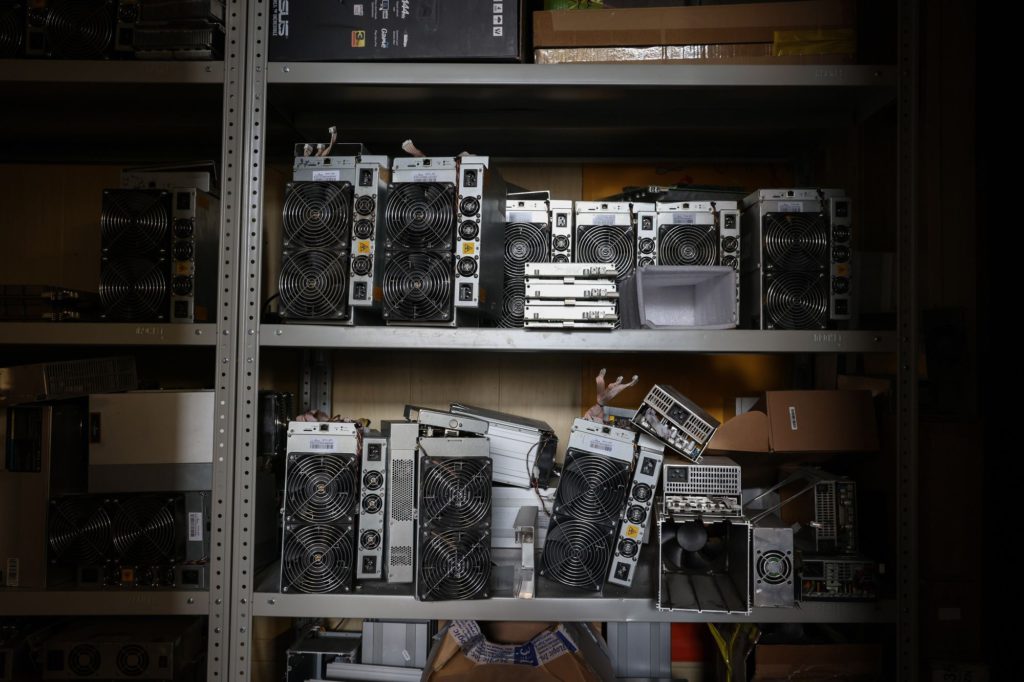
Grayscale Sets Up Entity to Invest in Bitcoin Mining Hardware

(Bloomberg) — Grayscale Investments, the largest crypto asset manager, is shifting strategy during the midst of the market downturn by setting up an entity seeking to buy Bitcoin mining equipment at distressed prices.

The New York-based firm will form Grayscale Digital Infrastructure Opportunities LLC (GDIO), which will be available to accredited investors such as hedge funds and family offices at a minimum investment of $25,000. GDIO plans to purchase the computer rigs used in mining and hopes to profit by selling the Bitcoin earned in the process, Grayscale’s CEO Michael Sonnenshein told Bloomberg News. Grayscale expects to finish the funding before the end of the fourth quarter. This is likely a three-to-five-year investment, similar to the kind of terms they would see when investing in private equity or infrastructure in other asset classes, he said. 

Grayscale is the latest firm aiming to capitalize on the distressed crypto-mining industry. Low Bitcoin prices, high energy costs and fierce completion among miners have depressed the prices of the hardware. The strategy is to buy mining rigs at a steep discount from distressed miners and expand operations at a low cost. Large-scale miner Bitdeer launched a $250 million Bitcoin mining distressed fund last week, while public mining firm CleanSpark Inc. bought a Georgia mining facility and thousands of rigs from another miner for over $30 million.

“We ultimately believe that there is some level of financial distress on mining hardware as the result of the lower pricing environment, which makes it a opportune time for investors to think about leaning into this exposure.” Sonnenshein said.

Foundry Digital, which shares the same parent, Digital Currency Group, with Grayscale, will run the mining operations. The Rochester, New York-based company is one of the major crypto-mining services providers. It has the largest Bitcoin mining pool by computing power in the world, according to data from btc.com. Such companies use software to aggregate computing power from miners and increase their chance to win the Bitcoin rewards by being the first to solve the cryptographic puzzles on the token’s blockchain. The pools charge miners a fee for the services. Foundry also offers other services such as underwriting loans for miners, according to its website. 

More stories like this are available on bloomberg.com

©2022 Bloomberg L.P.

Uber Revives Self-Driving Taxi Dreams, Plans to Start This Year

(Bloomberg) — Uber Technologies Inc. inked a deal with Motional Inc. to offer driverless deliveries and rides, rekindling its vision of a self-driving taxi fleet nearly two years after it sold its autonomous vehicle division.

The San Francisco-based company is partnering with Motional, which is an autonomous driving joint venture between Hyundai Motor Co. and Aptiv Plc. The 10-year deal will pair Motional’s all-electric IONIQ 5 robotaxis with Uber’s ride-hailing and delivery platform, the companies said in a statement Thursday. They did not disclose financial terms. 

“This agreement will be instrumental to the wide scale adoption of robotaxis,” Motional Chief Executive Officer Karl Iagnemma said in a statement. 

The move builds on an existing partnership between the two companies piloting driverless food deliveries on Uber Eats. That effort launched in May in Santa Monica, California. Uber will begin to offer driverless rides later this year in the US. 

“The scope of this partnership shows the important role that shared autonomous vehicles will play in the future of transportation, and in Uber’s strategy to be the global platform to help you go anywhere and get anything,” Noah Zych, Uber’s global head of autonomous mobility and delivery, said in the statement.

Read more about the reality-vs.-hype of self-driving cars

The agreement signifies Uber’s renewed interest in autonomous-driving technology for its ride-hailing business after it shelved lofty ambitions for self-driving cars in a bid to cut costs at the height of the pandemic. In December 2020, Uber sold its autonomous vehicle unit, Advanced Technologies Group, to Aurora Innovation Inc. and took a stake in the company. 

Before the sale, ATG had made progress building and testing autonomous driving systems, deploying pilots in cities including San Francisco, Toronto and Washington. The unit also struggled amid a damaging lawsuit brought by Waymo and a fatal crash in March 2018 involving one of its test vehicles. Lyft Inc. also tempered its expectations around the speed and scale it could roll out a driverless ride-hailing fleet, opting to sell its self-driving technology unit to Toyota Motor Corp. in April 2021 for $550 million. 

Both Uber and Lyft have shifted their strategy for advancing self-driving cars in recent years amid increasing pressure to focus more on profitability and less on costly bets. By partnering with autonomous vehicle technology companies, the ride-hailing giants have kept a stake in the sector without having to bring the research and development in-house. 

In September, Lyft rolled out autonomous rides in Austin, Texas, in partnership with Ford Motor Co. and Argo AI. It also teamed up with Motional for a self-driving ride-hail service in Las Vegas. 

More stories like this are available on bloomberg.com

©2022 Bloomberg L.P.

Close Bitnami banner
Bitnami