
Bloomberg

Microsoft’s Turn Is Coming in Stock Battle of Titans

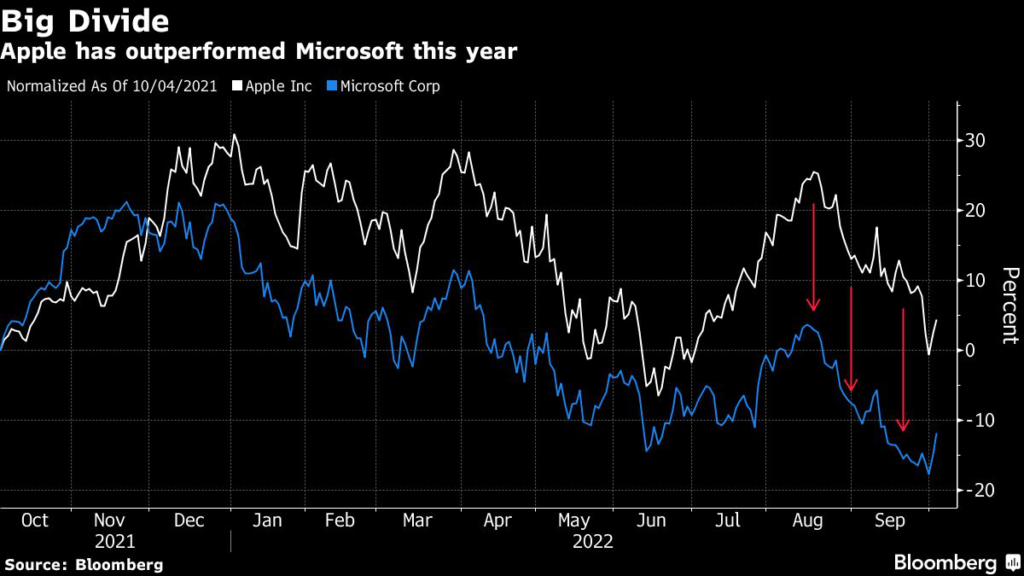
(Bloomberg) — In the stock market contest this year between the two biggest US companies, Microsoft Corp. has been no match for Apple Inc. With consumer spending under threat from a possible recession, some analysts are betting that performance is about to turn around.

Their valuations might be similar, but their business models are quite distinct. Much of Microsoft’s almost $200 billion of annual revenue comes from providing essential software and services to businesses. Meanwhile, Apple is more at the mercy of consumer demand and is exposed to markets like Europe and China. 

“Microsoft has an advantage because it’s a sticky business,” said Gene Munster, managing partner of Loup Ventures. “You get the benefit of that stickiness during a recession. Microsoft most likely outperforms Apple over the next six months based on that.” 

Microsoft shares have fallen 26% this year, wiping $669 billion from its market value, as the dollar soared against other currencies, reducing the value of the company’s international sales. Meanwhile, the iPhone maker has proved more resilient, with its stock down 18%, benefiting from investor perception that it’s a relatively safe haven in a bear market. 

With bargain hunters on the prowl, Microsoft has rallied 6.9% this week as the market rebounded and Apple rose 5.7%, as of Tuesday’s close. 

Neither stock qualifies as cheap: Both are hovering around 23 times estimated earnings for the next year, in line with the Nasdaq 100 Index. Yet for Apple, that’s a big premium to its 10-year average multiple of 16.9, and Microsoft is close to its long-term average of 21.7. 

And while analysts estimate that Microsoft will report double-digit revenue growth over the next two years, Apple’s growth is forecast to slow to 5% in the same period, according to Bloomberg data. 

Microsoft looks notably cheaper than Apple on another metric used by growth investors, the so-called PEG ratio, or the price-earnings multiple divided by the expected percentage increase in earnings. The software giant’s PE is 1.7 times the forecast rate of profit growth, versus 2.2 times for Apple, according to Bloomberg data.

With the Federal Reserve pursuing a series of interest rate increases to cool inflation, those sales and profit estimates may still be too high if a recession hits. Still, Apple may be more at risk, given that it produces and sells iPhones in China, where the economy is already teetering. 

“The software maker is better positioned to survive a recession and has lower exposure to China for assembly and sales than Apple,” Bloomberg Intelligence analyst Anurag Rana said. 

Tech Chart of the Day

The wild ride for Twitter Inc. shareholders isn’t over just yet. Shares of the social media company are down 2% on Wednesday after surging 22% Tuesday after Elon Musk said he intends to close his deal for the San Francisco-based firm for the original price of $54.20 per share. The massive rally is the latest in a long line of twists and turns for the stock since the acquisition was first announced in late April, including a termination letter sent by Musk in July that sent the stock tumbling to a closing low of $32.65. 

Top Tech Stories

  • Elon Musk revived a bid to buy Twitter at the original price of $54.20 a share, backtracking on his effort to quit the deal and potentially avoiding a contentious courtroom fight.
    • Musk has teased something called “X, the everything app” after he buys Twitter. Based on the billionaire’s past comments, that service could look a lot like Chinese super-app WeChat.
    • Musk’s shock proposal to proceed with his acquisition of Twitter for the original offer price poses a headache at the worst possible time for Wall Street banks already struggling to offload billions of dollars in buyout debt they committed to in better times.
  • Taiwan Semiconductor Manufacturing Co. surged the most in almost three months after Morgan Stanley projected a return to growth for the semiconductor industry by the second half of 2023, spurring a sector rally in Asia.
  • Taiwan pledged to work closely with the US and other allies to prevent China’s military from acquiring state-of-the-art technology, as Washington steps up efforts to contain the world’s No. 2 economy.
  • South Korean chipmakers have turned optimistic on profitability for the first time in more than a year as a rapidly weakening won offers a potential boost from overseas earnings.
  • Canon Inc. will spend more than 50 billion yen ($350 million) to build a plant in the central Japanese prefecture of Tochigi to expand production of its existing lithography machines for chipmaking.

(Updates with market open.)

More stories like this are available on bloomberg.com

©2022 Bloomberg L.P.
Musk Adds Twitter Mission While Taking Tesla’s in New Direction

(Bloomberg) —

Elon Musk’s sudden U-turn from months spent trying to get out of his agreement to buy Twitter isn’t sitting well with Tesla investors.

It’s no wonder why. Concern that the already-spread-thin chief executive officer was going to add even more to his workload were part of the reason the carmaker’s market value has taken such a hit since Musk disclosed back in early April that he’d become the social media company’s biggest shareholder. Tesla was a $1.18 trillion company then and is worth around $780 billion now.

There’s not a whole lot of overlap between accelerating the transition to sustainable energy at Tesla and crusading for free speech and eliminating spam bots at Twitter. But Musk’s followers are witnessing more than just mission creep across the many companies he controls. He acknowledged last week that it’s going on within Tesla, as well.

More than two hours into its AI Day event last week, Musk talked about wanting to change the perception Tesla is “just a car company.” Shortly thereafter, an attendee asked whether Tesla’s stated mission would be updated to reflect its outsize ambitions for Optimus, the robot project that’s progressed from dancing human to early-stage prototype humanoid in roughly a year.

“Optimus is not, strictly speaking, directly in line with accelerating sustainable energy,” Musk replied. “The mission effectively does somewhat broaden with the advent of Optimus to, you know, I don’t know, making the future awesome.”

A clear and concise mission has been one of Tesla’s biggest draws. Musk is apparently willing to gamble on moving away from this and into a vague new direction, despite the company struggling to meaningfully expand its existing non-automotive business line. Energy generation and storage revenue did tick up to $1.48 billion in the first half of this year, but that was just over 4% of total sales. This segment was more than 9% of Tesla’s revenue in 2017, the first full year after the company’s controversial acquisition of SolarCity.

That’s worlds apart from Musk’s repeated predictions that Tesla Energy eventually will be roughly the same size, or even bigger, than its car business. The extent to which the energy side of the company has fallen short so far helps explain why analysts haven’t been in a rush to put stock in the CEO’s declaration in April that Optimus ultimately will be worth more than Tesla’s car business.

It also didn’t help that the prototype that humans helped onto the stage late last week looked a bit primitive. Morgan Stanley’s Adam Jonas went into the event with an open mind, writing in a note last week that he was looking forward to seeing whether Optimus had the potential to save Tesla significant manufacturing costs, create a new revenue stream, or both. This week, in a report about third-quarter vehicle deliveries that came in lower than any estimate Jonas was aware of, he referred to AI Day as a “mostly non-event.”

Ryan Brinkman of JPMorgan Chase was similarly unimpressed, describing Tesla’s Optimus as similar in capability to Asimo, the robot Honda first unveiled 22 years ago.

“As of now we see little reason to value Tesla fundamentally differently as a result of this seemingly still skunkworks project that’s unlikely in our estimation to result in revenues (much less cash flows) for many years to come,” Brinkman wrote in a report.

Skunkworks may hold enormous appeal for some young engineers in the field who are eager to work for Musk. But when explaining back in January why the Cybertruck, Semi and Roadster weren’t coming until 2023 at the earliest, the CEO said then that Tesla had enough on its plate. If the company seems to be straying too far from its sustainable energy mission, it may also lose out on some of the best and the brightest its boss brings in.

More stories like this are available on bloomberg.com

©2022 Bloomberg L.P.
Equity Rally Sputters Amid Fizzling Fed-Pivot Talk: Markets Wrap

(Bloomberg) — US equity-index futures fell as investors took a pause from a rally driven by bets for less hawkish central banks, and sought more evidence that inflation is moderating.

December contracts on the S&P 500 and Nasdaq 100 dropped at least 0.9% each after the underlying indexes scaled two-week highs on Tuesday. Treasuries slid across the curve and the dollar rose for the first time in three days. US companies hired at a solid clip in September, suggesting demand for workers remains healthy despite rising economic uncertainty, according to data from ADP Research Institute.

A growing cohort of money managers is cautioning that expectations for a so-called Federal Reserve pivot are overdone and risk ignoring the economic pain that would underpin such a dovish tilt, should policymakers opt for it. With several Fed officials reiterating their focus on reducing inflation, US jobs numbers due Friday and a new earnings-reporting season may provide the next catalysts for markets. 

“A dovish pivot requires more evidence of weaker growth and a decisive fall in inflation,” Emmanuel Cau, the head of European equity strategy at Barclays Plc, wrote in a note. “We doubt equities are out of the woods yet.”

Europe’s Stoxx 600 halted its best three-day advance since November 2020. Real estate, auto-parts and retail shares slid the most. 

Meanwhile, investors’ attention remains focused on Friday’s nonfarm payrolls data, which is expected to show 263,000 jobs were added in September.

Key events this week:

  • Eurozone retail sales, Thursday
  • US initial jobless claims, Thursday
  • Fed’s Charles Evans, Lisa Cook, Loretta Mester speak at events, Thursday
  • US unemployment, wholesale inventories, nonfarm payrolls, Friday
  • BOE Deputy Governor Dave Ramsden speaks at event, Friday
  • Fed’s John Williams speaks at event, Friday

Will earnings disappoint and push equities to new lows? This week’s MLIV Pulse survey asks about corporate earnings. It’s brief and we don’t collect your name or any contact information. Please click here to share your views.

Some of the main moves in markets:

Stocks

  • Futures on the S&P 500 fell 1% as of 8:30 a.m. New York time
  • Futures on the Nasdaq 100 fell 1%
  • Futures on the Dow Jones Industrial Average fell 0.9%
  • The Stoxx Europe 600 fell 1%
  • The MSCI World index was little changed

Currencies

  • The Bloomberg Dollar Spot Index rose 0.6%
  • The euro fell 0.8% to $0.9911
  • The British pound fell 1.2% to $1.1333
  • The Japanese yen fell 0.2% to 144.49 per dollar

Cryptocurrencies

  • Bitcoin fell 1.7% to $19,989.8
  • Ether fell 2.2% to $1,331.95

Bonds

  • The yield on 10-year Treasuries advanced seven basis points to 3.70%
  • Germany’s 10-year yield advanced seven basis points to 1.94%
  • Britain’s 10-year yield advanced 12 basis points to 3.99%

Commodities

  • West Texas Intermediate crude rose 0.3% to $86.76 a barrel
  • Gold futures fell 0.6% to $1,719.50 an ounce

More stories like this are available on bloomberg.com

©2022 Bloomberg L.P.
Cboe Takes Step Into DeFi by Posting Free Market Data on Pyth

(Bloomberg) — Cboe Global Markets Inc. is making some real-time market data freely available over blockchain, as the exchange operator makes its entry into decentralized finance.

The Chicago-based firm is joining the Pyth Network, the Jump Trading Group-backed decentralized publisher of crypto and other market data, as a contributor. It will provide data of 10 equities starting in the fourth quarter. 

“We are curious about the Defi landscape, and feel that participating in Pyth gives us the ability to learn what it is like to be a part of this new market,” Catherine Clay, head of data and access solutions at Cboe, said in an interview. 

Market data is a lucrative business for exchange operators. Companies like Cboe and Nasdaq Inc. traditionally charge fees for professional users to access their data to make trading decisions. Increasingly, crypto funds are also considering paying for data from stock exchanges and other traditional markets. 

Cboe, the first global major exchange operator joining Pyth, doesn’t see the move cannibalizing its core business, said Clay. 

“We see it as an expansion of our current client base,” Clay said. “We don’t feel like it’s disruptive. This is another avenue where there are likely traders and users that aren’t necessarily participating in a traditional market.” 

Pyth, initiated by Jump in 2021, is a decentralized network built to bring real-time market data feeds onto smart contracts for trading and lending. It counts trading heavyweights, such as Jane Street, DRW Holdings and Virtu Financial Inc., and crypto exchanges such as FTX, as its data contributors. The network has suffered from errors, most notably reporting a wrong Bitcoin price last year that caused some accidental liquidations.

Read More: Cboe Is Teaming With Virtu, Jane Street to Build Crypto Business

The partnership with Cboe “is a massive validation for what Pyth is trying to build,” director of the Pyth Data Association Michael Cahill said. Currently providing data on crypto, equities and foreign exchange, Pyth is looking to add other asset classes over time, such as options. 

“In the long term there will be two markets, centralized and decentralized, and there will continue to be appetite for market data in both,” Cahill said. 

Cboe was one of the first exchanges to list Bitcoin futures back in 2017, then exited the market in 2019 and was replaced by CME Group Inc. It also sought and failed to win approval from the Securities and Exchange Commission to list a Bitcoin exchange-traded product in 2016.

The company got back into cryptocurrencies with the acquisition of Eris Digital Holdings LLC, which gave them access to a spot market, regulated futures exchange and clearinghouse. Today that business has been re-branded “Cboe Digital,” with backing from financial firms including market makers DRW, Jane Street and Virtu Financial Inc.

More stories like this are available on bloomberg.com

©2022 Bloomberg L.P.
Computer-Driven Hedge Funds Surge Ahead Amid Chaotic Markets

(Bloomberg) — A $200 billion corner of the hedge funds industry dominated by computer-driven algorithms has been making the most of wild swings in global markets, putting many of those funds on course for a record year of gains.

Aspect Capital’s Diversified Programme returned 5.2% last month to bolster its gains for this year to nearly 44%, according to an investor document. Tulip Trend Fund rose more than 58% through September, while the Lynx fund was up in excess of 45%, according to updates on their websites.

The funds, which use computing power to analyze vast amounts of data to predict the direction of stocks, bonds, currency and commodities markets, are emerging as one of the biggest winners among hedge fund strategies this year as soaring inflation and rising interest rate spark the volatility they thrive on.

Investors are piling in as they see these funds as a way to guard their portfolios against unforeseen shocks. They allocated a net $7.4 billion to them through August, while the industry as a whole suffered almost $45 billion of outflows.

“Things are breaking,” said Douglas Greenig, whose firm Florin Court Capital in London runs a quant funds that’s up 24% this year. “In this context, investors need some strategies to own the tails,” he said referring to investment strategies that try to limit losses or even gain in extreme markets.

Quants Revival

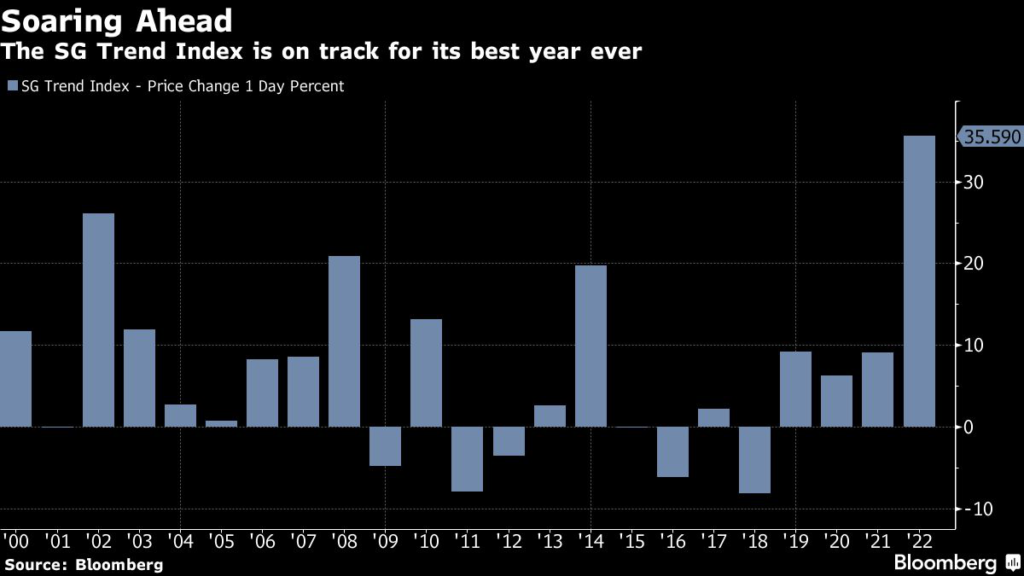
Systematic trend-following quants won a big following after gliding through the 2008 global financial crisis with double digit gains. They are now bouncing back from years of mediocre gains amid muted volatility caused by quantitative easing. That’s now reversing.

The SG Trend Index, which measures returns of some of the largest quant funds in the world run by investment firms such as Winton, Systematica Investments and AQR Capital Management, rose almost 36% through September, putting it on course for its best year ever.

Traders are betting on the pace and extent of rate hikes, leading to a more persistent sell off in stocks and rise in bond yields. The quant funds are riding that trend to provide investors with a cushion against sharp losses elsewhere.

UK Chancellor of the Exchequer Kwasi Kwarteng announced tax cuts in a mini budget which sparked a dramatic plunge in pound and sharp rise in bond yields, sending shockwaves across global markets. That provided further trading opportunities for the algorithms who are designed to quickly pick such momentum trades.

Most of the gains at Aspect’s flagship fund last week were because of bonds and currencies trades, the $10.6 billion firm said in a letter seen by Bloomberg.

“Given the widespread tightening of economic conditions with so many significant rate hikes during the month, the portfolio was able to benefit from short, fixed income exposures across the entire US Treasuries curve, across UK fixed income, as well as across German, Canadian and Korean bonds,” Razvan Remsing, Aspect’s director of investment solutions, said.

At the Tulip Trend fund, returns rose 11% in September as the strategy benefitted from short bets on U.S. bonds, gilts and the pound, according to its investor letter. The Lynx fund gained 9.3% during the month, putting it on track to match or exceed its record gain of 38% in 2008.

More Tightening 

With inflation rising, traders are betting that central banks will have to continue tightening rates and removing liquidity. Greenig of Florin Court said the main question is whether the macro environment has settled, or remains unstable.

“I see instability – inflation, tightening, high levels of debt, de-globalization, de-carbonization, geo-politics, and broken, polarized politics in the West,” he said. “Central banks moreover are cornered by simultaneous inflation and economic weakness.”

More stories like this are available on bloomberg.com

©2022 Bloomberg L.P.

SpaceX Rocket Set to Liftoff with Crew of Four, Including Russian Cosmonaut

(Bloomberg) — SpaceX is set to launch a crew of four astronauts for NASA to the International Space Station, including a Russian cosmonaut and the first Native American woman to travel to space. 

The blast-off is targeted for noon local time Wednesday from Kennedy Space Center in Florida, and follows a series of delays that have pushed back the launch by several weeks. The astronauts will travel on SpaceX’s Crew Dragon — the sixth time NASA has relied on Elon Musk’s company to transport NASA personnel and international partners to the space station since Dragon’s inaugural crewed mission in May of 2020.

The multinational crew’s arrival at the station will begin a six-month-long stay in orbit. They include two NASA astronauts: Josh Cassada and Nicole Mann, a member of one of the Round Valley Indian Tribes in California. Joining the Americans will be Japanese astronaut Koichi Wakata, and Anna Kikina from Russia.

Kikina’s presence marks the first time a Russian cosmonaut will ride aboard a Dragon spacecraft. Since SpaceX began launching crews to the ISS, NASA and Russia’s state space corporation Roscosmos have been working together on a crew-swap agreement. That has continued even as relations have deteriorated in the wake of Russia’s invasion of Ukraine. 

In July, NASA decried the actions of three Russian cosmonauts aboard the ISS, who posed for pictures with flags considered to be anti-Ukraine propaganda. But the two sides have pushed forward and on September 21, NASA astronaut Frank Rubio traveled to the ISS on a Russian Soyuz, along with two cosmonauts.

Adding drama to the timing of the launch are SpaceX Chief Executive Officer Musk’s tweets on Oct. 3 seeking a negotiated settlement between Ukraine and Russia. The unsolicited tweet outraged diplomats in Ukraine but isn’t expected to impact the launch or mission. 

Read More: Musk Sets Off Uproar in Ukraine by Tweeting His ‘Peace’ Plan 

The upcoming flight, called Crew-5, is the latest under a contract with NASA as part of the agency’s Commercial Crew Program. NASA has tapped SpaceX to fly up to 14 crewed missions to the ISS in a deal worth about $4.9 billion.

NASA’s second Commercial Crew provider, Boeing Co., has yet to fly people to space on its spacecraft, the CST-100 Starliner. Boeing is targeting February 2023 for its first crewed test flight to the ISS.

Crew-5 has taken longer than anticipated to get off the ground. In July, NASA pushed back the flight from early September to give SpaceX more time to repair hardware on the company’s Falcon 9 rocket for the mission. This particular rocket, which hasn’t been flown before, was damaged during transport when it collided with a bridge. 

The flight was delayed again last week as NASA’s Kennedy Space Center braced for Hurricane Ian. Hurricane Ian also forced NASA to rollback its massive Space Launch System moon rocket to its hangar, further slowing that rocket’s debut flight, a project unrelated to Wednesday’s ISS mission.

Once Crew-5 launches from Florida and reaches orbit, the Dragon plans to dock with the ISS on Thursday at 4:57 p.m. East Coast time. Astronauts now living on board the ISS, including those who launched to the station in April, intend to greet the new arrivals when the capsule’s hatch opens about one hour and 45 minutes later. 

The Crew-4 astronauts are slated to return back to Earth later this month in their own Dragon capsule which has been attached to the space station since their arrival.

More stories like this are available on bloomberg.com

©2022 Bloomberg L.P.
Blackstone in Talks to Buy Emerson Electric Assets

(Bloomberg) — Emerson Electric Co. is in talks with Blackstone Inc. to sell at least part of its commercial and residential solutions business, according to people familiar with the matter. 

A deal could be valued at between $5 billion to $10 billion, depending on how much of the portfolio changes hands, said the people, who asked to not be identified because the talks are private. No final decision has been made and discussions could fall through. 

If the transaction is agreed, it would mark a sizable private equity deal in an increasingly difficult environment. Tightening credit markets and slowing economic growth are keeping many buyout firms on the sidelines. 

Emerson shares rose as much as 2.9% in pre-market trading. The stock is down about 16% this year, valuing the St. Louis-based company at $46 billion.

“We think potential simplification of the Emerson portfolio at a reasonable valuation that supports evolution toward a higher underlying growth rate could be relatively well received by investors,” Citigroup Inc. analysts led by Andrew Kaplowitz said in a research note. “We do see potential for good value realization depending on what assets are included and where in the reported range a transaction is agreed upon (if a deal comes to fruition).” 

Representatives for Blackstone and Emerson declined to comment. 

The talks come following a pandemic boom in the US housing market, which saw home prices and home-improvement activity soar. The market has begun cooling in recent months amid rising interest rates and recession fears. 

Emerson has been reshuffling its business mix through divestitures after merging its industrial software business earlier this year with Aspen Technology Inc. In August, it agreed to sell its garbage-disposal arm to Whirlpool Corp. for $3 billion. 

The commercial and residential solutions division provides a range of products for making homes more comfortable and energy efficient, from thermostats and hot-water dispensers to heating, ventilation, and air-conditioning monitors, according to the company’s website.

It had $6.7 billion in sales in 2021, an increase of 18% from the year earlier, according to Emerson’s annual report. 

(Updates with share price in fourth paragraph, analyst quote in fifth)

More stories like this are available on bloomberg.com

©2022 Bloomberg L.P.
Lawyers Lose Out on Millions in Twitter-Musk Legal Fees

(Bloomberg) — Not everyone’s a winner in Elon Musk’s decision to go through with the Twitter Inc. deal.

Consider the dozens of lawyers who were preparing to spar at a trial over whether the world’s richest person could walk away from the buyout — and stood to earn millions of dollars doing it.

More than 70 lawyers were admitted to Delaware Chancery Court to represent various parties in the case — about 30 for Twitter, most of them from Wachtell Lipton Rosen & Katz, the most profitable firm in the country, and about 20 for Musk from firms including Quinn Emanuel Urquhart & Sullivan LLP and Skadden Arps Slate Meagher & Flom LLP.

“With all the lawyers in the case and the potential for other litigation to spin out of this, such as investor suits, I could see the total legal fees reaching $1 billion,” said John Coffee, a Columbia University law professor who teaches about M&A disputes. A few other cases have reached or exceeded the billion-dollar mark in fees, Coffee said in an interview before Musk revived his bid to buy Twitter, so the amount wouldn’t be historic, but still significant.

Even without a trial, lawyers have already racked up fees sending out dozens of subpoenas to witnesses that might have been called to the stand by one side or the other. 

All the Banks, Billionaires and VCs Sucked Into Twitter v. Musk

“They ought to give Elon Musk some kind of award for being the man who has done the most recently to ensure the economic health of the legal profession,” Coffee said.

Since Musk is involved in a myriad of businesses, he’s created some conflict-of-interest problems among lawyers over the years.

In the Twitter fight, both Musk’s main Delaware lawyers from Skadden Arps and Twitter’s lead firm, Wachtell, had to hire so-called conflict counsel to put out subpoenas to parties they’d represented in the past, according to court filings. For the Musk side, conflict counsel was the law firm of Chipman Brown Cicero & Cole LLP. For Twitter it was the Delaware office of Ballard Spahr LLP and the local law firm of Kobre & Kim LLP.

The massive amount of pre-trial fact-finding disputes in a case like the Musk-Twitter showdown keeps the law firms’ cash registers ringing, said Chuck Durante, a partner in Wilmington’s Connolly Gallagher LLP and the current head of the Delaware State Bar Association.

“It’s pretty difficult to quantify how much in legal fees each side will be spending, but it’s safe to say it’s going to be a good year for all the law firms involved in the case,” Durante said in an interview.

In a trial, legal fees for both sides could have reached the low-to-mid eight figures, as associates can work 14 to 16 hours a day on such cases, Peter Ladig, a Delaware lawyer who mostly handles Chancery Court cases, said in July. 

Wachtell’s partners in a 2019 bankruptcy case billed $1,100 to $1,500 an hour, while its associates charged $650 to $900. Those figures have likely grown in more recent years, but law firms don’t regularly report hourly prices.

William G. Ross, a law professor at Samford University in Alabama who specializes in legal fees, said it’s not uncommon in high-powered, winner-take-all corporate legal battles for lawyers to charges as much as $1,700 per hour.

“That’s a lot of money for one hour of a lawyer’s time, but some lawyers’ time is worth it,” he said.

A recent bill for services that got some public notice is former US Solicitor General Neal Katyal’s nearly $2,500-per-hour fee for representing Johnson & Johnson in an appellate argument over the controversial Chapter 11 filing of one of its units to corral it talc-cancer liability.

The case is Twitter v. Musk, 22-0613, Delaware Chancery Court (Wilmington).

More stories like this are available on bloomberg.com

©2022 Bloomberg L.P.

KKR Backs Cybersecurity Firm NetSPI With $410 Million Funding

(Bloomberg) — KKR & Co. has agreed to provide cybersecurity firm NetSPI Inc. with an additional $410 million in growth equity, according to a statement reviewed by Bloomberg.

The deal, slated to close by the end of the fourth quarter, is KKR’s second investment in the company, bringing the private equity firm’s total commitment to $500 million. KKR led a $90 million investment last year.

As part of the deal, existing investor Sunstone Partners will exit its position, according to NetSPI Chief Executive Officer Aaron Shilts.

“We’re now just focused on this next phase of growth that’s gonna require investment, focus and we’ve got some exciting plans for the next three-four years,” Shilts said in an interview. “We have really enjoyed the last 18 months of our relationship with KKR. I think we’ve had some really good, just strategic discussions on how to approach the market.”

Founded in 2001, NetSPI is a provider of penetration-testing and attack-management services for clients including Microsoft Corp. and the US Air Force, according to its website. That means its products simulate cyber attacks, which helps businesses and organizations prepare for real threats. 

Shilts said NetSPI is approaching $100 million in revenue this year following good growth since a “breakout” 2020. The company has operations in the US, Canada, UK and India.

Cybersecurity remains a coveted sector for KKR’s technology-growth team. It’s a market that the private equity firm has been tracking “well before” investing in NetSPI, according to KKR Director Ben Pederson.

“If you step back in terms of what we’re looking for broadly in this time of uncertainty, it’s companies that are going make it through the next five plus years regardless of what’s happening in the short term here on the macro side,” Pederson said. 

More stories like this are available on bloomberg.com

©2022 Bloomberg L.P.

Bouygues Weighs €1 Billion Sale of Equans Assets

(Bloomberg) — Bouygues SA is considering selling parts of Equans, the services business it’s just bought from Engie SA, people familiar with the matter said. 

The French conglomerate is working with advisers to discuss the sale of Equans’ district heating and electric car charging networks in the UK and Netherlands, according to the people. The assets could have a combined value of as much as €1 billion ($992 million), the people said.

Bouygues this week completed its roughly €6.5 billion-euro purchase of Equans, which installs and maintains electric systems such as air conditioning and telecommunications equipment, in what was its biggest ever acquisition. Engie sold the business to focus on renewables and large energy infrastructure.

Bouygues is looking to offload the district heating and electric car charging networks as they are more capital intensive than other parts of Equans, according to one of the people. The assets may attract infrastructure funds and strategic buyers, the people said, asking not to be identified discussing confidential information.

Deliberations are ongoing and no final decisions on the timing of any sales have been taken by Bouygues. A representative for Bouygues declined to comment.

The Equans acquisition will allow Bouygues, a construction, telecommunications and media conglomerate, to reinforce its own underperforming energy and services unit. The takeover is expected to be “significantly accretive” to the company’s earnings per share in year one, Bouygues said when the deal was announced.

More stories like this are available on bloomberg.com

©2022 Bloomberg L.P.

Close Bitnami banner
Bitnami