Bloomberg

Google to Build South African Cloud in $1 Billion Africa Plan

(Bloomberg) — Google said it will set up an African cloud service, as part of its $1 billion investment plan for the continent, that will allow users to store their data in-country. 

The cloud infrastructure will be based in South Africa, but will give users the options on where to store their data, said Niral Patel, the director of Google Cloud Africa. 

“We are giving customers and partners choice, they then have the choice where they would like to store data and where they would like to consumer cloud services from,” Patel said on a video call on Wednesday. 

African countries have a patchwork of laws on data sovereignty, with some requiring companies to store data within their borders, increasing demand for a more flexible regional cloud service. In Nigeria, phone companies are prohibited from sending government or customer information outside of the country, part of a push to encourage the development of local companies to store and manage the data.

The Alphabet Inc. unit will compete with Microsoft Corp. and Amazon Web Services in Africa’s most developed economy. Google estimates that the South Africa cloud region could contribute more than $2.1 billion to the country’s economy, and support the creation of more than 40,000 jobs by 2030, Patel said. 

Google also said it’s building out its African subsea cable and cloud interconnect sites in four cities including Cape Town, Johannesburg, Lagos and Nairobi to provide full cloud capability for the continent. 

More stories like this are available on bloomberg.com

©2022 Bloomberg L.P.

Republican Attacks on ESG May Be Overlooking US Workers

(Bloomberg) —  

With ESG increasingly in the crosshairs of Republican politicians—be it over the strategy’s efforts to address climate change or the lack of diversity in C-suites—one beneficiary of sustainable investing that the attacks seem to have overlooked is the American worker.

The “S” in ESG includes worker issues ranging from compensation to health and safety. While global warming often takes center stage when it comes to environmental, social and governance investing, the majority of Americans say paying workers a fair, living wage should be the top focus of the biggest US companies, according to a recent survey by JUST Capital, a nonprofit research group.Job creation, worker health, safety and training ranked among the top six priorities out of 20 stakeholder issues. Addressing human rights in supply chains was ninth, while combating global warming ranked 13th in the annual survey.

“The divisiveness of political messages, both on the left and right, is out of touch with what Americans really want,” said Martin Whittaker, chief executive of JUST Capital. “Workers are an issue where people across political divides are united.”

Republican governors including Florida’s Ron DeSantis have targeted ESG, describing the investing approach as “ideological.” More than a dozen Democratic-controlled states have hit back, saying it’s the ESG attacks that are politically motivated, adding that the GOP campaign will ultimately end up costing taxpayers.

“The blacklisting states apparently believe, despite ample evidence and scientific consensus to the contrary, that poor working conditions, unfair compensation, discrimination and harassment, and even poor governance practices don’t represent material threats to the companies in which they invest,” according to the nonprofit For the Long Term, which works with state treasurers and comptrollers.

There are signs investment firms are taking notice of worker issues, too:

  • In June, KKR & Co., one of the world’s largest private equity investors, sold a garage-door manufacturer. As part of the deal, roughly 800 employees received an average cash payout of $175,000.
  • Trillium Asset Management and New York City pension funds started pressing Starbucks Corp. and Apple Inc. last month to allow for an independent review of the companies’ labor practices.
  • The impact investing unit of money manager Two Sigma has invested in companies like Penn Foster Inc., which provide workers with computer skills and other specialized training.
  • Calvert Research and Management, one of the oldest socially responsible investors, said it has pressured utilities such as Xcel Energy Inc. to accommodate workers who may be adversely impacted by the shift to cleaner fuels.

“Workers affected by decarbonization will need to be retained, retrained, redeployed and/or compensated,” Kimberly Stokes, Calvert’s corporate engagement strategist, said in an April blog post. If societal impacts and the shift to cleaner fuels are instead pitted against each other, it will be difficult to reduce emissions, she said.

Lazard Asset Management said it has worked with a team at the Massachusetts Institute of Technology to create a “Living Wage Calculator” to examine wage issues at a discount retailer. Assessing worker-related issues is relevant to the long-term financial productivity of businesses, said Nikita Singhal, co-head of sustainable investment and ESG at Lazard. 

“This is not about virtue signaling or a political view, but rather an investment hypothesis that businesses that have sound human capital management practices, especially in human capital intensive industries, will outperform their peers all else equal,” she said.

The plight of American workers has become all the more poignant amid surging energy costs, inflation and the possibility of terminations as a potential recession looms. Since Donald Trump won the 2016 presidential election with votes from blue-collar workers, Republicans attacking ESG may wish to take these issues into consideration. JUST Capital’s Whittaker says there’s more to be done. While ESG investors have sought to address workforce issues—especially during the early stages of the pandemic—he advises they should put greater emphasis on that part of their strategy.

“They need to up their game,” he said.

Bloomberg Green publishes Good Business every week, providing unique insights on ESG and climate-conscious investing.

More stories like this are available on bloomberg.com

©2022 Bloomberg L.P.

The Taliban Crushed Afghanistan’s Crypto Market, Study Says

(Bloomberg) — A crackdown by the Taliban has led to a collapse in cryptocurrency use in Afghanistan following a surge last year when the nation was cut off from global banking and international aid, according to a study.

The value of crypto received in the country has fallen to an average of less than $80,000 a month since November, down from a peak of more than $150 million in September last year just after the Taliban swept back to power, according to a report by blockchain research firm Chainalysis.

“The Taliban’s crackdown has had a massive chilling effect on the country’s crypto markets,” according to the report, which added that “crypto dealers are left with three options: flee the country, cease operations, or risk arrest.”

Afghans turned to virtual coins as a lifeline to receive foreign remittances and donations, as well as to shield savings from the Taliban, who were shunned internationally after taking charge in the wake of a chaotic US withdrawal. 

In August, the regime imposed a nationwide ban on crypto, calling it “haram” — or sinful business. The Taliban arrested 13 crypto dealers who defied orders to stop trading digital tokens. They were later released on bail pending trial.

Chainalysis said Afghanistan has dropped to the bottom of its crypto adoption index after placing 20th last year. 

The Middle East and North Africa crypto market overall is relatively small but among the fastest growing, according to the researcher: Users there received $566 billion in crypto from July 2021 to June 2022, up 48% from a year earlier.

More stories like this are available on bloomberg.com

©2022 Bloomberg L.P.

Kenya’s Smooth Political Transition Seen Propeling M&A Deals

(Bloomberg) — The successful completion of Kenya’s presidential election can accelerate the pace of merger and acquisition negotiations that had been put on ice and also unlock new deals.

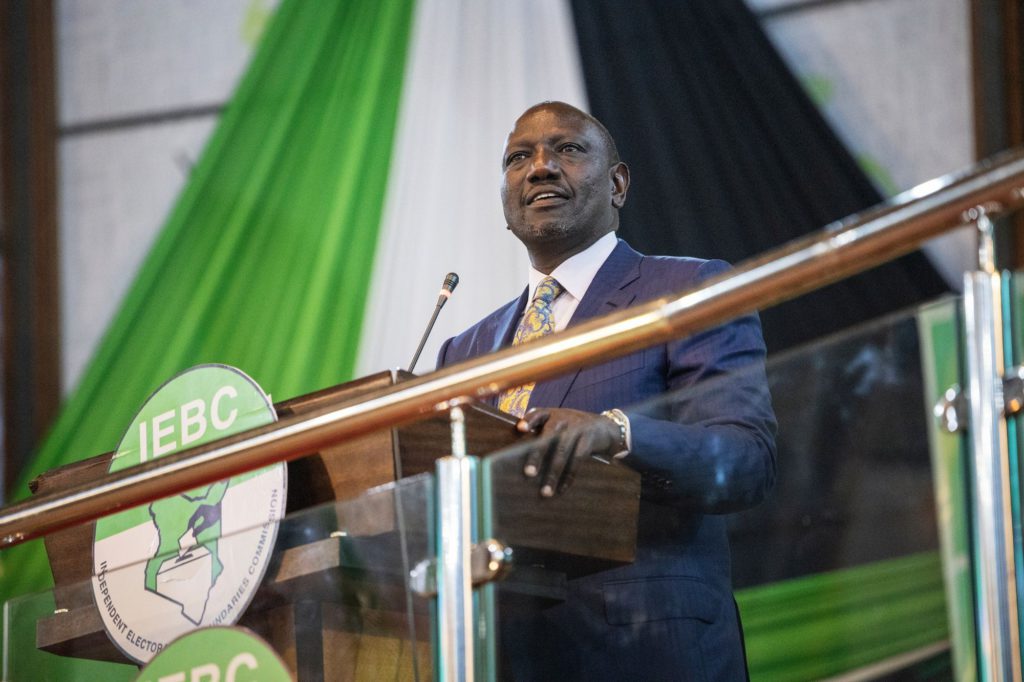
Since being sworn in three weeks ago newly elected President William Ruto has announced steps including the removal of an expensive gasoline subsidy and the lifting of a ban on genetically modified organisms that will allow for imports of enhanced white corn. He also wants to slash about 300 billion shillings ($2.48 billion) from the budget to lower the need for taking on more debt.

Ruto took the reins in East Africa’s biggest economy after a peaceful election, in contrast to some vote cycles that have been marred by violence and protracted court challenges, causing investors to hold off making any decisions on spending until things settled.

“The new government is very keen to fix and strengthen our economy and it seems it is focused on enabling a great economic environment to attract local and foreign investment,” said Paras Shah, managing partner for Kenya at legal firm Bowmans. “At least in the first few weeks, we have seen some hard decisions being made and a lot of strong indications to reform the economy to attract investment.”

Main Targets

Financial technology will continue to take the bulk of investments, driven by mobile-money innovations and good returns, Shah said in an interview. Regulatory requirements for Kenyan insurers to improve solvency ratios will also result in consolidation-driven mergers and acquisitions. 

Read: Funding for African Startups Doubles in First Half of 2022 (1)

“We see an overpopulation of insurance companies in Kenya coupled with strains on capital ratios for the smaller players,” Shah said. “This should be strong reason for consolidation and growth in the sector, perhaps by the larger players acquiring smaller players, or small players merging.” 

Other sectors that will be of interest include agriculture, consumer products and industrials in efforts to ease the local effects from the global supply chain constraints.

Kenya offers decent returns compared to other African countries and a lot of private equity investments made in the past seven to 10 years are ripe for exit, he said.

More stories like this are available on bloomberg.com

©2022 Bloomberg L.P.

Taiwan Pledges to Keep Advanced Chips From Chinese Military

(Bloomberg) — Taiwan pledged to work closely with the US and other allies to prevent China’s military from acquiring state-of-the-art technology, as Washington steps up efforts to contain the world’s No. 2 economy. 

Taiwan, home to the world’s largest semiconductor foundry, will keep its advanced chip development at home, while adopting measures to stop its tech from being used by the People’s Liberation Army, C.C. Chen, deputy minister of economic affairs, said on Wednesday. 

While Taiwan’s economy will not be able to decouple from its biggest trade partner, it will implement “very firm” export controls to keep advanced technologies from China’s military, Chen said. “With respect to national security, we will take measures to safeguard our trade secrets, safeguard our key technologies, safeguard our talents (so that they are) not to be poached illegally.”

Taiwan investigated Alchip Technologies Inc. for allegedly supplying advanced supercomputer chips to China’s Phytium Information Technology Co. — which some analysts have said has links to the Chinese military — and banned chip exports to Phytium, Chen said. “Once we find a loophole, we plug it.” 

Phytium, which is affiliated with research arms of the Chinese military, relied on Alchip for certain designs, the Washington Post reported in April 2021. The Taiwanese company also dealt with TSMC for production on behalf of Phytium, it said. The US eventually blacklisted Phytium, prompting Alchip to declare a suspension of shipments.

Regulators will also fine iPhone maker Foxconn Technology Group for failing to report an acquisition by the company’s Shanghai-listed arm of a stake in China’s top chipmaker, state-backed Tsinghua Unigroup, he said.

Chen’s comments come as the Biden administration prepares new restrictions on chip exports to China. Those will formalize export controls on technology behind advanced semiconductors, while restricting access to chips used in supercomputing and artificial intelligence. 

Read more: US Deals Heavy Blow to China Tech Ambitions With Nvidia Chip Ban

As the US seeks to limit access to cutting-edge technology while boosting its own domestic production capacity, Taiwan and fellow US allies South Korea and Japan have been forced to navigate increasingly incompatible business and security interests. 

Taiwan’s position as a leader in semiconductor production remains vulnerable. Concern is growing in the US over its reliance on chip production in Taiwan, as China ramps up military threats toward the democratic, self-ruled island that Beijing says is part of Chinese territory. With the implementation of the $50 billion Chips Act, the US plans to cut its dependence on Taiwan for semiconductors over the next decade, US Secretary of Commerce Gina Raimondo said last week. 

Taiwan Semiconductor Manufacturing Co., South Korea’s Samsung Electronics Co., and Intel Corp. are all building new fabrication plants in the US, as Washington strives to increase chip production on American soil.  

(Updates with details on Alchip from the fifth paragraph)

More stories like this are available on bloomberg.com

©2022 Bloomberg L.P.

Axiata’s Tower Arm Edotco Weighing $700 Million Financing, Sources Say

(Bloomberg) — Edotco Group Sdn., the wireless tower business of Malaysian telecommunications group Axiata Group Bhd., is considering raising as much as $700 million in loans, according to people familiar with the matter.

The Kuala Lumpur-based company is asking banks to submit proposals for the financing, the people said, asking not to be identified because the matter is private. Funds from the loans could be used for capital expenditures and overseas expansion, one of the people said.

Should the financing go ahead, the company is unlikely to move forward with a plan to raise as much as $600 million from a share sale, one of the people said. Edotco was working with an adviser on a potential equity offering, Bloomberg News reported last month. 

Discussions are preliminary and the company could still decide against taking out the loans, the people said. Representatives for Axiata and Edotco declined to comment.

Founded in 2012, Edotco has a portfolio of over 54,000 towers across nine Asian nations including Malaysia, Thailand, Pakistan and Myanmar, according to a recent press release. Axiata is the controlling shareholder of Edotco, while other minority holders include Malaysia sovereign wealth fund Khazanah Nasional Bhd. and Innovation Network Corp. of Japan.

The company’s services include tower leasing, colocation, operations and maintenance. In April it acquired almost 3,000 towers in the Philippines from PLDT Inc. 

More stories like this are available on bloomberg.com

©2022 Bloomberg L.P.

EU Backs Russia Sanctions Package Including Oil Price Cap

(Bloomberg) — The European Union backed a new package of sanctions against Russia that includes support for a price cap on oil sales to third countries.

The agreement includes measures to mitigate the impact the sanctions will have on countries with large shipping industries, such as Greece, Cyprus and Malta, according to people familiar with the matter who asked not to be identified because the discussions were private.

“We have approved a new package of sanctions,” Andrzej Sados, the Polish ambassador to the EU, told reporters. “It includes a price cap on Russian oil shipped to third countries and mechanisms to avoid circumvention of sanctions.”

The sanctions, which are due to come into force Thursday, would prohibit maritime transport of Russian oil to third countries above an oil price cap, the Czech presidency of the EU said in a tweet. The measure would extend an import ban on goods including steel products, and ban providing IT, engineering and legal services to Russian entities, it said.

The package would add a ban on shipping Russian oil to existing restrictions on services needed to transport it, but carve out an exemption for oil priced at or under a level set by a coalition of the Group of Seven and other countries, according to a draft of the proposal seen by Bloomberg.

OPEC+ Considers Big Production Cut in Move Set to Irk US

The broader sanctions package would target a range of individuals and entities, including senior Russian ministry officials and people involved in staging the recent, widely condemned referendums. It would also restrict access to aviation items, electronic components and specific chemical substances to deprive Russia’s military from important technologies. 

The US has been pushing hard to free up Russian crude exports for months, fearful that the EU’s current sanctions would hit oil supply too hard. 

Some nations were upset that the latest draft of the sanctions appears to have weakened several of the proposed measures, including the removal of a Russian diamond mining company from the penalty list.

“The process was difficult and we had to agree some exemptions, including on those already infamous red diamonds,” Sados said.

To allow for an oil price cap, the bloc will have to change its current legislation. In June, EU nations agreed to a full ban on insurance and financial services for seaborne oil, while shipping was spared from the restrictions. Most of those prohibitions are due to kick in Dec. 5 alongside a ban on EU purchases of Russian crude.

Effectively an industry standard passport to trade, European insurance for tanker shipments protects against risks including oil spills and is heavily reliant on European companies.

The G-7, which endorsed a cap earlier this month, has said it wants an agreement in place before Dec. 5.


(Updates with ambassador remarks, details from third paragraph)

More stories like this are available on bloomberg.com

©2022 Bloomberg L.P.

‘Flow’ is the New ‘We’ for Adam Neumann

  • Listen to Bloomberg Crypto on the iHeartRadio App
  • Listen to Bloomberg Crypto on Apple Podcasts
  • Listen to Bloomberg Crypto on Spotify  

(Bloomberg) — Do you remember Adam Neumann? The WeWork co-founder and former CEO who stepped down in 2019 in a cloud of accusations about eccentric behavior, sky-high expenses, and general extravagance? The one with an Apple TV miniseries about his rise and fall starring Jared Leto?

Well, Adam Neumann is back. Now, with bonus crypto, and an exceptionally large $350 million dollar check from the venture capitalists over at Andresseen Horowitz. 

To discuss these projects (and why the word ‘Flow’ is the new ‘We’)  Bloomberg reporter Hannah Miller joins this episode.

Follow us on Twitter @crypto, and subscribe to the Bloomberg Crypto Newsletter at https://bloom.bg/cryptonewsletter


More stories like this are available on bloomberg.com

©2022 Bloomberg L.P.

Musk Revives $44 Billion Twitter Bid, Aiming to Avoid Trial

(Bloomberg) — Elon Musk revived a bid to buy Twitter Inc. at the original price of $54.20 a share, backtracking on his effort to quit the deal and potentially avoiding a contentious courtroom fight.

Musk made the proposal in a letter to Twitter on Monday, according to a filing with the Securities and Exchange Commission that confirmed a Bloomberg report. San Francisco-based Twitter said it received the letter and intends to close the deal at the agreed-upon price, without commenting specifically on how it will respond to Musk.

For Twitter, proceeding with Musk’s plan augurs a future under a mercurial billionaire who has spent months publicly criticizing its management, questioning its value and changing his mind. It also means that his contested claims — that Twitter was lying about which percentage of users were bots, for instance — are not likely to be scrutinized in a court of law.

Twitter shares fell 0.6% in premarket trading after closing 22% higher at $52 in New York on Tuesday.

Read More: Twitter Dips Further Below Musk Offer; Analysts See Deal Closing

Musk had been trying for months to end his contract to acquire Twitter, signed in April. The billionaire began showing signs of buyer’s remorse shortly after the deal was announced, alleging that Twitter had misled him about the size of its user base and the prevalence of automated accounts known as bots.

Musk formally quit the accord in July and Twitter sued him in Delaware Chancery Court to force him to go forward with the purchase. A trial had been scheduled to begin Oct. 17. The judge in Delaware on Tuesday asked both sides to come back to her with a proposal on how the case can now proceed. The options include having Twitter seek to dismiss the case or have her continue to retain jurisdiction until the deal closes, said a person familiar with the matter.

In the letter, Musk’s attorneys wrote that he and his supporters “intend to proceed to closing of the transaction contemplated by the April 25, 2022, merger agreement, on the terms and subject to the conditions set forth therein.” The plan is also contingent on him lining up the necessary debt financing and the court issuing “an immediate stay of the action.” It’s a tough time for banks to sell debt. With yields at multiyear highs, banks led by Morgan Stanley could be on the hook for hundreds of millions of dollars of losses on the unsecured portion alone, should they attempt to unload it to investors.

Musk later tweeted that “buying Twitter is an accelerant to creating X, the everything app.” Musk has said he wants Twitter to be more like TikTok and WeChat, with many more highly engaged users.

In the run-up to the planned Delaware proceedings, lawyers for both sides have fired cannonades of subpoenas at each other aimed at teasing out testimony and evidence. Musk’s side needed to demonstrate that Twitter violated the terms of the deal. Twitter alleged that Musk used the bots issue as a pretext for backing out a deal he no longer found economically sound.

Musk’s legal team was getting the sense that the case was not going well, as Judge Kathaleen St. J. McCormick sided repeatedly with Twitter in pretrial rulings, according to one person familiar. Even with the late emergence of a Twitter whistle-blower who alleged executives weren’t forthcoming on security and bot issues, there were concerns Musk’s side would not be able to prove a material adverse effect, the legal standard required to exit the contract.

Inside Twitter on Tuesday, many employees were sitting through 2023 planning presentations when the news first started to circulate, according to multiple sources. Presenters did not acknowledge the news, which staffers saw spreading on their own social network. Many employees have opposed the idea of working for Musk, who has been openly mocked and criticized on internal Slack channels since the deal was signed.

In an internal memo Tuesday to Twitter staff, viewed by Bloomberg News, General Counsel Sean Edgett thanked workers for their patience as the company works through the legal issues. “I will continue to keep you posted on significant updates,” he wrote. Trading of Twitter shares was halted after the news broke and didn’t resume until after the company confirmed receipt of Musk’s letter.

Twitter shareholders voted Sept. 13 to accept the buyout offer as Musk submitted it. The company said at the time that 98.6% of the votes cast were in favor of the deal. Musk, Twitter’s largest shareholder, didn’t vote at all, according to two people familiar with his decision. Musk owned almost 10% of Twitter — more than 73 million shares — when he agreed to acquire the company.

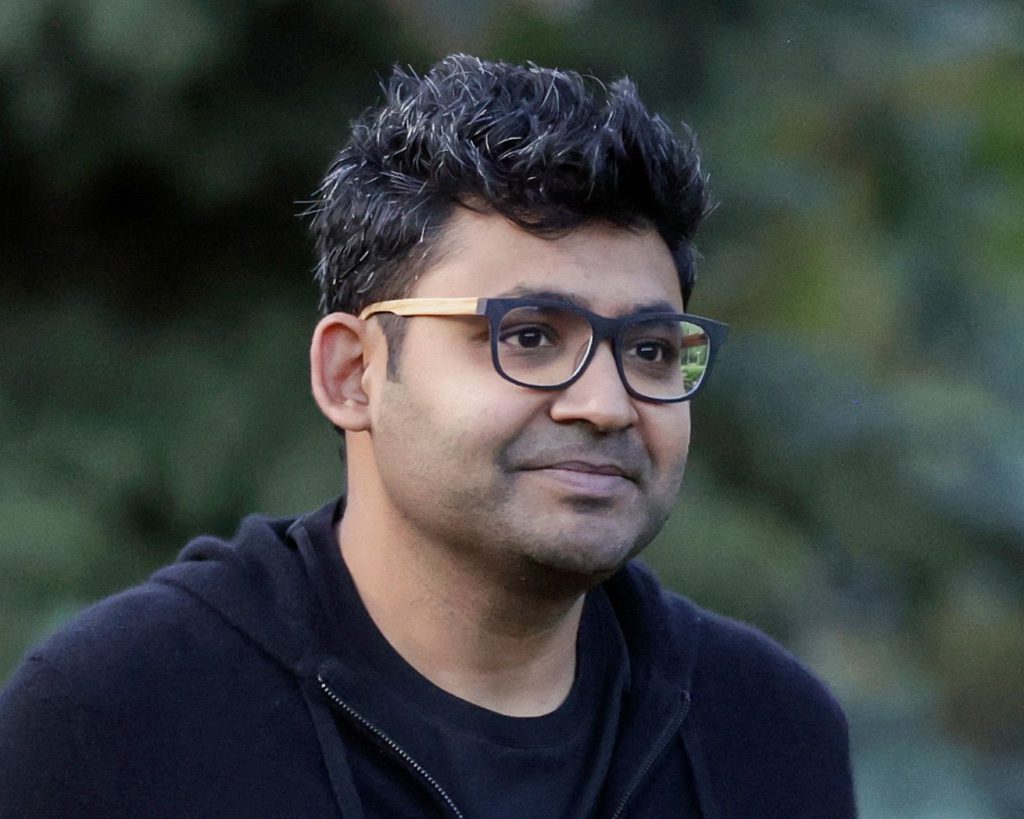
Musk was scheduled to answer questions about the deal in Austin, Texas, on Oct. 6-7, according to a court filing Tuesday. Twitter Chief Executive Officer Parag Agrawal was scheduled to sit down for his deposition Monday.  

The case is Twitter v. Musk, 22-0613, Delaware Chancery Court (Wilmington).

(Updates with share reaction in fourth paragraph)

More stories like this are available on bloomberg.com

©2022 Bloomberg L.P.

Morgan Stanley Says Bottom Near for Emerging-Market Equities

(Bloomberg) — Having endured a long stretch of losses, stocks in emerging markets and Asia excluding Japan are close to completing their bear-market cycles, according to Morgan Stanley.

It’s highly likely these markets are bottoming amid “abundant” signs of extreme selling, the investment bank’s strategists including Jonathan Garner wrote in note Tuesday. They upgraded emerging-market and Asia ex-Japan stocks to overweight from equal-weight.

The reassessment from Garner and team, which correctly predicted deepening routs in emerging and China markets earlier this year, follows the longest ever peak-to-trough run for the MSCI Emerging Markets Index as a surging dollar and China’s stringent Covid restrictions took a toll.

Morgan Stanley expects the MSCI EM benchmark, which has slumped for five straight quarters and lost 26% this year, to rally about 12% from Tuesday’s close till June.

“A lot of wood has been chopped” and “it’s time to plant saplings for next cycle,” Garner and his colleagues wrote. Investors should “rotate towards proven early-cycle beneficiaries,” they added, also upgrading Korea, Taiwan equities as well as Asia’s semiconductor and tech hardware sectors to overweight. 

The MSCI EM index is poised for its fourth annual underperformance versus a gauge of developed market equities. China takes a bulk of the blame for the historic downturn in EM shares, with the nation’s Covid-Zero policy, property crisis and tensions with the West rendering its markets one of the world’s worst performers.

Those issues will keep China from outperforming over the next 12 months even as it is likely to participate in an EM rebound due to its oversold state and low valuations, Morgan Stanley said.

To be sure, Chinese stocks listed in Hong Kong were Asia’s best performers on Wednesday as trading in the financial hub resumed after a holiday. The benchmark Hang Seng Index jumped more than 6%, playing catch up to a global rally that came after weak US economic data spurred bets that the Federal Reserve won’t be too aggressive in raising rates.

READ: China’s $5 Trillion Rout Creates Historic Gap With Indian Stocks

Meanwhile, Garner’s US colleague Michael J. Wilson — one of Wall Street’s biggest equity bears — still sees further downside in US equities. He has however predicted an eventual low for the S&P 500 coming later this year, or early next, at the 3,000 to 3,400 point level.

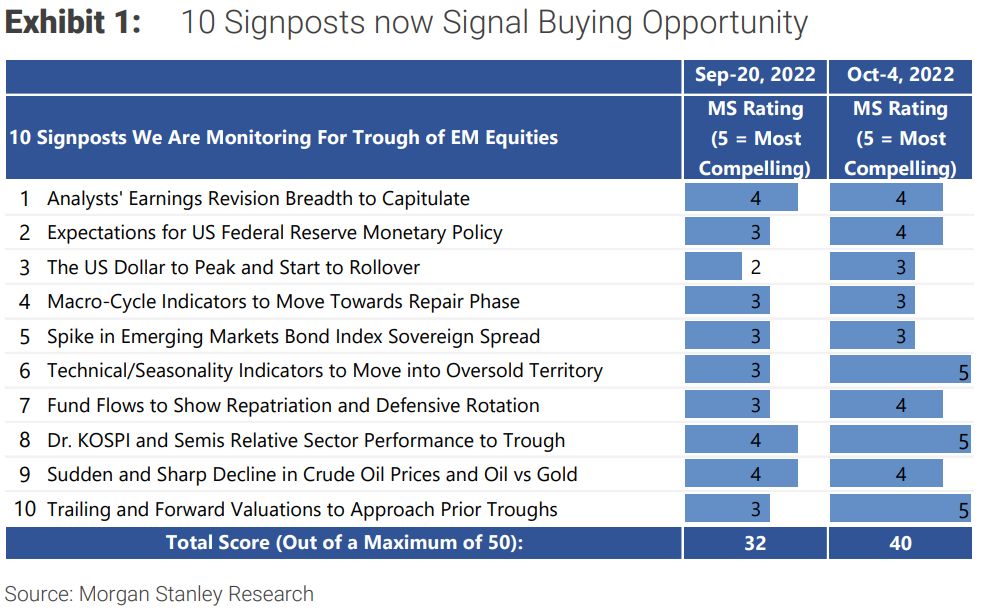
A framework of 10 signposts that Morgan Stanley uses to identify market inflection points now indicates a high probability for a trough to form for EM and Asian stocks, signaling a “compelling” buying opportunity, according to the note.

South Korea and Taiwan are the “highest conviction opportunities into a new cycle” as both markets have substantially underperformed this year and a turning point in the semiconductor inventory cycle is near, Garner’s team wrote.

In separate reports, the US investment bank also upgraded stocks including Korean chipmaker SK Hynix Inc., Apple Inc. supplier LG Display Co. and its Taiwanese rival AUO Corp. Taiwan Semiconductor Manufacturing Co. is among its top picks. Asian chip stocks rallied on Wednesday.

Morgan Stanley lowered its views on some of this year’s outperformers, downgrading India and Malaysia to underweight and moving Indonesia, Singapore and Chile to equal-weight. The bank also raised Mexico to neutral.

(Adds more context, market performance and more rating changes.)

More stories like this are available on bloomberg.com

©2022 Bloomberg L.P.
Close Bitnami banner
Bitnami