Bloomberg

Morgan Stanley Says Bottom Is Near for Emerging Market Stocks

(Bloomberg) — After a long stretch of steep losses, emerging and Asian stocks are close to completing their current bear-market cycle, Morgan Stanley said.

It’s highly likely these markets are bottoming amid “abundant” signs of capitulation, the investment bank’s strategists including Jonathan Garner wrote in note Tuesday, adding that they are shifting recommendations on emerging-market and Asia excluding Japan stocks to overweight from equal weight.

The reassessment from Garner, who correctly predicted deepening routs in emerging and China markets earlier this year, came just as EM stocks have had a longest losing run from its recent peak in February last year amid a surging dollar and China’s stringent Covid restrictions. The broker expects the MSCI EM benchmark, which has fallen 26% this year, to rally about 12% from now till June. 

“A lot of wood has been chopped” and “it’s time to plant saplings for next cycle,” Garner and his colleagues wrote. Investors should “rotate towards proven early-cycle beneficiaries,” they added, also upgrading Korea, Taiwan, the semiconductor and tech hardware sectors to overweight. 

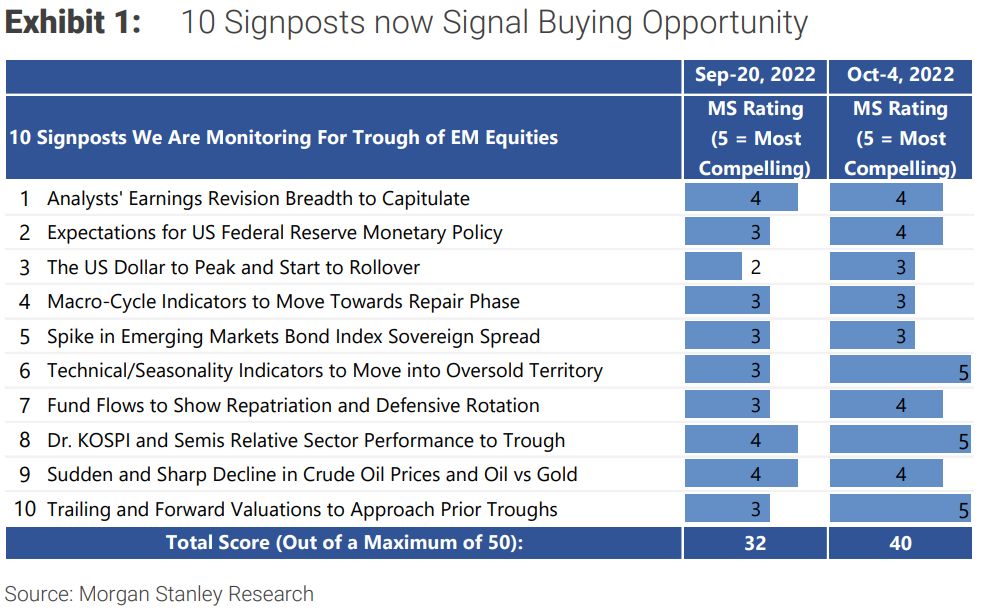
A framework of 10 signposts that Morgan Stanley uses to identify market inflection points now indicates a high probability for a trough to form for EM and Asian stocks, signaling a “compelling” buying opportunity, according to the note.  

Morgan Stanley said South Korea and Taiwan are “highest conviction opportunities into a new cycle” as both markets have substantially underperformed this year and a turning point in the semiconductor inventory cycle is near. 

In seperate reports, the investment bank also upgraded stocks including Korean chipmaker SK Hynix Inc., Apple Inc. supplier LG Display Co. and its Taiwanese rival AUO Corp. Taiwan Semiconductor Manufacturing Co. is among its top picks. Asia chip stocks rallied on Wednesday.

Meanwhile, Morgan Stanley lowered its views on some of this year’s outperformers, downgrading India to underweight and moving Indonesia and Singapore to equal weight.

More stories like this are available on bloomberg.com

©2022 Bloomberg L.P.

India Mars Orbiter Dies After 6-Month Mission Lasts Eight Years

(Bloomberg) — India’s mission to Mars — an orbiter studying the surface and atmosphere — finally ran out of fuel after spending eight years in the outer world, according to the nation’s space agency.

The device, launched in 2013, was expected to last just six months — demonstrating India’s technological prowess on a frugal budget, the Indian Space Research Organization said in a statement Monday. A long eclipse led to the orbiter losing contact with the ground station in April. It ran out of fuel and couldn’t achieve the necessary altitude to generate power, the agency said, declaring the spacecraft “non-recoverable.”

The orbiter, called Mangalyaan in Sanskrit, made India only the fourth nation to reach the distant planet. It garnered global attention primarily for its shoestring budget — the probe cost about $74 million, just 11% of the price tag for NASA’s Maven probe, and tens of millions less than the $108 million 20th Century Fox spent making The Martian.

Mangalyaan’s objectives included looking for methane and carbon dioxide in Mars’s atmosphere to determine whether life ever existed on the Red planet. The mission studied the composition of several gases and quantified the altitude at which a carbon dioxide-rich atmosphere turns into an atomic Oxygen-rich one during the local evening, according to the statement. 

Social media was abuzz with admiration for Indian scientists at ISRO, who have made a name for themselves by delivering a string of successful space projects despite working with a fraction of the budget of the US, China or Europe. Thrift has been the hallmark of India’s space program since the early 1960s, when rocket sections were transported by bicycle and assembled by hand inside St. Mary Magdalene Church in Thumba, a fishing village near the tip of the Indian peninsula.

The Mars mission “will be ever-regarded as a remarkable technological and scientific feat in the history of planetary exploration,” ISRO said. 

More stories like this are available on bloomberg.com

©2022 Bloomberg L.P.

Apollo-Backed EmployBridge to Acquire Bluecrew From IAC

(Bloomberg) — IAC Inc. has agreed to sell its app-based Bluecrew business to EmployBridge, an industrial-staffing company backed by Apollo Global Management Inc. 

IAC will keep a minority stake in the combined company, which will generate more than $4 billion in pro-forma revenue, according to a statement Tuesday reviewed by Bloomberg. 

Financial terms of the transaction weren’t disclosed.

Bluecrew uses analytics to help companies with their variable staffing needs, utilizing its more than 100,000 ready-to-work crew members, according to its website. BlueCrew Chief Executive Officer Stephen Avalone will join EmployBridge as chief platform officer after the deal closes. 

Bluecrew and Employbridge are complementary, Billy Milam, chief executive officer at EmployBridge, said in an interview. Bluecrew is app-based while EmployBridge has branches nationwide. So the deal will help EmployBridge build upon the stickiness of its business clients, Milam said. 

“It’s an instant connection to client opportunities for the Bluecrew mobile platform,” Milam said. 

Founded in 1985, EmployBridge is a provider of career and workforce services based in Atlanta. The business has about 400 locations and operates across 48 states. It was acquired in 2021 by Apollo.

The deal came together from bilateral talks between Bluecrew and EmployBridge, according to Robert Kalsow-Ramos, an Apollo partner.  

“I’d say this is a unique transaction in that it was a cash and stock sort of merger and acquisition of Bluecrew and required no external financing,” Kalsow-Ramos said. “So we were really — despite the market volatility and in light of the creative structure of the transaction — able to put together this transformative deal in sort of a really unique way.”

The deal is slated to close in the fourth quarter. 

“EmployBridge is the right owner to unlock Bluecrew’s potential, and as a minority shareholder we look forward to seeing how far they go,” a representative for IAC said in a statement. 

Royal Bank of Canada, Evercore Inc., Houlihan Lokey Inc. and Paul Weiss Rifkind Wharton & Garrison advised EmployBridge on the deal while IAC was represented by Morrison Cohen.

(Updates Apollo partner’s quote in ninth paragraph.)

More stories like this are available on bloomberg.com

©2022 Bloomberg L.P.

Asian Stocks Extend Gains After US Equities Rally: Markets Wrap

(Bloomberg) — Asian stocks extended a rally on Wednesday following the best two-day run for US equities in more than two years, as investors begin to anticipate a slowing to central bank tightening that could jolt risk assets higher.

Hong Kong stocks jumped after a one-day break and Australian, Japanese and South Korean shares rose as improving risk sentiment drags global equities from oversold levels. US and European stock futures inched lower after the S&P 500 jumped 3.1% Tuesday and the Euro Stoxx 50 enjoyed its best day since March. Elon Musk revived his $44 billion bid for Twitter Inc., which soared 22%.

A decline in US job openings provided evidence the labor market may be cooling, offering hope the Federal Reserve may soon slow its rate-hiking path. Policy makers in Australia gave that view a boost on Tuesday by delivering a smaller-than-expected rate rise, though that move wasn’t repeated Wednesday in New Zealand, where the central bank pushed its benchmark lending rate to the highest in seven years, as expected.

A Fed official speaking on Tuesday indicated further tightening ahead for the US central bank, dousing hopes that peak interest rates may be near.

“I don’t think we’re out of the woods yet,” said Erin Gibbs, senior partner and chief investment officer of Main Street Asset Management, about the outlook for risk assets in an interview on Bloomberg TV. “I still think we could see some downward motion here.”

“There are a lot more bonds for sale,” Gibbs said. “That pushes prices down and yields up. That would make bonds more attractive than equities and put more and more headwinds on equities.”

A Bloomberg index of the dollar steadied after falling 3% from a peak last week. The pound inched lower after climbing on Tuesday to the highest level in two weeks. The price of oil traded flat after jumping on Tuesday as OPEC+ said it was considering an output cut of as much as 2 million barrels a day, double prior estimates.

Investors will be keenly focused on Friday’s US jobs data that economists anticipate is set to show a slowing in new jobs added. 

“For the market to continue higher, the jobs data will have to be in-line with, or short of expectations,” said Lindsey Bell, chief markets and money strategist at Ally. The market is currently anticipating a “goldilocks” labor-market report that’s “not too hot and not too cold.”

Key events this week:

  • Eurozone services PMIs, Wednesday
  • OPEC+ meeting begins, Wednesday
  • Fed’s Raphael Bostic speaks, Wednesday
  • The Reserve Bank of New Zealand meets, Wednesday
  • Eurozone retail sales, Thursday
  • US initial jobless claims, Thursday
  • Fed’s Charles Evans, Lisa Cook, Loretta Mester speak at events, Thursday
  • US unemployment, wholesale inventories, nonfarm payrolls, Friday
  • BOE Deputy Governor Dave Ramsden speaks at event, Friday
  • Fed’s John Williams speaks at event, Friday

Will earnings disappoint and push equities to new lows? This week’s MLIV Pulse survey asks about corporate earnings. It’s brief and we don’t collect your name or any contact information. Please click here to share your views.

Some of the main moves in markets:

Stocks

  • The S&P 500 futures fell 0.4% as of 10.35 a.m. in Tokyo. The S&P 500 added 3.1%
  • Nasdaq 100 futures fell 0.5%. The Nasdaq 100 gained 3.1%
  • Japan’s Topix climbed 0.4%
  • Australia’s S&P/ASX 200 added 1.5%
  • Hong Kong’s Hang Seng index jumped 3.9%
  • South Korea’s Kospi index added 0.3%
  • Euro Stoxx 50 futures fell 0.3%

Currencies

  • The Bloomberg Dollar Spot Index traded flat
  • The Japanese yen climbed 0.2% to 143.88 per dollar
  • The offshore yuan traded flat at 7.0445 per dollar
  • The euro was flat at $0.9978

Cryptocurrencies

  • Bitcoin fell 0.5% to $20,232.45
  • Ether rose 0.5% to $1,354.77

Bonds

  • The yield on 10-year Treasuries fell one basis point to 3.62%
  • Australia’s 10-year yield fell seven basis points to 3.66%
  • Britain’s 10-year yield declined nine basis points to 3.87%

Commodities

  • West Texas Intermediate crude traded at $86.31 a barrel
  • Gold futures fell slightly to $1,720.42 an ounce

More stories like this are available on bloomberg.com

©2022 Bloomberg L.P.

Canon to Build $350 Million Plant for Key Chip Equipment

(Bloomberg) — Canon Inc. will spend more than 50 billion yen ($350 million) to build a plant in the central Japanese prefecture of Tochigi to expand production of its existing lithography machines for chipmaking.

Construction will begin in Utsunomiya in 2023 and the plant will start operation in 2025, Canon spokesman Hiroki Kobayashi told Bloomberg News by phone on Wednesday. The company may also use the facility to produce next-generation chipmaking equipment — around a technique it calls Nanoimprint — however it hasn’t made a final decision yet as that technology is still under development, Kobayashi said.

Lithography machines are critical equipment in the chipmaking process. Washington has ensured that China cannot procure the most advanced lithography technology from industry leader ASML Holding NV and is ratcheting up efforts to further restrict China’s access to more mature lithography equipment as well.

US to Announce New Limits on Chip Technology Exports to China

Tokyo-based Canon trails compatriot Nikon Corp. and the Netherlands’ ASML in the supply of chipmaking gear, and its products are used to fabricate less advanced semiconductors on mature production nodes. According to China’s Founder Securities, Canon’s lithography machines can make chips only as advanced as 130 nanometers, a technology that first became available more than 20 years ago.

Canon’s move to build an entire new plant signals an expectation of enduring demand for older chip technology.

More stories like this are available on bloomberg.com

©2022 Bloomberg L.P.

Yankees’ Aaron Judge Breaks Roger Maris’s AL Home-Run Record

(Bloomberg) — New York Yankees outfielder Aaron Judge made baseball history with his 62nd home run of the season, surpassing the American League record that Roger Maris set in 1961.

The historic blast occurred in Arlington, Texas, where the Yankees took on the Rangers in their final series of the regular season, which ends Oct. 5.

Judge’s quest for the record and the Yankees’ division-winning play have boosted TV ratings this year for the team’s YES Network. The regional sports channel is owned by a consortium that includes the Yankees, Sinclair Broadcast Group Inc. and Amazon.com Inc.

Judge, 30, is also in contention for the elusive Triple Crown — which means leading the league in homers, batting average and runs batted in.

Judge is set to be a free agent at the conclusion of this season. Prior to the start of this year’s campaign, he reportedly turned down a seven-year, $213.5 million contract extension.

Yankees President Randy Levine told Bloomberg’s “Business of Sports” podcast that the team is “not going to leave any stone unturned in trying to bring him back.”

The MLB record for home runs in a single season is 73, set in 2001 by Barry Bonds. That record is considered controversial due to allegations that Bonds juiced his performance with steroids.


More stories like this are available on bloomberg.com

©2022 Bloomberg L.P.

South Korea’s Chipmakers See Boost to Earnings From Weaker Won

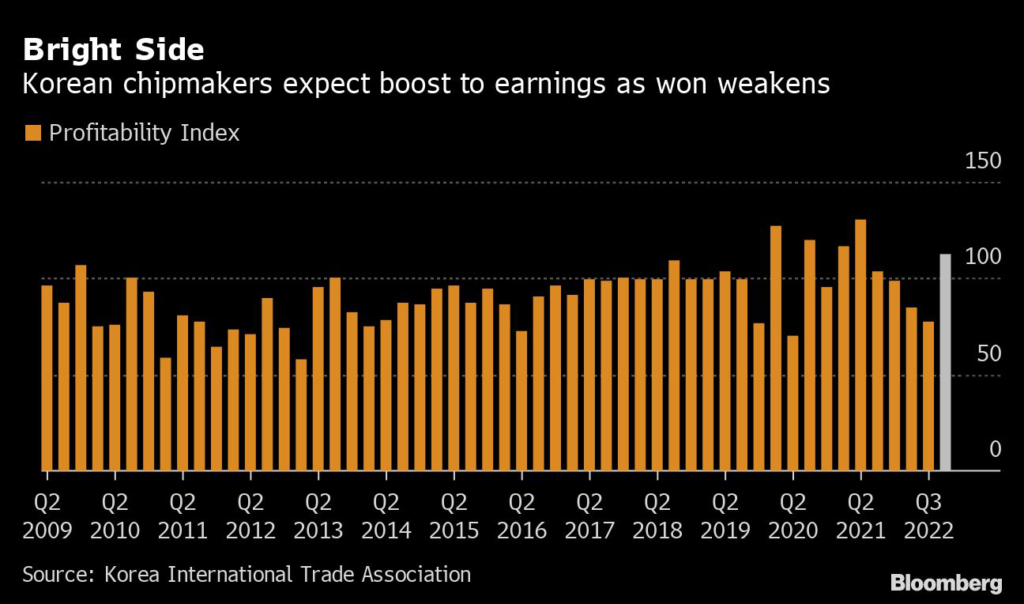
(Bloomberg) — South Korean chipmakers have turned optimistic on profitability for the first time in more than a year as a rapidly weakening won offers a potential boost from overseas earnings.

The profitability outlook among chip exporters jumped to 112.6 for the current quarter from 77.7 in the previous one, a Korea International Trade Association survey showed Wednesday. Still, the overall business outlook slid to 112 from 114.3 as expectations for orders deteriorated.

A reading between 90 and 110 suggests sentiment remains largely mixed, while anything from 110 indicates optimism.

Anticipation of better balance sheets highlights the windfall export gains from a depreciating currency, even as chipmakers struggle with inflationary pressures that have driven up the cost of raw materials.

“Probably the biggest factor behind the surprising rise is the currency,” said Estella Kim, the KITA researcher who conducted the survey between late August and early September, a period when the won’s weakening intensified.

The won has been Asia’s worst-performing currency after the yen this year, putting pressure on the Bank of Korea to consider another outsized interest-rate increase when it meets next week.

The outlook for chip prices also rose to 138.6 for the fourth quarter from 80.5 for the previous period, according to the KITA survey. That’s a potential sign of the impact of a monthslong retrenchment in production in response to slowing demand.

Total confidence among Korean exporters declined to 84.4 for the final three months of the year from 94.4 in the third quarter, according to the survey, in which some 1,000 companies participated.

Samsung Electronics Co. is expected to report a slowdown in revenue growth and sharp drop in operating earnings for the September quarter on Friday.

More stories like this are available on bloomberg.com

©2022 Bloomberg L.P.

Marc Andreessen Compares California to Rome Circa 250 A.D.

(Bloomberg) — Billionaire venture capitalist Marc Andreessen said he decided to “double down on California” and stay in the state, even as he likened it to “living in the ruins of a once great civilization.”

In a 34-tweet thread on Tuesday Andreessen, who co-founded the venture capital firm Andreessen Horowitz, said that he and his family considered leaving after a “surreal 2020.” They  bought real estate in Nevada and almost bought in Manhattan, he said. But they ultimately decided to stay, and now “rationalize” the decision by comparing it to living it in Rome before the fall. 

“Like Rome in maybe 250 A.D., we live amidst an enormous flowering of culture and creativity, but the roads are becoming unsafe and nobody is quite sure why,” he wrote.

Andreessen has been critical about the Silicon Valley area and its governance in the past, calling out San Francisco’s allergy to constructing new housing in his 2020 essay, “It’s Time to Build.” Even as the region’s economy has surged, Andreessen and other tech industry leaders have lamented the social problems persisting in the Bay Area, including a housing affordability crisis. 

In addition to his Nevada home purchase, the billionaire also bought a $177 million mansion in Malibu last year that was the most expensive home sale in California history, and also has a house in the wealthy Silicon Valley enclave Atherton. Despite his previous public comments about the need to build affordable housing in California, Andreessen and his wife vigorously opposed plans for denser construction in Atherton. The proposal was expunged from the housing plan in August.  

Andreessen’s comment about remaining in California comes as many longtime Silicon Valley boosters are questioning the value of the region. The shift to work-from-home and hybrid offices has been seized on by high-profile investors and technologists, proclaiming greener opportunities in places like Miami and Austin, Texas.

A representative for Andreessen Horowitz said earlier this year that it moved operations to “the cloud,” and will open new offices in New York, Miami and Los Angeles to supplement its existing digs in Menlo Park and in San Francisco.

More stories like this are available on bloomberg.com

©2022 Bloomberg L.P.

Musk’s Twitter Deal Has Employees Asking: Should I Stay or Should I Go?

(Bloomberg) — When news first broke Tuesday morning that Elon Musk was again interested in acquiring Twitter Inc. for $44 billion, most employees of the social network were sitting through an hourslong 2023 strategy presentation.Presenters from internal groups like the product and revenue teams didn’t officially discuss the development, or even acknowledge that Musk was back on board. They didn’t need to — employees were following along with the news on their Twitter feeds, closely watching the latest twist in the saga that has cast a shadow over their professional lives since April, when the billionaire Tesla Inc. chief executive officer first agreed to purchase the social network for $54.20 a share.

Many current and former Twitter employees, known as tweeps, were quick to jump in and share their reactions Tuesday morning. A meme account run by one employee repeatedly joked about people simply trying to get through the day without crying. “Somebody’s tired of getting embarrassed in court,” wrote a former worker.

The cafeteria sound system in Twitter’s New York office even chimed in. It was playing the song “Should I Stay or Should I Go” by the Clash, one worker said.

That question is on the minds of a lot of Twitter staffers now that it’s more likely that Musk will buy the company. For the past three months, Musk has been trying to walk away from his agreement, disparaging Twitter and its executives and creating confusion and instability at the San Francisco-based company as the two sides fought an expensive legal battle. While Twitter’s board understandably supports a sale at $54.20 a share, many workers have dreaded the prospect.

They have taken issue with everything from his politics (he voted in Texas for a far-right Republican for Congress this year) to his personal life (he was accused of sexual harassment in May) to his views on remote work (not a fan). Some employees in the past have mocked him ruthlessly on internal Slack channels, and even made subtle jabs at their would-be-boss via public tweets. One employee posted on Slack in May that Musk “puts the douche in fiduciary.”If the newest development holds and Musk does actually take over, it remains to be seen how workers will react, though there have been hints as to how things might change under his leadership. The SpaceX and Tesla CEO has publicly criticized some of Twitter’s executives, and text messages unveiled last week as part of the ongoing lawsuit show that Musk is unlikely to keep Twitter CEO Parag Agrawal in charge.

The two had a tense text exchange early on in the deal process after Agrawal told Musk his critical tweets about the company were “not helping me make Twitter better in the current context.” Musk quickly snapped back. “What did you get done this week?” he challenged, before adding, “I’m not joining the board. This is a waste of time.” He then vowed to take Twitter private.

After Twitter co-founder Jack Dorsey brokered a meeting between the two the day after the deal was announced, it became apparent that Musk and Agrawal were not a fit. “At least it became clear that you can’t work together,” Dorsey messaged Musk after the meeting. “That was clarifying.”

There’s also the question of whether other senior employees will want to work for Musk. The billionaire has criticized Twitter’s policy decisions and its top policy and legal exec, Vijaya Gadde, a move that generated a lot of anger internally given that Gadde is broadly well-liked.It’s also likely that Musk will cut costs at the company, a move that was part of his pitch to bankers early in the process when he was working to line up financing for the deal. At an all-hands meeting with Twitter employees in June, Musk acknowledged the company “needs to get healthy” and alluded to layoffs if and when he takes over. He also criticized remote work, a perk that many Twitter employees have enjoyed since the company went fully remote shortly after the pandemic started. Musk’s promise that “exceptional” employees needn’t worry about being laid off or called back into the office did not sit well with some.If workers choose to quit or are forced to leave Twitter, their options for other jobs at large technology companies may be limited, as several other major employers have announced hiring freezes and cost cuts of their own.Though many Twitter employees have bemoaned a lack of communication from management during the ups and downs of the legal battle over the deal, the company did reach out to workers on Tuesday to acknowledge Musk’s new stance. In an internal memo to Twitter staff, viewed by Bloomberg News, General Counsel Sean Edgett thanked staffers for their patience, while pledging, “I will continue to keep you posted on significant updates.”

More stories like this are available on bloomberg.com

©2022 Bloomberg L.P.

Activision Blizzard’s Overwatch 2 Hit With Cyberattack at Launch

(Bloomberg) — Activision Blizzard Inc. was hit with a cyberattack on Tuesday, causing wide-scale connectivity issues during the launch of its hotly anticipated Overwatch 2 video game. 

Mike Ybarra, president of Activision subsidiary Blizzard Entertainment, tweeted that the company was experiencing “a mass DDoS attack” on its servers Tuesday afternoon. Distributed-denial-of-service attacks, known as DDoS, are when traffic is directed at an organization’s servers that support a website, effectively knocking it offline.

The launch of Overwatch 2 already had long queue times for players waiting to get a chance to play the new game. It had been six years since the original, highly acclaimed Overwatch first came out and the sequel is one of Activision’s flagship game launches this year.

Activision Blizzard didn’t respond to a request for comment.

Even before the attack, players complained on Twitter of connectivity issues. Earlier in the day, Ybarra had tweeted that teams were working on server issues and were “humbled by the excitement of players.” 

However, anticipation of the launch was clouded Monday when the National Labor Relations Board found that the company withheld raises for some of its staff for campaigning to form a union, according to the Washington Post. 

Microsoft Corp. announced in January that it had agreed to buy the video game publisher in a deal valued at almost $69 billion. The software giant is facing regulatory scrutiny over concerns the acquisition could hamper competition.

More stories like this are available on bloomberg.com

©2022 Bloomberg L.P.
Close Bitnami banner
Bitnami