Bloomberg

Musk’s Losses in Twitter Court Fight Presaged His Surrender

(Bloomberg) — Elon Musk dropped his bid to walk away from a $44 billion buyout of Twitter Inc. after losing a series of pre-trial rulings that may have foreshadowed difficulties in making his case in court. 

Musk, the world’s richest person, on Tuesday proposed carrying out his original plan to buy Twitter for $54.20 per share just days before he was scheduled to argue to a judge that executives of the social-media platform misled him about the number of spam and robot accounts embedded in the company’s more than 230-million user base. 

That decision may have been influenced by almost a half-dozen rulings by Delaware Chancery Judge Kathaleen St. J. McCormick over the last three months that went Twitter’s way and frustrated Musk’s efforts to show he had legitimate grounds to cancel the deal. 

“It was pretty clear from her rulings the judge was laser-focused on the agreement and not the stuff Musk wanted to talk about,” said Brian Quinn, a Boston College law professor who focuses on merger-and-acquisition disputes. “His grand theory involving the bots didn’t seem to be gaining any traction with her.” 

To be sure, the judge ruled for Musk on some issues, including letting him try to bolster his case for abandoning the buyout with allegations by Twitter whistle-blower Peiter Zatko about lax computer security and a lack of interest by the company in the bots issue.

But McCormick also came down hard on the Musk team’s mishandling of pre-trial information exchanges common in corporate litigation. In a September ruling, she slammed the billionaire for not turning over copies of text messages for himself and top aide Jared Birchall. The judge said there were “glaring deficiencies” in how the Tesla CEO and his lawyers responded to Twitter’s demands for relevant text messages and sloppiness in adhering to deadlines.

Here are some other rulings Musk lost:

  • A week after Twitter sued Musk in July, McCormick rebuffed the billionaire’s request for a February trial and set the case to be tried before her Oct. 17. She also lined up behind Twitter’s insistence on scheduling five court days to present testimony.
  • In August, McCormick ordered Musk to hand over files about potential investors in a $7 billion equity raise as part of the deal. Musk complained Twitter was overreaching, arguing they’d gotten sufficient data on actual investors. McCormick also granted Twitter’s request to make Musk identify people “with knowledge of or involvement in key issues and events” in the deal, over his lawyers’ protests.
  • In late September, the judge denied Musk’s demand for additional documents about Twitter’s internal measure of robot and spam accounts after concluding the company already disclosed enough of the information.
  • Just before the public learned about the billionaire’s decision to give up his legal fight to nix the buyout, McCormick allowed Twitter to expand its hunt for evidence that Musk and his lawyers were in contact with whistle-blower Zatko before his allegations became public. She ordered the Musk side to widen its searches of internal files to include texts, instant messages and encrypted emails.

The case is Twitter v. Musk, 22-0613, Delaware Chancery Court (Wilmington). 

More stories like this are available on bloomberg.com

©2022 Bloomberg L.P.

Crypto Hedge Fund Focused on ESG Buys Algorand, Polkadot

(Bloomberg) — Modular Asset Management’s crypto hedge fund has been buying tokens like Algorand and Polkadot in a bet that coins with stronger sustainability characteristics will outperform after a $2 trillion shakeout in digital assets. 

The Modular Blockchain Fund, launched in May, has also stepped up purchases of Cosmos in recent weeks, Chief Investment Officer Daniel Liebau said in an interview. 

Liebau is seeking to gain an edge in choppy markets by picking coins he believes will better withstand rising scrutiny of the environmental, social and governance characteristics of crypto — a trend that’s taken hold in other asset classes like stocks and bonds over the past decade.

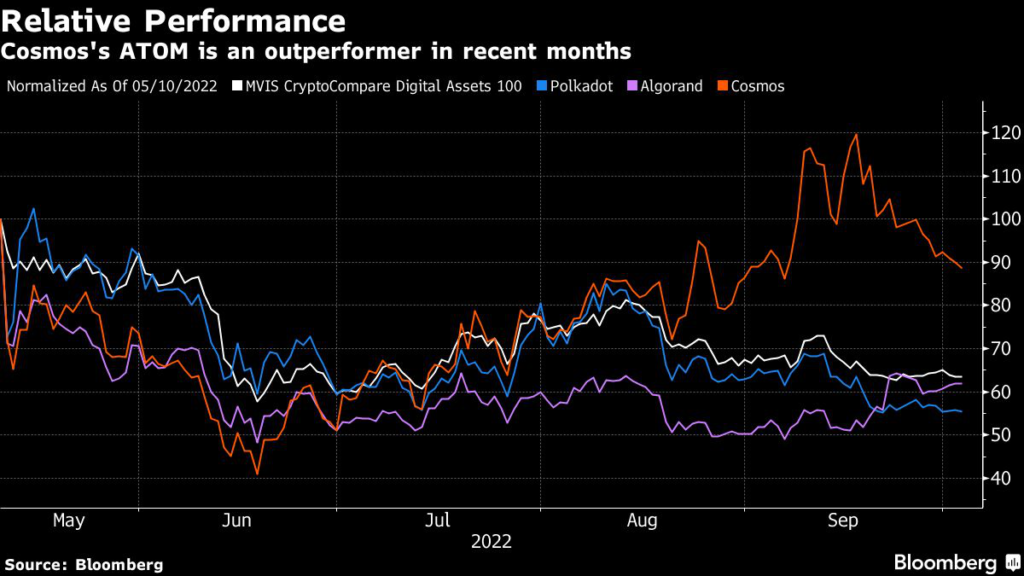
So far, Liebau’s picks have had a mixed performance. Polkadot and Algorand have dropped 43% and 39%, respectively, since Liebau’s fund was launched on May 10, compared with a 34% decline in the MVIS CryptoCompare Digital Assets 100 Index. Cosmos has performed better, slipping about 6%. 

“In digital asset markets, we believe that the adoption of platforms is very much tied to good sustainability characteristics,” Liebau said, adding that an ESG strategy may take time to pay off. “Not all of these sustainability characteristics are clearly adding an excess return today.”

While the energy demands of Bitcoin mining have long been a point of contention, this year’s market carnage has brought attention to other aspects of ESG where crypto is lagging far behind. 

The collapse of the TerraUSD stablecoin in May has triggered investigations in the US and South Korea, and its creator is being sought by Korean authorities. Several digital-asset lenders have frozen deposits and gone bankrupt, and a prominent crypto hedge fund is being liquidated, prompting a spate of lawsuits and allegations of fraud. And cryptoasset applications that had touted their role in making finance more fair and equal have descended into infighting over governance. 

  • Read more: South Korea Moves to Freeze $67 Million of Bitcoin Tied to Kwon

Modular, which manages about $1 billion, was spun out of Izzy Englander’s Millennium Management in January 2020. Liebau has been working with the firm since mid-2021 to develop an ESG-focused blockchain strategy. He declined to disclose the strategy’s assets under management. From its inception through the end of August, the Modular Blockchain Fund outperformed Bitcoin by 7.3 percentage points, according to Liebau. It beat the MVIS CryptoCompare Digital Assets 100 Index by 4.8 percentage points over the same period. The fund doesn’t take short positions. 

Modular is “capitalizing on the trend where crypto is being included in asset allocation and ESG integration frameworks,” said Bloomberg Intelligence analyst Jamie Douglas Coutts.

Sharding Technique

Liebau said his fund studies some 25 ESG metrics of the underlying blockchain or smart-contract platform when deciding whether to buy a token. They include energy consumption, changes in the wealth distribution among wallets and the composition of validators on the network. Validators help to order transactions on a blockchain to ensure it runs smoothly, typically in exchange for a fee paid in the protocol’s native token. 

The fund currently holds about a dozen tokens, Liebau said. It’s overweight Polkadot, whose blockchain uses sharding, a scaling solution the lowers the cost of bundled transactions. Other blockchains like Ethereum are also implementing sharding. 

Liebau said he invested in Algorand because of what he says is its secure and energy efficient consensus mechanism. Algorand network nodes can run on relatively basic computers, which means the blockchain can employ a more decentralized system, he said. A poorly designed consensus mechanism can be tampered with, undermining trust in the blockchain, according to Liebau.

“One of the reasons why we like Cosmos is its deterministic consensus mechanism, Tendermint, that offers instant finality when a transaction is added to a block,” Liebau said. “Finality guarantees the integrity of the ledger — this is of particular importance for financial applications.”

More stories like this are available on bloomberg.com

©2022 Bloomberg L.P.

Hedge Funds Betting Musk Will Be Forced to Buy Twitter (Repeat)

(Bloomberg) — (This story was originally published Sept. 14. On Tuesday, Bloomberg broke the news that Elon Musk revived his bid to buy Twitter at the original price of $54.20 a share, pulling back from an attempt to withdraw from the deal and possibly avoiding a contentious court battle.)

Hedge funds including David Einhorn’s Greenlight Capital and Pentwater Capital Management are wagering that Elon Musk won’t get his way this time. 

Musk, the world’s richest person and a renowned sparring partner with regulators over securities laws, is trying to back out of his agreement to buy Twitter Inc. for $44 billion. Several hedge funds have purchased stock, options or bonds — speculating that Musk will lose a trial scheduled to begin Oct. 17 in Delaware Chancery Court.

That could be a bright spot for a type of hedge fund having a tough year. So called event-driven funds, which often bet on mergers and acquisitions, are down 4% on average, according to research firm PivotalPath. 

The law is clear, Einhorn told investors in a letter last month. And “if it were anyone other than Musk, we would handicap the odds of the buyer wiggling out of the deal to be much less than 5%,” he said.

The money manager, whose firm bought Twitter shares at an average price of $37.24, dismissed speculation that the court would rule in Musk’s favor to avoid embarrassment should the man commanding a net worth of more than $250 billion simply choose to ignore its decision.

“We think that the incentive of the Delaware Chancery Court, the preeminent and most respected business court in the nation, is to actually follow the law and apply it here,” Einhorn wrote.

An attorney for Musk and a Twitter spokesperson declined to comment.

Pentwater, led by Matthew Halbower, bought more than 18 million Twitter shares in the second quarter, making his firm the seventh-biggest owner with a 2.4% stake. He told CNBC in July that he expected Musk, who offered to buy Twitter for $54.20 a share, to be forced to complete the purchase. 

Market Plunge

So far, the market appears to be supporting that view.

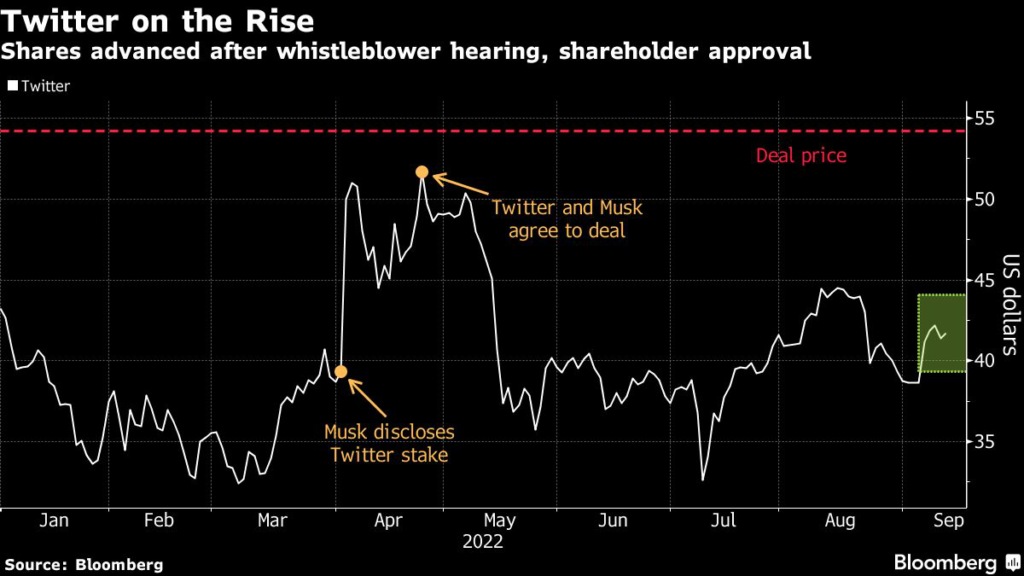
On Tuesday, when US equity markets plunged the most in more than two years, Twitter shareholders voted to approve the merger — and the stock was the second-best performer in the S&P 500, gaining 0.8% to $41.74. While it hasn’t closed above $44.50 since Musk first suggested in May that he might renege, some analysts and investors, including Einhorn, have said the stock would tumble to $20 if the deal falls apart.

The idea that Musk, the chief executive officer of both Tesla Inc. and SpaceX, could one day own Twitter took root in early April. That’s when he disclosed he had acquired 9% of the social media giant, making him its largest individual shareholder. Within weeks, the parties announced they’d reached an agreement. But less than a month later, Musk was threatening to pull out, accusing Twitter of understating the prevalence of bots on its platform. On July 8, he said he was terminating the deal. 

Since then, Musk’s lawyers have pointed to allegations from whistle-blower Peiter Zatko, Twitter’s former head of security, saying “egregious deficiencies” in the company’s defenses against hackers and privacy issues meant that Twitter had breached the conditions in the merger agreement.

An article in the New Yorker this week said that after Zatko’s claims became public, his former colleagues were contacted by researchers, sometimes offering money for information on the cybersecurity executive. At least a few of the researchers were gathering information for investment firms with bets on the deal, according to the report.

Read more: Twitter Whistle-Blower Testimony Spurs Calls for Tech Regulator

Some investors and analysts suggest the parties could reach a settlement before the trial, with Musk paying closer to $50 a share. 

Carronade Capital Management, a $900 million multi-strategy credit hedge fund, invested in various Twitter debt and equity securities, wagering that the deal will ultimately be done, either after a trial or through a settlement, according to people familiar with the matter. A representative for the firm declined to comment. 

Kellner Capital’s Chris Pultz said Musk and Twitter might agree to forgo a trial for a discount of 10% to 15% from the original deal price.

“Anything more than that and the Twitter board may say they would rather take their chances going to court,” said Pultz, whose firm manages about $250 million.

In April, when Musk brought in outside financing, including from fellow billionaires Larry Ellison and Saudi Prince Alwaleed bin Talal, Pultz acquired a small Twitter stake. When the stock plunged in July, approaching its low for the year, Kellner bolstered its position by 40%.

Cabot Henderson, a merger strategist at Jones Trading, said Twitter now has less incentive to accept a lower price because the company has been winning in pretrial hearings, making the odds of a settlement lower than he previously predicted. 

“At this point, people are mentally preparing that this thing is actually going to trial now,” Henderson said. “It’s hard to sometimes parse through the posturing, but it does seem there’s been a real hardening of attitudes.”

More stories like this are available on bloomberg.com

©2022 Bloomberg L.P.

SoftBank-Backed Servicer of a Kabbage Portfolio Goes Bankrupt Amid Fraud Probes

(Bloomberg) — SoftBank-backed small business loan servicer KServicing filed for bankruptcy after the company, which holds old loans made by online lender Kabbage, was weighed down by allegations of overly lax lending under the US government’s Paycheck Protection Program.

KServicing is in the process of winding down after Kabbage’s teams and technology were sold to American Express Co. about two years ago for around $750 million. KServicing’s business now mostly consists of servicing a $1.3 billion portfolio of Covid-era small business loans backstopped by the federal government, court papers show. 

The company is focused on minimizing any impact the bankruptcy filing will have on borrowers, according to a statement. KServicing plans to continue paying employees during the bankruptcy, per the statement.

KServicing is facing a bevy of state and federal investigations into its lending practices, according to bankruptcy court documents. The Small Business Administration, for example, alleges KServicing lent PPP money too freely and that the company should be liable for wrongly disbursed loans. 

Good Faith

From April 2020 to September 2021, the company doled out more than $7 billion in PPP loans to more than 300,000 borrowers, according to court papers. That made KServicing, formerly known as Kabbage, the second biggest PPP lender by application volume.

The company processed loan applications in good faith as quickly as possible despite shifting guidance from the SBA, Deborah Rieger-Paganis, a KServicing restructuring adviser, said in a sworn court declaration. Almost all of the discussions and disputes surrounding KServicing’s PPP activities are “vigorously disputed” by the company, she said. 

“The hindsight investigations and misdirected scrutiny severely hamper the Company’s ability to accomplish its mission of servicing the balance of the PPP Loans in its Loan Portfolio and have caused significant additional costs to winding down its business,” Rieger-Paganis wrote. 

KServicing accused American Express of contributing to its problems, claiming the credit card giant refused to honor a transition services agreement worked out as part of the sale of Kabbage affiliates, according to court documents. The company may sue American Express for any damage the bankrupt company suffered related to the services agreement, it said in a court filing.

“American Express has honored its obligations under the transition services agreement and will continue to do so in accordance with its terms,” the company said in an emailed statement. 

Kabbage was founded in 2008. KServicing — the bankrupt unit — still counts the SoftBank Vision Fund as it largest shareholder, with 14.62% stake, court papers show.

The case is Kabbage Inc., 22-10951, U.S. Bankruptcy Court for the District of Delaware.

(Adds American Express statement in paragraph nine.)

More stories like this are available on bloomberg.com

©2022 Bloomberg L.P.

Amazon Discontinues Glow Video-Calling Device for Kids 

(Bloomberg) — Amazon.com Inc. is discontinuing its pandemic-era kids’ video calling device amid lackluster sales and a shift in consumer behavior.

Launched a year ago, the Amazon Glow emerged from the company’s Grand Challenge moonshot laboratory. It seemed the perfect pandemic-era product: a combination video screen and projector that helped children get face time, play games, read and even draw with distant relatives. 

But sales were slow, and Amazon is now looking to shift employees who worked on the gadget into other roles.

“At Amazon we think big, experiment, and invest in new ideas to delight customers,” said Amazon spokeswoman Kristy Schmidt, who confirmed the Glow’s cancellation. “We also continually evaluate the progress and potential of our products to deliver customer value, and we regularly make adjustments based on those assessments. We will be sharing updates and guidance with Glow customers soon.”

Amazon has taken a number of measures to restrain costs as sales growth stagnates, including shuttering warehouses and freezing hiring for corporate jobs in its retail business.

Reviewers praised the device’s concept, but said it felt unfinished. A monthly subscription to an Amazon kid-focused service and a recommendation that the person on the other end use a tablet, not a smartphone, also may have limited its appeal. The device also hit the market as many consumers began to resume their normal habits following the release of Covid-19 vaccines.

Amazon doesn’t disclose sales data for its electronics, but Glow had about 500 customer reviews on the company’s retail site, low even by the standard of Amazon’s niche or experimental products. Glow was steeply discounted on Tuesday, listed at $150 for members of Amazon’s Prime program, 55% off the list price. Later in the day, it was unavailable.

Amazon’s devices group has produced such hits as the Echo smart speaker and Fire streaming sticks, but also has a history of launching devices that seem to be looking for a purpose. A voice-activated microwave oven launched in 2018 never caught on with shoppers, and Amazon’s effort to make its own smartphone, the Fire Phone launched in 2014, remains its biggest dud.

More stories like this are available on bloomberg.com

©2022 Bloomberg L.P.

A Timeline of Elon Musk’s Takeover of Twitter: The Deal Is On

(Bloomberg) — Twitter users woke up April 4 and found the words “Elon” and “Elon Musk” trending on the site — not because the world’s richest, most-followed businessman had caused a stir with his futuristic companies, but because he’d disclosed a major stake in Twitter Inc.

Suddenly, Musk was Twitter’s largest individual shareholder, with more than 9% of the company, and speculation swirled about how he would influence the network’s future. He’d been frequently tweeting ideas for revamping the social media platform. Over the next week, Musk would accept an offer to join Twitter’s board of directors and, in a sudden reversal, reject that offer five days later, leaving the company’s management, employees, investors and interested observers guessing about his plans.

On April 25, Twitter and Musk said they’d reached an agreement for the billionaire to acquire the company and take it private. They expect the deal to close by the end of the year, and a lot could happen before then. As the news develops, here’s a look at what’s happened so far:

Jan. 31: Musk starts building his stake 

Musk started quietly buying Twitter shares on Jan. 31. By March 14, Musk had accumulated an over 5% stake, the point after which he was supposed to disclose the activity to the Securities and Exchange Commission, and by extension, the public. Musk missed the deadline to inform the SEC by 10 days. Because Twitter’s share price rose the second his stake was revealed, he was able to accumulate more on the cheap by not disclosing — a misstep that would later trigger a shareholder lawsuit. 

March 24: Musk starts critiquing Twitter, on Twitter

His stake still secret, Musk began tweeting criticisms of the company in late March.

“Worried about de facto bias in the Twitter algorithm having a major effect on public; Twitter algorithm should be open source,” Musk tweeted on March 24.

“Free speech is essential to a functioning democracy. Do you believe Twitter rigorously adheres to this principle?” Musk asked his Twitter followers in a poll posted on March 25.

“Is a new platform needed?” Musk asked in a tweet on March 26. “Am giving serious thought to this.”

Several users commenting on the Tesla Inc. chief executive officer’s tweet recommended he look into buying Twitter instead. Soon they would find out he was already acquiring shares.

April 4: Musk’s stake becomes public, and he’s invited to join Twitter’s board

Musk’s filing listed him as a passive investor, and yet, shortly after it became public, he started tweeting out business propositions for the social media company. Musk posted another poll on Twitter asking users to vote on whether they wanted the company to add an edit button that would allow people to change tweets after they’ve been published. Twitter CEO Parag Agrawal urged users to “vote carefully” on the poll. “The consequences of this poll will be important.”

By the end of the day, Twitter invited Musk to join the board. Musk signaled that he would sign an agreement stipulating that he could not own more than 14.9% of the company’s stock. 

April 5: Musk becomes an active investor

In the morning, several of Twitter’s board members took to the platform to congratulate Musk on his decision to join their ranks. Agrawal tweeted that the company and Musk had been chatting for weeks. Agrawal’s tweet led people to question why someone engaged in discussions to become a director would file as a passive investor. 

Later that day, Musk refiled the disclosure of his stake to classify himself as an active investor, making the change only after indicating that he would accept a seat on the social media company’s board.

April 9: Musk rejects the board seat

The day that Musk was set to officially join Twitter’s board, Musk informed the company that he would be rejecting its offer. But, Twitter sat on the news for roughly 36 hours while waiting to see whether Musk would change his mind. Twitter’s investor relations website listed Musk as a board member throughout the weekend.

During that time, while the public still thought Musk was set to join Twitter’s board, Musk tweeted several veiled criticisms and suggestions for the company. Musk asked his followers, “Is Twitter dying?”

Musk suggested that everyone who signs up for Twitter Blue, a subscription version for power users, should get an authentication checkmark. He suggested Twitter should convert its San Francisco headquarters into a homeless shelter “since no one shows up anyway.” And he made some crass jokes, suggesting removal of the “w” in Twitter.

April 10: Twitter makes the news public

On Sunday, Agrawal sends out a note to employees, and later tweets it publicly. Neither Agrawal or Musk give a reason for the reversal.

April 11: Speculation abounds

Musk files an amended disclosure with the SEC. He can now purchase as many shares as he wants. Without a board seat, he no longer has to act in the best interest of Twitter shareholders. At Twitter, which doesn’t have a founder with majority control like other tech giants, employees are “ super stressed,” concerned that this is only the beginning of the whiplash.

April 14: Musk offers to buy the whole company

In an SEC filing and accompanying tweet, Musk said he would buy out stockholders in a cash deal valued at $43 billion and  take Twitter private. The offer is $54.20 a share, a 54% premium over the price when he started building his stake in January. The number is also an apparent (and not-very-subtle) reference to Musk’s failed bid to take Tesla private in 2018 for $420 a share — and, of course, to a special number in pot culture. Morgan Stanley is brought in to advise on the bid, which Musk describes as his “best and final” one.

April 15: Twitter adopts ‘poison pill’ to ward off Musk takeoverTo thwart Musk, Twitter launched a so-called poison pill, which is a rights plan that allows shareholders to purchase shares at a discount if any shareholder exceeds 15% ownership. This would effectively dilute the billionaire’s stake. The company said in a statement that the intention of the plan is to ensure that anyone taking control through open-market accumulation pay all shareholders an appropriate premium. Twitter has been fielding interest from other parties, including private equity firm Thoma Bravo, according to a person familiar. The company is being advised by Goldman Sachs Group Inc. and JPMorgan Chase & Co. Twitter founder Jack Dorsey, a friend of Musk, acknowledged in a tweet that as a public company Twitter has always been for sale.

April 16: ‘Twitter’s board owns almost no shares’

In a flurry of tweets about the potential deal, Musk said, “With Jack departing, the Twitter board collectively owns almost no shares,” so its economic interests are not aligned with shareholders. Dorsey replied, “It’s consistently been the dysfunction of the company.” Dorsey is scheduled to leave the board once his term expires at the next shareholder meeting on May 25.

Vanguard’s April 8 disclosure that it owns 82.4 million shares or 10.3% of the company fuels tweets that Musk is no longer the top Twitter shareholder. 

April 19:  Musk retains Morgan Stanley to consider leveraged buyout

The New York Post reports that Musk is willing to invest up to $15 billion of his own cash and borrow against his Twitter stake to push through a deal. April 21: Musk lines up $46.5 billion in funding

Musk explores a tender offer for Twitter, saying he’s secured $46.5 in funding. A filing with the SEC shows that he has $25.5 billion in debt financing from Morgan Stanley and other financial institutions, including margin loans backed by his equity stake in Tesla and $21 billion in equity financing from himself. But whether the billionaire will sell part of his stake in one of his prized companies to acquire Twitter remains to be seen.

April 24: The board holds discussions with Musk

Talks between Twitter’s board and Musk took place Sunday and continued into the next day. The board began to take Musk’s offer more seriously once he presented details of his financing.

April 25: Twitter yields to Musk, agrees to offer

Twitter agreed to sell to Musk for his original offer of $54.20 a share. The transaction, valued at about $44 billion, will take the company private. Musk said he will prioritize free speech on the site, open-source its algorithms, eliminate spam and add new features. Twitter said it expects the deal to close in 2022.

April 29: Musk sells Tesla stock

Musk disclosed an additional $4.5 billion worth of Tesla Inc. stock sales in new regulatory filings, bringing the total he’s disposed of in the process of buying Twitter to more than $8.5 billion. Tesla’s CEO offloaded more than 5 million shares on April 28, according to the new filings, and tweeted “No further TSLA sales planned after today.” That followed previous disclosures of sales totaling 4.4 million shares the two prior days. Musk has now sold about $25 billion worth of stock in the electric-car maker during the last six months.

May 4:  Billionaire backers pony up additional funds 

Musk raises an additional $7.1 billion of new financing commitments to fund the deal. Backers include Oracle Corp. founder Larry Ellison who puts up $1 billion, Sequoia Capital for $800 million, Vy Capital $700 million, Binance $500 million, and more than a dozen others, according to company filings. He also secures a pledge from Saudi Arabia’s Prince Alwaleed bin Talal, who agreed to roll over his nearly 35 million Twitter shares, worth about $1.9 Billion at $54.20 per share.

May 6: Plans for Twitter revealed

The New York Times reports that, according to a pitch deck presented to investors, Musk is planning to quintuple Twitter’s revenue $26.4 billion by 2028, from $5 billion last year, and sees a similar growth of users, to 931 million from 217 million. To accomplish this he plans to expand the company’s negligible payments business currently used for tipping creators, and grow it to $15 million in revenue by 2023, and $1.3 billion by 2028. The deck also revealed plans to cut the company’s reliance on advertising to less than 50% of revenue, further develop a subscription product and prepare for fluctuating headcount. 

May 10: Trump ban to be lifted

Musk confirms that he would reverse Twitter’s ban on former US president Donald Trump once owner. 

“I would reverse the permanent ban,” he said at a Financial Times conference. “Perma bans just fundamentally undermine trust in Twitter as a town square where everyone can voice their opinion.”

“My opinion, and Jack Dorsey I want to be clear shares this opinion, is that we should not have permanent bans,” Musk said, referring to the Twitter co-founder and former chief executive officer. Dorsey tweeted his agreement, and both men added caveats that illegal behavior or spam wouldn’t be allowed.

May 12: Hiring freeze goes into effect and key executives depart

Twitter CEO Parag Agrawal announces a hiring freeze and other cost-cutting efforts amid the state of uncertainty over the acquisition. Two of Twitter’s top leaders also depart: Kayvon Beykpour, head of consumer product, and Bruce Falck, in charge of revenue product, were both asked to leave, the two executives said in separate posts. Beykpour was laid off while on paternity leave, he said in a Twitter thread. “Interrupting my paternity leave to share some final @twitter-related news: I’m leaving the company after over 7 years,” and added, “The truth is this isn’t how and when I imagined leaving Twitter, and this wasn’t my decision. Parag asked me to leave after letting me know that he wants to take the team in a different direction.”

The social media company won’t hire new employees and may rescind offers already out, according to an internal memo obtained by Bloomberg. Some exceptions will be made for business-critical roles, as determined by Twitter leadership. The company is also pulling back on costs such as travel, consulting and marketing, according to the memo.

Agrawal said global events, including the war in Ukraine and the supply chain crunch, have hurt Twitter’s business and may continue to do so. The company isn’t planning broad job cuts, “but leaders will continue making changes to their organizations to improve efficiencies as needed,” Agrawal wrote. 

May 13: Twitter deal on hold, Musk said

“Twitter deal temporarily on hold pending details supporting calculation that spam/fake accounts do indeed represent less than 5% of users,” Musk said in a tweet, which sent Twitter stock plummeting. 

A few hours later he sent another tweet saying he is “still committed” to the acquisition. 

Musk said he was waiting for details on a recent filing from Twitter that fake accounts on the social media platform contributed less than 5% of its users. In a follow-up tweet late Friday, he added that his team would do a random sample of 100 followers as a way to find out. 

May 16: Musk and Agrawal have it out… on Twitter

In a Twitter thread, Agrawal said that measuring spam accounts was complicated because some are actually real humans even if they look like spam, and vice versa. Twitter also allows bots on the service, so simply setting up an automated account is not against the rules. 

Musk was not impressed with Agrawal’s response. He suggested calling users to verify their accounts, then he simply replied to Agrawal with a poop emoji. 

May 17: Musk threatens to pull out 

Musk declared he won’t proceed with his takeover plan unless the social media giant can prove bots make up fewer than 5% of its users. The comment stoked speculation that Musk may try to lower the price.

But Twitter’s board said it plans to enforce the $44 billion agreement, saying the transaction is in the best interest of all shareholders. Directors had already voted to unanimously recommended that shareholders approve Musk’s $54.20-a-share offer.

The proposed takeover includes a $1 billion breakup fee, which Musk will have to pay if the deal falls apart due to financing issues. But Musk can’t walk away for just any reason. The merger agreement includes a specific performance provision that allows Twitter to force Musk to consummate the deal, according to a securities filing. That could mean that, should the deal end up in court, Twitter might secure an order obligating Musk to complete the merger rather than winning monetary compensation for any violations of it.

July 8: Musk backs out of deal citing “spam bots”

Musk backs out of the deal to buy the platform on July 8 saying in a regulatory filing that the company has made “misleading representations” over the number of so-called spam bots on the service. Twitter hasn’t “complied with its contractual obligations” to provide information about how to assess how prevalent the bots are on the social media service,” Musk said in a letter to Twitter.

Musk also argued that Twitter has failed to operate its normal course of business. The company instituted a hiring freeze, fired senior leaders and saw other major departures. “The company has not received parent’s consent for changes in the conduct of its business, including for the specific changes listed above,” Musk said in the letter, calling it a “material breach” of the merger agreement.

July 12: Twitter sues Musk

Twitter files suit in Delaware Chancery Court to compel Musk to complete the deal. “Having mounted a public spectacle to put Twitter in play, and having proposed and then signed a seller-friendly merger agreement, Musk apparently believes that he — unlike every other party subject to Delaware contract law — is free to change his mind, trash the company, disrupt its operations, destroy stockholder value, and walk away,” Twitter said in the lawsuit.

Twitter said it provided Musk, the co-founder of electric-carmaker Tesla Inc., with “the full ‘firehose’ data set that he has been mining for weeks,” handing the billionaire “granular monthly reporting identifying each of the sampled accounts by ‘user id’ and the determination as to whether the account was false or spam, along with the calculations supporting Twitter’s estimates, going back to January 1, 2021.”

Musk then countersues Twitter arguing the company misled investors and the US Securities and Exchange Commission and was “frantically closing the gates on information in a desperate bid to prevent the Musk Parties from uncovering its fraud,” according to the filing reviewed by Bloomberg.

September 29: Texts reveal Musk’s inner circle

A treasure trove of private text messages released as part of the lawsuit slated to go to trial in Delaware Chancery Court on Oct. 17 showed how the deal came together.  

In about 40 pages of published exchanges, Dorsey leans on Musk as activist investors push for change. Lamenting the pitfalls of being a public company instead of an openly available technology protocol anyone could build on, Dorsey tells him, “I tried my hardest to get you on our board, and the board said no,” Dorsey added. “That’s about the time I decided I need to work to leave, as hard as it was for me.” 

Oracle Corp.’s Larry Ellison offered something of a blank check when Musk asked if he had any interest in participating. Ellison said, “Since you think I should come in for at least $2B … I’m in for $2B.” 

And there were a flurry of messages as to who Musk should hire as CEO. Investor Bill Lee suggested Bill Gurley of Benchmark Capital. Steve Jurvetson pushed for Emil Michael, the former chief business officer of Uber Technologies Inc. and Jason Calacanis texted, “Put me in the game coach! Twitter CEO is my dream job.”

Joe Rogan was a fan of the deal. “I REALLY hope you get Twitter,” the podcaster texted. “If you do, we should throw a hell of a party.”

October 4: Musk revives $44 billion takeover bid

Elon Musk revives his bid for Twitter at the original offer price of $54.20 a share, potentially avoiding a courtroom fight over one of the most contentious acquisitions in recent history. Shares in Twitter climbed as much as 23% when they resumed trading following a halt on the news.

(Updates with deal agreement in the last paragraph.)

More stories like this are available on bloomberg.com

©2022 Bloomberg L.P.

Stock Shorts Fold in Best Two-Day Rally Since 2020: Markets Wrap

(Bloomberg) — Stocks extended their rebound from deeply oversold levels, with traders weighing whether it would be realistic that central banks moderate their aggressive stance to prevent a hard landing.

The S&P 500 had its best two-day surge since April 2020. Tesla Inc. climbed even after Elon Musk revived his $44 billion bid for Twitter Inc., which soared 22%. On top of the equity short squeeze, soft economic data gave bulls a glimmer of hope when it comes to policy. US job openings sank to a 14-month low — which may fit well with a Federal Reserve that’s worried about a hot labor market. The dollar slumped.

The debate over peak hawkishness intensified after a dovish surprise from Australia’s central bank and bond buying by the Bank of England. The idea of a Fed pivot, however, has been met with a lot of skepticism in Wall Street — with top US officials warning that the battle against inflation will require more time.

Read: Fed Telegraphs No Aussie-Style Policy Pivot in Inflation Battle

So when it comes to the explanation for the rally in stocks, traders generally prefer to stick with the idea that pessimism reached such extreme levels that a bounce would be just a matter of when. 

For markets that had been “nearly one-sided,” the liquidation of those positions is a big reason to squeeze in the other direction so vigorously, said Fawad Razaqzada at City Index and Forex.com.

“While it ‘feels’ like the markets may have bottomed out — which is certainly a possibility, a small possibility, but a possibility nonetheless — it is important to not get caught in another bull trap,” Razaqzada noted. “We are still in a bear market, and this could just turn out to be another relief rally.”

In fact, after raising bearish wagers in one of the longest stretches in years, short sellers are being forced to fold. At the center of the rally are most-shorted stocks, as tracked by Goldman Sachs Group Inc., which jumped over 6.5% Tuesday, handing losses for those who had placed bets against them.

Short squeeze has indeed been big factor behind the rebound in equities, but it’s not like traders are minimizing the potential impact of the recent economic reports on Fed thinking. Tuesday’s jobs data could reinforce the case for officials to get off the “hamster wheel” of 75 basis points sooner rather than later, said Evercore’s Peter Williams.

That doesn’t mean any pivot would be imminent. Markets are still mostly betting on a hike of that magnitude next month.

“In short, we’re starting to see some things the doves can hang their hat on, but I don’t think it will be enough to stop another 75bp move in November,” wrote Neil Dutta, head of economics at Renaissance Macro Research. “All eyes on Friday payrolls.”

Lindsey Bell, chief markets and money strategist at Ally, says the bets are on a “goldilocks” labor-market report that’s “not too hot and not too cold.”

“For the market to continue higher, the jobs data will have to be in-line with, or short of expectations,” she added.

Elsewhere, oil surged for a second day as OPEC+ said it was considering an output cut of as much as 2 million barrels a day, a million barrels higher than previously anticipated.

Key events this week:

  • Eurozone services PMIs, Wednesday
  • OPEC+ meeting begins, Wednesday
  • Fed’s Raphael Bostic speaks, Wednesday
  • The Reserve Bank of New Zealand meets, Wednesday
  • Eurozone retail sales, Thursday
  • US initial jobless claims, Thursday
  • Fed’s Charles Evans, Lisa Cook, Loretta Mester speak at events, Thursday
  • US unemployment, wholesale inventories, nonfarm payrolls, Friday
  • BOE Deputy Governor Dave Ramsden speaks at event, Friday
  • Fed’s John Williams speaks at event, Friday

Will earnings disappoint and push equities to new lows? This week’s MLIV Pulse survey asks about corporate earnings. It’s brief and we don’t collect your name or any contact information. Please click here to share your views.

Some of the main moves in markets:

Stocks

  • The S&P 500 rose 3.1% as of 4 p.m. New York time
  • The Nasdaq 100 rose 3.1%
  • The Dow Jones Industrial Average rose 2.8%
  • The MSCI World index rose 3.3%

Currencies

  • The Bloomberg Dollar Spot Index fell 1%
  • The euro rose 1.7% to $0.9989
  • The British pound rose 1.3% to $1.1474
  • The Japanese yen rose 0.4% to 144.03 per dollar

Cryptocurrencies

  • Bitcoin rose 3.1% to $20,214.08
  • Ether rose 2.4% to $1,355.1

Bonds

  • The yield on 10-year Treasuries was little changed at 3.63%
  • Germany’s 10-year yield declined five basis points to 1.87%
  • Britain’s 10-year yield declined nine basis points to 3.87%

Commodities

  • West Texas Intermediate crude rose 3.1% to $86.25 a barrel
  • Gold futures rose 1.9% to $1,734 an ounce

More stories like this are available on bloomberg.com

©2022 Bloomberg L.P.
Bitcoin Bounces Above $20,000; Doge Jumps After Musk Twitter Bid

(Bloomberg) — Cryptocurrencies advanced alongside US stocks, with Bitcoin posting its biggest two-day increase in about a month, as investors speculate central banks could soon pull back from aggressive interest-rate hikes.

Bitcoin, the largest digital coin by market value, rose as much as 4% on Tuesday to trade around $20,372, its highest since Sept 15. That’s in line with broader gains in US stocks. The S&P 500 posted its best two-day surge since April 2020. 

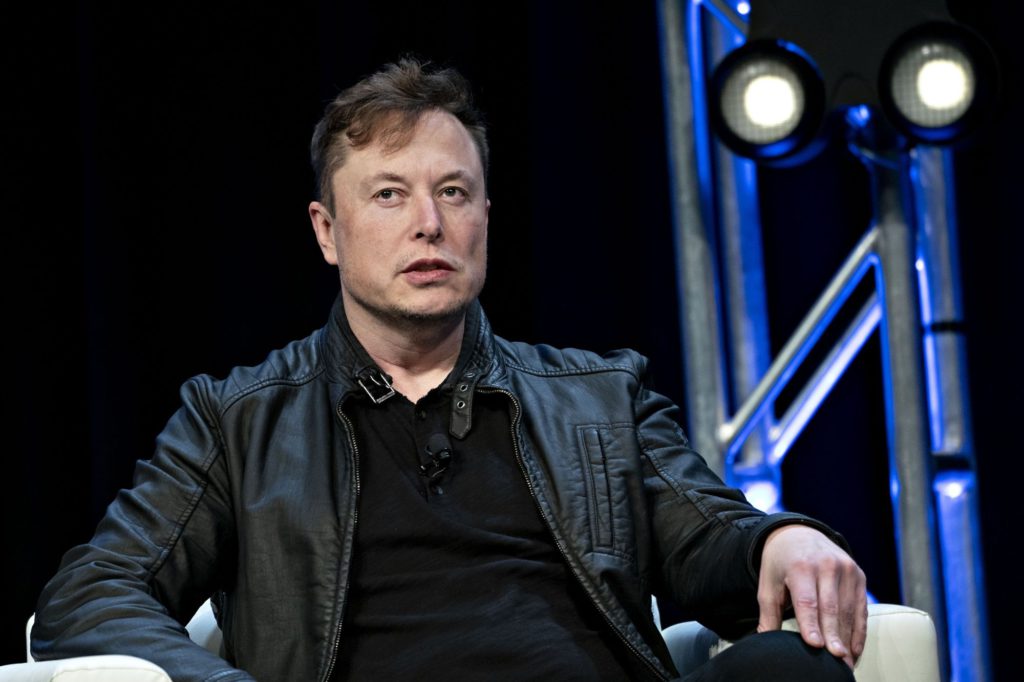
Dogecoin gained as much as 10% to 66 cents. Tesla CEO Elon Musk, an ardent supporter of the token, revived his $44 billion bid for Twitter Inc. on Tuesday. 

Bitcoin’s performance has correlated with the S&P 500 all year. “It’s very hard to find days where Bitcoin’s up and the markets aren’t up,” said Michael Purves, founder and CEO of Tallbacken Capital. He added that the opposite is also true: a decline in Bitcoin prices generally lines up with a decline in the equity markets.

However, Purves said the recent rally in crypto prices does not signal that more institutional investors are buying Bitcoin.

“This is just more of what we’ve seen,” he said. “Nasdaq up, equities up, dollar weaker, Bitcoin stronger.” 

More stories like this are available on bloomberg.com

©2022 Bloomberg L.P.
Apple Discriminated Against Pro-Union Staff, NLRB Alleges

(Bloomberg) — The US National Labor Relations Board issued a complaint against Apple Inc. accusing it of illegally interrogating and discriminating against employees at a New York City store, ratcheting up pressure on a company that’s increasingly become the target of labor organizers.

In a filing, the agency accused Apple of “prohibiting the placement of union flyers on the break room table while permitting nonunion solicitations and distributions,” NLRB spokesperson Kayla Blado said in an email Tuesday. The complaint said the company discriminated against workers by only enforcing its “no solicitation” policy against staff who supported a union, according to the NLRB. The filing also said Apple interrogated employees about their workplace activism.

The complaint was spurred by an earlier filing from the Communications Workers of America, which said Apple was suppressing union organizing efforts. The group cited the alleged interrogations and restrictions on flyers and said Apple required employees to attend mandatory anti-union speeches. The conduct took place at the company’s World Trade Center store in Manhattan, a CWA representative said in May.

Apple disputed the allegations. “We are fortunate to have incredible retail team members and we deeply value everything they bring to Apple,” the company said Tuesday in a statement. “We regularly communicate with our teams and always want to ensure everyone’s experience at Apple is the best it can be.”

Apple’s retail chain, which includes roughly 270 stories in the US, is facing unionization campaigns in multiple cities. CWA has said that it is in touch with Apple employees around the country, and staffers in Oklahoma City are slated to vote next week in an NLRB election on whether to become the first Apple retail workers to join the group.

“It is past time for Apple’s senior management to respect its retail employees and stop its unlawful attempts to prevent them from forming unions,” CWA’s secretary-treasurer, Sara Steffens, said in a statement Tuesday. “Apple has a choice — does it want to be known for intimidating its workers and creating a culture of fear, or does it want to live up to its stated values and welcome true collaboration with all of its employees — including retail workers.”

Employees in Maryland voted in June to join another union, the International Association of Machinists, marking one of the most prominent in a series of landmark labor wins over the past year at top US businesses. CWA also filed a still-pending NLRB claim against Apple in Atlanta, where in May the labor group withdrew a petition for a unionization vote, citing alleged union-busting by the company.

Complaints issued by labor board prosecutors are considered by administrative law judges, whose rulings can be appealed to NLRB members in Washington and from there to federal court. The agency can order companies to change policies that conflict with the law, but it lacks authority to issue punitive damages for violations.

(Updates with additional labor board comment in second paragraph.)

More stories like this are available on bloomberg.com

©2022 Bloomberg L.P.
EU Strikes Russia Sanctions Compromise That Adds Oil Price Cap

(Bloomberg) — European Union countries reached a compromise on a new package of Russia sanctions that includes support for a price cap on oil sales to third countries, with a formal agreement expected on Wednesday, according to people familiar with the matter. 

EU ambassadors on Tuesday night discussed ways to mitigate the impact the new package would have on countries with large shipping industries, said the people, who asked not to be identified because the talks were private. 

Greece, Cyprus and Malta expressed concerns about curbs on transporting Russian oil and have been pushing for assurances on the effectiveness of the new mechanism and its potential impact, according to the people. 

The sanctions would add a ban on shipping Russian oil to existing restrictions on services needed to transport it, but carve out an exemption for oil priced at or under a level set by a coalition of the Group of Seven and other countries, according to a draft of the proposal seen by Bloomberg. The compromise reached on Tuesday would make entry into force of the sanctions conditional on adoption of the measures by the G-7. 

The sanctions package will be formally adopted by the bloc on Wednesday barring any last-minute objections by national governments.

The broader sanctions package would target a range of individuals and entities, including senior Russian ministry officials and people involved in staging the recent, widely condemned referendums. It would also restrict access to aviation items, electronic components and specific chemical substances to deprive Russia’s military from important technologies. 

Some nations were upset that the latest draft of the sanctions appears to have weakened several of the proposed measures, including the removal of a Russian diamond mining company from the penalty list.

To allow for an oil price cap, the bloc will have to change its current legislation. In June, EU nations agreed to a full ban on insurance and financial services for seaborne oil, while shipping was spared from the restrictions. Most of those prohibitions are due to kick in Dec. 5 alongside a ban on EU purchases of Russian crude.

The G-7, which endorsed a cap earlier this month, has said it wants an agreement in place before that date.

More stories like this are available on bloomberg.com

©2022 Bloomberg L.P.
Close Bitnami banner
Bitnami