
Bloomberg

Twitter Buyout Revives $12.5 Billion Headache for Wall Street Banks

(Bloomberg) — Elon Musk’s shock proposal to proceed with his acquisition of Twitter Inc. for the original offer price poses a headache at the worst possible time for Wall Street banks already struggling to offload billions of dollars in buyout debt they committed to in better times.

After months of legal drama in an attempt to back out of the deal, billionaire Musk is now willing to buy the social-media giant for $54.20 a share. In a letter his lawyers sent to Twitter, Musk’s acquisition is now pending “receipt of the proceeds of the debt financing.” 

That means it’s now time for a group of Wall Street banks led by Morgan Stanley to step up. They committed debt financing for the deal back in April, with the intention to sell most of that to institutional investors. 

If terms of the original $12.5 billion financing package remain the same, bankers may struggle to sell the risky Twitter buyout debt just as credit markets begin to crack. With yields at multiyear highs, they’re potentially on the hook for hundreds of millions of dollars of losses on the unsecured portion alone should they try to unload it to investors. That’s because they would almost certainly have to offer the debt at a steep discount.

The Twitter debt package is the largest in a roughly $51 billion pipeline of risky committed financings that banks need to sell to asset managers, according to Deutsche Bank AG estimates. 

It all threatens to fuel a wider fallout in corporate debt markets. New issues have come to a virtual standstill given muted investor appetite and rising balance-sheet constraints at the big banks as the Federal Reserve ramps up interest rates.

Read more: Confused by Musk’s Twitter LBO? Here’s What’s Weird: QuickTake

“It’s similar to a vegetarian going to a steakhouse: Very limited appetite,” said John McClain, a high-yield portfolio manager at Brandywine Global Investment Management, referring to investor demand for buyout debt. “Given the incremental company specific news flow since the deal was agreed to — combined with the meaningful deterioration in the economy — lenders will be very hesitant to provide financing.”

The most recent version of the Twitter debt package announced in April includes a $6.5 billion leveraged loan, $3 billion of secured bonds, and another $3 billion of unsecured bonds, with the latter particularly tricky to sell in recent months as the capital structure is riskier. 

Banks had originally planned to sell all that debt to institutional asset managers. In addition, banks are providing a $500 million revolving credit facility that they plan to hold. 

A spokesperson for Morgan Stanley declined to comment. Representatives for Twitter and Musk did not immediately respond to a request for comment.

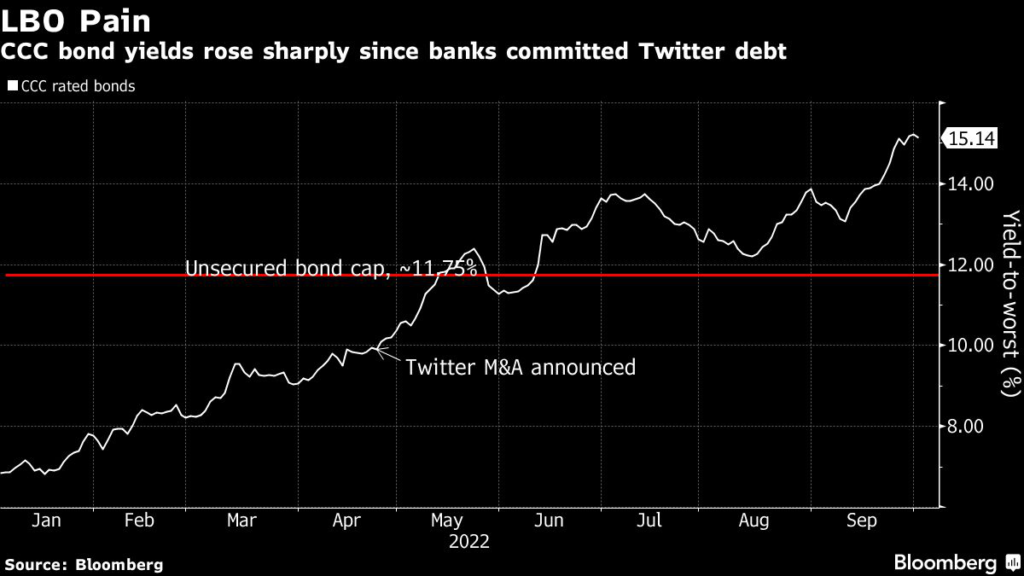
The group of banks was already facing potential losses of hundreds of millions of dollars on the riskiest unsecured bonds if they had to sell the debt at current market levels. They promised a maximum interest rate of about 11.75% on the unsecured bond portion, Bloomberg reported, but CCC debt now trades on average at around 15%, according to Bloomberg data.

Read more: Musk’s Debt Bankers Would Avoid Steep Losses If Deal Fails (1)

Twitter shareholders voted Sept. 13 to accept the buyout offer as Musk originally submitted it. Depending on the closing date of the deal, banks will have a limited amount of time to offload the debt to investors. That would force them to fund the financing themselves — as is expected on another big buyout deal in the pipeline for Nielsen Holdings Plc. 

Wall Street has been struggling to offload leveraged buyout debt in recent months. Part of the package for Citrix Systems Inc., for example, sold in September at a steep discount and left the banks holding about $6.5 billion of debt and realizing roughly $600 million in losses. Shortly after, a group of banks got stuck with roughly $4 billion of bonds and loans tied to an Apollo Global Management Inc.-backed buyout that wasn’t able to garner much demand and was pulled from the market last week. 

As the economy continues to tip toward a downturn, investors have shied away from risky transactions and are instead putting money into higher-rated credits. Some high-yield managers are even allocating cash to investment-grade obligations given that those companies are best positioned to weather a recession and are offering yields at levels not seen in more than a decade.

(Updates throughout with Musk’s official letter he is going through with the acquisition.)

More stories like this are available on bloomberg.com

©2022 Bloomberg L.P.
Nasdaq to Wait for Regulation Before Launching Crypto Exchange

(Bloomberg) — Nasdaq Inc. will likely wait until there is greater regulatory clarity and institutional adoption around crypto exchanges before debuting plans to launch one of of its own, says Tal Cohen, the company’s executive vice president and head of North American markets.

“Those are discussions we are happy to have,” Cohen told Bloomberg TV on Tuesday. “But right now, on the retail side, the market is fairly saturated,” he added. “There’s a number of exchanges servicing the retail customer base.” 

Instead, the company will stay focused on its crypto custody services which Cohen says are foundational for clients, citing “massive” demand and opportunity there. “We think if you can safe-keep peoples’ assets, they’ll trust you to do everything else afterwards,” he said.

On top of safe-keeping services, Nasdaq will also work on building out its execution capabilities to facilitate the movement and transfer of the assets, said Cohen. 

Last month, the world’s second-largest stock exchange announced it would offer custody services for Bitcoin and Ether to institutional investors. The firm recruited Ira Auerbach, who ran prime broker services at crypto exchange Gemini, to head the new Nasdaq Digital Assets unit.


More stories like this are available on bloomberg.com

©2022 Bloomberg L.P.
Amazon Sues Washington Safety Regulator Over Warehouse Fines

(Bloomberg) — Amazon.com Inc. is suing the Washington State Department of Labor & Industries, escalating a clash over fines the regulator issued regarding safety practices in the company’s warehouses. 

In a complaint filed in federal court in Seattle on Monday, Amazon asked a judge to set aside orders to remedy workplace hazards during the company’s appeal on the grounds that the state’s procedures for addressing workplace violations contravene due process protections in the US Constitution’s Fourteenth Amendment. 

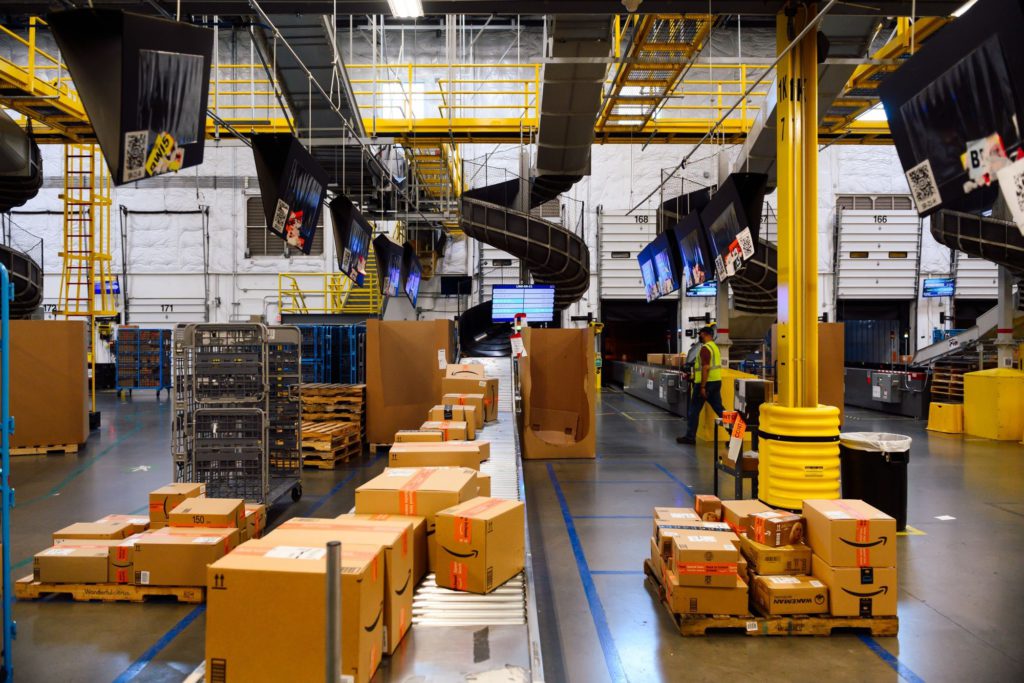
The company’s home state workplace safety regulator in March found that Amazon was “knowingly putting workers at risk” at a Kent, Washington, warehouse, called BFI4, and fined the company $60,000. 

Owing to similar findings during previous inspections, the regulator declared the citation a willful violation, a more serious contention that imposes higher penalties and orders Amazon to move quickly to address the issues. It was the third Amazon warehouse Washington regulators had cited for injury risk in less than a year and coincided with mounting data showing Amazon warehouses have higher rates of injuries than other logistics employers. 

Amazon denied the allegations and contested the fines, asking the regulator to stay its orders to abate the alleged hazards while an appeal was pending. The state’s Board of Industrial Insurance Appeals denied that request in August — citing procedural violations by Amazon, including a failure to certify that the company had posted notices in its facilities informing workers of its appeal. Hearings on the citations had been scheduled to begin in January, before being postponed to summer 2023 after scheduling conflicts. 

Fixing the alleged hazards would be “tremendously disruptive to Amazon’s operations,” requiring a redesign of the facilities to meet ergonomic standards that are not well defined by the state, the company said in its Monday complaint. “That lack of clarity affords the Department near limitless discretion to interfere in the details of company operations, all in the name of reducing unsubstantiated alleged hazard,” the company said. 

“The safety of our employees is our top priority, and we disagree with these allegations and look forward to showing the facts as the legal process plays out,” Amazon spokesperson Maureen Lynch Vogel said in an emailed statement. “In this particular filing, we’re challenging an unusual state requirement that says we need to change our operations prior to a full and fair hearing on the merits, which we don’t believe is the right approach.”

Matt Ross, a spokesperson for the Washington State Department of Labor & Industries, said that office and the Washington State Attorney General’s office were reviewing the lawsuit, and didn’t immediately have further comment. The lawsuit was reported earlier by technology news site GeekWire. 

The department had said in a March release it had provided Amazon “numerous options to reduce the risk of injuries,” including “installing height adjustable platforms to reduce awkward lifting, using powered equipment to move heavy pallets, and setting a safe pace of work for each process.” 

The case is Amazon.com Services LLC v. Joel Sacks and the Department of Labor & Industries of the State of Washington, 22-cv-01404, US District Court, Western District of Washington (Seattle).

(Updated with citation hearing schedule, Washington state comment, starting in the fifth paragraph.)

More stories like this are available on bloomberg.com

©2022 Bloomberg L.P.

Celsius Says Co-Founder Daniel Leon Has Resigned From Crypto Lender

(Bloomberg) — Celsius Network Ltd., the crypto lender that filed for bankruptcy, said that co-founder Daniel Leon resigned this week. 

“We confirm that Daniel Leon resigned from his position at Celsius and is no longer part of the organization,” the company said in a statement Tuesday to Bloomberg News.

Fellow co-founder and Celsius chief executive officer, Alex Mashinsky stepped down last week. The once high-lying crypto lender is going through bankruptcy after having left thousands of investors in a lurch after making risky bets before the collapse of cryptocurrency prices. In July, the company disclosed a $1.19 billion deficit. The bankruptcy judge in the case recently appointed an examiner to look into allegations of misconduct against the company and its management.

Celsius claimed to take on traditional banks, by letting people invest their coins and receive interest on them. In many of its YouTube videos, the company downplayed risks of such investing.

Celsius is currently accepting bids for its assets, and may consider doing an auction on Oct. 20, according to a Monday filing. A sale hearing is scheduled for Nov. 1. Crypto billionaire Sam Bankman-Fried is considering going after the assets, Bloomberg reported earlier.

Leon, whose LinkedIn profile says he is based in Israel, said in a Sept. 5 court filing that he owns 32,600 shares of Celsius’s common stock.

In a June 2021 YouTube video, Leon said he ran into Mashinsky in 2017 while in New York, and they decided to work together, eventually deciding to start Celsius.

(Adds information on the resignation of the other co-founder, starting in the third paragraph.)

More stories like this are available on bloomberg.com

©2022 Bloomberg L.P.
Long-Festering Debate Over Social Media Liability to Get Supreme Court Review

(Bloomberg) — The Supreme Court’s decision to hear a case challenging a legal shield for social media platforms puts the justices in the middle of a politically fraught debate over whether some of the world’s most powerful companies should be protected as neutral forums for speech or held accountable for the content. 

At stake is the very business model that has allowed companies like Alphabet Inc.’s Google, Meta Platforms Inc. and Twitter Inc. to reap enormous profits while shaping civic discourse.

The case involves a lawsuit brought by the family of Nohemi Gonzalez, a 23-year-old US citizen who was among 129 people killed in coordinated attacks by ISIS in Paris in November 2015. Gonzalez’s family says Google’s YouTube service, through its algorithms, violated the Anti-Terrorism Act by recommending the terrorist group’s videos to other users.

In announcing Monday that it was taking up Gonzalez v. Google, the Supreme Court agreed to hear a challenge to Section 230 of the 1996 Communications Decency Act, which protects online platforms from liability for user-generated content. 

“The Supreme Court hearing the Gonzalez case and ruling on where the limits are in immunizing these tech companies is a pivotal moment in culture and the law,” said Carrie Goldberg, a victims’ rights lawyer who has sued social media companies. “Our society has gone from seeing big tech platforms as untouchable by law and legislation to finally recognizing that when left to run amok they can cause atrocious personal and social injuries.” 

Courts have interpreted Section 230 as giving a legal shield to internet companies when they decide how to display third-party content. Gonzalez’s family said the algorithmic recommendations are equivalent to editorial judgment and shouldn’t be protected by the liability provision.

Google says YouTube at the time of the attack used a sidebar tool to queue up videos based on user inputs including browsing history. The company says the only alleged link between the Paris attacker and YouTube was that one attacker was an active user of the video-sharing service and once appeared in an ISIS propaganda video.

The court on Monday also announced it would hear a related case involving allegations that Twitter and other social media sites helped facilitate acts of international terrorism through their services. That case, Twitter v. Taamneh, could clarify an anti-terrorism law that allows victims to sue those who have aided a terrorist group.

Google, Twitter and Meta declined to comment on the court’s decision to take up the cases.

Congress for years has debated the need to reform or revoke Section 230, but there has been little action in the face of partisan differences over the best approach and the practical difficulties of writing legislation for complex technology. 

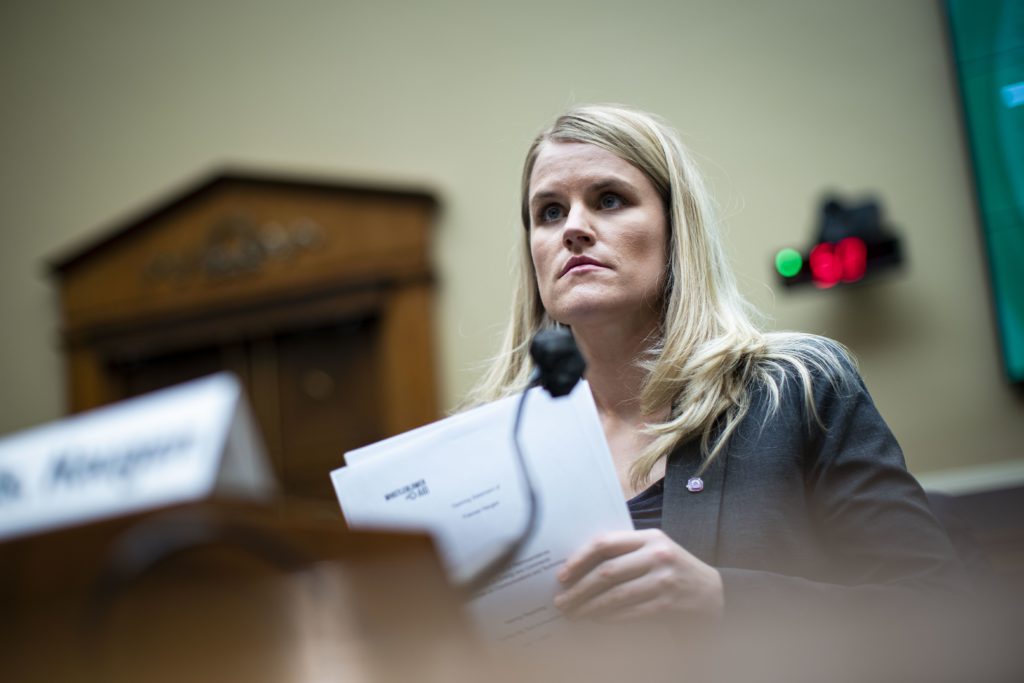
The issue was reignited last year when a Facebook whistle-blower, Frances Haugen, released thousands of internal documents revealing that the company understood the control it exerts over the flow of information and that the mechanics “are not neutral.” 

Republicans, including former President Donald Trump, have threatened to revoke Section 230 protections as punishment for platforms they accuse of censoring conservative viewpoints. Democrats have made the opposite argument: that tech companies should do more to remove offensive content or face legal consequences. 

Republican-controlled legislatures in Texas and Florida have each passed laws taking aim at what they view as social media censorship. The Texas law bars social media platforms with more than 50 million users from discriminating on the basis of viewpoint and the Florida law requires platforms to host political candidates. 

The laws were challenged by a tech industry trade association, and while one federal appeals court struck down Florida’s law in May, another court last month upheld Texas’ law. NetChoice, which represents Meta, Twitter, and other tech companies, has petitioned the Supreme Court to resolve the split. 

Google Chief Executive Officer Sundar Pichai told Congress last year that revoking Section 230 would revert content moderation to the early 1990s before that protection from lawsuits existed. “Platforms would either over-filter content or not be able to filter content at all,” Pichai said.

‘Remove’ Section 230 

The White House, in remarks released in September after a technology policy roundtable, called for reforming the industry. Among the recommendations: “remove special legal protections for large tech platforms” afforded by Section 230. Now the Supreme Court has the opportunity to do just that. 

The high court in 2020 declined to hear an appeal regarding Facebook’s liability for posts advocating violence in Israel. But a concurring opinion from Justice Clarence Thomas on a different case earlier this year made clear that he was willing to entertain challenges to this provision of the 1996 law. 

“Assuming Congress does not step in to clarify Section 230’s scope, we should do so in an appropriate case,” he wrote. “When Congress enacted the statute, most of today’s major internet platforms did not exist.”

It is in some ways an unusual case for the court to take up, according to Carter Phillips, a veteran Supreme Court advocate, since it wouldn’t be resolving a conflict between two different appeals courts. Agreeing to hear the case suggests that the high court is “unusually interested in getting at the question of the scope of Section 230 and how that will regulate the tech industry,” Phillips said Monday on Bloomberg TV. 

This court has shown a willingness to consider controversial cases with sweeping implications for society and the law, such as this year’s decision overturning the precedent that protected abortion access. But it’s unclear where the ideological lines will fall on this case, according to Jeff Kosseff, a cybersecurity law professor at the US Naval Academy. 

Appeals Ruling

“You can tell that some justices thought it was important enough to hear, but I don’t know if they all thought that for the same reason,” Kosseff said. “You need five justices to agree on a particular way to read a statute. I don’t know if we have that.”

Two lower courts, including the San Francisco-based 9th US Circuit Court of Appeals, sided with Google and said the lawsuit should be dismissed. 

Eric Goldman, an internet law professor at Santa Clara University who supports leaving liability protections intact, said the San Francisco-based court’s opinion “exuded an unusually high degree of hostility to Section 230” in what he described as an “extremely problematic” ruling. Where the Supreme Court comes down — and the scope of an eventual ruling — could drastically change how user-generated content moves around the internet, Goldman said. 

Altering Section 230, or making its protections conditional on other factors, would negate the provision entirely, according to Cathy Gellis, an internet law attorney who has written appeals court amicus briefs supporting Section 230. 

“Every time we try to narrow Section 230 to not cover this, or not cover that, or cover something only conditionally, then all of the sudden there’s no point in having Section 230 at all,” Gellis said. “Because you’re going to go to court to fight over whether Section 230 applies to you.”

(Updates with details of state laws begining in 13th paragraph)

More stories like this are available on bloomberg.com

©2022 Bloomberg L.P.
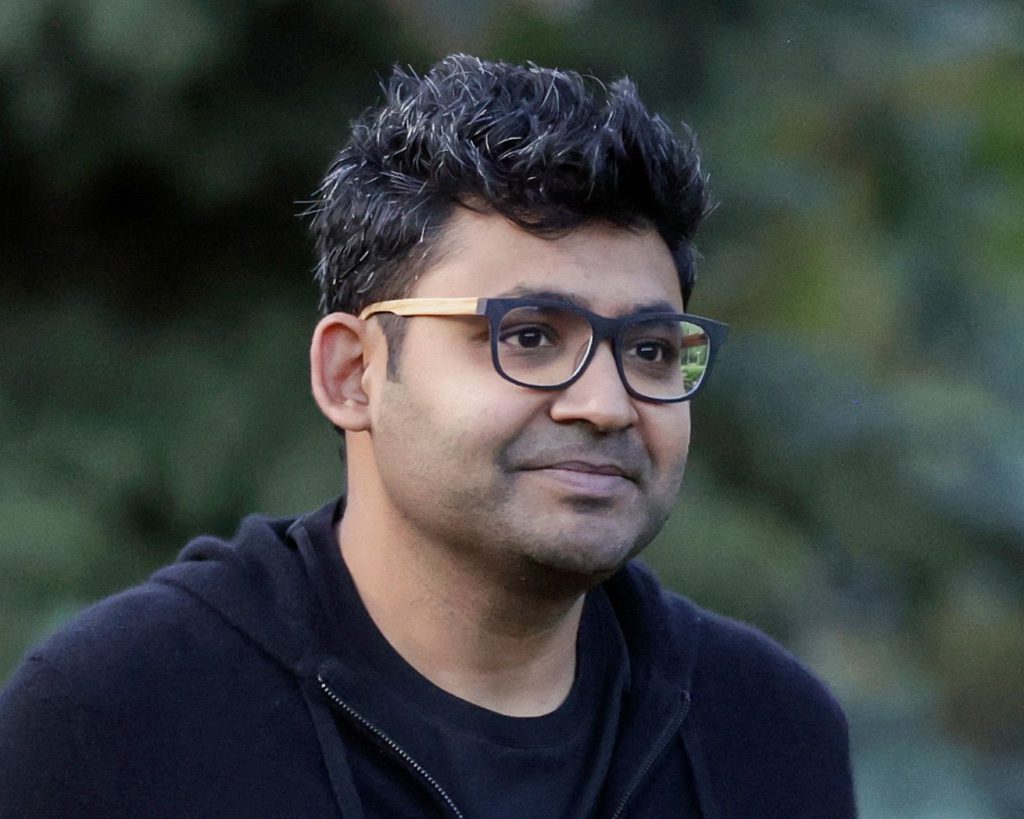
Musk Proposes to Buy Twitter for Original Price of $54.20 a Share

(Bloomberg) — Elon Musk revived his bid for Twitter Inc. at the original offer price of $54.20 a share, potentially avoiding a courtroom fight over one of the most contentious acquisitions in recent history. 

Musk made the proposal in a letter to Twitter, according to people familiar with the matter, who asked not to be identified discussing confidential information. Shares in Twitter climbed as much as 18% on the news, and trading has since been halted. Musk and representatives for San Francisco-based Twitter didn’t respond to requests for comment on the letter or whether the company would accept the proposal.

Musk’s offer to match the original deal terms means Twitter is facing a future under the leadership of a mercurial billionaire who has spent months publicly criticizing its management, questioning its value and changing his mind. It also means that his contested claims — that Twitter was lying about which percentage of users were bots, for instance — are not likely to be scrutinized in a courtroom.

Musk had been trying for months to back out of his contract to acquire Twitter, signed in April. The billionaire began showing signs of buyer’s remorse shortly after the deal was announced, alleging that Twitter had misled him about the size of its user base and the prevalence of automated accounts known as bots.

Musk formally quit the accord in July and Twitter sued him in Delaware Chancery Court to force him to go forward with the purchase. A trial is scheduled to begin Oct. 17. The judge in Delaware on Tuesday asked both sides to come back to her with a proposal on how the case can now proceed. The options include having Twitter seek to dismiss the case or have her continue to retain jurisdiction until the deal closes, said a person familiar with the matter.

In the weeks-long run-up to the Delaware showdown, lawyers for both sides have fired cannonades of subpoenas at each other aimed at teasing out testimony and evidence. Musk’s side needed to demonstrate that Twitter violated the terms of the deal. Twitter alleged that Musk used the bots issue as a pretext for backing out a deal he no longer found economically sound. 

Musk’s legal team was getting the sense that the case was not going well, as Judge Kathaleen St. J. McCormick sided repeatedly with Twitter in pretrial rulings, according to one person familiar. Even with the late emergence of a Twitter whistleblower who alleged executives weren’t forthcoming on security and bot issues, there were concerns Musk’s side would not be able to prove a material adverse effect, the legal standard required to exit the contract.

Inside Twitter on Tuesday, many employees were sitting through 2023 planning presentations when the news first started to circulate, according to multiple sources. Presenters did not acknowledge the news, which staffers saw spreading on their own social network. Many employees have opposed the idea of working for Musk, who has been openly mocked and criticized on internal Slack channels since the deal was signed.

Twitter shareholders voted Sept. 13 to accept the buyout offer as Musk submitted it. The company said at the time that 98.6% of the votes cast were in favor of the deal. Musk, Twitter’s largest shareholder, didn’t vote at all, according to two people familiar with his decision. Musk owned almost 10% of Twitter — more than 73 million shares — when he agreed to acquire the company.

Musk was scheduled to answer questions about the deal in Austin, Texas, on Oct. 6-7, according to a court filing Tuesday. Twitter Chief Executive Officer Parag Agrawal was scheduled to sit down for his deposition Monday.  

The case is Twitter v. Musk, 22-0613, Delaware Chancery Court (Wilmington).

(Updates with detail from judge’s request in fifth paragraph.)

More stories like this are available on bloomberg.com

©2022 Bloomberg L.P.
Amazon Freezes Corporate Hiring in Retail Business With Slowing Sales

(Bloomberg) — Amazon.com Inc. has paused hiring for corporate positions in its retail business, the latest sign that the world’s largest e-commerce company is adjusting its workforce to slowing online sales. 

The company will pause recruitment until the end of the year, according to a person familiar with the matter. The freeze applies to corporate roles in the Worldwide Amazon Stores division, not the warehouse network where most of its employees work, the person said.

“Amazon continues to have a significant number of open roles available across the company,” Amazon spokesman Brad Glasser said in a statement Tuesday. “We have many different businesses at various stages of evolution, and we expect to keep adjusting our hiring strategies in each of these businesses at various junctures.”

Amazon is the latest tech company to try to control costs amid signs of a weakening economy. Meta Platforms Inc. last month announced plans to reduce headcount for the first time.

Chief Executive Officer Andy Jassy has pledged to unwind part of a pandemic-era expansion that saddled Amazon with a surfeit of warehouse space and too many employees. The company has shuttered, delayed or abandoned plans for dozens of warehouses in the US and Europe, Bloomberg reported in September. 

Amazon reduced its workforce — primarily through attrition, the company says — by almost 100,000 people between March and June, the biggest quarterly decline in its history. Amazon had more than 1.5 million full- and part-time workers as of June 30.

The New York Times earlier reported the freeze on corporate hiring in Amazon’s retail business, citing an internal e-mail. The newspaper said the hiring pause would not affect the company’s highly profitable cloud services unit.

More stories like this are available on bloomberg.com

©2022 Bloomberg L.P.
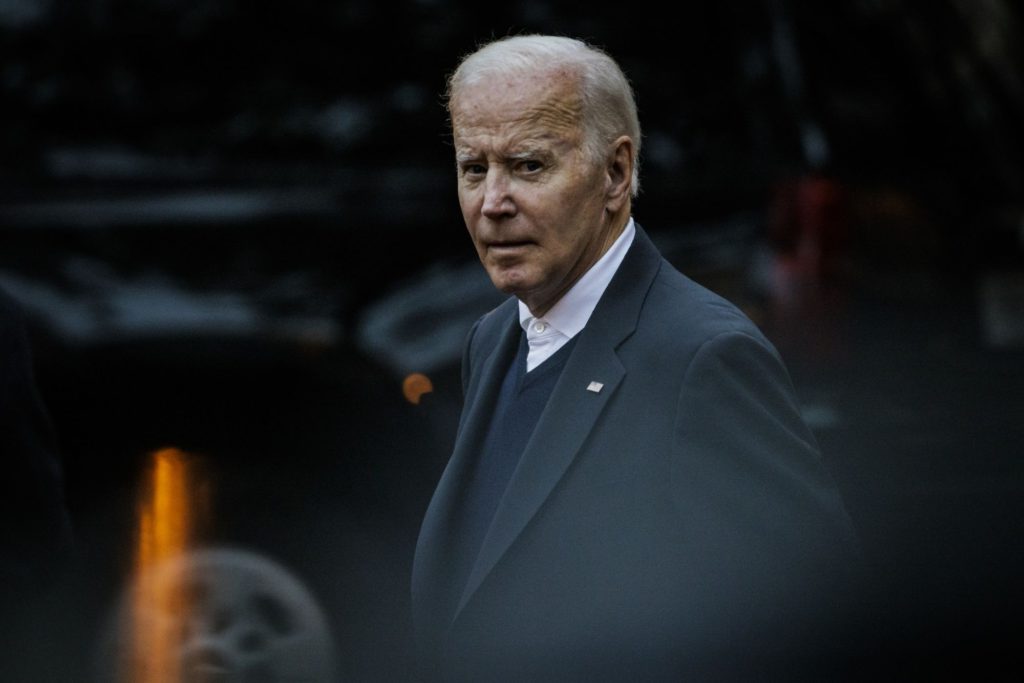
Biden Heads to New York for IBM Jobs Event and Fundraisers

(Bloomberg) — President Joe Biden will head to the New York area Thursday for a jobs event hosted by IBM Corp. and a pair of fundraisers ahead of November’s midterm elections.

The trip will include a visit to the IBM campus in Poughkeepsie, according to a White House official who asked not to be identified because the trip hasn’t yet been announced.

The company has promoted key elements of Biden’s legislative agenda: IBM Chairman Arvind Krishna attended the August signing ceremony for legislation providing subsidies for US semiconductor manufacturers, and IBM lobbied lawmakers to pass a bipartisan infrastructure bill that includes funding to build out broadband networks.

Biden is expected to then travel to New Jersey for a fundraiser hosted by the Democratic National Committee. The event will be held at the Middletown home of Gov. Phil Murphy, a former Goldman Sachs Group Inc. executive, NJ Advance Media reported. 

From there, Biden will travel into New York City for a fundraiser to benefit the Democratic Senatorial Campaign Committee. That event will be hosted by James Murdoch — son of News Corp. Chairman Rupert Murdoch — Politico previously reported.

More stories like this are available on bloomberg.com

©2022 Bloomberg L.P.
Twitter LBO Revives $12.5 Billion Headache for Wall Street Banks

(Bloomberg) — Elon Musk’s shock proposal to proceed with his acquisition of Twitter Inc. for the original offer price poses a headache at the worst possible time for Wall Street banks already struggling to offload billions of dollars in buyout debt they committed to in better times.

After months of legal drama in an attempt to back out of the deal, billionaire Musk is now willing to buy the social-media giant for $54.20 a share, Bloomberg News reported Tuesday, citing people familiar with the matter. 

If terms of the original $12.5 billion financing package remain the same, bankers may struggle to sell the risky Twitter buyout debt just as credit markets begin to crack. On the current trajectory, they’re potentially on the hook for hundreds of millions of dollars of losses on just the unsecured portion, if they try to offload it to investors given yields are now at multiyear highs.

The Twitter debt package is the largest in a roughly $51 billion pipeline of risky committed financings that banks need to sell to asset managers, according to Deutsche Bank AG estimates. 

It all threatens to fuel a wider fallout in corporate debt markets. New issues have come to a virtual standstill given muted investor appetite and rising balance-sheet constraints at the big banks as the Federal Reserve ramps up interest rates.

Read more: Confused by Musk’s Twitter LBO? Here’s What’s Weird: QuickTake

“It’s similar to a vegetarian going to a steakhouse: Very limited appetite,” said John McClain, a high-yield portfolio manager at Brandywine Global Investment Management, referring to investor demand for buyout debt. “Given the incremental company specific news flow since the deal was agreed to — combined with the meaningful deterioration in the economy — lenders will be very hesitant to provide financing.”

The most recent version of the Twitter debt package announced in April includes a $6.5 billion leveraged loan, $3 billion of secured bonds, and another $3 billion of unsecured bonds, with the latter particularly tricky to sell in recent months as the capital structure is riskier. 

Banks had originally planned to sell all that debt to institutional asset managers. In addition, banks are providing a $500 million revolving credit facility that they plan to hold. 

A spokesperson for Morgan Stanley, which is the lead underwriter on the deal, declined to comment. Representatives for Twitter and Musk did not immediately respond to a request for comment.

The group of banks was already facing potential losses of hundreds of millions of dollars on the riskiest unsecured bonds if they had to sell the debt at current market levels. They promised a maximum interest rate of about 11.75% on the unsecured bond portion, Bloomberg reported, but CCC debt now trades on average at around 15%, according to Bloomberg data.

Read more: Musk’s Debt Bankers Would Avoid Steep Losses If Deal Fails (1)

Twitter shareholders voted Sept. 13 to accept the buyout offer as Musk originally submitted it. Depending on the closing date of the deal, banks will have a limited amount of time to offload the debt to investors. That would force them to fund the financing themselves — as is expected on another big buyout deal in the pipeline for Nielsen Holdings Plc. 

Wall Street has been struggling to offload leveraged buyout debt in recent months. Part of the package for Citrix Systems Inc., for example, sold in September at a steep discount and left the banks holding about $6.5 billion of debt and realizing roughly $600 million in losses. Shortly after, a group of banks got stuck with roughly $4 billion of bonds and loans tied to an Apollo Global Management Inc.-backed buyout that wasn’t able to garner much demand and was pulled from the market last week. 

As the economy continues to tip toward a downturn, investors have shied away from risky transactions and are instead putting money into higher-rated credits. Some high-yield managers are even allocating cash to investment-grade obligations given that those companies are best positioned to weather a recession and are offering yields at levels not seen in more than a decade.

More stories like this are available on bloomberg.com

©2022 Bloomberg L.P.

Apple Receives Complaint From Labor Board in New York Case

(Bloomberg) — The US National Labor Relations Board issued a complaint against Apple Inc. in a New York City case, spurred by an accusation from the Communications Workers of America that the company has suppressing union organizing efforts.

The complaint followed a CWA filing alleging that Apple interrogated staff, restricted the posting of union flyers and required employees to attend mandatory anti-union speeches. The conduct took place at Apple’s World Trade Center store in Manhattan, a CWA representative said in May.

Apple said Tuesday that it disagrees with the allegations. “We are fortunate to have incredible retail team members and we deeply value everything they bring to Apple,” the company said in an emailed statement. “We regularly communicate with our teams and always want to ensure everyone’s experience at Apple is the best it can be.”

Apple’s retail chain, which includes more than 270 stories in the US, has increasingly become a focal point for union organizers. CWA has said that it is in touch with Apple employees around the country, and staffers in Oklahoma City are slated to vote next week in an NLRB election on whether to become the first Apple retail workers to join the group.

“It is past time for Apple’s senior management to respect its retail employees and stop its unlawful attempts to prevent them from forming unions,” CWA’s secretary-treasurer, Sara Steffens, said in an emailed statement Tuesday. “Apple has a choice — does it want to be known for intimidating its workers and creating a culture of fear, or does it want to live up to its stated values and welcome true collaboration with all of its employees — including retail workers.”

Employees in Maryland voted in June to join another union, the International Association of Machinists, marking one of the most prominent in a series of landmark labor wins over the past year at top US businesses. CWA also filed a still-pending NLRB claim against Apple in Atlanta, where in May the labor group withdrew a petition for a unionization vote, citing alleged union-busting by the company.

Complaints issued by labor board prosecutors are considered by administrative law judges, whose rulings can be appealed to NLRB members in Washington and from there to federal court. The agency can order companies to change policies that conflict with the law, but it lacks authority to issue punitive damages for violations.

(Updates with Apple comment in third paragraph.)

More stories like this are available on bloomberg.com

©2022 Bloomberg L.P.

Close Bitnami banner
Bitnami