Bloomberg

Social Media Company Liability Draws Supreme Court Scrutiny

(Bloomberg) — The US Supreme Court will decide whether social media companies can be sued for hosting and recommending terrorist content, taking up two cases that challenge their liability protections.

The cases mark the court’s first test of the broad immunity social media companies have enjoyed under a provision known as Section 230, part of the 1996 Communications Decency Act. Section 230 has become a target of conservatives, including former President Donald Trump, who say it lets left-leaning tech companies censor right-wing voices.

In one case, Alphabet Inc.’s Google is trying to defeat a suit involving Nohemi Gonzalez, a 23-year-old US citizen who was among 129 people killed in coordinated ISIS attacks in Paris in November 2015. Gonzalez’s family says Google’s YouTube service, through its algorithms, violated the Anti-Terrorism Act by recommending the terrorist group’s videos to other users.

Courts have interpreted Section 230 as immunizing computer services when they are engaged in activities traditionally performed by publishers, such as deciding whether to display or edit third-party content. But Gonzalez’s family says recommendations are a different matter.

‘Enormous’ Importance

“Whether Section 230 applies to these algorithm-generated recommendations is of enormous practical importance,” the family argued in the appeal. “Interactive computer services constantly direct such recommendations, in one form or another, at virtually every adult and child in the United States who uses social media.”

Google says YouTube at the time of the attack used a sidebar tool to queue up videos based on user inputs including browsing history. The company says the only alleged link between the Paris attacker and YouTube was that one attacker was an active user of the video-sharing service and once appeared in an ISIS propaganda video.

“This court should not lightly adopt a reading of section 230 that would threaten the basic organizational decisions of the modern internet,” Google argued.

Two lower courts, including the San Francisco-based 9th US Circuit Court of Appeals, sided with Google and said the lawsuit should be dismissed.

The Supreme Court also agreed to hear a related appeal by Twitter Inc. in a case stemming from a 2017 terrorist shooting in an Istanbul nightclub. In same ruling that absolved Google for the Paris attacks, the appeals court said Twitter, Google and Meta Platforms Inc.’s Facebook had to face claims that they played a role in the Istanbul attack by failing to identify and remove ISIS materials. 

Twitter contends the appeals court improperly expanded the scope of the Anti-Terrorism Act by letting the suit go forward. 

Calls on Congress

In May 2020, the Supreme Court declined to address a similar case, turning down an appeal on whether Section 230 protected Facebook from a lawsuit brought by US citizens injured in terror attacks in Israel who alleged the social network promoted posts by terrorist group Hamas.

The US Court of Appeals for the 2nd Circuit had ruled earlier that Section 230 barred the suit, but the chief judge of the court dissented, criticizing the extensive immunity courts have granted to internet companies and calling on Congress to amend the law.

In March, Justice Clarence Thomas urged the court to take up a case addressing “the proper scope of immunity” under the law in a concurrence. “Assuming Congress does not step in to clarify Section 230’s scope, we should do so in an appropriate case,” he wrote.

Trump had also set his sights on Section 230, directing his then Attorney General Bill Barr to send a proposal to Congress for how to impose new requirements on how the companies manage their content policies. Although several legislative proposal were floated, no changes were made to the measure.

Barr had highlighted the case as one where courts have granted “virtually limitless immunity” to shield online platforms. The Justice Department reviewed Section 230 as part of its investigation into major online platforms like Google and Facebook, and held a workshop on the issue.

The court will hear arguments early next year and rule by the end of its term in late June. The cases are Gonzalez v. Google, 21-1333 and Twitter v. Taamneh, 21-1496. 

EXPLAINER: Twitter, Trump and How Online Speech Is Moderated

(Updates with timeframe for court to hear case in last paragraph. An earlier version corrected description of Thomas statement.)

More stories like this are available on bloomberg.com

©2022 Bloomberg L.P.

Nvidia to Cease All Russia Operations as Ukraine War Rages On

(Bloomberg) — Nvidia Corp., the most valuable US chipmaker, is closing up operations in Russia after that country’s invasion of Ukraine entered its eighth month and President Vladimir Putin mobilized hundreds of thousands of reservists. 

Nvidia had already suspended shipments to Russia but kept a presence there “to support our employees and their families,” the company said in a statement Monday. Now it is “ceasing all activities” in the country, Nvidia said.

“With recent developments, we can no longer operate effectively there,” the Santa Clara, California-based chipmaker said. “All employees will be given the option of continuing their jobs in other countries.”

Nvidia was part of a wave of tech companies cutting off deliveries to Russia shortly after the invasion began in February. It later blamed the war for hurting its financial outlook.

Putin has struggled to gain ground in Ukraine, and the mobilization of more troops has triggered an exodus of Russians trying to avoid being sent to the front lines. The president also moved to annex four occupied regions in Ukraine last month, drawing international condemnation.

Reuters previously reported on Nvidia pulling out of Russia. 

More stories like this are available on bloomberg.com

©2022 Bloomberg L.P.

Facebook Post Spurs Hours of Questioning for Sierra Leone Mayor

(Bloomberg) — Police in Sierra Leone questioned the mayor of Freetown, the West African nation’s capital, for at least seven hours over a Facebook post protesting the arrest of one of her councilors.

Mayor Yvonne Aki-Sawyerr complained in a live video filmed in front of police about the arrest of Councilor Sheku Turay, who was detained for allegedly inciting deadly violence earlier this year.

Turay and Aki-Sawyerr were about to board a flight to New York to attend the Bill & Melinda Gates Foundation’s Goalkeepers event last month when he was apprehended. Police then invited Aki-Sawyerr to answer questions on “an alleged case of obstruction of police duties and disorderly behavior,” a police notice shows.

Aki-Sawyerr, arrived to the police’s Crime Investigation Department in Freetown Monday at 10 a.m. and was still under questioning seven hours later, another councilor, Zainab Conteh, said by phone. A police spokesperson didn’t immediately respond to a call and message seeking comment.

There have been simmering tensions between the ruling Sierra Leone People’s Party and Aki-Sawyerr’s opposition All People’s Congress party as the nation heads toward an election in 2023.  

President Julius Maada Bio blamed the opposition — including the mayor– for the deadly protests in August against the rising cost of living. Inflation accelerated to 29.5% in July, and the government’s high debt burden limited its ability to help subsidize costs for the nation’s 8 million people. Aki-Sawyerr has denied any involvement in the protests that led to the deaths of at least 20 people. 

The mayor was among 15 winners of Bloomberg Philanthropies’ Global Mayors Challenge this year for her proposal to tackle deforestation by using digital technologies to support tree maintenance in Freetown. Winners get $1 million grant to implement the projects over three years. 

Bloomberg Philanthropies founder Michael Bloomberg is the majority owner of Bloomberg LP, the parent of Bloomberg News.

Local media have touted Aki-Sawyerr as a likely All People’s Congress vice-presidential candidate for next year’s election. Aki-Sawyerr said she’s keen to run for mayor again.

More stories like this are available on bloomberg.com

©2022 Bloomberg L.P.

S&P 500 Jumps 3% After Washout as Bond Yields Sink: Markets Wrap

(Bloomberg) — Stocks kicked off the week with big gains after suffering their worst September in two decades as Treasury yields halted a seemingly endless surge, with weak US manufacturing data soothing concern that the Federal Reserve will overtighten monetary policy.

As a sign of exhaustion of the recent selling, 97% of the S&P 500 shares flashed green, with the gauge up about 3% and on pace for its best day since June. Aside from being oversold from a technical perspective, extreme pessimism and low fund positioning also fueled a rebound that followed its third-worst performance during the first nine months of a year since 1931.

In a world of bad-economic-news-is-good-news as far as Fed policy goes, a drop in the Institute for Supply Management’s gauge of factory activity suggested the economy may be faltering — reducing the urgency for more aggressive hikes. Equities also managed to gain even in the face of Credit Suisse Group AG’s market turmoil and disappointing deliveries from Tesla Inc. 

“The market is oversold, and sentiment is extremely negative, so a bounce…even a sharp one…could happen at any time,” wrote Matt Maley, chief market strategist at Miller Tabak + Co. “However, we see lower-lows before the ultimate bottom is reached for this bear market…as the stock market has not fully priced-in a recession.”

With the equity bounce, the Cboe Volatility Index — the market’s so-called fear gauge — tumbled back below 30. The VIX closed above that threshold every day last week. Nicholas Colas at DataTrek Research said Friday he’d like to see the gauge closing over that mark for several more days before believing on a “tradeable low.”

Read: BofA’s Subramanian Says Wall Street Hasn’t Fully Capitulated Yet

Treasuries surged across the curve, with the five-year yield at one point plummeting over 30 basis points. The 10-year rate sank to 3.6% after recently topping 4% and climbing for nine straight weeks. Swaps tied to Fed policy meeting dates fell sharply for early 2023. The March meeting contract’s rate currently suggests a peak policy rate of 4.40% next year, down from recent highs above 4.60%.

The dollar slipped, yet the latest MLIV Pulse survey showed the greenback is expected to hit new highs over the next month. Gold surged. US coal prices surged past $200 for the first time as a global energy crunch drives up demand for the dirtiest fossil fuel. Oil rallied as the OPEC+ alliance considers slashing production to revive prices when it meets this week.

The Fed should consider stopping its tightening campaign after one more rate hike in November, according to Ed Yardeni, who coined terms like “Fed Model” and “bond vigilantes.” The stress in financial markets from big rate increases, a surging dollar and quantitative tightening has reached the point that officials should make financial stability the top priority, he added.

“Investors are starting to doubt central banks globally will remain aggressive with fighting inflation as financial stability risks are growing,” said Ed Moya, senior market analyst at Oanda. “It is too early to call for a Fed pivot, but it seems the action in Treasury markets suggests traders are growing confident that the global growth slowdown is starting to drag down pricing pressures.”

Despite the rebound in stocks and bonds, markets are bracing for more turbulence as a crucial reading on the still-tight US labor market is set to give traders a chance to reassess the Fed’s commitment to its aggressive path of rate hikes. Friday’s release of September job figures looms as a test of the central bank’s plan to rein in inflation by tightening policy further and unwinding its mammoth balance sheet.

Read: Credit Wipeout Foretells More Junk-Debt Pain as Recession Looms

Brazilian assets soared after President Jair Bolsonaro secured his way to a runoff election against Luiz Inacio Lula da Silva as investors cheered on the incumbent’s better-than-expected showing and bet his leftist challenger will be forced to moderate his stances in the second stretch of the race. The real was the best-performing among the world’s major currencies Monday.

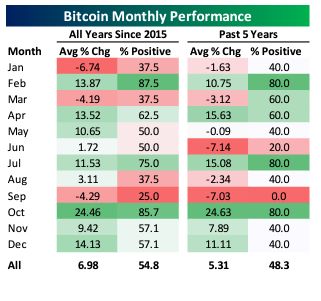
After two consecutive months of declines, Bitcoin advocates are hoping that the largest cryptocurrency reverts to form in October, which has typically been one of its best months for gains. The virtual currency tends to rise roughly 25% in October and has, since 2015, advanced more than 85% of the time during it, according to Bespoke Investment Group.

Traders are betting it will take a bigger UK government policy U-turn to restore credibility with markets. Wagers against the pound over the next year have climbed to a record high in the options market, even after Chancellor Kwasi Kwarteng said he will scrap a proposed tax cut for the country’s highest earners.

Key events this week:

  • Eurozone PPI, Tuesday
  • US factory orders, durable goods, Tuesday
  • Fed’s John Williams, Lorie Logan, Loretta Mester, Mary Daly speak at events, Tuesday
  • Eurozone services PMIs, Wednesday
  • OPEC+ meeting begins, Wednesday
  • Fed’s Raphael Bostic speaks, Wednesday
  • Eurozone retail sales, Thursday
  • US initial jobless claims, Thursday
  • Fed’s Charles Evans, Lisa Cook, Loretta Mester speak at events, Thursday
  • US unemployment, wholesale inventories, nonfarm payrolls, Friday
  • BOE Deputy Governor Dave Ramsden speaks at event, Friday
  • Fed’s John Williams speaks at event, Friday

Some of the main moves in markets:

Stocks

  • The S&P 500 rose 3% as of 2:53 p.m. New York time
  • The Nasdaq 100 rose 2.9%
  • The Dow Jones Industrial Average rose 3.1%
  • The MSCI World index rose 2.2%

Currencies

  • The Bloomberg Dollar Spot Index fell 0.4%
  • The euro rose 0.1% to $0.9816
  • The British pound rose 1.3% to $1.1314
  • The Japanese yen was little changed at 144.70 per dollar

Cryptocurrencies

  • Bitcoin rose 2% to $19,612.33
  • Ether rose 1.2% to $1,318.09

Bonds

  • The yield on 10-year Treasuries declined 19 basis points to 3.64%
  • Germany’s 10-year yield declined 19 basis points to 1.92%
  • Britain’s 10-year yield declined 13 basis points to 3.96%

Commodities

  • West Texas Intermediate crude rose 5% to $83.46 a barrel
  • Gold futures rose 2.1% to $1,707.90 an ounce

More stories like this are available on bloomberg.com

©2022 Bloomberg L.P.

T-Mobile Follows Verizon’s Playbook in Asset-Backed Bond Market

(Bloomberg) — T-Mobile US Inc. is selling its first-ever bond backed by customers’ phone loans, a move that helps diversify its funding sources as the company digests its 2020 purchase of rival Sprint Corp.

The telecommunications giant has kicked off marketing for the $842 million of asset-backed securities. Of that, it may sell $750 million to investors, while the remainder is not being offered.

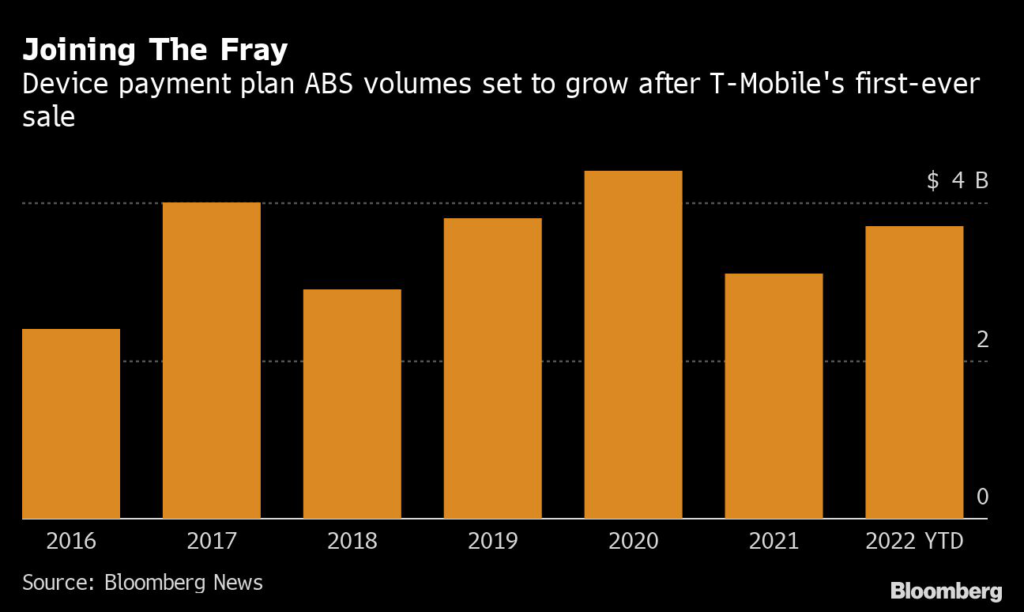
With the bond sale, the wireless network operator is following a path created by competitor Verizon Communications Inc., which started issuing similar securities backed by device payment plans in 2016. Until now, Verizon’s ABS bonds had comprised the entire market for such securities, according to data compiled by Bloomberg News. 

The market for phone plan-backed bonds is on track for a record this year. Issuance stands at $3.7 billion so far — not including T-Mobile’s sale — compared to $4.4 billion for all of 2020. T-Mobile’s issuance would bring the tally to about $4.5 billion. 

“Verizon has been able to grow the maturity of this sector, with stable performance over time and I think that has really helped develop this niche consumer ABS sector into something that’s a bit more open to investors,” said Ian Rasmussen, managing director of asset-backed securities at Fitch Ratings, in an interview.

Fitch and Moody’s Investors Service are rating the T-Mobile transaction, and expect to award an ‘AAA’ grade to the largest tranche. RBC Capital Markets is leading the bond sale, along with Barclays Plc and Mitsubishi UFJ Financial Group. 

The money raised will help T-Mobile diversify its funding sources after taking on a large debt load to pay for its April 2020 acquisition of Sprint as well as its purchase of spectrum rights. Spectrum is crucial to building out wireless networks. 

Representatives for T-Mobile and the banks arranging the transaction declined to comment.

T-Mobile has been on a hot streak lately. Subscriber growth has been rising even after its purchase of Sprint put it firmly among the top three US mobile providers. Its stock price has been on a tear even as rivals Verizon and AT&T Inc. struggle, helping make the company a hedge fund favorite. 

The firm has also been recently upgraded to investment grade by S&P Global Ratings, with Moody’s having given it a blue-chip rating earlier in the summer. Fitch also rates the company BBB-.

AT&T said in July that more of its customers were falling behind on their bills, a risk for a telecom company when economic growth is slowing. If T-Mobile were to face earnings pressure and possible corporate credit ratings downgrades, this securitization could be hurt, Fitch said in its presale report dated Sept. 27, in which it examined the transaction.

The collateral looks safe for now. The loans, or “equipment installment plan sale contracts,” that back the securitization are originated by T-Mobile, and have an average FICO score of 706, according to the report.

A Priority

Despite the risks of a looming recession and the fact that households can now no longer count on the support of government stimulus payments, consumer finances are still in relatively good shape. Even if households begin to run low on cash, it’s likely to take a lot for them to stop making payments on their phones, analysts said. 

“The payment priority of your phone plan has increased over the years, and the pandemic has pushed that even further along,” said Rasmussen.

Increased market volatility and changing benchmark rates have not deterred the issuer from coming to the market, and it expects to price the deal this week. 

More stories like this are available on bloomberg.com

©2022 Bloomberg L.P.

Ian Latest: Florida’s Death Toll From Storm Rises to 58 People

(Bloomberg) — Five days after Hurricane Ian slammed into Florida, bringing with it a deadly storm surge, catastrophic flooding and powerful winds, the destruction it caused is becoming clearer.

Florida’s death toll from Ian is at 58, according to officials, adding to fatalities in Cuba and North Carolina. Insured losses have risen to as much as $57 billion, according to modeler Verisk. President Joe Biden is scheduled to come to Florida on Wednesday to survey the damage from what he described as one of the worst storms to ever hit the US. Biden is currently in Puerto Rico, where the US government has pledged more than $60 million in funding to help the island rebuild after Hurricane Fiona.

The National Hurricane Service discontinued its updates on Ian over the weekend after it weakened to a post-tropical cyclone. By Saturday, the system had “fully dissipated,” according to the agency.

Rebuilding Cities Comes at a Costly Time (2:20 p.m. NY)

Florida cities looking to rebuild from the devastation of Hurricane Ian will be financing their efforts during the worst environment for municipal borrowing in more than a decade. 

Washed-out roads and bridges are only the most glaring examples of urgent infrastructure repairs that the state and its localities are grappling with after the storm. Debt to fund the recovery will probably start hitting the municipal market as soon as this quarter, according to Barclays Plc.

Federal and state aid will likely ease much of the financial blow, but officials looking to issue debt to rebuild and also bolster infrastructure against the risk of increasingly severe weather will be doing so during a brutal juncture for the bond market: Ten-year benchmark municipal yields are near the highest since 2011, and the Federal Reserve is signaling further interest-rate hikes to combat rampant inflation.

Berry Supplier Had Submerged Strawberry Fields (1:44 p.m. NY)

Florida-based berry supplier Wish Farms suffered from some submerged fields and a loss of power due to Ian. The storm also ripped up as much as 15% of the plastic ground cover used to prepare fields for strawberry planting, according to spokesman Nick Wishnatzki.

“We consider ourselves very lucky to only experience that minimal damage,” he said Monday in a phone interview.

Electricity has since been restored and the plastic ground covering is expected to be fixed as soon as Monday. The farm typically would have planted in late September, but they held off because of Ian.

Meanwhile, International Fresh Produce Association Chief Executive Officer Cathy Burns said she expects some short-term impacts on price and availability of some fresh produce grown in the state. Florida ranks No. 1 for production of whole cucumbers and tomatoes, according to the association.

Lee County Bears Brunt of Florida Storm Fatalities (12:22 p.m. NY)

The number of confirmed deaths in Florida tied to Hurricane Ian reached 58 as of Monday morning, according to the latest count by the Florida Medical Examiners Commission. A majority of those deaths — 42 — occurred in Lee County, home to Fort Myers, which bore the brunt of the damage from the storm.

The Florida Department of Law Enforcement, which staffs the medical commission, said the next death count will be released either Monday evening or Tuesday by noon if new confirmed data is received from authorities.

Fuel Woes Ease Though Lines Linger (12:04 p.m. NY)

Florida’s fuel supplies are improving after Hurricane Ian disrupted deliveries. Places are now getting consistent deliveries and while there are still some long lines, all communities have supplies, according to Ned Bowman, executive director of the Florida Petroleum Marketers Association. He said it may take another 5 to 7 days to fully return to normal. Challenges remain for Sanibel Island and Pine Island, since bridge access has been disrupted, he said.

Insurer of Last Resort Can Absorb Ian Claims Costs (11:40 a.m. NY)

Citizens Property Insurance Corp., Florida’s state-backed insurer of last resort, said it won’t need to charge its policyholders or taxpayers to cover claims brought on by Hurricane Ian.

The insurer is facing more than 225,000 claims and $1.9 billion to $3.7 billion in losses, Citizens spokesman Michael Peltier said Monday in an email. State law requires the company to levy assessments when it experiences deficits in the wake of a major storm or disaster.

Florida’s homeowners insurance market is in disarray, with companies entering insolvency or halting policy issuance, and Citizens has been forced to pick up the slack. The company accounts for slightly more than 10% of the market by premiums written.

Florida Utility Aims to Restore Power by Friday (11:15 a.m. NY)

Florida Power & Light, the state’s largest utility, said it plans to have power restored to almost all of its customers by late Friday if all goes well, Chief Executive Officer Eric Silagy said in a Monday briefing with reporters.

The utility, a subsidiary of NextEra Energy Inc., still has several thousand customers without power, Silagy said. FPL initially focused on restoring power to critical infrastructure such as water treatment centers and emergency responders, the CEO said.

“It’s been 76 hours since Ian, which was a monster storm, left Florida,” Silagy said. Since then the utility has restored power to 1.8 million customers, which is 83% of all those affected, he said. “We’re going to be able to get this done faster than I thought.”

As utilities across Florida work to restore power, about 600,000 homes and businesses remain in the dark, according to PowerOutage.us.

Flooded Groves Are Putting Citrus Crop at Risk (10:51 a.m. NY) 

Initial damage estimates to Florida groves from Hurricane Ian are pointing to a significant crop loss from high winds, pushing orange juice futures to the highest in almost six years in New York. The contracts soared 4.8% to edge past $2 a pound, the highest since mid-December 2016.

Mixon Fruit Farms, a family operated coastal citrus producer based just south of Tampa, is still without power days after the hurricane.

“It looks like about 30% of the fruit was knocked off the tree,” Janet Mixon said, referring to orchards located in the hard-hit Manatee County. “The oranges are now laying under the tree.”

Flooding from the storm is also threatening the long-term health of citrus trees, Ray Royce, executive director at Highlands County Citrus Growers Association, said in a Monday interview.

“There is so much water standing for so many days, it can kill roots and trees,” he said by phone, adding that uprooting and broken trees are also being reported in producing areas.

Climate Change Made Ian’s Rainfall Worse (8:21 a.m. NY)

Climate change made Hurricane Ian’s most extreme rainfall about 10% worse than it would have been without two centuries of greenhouse gas pollution, according to a first-take analysis of the storm by two US climate researchers. The rapid analysis by Michael Wehner of the Lawrence Berkeley National Laboratory and Kevin Reed of Stony Brook University was shared on Twitter.

Wehner said the quick look at Hurricane Ian turned out to be “a little more interesting” scientifically than he had expected.

About 613,000 in Florida Are Still Without Power (7:45 a.m. NY)

Just over 613,000 customers in Florida still have no electricity as of early Monday morning, according to PowerOutage.us. Crews have already restored power to some 1.8 million customers across the state, figures from the Florida Division of Emergency Management show. In Puerto Rico, more than 120,000 are without power.

Insured Losses Mount From Ian’s Devastation (6:05 a.m. NY)

Verisk estimated that insured losses to onshore property from Ian will range from $42 billion to $57 billion. That includes wind, storm surge and inland flood losses resulting from both of Ian’s landfalls in Florida and South Carolina. 

Wind damage accounts for the majority of the loss estimate, totaling anywhere from $38 billion to $51 billion. Ian’s storm surge likely racked up $3 billion to $5.5 billion in insured losses and inland flooding less than $1 billion.

Death Toll From Ian Rises to At least 68 (4:44 a.m. NY)

At least 68 people have been confirmed dead: 61 in Florida, four in North Carolina and three in Cuba, the Associated Press reported. Deanne Criswell, administrator of the Federal Emergency Management Agency, told the news wire that the federal government was ready to help in a “huge way,” focusing first on victims in Florida, which took the brunt of one of the strongest storms to make landfall in the United States.

More than 640,000 in Florida Still Without Power (11:34 p.m. NY)

More than 640,000 customers in Florida are still without power, according to PowerOutage.us. Electricity has been restored to more than 1.8 million user accounts across the state, figures from the Florida Division of Emergency Management showed on Sunday.

Governor Ron DeSantis visited the cities of North Port and Arcadia over the weekend, where flooding hasn’t subsided, according to local media reports.

Lee County Reports 42 Deaths Amid Rising Florida Toll (6:32 p.m. NY)

The death toll in Florida is rising, though the numbers remained uncertain and incomplete amid ongoing searches through masses of wreckage.   

In Lee County, on the state’s southwest coast, Sheriff Carmine Marceno said on Sunday that 42 people had died there.

“We have buildings, multiple-floor buildings that have been washed out, OK? It is incomprehensible what we’re looking at,” Marceno said. “Those numbers could go up. I don’t know. I pray and hope that they don’t.”

On Saturday night, the Florida Medical Examiners Commission released a count of 44 dead across the state, including 30 in Lee County. The commission had not updated the toll on Sunday. 

Florida Cell Service Returning With Gaps in Hard-Hit Areas (3:51 p.m. NY)

Cell-service has been restored across most of Florida, though the hardest-hit counties are still experiencing significant zones without signal, according to a report from the Federal Communications Commission Sunday. 

The report listed the top counties by percentage with cell sites still not operational: DeSoto 38.5%; Hardee 33.3%; Charlotte 20.2%; and Lee 19.5%.

Governor Ron DeSantis announced Saturday that Elon Musk’s SpaceX will deploy 120 units of its Starlink satellites to southwest Florida to provide Internet service for those affected.

More Than 820,000 in Florida Remain Without Power (1:12 p.m. NY)

About 822,000 customers remain without power in Florida, according to PowerOutage.us. That’s a recovery from the peak of 2.7 million customers without power after Hurricane Ian made landfall in southwest Florida on Wednesday. 

In North Carolina, where the storm hit on Friday, there are close to 21,000 customers without power.

‘Old Florida’ Flattened by Hurricane, Rubio Says (12:21 p.m. NY)

Some of Florida’s oldest and most popular beach destinations devastated by Hurricane Ian will never look the same, Senator Marco Rubio said on Sunday.

Fort Myers Beach, a seaside tourist town, “no longer exists,” Rubio said on ABC’s “This Week.” Sanibel Island, another barrier island along Florida’s southwest coast, has also been ravaged, he said. 

“This is a character-altering event,” he said. 

FEMA Head Warns of Post-Storm Hazards (9:50 a.m. NY)

People working to clean up after Hurricane Ian need to “stay vigilant right now” because of the potential danger amid debris, downed power lines and other hazards, warned Deanne Criswell, administrator of the Federal Emergency Management Agency. 

“We see so many more injuries and sometimes more fatalities after the storm, because there are so many dangers out there,” Criswell said on “Fox News Sunday.” “Standing water brings with it all kinds of hazards…We want to make sure that people are being extra cautious.”

Biden to Visit Puerto Rico, Florida (10:39 p.m. NY)

President Joe Biden will travel to Puerto Rico on Monday and Florida on Wednesday to survey the damage there after vowing to commit the full strength of the federal government to recovery efforts in the wake of two devastating hurricanes.

The president will be accompanied by the first lady, the White House said.

Ian Expected to End by Sunday Morning (5:12 p.m. NY)

Storm Ian is expected to dissipate on Sunday morning, the National Weather Service said in an update. By 5 p.m., the storm had slowed over Virginia, moving east-northeast at about 6 miles an hour with maximum sustained winds near 25 miles per hour, the service reported.

Central Florida will continue to experience “major to record” river flooding through next week. Areas of Maryland and West Virginia may also experience several inches of rain into Sunday morning, with the potential of some flooding.

Four Die in North Carolina (4:06 p.m.)

Four storm-related deaths were reported in North Carolina: one drowning, two in vehicle accidents and one poisoned by carbon monoxide from a generator, Governor Roy Cooper’s office reported. 

Power was restored to about half the 418,000 customers who had lost electricity on Friday night, his office said in a press release Saturday.

No Deaths in South Carolina, Governor Says (3:09 p.m. NY)

South Carolina suffered no deaths despite being hit by winds as high as 92 miles an hour from Hurricane Ian on Friday, Governor Henry McMaster said in a press briefing Saturday. Unlike Florida, there has been relatively little flooding, and most electricity has already been restored, he said.

“We know that we have much cleaning up and rebuilding to do,” McMaster said. “There’s some heartbreak, there’s work to be done. But all in all it’s a good story.”

Florida Governor Says Flooding Did Most Damage (2:47 p.m. NY)

Florida suffered more damage from flooding caused by Hurricane Ian than strong winds, Governor Ron DeSantis said Saturday.

“When you’ve got a torrent of water coming in, there’s really nothing you can do about that, so that’ll require a lot of flood claims being filed,” DeSantis said at a news briefing in Fort Myers. 

DeSantis added that nearly 55% of power has been restored to those affected by power outages. Power has been restored to 1.5 million customers serviced by Florida Power & Light, with another 650,000 customers still without power, said FPL president and chief executive officer Eric Silagy.

More stories like this are available on bloomberg.com

©2022 Bloomberg L.P.

Here’s the First Woman to Launch a Billion-Dollar Hedge Fund

(Bloomberg) — Divya Nettimi started her own hedge fund Monday with more than $1 billion of commitments, making it the largest launch of a woman-led firm in the industry’s history and among the biggest of any to debut this year.

Avala Global has begun investing the majority of the cash, with the rest expected to arrive early in the first quarter, according to people familiar with the matter, who asked not to be identified because the fund’s inception hasn’t been announced publicly. A representative for the New York-based firm declined to comment.

Nettimi, a portfolio manager who oversaw more than $4 billion at Andreas Halvorsen’s Viking Global Investors before leaving last year, will bet on and against stocks in the consumer, business services and technology, media and telecom sectors, while also backing private companies, the people said. The money gathered so far doesn’t include investments from Viking clients because anti-competition agreements prohibit her from soliciting them until November.  

Her ability to kick-start the firm now is all the more remarkable as a sharp decline in equity markets has made fundraising more difficult, with some of the industry’s most prolific tech-focused stock-pickers experiencing their worst year on record. This year’s largest new launch is Alex Karnal’s Braidwell, which started in April with $3.5 billion. 

Another highly anticipated debut is Mala Gaonkar’s SurgoCap Partners. She’s expected to launch her firm in 2023 with at least $1 billion. 

Read more: Hedge Fund Startups Led by Women Are Finally on the Rise

Nettimi, 36, and Gaonkar, 52, will be part of an exclusive club of women leaders in an industry dominated by men, with their debuts coming almost a decade after Leda Braga took the helm of Systematica Investments, then an $8.3 billion collection of quant funds that was spun out from Michael Platt’s BlueCrest Capital Management. 

While Avala Global’s launch should be applauded, “it’s also damning that it’s a historical first in 2022” for a $4 trillion industry with 12,000 funds, said Dominique Mielle, a former partner at Canyon Partners.

Having so few funds led by women means they can face more scrutiny over their performance, said Mielle, the author of Damsel in Distressed: My Life in the Golden Age of Hedge Funds. “People may use them as a gauge for their entire gender, rather than just their own fund,” she said.

Avala’s clients will face some constraints. They won’t be able to pull their cash for the first two years and, if they choose to do so after, it will take an additional two years for them to withdraw all of their capital, the people said. 

Nettimi joins a growing list of Viking alumni to set out on their own in recent years. The most prominent among them is Dan Sundheim, who stepped down as chief investment officer to found D1 Capital Partners in 2018, building it into a $22 billion behemoth. In 2020, former Viking co-CIOs Ben Jacobs and Tom Purcell started Anomaly Capital Management and Alua Capital Management, respectively. Last year, former Viking portfolio manager Grant Wonders launched Voyager Global Management.

(Updates with comment from Mielle starting in seventh paragraph.)

More stories like this are available on bloomberg.com

©2022 Bloomberg L.P.
Wall Street Bikes for Autism Research in Rain-Soaked Ride

(Bloomberg) — It took two bicycles to get the New York Stock Exchange’s chief operating officer across the finish line of the trading industry’s fall ride for autism research. 

“I came in dead last, but was still greeted with smiles,” said Michael Blaugrund, whose chain snapped on his first bike at mile seven, prompting the event to send a “rescue vehicle” that brought him to a replacement. “Even in the face of a torrential downpour, the Wall Street community came out to support people in need,” he said.

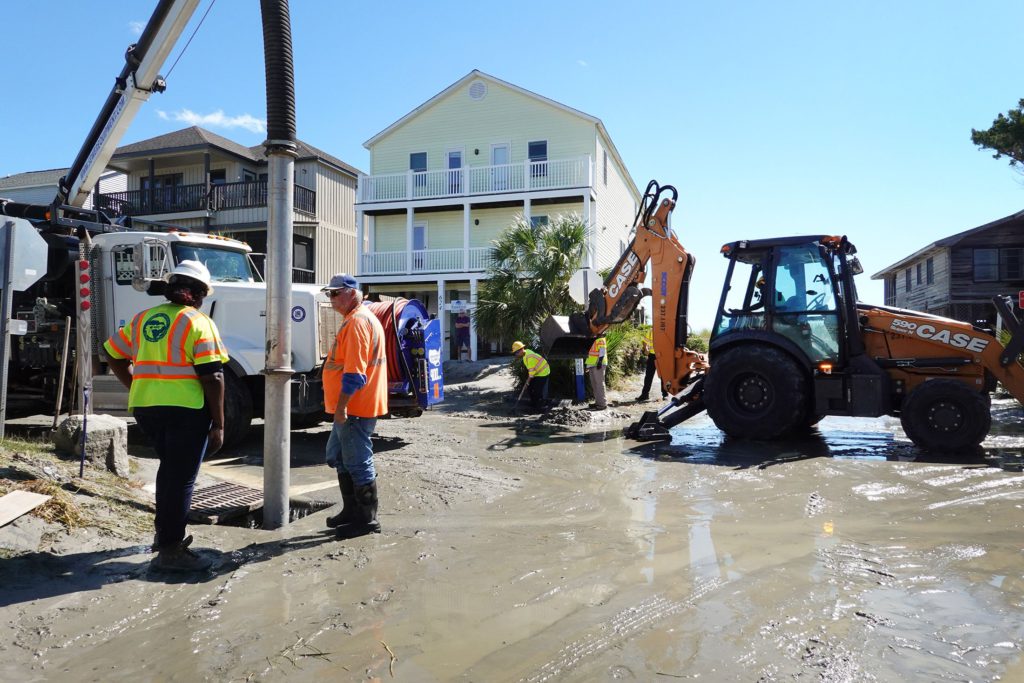
More than 100 hundred participants from high-speed trading firms, exchange operators and crypto companies braved the rain Saturday for Wall Street Rides for Autism Research. The annual event went on, though modified, as remnants of Hurricane Ian passed through the area. 

With a range of distances to choose from, organizers had to cancel the 62- and 30-mile courses for riders’ safety. The longest course would have spanned over 4,000 feet (1,219 meters) of elevation through the towns of White Plains, Harrison, Rye Brook, New Castle, Bedford and Port Chester as well as Stamford and Greenwich in Connecticut. The rides all start and end at a park in Mamaroneck, a suburb of New York City. 

“I’m disappointed it was cut but you can’t control the weather,” said Adam Fox, a quantitative strategist at trading firm Virtu Financial who planned for the longer course. He and his father biked 20 miles instead. “I don’t get put off by rain,” Fox said.

Riders faced gusts of wind and rain, though there were periods when just a gentle mist offered a bit of a respite from the weather. Those brave enough to tackle the wet streets took on routes of either 20, 12 or four miles, or could choose a five-kilometer trail walk. Some opted for bikes with thicker tires to avoid accidents. Others skipped out entirely, huddling under the protection of tents with hot chocolate and croissants.

“Given how bad the weather was when we woke up, we gave people the choice to ride — You don’t have to do this or be here,” Bryan Harkins, co-founder of the event and Trumid Financial’s chief revenue officer, said. “But people showed up because they care about the cause.”

Now in its eighth year, Wall Street Rides FAR has raised more than $3 million for the Autism Science Foundation. The fundraiser was the brainchild of Harkins, a former Cboe Global Markets executive, and his wife Melissa Moo Harkins, sales director at crypto company Blockdaemon and founder of the women’s triathlon apparel brand MooMotion. Some of their own extended family members were diagnosed with autism.

This year’s event brought in more than $1 million. Sponsors span traditional players such as trading firms Citadel Securities and GTS, banks including Morgan Stanley and JPMorgan Chase & Co., and exchange operators Cboe, IEX Group Inc. and the New York Stock Exchange. Crypto firms are also in the mix, including FTX and The Block. 

“This is one place where competing firms come together and just ride,” Paul O’Donnell, who works in business development at Hudson River Trading, said. In his eighth year of riding, the veteran says it’s a surprisingly hilly course. “I rode with someone at a clearing firm and another from a competing firm I didn’t previously know, which was great,” he said.

Talos Trading, the crypto company for buy-side institutions, uses the event as a team-building exercise. The firm flew in employees from Chicago and London to participate. “The rain helped us bond. We now have a good story to tell,” co-founder and Chief Technology Officer Ethan Feldman said. “Plus it’s a who’s who of fintech and crypto.” 

Trumid Financial co-Chief Executive Officer Mike Sobel was a first-time rider. His group missed a sign and got lost on the course, adding on an extra mile or two. “Part of the adventure is good team building,” he said. “Grabbing a beer after work is great, but being out on a ride in the rain breaking a sweat is way better.”

The mix of participants is what brings NYSE’s Blaugrund back. “You get to see a side of people that is mostly guarded,” he said. “Some are still talking shop, but ultimately you’re getting people out of the office and into a pair of bike shorts.” 

More stories like this are available on bloomberg.com

©2022 Bloomberg L.P.
Bitcoin’s October Track Record Has Diehards Keeping the Faith

(Bloomberg) — After two consecutive months of declines, Bitcoin advocates are hoping that the largest cryptocurrency reverts to form in October, which has typically been one of its best months for gains. 

The virtual currency tends to rise roughly 25% in October and has, since 2015, advanced more than 85% of the time during it, according to Bespoke Investment Group. 

“For the average monthly moves, October ranks as the best for Bitcoin,” Bespoke’s Jake Gordon wrote in a note. The month has also, in the past, been good to Ether, with that coin rising three-quarters of the time and posting an average gain above 9%. 

Bitcoin is starting October on a slightly positive note, adding as much as 1.3% to $19,492 on Monday. Bespoke said another notable trend for the coin recently has been its resurgence as the predominant crypto in terms of volume. Its share of total crypto market share has risen to 48%, the highest since mid-2017. 

A more positive trading stretch would be a reprieve for crypto investors who have gone through a stomach-churning ride of late. Bitcoin lost nearly 4% in September after dropping 15% the month prior. It’s been trading in tandem with US stocks, which have been choppy as a result of the Federal Reserve’s objective of tamping down red-hot inflation. 

Read more: Bitcoiners Hunker Down for ‘Storms Ahead’ as Retail Stays Away

In this environment, Bitcoin’s long-term holders have largely held onto their investments, potentially waiting out another leg lower in markets, according to Glassnode. Meanwhile, retail investors have remained on the sidelines, with analysts saying they might not re-enter until prices start to recover. 

“The market has continued to react to heavy global macro catalysts,” said a note from Securitize Capital. 

More stories like this are available on bloomberg.com

©2022 Bloomberg L.P.

Corporate-Default Rates May Top 6% in US, EMEA in the Next Year, Moody’s Says

(Bloomberg) — The share of companies failing to pay debt on time could soar more than threefold in the next year due to a liquidity squeeze and worsening trading conditions, according to Moody’s Investor Services. 

“If interest rates continue to surge and the global economic slowdown deepens, weaker speculative grade companies face declining earnings and escalating debt costs. In that scenario, defaults will escalate,” Moody’s analysts wrote in the report published Monday. 

In the US, default rates could grow from below 2% to 7.8% by August 2023 in a more pessimistic forecast, while reaching 6.5% in that time in the EMEA region from about 2%, according to the report.  

Read more: A $1 Trillion Burden Looms for World Borrowers Refinancing Debt

Borrowers rated B2 and B3 –five and six notches deep into junk territory– represent 65% of speculative grade companies in the US and Europe, Middle East and Africa, the analysts said. 

The drought in new issuance — global leveraged finance issuance was about $315 billion from a record $1.6 trillion in 2021 for bonds and loans, according to Moody’s data– points to tougher conditions for companies looking to refinance or add debt to get extra liquidity. 

One feature that could delay –or in some cases even avert– defaults is the loose covenants in the debt documents most borrowers managed to achieve when they locked in new financing in a frothy market, according to Moody’s. That would provide them more flexibility to add debt without breaching covenants, but would also mean lower recoveries in the event of a default, they added.  

More stories like this are available on bloomberg.com

©2022 Bloomberg L.P.

Close Bitnami banner
Bitnami