Bloomberg

EU Moves Closer to Russia Sanctions Deal With Oil Price Cap

(Bloomberg) — European Union countries edged closer to a deal on a new sanctions package, as they face strong pressure to punish Russia for escalating its war in Ukraine and illegally annexing four occupied territories there.

The main remaining hitch has been agreeing on the details of a price cap on Russian oil sales to third countries, where the bloc has faced pushback from a few seafaring nations.

“We have preliminary political agreement on the package, with capitals having until 10 a.m. to confirm,” Polish ambassador to the EU, Andrzej Sados, told reporters.

The final details of the package are still in some flux. Greece, Cyprus and Malta, which have large shipping industries and have expressed concerns about curbs on transporting Russian oil, are pushing for exemptions in the package, according to people familiar with the matter. 

Member states still need to formally approve the deal, which could happen as early as Tuesday.

The EU has been eager to reach an agreement before leaders meet in Prague on Oct. 7, said the people, who asked not to be identified because the discussions are private. 

Hungary has also been an obstacle in the discussions, according to the people. Sanctions decisions in the EU require unanimity, giving each country an effective veto.

Chemicals, Aviation

The broader sanctions package would target a range of individuals and entities, including senior Russian ministry officials and people involved in staging the recent, widely condemned referendums. It would also restrict access to aviation items, electronic components and specific chemical substances to deprive Russia’s military from important technologies. 

Read more: EU Aims to Exempt Maritime Pilot Services From Russia Oil Ban

Some nations were upset that the latest draft of the sanctions appears to have weakened several of the proposed measures, including the removal of a Russian diamond mining company from the penalty list, one of the people said.

The sanctions would add a ban on shipping Russian oil, but carve out an exemption for oil priced at or under a level set by a coalition of the Group of Seven and other countries, according to a draft of the proposal seen by Bloomberg. 

To allow for an oil price cap, the bloc will have to change its current legislation. In June, EU nations agreed to a full ban on insurance and financial services for seaborne oil, while shipping was spared from the restrictions. Most of those prohibitions are due to kick in Dec. 5 alongside a ban on EU purchases of Russian crude.

The G-7, which endorsed a cap earlier this month, has said it wants an agreement in place before that date.

More stories like this are available on bloomberg.com

©2022 Bloomberg L.P.

Jay-Z’s VC Firm Leads Investment in Robot Pizza Truck Startup

(Bloomberg) — Jay-Z’s venture capital firm was the lead investor in a Los Angeles-area startup that’s building pizza-making robot trucks.

Stellar Pizza said Monday that it raised $16.5 million in a round led by the hip-hop icon’s Marcy Venture Partners. The pizza startup joins a portfolio for the VC firm that includes Rihanna’s Savage x Fenty clothing brand.

The pitch from Stellar Pizza is to make ordering a pie quicker and more affordable using automation. A customer would place their order on a mobile app, which signals a robot inside of a truck to assemble and bake pizzas from scratch. A worker removes the pie from the oven to cut and box before serving. Once the service is fully operating, a Stellar truck will take less than five minutes to make a pizza, while cutting down on real estate and labor costs, according to the company.

Stellar Pizza was founded in 2019 by three former Space Exploration Technologies Corp. engineers. The startup, led by Chief Executive Officer Benson Tsai, had over 30 employees from the spacecraft manufacturer on their original team. They’ve bolstered their culinary credentials with the addition of the former SpaceX Executive Chef Ted Cizma and guidance from artisan pizzaiolo Noel Brohner.

More stories like this are available on bloomberg.com

©2022 Bloomberg L.P.

Trudeau’s Industry Minister Pushes for Toyota-Panasonic EV Deal

(Bloomberg) — Canada ranks “very high” in strategic plans for electric vehicles produced by Japanese manufacturers, according to the North American nation’s industry minister.

Francois-Philippe Champagne met last week in Tokyo with Hiroaki Koda, the head of Prime Planet Energy & Solutions Inc., an automotive battery joint-venture between Toyota Motor Corp. and Panasonic Holdings Corp. 

“It’s no longer why Canada,” Champagne said in an interview after his trip to Asia. “It’s how Canada, and what I’m focusing now is when.”

Though he declined to say if any agreements were reached in his meeting with Koda, the minister said “we had a very long, I would say very interesting conversation.”

The 52-year-old politician has been talking up Canada’s industrial prowess around the world since taking over the key ministry in January 2021. His previous posts in Prime Minister Justin Trudeau’s cabinet included both foreign affairs and trade.  

Champagne said Canada’s talented workforce, thriving automotive ecosystem, abundance of critical minerals and renewable energy, and its access to the US market will “lead to the type of investments we’re looking for.”

Provincial Competition

In August, German carmarkers Mercedes-Benz Group AG and Volkswagen AG sealed partnerships with Canada to secure EV battery materials. Earlier this year, Dutch automotive conglomerate Stellantis NV and LG Energy Solution announced a C$5 billion ($3.6 billion) battery plant in Windsor, Ontario, while Umicore SA of Belgium unveiled a C$1.5 billion battery materials facility in Kingston, Ontario. 

And in Quebec, a General Motors Co. joint-venture with POSCO Chemical Co. and German chemical giant BASF SE will build cathode manufacturing plants in Becancour, 90 miles northeast of Montreal.

“What I hear from original equipment and battery manufacturers is that the investment made both in Ontario and Quebec are very complementary,” Champagne said when asked about competition between Canada’s two biggest provinces in the EV supply chain. 

All projects announced so far are backed by hundreds of millions in subsidies from both the federal and provincial governments.

Champagne said “speed and scale” are a big challenge for Canada in building out its EV battery ecosystem and suggested institutional investors could help accelerate the process. He cited a Brookfield Infrastructure Partners LP agreement to fund an Intel Corp. semiconductor facility in Arizona as a potential example to follow.

“That would be a way on one end to allow these facilities to be built faster and at the same time, to provide stable returns to these pension funds,” Champagne said. “It is basically a model where you build and lease it back to the manufacturers.”

Canada’s two biggest funds, Canada Pension Plan Investment Board and Caisse de Depot et Placement du Quebec, declined to comment on their interest in such a strategy.

More stories like this are available on bloomberg.com

©2022 Bloomberg L.P.

Ian Latest: Florida Utility Pushes to Restore Power by Friday

(Bloomberg) — Five days after Hurricane Ian slammed into Florida, bringing with it a deadly storm surge, catastrophic flooding and powerful winds, the death and destruction it wrought are starting to become clearer.

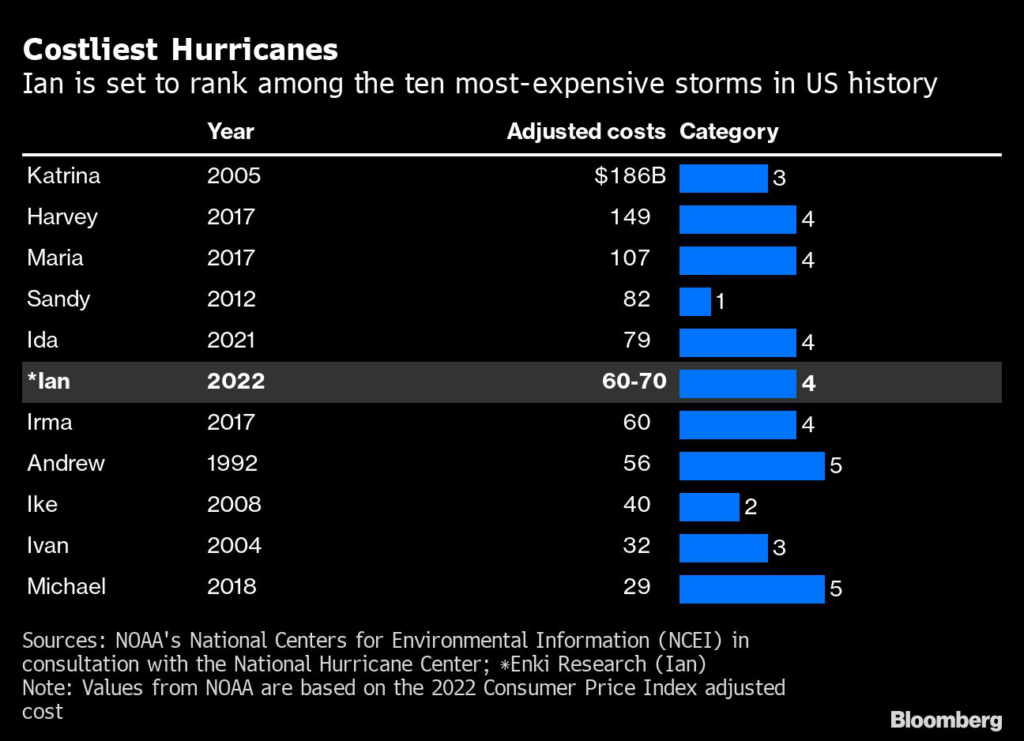
The overall death toll from Ian had climbed to at least 68 as of early Monday, according to the Associated Press. Insured losses have risen to as much as $57 billion, according to modeler Verisk. On Wednesday, President Joe Biden is scheduled to visit Florida to survey the damage from what he described as one of the worst storms to ever hit the US. But first, he is headed to Puerto Rico, where he is announcing more than $60 million in funding to help the island rebuild after Hurricane Fiona.

The National Hurricane Service discontinued its updates on Ian over the weekend after it had weakened to a post-tropical cyclone. By Saturday, the system had “fully dissipated,” according to the National Weather Service.

Insurer of Last Resort Can Absorb Ian Claims Costs (11:40 a.m. NY)

Citizens Property Insurance Corp., Florida’s state-backed insurer of last resort, said it won’t need to charge its policyholders or taxpayers to cover claims brought on by Hurricane Ian.

The insurer is facing more than 225,000 claims and $1.9 billion to $3.7 billion in losses, Citizens spokesman Michael Peltier said Monday in an email. State law requires the company to levy assessments when it experiences deficits in the wake of a major storm or disaster.

Florida’s homeowners insurance market is in disarray, with companies entering insolvency or halting policy issuance, and Citizens has been forced to pick up the slack. The company accounts for slightly more than 10% of the market by premiums written.

Florida Utility Aims to Restore Power by Friday (11:15 a.m. NY)

Florida Power & Light, the state’s largest utility, said it plans to have power restored to almost all of its customers by late Friday if all goes well, Chief Executive Officer Eric Silagy said in a Monday briefing with reporters.

The utility, a subsidiary of NextEra Energy Inc., still has several thousand customers without power, Silagy said. FPL initially focused on restoring power to critical infrastructure such as water treatment centers and emergency responders, the CEO said.

“It’s been 76 hours since Ian, which was a monster storm, left Florida,” Silagy said. Since then the utility has restored power to 1.8 million customers, which is 83% of all those affected, he said. “We’re going to be able to get this done faster than I thought.”

As utilities across Florida work to restore power, about 600,000 homes and businesses remain in the dark, according to PowerOutage.us.

Flooded Groves Are Putting Citrus Crop at Risk (10:51 a.m. NY) 

Initial damage estimates to Florida groves from Hurricane Ian are pointing to a significant crop loss from high winds, pushing orange juice futures to the highest in almost six years in New York. The contracts soared 4.8% to edge past $2 a pound, the highest since mid-December 2016.

Mixon Fruit Farms, a family operated coastal citrus producer based just south of Tampa, is still without power days after the hurricane.

“It looks like about 30% of the fruit was knocked off the tree,” Janet Mixon said, referring to orchards located in the hard-hit Manatee County. “The oranges are now laying under the tree.”

Flooding from the storm is also threatening the long-term health of citrus trees, Ray Royce, executive director at Highlands County Citrus Growers Association, said in a Monday interview.

“There is so much water standing for so many days, it can kill roots and trees,” he said by phone, adding that uprooting and broken trees are also being reported in producing areas.

Climate Change Made Ian’s Rainfall Worse (8:21 a.m. NY)

Climate change made Hurricane Ian’s most extreme rainfall about 10% worse than it would have been without two centuries of greenhouse gas pollution, according to a first-take analysis of the storm by two US climate researchers. The rapid analysis by Michael Wehner of the Lawrence Berkeley National Laboratory and Kevin Reed of Stony Brook University was shared on Twitter.

Wehner said the quick look at Hurricane Ian turned out to be “a little more interesting” scientifically than he had expected.

About 613,000 in Florida Are Still Without Power (7:45 a.m. NY)

Just over 613,000 customers in Florida still have no electricity as of early Monday morning, according to PowerOutage.us. Crews have already restored power to some 1.8 million customers across the state, figures from the Florida Division of Emergency Management show. In Puerto Rico, more than 120,000 are without power.

Insured Losses Mount From Ian’s Devastation (6:05 a.m. NY)

Verisk estimated that insured losses to onshore property from Ian will range from $42 billion to $57 billion. That includes wind, storm surge and inland flood losses resulting from both of Ian’s landfalls in Florida and South Carolina. 

Wind damage accounts for the majority of the loss estimate, totaling anywhere from $38 billion to $51 billion. Ian’s storm surge likely racked up $3 billion to $5.5 billion in insured losses and inland flooding less than $1 billion.

Death Toll From Ian Rises to At least 68 (4:44 a.m. NY)

At least 68 people have been confirmed dead: 61 in Florida, four in North Carolina and three in Cuba, the Associated Press reported. Deanne Criswell, administrator of the Federal Emergency Management Agency, told the news wire that the federal government was ready to help in a “huge way,” focusing first on victims in Florida, which took the brunt of one of the strongest storms to make landfall in the United States.

More than 640,000 in Florida Still Without Power (11:34 p.m. NY)

More than 640,000 customers in Florida are still without power, according to PowerOutage.us. Electricity has been restored to more than 1.8 million user accounts across the state, figures from the Florida Division of Emergency Management showed on Sunday.

Governor Ron DeSantis visited the cities of North Port and Arcadia over the weekend, where flooding hasn’t subsided, according to local media reports.

Lee County Reports 42 Deaths Amid Rising Florida Toll (6:32 p.m. NY)

The death toll in Florida is rising, though the numbers remained uncertain and incomplete amid ongoing searches through masses of wreckage.   

In Lee County, on the state’s southwest coast, Sheriff Carmine Marceno said on Sunday that 42 people had died there.

“We have buildings, multiple-floor buildings that have been washed out, OK? It is incomprehensible what we’re looking at,” Marceno said. “Those numbers could go up. I don’t know. I pray and hope that they don’t.”

On Saturday night, the Florida Medical Examiners Commission released a count of 44 dead across the state, including 30 in Lee County. The commission had not updated the toll on Sunday. 

Florida Cell Service Returning With Gaps in Hard-Hit Areas (3:51 p.m. NY)

Cell-service has been restored across most of Florida, though the hardest-hit counties are still experiencing significant zones without signal, according to a report from the Federal Communications Commission Sunday. 

The report listed the top counties by percentage with cell sites still not operational: DeSoto 38.5%; Hardee 33.3%; Charlotte 20.2%; and Lee 19.5%.

Governor Ron DeSantis announced Saturday that Elon Musks’s SpaceX will deploy 120 units of its Starlink satellites to southwest Florida to provide Internet service for those affected.

More Than 820,000 in Florida Remain Without Power (1:12 p.m.)

About 822,000 customers remain without power in Florida, according to PowerOutage.US. That’s a recovery from the peak of 2.7 million customers without power after Hurricane Ian made landfall in southwest Florida on Wednesday. 

In North Carolina, where the storm hit on Friday, there are close to 21,000 customers without power.

‘Old Florida’ Flattened by Hurricane, Rubio Says (12:21 p.m.)

Some of Florida’s oldest and most popular beach destinations devastated by Hurricane Ian will never look the same, Senator Marco Rubio said on Sunday.

Fort Myers Beach, a seaside tourist town, “no longer exists,” Rubio said on ABC’s “This Week.” Sanibel Island, another barrier island along Florida’s southwest coast, has also been ravaged, he said. 

“This is a character-altering event,” he said. 

FEMA Head Warns of Post-Storm Hazards (9:50 a.m.)

People working to clean up after Hurricane Ian need to “stay vigilant right now” because of the potential danger amid debris, downed power lines and other hazards, warned Deanne Criswell, administrator of the Federal Emergency Management Agency. 

“We see so many more injuries and sometimes more fatalities after the storm, because there are so many dangers out there,” Criswell said on “Fox News Sunday.” “Standing water brings with it all kinds of hazards…We want to make sure that people are being extra cautious.”

Biden to Visit Puerto Rico, Florida (10:39 p.m.)

President Joe Biden will travel to Puerto Rico on Monday and Florida on Wednesday to survey the damage there after vowing to commit the full strength of the federal government to recovery efforts in the wake of two devastating hurricanes.

The president will be accompanied by the first lady, the White House said.

Ian Expected to End by Sunday Morning (5:12 p.m.)

Storm Ian is expected to dissipate on Sunday morning, the National Weather Service said in an update. By 5 p.m., the storm had slowed over Virginia, moving east-northeast at about 6 miles an hour with maximum sustained winds near 25 miles per hour, the service reported.

Central Florida will continue to experience “major to record” river flooding through next week. Areas of Maryland and West Virginia may also experience several inches of rain into Sunday morning, with the potential of some flooding.

Four Die in North Carolina (4:06 p.m.)

Four storm-related deaths were reported in North Carolina: one drowning, two in vehicle accidents and one poisoned by carbon monoxide from a generator, Governor Roy Cooper’s office reported. 

Power was restored to about half the 418,000 customers who had lost electricity on Friday night, his office said in a press release Saturday.

No Deaths in South Carolina, Governor Says (3:09 p.m.)

South Carolina suffered no deaths despite being hit by winds as high as 92 miles an hour from Hurricane Ian on Friday, Governor Henry McMaster said in a press briefing Saturday. Unlike Florida, there has been relatively little flooding, and most electricity has already been restored, he said.

“We know that we have much cleaning up and rebuilding to do,” McMaster said. “There’s some heartbreak, there’s work to be done. But all in all it’s a good story.”

Florida Governor Says Flooding Did Most Damage (2:47 p.m. NY)

Florida suffered more damage from flooding caused by Hurricane Ian than strong winds, Governor Ron DeSantis said Saturday.

“When you’ve got a torrent of water coming in, there’s really nothing you can do about that, so that’ll require a lot of flood claims being filed,” DeSantis said at a news briefing in Fort Myers. 

DeSantis added that nearly 55% of power has been restored to those affected by power outages. Power has been restored to 1.5 million customers serviced by Florida Power & Light, with another 650,000 customers still without power, said FPL president and chief executive officer Eric Silagy. 

Biden Briefed on Damage, Restoration of Power and Water (2:26 p.m.)

President Joe Biden was briefed by advisers including Chief of Staff Ron Klain on the damage from the storm, focusing on power and water restoration in Florida and damage in South Carolina, White House Press Secretary Karine Jean-Pierre said in a tweet.

Ian Weakens as It Moves North (12:15 a.m.)

Post-tropical cyclone Ian continued to weaken midday Saturday as it moved north through North Carolina and toward Virginia, according to a National Weather Service update at 11 a.m. 

Maximum sustained winds slowed to to 25 mph (40 kph), the service reported. Another 1-3 inches or rain was expected to fall across the central Appalachians and mid-Atlantic, “with local heavier amounts possible.” 

Across central Florida, “major to record river flooding” is expected over the next week.

Biden Calls Storm Damage ‘Among Worst’ Ever in US (10:41 a.m.)

President Biden said the damage from storm Ian “is likely to rank among the worst” in US history. 

Few Florida Homes Covered for Flooding (9:12 a.m.)

A majority of Florida homeowners caught in the hurricane’s path now face rebuilding without the benefit of flood insurance — and some might not even realize they’re uncovered.

Only 18% of all Florida homes — of which there more than 10 million, per census data — have flood insurance, according to the Insurance Information Institute. And some property owners harbor the misconception that policies protecting against damage from wind and rain will also apply to losses brought on by rising water.

Officials in Florida County Delayed Evacuation, NYT Says (3:53 a.m.)

Emergency officials in Lee County, Florida, only issued a mandatory evacuation order for the areas likely to be hit the most by Hurricane Ian on Tuesday, giving residents less time to evacuate, the New York Times reported.

While much of the areas set to be affected had told their residents to flee on Monday, Lee County officials opted to wait to see how forecasts for the hurricane evolved overnight. At least 16 storm-related deaths have been identified in Lee County, the highest toll anywhere in the state, the newspaper said.

Biden Declares Emergency in North Carolina (1:51 a.m.)

US President Joe Biden has declared an emergency in the state of North Carolina in the wake of Hurricane Ian, and ordered federal assistance to supplement response efforts, according to a statement released by the White House.

More stories like this are available on bloomberg.com

©2022 Bloomberg L.P.

Tesla Falls Most Since June as Quarterly Deliveries Disappoint

(Bloomberg) — Tesla Inc.’s shares dropped the most in three months after the carmaker blamed a disappointing deliveries report on shipment issues that increased the number of vehicles that were on their way to customers as the quarter came to a close.

The maker of Model 3 sedans and Model Y crossovers handed over 343,830 vehicles to customers in the last three months, short of the almost 358,000 total that analysts expected. The stock fell 8.2% at 11:20 a.m. in New York, the biggest intraday decline since June 16.

Tesla has for years delivered big batches of vehicles toward the end of each quarter, a practice Chief Executive Officer Elon Musk has tried to move away from by localizing production in all major regions. While the carmaker opened its first European factory in Germany in March, record shipping costs are still bedeviling the auto industry along with shortages of semiconductors and other components.

“As our production volumes continue to grow, it is becoming increasingly challenging to secure vehicle transportation capacity and at a reasonable cost during these peak logistics weeks,” Tesla said in a statement Sunday. “In Q3, we began transitioning to a more even regional mix of vehicle builds each week, which led to an increase in cars in transit at the end of the quarter.”

Through the first nine months of the year, Tesla’s deliveries are up about 45%, shy of the 50% average annual growth rate the company has targeted for the next several years. Legacy automakers and new entrants alike are bringing more EVs to market to take on Tesla, which has led the charge for battery-powered cars since the Model S sedan debuted a decade ago.

See also: General Motors Retains US Sales Crown in Third Quarter

“Naysayers on the Tesla story will point to the shortfall in 3Q as a demand issue,” Jeffrey Osborne, an analyst at Cowen & Co. with the equivalent of a holding rating on the shares, wrote in a report. “Monthly registrations and 4Q results will need to be monitored to better assess the situation.”

Tesla had said that its delivery count is conservative and that final numbers could vary by 0.5% or more. The company produced 365,923 vehicles for the quarter.

Musk wrote in a series of tweets on Sunday that the company was “smoothing out” the number of vehicles it hands over to customers from quarter to quarter. Deliveries rose to a record in the last three months, recovering from lockdowns in Shanghai that crimped production in the second quarter.

“Customer experience suffers when there is an end of quarter rush,” Musk wrote in one post. “Steady as she goes is the right move.”

Tesla doesn’t break out sales by geography, but the US and China are its largest markets. The Model 3 and Model Y accounted for almost 95% of last quarter’s deliveries. The company also makes the Model S and X at its factory in Fremont, California.

The delivery figures came on the heels of Tesla’s AI Day event, held after the close on Sept. 30. Musk showed off a prototype humanoid that walked and raised its hands just over a year after a human dressed as robot danced on stage during a similar showcase of the company’s artificial intelligence efforts in August 2021.

Read more: Tesla Shows Latest Robot Prototype With Opposable Thumbs

“One of the main purposes of hosting AI day 2 was to attract talent,” Ben Kallo, a Baird analyst who rates Tesla the equivalent of a buy, said in a note. “This is a critical piece of advancing its initiatives as the shortage of laborers in the market continues, specifically for highly trained engineers.”

More stories like this are available on bloomberg.com

©2022 Bloomberg L.P.
Stocks Stage Oversold Comeback as ISM Sinks Yields: Markets Wrap

(Bloomberg) — Stocks kicked off the week with gains after suffering their worst September in two decades as Treasury yields halted a seemingly endless surge, with weak US manufacturing data soothing concern about the Federal Reserve overtightening monetary policy. 

In a sign of exhaustion of the recent selling, over 95% of the S&P 500 firms rose. Aside from being oversold from a technical perspective, extreme pessimism and low fund positioning also fueled a rebound that followed the gauge’s third-worst performance during the first nine months of a year since 1931. One notable outlier in Monday’s rally was electric-vehicle maker Tesla Inc., which plunged after disappointing deliveries.

Treasuries surged across the curve, with the 10-year yield down more than 20 basis points to about 3.6%. The rate recently topped 4%, climbing for nine straight weeks — the longest streak since 1994. The dollar fell, yet the latest MLIV Pulse survey showed the greenback is expected to hit new highs over the next month.

“The market is oversold, and sentiment is extremely negative, so a bounce…even a sharp one…could happen at any time,” wrote Matt Maley, chief market strategist at Miller Tabak + Co. “However, we see lower-lows before the ultimate bottom is reached for this bear market…as the stock market has not fully priced-in a recession.”

In fact, a gauge of US manufacturing stumbled in September to a more than two-year low, moving closer to outright stagnation as orders contracted for the third time in four months. The Institute for Supply Management’s gauge of factory activity dropped nearly 2 points to 50.9, the lowest since May 2020.

The Fed should consider stopping its tightening campaign after one more rate hike in November, according to Ed Yardeni, who coined terms like “Fed Model” and “bond vigilantes.” The stress in financial markets from big rate increases, a surging dollar and quantitative tightening has reached the point that officials should make financial stability the top priority, he added. 

Despite the rebound in stocks and bonds, markets are bracing for more turbulence as a crucial reading on the still-tight US labor market is set to give traders a chance to reassess the Fed’s commitment to its aggressive path of rate hikes. Friday’s release of September job figures looms as a test of the central bank’s plan to rein in inflation by tightening policy further and unwinding its mammoth balance sheet.

Brazilian assets soared after President Jair Bolsonaro secured his way to a runoff election against Luiz Inacio Lula da Silva as investors cheered on the incumbent’s better-than-expected showing and bet his leftist challenger will be forced to moderate his stances in the second stretch of the race. The real was the best-performing among the world’s major currencies Monday.

Read: A $1 Trillion Burden Looms for World Borrowers Refinancing Debt

Key events this week:

  • Eurozone PPI, Tuesday
  • US factory orders, durable goods, Tuesday
  • Fed’s John Williams, Lorie Logan, Loretta Mester, Mary Daly speak at events, Tuesday
  • Eurozone services PMIs, Wednesday
  • OPEC+ meeting begins, Wednesday
  • Fed’s Raphael Bostic speaks, Wednesday
  • Eurozone retail sales, Thursday
  • US initial jobless claims, Thursday
  • Fed’s Charles Evans, Lisa Cook, Loretta Mester speak at events, Thursday
  • US unemployment, wholesale inventories, nonfarm payrolls, Friday
  • BOE Deputy Governor Dave Ramsden speaks at event, Friday
  • Fed’s John Williams speaks at event, Friday

Some of the main moves in markets:

Stocks

  • The S&P 500 rose 2% as of 11:05 a.m. New York time
  • The Nasdaq 100 rose 1.5%
  • The Dow Jones Industrial Average rose 2.1%
  • The Stoxx Europe 600 rose 0.7%
  • The MSCI World index rose 1.5%

Currencies

  • The Bloomberg Dollar Spot Index fell 0.4%
  • The euro rose 0.2% to $0.9821
  • The British pound rose 1.1% to $1.1294
  • The Japanese yen rose 0.2% to 144.43 per dollar

Cryptocurrencies

  • Bitcoin rose 0.9% to $19,408.94
  • Ether rose 1.3% to $1,319.8

Bonds

  • The yield on 10-year Treasuries declined 23 basis points to 3.60%
  • Germany’s 10-year yield declined 19 basis points to 1.92%
  • Britain’s 10-year yield declined 16 basis points to 3.93%

Commodities

  • West Texas Intermediate crude rose 3.8% to $82.50 a barrel
  • Gold futures rose 1.6% to $1,698 an ounce

More stories like this are available on bloomberg.com

©2022 Bloomberg L.P.

Nord Stream Leak Is a Climate Disaster That the Oil and Gas Industry Repeats Daily

(Bloomberg) — Planet-warming methane that’s bubbled up from the ruptured Nord Stream gas pipelines at the bottom of the Baltic Sea into the atmosphere is a climate disaster. But it’s one that’s repeated across the globe roughly every 1.5 days. The oil and gas industry emits an estimated 80 million metric tons of methane each year during production, processing and transport of the fuels, according to the International Energy Agency’s Methane Tracker. That works out to about 220,000 tons each day — slightly less than the 300,000 tons the German government estimated last week would enter the atmosphere from the ruptured pipes.

“As massive as the Nord Stream methane release may be — and it does seem to set a new record — these emissions are dwarfed by what the oil and gas industry routinely releases,’’ said Antoine Halff, co-founder and chief analyst at Kayrros SAS, a geoanalytics company. 

For decades leaks and intentional releases of the odorless and invisible gas from pipelines, wellheads and processing facilities escaped public scrutiny. Now, a new wave of satellites that use infrared cameras to track the releases are exposing fossil fuel operators who still routinely vent methane directly into the atmosphere despite approaches that can limit those emissions by as much as 90%. 

To assess the impact of methane on the climate, scientists typically convert the gas into CO2 equivalent using  short-term and long-term multipliers. Because methane degrades quickly after its first couple of decades in the atmosphere its impact is front-loaded, and curbing emissions of the gas is one of the cheapest and easiest ways to curb global warming.

Converting the German government estimate shows the leaked gas will have the same warming impact as roughly 25.2 million tons of CO2 over the next two decades. Even though that impact may be short-lived, it can still trigger irreparable damage through higher temperatures that contribute to melting icecaps and glaciers and warmer seas, which disrupt key water cycles.Two of the three releases occurred in Denmark’s exclusive economic zone and authorities there said the emissions would be equal to about 32% of the country’s annual greenhouse gas discharges.  Danish authorities said on Sunday that the Nord Stream 1 pipeline was no longer leaking, a day after officials said the release on Nord Stream 2 had also stopped. Russia’s Gazprom, which supplies the gas, confirmed in a statement Monday that the leaks had ended. Here are some activities whose emissions are roughly similar or otherwise comparable to the Nord Stream leaks. The calculations don’t take into account CO2 emissions from the gas had it been combusted to generate heat or power. 

EVs

Electric vehicles are set to avert about 63.3 million tons of CO2 emissions this year, according to the International Energy Agency’s Global EV Outlook published last year. One way to think about the short-term climate impact of the Nord Stream leaks is that they effectively wipe out 40% of those gains.

Crypto

Bitcoin mining generates in excess of 70 million tons of CO2 per year, according to Digiconimist, a website that calculates the energy consumed from mining crypto. The amount of the digital currency that could have been generated with electricity produced from 25.2 million tons of CO2 is approximately 117,000 coins, according to Alex de Vries, founder of the website and a researcher at Vrije University of Amsterdam.

Hail Creek Coal Mine

Glencore Plc’s Hail Creek coal mine spewed between 123,000 and 263,000 tons of methane last year based on concentrations of the super-potent greenhouse gas detected by satellite, according to researchers with SRON Netherlands Institute for Space Research, who analyzed satellite data. The short term impact of those emissions equate to between 10.3 million and 22 million tons of CO2. 

Beef

About 480 million tons of beef would produce the same climate footprint as the Nord Stream leaks, according to a calculation from the non-profit Environmental Defense Fund. That’s enough meat to supply Israel for one year. 

Coal Plants

Six coal-fired power plants operating for a year would generate roughly the same amount of planet warming pollution as the Nord Stream emissions, according to the EDF calculator. 

Internal Combustion Engine Cars

The climate impact from the Nord Stream leaks is equivalent to the annual emissions from 5.2 million US cars, according to a calculation by Bloomberg based on Environmental Protection Agency figures about vehicle efficiency. 

More stories like this are available on bloomberg.com

©2022 Bloomberg L.P.

Kim Kardashian to Pay $1.3 Million to SEC for Crypto Touting

(Bloomberg) —

Kim Kardashian will pay $1.26 million to settle Securities and Exchange Commission allegations that she broke US rules by touting a crypto token without disclosing she was paid for the promotion.

The SEC said Monday Kardashian was paid $250,000 to post on her Instagram account about EMAX tokens, a crypto asset offered by EthereumMax. Kardashian didn’t admit or deny the regulator’s allegations as part of the settlement, in which she agreed not to tout any digital assets for three years.

The reality television star settled the case to avoid a protracted dispute and “so that she can move forward with her many different business pursuits,” said Patrick Gibbs, a partner at the law firm Cooley who is representing Kardashian. She “fully cooperated with the SEC from the very beginning and she remains willing to do whatever she can to assist the SEC in this matter,” he added.  

Wall Street’s main regulator has previously warned that celebrities touting cryptocurrencies it deems securities need to make clear to investors if they’re paid for the backing. In 2018, the regulator fined boxer Floyd Mayweather and music producer DJ Khaled for failing to disclose payments they received for hyping initial coin offerings.

Kardashian included “#AD” at the bottom of the post in 2021, according to the SEC. Despite that, the SEC said investors weren’t made aware of her being paid for the ad. 

The main difference between Kardashian’s settlement and earlier ones related to digital assets is the size of the penalty, said Coy Garrison, a partner at Steptoe & Johnson. “The higher penalty suggests that the SEC is taking a tougher stance against celebrities and believes that celebrities are on notice of their need to comply with the anti-touting provision of the securities laws with respect to crypto assets,” said Garrison, who used to work at the SEC.

Wall Street’s main regulator has long asserted that many virtual tokens are securities and under its jurisdiction. To determine whether something is a security, the SEC applies a legal test, which comes from a 1946 Supreme Court decision. Under that framework, an asset can be under SEC purview when it involves investors kicking in money with the intention of profiting from the efforts of the organization’s leadership.

The advertisement was also singled out by the UK’s financial regulator last year as part of a crackdown on crypto endorsements by social influencers. Charles Randell, then chair of the Financial Conduct Authority, said Kardashian’s Instagram post “may have been the financial promotion with the single biggest audience reach in history.”

(Updates with Kardashian attorney statement in the third paragraph.)

More stories like this are available on bloomberg.com

©2022 Bloomberg L.P.
DeFi Project SushiSwap Finds a New Leader After Crypto Struggles

(Bloomberg) — Sushi DAO, the organization behind a once top decentralized cryptocurrency exchange, is banking on a new leader to reshape the struggling business.

Jared Grey, elected “head chef,” Sushi’s equivalent to a chief executive officer, has an uphill climb. Several leaders have exited in the past year, and SushiSwap — once an industry darling — has seen the total value of cryptocurrency sent to the platform slide to about $500 million from a peak of $7 billion in November 2021, according to data tracker DefiLlama. Its native Sushi token has dropped more than 95% from an all-time high in March 2021. 

DeFi, the next frontier of the cryptocurrency industry, has faced a challenging year overall as prices of tokens crashed, hacks increased and global stocks fell into a bear market, curbing investor appetite for what they see as riskier assets. 

With hits to the DeFi industry from within and amid the stocks rout, many top projects have seen their treasuries diminish in value. SushiSwap’s is currently valued at $17 million, with the majority in its Sushi token, compared with more than $50 million as recently as April, according to blockchain data firm Nansen.

Grey, who co-founded a few crypto startups, was among five candidates that made it to the final round and they debated two weeks ago on Sushi’s channel on Discord. He said at the time that the project had “been underserved a little bit by some past leadership.”

“It’s no secret our industry is in flux, with increased scrutiny from regulators, bearish economic sentiment, & a strange post-COVID aura,” Grey tweeted on Monday.  

First Tasks

In a Twitter message to Bloomberg News, he said his first tasks will be focusing on revenue and market share growth.

“We have some great products coming out, but need to continue providing more efficient pricing and fee structure for our users and liquid providers,” Grey said.

It’s the second time in a few months that the project has needed to fill the role, after Jonathan Howard said in late August he was unable to step into the job he was elected to a month earlier due to illness. His announcement came after his $800,000-salary package — paid in stablecoin — caused a heated debate in the Sushi community.

In December, Chief Technology Officer Joseph Delong quit, suggesting in a tweet that the organization needed a “radical structural transformation.”

Members of the community are looking to Grey to improve both its structure and Sushi’s products.

Conflict Resolution

“Sushi had a flat hierarchy which caused some issues for us in the past, and conflict resolution was an issue,” Sarang Parikh, a core developer of SushiSwap, said in a Twitter message. “It was difficult to coordinate with people and come to a decision,” 

In cases of such conflicts, the new head chef “would have a larger say,” Parikh said.

Despite the internal drama, SushiSwap — which was built in 2020 on the code of Uniswap, another top decentralized exchange — had initially gained popularity because of its grassroots community. Uniswap, on the other hand, is known for its big venture-capital backers such as Andreessen Horowitz and the main entity supporting its business, Uniswap Labs. 

“Sushi has a lot of firepower which we failed to channel earlier,” Parikh said. And with the current bear market in equities “it does get challenging, but it only makes us work harder.”

More stories like this are available on bloomberg.com

©2022 Bloomberg L.P.

Dutch Probe Criticizes PM Rutte’s Office for Deleting Nokia Phone Messages

(Bloomberg) — Dutch Prime Minister Mark Rutte’s office didn’t archive text messages on the premier’s old Nokia phone sufficiently, a government body has concluded.

An investigation into his office’s handling of communications was initiated after Dutch newspaper Volkskrant reported in May that Rutte had to delete standard text messages on his old Nokia phone because it had very little storage capacity.

Chat messages were insufficiently archived and fewer messages were stored than should have been, the government’s Information and Heritage Inspectorate concluded in a report published on Monday. Officials, who are responsible for the archiving process and for instructing the prime minister, didn’t always act in accordance to the archive law, the inspectorate concluded. 

Dutch Premier’s Old Nokia Under Scrutiny Over Deleted Messages

Data loss occurred because Rutte “forwarded or paraphrased chat messages and then deleted the original chat message on his Nokia,” said the inspectorate.

The prime minister’s office is “grateful to the Inspectorate for the investigation” and is working on fully adopting its recommendations, according to a letter sent from Rutte to the parliament.

In May, Rutte has replaced his Nokia phone with a second iPhone from which he no longer deletes chat messages. The prime minister’s office isn’t the only department that needs to improve its archiving of chat messages and the inspectorate has therefore shared its recommendations more widely with other departments.

More stories like this are available on bloomberg.com

©2022 Bloomberg L.P.

Close Bitnami banner
Bitnami